Group Members
UNILEVER
Group Members
Siam Uzzaman Khan
Sristy Merycelyn Gomes
Najia Murshed
Rahat Hawlader Mimu
INDEX
NO CONTENTS
01 Introduction
02 SWOT Analysis
03 BCG Matrix
04 Five Competitive Forces
05 Different Strategy Level
06 Organizational Structure
07 Match Strenghts to Opportunities
08 Correct weakness and guard against threats
09 Recommending Strategy
10 Conclusion
UNILEVER
 Multinational company – headquarter London ,
England
 Two divisions – Foods and Home & Personal Care
 Third largest company
 Competitors – Nestle , Procter and Gamble
SWOT Analysis
One of the things that we know about SWOT analysis is that it
stands for strengths, weaknesses, opportunities and threats.
This is a type of analysis or research that a company will study
to learn about another company. They do the research because
they want to learn about a competitor.
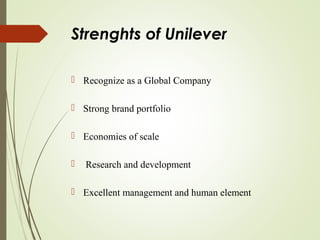
Strenghts of Unilever
 Recognize as a Global Company
 Strong brand portfolio
 Economies of scale
 Research and development
 Excellent management and human element
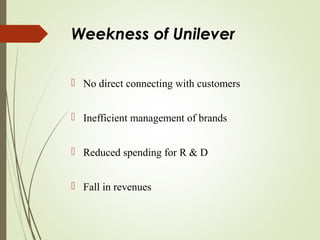
Weekness of Unilever
 No direct connecting with customers
 Inefficient management of brands
 Reduced spending for R & D
 Fall in revenues
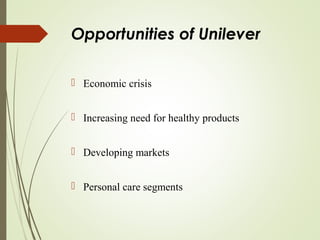
Opportunities of Unilever
 Economic crisis
 Increasing need for healthy products
 Developing markets
 Personal care segments
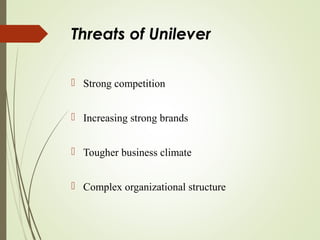
Threats of Unilever
 Strong competition
 Increasing strong brands
 Tougher business climate
 Complex organizational structure
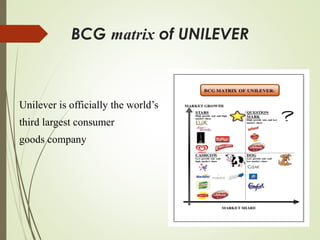
BCG matrix of UNILEVER
Unilever is officially the world’s
third largest consumer
goods company
Five Competitive Forces
 Threats of new entrants : low
 Threats of substitute : moderate to high
 Bargaining power of suppliers : medium
 Bargaining power of buyers : moderate to high
 Current rivalry : medium
Different Strategy Level
Unilever company is using to corporate level
strategy for market their product . There are three
types of corporate level strategy
 Growth - concentration , vertical integration
,horizontal integration
 Stability
 Renewal Strategy – retrenchment , turnaround
Organizational Structure
Unilever has the mechanistic structure organization .
 Low decision participation
 Simple integrating mechanism
 Centralization
 Standardization
 Much written communication
Match Strenghts to Opportunities
Consumers are more aware today and prefer healthy products,
so it is a good opportunity for Unilever to introduce healthy
and safe products under its brand name to increase its market
share and knock out its competitors. Unilever is an innovative
company and investing a huge sum on research and
development of new products and brands , whither the
consumers needs is healthy product so Unilever should use
this strategy to gain more profit .
Correct Weakness
If Unilever can set up a good management of brands then this
weakness can be solved and this will help to gain more profit
and also if it can reduce the amount of R&D then it will have
the chance to introduction of the new products.
Guard against Threats
To reduce threats Uniliver should maintain their good
relationship with buyers and suppliers. Their product price
should not be more than peoples demand. product price should
be reasonable and they should maintain their good
relationship with the customers.
Recommending Strategy
 It would be difficult for new companies to enter the market,
but if Unilever Company can represent any new brand
products customer will definitely buy their products for their
fame.
 They should create a unique and distinctive products for the
customers, so they should follow Differentiation strategy
which is the type of competitive strategy.
 They should use some e-Techniques, in this techniques
there are three types of strategy like- Cost leadership strategy ,
Differentiation , Focus.
Conclusion
 A value creating company
 Globally successful company
 Creating branch for specific countries and
regions
 Production and distribution is expanding rapidly
Unilever

Unilever

  • 1.
  • 2.
    UNILEVER Group Members Siam UzzamanKhan Sristy Merycelyn Gomes Najia Murshed Rahat Hawlader Mimu
  • 3.
    INDEX NO CONTENTS 01 Introduction 02SWOT Analysis 03 BCG Matrix 04 Five Competitive Forces 05 Different Strategy Level 06 Organizational Structure 07 Match Strenghts to Opportunities 08 Correct weakness and guard against threats 09 Recommending Strategy 10 Conclusion
  • 4.
    UNILEVER  Multinational company– headquarter London , England  Two divisions – Foods and Home & Personal Care  Third largest company  Competitors – Nestle , Procter and Gamble
  • 5.
    SWOT Analysis One ofthe things that we know about SWOT analysis is that it stands for strengths, weaknesses, opportunities and threats. This is a type of analysis or research that a company will study to learn about another company. They do the research because they want to learn about a competitor.
  • 6.
    Strenghts of Unilever Recognize as a Global Company  Strong brand portfolio  Economies of scale  Research and development  Excellent management and human element
  • 7.
    Weekness of Unilever No direct connecting with customers  Inefficient management of brands  Reduced spending for R & D  Fall in revenues
  • 8.
    Opportunities of Unilever Economic crisis  Increasing need for healthy products  Developing markets  Personal care segments
  • 9.
    Threats of Unilever Strong competition  Increasing strong brands  Tougher business climate  Complex organizational structure
  • 10.
    BCG matrix ofUNILEVER Unilever is officially the world’s third largest consumer goods company
  • 11.
    Five Competitive Forces Threats of new entrants : low  Threats of substitute : moderate to high  Bargaining power of suppliers : medium  Bargaining power of buyers : moderate to high  Current rivalry : medium
  • 12.
    Different Strategy Level Unilevercompany is using to corporate level strategy for market their product . There are three types of corporate level strategy  Growth - concentration , vertical integration ,horizontal integration  Stability  Renewal Strategy – retrenchment , turnaround
  • 13.
    Organizational Structure Unilever hasthe mechanistic structure organization .  Low decision participation  Simple integrating mechanism  Centralization  Standardization  Much written communication
  • 14.
    Match Strenghts toOpportunities Consumers are more aware today and prefer healthy products, so it is a good opportunity for Unilever to introduce healthy and safe products under its brand name to increase its market share and knock out its competitors. Unilever is an innovative company and investing a huge sum on research and development of new products and brands , whither the consumers needs is healthy product so Unilever should use this strategy to gain more profit .
  • 15.
    Correct Weakness If Unilevercan set up a good management of brands then this weakness can be solved and this will help to gain more profit and also if it can reduce the amount of R&D then it will have the chance to introduction of the new products.
  • 16.
    Guard against Threats Toreduce threats Uniliver should maintain their good relationship with buyers and suppliers. Their product price should not be more than peoples demand. product price should be reasonable and they should maintain their good relationship with the customers.
  • 17.
    Recommending Strategy  Itwould be difficult for new companies to enter the market, but if Unilever Company can represent any new brand products customer will definitely buy their products for their fame.  They should create a unique and distinctive products for the customers, so they should follow Differentiation strategy which is the type of competitive strategy.  They should use some e-Techniques, in this techniques there are three types of strategy like- Cost leadership strategy , Differentiation , Focus.
  • 18.
    Conclusion  A valuecreating company  Globally successful company  Creating branch for specific countries and regions  Production and distribution is expanding rapidly