University Of Garden City For Science &
Technology
Topic :- Orthogonal Frequency Division
Multiplexing (OFDM)
Prepared by:-
SHOAYB MOHAMED
EMAIL:- Supercadde6@gmail.com
ORTHOGONALFREQUENCY
DIVISION MULTIPLEXING(OFDM)
CONTENTS
 DEFINATION OFOFDM
 OFDMVSFDM
 OFDMADVANTAGES
 OFDMDIS-ADVANTAGES
 TYPESOFOFDM
 OFDMSYSTEMMODEL
 APPLICATIONS
DEFINATIONS OF OFDM
Orthogonal Frequency Division Multiplexing:-
Is a frequency-division multiplexing (FDM) scheme used as a
digital multi-carrier modulation method.A large number of
closely spaced orthogonal sub-carrier signals are used to carry
data
DEFINATIONS OF (OFDM)
OFDM is a method of encoding digital data on multiple carrier
frequencies
OFDM has developed into a popular scheme for wideband digital
communication,used in applications such as digital television and
audio broadcasting,DSL Internet access,wireless networks,power line
networks,and 4G mobile communications.
OFDM is also modulated with a conventional modulation scheme (such
as quadrature amplitude modulation or phase-shift keying) at a low
symbol rate,maintaining total data rates similar to
conventional single-carrier modulation schemes in the same
bandwidth.
OFDM VS FDM
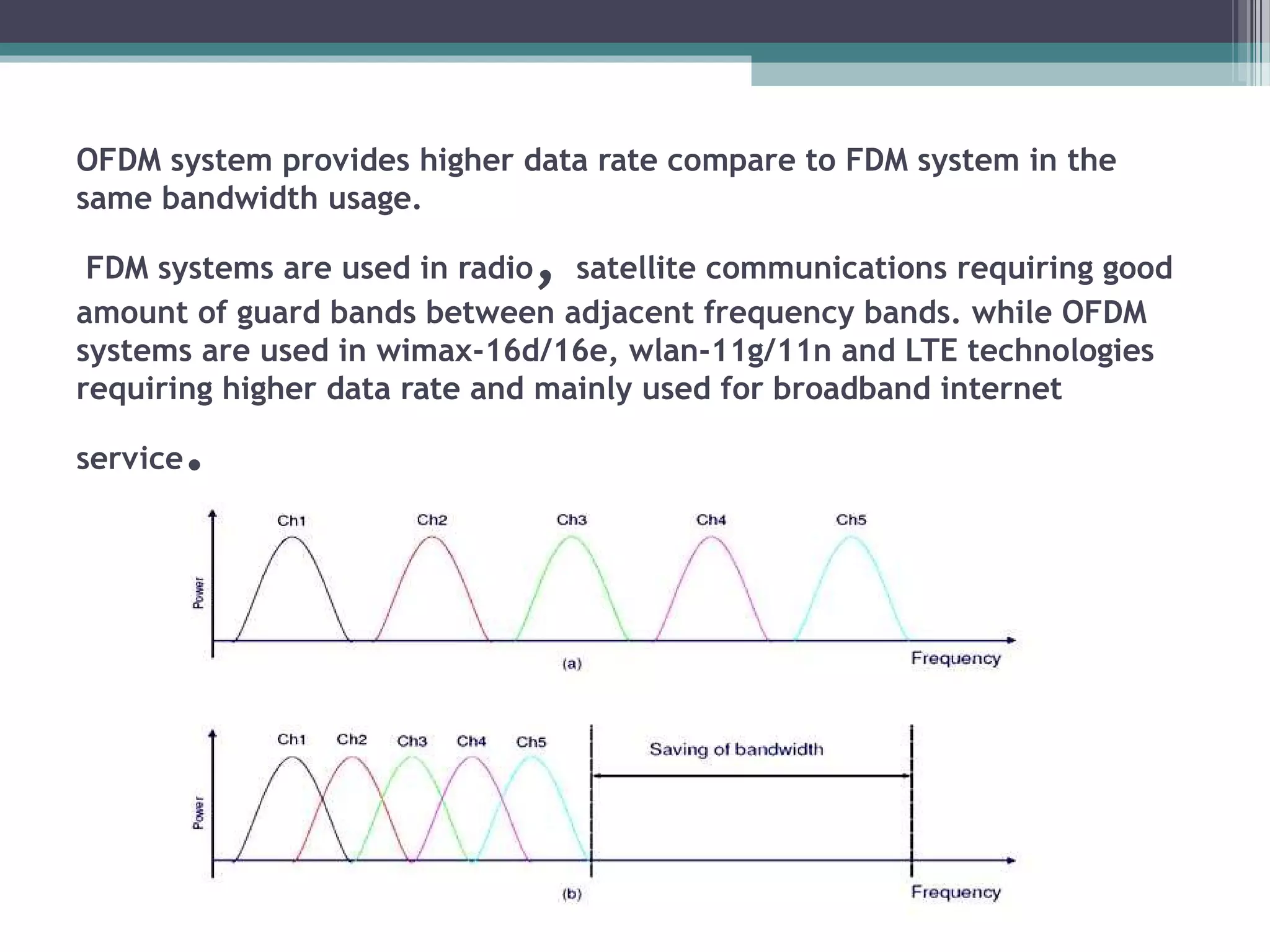
 As shown in the figure in FDM systems carriers are far apart with
respect to each other and in OFDM systems carriers are densely
packed and are orthogonal to the other carriers. Orthogonal means
peak of one carrier occurs at null of the other. Hence OFDM system is
bandwidth efficient compare to FDM system. In FDM system carriers
are not orthogonal
 OFDM system usually will have more Peak-to Average Power ration i.e.
PAPR compare to FDM system. PAPR can be reduced by use of
scrambler module and other techniques in OFDM systems
OFDM system provides higher data rate compare to FDM system in the
same bandwidth usage.
 FDM systems are used in radio, satellite communications requiring good
amount of guard bands between adjacent frequency bands. while OFDM
systems are used in wimax-16d/16e, wlan-11g/11n and LTE technologies
requiring higher data rate and mainly used for broadband internet
service.
ADVANTAGES OF OFDM
Can easily adapt to severe channel conditions without complex
time-domain equalization
Robust against narrow-band co-channel interference
Robust against inter-symbol interference (ISI) and fading
caused by multipath propagation
Efficient implementation using fast Fourier transform (FFT)
Low sensitivity to time synchronization errors
Tuned sub-channel receiver filters are not required (unlike
conventional-FDM)
Facilitates single frequency networks (SFNs) (i.e.
transmitter macro-diversity)
DIS-ADVANTAGES OF OFDM
Sensitive to Doppler shift
Sensitive to frequency synchronization problems
High peak-to-average-power ratio (PAPR), requiring
linear transmitter circuitry, which suffers from poor
power efficiency
Loss of efficiency caused by cyclic prefix/guard interval
OFDM SYSTEM MODEL (TRANSMITER)
• Serial to parallel conversion
• QPSK modulation
• DAC
• Inverse Fast Fourier –Transform 
OFDM SYSTEM MODEL (RECEIVER)
• Low pass filter
• ADC
• Fast Fourier-Transform
GENERAL BLOCK DIAGRAM
TYPES OF OFDM
C-OFDM 
MIMO-OFDM 
V-OFDM 
W-OFDM 
Flash-OFDM
Coded (C-OFDM )
Digital Audio Broadcasting (DAB)
Digital Video Broadcasting (DVB-T)
COFDM offers real benefit in the presence of isolated
narrow-band interfering signals
Multiple Input, Multiple Output OFDM
(MIMO-OFDM)
Developed by Iospan Wireless
Uses multiple antennas to transmit and receive radio
signals
Spatial multiplexing
VICTOR (V-OFDM)
Developed by CISCO
Increases subscriber coverage
Employs both frequency and spatial diversity
Wideband (W-OFDM )
Invented by Wi-LAN
Large spacing between carriers
ADVANTAGES:-
Optimal performance against Multi-path
Less sensitive to carrier offset
Optimal power efficiency of the transmitter
amplifier
More immune against fading
FLASH-OFDM
• Fast-hopped OFDM
• Wide-band spread-spectrum technology
• Avoids the compromises inherent in other mobile data
systems
• Capability to work around interfering signals
APPLICATIONS
Digital Audio and Video Broadcasting
Asymmetric Digital Subscriber Line (ADSL)
Wireless Networking
Power-line Technology

Orthogonal Frequency Division Multiplexing (Ofdm)

  • 1.
    University Of GardenCity For Science & Technology Topic :- Orthogonal Frequency Division Multiplexing (OFDM) Prepared by:- SHOAYB MOHAMED EMAIL:- Supercadde6@gmail.com
  • 2.
    ORTHOGONALFREQUENCY DIVISION MULTIPLEXING(OFDM) CONTENTS  DEFINATIONOFOFDM  OFDMVSFDM  OFDMADVANTAGES  OFDMDIS-ADVANTAGES  TYPESOFOFDM  OFDMSYSTEMMODEL  APPLICATIONS
  • 3.
    DEFINATIONS OF OFDM OrthogonalFrequency Division Multiplexing:- Is a frequency-division multiplexing (FDM) scheme used as a digital multi-carrier modulation method.A large number of closely spaced orthogonal sub-carrier signals are used to carry data
  • 4.
    DEFINATIONS OF (OFDM) OFDMis a method of encoding digital data on multiple carrier frequencies OFDM has developed into a popular scheme for wideband digital communication,used in applications such as digital television and audio broadcasting,DSL Internet access,wireless networks,power line networks,and 4G mobile communications. OFDM is also modulated with a conventional modulation scheme (such as quadrature amplitude modulation or phase-shift keying) at a low symbol rate,maintaining total data rates similar to conventional single-carrier modulation schemes in the same bandwidth.
  • 5.
    OFDM VS FDM As shown in the figure in FDM systems carriers are far apart with respect to each other and in OFDM systems carriers are densely packed and are orthogonal to the other carriers. Orthogonal means peak of one carrier occurs at null of the other. Hence OFDM system is bandwidth efficient compare to FDM system. In FDM system carriers are not orthogonal  OFDM system usually will have more Peak-to Average Power ration i.e. PAPR compare to FDM system. PAPR can be reduced by use of scrambler module and other techniques in OFDM systems
  • 6.
    OFDM system provideshigher data rate compare to FDM system in the same bandwidth usage.  FDM systems are used in radio, satellite communications requiring good amount of guard bands between adjacent frequency bands. while OFDM systems are used in wimax-16d/16e, wlan-11g/11n and LTE technologies requiring higher data rate and mainly used for broadband internet service.
  • 7.
    ADVANTAGES OF OFDM Caneasily adapt to severe channel conditions without complex time-domain equalization Robust against narrow-band co-channel interference Robust against inter-symbol interference (ISI) and fading caused by multipath propagation Efficient implementation using fast Fourier transform (FFT) Low sensitivity to time synchronization errors Tuned sub-channel receiver filters are not required (unlike conventional-FDM) Facilitates single frequency networks (SFNs) (i.e. transmitter macro-diversity)
  • 8.
    DIS-ADVANTAGES OF OFDM Sensitiveto Doppler shift Sensitive to frequency synchronization problems High peak-to-average-power ratio (PAPR), requiring linear transmitter circuitry, which suffers from poor power efficiency Loss of efficiency caused by cyclic prefix/guard interval
  • 9.
    OFDM SYSTEM MODEL(TRANSMITER) • Serial to parallel conversion • QPSK modulation • DAC • Inverse Fast Fourier –Transform 
  • 10.
    OFDM SYSTEM MODEL(RECEIVER) • Low pass filter • ADC • Fast Fourier-Transform
  • 11.
  • 12.
  • 13.
    Coded (C-OFDM ) DigitalAudio Broadcasting (DAB) Digital Video Broadcasting (DVB-T) COFDM offers real benefit in the presence of isolated narrow-band interfering signals Multiple Input, Multiple Output OFDM (MIMO-OFDM) Developed by Iospan Wireless Uses multiple antennas to transmit and receive radio signals Spatial multiplexing
  • 14.
    VICTOR (V-OFDM) Developed byCISCO Increases subscriber coverage Employs both frequency and spatial diversity Wideband (W-OFDM ) Invented by Wi-LAN Large spacing between carriers ADVANTAGES:- Optimal performance against Multi-path Less sensitive to carrier offset Optimal power efficiency of the transmitter amplifier More immune against fading
  • 15.
    FLASH-OFDM • Fast-hopped OFDM •Wide-band spread-spectrum technology • Avoids the compromises inherent in other mobile data systems • Capability to work around interfering signals
  • 16.
    APPLICATIONS Digital Audio andVideo Broadcasting Asymmetric Digital Subscriber Line (ADSL) Wireless Networking Power-line Technology