Special Education
School Committee
Presentation
January 11,2022
Special Education Laws
2
❏ The Individuals with Disabilities
Education Act
❏ 603 CMR Section 28.00 (Code of
Massachusetts Regulations) Also
known as Chapter 766
❏ The Massachusetts Education Reform
Act
❏ Section 504 of the Rehabilitation Act
❏ Chapter 688 of the Acts of 1983
❏ The Americans with Disabilities Act
Basic Principles of the Laws
❏ Parent and Student Participation
❏ Appropriate Evaluation
❏ Individualized Education Program
– IEP
❏ Free Appropriate Public Education
– FAPE
❏ Least Restrictive Environment –
LRE
❏ Inclusive Practice
❏ Procedural Safeguards
3
What is Special Education?
Special Education is…
❏ Specially designed instruction to meet
the unique needs of an eligible
student,and/or
❏ Related services necessary to access
and make progress within the general
curriculum
❏ Special education services are a
significant modification of content,
instructional approach,instructional
level or performance criteria
4
Disability Categories
Autism- 153
Developmental Delay- 80
Intellectual- 26
Sensory – Hearing- 7
Sensory - Vision- *
Sensory - Deaf-Blind- *
5
Emotional- 123
Communication- 110
Health- 144
Specific Learning- 203
Multiple Disabilities- *
Neurological- 59
Physical- *
*Data
suppressed
for privacy
due to small
numbers.
When is a Student Eligible?
A student is eligible for special education when
the Team determines:
❏ A student has one or more educational
disabilities as defined by state and federal
law
❏ The student is not making effective school
progress
❏ The lack of progress is caused by the
disability
❏ The student requires specialized
instruction in order to make effective
progress
6
District Resources
❏ Instructional Support Team
❏ Building Curriculum Accommodation
Plan (BCAP)
❏ Team Chairperson
❏ Special Educator
❏ School Psychologist
❏ Speech- Language Pathologist
❏ Occupational and Physical Therapist
❏ Board Certified Behavior Analyst
❏ Workshops and Training Programs
❏ Consultants
❏ Colleagues
❏ Administrators both building based and
CO
7
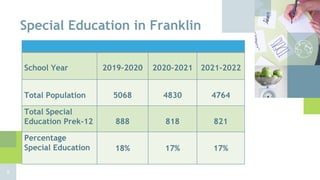
Special Education in Franklin
School Year 2019-2020 2020-2021 2021-2022
Total Population 5068 4830 4764
Total Special
Education Prek-12 888 818 821
Percentage
Special Education 18% 17% 17%
8
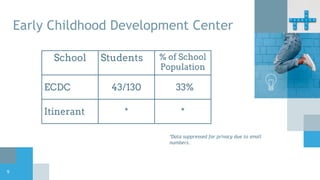
Early Childhood Development Center
School Students % of School
Population
ECDC 43/130 33%
Itinerant * *
*Data suppressed for privacy due to small
numbers.
9
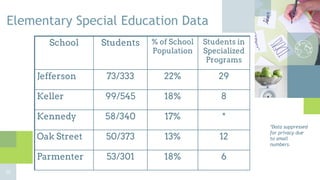
Elementary Special Education Data
School Students % of School
Population
Students in
Specialized
Programs
Jefferson 73/333 22% 29
Keller 99/545 18% 8
Kennedy 58/340 17% *
Oak Street 50/373 13% 12
Parmenter 53/301 18% 6
10
*Data suppressed
for privacy due
to small
numbers.
11
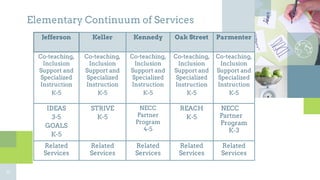
Elementary Continuum of Services
Jefferson Keller Kennedy Oak Street Parmenter
Co-teaching,
Inclusion
Support and
Specialized
Instruction
K-5
Co-teaching,
Inclusion
Support and
Specialized
Instruction
K-5
Co-teaching,
Inclusion
Support and
Specialized
Instruction
K-5
Co-teaching,
Inclusion
Support and
Specialized
Instruction
K-5
Co-teaching,
Inclusion
Support and
Specialized
Instruction
K-5
IDEAS
3-5
GOALS
K-5
STRIVE
K-5
NECC
Partner
Program
4-5
REACH
K-5
NECC
Partner
Program
K-3
Related
Services
Related
Services
Related
Services
Related
Services
Related
Services
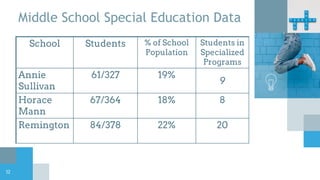
Middle School Special Education Data
School Students % of School
Population
Students in
Specialized
Programs
Annie
Sullivan
61/327 19%
9
Horace
Mann
67/364 18% 8
Remington 84/378 22% 20
12
13
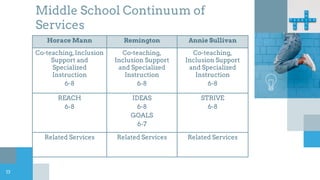
Horace Mann Remington Annie Sullivan
Co-teaching,Inclusion
Support and
Specialized
Instruction
6-8
Co-teaching,
Inclusion Support
and Specialized
Instruction
6-8
Co-teaching,
Inclusion Support
and Specialized
Instruction
6-8
REACH
6-8
IDEAS
6-8
GOALS
6-7
STRIVE
6-8
Related Services Related Services Related Services
Middle School Continuum of
Services
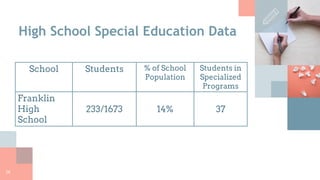
High School Special Education Data
School Students % of School
Population
Students in
Specialized
Programs
Franklin
High
School
233/1673 14% 37
14
15
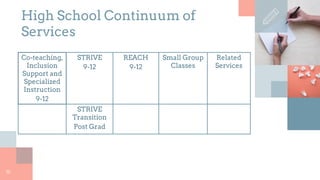
Co-teaching,
Inclusion
Support and
Specialized
Instruction
9-12
STRIVE
9-12
REACH
9-12
Small Group
Classes
Related
Services
STRIVE
Transition
Post Grad
High School Continuum of
Services
IDEAS Program
Mission/Philosophy:
The IDEAS program provides an environment of structured,
multi-sensory instruction addressing all areas of language
development throughout the school day. Students in the IDEAS
program are held to high educational expectations based on
curriculum standards. Necessary supports are provided to students
in order to develop their skills in the areas of receptive and
expressive language (both oral and written) across curriculum areas
as well as within the areas of social pragmatics and social
communication for the purpose of increasing self-esteem and
working toward independence and success in inclusive settings.
16
REACH Program
Mission/Philosophy
The REACH Program offers students a safe and structured
continuum of therapeutic supports and specialized
instruction to foster social-emotional growth across all
settings while accessing rigorous academic experiences.
The REACH Program explicitly teaches positive
self-management,self-awareness,social awareness,
relationship skills,and responsible decision-making to
promote independence and personal success.
17
GOALS Program
Mission/Philosophy:
The GOALS program is designed to provide an educational
environment in which students with Autism and related disabilities
learn academic,communication and social skills needed to be
contributing members of the school and community. A primary
focus of the program is to build independence in the areas of
communication and social skills necessary to access curricula and
social opportunities in the general education setting. Students’
individualized needs are met through a transdisciplinary approach
using evidence-based teaching practices.
18
STRIVE Program
Mission/Philosophy
The STRIVE Program provides an environment of consistent
educational and behavioral support. Students are provided with
access to modified curriculum in order to allow each student to
develop to their maximum potential at their own pace. Skill
development in this program focuses on communication,functional
academics,social pragmatics,activities of daily living,motor skills,
sensory processing,and vocational skills for the purpose of working
toward independence and success with school,home and the
community at large.
19
The New England Center for Children
(NECC) Partner Program Classroom
Mission/Philosophy
The Partner Program Classroom is a flexible educational model
designed to teach students with autism to reach their full potential.
NECC partners with Franklin Public School's professionals to
collaborate and provide a comprehensive ABA classroom that
integrates best clinical practices and mirrors the structure and
support often found only in private school settings.
20
21
Ages 6-21 71
Out of District Placements
❏ Other Public Schools
❏ Member Collaboratives
❏ Non-member Collaboratives
❏ Private Day Schools
❏ Residential Schools
❏ Out of State Approved Schools
❏ Unapproved Programs
22
Member Collaboratives
❏ ACCEPT and BICO
❏ Specialized Programs
❏ Professional Development
❏ Job Alike Meetings
❏ Evaluations
❏ Training
❏ Resources
23
Our Goal…
❏ Maintain high standards and expectations ensuring access to and
progress within the general education curriculum
❏ Teach skills that are impacted by disability through specialized
instruction
❏ Research-based interventions
❏ High quality staff
❏ State of the art strategies and techniques
❏ Teach strategies to assist a child in compensating for their disability in
all learning environments
❏ Universal Design
❏ Accessible materials
❏ Meaningful and appropriate accommodations and
modifications in the least restrictive environment
❏ Engage parents in ongoing,two way communication and collaboration
❏ Maintain full compliance with the laws,regulations,process and
procedures governing special education
24
In the End…
❏ Teach students with disabilities to become
confident and self-aware individuals,
empathetic and productive citizens,curious
and creative thinkers,effective
communicators and collaborators,and
reflective and innovative problem-solvers.
❏ Provide a safe and inclusive school
environment so that each student truly
belongs and is empowered to participate in
decision-making and achieves to their full
potential.
25
Thanks!
Any questions?
26

School Committee Presentation on FPS Student Services 01/11/22

  • 1.
  • 2.
    Special Education Laws 2 ❏The Individuals with Disabilities Education Act ❏ 603 CMR Section 28.00 (Code of Massachusetts Regulations) Also known as Chapter 766 ❏ The Massachusetts Education Reform Act ❏ Section 504 of the Rehabilitation Act ❏ Chapter 688 of the Acts of 1983 ❏ The Americans with Disabilities Act
  • 3.
    Basic Principles ofthe Laws ❏ Parent and Student Participation ❏ Appropriate Evaluation ❏ Individualized Education Program – IEP ❏ Free Appropriate Public Education – FAPE ❏ Least Restrictive Environment – LRE ❏ Inclusive Practice ❏ Procedural Safeguards 3
  • 4.
    What is SpecialEducation? Special Education is… ❏ Specially designed instruction to meet the unique needs of an eligible student,and/or ❏ Related services necessary to access and make progress within the general curriculum ❏ Special education services are a significant modification of content, instructional approach,instructional level or performance criteria 4
  • 5.
    Disability Categories Autism- 153 DevelopmentalDelay- 80 Intellectual- 26 Sensory – Hearing- 7 Sensory - Vision- * Sensory - Deaf-Blind- * 5 Emotional- 123 Communication- 110 Health- 144 Specific Learning- 203 Multiple Disabilities- * Neurological- 59 Physical- * *Data suppressed for privacy due to small numbers.
  • 6.
    When is aStudent Eligible? A student is eligible for special education when the Team determines: ❏ A student has one or more educational disabilities as defined by state and federal law ❏ The student is not making effective school progress ❏ The lack of progress is caused by the disability ❏ The student requires specialized instruction in order to make effective progress 6
  • 7.
    District Resources ❏ InstructionalSupport Team ❏ Building Curriculum Accommodation Plan (BCAP) ❏ Team Chairperson ❏ Special Educator ❏ School Psychologist ❏ Speech- Language Pathologist ❏ Occupational and Physical Therapist ❏ Board Certified Behavior Analyst ❏ Workshops and Training Programs ❏ Consultants ❏ Colleagues ❏ Administrators both building based and CO 7
  • 8.
    Special Education inFranklin School Year 2019-2020 2020-2021 2021-2022 Total Population 5068 4830 4764 Total Special Education Prek-12 888 818 821 Percentage Special Education 18% 17% 17% 8
  • 9.
    Early Childhood DevelopmentCenter School Students % of School Population ECDC 43/130 33% Itinerant * * *Data suppressed for privacy due to small numbers. 9
  • 10.
    Elementary Special EducationData School Students % of School Population Students in Specialized Programs Jefferson 73/333 22% 29 Keller 99/545 18% 8 Kennedy 58/340 17% * Oak Street 50/373 13% 12 Parmenter 53/301 18% 6 10 *Data suppressed for privacy due to small numbers.
  • 11.
    11 Elementary Continuum ofServices Jefferson Keller Kennedy Oak Street Parmenter Co-teaching, Inclusion Support and Specialized Instruction K-5 Co-teaching, Inclusion Support and Specialized Instruction K-5 Co-teaching, Inclusion Support and Specialized Instruction K-5 Co-teaching, Inclusion Support and Specialized Instruction K-5 Co-teaching, Inclusion Support and Specialized Instruction K-5 IDEAS 3-5 GOALS K-5 STRIVE K-5 NECC Partner Program 4-5 REACH K-5 NECC Partner Program K-3 Related Services Related Services Related Services Related Services Related Services
  • 12.
    Middle School SpecialEducation Data School Students % of School Population Students in Specialized Programs Annie Sullivan 61/327 19% 9 Horace Mann 67/364 18% 8 Remington 84/378 22% 20 12
  • 13.
    13 Horace Mann RemingtonAnnie Sullivan Co-teaching,Inclusion Support and Specialized Instruction 6-8 Co-teaching, Inclusion Support and Specialized Instruction 6-8 Co-teaching, Inclusion Support and Specialized Instruction 6-8 REACH 6-8 IDEAS 6-8 GOALS 6-7 STRIVE 6-8 Related Services Related Services Related Services Middle School Continuum of Services
  • 14.
    High School SpecialEducation Data School Students % of School Population Students in Specialized Programs Franklin High School 233/1673 14% 37 14
  • 15.
  • 16.
    IDEAS Program Mission/Philosophy: The IDEASprogram provides an environment of structured, multi-sensory instruction addressing all areas of language development throughout the school day. Students in the IDEAS program are held to high educational expectations based on curriculum standards. Necessary supports are provided to students in order to develop their skills in the areas of receptive and expressive language (both oral and written) across curriculum areas as well as within the areas of social pragmatics and social communication for the purpose of increasing self-esteem and working toward independence and success in inclusive settings. 16
  • 17.
    REACH Program Mission/Philosophy The REACHProgram offers students a safe and structured continuum of therapeutic supports and specialized instruction to foster social-emotional growth across all settings while accessing rigorous academic experiences. The REACH Program explicitly teaches positive self-management,self-awareness,social awareness, relationship skills,and responsible decision-making to promote independence and personal success. 17
  • 18.
    GOALS Program Mission/Philosophy: The GOALSprogram is designed to provide an educational environment in which students with Autism and related disabilities learn academic,communication and social skills needed to be contributing members of the school and community. A primary focus of the program is to build independence in the areas of communication and social skills necessary to access curricula and social opportunities in the general education setting. Students’ individualized needs are met through a transdisciplinary approach using evidence-based teaching practices. 18
  • 19.
    STRIVE Program Mission/Philosophy The STRIVEProgram provides an environment of consistent educational and behavioral support. Students are provided with access to modified curriculum in order to allow each student to develop to their maximum potential at their own pace. Skill development in this program focuses on communication,functional academics,social pragmatics,activities of daily living,motor skills, sensory processing,and vocational skills for the purpose of working toward independence and success with school,home and the community at large. 19
  • 20.
    The New EnglandCenter for Children (NECC) Partner Program Classroom Mission/Philosophy The Partner Program Classroom is a flexible educational model designed to teach students with autism to reach their full potential. NECC partners with Franklin Public School's professionals to collaborate and provide a comprehensive ABA classroom that integrates best clinical practices and mirrors the structure and support often found only in private school settings. 20
  • 21.
    21 Ages 6-21 71 Outof District Placements
  • 22.
    Out of DistrictPlacements ❏ Other Public Schools ❏ Member Collaboratives ❏ Non-member Collaboratives ❏ Private Day Schools ❏ Residential Schools ❏ Out of State Approved Schools ❏ Unapproved Programs 22
  • 23.
    Member Collaboratives ❏ ACCEPTand BICO ❏ Specialized Programs ❏ Professional Development ❏ Job Alike Meetings ❏ Evaluations ❏ Training ❏ Resources 23
  • 24.
    Our Goal… ❏ Maintainhigh standards and expectations ensuring access to and progress within the general education curriculum ❏ Teach skills that are impacted by disability through specialized instruction ❏ Research-based interventions ❏ High quality staff ❏ State of the art strategies and techniques ❏ Teach strategies to assist a child in compensating for their disability in all learning environments ❏ Universal Design ❏ Accessible materials ❏ Meaningful and appropriate accommodations and modifications in the least restrictive environment ❏ Engage parents in ongoing,two way communication and collaboration ❏ Maintain full compliance with the laws,regulations,process and procedures governing special education 24
  • 25.
    In the End… ❏Teach students with disabilities to become confident and self-aware individuals, empathetic and productive citizens,curious and creative thinkers,effective communicators and collaborators,and reflective and innovative problem-solvers. ❏ Provide a safe and inclusive school environment so that each student truly belongs and is empowered to participate in decision-making and achieves to their full potential. 25
  • 26.