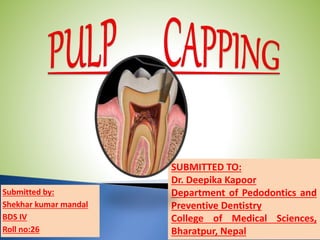
Submitted by:
Shekhar kumar mandal
BDS IV
Roll no:26
SUBMITTED TO:
Dr. Deepika Kapoor
Department of Pedodontics and
Preventive Dentistry
College of Medical Sciences,
Bharatpur, Nepal
1. INTRODUCTION
2. TREATMENT MODALITIES
3. TYPES OF PULP CAPPING
4. INDIRECT PULP CAPPING
5. PATENT DENTIN MEASURING DEVICE
6. DIRECT PULP CAPPING
7. FEATURES OF SUCCESSFUL PULP CAPPING
8. PULP CAPPING AGENTS
9. CONCLUSION
10.REFERENCES
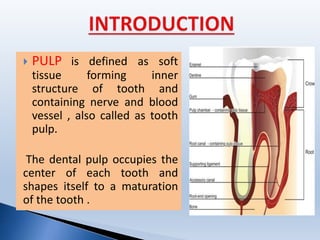
 PULP is defined as soft
tissue forming inner
structure of tooth and
containing nerve and blood
vessel , also called as tooth
pulp.
The dental pulp occupies the
center of each tooth and
shapes itself to a maturation
of the tooth .
PULP TREATMENT
CONSERVATIVE RADICAL
1. Protective base 1. Pulpectomy
2. Indirect pulp therapy 2. Root filling
3. Direct pulp therapy
4. Pulpotomy
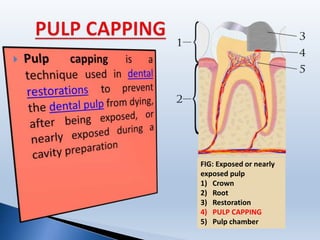
FIG: Exposed or nearly
exposed pulp
1) Crown
2) Root
3) Restoration
4) PULP CAPPING
5) Pulp chamber
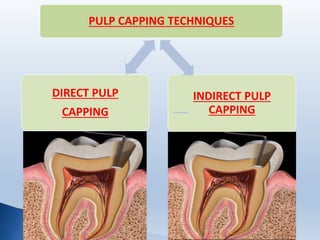
PULP CAPPING TECHNIQUES
INDIRECT PULP
CAPPING
DIRECT PULP
CAPPING
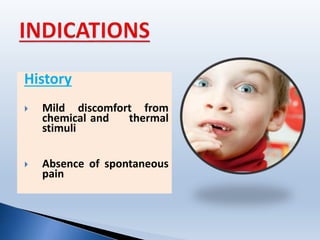
History
 Mild discomfort from
chemical and thermal
stimuli
 Absence of spontaneous
pain
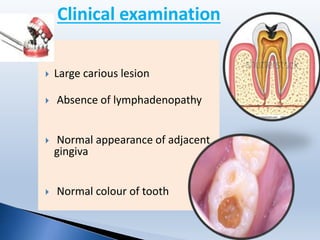
 Large carious lesion
 Absence of lymphadenopathy
 Normal appearance of adjacent
gingiva
 Normal colour of tooth
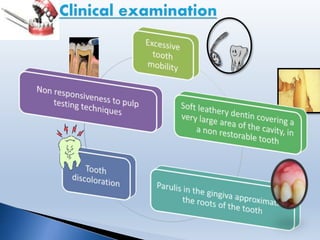
Clinical examination
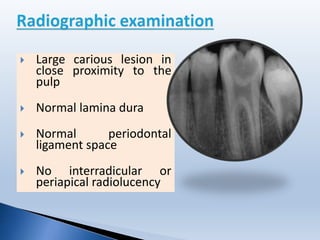
 Large carious lesion in
close proximity to the
pulp
 Normal lamina dura
 Normal periodontal
ligament space
 No interradicular or
periapical radiolucency
CONTRAINDICATIONS
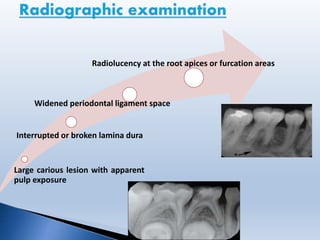
Large carious lesion with apparent
pulp exposure
Interrupted or broken lamina dura
Widened periodontal ligament space
Radiolucency at the root apices or furcation areas
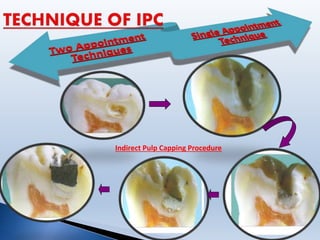
Indirect Pulp Capping Procedure
Two Appointment
Technique
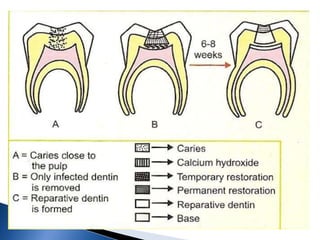
First appointment
• Tooth is isolated with a rubber dam
• The gross caries is removed with a large round bur (6 or
8) or sharp spoon exclavator .Care must be taken
removing the caries to prevent exposure of pulp .Care
must be taken to eliminate all the caries at the DEJ .
Because of its closeness to the surface caries left in the
areas will likely cause failure .
• The remaining thin layer of caries is covered
with a radiopaque biocompatible base
material and sealed with a durable interim
restoration
• Wait for 6-8 weeks.
• During this time the caries process
in the deeper layer is arrested.
.
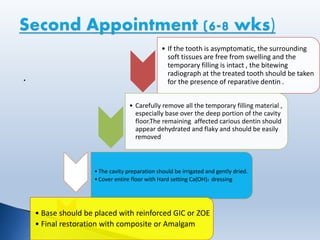
• If the tooth is asymptomatic, the surrounding
soft tissues are free from swelling and the
temporary filling is intact , the bitewing
radiograph at the treated tooth should be taken
for the presence of reparative dentin .
• Carefully remove all the temporary filling material ,
especially base over the deep portion of the cavity
floor.The remaining affected carious dentin should
appear dehydrated and flaky and should be easily
removed
•The cavity preparation should be irrigated and gently dried.
•Cover entire floor with Hard setting Ca(OH)2 dressing
• Base should be placed with reinforced GIC or ZOE
• Final restoration with composite or Amalgam
Avoid unintentional pulp exposure
Dentist get chance to assess reaction of tooth and
caries activity
Helps to remove slowly progressing lesion
Final excavation of caries is safer in second sitting.
ONE APPOINTMENT
TECHNIQUE
If the tooth remains asymptomatic there is no need for reentry.
The removal of bacteria and substrate together with an effective seal of restoration
provides the means whereby the pulp can recover the laying down secondary dentin .
Assure retention and sealing of temporary restoration
A protective radiopaque biocompatible base material must be placed prior to
temporary restoration
Remove all the soft moist and leathery texture of dentin
The DEJ must be free from all softened material and stain even if the stain is firm .
All margins are left adequately supported and peripheral caries is removed with a
large round bur .
The tooth is isolated with rubber dam ,the cavity outline form is made .
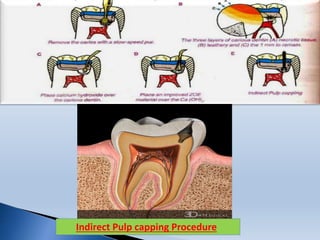
Indirect Pulp capping Procedure
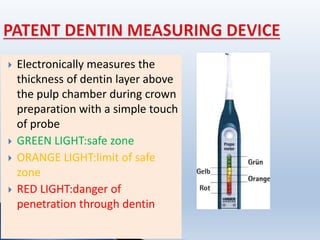
 Electronically measures the
thickness of dentin layer above
the pulp chamber during crown
preparation with a simple touch
of probe
 GREEN LIGHT:safe zone
 ORANGE LIGHT:limit of safe
zone
 RED LIGHT:danger of
penetration through dentin.
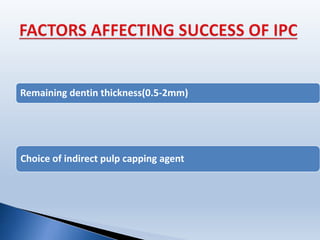
Remaining dentin thickness(0.5-2mm)
Choice of indirect pulp capping agent
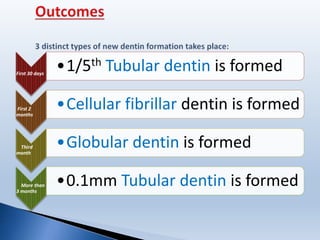
First 30 days
•1/5th Tubular dentin is formed
First 2
months
•Cellular fibrillar dentin is formed
Third
month
•Globular dentin is formed
More than
3 months
•0.1mm Tubular dentin is formed
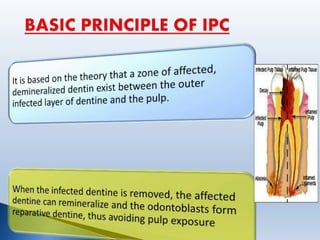
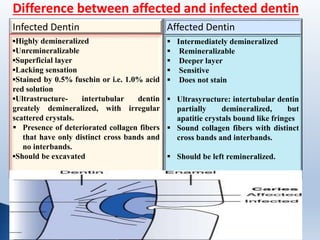
Infected Dentin
▪Highly demineralized
▪Unremineralizable
▪Superficial layer
▪Lacking sensation
▪Stained by 0.5% fuschin or i.e. 1.0% acid
red solution
▪Ultrastructure- intertubular dentin
greately demineralized, with irregular
scattered crystals.
 Presence of deteriorated collagen fibers
that have only distinct cross bands and
no interbands.
▪Should be excavated
Affected Dentin
 Intermediately demineralized
 Remineralizable
 Deeper layer
 Sensitive
 Does not stain
 Ultrasyructure: intertubular dentin
partially demineralized, but
apatitie crystals bound like fringes
 Sound collagen fibers with distinct
cross bands and interbands.
 Should be left remineralized.
Difference between affected and infected dentin
One year later, Rebel performed the first animal experiments with disastrous results, so he regarded the
exposed pulp as a doomed organ.
The first scientific clinical study to compare different capping materials was made by Dätwyler in 1921,
whereupon zinc oxide-eugenol showed the best results.
Hunter(1883) suggested 1st pulp capping materials. He recommended covering an exposure with a mixture
of Sorghum molasses and the droppings of the English sparrow and claimed 98% success rate
Until the end of the 19th century, most materials were used empirically with the idea that the pulp tissue
must be irritated by etching or cauterization to heal.
The first method of capping exposed pulps, using gold foils, was described by Pfaff in 1756. Thereafter,
numerous agents for direct pulp capping have been recommended.
Placement of a medicated or a nonmedicated material on a pulp that
has been exposed in the course of preparing a cavity in a carious
tooth or as the result of trauma.[Kopel, 1997]
Since then, calcium hydroxide has been recommended by several
authors for direct pulp capping, but it took until the middle of 20th
century until it was regarded as the standard of care.
In 1920 Hermann, introduced calcium hydroxide for root canal fillings.
Between 1928 and 1930 he studied the reaction of vital pulp tissue to
calcium hydroxide to prove that it was a biocompatible material.
Encouragement of young , healthy pulps to initiate a
dentin bridge, thus walling of the exposure site
OBJECTIVES
a) preservation of vitality of the radicular pulp.
b) relief of pain in patients with acute pulpagia.
c) ensuring the continuity of normal apexogenesis in immature
permanent teeth
Accidental pin point exposure of pulp when
excavating deep caries, less than 1 sq. mm.
surrounded by clean dentin for (<24hours)
Traumatic fracture of tooth(<24 hours) with
pin point exposure
Iatrogenic exposure during cavity
preparation & crown preparation
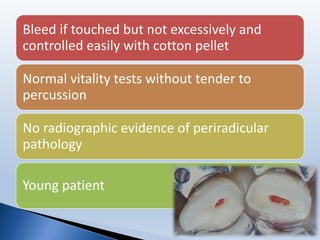
Bleed if touched but not excessively and
controlled easily with cotton pellet
Normal vitality tests without tender to
percussion
No radiographic evidence of periradicular
pathology
Young patient
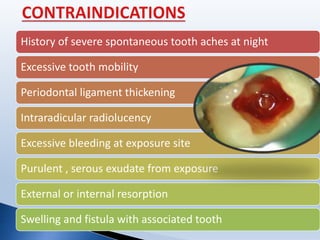
History of severe spontaneous tooth aches at night
Excessive tooth mobility
Periodontal ligament thickening
Intraradicular radiolucency
Excessive bleeding at exposure site
Purulent , serous exudate from exposure
External or internal resorption
Swelling and fistula with associated tooth
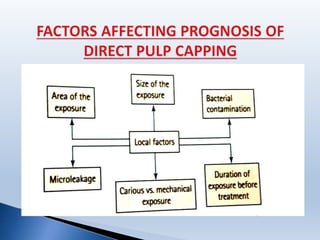
Localization of infection & inflammation in primary teeth is poorer than
in permanent teeth. [Mc Donalds,1956]
Incidence of reparative dentin formation in primary teeth is more
extensive than permanent Teeth. [Sayegh , 1968]
Primary pulp contain high cellular content which might be responsible
for failures. Primary pulp responds more rapidly to the effects of
dentinal caries then the perm. Teeth. [Rayner & Southam, 1979]
Undifferentiated mesenchymal cells may differentiate into osteoclasts
in response to caries or pulp capping material which could lead to
internal resorption. [Kennedy,1985]
Primary Pulp are more closer to outer enamel surface & are rapidly
infected by the carious lesion. Once exposed pulpal inflammation is so
involved that the DPC proves unfavorable. [Kennedy & Kopel,1985]
Increased resorption in primary teeth is because already root resorption
is in progress. [Stanley, 1985]
Wide apical foramina in pri. teeth leads to abundant blood supply which
results in more typical and faster inflammation response to irritation than
in permanent teeth. [Kopel,1992]
Acc. To finn, in primary teeth pulp capping is best carried out in teeth
where dental pulp has been mechanically exposed.
Pulp capping not recommended. Internal resorption or acute
dentoalveolar abscess may result . [Pinkham]
Rubber Dam placement
Deep carious dentin
excavation:inhibit infected matter
from entering pulp. Necrotic &
infected dentin chips will invariably be
pushed into the exposed pulp during
last stages of caries removal.
Bleeding controlled with sterile cotton
wool (blast of air not used).No
instruments should be inserted into
exposure site.
Layer of hard setting calcium flowed IRM
and a permanent restoration. In small teeth,
Ca(OH)2 can act as base. Blood clot-not
allowed to be formed after cessation of
bleeding from exposure as it impedes pulpal
healing. Kopel,1992 a more adequate seal of
pulp capping is needed (Stainless steel crown
-best).
Dentin bridging
Maintenance of pulp vitality
Lack of undue sensitivity or pain
Minimum pulpal inflammation response
Ability of pulp to maintain itself without progressive degeneration
Lack of internal resorption and/ or interradicular pathosis
In Accordance with Kennedy & Kopel (1985):
IDEAL REQUIREMENTS
Ideal dressing material for pulp therapy in primary teeth does not
exist, but the material should be:
1. Bactericidal
2. Biocompatible
3. Harmless to the pulp, surrounding structures and the
permanent tooth germ.
4. Promote healing
5. Not interfere with physiologic process of resorption.
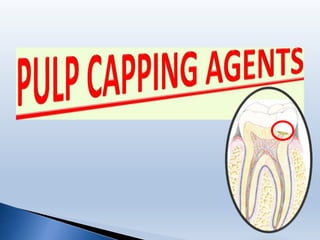
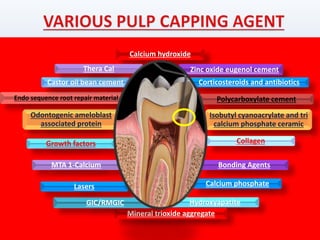
Calcium hydroxide
Zinc oxide eugenol cement
Corticosteroids and antibiotics
Polycarboxylate cement
Isobutyl cyanoacrylate and tri
calcium phosphate ceramic
Collagen
Bonding Agents
Calcium phosphate
Hydroxyapatite
Mineral trioxide aggregate
GIC/RMGIC
Lasers
MTA 1-Calcium
Growth factors
Odontogenic ameloblast
associated protein
Endo sequence root repair material
Castor oil bean cement
Thera Cal
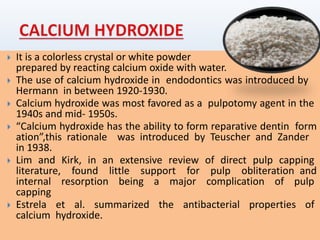
 It is a colorless crystal or white powder
prepared by reacting calcium oxide with water.
 The use of calcium hydroxide in endodontics was introduced by
Hermann in between 1920-1930.
 Calcium hydroxide was most favored as a pulpotomy agent in the
1940s and mid- 1950s.
 “Calcium hydroxide has the ability to form reparative dentin form
ation”,this rationale was introduced by Teuscher and Zander
in 1938.
 Lim and Kirk, in an extensive review of direct pulp capping
literature, found little support for pulp obliteration and
internal resorption being a major complication of pulp
capping
 Estrela et al. summarized the antibacterial properties of
calcium hydroxide.
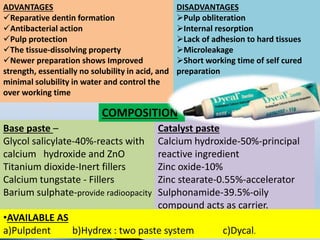
ADVANTAGES
Reparative dentin formation
Antibacterial action
Pulp protection
The tissue-dissolving property
Newer preparation shows Improved
strength, essentially no solubility in acid, and
minimal solubility in water and control the
over working time
DISADVANTAGES
Pulp obliteration
Internal resorption
Lack of adhesion to hard tissues
Microleakage
Short working time of self cured
preparation
Base paste –
Glycol salicylate-40%-reacts with
calcium hydroxide and ZnO
Titanium dioxide-Inert fillers
Calcium tungstate - Fillers
Barium sulphate-provide radioopacity
Catalyst paste
Calcium hydroxide-50%-principal
reactive ingredient
Zinc oxide-10%
Zinc stearate-0.55%-accelerator
Sulphonamide-39.5%-oily
compound acts as carrier.
COMPOSITION
•AVAILABLE AS
a)Pulpdent b)Hydrex : two paste system c)Dycal.
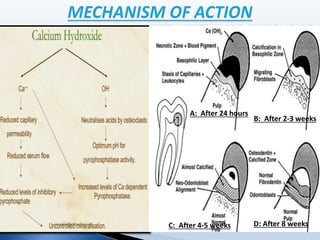
D: After 8 weeks
A: After 24 hours
B: After 2-3 weeks
C: After 4-5 weeks
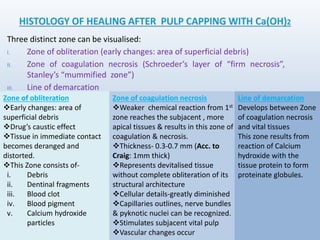
Three distinct zone can be visualised:
I. Zone of obliteration (early changes: area of superficial debris)
II. Zone of coagulation necrosis (Schroeder’s layer of “firm necrosis”,
Stanley’s “mummified zone”)
III. Line of demarcation
Zone of obliteration
Early changes: area of
superficial debris
Drug’s caustic effect
Tissue in immediate contact
becomes deranged and
distorted.
This Zone consists of-
i. Debris
ii. Dentinal fragments
iii. Blood clot
iv. Blood pigment
v. Calcium hydroxide
particles
Zone of coagulation necrosis
Weaker chemical reaction from 1st
zone reaches the subjacent , more
apical tissues & results in this zone of
coagulation & necrosis.
Thickness- 0.3-0.7 mm (Acc. to
Craig: 1mm thick)
Represents devitalised tissue
without complete obliteration of its
structural architecture
Cellular details-greatly diminished
Capillaries outlines, nerve bundles
& pyknotic nuclei can be recognized.
Stimulates subjacent vital pulp
Vascular changes occur
Line of demarcation
Develops between Zone
of coagulation necrosis
and vital tissues
This zone results from
reaction of Calcium
hydroxide with the
tissue protein to form
proteinate globules.
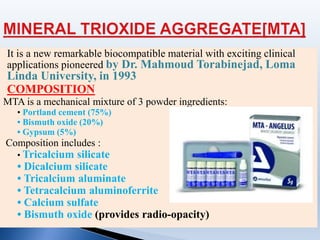
It is a new remarkable biocompatible material with exciting clinical
applications pioneered by Dr. Mahmoud Torabinejad, Loma
Linda University, in 1993
COMPOSITION
MTA is a mechanical mixture of 3 powder ingredients:
• Portland cement (75%)
• Bismuth oxide (20%)
• Gypsum (5%)
Composition includes :
• Tricalcium silicate
• Dicalcium silicate
• Tricalcium aluminate
• Tetracalcium aluminoferrite
• Calcium sulfate
• Bismuth oxide (provides radio-opacity)
CONTRAINDIACTION
Irreversible pulpitis
INDICATION
•To preserve pulp vitality
• Prevent pathological changes in the
periradicular tissues
• Mechanical pulp exposures
• Carious pulp exposures with
immature apices.
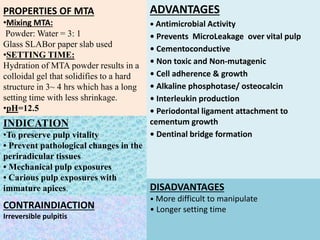
PROPERTIES OF MTA
•Mixing MTA:
Powder: Water = 3: 1
Glass SLABor paper slab used
•SETTING TIME:
Hydration of MTA powder results in a
colloidal gel that solidifies to a hard
structure in 3~ 4 hrs which has a long
setting time with less shrinkage.
•pH=12.5
ADVANTAGES
• Antimicrobial Activity
• Prevents MicroLeakage over vital pulp
• Cementoconductive
• Non toxic and Non-mutagenic
• Cell adherence & growth
• Alkaline phosphotase/ osteocalcin
• Interleukin production
• Periodontal ligament attachment to
cementum growth
• Dentinal bridge formation
DISADVANTAGES
• More difficult to manipulate
• Longer setting time
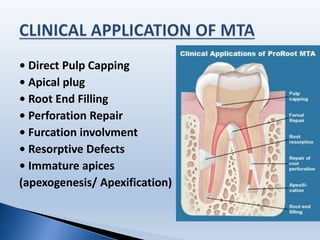
• Direct Pulp Capping
• Apical plug
• Root End Filling
• Perforation Repair
• Furcation involvment
• Resorptive Defects
• Immature apices
(apexogenesis/ Apexification)
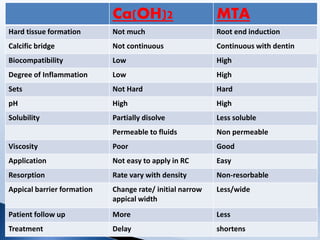
Ca(OH)2 MTA
Hard tissue formation Not much Root end induction
Calcific bridge Not continuous Continuous with dentin
Biocompatibility Low High
Degree of Inflammation Low High
Sets Not Hard Hard
pH High High
Solubility Partially disolve Less soluble
Permeable to fluids Non permeable
Viscosity Poor Good
Application Not easy to apply in RC Easy
Resorption Rate vary with density Non-resorbable
Appical barrier formation Change rate/ initial narrow
appical width
Less/wide
Patient follow up More Less
Treatment Delay shortens
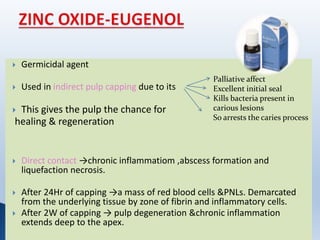
 Germicidal agent
 Used in indirect pulp capping due to its
 This gives the pulp the chance for
healing & regeneration
 Direct contact →chronic inflammatiom ,abscess formation and
liquefaction necrosis.
 After 24Hr of capping →a mass of red blood cells &PNLs. Demarcated
from the underlying tissue by zone of fibrin and inflammatory cells.
 After 2W of capping → pulp degeneration &chronic inflammation
extends deep to the apex.
Palliative affect
Excellent initial seal
Kills bacteria present in
carious lesions
So arrests the caries process
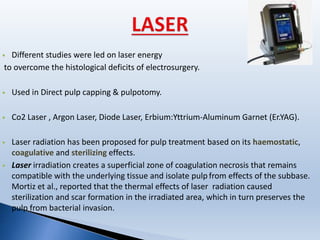
 Different studies were led on laser energy
to overcome the histological deficits of electrosurgery.
 Used in Direct pulp capping & pulpotomy.
 Co2 Laser , Argon Laser, Diode Laser, Erbium:Yttrium-Aluminum Garnet (Er.YAG).
 Laser radiation has been proposed for pulp treatment based on its haemostatic,
coagulative and sterilizing effects.
 Laser irradiation creates a superficial zone of coagulation necrosis that remains
compatible with the underlying tissue and isolate pulp from effects of the subbase.
Mortiz et al., reported that the thermal effects of laser radiation caused
sterilization and scar formation in the irradiated area, which in turn preserves the
pulp from bacterial invasion.
 Alpha-tricalcium phosphate & Tetracalcium phosphate (4CP)
set & convert to hydroxyapatite.
 Stimulate the pulp to form hard tissue.
 No finding of necrotic pulp tissue in direct contact with 4CP
cement compared to calcium hydroxide slight acidity after
mixing
 4CP cement has mechanical strengths so it could be used as
so called “dentin substitute”. Pulp capping agent
lining material
 There were suggested as direct pulp capping and pulpotomy
agents with the introduction of adhesive dentistry in both
primary and permanent dentition.
 Adhesive material forms:
- A complete marginal seal
- Prevents bacterial intrusion
- Allowed pulp repair, characterized by a new odontoblast cell
layer underlying the dentin bridge formation.
 Many studies have indicated that composite & resin-modified
glass-ionomer are compatible with pulp tissue.
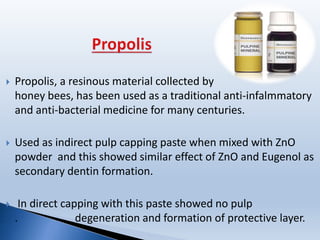
 Propolis, a resinous material collected by
honey bees, has been used as a traditional anti-infalmmatory
and anti-bacterial medicine for many centuries.
 Used as indirect pulp capping paste when mixed with ZnO
powder and this showed similar effect of ZnO and Eugenol as
secondary dentin formation.
 In direct capping with this paste showed no pulp
. degeneration and formation of protective layer.
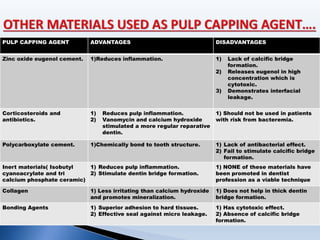
PULP CAPPING AGENT ADVANTAGES DISADVANTAGES
Zinc oxide eugenol cement. 1)Reduces inflammation. 1) Lack of calcific bridge
formation.
2) Releases eugenol in high
concentration which is
cytotoxic.
3) Demonstrates interfacial
leakage.
Corticosteroids and
antibiotics.
1) Reduces pulp inflammation.
2) Vanomycin and calcium hydroxide
stimulated a more regular reparative
dentin.
1) Should not be used in patients
with risk from bacteremia.
Polycarboxylate cement. 1)Chemically bond to tooth structure. 1) Lack of antibacterial effect.
2) Fail to stimulate calcific bridge
formation.
Inert materials( Isobutyl
cyanoacrylate and tri
calcium phosphate ceramic)
1) Reduces pulp inflammation.
2) Stimulate dentin bridge formation.
1) NONE of these materials have
been promoted in dentist
profession as a viable technique
Collagen 1) Less irritating than calcium hydroxide
and promotes mineralization.
1) Does not help in thick dentin
bridge formation.
Bonding Agents 1) Superior adhesion to hard tissues.
2) Effective seal against micro leakage.
1) Has cytotoxic effect.
2) Absence of calcific bridge
formation.
PULP CAPPING
AGENT
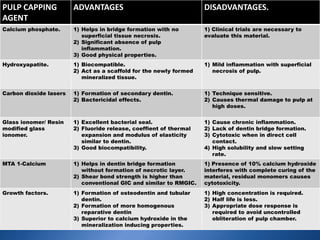
ADVANTAGES DISADVANTAGES.
Calcium phosphate. 1) Helps in bridge formation with no
superficial tissue necrosis.
2) Significant absence of pulp
inflammation.
3) Good physical properties.
1) Clinical trials are necessary to
evaluate this material.
Hydroxyapatite. 1) Biocompatible.
2) Act as a scaffold for the newly formed
mineralized tissue.
1) Mild inflammation with superficial
necrosis of pulp.
Carbon dioxide lasers 1) Formation of secondary dentin.
2) Bactericidal effects.
1) Technique sensitive.
2) Causes thermal damage to pulp at
high doses.
Glass ionomer/ Resin
modified glass
ionomer.
1) Excellent bacterial seal.
2) Fluoride release, coeffient of thermal
expansion and modulus of elasticity
similar to dentin.
3) Good biocompatibility.
1) Cause chronic inflammation.
2) Lack of dentin bridge formation.
3) Cytotoxic when in direct cell
contact.
4) High solubility and slow setting
rate.
MTA 1-Calcium 1) Helps in dentin bridge formation
without formation of necrotic layer.
2) Shear bond strength is higher than
conventional GIC and similar to RMGIC.
1) Presence of 10% calcium hydroxide
interferes with complete curing of the
material, residual monomers causes
cytotoxicity.
Growth factors. 1) Formation of osteodentin and tubular
dentin.
2) Formation of more homogenous
reparative dentin
3) Superior to calcium hydroxide in the
mineralization inducing properties.
1) High concentration is required.
2) Half life is less.
3) Appropriate dose response is
required to avoid uncontrolled
obliteration of pulp chamber.
PULP CAPPING
AGENT
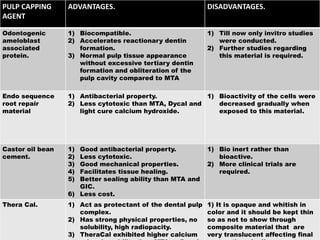
ADVANTAGES. DISADVANTAGES.
Odontogenic
ameloblast
associated
protein.
1) Biocompatible.
2) Accelerates reactionary dentin
formation.
3) Normal pulp tissue appearance
without excessive tertiary dentin
formation and obliteration of the
pulp cavity compared to MTA
1) Till now only invitro studies
were conducted.
2) Further studies regarding
this material is required.
Endo sequence
root repair
material
1) Antibacterial property.
2) Less cytotoxic than MTA, Dycal and
light cure calcium hydroxide.
1) Bioactivity of the cells were
decreased gradually when
exposed to this material.
Castor oil bean
cement.
1) Good antibacterial property.
2) Less cytotoxic.
3) Good mechanical properties.
4) Facilitates tissue healing.
5) Better sealing ability than MTA and
GIC.
6) Less cost.
1) Bio inert rather than
bioactive.
2) More clinical trials are
required.
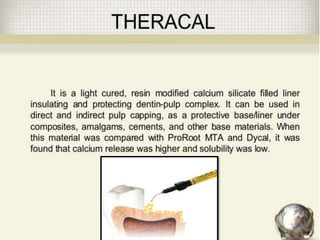
Thera Cal. 1) Act as protectant of the dental pulp
complex.
2) Has strong physical properties, no
solubility, high radiopacity.
3) TheraCal exhibited higher calcium
1) It is opaque and whitish in
color and it should be kept thin
so as not to show through
composite material that are
very translucent affecting final
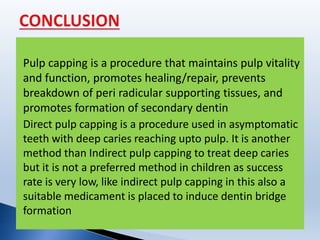
Pulp capping is a procedure that maintains pulp vitality
and function, promotes healing/repair, prevents
breakdown of peri radicular supporting tissues, and
promotes formation of secondary dentin
Direct pulp capping is a procedure used in asymptomatic
teeth with deep caries reaching upto pulp. It is another
method than Indirect pulp capping to treat deep caries
but it is not a preferred method in children as success
rate is very low, like indirect pulp capping in this also a
suitable medicament is placed to induce dentin bridge
formation
 Teacher’s Note
 Textbook of Pedodontics 2e, - Shobha Tandon
 Principle and practice of pedodontics, 3e, Aarti Rao
 Textbook of Pedodontics, 3e, Nikhil Marwah
 Dentisry on Child and Adloscence, Mc Donald
 Text book of Endodontics, Grossman
 Pathway of Pulp 9e,Cohen
 Stewart DJ and Kramer IRH. Effects of calcium hydroxide on the
unexposed pulp, J. Dent
 Suneda YT et al . A histopathological study of direct pulp capping with
adhesive resins
 Teethanime.com/pulp
 Peter. Murray et al. Analysis of pulpal reactions to restorative
procedures, materials, pulp capping, and future therapies crit rev oral
biol med 509-13:5202002

Pulp capping

  • 1.
    Submitted by: Shekhar kumarmandal BDS IV Roll no:26 SUBMITTED TO: Dr. Deepika Kapoor Department of Pedodontics and Preventive Dentistry College of Medical Sciences, Bharatpur, Nepal
  • 2.
    1. INTRODUCTION 2. TREATMENTMODALITIES 3. TYPES OF PULP CAPPING 4. INDIRECT PULP CAPPING 5. PATENT DENTIN MEASURING DEVICE 6. DIRECT PULP CAPPING 7. FEATURES OF SUCCESSFUL PULP CAPPING 8. PULP CAPPING AGENTS 9. CONCLUSION 10.REFERENCES
  • 3.
     PULP isdefined as soft tissue forming inner structure of tooth and containing nerve and blood vessel , also called as tooth pulp. The dental pulp occupies the center of each tooth and shapes itself to a maturation of the tooth .
  • 4.
    PULP TREATMENT CONSERVATIVE RADICAL 1.Protective base 1. Pulpectomy 2. Indirect pulp therapy 2. Root filling 3. Direct pulp therapy 4. Pulpotomy
  • 5.
    FIG: Exposed ornearly exposed pulp 1) Crown 2) Root 3) Restoration 4) PULP CAPPING 5) Pulp chamber
  • 6.
    PULP CAPPING TECHNIQUES INDIRECTPULP CAPPING DIRECT PULP CAPPING
  • 11.
    History  Mild discomfortfrom chemical and thermal stimuli  Absence of spontaneous pain
  • 12.
     Large cariouslesion  Absence of lymphadenopathy  Normal appearance of adjacent gingiva  Normal colour of tooth Clinical examination
  • 13.
     Large cariouslesion in close proximity to the pulp  Normal lamina dura  Normal periodontal ligament space  No interradicular or periapical radiolucency
  • 14.
  • 17.
    Large carious lesionwith apparent pulp exposure Interrupted or broken lamina dura Widened periodontal ligament space Radiolucency at the root apices or furcation areas
  • 19.
  • 20.
  • 21.
    First appointment • Toothis isolated with a rubber dam • The gross caries is removed with a large round bur (6 or 8) or sharp spoon exclavator .Care must be taken removing the caries to prevent exposure of pulp .Care must be taken to eliminate all the caries at the DEJ . Because of its closeness to the surface caries left in the areas will likely cause failure . • The remaining thin layer of caries is covered with a radiopaque biocompatible base material and sealed with a durable interim restoration • Wait for 6-8 weeks. • During this time the caries process in the deeper layer is arrested.
  • 22.
    . • If thetooth is asymptomatic, the surrounding soft tissues are free from swelling and the temporary filling is intact , the bitewing radiograph at the treated tooth should be taken for the presence of reparative dentin . • Carefully remove all the temporary filling material , especially base over the deep portion of the cavity floor.The remaining affected carious dentin should appear dehydrated and flaky and should be easily removed •The cavity preparation should be irrigated and gently dried. •Cover entire floor with Hard setting Ca(OH)2 dressing • Base should be placed with reinforced GIC or ZOE • Final restoration with composite or Amalgam
  • 24.
    Avoid unintentional pulpexposure Dentist get chance to assess reaction of tooth and caries activity Helps to remove slowly progressing lesion Final excavation of caries is safer in second sitting.
  • 25.
  • 26.
    If the toothremains asymptomatic there is no need for reentry. The removal of bacteria and substrate together with an effective seal of restoration provides the means whereby the pulp can recover the laying down secondary dentin . Assure retention and sealing of temporary restoration A protective radiopaque biocompatible base material must be placed prior to temporary restoration Remove all the soft moist and leathery texture of dentin The DEJ must be free from all softened material and stain even if the stain is firm . All margins are left adequately supported and peripheral caries is removed with a large round bur . The tooth is isolated with rubber dam ,the cavity outline form is made .
  • 27.
  • 28.
     Electronically measuresthe thickness of dentin layer above the pulp chamber during crown preparation with a simple touch of probe  GREEN LIGHT:safe zone  ORANGE LIGHT:limit of safe zone  RED LIGHT:danger of penetration through dentin.
  • 29.
    Remaining dentin thickness(0.5-2mm) Choiceof indirect pulp capping agent
  • 30.
    First 30 days •1/5thTubular dentin is formed First 2 months •Cellular fibrillar dentin is formed Third month •Globular dentin is formed More than 3 months •0.1mm Tubular dentin is formed
  • 31.
    Infected Dentin ▪Highly demineralized ▪Unremineralizable ▪Superficiallayer ▪Lacking sensation ▪Stained by 0.5% fuschin or i.e. 1.0% acid red solution ▪Ultrastructure- intertubular dentin greately demineralized, with irregular scattered crystals.  Presence of deteriorated collagen fibers that have only distinct cross bands and no interbands. ▪Should be excavated Affected Dentin  Intermediately demineralized  Remineralizable  Deeper layer  Sensitive  Does not stain  Ultrasyructure: intertubular dentin partially demineralized, but apatitie crystals bound like fringes  Sound collagen fibers with distinct cross bands and interbands.  Should be left remineralized. Difference between affected and infected dentin
  • 34.
    One year later,Rebel performed the first animal experiments with disastrous results, so he regarded the exposed pulp as a doomed organ. The first scientific clinical study to compare different capping materials was made by Dätwyler in 1921, whereupon zinc oxide-eugenol showed the best results. Hunter(1883) suggested 1st pulp capping materials. He recommended covering an exposure with a mixture of Sorghum molasses and the droppings of the English sparrow and claimed 98% success rate Until the end of the 19th century, most materials were used empirically with the idea that the pulp tissue must be irritated by etching or cauterization to heal. The first method of capping exposed pulps, using gold foils, was described by Pfaff in 1756. Thereafter, numerous agents for direct pulp capping have been recommended.
  • 35.
    Placement of amedicated or a nonmedicated material on a pulp that has been exposed in the course of preparing a cavity in a carious tooth or as the result of trauma.[Kopel, 1997] Since then, calcium hydroxide has been recommended by several authors for direct pulp capping, but it took until the middle of 20th century until it was regarded as the standard of care. In 1920 Hermann, introduced calcium hydroxide for root canal fillings. Between 1928 and 1930 he studied the reaction of vital pulp tissue to calcium hydroxide to prove that it was a biocompatible material.
  • 36.
    Encouragement of young, healthy pulps to initiate a dentin bridge, thus walling of the exposure site OBJECTIVES a) preservation of vitality of the radicular pulp. b) relief of pain in patients with acute pulpagia. c) ensuring the continuity of normal apexogenesis in immature permanent teeth
  • 37.
    Accidental pin pointexposure of pulp when excavating deep caries, less than 1 sq. mm. surrounded by clean dentin for (<24hours) Traumatic fracture of tooth(<24 hours) with pin point exposure Iatrogenic exposure during cavity preparation & crown preparation
  • 38.
    Bleed if touchedbut not excessively and controlled easily with cotton pellet Normal vitality tests without tender to percussion No radiographic evidence of periradicular pathology Young patient
  • 39.
    History of severespontaneous tooth aches at night Excessive tooth mobility Periodontal ligament thickening Intraradicular radiolucency Excessive bleeding at exposure site Purulent , serous exudate from exposure External or internal resorption Swelling and fistula with associated tooth
  • 40.
    Localization of infection& inflammation in primary teeth is poorer than in permanent teeth. [Mc Donalds,1956] Incidence of reparative dentin formation in primary teeth is more extensive than permanent Teeth. [Sayegh , 1968] Primary pulp contain high cellular content which might be responsible for failures. Primary pulp responds more rapidly to the effects of dentinal caries then the perm. Teeth. [Rayner & Southam, 1979] Undifferentiated mesenchymal cells may differentiate into osteoclasts in response to caries or pulp capping material which could lead to internal resorption. [Kennedy,1985]
  • 41.
    Primary Pulp aremore closer to outer enamel surface & are rapidly infected by the carious lesion. Once exposed pulpal inflammation is so involved that the DPC proves unfavorable. [Kennedy & Kopel,1985] Increased resorption in primary teeth is because already root resorption is in progress. [Stanley, 1985] Wide apical foramina in pri. teeth leads to abundant blood supply which results in more typical and faster inflammation response to irritation than in permanent teeth. [Kopel,1992] Acc. To finn, in primary teeth pulp capping is best carried out in teeth where dental pulp has been mechanically exposed. Pulp capping not recommended. Internal resorption or acute dentoalveolar abscess may result . [Pinkham]
  • 42.
    Rubber Dam placement Deepcarious dentin excavation:inhibit infected matter from entering pulp. Necrotic & infected dentin chips will invariably be pushed into the exposed pulp during last stages of caries removal. Bleeding controlled with sterile cotton wool (blast of air not used).No instruments should be inserted into exposure site. Layer of hard setting calcium flowed IRM and a permanent restoration. In small teeth, Ca(OH)2 can act as base. Blood clot-not allowed to be formed after cessation of bleeding from exposure as it impedes pulpal healing. Kopel,1992 a more adequate seal of pulp capping is needed (Stainless steel crown -best).
  • 43.
    Dentin bridging Maintenance ofpulp vitality Lack of undue sensitivity or pain Minimum pulpal inflammation response Ability of pulp to maintain itself without progressive degeneration Lack of internal resorption and/ or interradicular pathosis In Accordance with Kennedy & Kopel (1985):
  • 46.
    IDEAL REQUIREMENTS Ideal dressingmaterial for pulp therapy in primary teeth does not exist, but the material should be: 1. Bactericidal 2. Biocompatible 3. Harmless to the pulp, surrounding structures and the permanent tooth germ. 4. Promote healing 5. Not interfere with physiologic process of resorption.
  • 47.
    Calcium hydroxide Zinc oxideeugenol cement Corticosteroids and antibiotics Polycarboxylate cement Isobutyl cyanoacrylate and tri calcium phosphate ceramic Collagen Bonding Agents Calcium phosphate Hydroxyapatite Mineral trioxide aggregate GIC/RMGIC Lasers MTA 1-Calcium Growth factors Odontogenic ameloblast associated protein Endo sequence root repair material Castor oil bean cement Thera Cal
  • 48.
     It isa colorless crystal or white powder prepared by reacting calcium oxide with water.  The use of calcium hydroxide in endodontics was introduced by Hermann in between 1920-1930.  Calcium hydroxide was most favored as a pulpotomy agent in the 1940s and mid- 1950s.  “Calcium hydroxide has the ability to form reparative dentin form ation”,this rationale was introduced by Teuscher and Zander in 1938.  Lim and Kirk, in an extensive review of direct pulp capping literature, found little support for pulp obliteration and internal resorption being a major complication of pulp capping  Estrela et al. summarized the antibacterial properties of calcium hydroxide.
  • 49.
    ADVANTAGES Reparative dentin formation Antibacterialaction Pulp protection The tissue-dissolving property Newer preparation shows Improved strength, essentially no solubility in acid, and minimal solubility in water and control the over working time DISADVANTAGES Pulp obliteration Internal resorption Lack of adhesion to hard tissues Microleakage Short working time of self cured preparation Base paste – Glycol salicylate-40%-reacts with calcium hydroxide and ZnO Titanium dioxide-Inert fillers Calcium tungstate - Fillers Barium sulphate-provide radioopacity Catalyst paste Calcium hydroxide-50%-principal reactive ingredient Zinc oxide-10% Zinc stearate-0.55%-accelerator Sulphonamide-39.5%-oily compound acts as carrier. COMPOSITION •AVAILABLE AS a)Pulpdent b)Hydrex : two paste system c)Dycal.
  • 50.
    D: After 8weeks A: After 24 hours B: After 2-3 weeks C: After 4-5 weeks
  • 51.
    Three distinct zonecan be visualised: I. Zone of obliteration (early changes: area of superficial debris) II. Zone of coagulation necrosis (Schroeder’s layer of “firm necrosis”, Stanley’s “mummified zone”) III. Line of demarcation Zone of obliteration Early changes: area of superficial debris Drug’s caustic effect Tissue in immediate contact becomes deranged and distorted. This Zone consists of- i. Debris ii. Dentinal fragments iii. Blood clot iv. Blood pigment v. Calcium hydroxide particles Zone of coagulation necrosis Weaker chemical reaction from 1st zone reaches the subjacent , more apical tissues & results in this zone of coagulation & necrosis. Thickness- 0.3-0.7 mm (Acc. to Craig: 1mm thick) Represents devitalised tissue without complete obliteration of its structural architecture Cellular details-greatly diminished Capillaries outlines, nerve bundles & pyknotic nuclei can be recognized. Stimulates subjacent vital pulp Vascular changes occur Line of demarcation Develops between Zone of coagulation necrosis and vital tissues This zone results from reaction of Calcium hydroxide with the tissue protein to form proteinate globules.
  • 52.
    It is anew remarkable biocompatible material with exciting clinical applications pioneered by Dr. Mahmoud Torabinejad, Loma Linda University, in 1993 COMPOSITION MTA is a mechanical mixture of 3 powder ingredients: • Portland cement (75%) • Bismuth oxide (20%) • Gypsum (5%) Composition includes : • Tricalcium silicate • Dicalcium silicate • Tricalcium aluminate • Tetracalcium aluminoferrite • Calcium sulfate • Bismuth oxide (provides radio-opacity)
  • 53.
    CONTRAINDIACTION Irreversible pulpitis INDICATION •To preservepulp vitality • Prevent pathological changes in the periradicular tissues • Mechanical pulp exposures • Carious pulp exposures with immature apices. PROPERTIES OF MTA •Mixing MTA: Powder: Water = 3: 1 Glass SLABor paper slab used •SETTING TIME: Hydration of MTA powder results in a colloidal gel that solidifies to a hard structure in 3~ 4 hrs which has a long setting time with less shrinkage. •pH=12.5 ADVANTAGES • Antimicrobial Activity • Prevents MicroLeakage over vital pulp • Cementoconductive • Non toxic and Non-mutagenic • Cell adherence & growth • Alkaline phosphotase/ osteocalcin • Interleukin production • Periodontal ligament attachment to cementum growth • Dentinal bridge formation DISADVANTAGES • More difficult to manipulate • Longer setting time
  • 54.
    • Direct PulpCapping • Apical plug • Root End Filling • Perforation Repair • Furcation involvment • Resorptive Defects • Immature apices (apexogenesis/ Apexification)
  • 55.
    Ca(OH)2 MTA Hard tissueformation Not much Root end induction Calcific bridge Not continuous Continuous with dentin Biocompatibility Low High Degree of Inflammation Low High Sets Not Hard Hard pH High High Solubility Partially disolve Less soluble Permeable to fluids Non permeable Viscosity Poor Good Application Not easy to apply in RC Easy Resorption Rate vary with density Non-resorbable Appical barrier formation Change rate/ initial narrow appical width Less/wide Patient follow up More Less Treatment Delay shortens
  • 56.
     Germicidal agent Used in indirect pulp capping due to its  This gives the pulp the chance for healing & regeneration  Direct contact →chronic inflammatiom ,abscess formation and liquefaction necrosis.  After 24Hr of capping →a mass of red blood cells &PNLs. Demarcated from the underlying tissue by zone of fibrin and inflammatory cells.  After 2W of capping → pulp degeneration &chronic inflammation extends deep to the apex. Palliative affect Excellent initial seal Kills bacteria present in carious lesions So arrests the caries process
  • 57.
     Different studieswere led on laser energy to overcome the histological deficits of electrosurgery.  Used in Direct pulp capping & pulpotomy.  Co2 Laser , Argon Laser, Diode Laser, Erbium:Yttrium-Aluminum Garnet (Er.YAG).  Laser radiation has been proposed for pulp treatment based on its haemostatic, coagulative and sterilizing effects.  Laser irradiation creates a superficial zone of coagulation necrosis that remains compatible with the underlying tissue and isolate pulp from effects of the subbase. Mortiz et al., reported that the thermal effects of laser radiation caused sterilization and scar formation in the irradiated area, which in turn preserves the pulp from bacterial invasion.
  • 58.
     Alpha-tricalcium phosphate& Tetracalcium phosphate (4CP) set & convert to hydroxyapatite.  Stimulate the pulp to form hard tissue.  No finding of necrotic pulp tissue in direct contact with 4CP cement compared to calcium hydroxide slight acidity after mixing  4CP cement has mechanical strengths so it could be used as so called “dentin substitute”. Pulp capping agent lining material
  • 59.
     There weresuggested as direct pulp capping and pulpotomy agents with the introduction of adhesive dentistry in both primary and permanent dentition.  Adhesive material forms: - A complete marginal seal - Prevents bacterial intrusion - Allowed pulp repair, characterized by a new odontoblast cell layer underlying the dentin bridge formation.  Many studies have indicated that composite & resin-modified glass-ionomer are compatible with pulp tissue.
  • 60.
     Propolis, aresinous material collected by honey bees, has been used as a traditional anti-infalmmatory and anti-bacterial medicine for many centuries.  Used as indirect pulp capping paste when mixed with ZnO powder and this showed similar effect of ZnO and Eugenol as secondary dentin formation.  In direct capping with this paste showed no pulp . degeneration and formation of protective layer.
  • 62.
    PULP CAPPING AGENTADVANTAGES DISADVANTAGES Zinc oxide eugenol cement. 1)Reduces inflammation. 1) Lack of calcific bridge formation. 2) Releases eugenol in high concentration which is cytotoxic. 3) Demonstrates interfacial leakage. Corticosteroids and antibiotics. 1) Reduces pulp inflammation. 2) Vanomycin and calcium hydroxide stimulated a more regular reparative dentin. 1) Should not be used in patients with risk from bacteremia. Polycarboxylate cement. 1)Chemically bond to tooth structure. 1) Lack of antibacterial effect. 2) Fail to stimulate calcific bridge formation. Inert materials( Isobutyl cyanoacrylate and tri calcium phosphate ceramic) 1) Reduces pulp inflammation. 2) Stimulate dentin bridge formation. 1) NONE of these materials have been promoted in dentist profession as a viable technique Collagen 1) Less irritating than calcium hydroxide and promotes mineralization. 1) Does not help in thick dentin bridge formation. Bonding Agents 1) Superior adhesion to hard tissues. 2) Effective seal against micro leakage. 1) Has cytotoxic effect. 2) Absence of calcific bridge formation.
  • 63.
    PULP CAPPING AGENT ADVANTAGES DISADVANTAGES. Calciumphosphate. 1) Helps in bridge formation with no superficial tissue necrosis. 2) Significant absence of pulp inflammation. 3) Good physical properties. 1) Clinical trials are necessary to evaluate this material. Hydroxyapatite. 1) Biocompatible. 2) Act as a scaffold for the newly formed mineralized tissue. 1) Mild inflammation with superficial necrosis of pulp. Carbon dioxide lasers 1) Formation of secondary dentin. 2) Bactericidal effects. 1) Technique sensitive. 2) Causes thermal damage to pulp at high doses. Glass ionomer/ Resin modified glass ionomer. 1) Excellent bacterial seal. 2) Fluoride release, coeffient of thermal expansion and modulus of elasticity similar to dentin. 3) Good biocompatibility. 1) Cause chronic inflammation. 2) Lack of dentin bridge formation. 3) Cytotoxic when in direct cell contact. 4) High solubility and slow setting rate. MTA 1-Calcium 1) Helps in dentin bridge formation without formation of necrotic layer. 2) Shear bond strength is higher than conventional GIC and similar to RMGIC. 1) Presence of 10% calcium hydroxide interferes with complete curing of the material, residual monomers causes cytotoxicity. Growth factors. 1) Formation of osteodentin and tubular dentin. 2) Formation of more homogenous reparative dentin 3) Superior to calcium hydroxide in the mineralization inducing properties. 1) High concentration is required. 2) Half life is less. 3) Appropriate dose response is required to avoid uncontrolled obliteration of pulp chamber.
  • 64.
    PULP CAPPING AGENT ADVANTAGES. DISADVANTAGES. Odontogenic ameloblast associated protein. 1)Biocompatible. 2) Accelerates reactionary dentin formation. 3) Normal pulp tissue appearance without excessive tertiary dentin formation and obliteration of the pulp cavity compared to MTA 1) Till now only invitro studies were conducted. 2) Further studies regarding this material is required. Endo sequence root repair material 1) Antibacterial property. 2) Less cytotoxic than MTA, Dycal and light cure calcium hydroxide. 1) Bioactivity of the cells were decreased gradually when exposed to this material. Castor oil bean cement. 1) Good antibacterial property. 2) Less cytotoxic. 3) Good mechanical properties. 4) Facilitates tissue healing. 5) Better sealing ability than MTA and GIC. 6) Less cost. 1) Bio inert rather than bioactive. 2) More clinical trials are required. Thera Cal. 1) Act as protectant of the dental pulp complex. 2) Has strong physical properties, no solubility, high radiopacity. 3) TheraCal exhibited higher calcium 1) It is opaque and whitish in color and it should be kept thin so as not to show through composite material that are very translucent affecting final
  • 65.
    Pulp capping isa procedure that maintains pulp vitality and function, promotes healing/repair, prevents breakdown of peri radicular supporting tissues, and promotes formation of secondary dentin Direct pulp capping is a procedure used in asymptomatic teeth with deep caries reaching upto pulp. It is another method than Indirect pulp capping to treat deep caries but it is not a preferred method in children as success rate is very low, like indirect pulp capping in this also a suitable medicament is placed to induce dentin bridge formation
  • 66.
     Teacher’s Note Textbook of Pedodontics 2e, - Shobha Tandon  Principle and practice of pedodontics, 3e, Aarti Rao  Textbook of Pedodontics, 3e, Nikhil Marwah  Dentisry on Child and Adloscence, Mc Donald  Text book of Endodontics, Grossman  Pathway of Pulp 9e,Cohen  Stewart DJ and Kramer IRH. Effects of calcium hydroxide on the unexposed pulp, J. Dent  Suneda YT et al . A histopathological study of direct pulp capping with adhesive resins  Teethanime.com/pulp  Peter. Murray et al. Analysis of pulpal reactions to restorative procedures, materials, pulp capping, and future therapies crit rev oral biol med 509-13:5202002