Bangladesh University of Textiles
Presented To
MD. Emdad Sarker
Assistant Professor
Department of Fabric Engineering
Bangladesh University of Textiles
Presented By
Jahirul Alam Chowdhury (2017-2-4-10)
Md. Rasel Hossen (2017-2-4-14)
Abu Ekhtiar Tawhid (2017-2-5-09)
Md. Maidul Islam (2017-2-1-12)
Introduction
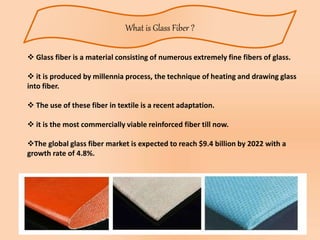
What is Glass Fiber ?
 Glass fiber is a material consisting of numerous extremely fine fibers of glass.
 it is produced by millennia process, the technique of heating and drawing glass
into fiber.
 The use of these fiber in textile is a recent adaptation.
 it is the most commercially viable reinforced fiber till now.
The global glass fiber market is expected to reach $9.4 billion by 2022 with a
growth rate of 4.8%.
HISTORY
 The ancient Egyptians was the first civilization that made glass, and turn it
into glass fibers, they used it for decoration; unaware of the potential that lay
within it.
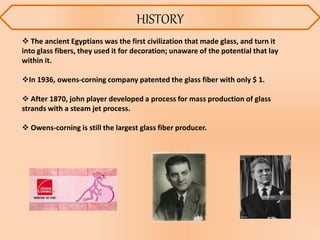
In 1936, owens-corning company patented the glass fiber with only $ 1.
 After 1870, john player developed a process for mass production of glass
strands with a steam jet process.
 Owens-corning is still the largest glass fiber producer.
Types of Glass Fiber
As per ASTM C 162 the glass fiber were classified according to the end use and
chemical compositions.
A Glass – soda lime silicate glasses used where the strength, durability and good
electrical resistivity.
C Glass – Chemical stability in corrosive acid environment.
D Glass – Borosilicate glasses with a low dielectric constant for electrical
application.
E Glass – alumina-Calcium-borosilicate glasses with a maximum alkali content 2%
used as general purpose fibers where strength and high Electrical resistivity are
required.
 ECRGLAS® – Calcium aluminosilicate glasses with a maximum alkali content of 2
wt.% used where strength, electrical resistivity, and acid corrosion resistance are
desired.
 AR GLASS – Alkali Resistant Glasses composed of alkali zirconium silicates used in
cement substrates and concrete.
 R GLASS – Calcium aluminosilicate glasses used for reinforcement where added
strength and acid corrosion resistance are required.
 S-2 GLASS® – Magnesium aluminosilicate glasses used for textile substrates or
reinforcement in composite structural applications which require high strength,
modulus, and stability under extreme temperature and corrosive environments.
Chemical structure
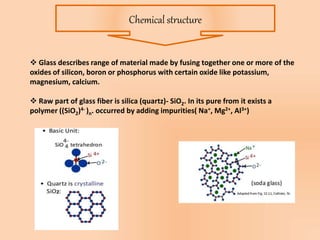
 Glass describes range of material made by fusing together one or more of the
oxides of silicon, boron or phosphorus with certain oxide like potassium,
magnesium, calcium.
 Raw part of glass fiber is silica (quartz)- SiO2. In its pure from it exists a
polymer ((SiO2)4- )n. occurred by adding impurities( Na+, Mg2+, Al3+)
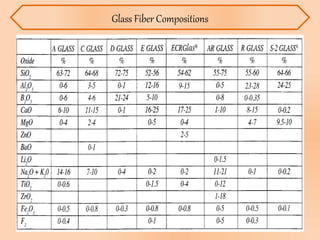
Glass Fiber Compositions
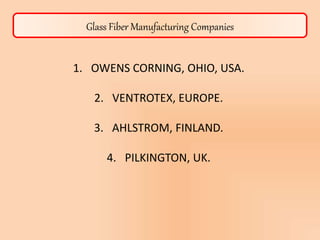
Glass Fiber Manufacturing Companies
1. OWENS CORNING, OHIO, USA.
2. VENTROTEX, EUROPE.
3. AHLSTROM, FINLAND.
4. PILKINGTON, UK.
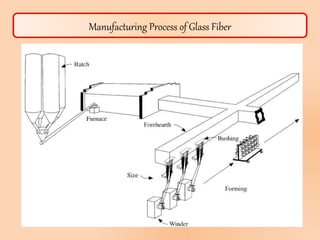
Manufacturing Process of Glass Fiber
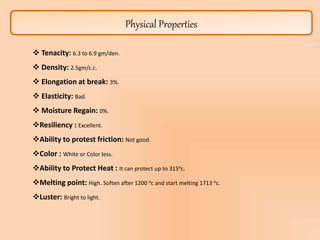
Physical Properties
 Tenacity: 6.3 to 6.9 gm/den.
 Density: 2.5gm/c.c.
 Elongation at break: 3%.
 Elasticity: Bad.
 Moisture Regain: 0%.
Resiliency : Excellent.
Ability to protest friction: Not good.
Color : White or Color less.
Ability to Protect Heat : It can protect up to 315ᵒc.
Melting point: High. Soften after 1200 ᵒc and start melting 1713 ᵒc.
Luster: Bright to light.
Chemical properties
 Acids: Hydro Choleric acid and hot phosphoric acid causes harm to the glass
fiber.
 Basic: It has enough protection ability to alkali.
 Effect of bleaching: Bleaching agent does not cause harm to glass fiber.
 Organic solvent: It does not changes with the effect of organic solvent.
 Protection ability against mildew: It is not affected by mildew.
 Protection ability against micro-organism: Micro-organism does not harm
glass fiber.
 Dyeing: It is not possible to dye after production, it is dyed in solution bath.
Advantages And Disadvantages
Advantages
 Light weigh, Long spans available with a separate structural frame.
 High ratio of strength to weight.
 Good molding ability.
 High melting point.
 Easily installed, can be cut, patched, sanded.
 Non-corrosive and rot-resistant.
Disadvantages
 Ultraviolet sensitive unless surface is coated with gel cot.
 poor ventilation.
End Products
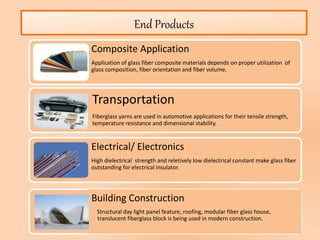
Composite Application
Application of glass fiber composite materials depends on proper utilization of
glass composition, fiber orientation and fiber volume.
Transportation
Fiberglass yarns are used in automotive applications for their tensile strength,
temperature resistance and dimensional stability.
Electrical/ Electronics
High dielectrical strength and reletively low dielectrical constant make glass fiber
outstanding for electrical insulator.
Building Construction
Structural day light panel feature, roofing, modular fiber glass house,
translucent fiberglass block is being used in modern construction.
End Products
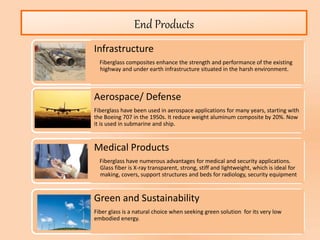
Infrastructure
Fiberglass composites enhance the strength and performance of the existing
highway and under earth infrastructure situated in the harsh environment.
Aerospace/ Defense
Fiberglass have been used in aerospace applications for many years, starting with
the Boeing 707 in the 1950s. It reduce weight aluminum composite by 20%. Now
it is used in submarine and ship.
Medical Products
Fiberglass have numerous advantages for medical and security applications.
Glass fiber is X-ray transparent, strong, stiff and lightweight, which is ideal for
making, covers, support structures and beds for radiology, security equipment
Green and Sustainability
Fiber glass is a natural choice when seeking green solution for its very low
embodied energy.
Conclusion
Fiberglass textiles are commonly used as a reinforcement material for molded and
laminated plastics.
Glass fiber has roughly comparable mechanical properties to other fibers such
as carbon fiber. Although not as strong or as rigid as carbon fiber, it is much
cheaper and significantly less brittle when used in composites.
Glass fiber have a very bright future for it its unique physical properties. It is twice
as strong as still wire.
References
1. https://en.wikipedia.org/wiki/Glass_fiber
2. http://www.productionglassfibre.co.uk/downloads.asp
3. https://www.britglass.org.uk/glass-fibre-manufacture
4. http://textilelearner.blogspot.com/2011/08/glass-fiber-types-of-glass-
fiber_3834.html
5. https://books.google.com.bd/books?id=Z0QggRubnNMC&pg=PR7&lpg=PR7&
dq=glass+fibre&source=bl&ots=OJM8IUKVnv&sig=TsIc6xyQ0nwNSDD3m-Lkx-
5uXdE&hl=bn&sa=X&redir_esc=y#v=onepage&q=glass%20fibre&f=false
6. https://www.youtube.com/watch?v=h8JYKZbsnrk&t=56s
7. https://www.slideshare.net/search/slideshow?searchfrom=header&q=glass+fi
bre
Presentation on glass fiber

Presentation on glass fiber

  • 1.
    Bangladesh University ofTextiles Presented To MD. Emdad Sarker Assistant Professor Department of Fabric Engineering Bangladesh University of Textiles Presented By Jahirul Alam Chowdhury (2017-2-4-10) Md. Rasel Hossen (2017-2-4-14) Abu Ekhtiar Tawhid (2017-2-5-09) Md. Maidul Islam (2017-2-1-12)
  • 2.
  • 3.
    What is GlassFiber ?  Glass fiber is a material consisting of numerous extremely fine fibers of glass.  it is produced by millennia process, the technique of heating and drawing glass into fiber.  The use of these fiber in textile is a recent adaptation.  it is the most commercially viable reinforced fiber till now. The global glass fiber market is expected to reach $9.4 billion by 2022 with a growth rate of 4.8%.
  • 4.
    HISTORY  The ancientEgyptians was the first civilization that made glass, and turn it into glass fibers, they used it for decoration; unaware of the potential that lay within it. In 1936, owens-corning company patented the glass fiber with only $ 1.  After 1870, john player developed a process for mass production of glass strands with a steam jet process.  Owens-corning is still the largest glass fiber producer.
  • 5.
    Types of GlassFiber As per ASTM C 162 the glass fiber were classified according to the end use and chemical compositions. A Glass – soda lime silicate glasses used where the strength, durability and good electrical resistivity. C Glass – Chemical stability in corrosive acid environment. D Glass – Borosilicate glasses with a low dielectric constant for electrical application. E Glass – alumina-Calcium-borosilicate glasses with a maximum alkali content 2% used as general purpose fibers where strength and high Electrical resistivity are required.
  • 6.
     ECRGLAS® –Calcium aluminosilicate glasses with a maximum alkali content of 2 wt.% used where strength, electrical resistivity, and acid corrosion resistance are desired.  AR GLASS – Alkali Resistant Glasses composed of alkali zirconium silicates used in cement substrates and concrete.  R GLASS – Calcium aluminosilicate glasses used for reinforcement where added strength and acid corrosion resistance are required.  S-2 GLASS® – Magnesium aluminosilicate glasses used for textile substrates or reinforcement in composite structural applications which require high strength, modulus, and stability under extreme temperature and corrosive environments.
  • 7.
    Chemical structure  Glassdescribes range of material made by fusing together one or more of the oxides of silicon, boron or phosphorus with certain oxide like potassium, magnesium, calcium.  Raw part of glass fiber is silica (quartz)- SiO2. In its pure from it exists a polymer ((SiO2)4- )n. occurred by adding impurities( Na+, Mg2+, Al3+)
  • 8.
  • 9.
    Glass Fiber ManufacturingCompanies 1. OWENS CORNING, OHIO, USA. 2. VENTROTEX, EUROPE. 3. AHLSTROM, FINLAND. 4. PILKINGTON, UK.
  • 10.
  • 12.
    Physical Properties  Tenacity:6.3 to 6.9 gm/den.  Density: 2.5gm/c.c.  Elongation at break: 3%.  Elasticity: Bad.  Moisture Regain: 0%. Resiliency : Excellent. Ability to protest friction: Not good. Color : White or Color less. Ability to Protect Heat : It can protect up to 315ᵒc. Melting point: High. Soften after 1200 ᵒc and start melting 1713 ᵒc. Luster: Bright to light.
  • 13.
    Chemical properties  Acids:Hydro Choleric acid and hot phosphoric acid causes harm to the glass fiber.  Basic: It has enough protection ability to alkali.  Effect of bleaching: Bleaching agent does not cause harm to glass fiber.  Organic solvent: It does not changes with the effect of organic solvent.  Protection ability against mildew: It is not affected by mildew.  Protection ability against micro-organism: Micro-organism does not harm glass fiber.  Dyeing: It is not possible to dye after production, it is dyed in solution bath.
  • 14.
    Advantages And Disadvantages Advantages Light weigh, Long spans available with a separate structural frame.  High ratio of strength to weight.  Good molding ability.  High melting point.  Easily installed, can be cut, patched, sanded.  Non-corrosive and rot-resistant. Disadvantages  Ultraviolet sensitive unless surface is coated with gel cot.  poor ventilation.
  • 15.
    End Products Composite Application Applicationof glass fiber composite materials depends on proper utilization of glass composition, fiber orientation and fiber volume. Transportation Fiberglass yarns are used in automotive applications for their tensile strength, temperature resistance and dimensional stability. Electrical/ Electronics High dielectrical strength and reletively low dielectrical constant make glass fiber outstanding for electrical insulator. Building Construction Structural day light panel feature, roofing, modular fiber glass house, translucent fiberglass block is being used in modern construction.
  • 16.
    End Products Infrastructure Fiberglass compositesenhance the strength and performance of the existing highway and under earth infrastructure situated in the harsh environment. Aerospace/ Defense Fiberglass have been used in aerospace applications for many years, starting with the Boeing 707 in the 1950s. It reduce weight aluminum composite by 20%. Now it is used in submarine and ship. Medical Products Fiberglass have numerous advantages for medical and security applications. Glass fiber is X-ray transparent, strong, stiff and lightweight, which is ideal for making, covers, support structures and beds for radiology, security equipment Green and Sustainability Fiber glass is a natural choice when seeking green solution for its very low embodied energy.
  • 17.
    Conclusion Fiberglass textiles arecommonly used as a reinforcement material for molded and laminated plastics. Glass fiber has roughly comparable mechanical properties to other fibers such as carbon fiber. Although not as strong or as rigid as carbon fiber, it is much cheaper and significantly less brittle when used in composites. Glass fiber have a very bright future for it its unique physical properties. It is twice as strong as still wire.
  • 18.
    References 1. https://en.wikipedia.org/wiki/Glass_fiber 2. http://www.productionglassfibre.co.uk/downloads.asp 3.https://www.britglass.org.uk/glass-fibre-manufacture 4. http://textilelearner.blogspot.com/2011/08/glass-fiber-types-of-glass- fiber_3834.html 5. https://books.google.com.bd/books?id=Z0QggRubnNMC&pg=PR7&lpg=PR7& dq=glass+fibre&source=bl&ots=OJM8IUKVnv&sig=TsIc6xyQ0nwNSDD3m-Lkx- 5uXdE&hl=bn&sa=X&redir_esc=y#v=onepage&q=glass%20fibre&f=false 6. https://www.youtube.com/watch?v=h8JYKZbsnrk&t=56s 7. https://www.slideshare.net/search/slideshow?searchfrom=header&q=glass+fi bre