
POETRY


           “Ode to Evening”
           by William Collins

Mona AL-Ghamdi
What is "transitional period"?
It is period between (1745-1785) between Neoclassical and
Romantic periods. Some literary historians call this period the "age
of sensibility".


What are the main aspects of the
"transitional period"?
1-The poetry involve a move inward - writers are more introspective,
thinking of their own thoughts and feelings as possible subject matter
for their work.
2-Is contrast to Pope who writes about others, and adds the further
detachment of satire.
3-The many writers become fascinated by the morbid, the macabre,
and the Gothic: death, suicide, melancholia, and graves become
popular motifs.
4-At the same time, there is a great interest in natural landscape ,in
gardens, parks and rural life.
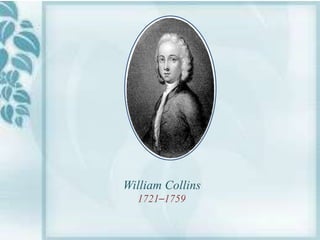
William Collins
  1721–1759
William Collins is considered as one of the most skilled 18th-century
                            lyric poets.


He is one of the poets who is marking a transitional period in
English literature.

  -This is due to Collins’s style which is formally
  Neoclassical but represents the themes of the Romantic
  period.
   -His treatment of individual experience and descriptions
  of emotion influenced his peers as well as the next
  generation of writers.
   -His lyrical odes marks a turn away from the Augustan
  poetry of Alexander Pope's generation with its focus on
  reason and objective views , towards the Romantic era
  which would soon follow with its emphasis on emotional
  and subjective view.
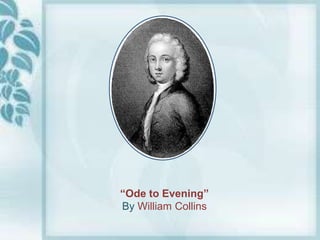
“Ode to Evening”
By William Collins
-Collins was born in England, where his father
served as mayor.
-He enrolled in Winchester College at age 11 and
began publishing poems.
-After finishing study in Oxford, Collins moved
to London to write.

- Collins’s poems like Odes are among his most
celebrated works and include “Ode to Evening”
and “Ode to Fear.”
- Collins’s mental health began to fail during the
final decade of his life, and his writing suffered
as a result.
The Poem
If aught of oaten stop, or past'ral song,
May hope, chaste Eve, to soothe thy modest ear,
    Like thy own solemn springs,
   Thy springs and dying gales,
O nymph reserved, while now the bright-haired sun
Sits in yon western tent, whose cloudy skirts,
    With brede ethereal wove,
    O'erhang his wavy bed;
Now air is hushed, save where the weak-ey'd bat
With short shrill shriek flits by on leathern wing,
    Or where the beetle winds
    His small but sullen horn
As oft he rises 'midst the twilight path
Against the pilgrim, borne in heedless hum:
    Now teach me, maid composed,
   To breathe some softened strain,
Whose numbers stealing through thy dark'ning vale
May not unseemly with its stillness suit,
   As musing slow, I hail
   Thy genial loved return.
For when thy folding star arising shows
His paly circlet, at his warning lamp
  The fragrant Hours, and elves
  Who slept in flowers the day,
And many a nymph who wreathes her brows with sedge
And sheds the fresh'ning dew, and lovelier still,
  The pensive pleasures sweet
  Prepare thy shad'wy car.
Then lead, calm votress, where some sheety lake
Cheers the lone heath, or some time-hallowed pile
  Or upland fallows grey
  Reflect its last cool gleam.
But when chill blust'ring winds, or driving rain,
Forbid my willing feet, be mine the hut
  That from the mountain's side
  Views wilds, and swelling floods,
And hamlets brown, and dim-discovered spires,
And hears their simple bell, and marks o'er all
  Thy dewy fingers draw
  The gradual dusky veil.
While Spring shall pour his showers, as oft he wont,
And bathe thy breathing tresses, meekest Eve;
  While Summer loves to sport
  Beneath thy ling'ring light;
While sallow Autumn fills thy lap with leaves;
Or Winter, yelling through the troublous air,
  Affrights thy shrinking train
  And rudely rends thy robes;
So long, sure-found beneath the sylvan shed,
Shall Fancy, Friendship, Science, rose-lipp'd Health,
  Thy gentlest influence own,
  And hymn thy fav'rite name!
EXPLAINATION

“Ode to Evening,” is one among the most enduring poems of
William Collins. It is a beautiful poem of fifty-two lines, addressed
to a goddess figure representing evening. This nymph, or maid,
who personifies dusk, is chaste, reserv‟d, and meek, in contrast to
the bright-hair‟d sun, a male figure who withdraws into his tent,
making way for night. Thus evening is presented as the transition
between light and darkness.


In "Ode to Evening" the poet is seen at his best. It is a masterpiece
creation of Collins. Evening has been personified. It is not just a
time of dusk, it is the spirit of evening. She is described as
reserved by nature. She is peaceful Nymph and simple. In her tent
sunsets and resets. She has been imagined as a maid composed.
The poet would like to sing his songs to soothe her modest ear.
The poem begins with an invocation to the spirit of evening to
teach the poet to sing a soft strain to it. She is not just a part of
dead nature. Sometime she appears as pensive Eve. She likes to
hear the poet's songs. Her hours are fragrant. Fairies who sleep
in the buds during daytime, come out in the evening and make
the atmosphere fragrant.


His song should be as soft as the murmur of the streams or the
dying winds. The poet says that barring the cry of the bat and the
beetle , there is complete calm all around in the evening. He
wishes to go to some solitary and barren spot or some ancient
ruined building among lonely valleys in the evening to watch its
beauty. But if he is prevented from doing so by "chill, blustering
winds or driving rain", he would like to go to a lovely cottage on
the mountain side to watch the dark colored evening gradually
descending over the surrounding landscape with the "gradual
dusky veil”.
The poem ends with the poet's conviction that the
evening shall continue to inspire fancy
(poets), friendship (friends), science (men of
learning), and smiling peace (lovers of peace)
throughout the seasons of the year.
The figure of speech
„ If ought of oaten stop, or pastoral song
May hope , chaste Eye, to soothe thy modest ear,


               This is a case of Apostrophe, since
            the abstract entity had been addressed
            as a person or deity .Evening has been
            addressed as Eve.


‘O nymph reserved, while now the bright-haired sun
Sits in yon western tent, whose cloudy skirts,'


          This is a case of personification since the sun is
          referred to as a person sitting in a tent .
             This is also a case of Metaphor since the sun is
          implicitly compared to a person with bright hair
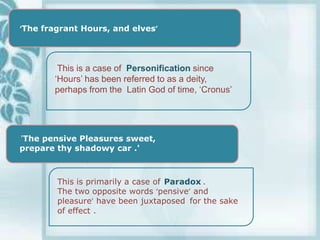
‘The fragrant Hours, and elves’


          This is a case of Personification since
     .   „Hours‟ has been referred to as a deity,
         perhaps from the Latin God of time, „Cronus‟


'The pensive Pleasures sweet,
prepare thy shadowy car .'


         This is primarily a case of Paradox .
         The two opposite words ‘pensive’ and
         pleasure’ have been juxtaposed for the sake
         of effect .
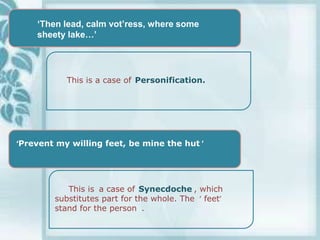
„Then lead, calm vot‟ress, where some
    sheety lake…‟


           This is a case of Personification.


‘Prevent my willing feet, be mine the hut ’


           This is a case of Synecdoche , which
        substitutes part for the whole. The ‘ feet’
        stand for the person .
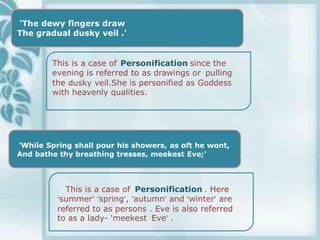
'The dewy fingers draw
The gradual dusky veil .'


        This is a case of Personification since the
        evening is referred to as drawings or pulling
        the dusky veil.She is personified as Goddess
        with heavenly qualities.


'While Spring shall pour his showers, as oft he wont,
And bathe thy breathing tresses, meekest Eve;'


            This is a case of Personification . Here
          ‘summer’ ‘spring’, ‘autumn’ and ‘winter’ are
          referred to as persons . Eve is also referred
          to as a lady- 'meekest Eve’ .
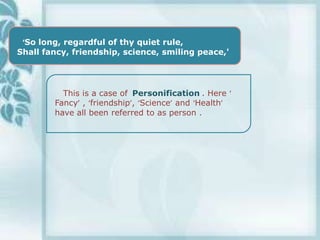
‘So long, regardful of thy quiet rule,
Shall fancy, friendship, science, smiling peace,'


          This is a case of Personification . Here ‘
        Fancy’ , ‘friendship’, ‘Science’ and ‘Health’
        have all been referred to as person .
4.1. Transitional Period + Ode to Evening

4.1. Transitional Period + Ode to Evening

  • 1.
    POETRY “Ode to Evening” by William Collins Mona AL-Ghamdi
  • 2.
    What is "transitionalperiod"? It is period between (1745-1785) between Neoclassical and Romantic periods. Some literary historians call this period the "age of sensibility". What are the main aspects of the "transitional period"? 1-The poetry involve a move inward - writers are more introspective, thinking of their own thoughts and feelings as possible subject matter for their work. 2-Is contrast to Pope who writes about others, and adds the further detachment of satire. 3-The many writers become fascinated by the morbid, the macabre, and the Gothic: death, suicide, melancholia, and graves become popular motifs. 4-At the same time, there is a great interest in natural landscape ,in gardens, parks and rural life.
  • 3.
    William Collins 1721–1759
  • 4.
    William Collins isconsidered as one of the most skilled 18th-century lyric poets. He is one of the poets who is marking a transitional period in English literature. -This is due to Collins’s style which is formally Neoclassical but represents the themes of the Romantic period. -His treatment of individual experience and descriptions of emotion influenced his peers as well as the next generation of writers. -His lyrical odes marks a turn away from the Augustan poetry of Alexander Pope's generation with its focus on reason and objective views , towards the Romantic era which would soon follow with its emphasis on emotional and subjective view.
  • 5.
    “Ode to Evening” ByWilliam Collins
  • 6.
    -Collins was bornin England, where his father served as mayor. -He enrolled in Winchester College at age 11 and began publishing poems. -After finishing study in Oxford, Collins moved to London to write. - Collins’s poems like Odes are among his most celebrated works and include “Ode to Evening” and “Ode to Fear.” - Collins’s mental health began to fail during the final decade of his life, and his writing suffered as a result.
  • 7.
    The Poem If aughtof oaten stop, or past'ral song, May hope, chaste Eve, to soothe thy modest ear, Like thy own solemn springs, Thy springs and dying gales, O nymph reserved, while now the bright-haired sun Sits in yon western tent, whose cloudy skirts, With brede ethereal wove, O'erhang his wavy bed; Now air is hushed, save where the weak-ey'd bat With short shrill shriek flits by on leathern wing, Or where the beetle winds His small but sullen horn As oft he rises 'midst the twilight path Against the pilgrim, borne in heedless hum: Now teach me, maid composed, To breathe some softened strain, Whose numbers stealing through thy dark'ning vale May not unseemly with its stillness suit, As musing slow, I hail Thy genial loved return.
  • 8.
    For when thyfolding star arising shows His paly circlet, at his warning lamp The fragrant Hours, and elves Who slept in flowers the day, And many a nymph who wreathes her brows with sedge And sheds the fresh'ning dew, and lovelier still, The pensive pleasures sweet Prepare thy shad'wy car. Then lead, calm votress, where some sheety lake Cheers the lone heath, or some time-hallowed pile Or upland fallows grey Reflect its last cool gleam. But when chill blust'ring winds, or driving rain, Forbid my willing feet, be mine the hut That from the mountain's side Views wilds, and swelling floods, And hamlets brown, and dim-discovered spires, And hears their simple bell, and marks o'er all Thy dewy fingers draw The gradual dusky veil.
  • 9.
    While Spring shallpour his showers, as oft he wont, And bathe thy breathing tresses, meekest Eve; While Summer loves to sport Beneath thy ling'ring light; While sallow Autumn fills thy lap with leaves; Or Winter, yelling through the troublous air, Affrights thy shrinking train And rudely rends thy robes; So long, sure-found beneath the sylvan shed, Shall Fancy, Friendship, Science, rose-lipp'd Health, Thy gentlest influence own, And hymn thy fav'rite name!
  • 10.
    EXPLAINATION “Ode to Evening,”is one among the most enduring poems of William Collins. It is a beautiful poem of fifty-two lines, addressed to a goddess figure representing evening. This nymph, or maid, who personifies dusk, is chaste, reserv‟d, and meek, in contrast to the bright-hair‟d sun, a male figure who withdraws into his tent, making way for night. Thus evening is presented as the transition between light and darkness. In "Ode to Evening" the poet is seen at his best. It is a masterpiece creation of Collins. Evening has been personified. It is not just a time of dusk, it is the spirit of evening. She is described as reserved by nature. She is peaceful Nymph and simple. In her tent sunsets and resets. She has been imagined as a maid composed. The poet would like to sing his songs to soothe her modest ear.
  • 11.
    The poem beginswith an invocation to the spirit of evening to teach the poet to sing a soft strain to it. She is not just a part of dead nature. Sometime she appears as pensive Eve. She likes to hear the poet's songs. Her hours are fragrant. Fairies who sleep in the buds during daytime, come out in the evening and make the atmosphere fragrant. His song should be as soft as the murmur of the streams or the dying winds. The poet says that barring the cry of the bat and the beetle , there is complete calm all around in the evening. He wishes to go to some solitary and barren spot or some ancient ruined building among lonely valleys in the evening to watch its beauty. But if he is prevented from doing so by "chill, blustering winds or driving rain", he would like to go to a lovely cottage on the mountain side to watch the dark colored evening gradually descending over the surrounding landscape with the "gradual dusky veil”.
  • 12.
    The poem endswith the poet's conviction that the evening shall continue to inspire fancy (poets), friendship (friends), science (men of learning), and smiling peace (lovers of peace) throughout the seasons of the year.
  • 13.
    The figure ofspeech „ If ought of oaten stop, or pastoral song May hope , chaste Eye, to soothe thy modest ear, This is a case of Apostrophe, since the abstract entity had been addressed as a person or deity .Evening has been addressed as Eve. ‘O nymph reserved, while now the bright-haired sun Sits in yon western tent, whose cloudy skirts,' This is a case of personification since the sun is referred to as a person sitting in a tent . This is also a case of Metaphor since the sun is implicitly compared to a person with bright hair
  • 14.
    ‘The fragrant Hours,and elves’ This is a case of Personification since . „Hours‟ has been referred to as a deity, perhaps from the Latin God of time, „Cronus‟ 'The pensive Pleasures sweet, prepare thy shadowy car .' This is primarily a case of Paradox . The two opposite words ‘pensive’ and pleasure’ have been juxtaposed for the sake of effect .
  • 15.
    „Then lead, calmvot‟ress, where some sheety lake…‟ This is a case of Personification. ‘Prevent my willing feet, be mine the hut ’ This is a case of Synecdoche , which substitutes part for the whole. The ‘ feet’ stand for the person .
  • 16.
    'The dewy fingersdraw The gradual dusky veil .' This is a case of Personification since the evening is referred to as drawings or pulling the dusky veil.She is personified as Goddess with heavenly qualities. 'While Spring shall pour his showers, as oft he wont, And bathe thy breathing tresses, meekest Eve;' This is a case of Personification . Here ‘summer’ ‘spring’, ‘autumn’ and ‘winter’ are referred to as persons . Eve is also referred to as a lady- 'meekest Eve’ .
  • 17.
    ‘So long, regardfulof thy quiet rule, Shall fancy, friendship, science, smiling peace,' This is a case of Personification . Here ‘ Fancy’ , ‘friendship’, ‘Science’ and ‘Health’ have all been referred to as person .