First Steps Towards Understanding
the Genetics of Atherosclerotic Vascular Disease:
Genetic Differences in Shear Stress Regulation
and Vascular Remodeling in the Rat
Editorial Comment
Peter H. Stone, M.D. and Charles L. Feldman, Sc.D.
Cardiovascular Division
Brigham & Women’s Hospital
Harvard Medical School
Boston, MA
Background
• Atherosclerosis is a diffuse disease with primarily
focal manifestations1
. It consisting of a complex series
of dynamic processes of atheroma formation and
vascular remodeling.
– Each area of atherosclerosis acts independently in
terms of progression, regression, or stability2,3
.
– There is great variability of vascular behavior
within and between individuals.
• suggests a polygenic process
Background
• The specific location of each portion of the arterial
tree, and the consequent pattern of blood flow, are
important factors responsible for the initiation and
progression of atherosclerosis1,4
.
– The endothelium is in a unique position to
transduce local hemodynamic forces and
modulate arterial function4
.
• Shear stress, the frictional drag on the
endothelium as blood courses through the
artery, has an enormous effect on endothelial
structure and function.
Background
• Alterations in endothelial shear stress (ESS) lead to very
different phenotypic expression by endothelial cells4
:
– Low ESS (<~10 dynes/cm2
) is associated with the
development and progression of atherosclerosis.
• Promotes cell adhesion, proliferation,migration; inflammation;
oxidative stress; and procoagulant and prothrombotic state.
• Areas with low ESS are those on the inner aspects of curved
portions of the artery, outer aspects (“waists”) of bifurcations,
and regions of disturbed flow in the vicinity of focal
obstructions.
– Physiologic ESS (~10-30 dynes/cm2
) is vasculoprotective
and promotes quiescence of endothelium.
– High ESS (>~30 dynes/cm2
) promotes platelet aggregation
and outward remodeling.
• Areas with high ESS are those at the narrowest portions of
obstructions.
Background
• Arteries maintain endothelial shear stress within normal physiologic
range to avoid consequences of excessively low or excessively high
endothelial shear stress.
• Pathologic conditions are initially created locally within the artery from
abnormal flow patterns in a susceptible individual (i.e., development
of fatty streaks).
– Arterial outward remodeling leads to preservation of lumen size
and normalization of ESS.
– Ongoing conditions of local flow and systemic risk factors
combine to create progressive atherosclerosis, which continues to
be compensated by outward remodeling5
.
– Ultimately the limit of outward remodeling is reached, and further
atherosclerosis development encroaches on the artery lumen
(Glagov phenomenon6
).
– The upper limit of remodeling appears to vary among individuals,
and among different arterial locations in a given individual.
Background
• Mechanisms responsible for the variable occurrence and
variable manifestations of atherosclerosis, particularly
coronary atherosclerosis, are unknown.
– Conventional risk factors (hypercholesterolemia,
hypertension, cigarette smoking, diabetes mellitus) are
strongly associated with incidence of CAD.
– But not all patients with similar risk factor profiles are
affected with CAD to a similar degree, or in a similar
manner, or at a similar age.
• At similar levels of risk factors, including serum lipids,
different populations have different prevalence of CAD7
.
Background
• It is likely that genetic differences account for many of the
differences in CAD outcomes among individuals exposed to
similar risk factors.
– Differences are probably polygenic and complex.
• Genetic differences in susceptibility to atherosclerosis
• Genetic differences in manifestations of atherosclerosis
• There are also likely genetic differences among different
vascular beds in terms of susceptibility and manifestations of
atherosclerosis.
• The study performed by Ibrahim and co-investigators8
is one of
the first investigations to analyze genetic differences in shear
stress regulation and vascular remodeling.
– Provides an extremely important approach to begin to
understand genetic differences potentially responsible for
difference courses of vascular disease in individuals from
different ethnic and racial background, or in different
individuals from a similar background.
Experimental Methods8
Vascular Model in Rat
• Ligation of left carotid artery, leading to:
– left common carotid flow reduction to ~90% of baseline;
– right carotid artery flow increase to ~150% of baseline
• Endpoints included blood flow, shear stress, artery
dimensions, histology, and immunohistochemistry
immediately before surgery (baseline) and 4 weeks after
surgery.
• 4 inbred rat strains studied to investigate genetic
differences in response to altered flow, and,
consequently, altered shear stress:
– BN, Fischer 344, GH, and SHR-SP rats
Results8
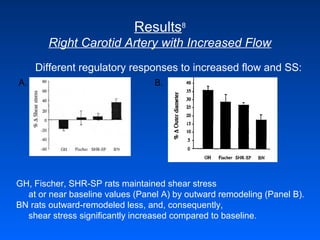
Right Carotid Artery with Increased Flow
Different regulatory responses to increased flow and SS:
GH, Fischer, SHR-SP rats maintained shear stress
at or near baseline values (Panel A) by outward remodeling (Panel B).
BN rats outward-remodeled less, and, consequently,
shear stress significantly increased compared to baseline.
A. B.
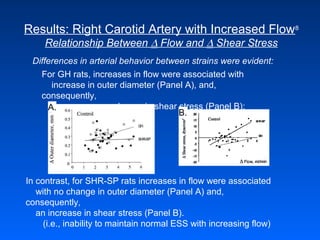
Results: Right Carotid Artery with Increased Flow8
Relationship Between ∆ Flow and ∆ Shear Stress
For GH rats, increases in flow were associated with
increase in outer diameter (Panel A), and,
consequently,
decrease or no change in shear stress (Panel B):
B.
In contrast, for SHR-SP rats increases in flow were associated
with no change in outer diameter (Panel A) and,
consequently,
an increase in shear stress (Panel B).
(i.e., inability to maintain normal ESS with increasing flow)
Differences in arterial behavior between strains were evident:
A.
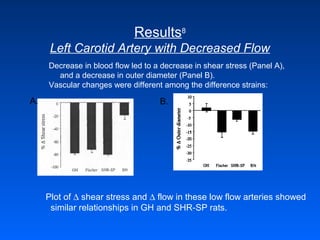
Results8
Left Carotid Artery with Decreased Flow
Decrease in blood flow led to a decrease in shear stress (Panel A),
and a decrease in outer diameter (Panel B).
Vascular changes were different among the difference strains:
A. B.
Plot of ∆ shear stress and ∆ flow in these low flow arteries showed
similar relationships in GH and SHR-SP rats.
Results8
Immunohistochemical Analyses of Medial Cell
Proliferation and eNOS Expression
• Cell proliferation:
– decreased in high-flow state more in GH than in
SHR-SP strains.
– decreased also in low-flow state more in GH than
in SHR-SP strains.
• Endothelial integrity was intact and morphologically
normal among strains, but expression of eNOS
significantly different among strains:
– significantly greater in GH than SHR-SP rats in ligated left
and right carotid arteries
Cell proliferation and eNOS expression were different in
different strains in response to similar stimulus.
Discussion8
Potential Explanations for Differences in
Shear Stress Regulation
1. Differences in expression or activity of flow-sensing
mechanisms:
– e.g., integrin-matrix interactions, caveolae, G proteins, or ion
channels
2. Differences in flow transduction mechanism as a
consequence of differential expression and/or
coupling of molecular signaling pathways:
– e.g, NO-dependent events
3. Differences in the integrated cellular response to
vascular remodeling:
– e.g., differences in cellular migration and proliferation, or
matrix production and turnover
Methodologic Concerns
• The authors investigated the process of “physiologic” remodeling
based on alterations in shear stress.
– This may not be the same process as the remodeling that occurs as
part of the atherosclerotic process, where outward remodeling may also
be related to the ongoing atherosclerosis, inflammation, matrix
production/degradation, etc.
• The authors used the artery “outer diameter” to calculate shear
stress, instead of the “inner diameter” (i.e., lumen).
– The outer diameter also incorporates the media and adventitia, and
these vascular layers may change as part of the remodeling process.
• Use of the Hagen-Poiseuille equation is valid only if the
measurement of shear stress was made at a location where the
flow was unaffected by the bifurcation (i.e. 5-10 diameters proximal
to the carotid bifurcation).
• These latter two issues would affect only the quantitative measures
of the outcomes and would not qualitatively change the results.
Significance of Investigation
• This study identifying genetic differences in the regulation
of vascular remodeling among inbred strains is of
enormous importance.
– Shear stress regulates much of local vascular responses
throughout the arterial tree.
• important implications for the initiation and progression of
atherosclerosis
– and perhaps for conversion of “quiescent” plaque to
“vulnerable” plaque
• important implications for development of systemic arterial
hypertension, as well as the vascular complications resulting
from hypertension.
– Plaques in areas of outward remodeling are most likely to
have characteristics of “vulnerability” and be prone to
rupture9
.
• As suggested by the authors, a genetic cross among the
inbred strains would yield phenotypic differences that
could be used to identify regulatory genes.
Significance of Investigation
• Differences in endothelial phenotypic responses to
vascular stresses may clearly be present among
individuals.
– These differences may contribute to the explanation of the
differential susceptibility of individuals, and the differential
susceptibility of different vascular beds, to atherosclerosis .
– May partially account for the mechanisms of CAD not solely
related to known systemic risk factors (e.g., DM, HTN,
cigarette use, hyperlipidemia).
Important Areas for Future Investigation
1. These studies are in relatively large caliber arteries,
involving a relatively straight course.
– Are there other differences in regulation among smaller
caliber and more tortuous arteries, such as coronary
arteries?
– Are there differences in regulation in different locations along
the course of the artery (e.g., proximal versus mid versus
distal location)?
2. Are these differences also observed in man?
3. Are there genetic differences of vascular regulation of
remodeling based on gender, age, ethnic, or racial
background?
Important Areas for Future Investigation
4. Is genetic regulation of vascular remodeling age-
dependent, and does it change over time?
- Is the worse clinical outcome of CAD observed with
increasing age related to changes in the ability of the
artery to regulate ESS over time?
5. Are there differences in the genetic regulation of
vascular responses in different vascular beds
within the same individual?
Conclusion
The report by Dr. Ibrahim and co-investigators
provides a sound foundation to enhance further
study to investigate the specific genetic factors
contributing to the mechanism(s) of vascular
disease.
References
1. Asakura T, Karino T. Flow patterns and spatial distribution of atherosclerotic lesions in
human coronary arteries. Circulation 1990;66:1045-56.
2. Sacks FM, Pasternak RC, Gibson MC, Rosner B, Stone PH. Effect on coronary
atherosclerosis of decrease in plasma cholesterol concentrations in
normocholesterolaemic patients. Lancet 1994; 344.
3. Gibson C, Kuntz RE, Nobuyoshi M, Rosner B, Baim D. Lesion-to-lesion independence
of restenosis after treatment by conventional angioplasty, stenting, or direction
atherectomy. Validation of lesion-based restenosis analysis. Circulation 1993;
87:1123-9.
4. Malek A, Alper S, Izumo S. Hemodynamics shear stress and its role in atherosclerosis.
JAMA 1999;282:2035-42.
5. Stone PH, Coskun AU, Kinlay S,et al. The effect of endothelial shear stress on the
progression of coroanry artery disease, vascular remodeling, and in-stent restenosis
in man: An in-vivo 6-month followup study. Circulation 2003; in press
6. Glagov S, Weisenberg E, Zarins CK, et al. Compensatory enlargement of human
atherosclerotic coronary arteries.NEJM 1987;316:1371-5.
7. Logan RL, Riemersma RA, Thomson M, et al. Risk factors for ischemic heart-disease
in normal men aged 40. Edinburgh-Stockholm study. Lancet 1978;1:949-954.
8. Ibrahim J, Miyashiro JK, Berk, BC. Shear stress is differentially regulated among
inbred rat strains. Circulation Research 2003;92:
9. Varnava AM, Mills PG, Davies MJ. Relationship between coronary artery remodeling
and plaque vulnerability. Circulation 2002;105:939-943.

511 first steps towards understanding

  • 1.
    First Steps TowardsUnderstanding the Genetics of Atherosclerotic Vascular Disease: Genetic Differences in Shear Stress Regulation and Vascular Remodeling in the Rat Editorial Comment Peter H. Stone, M.D. and Charles L. Feldman, Sc.D. Cardiovascular Division Brigham & Women’s Hospital Harvard Medical School Boston, MA
  • 2.
    Background • Atherosclerosis isa diffuse disease with primarily focal manifestations1 . It consisting of a complex series of dynamic processes of atheroma formation and vascular remodeling. – Each area of atherosclerosis acts independently in terms of progression, regression, or stability2,3 . – There is great variability of vascular behavior within and between individuals. • suggests a polygenic process
  • 3.
    Background • The specificlocation of each portion of the arterial tree, and the consequent pattern of blood flow, are important factors responsible for the initiation and progression of atherosclerosis1,4 . – The endothelium is in a unique position to transduce local hemodynamic forces and modulate arterial function4 . • Shear stress, the frictional drag on the endothelium as blood courses through the artery, has an enormous effect on endothelial structure and function.
  • 4.
    Background • Alterations inendothelial shear stress (ESS) lead to very different phenotypic expression by endothelial cells4 : – Low ESS (<~10 dynes/cm2 ) is associated with the development and progression of atherosclerosis. • Promotes cell adhesion, proliferation,migration; inflammation; oxidative stress; and procoagulant and prothrombotic state. • Areas with low ESS are those on the inner aspects of curved portions of the artery, outer aspects (“waists”) of bifurcations, and regions of disturbed flow in the vicinity of focal obstructions. – Physiologic ESS (~10-30 dynes/cm2 ) is vasculoprotective and promotes quiescence of endothelium. – High ESS (>~30 dynes/cm2 ) promotes platelet aggregation and outward remodeling. • Areas with high ESS are those at the narrowest portions of obstructions.
  • 5.
    Background • Arteries maintainendothelial shear stress within normal physiologic range to avoid consequences of excessively low or excessively high endothelial shear stress. • Pathologic conditions are initially created locally within the artery from abnormal flow patterns in a susceptible individual (i.e., development of fatty streaks). – Arterial outward remodeling leads to preservation of lumen size and normalization of ESS. – Ongoing conditions of local flow and systemic risk factors combine to create progressive atherosclerosis, which continues to be compensated by outward remodeling5 . – Ultimately the limit of outward remodeling is reached, and further atherosclerosis development encroaches on the artery lumen (Glagov phenomenon6 ). – The upper limit of remodeling appears to vary among individuals, and among different arterial locations in a given individual.
  • 6.
    Background • Mechanisms responsiblefor the variable occurrence and variable manifestations of atherosclerosis, particularly coronary atherosclerosis, are unknown. – Conventional risk factors (hypercholesterolemia, hypertension, cigarette smoking, diabetes mellitus) are strongly associated with incidence of CAD. – But not all patients with similar risk factor profiles are affected with CAD to a similar degree, or in a similar manner, or at a similar age. • At similar levels of risk factors, including serum lipids, different populations have different prevalence of CAD7 .
  • 7.
    Background • It islikely that genetic differences account for many of the differences in CAD outcomes among individuals exposed to similar risk factors. – Differences are probably polygenic and complex. • Genetic differences in susceptibility to atherosclerosis • Genetic differences in manifestations of atherosclerosis • There are also likely genetic differences among different vascular beds in terms of susceptibility and manifestations of atherosclerosis. • The study performed by Ibrahim and co-investigators8 is one of the first investigations to analyze genetic differences in shear stress regulation and vascular remodeling. – Provides an extremely important approach to begin to understand genetic differences potentially responsible for difference courses of vascular disease in individuals from different ethnic and racial background, or in different individuals from a similar background.
  • 8.
    Experimental Methods8 Vascular Modelin Rat • Ligation of left carotid artery, leading to: – left common carotid flow reduction to ~90% of baseline; – right carotid artery flow increase to ~150% of baseline • Endpoints included blood flow, shear stress, artery dimensions, histology, and immunohistochemistry immediately before surgery (baseline) and 4 weeks after surgery. • 4 inbred rat strains studied to investigate genetic differences in response to altered flow, and, consequently, altered shear stress: – BN, Fischer 344, GH, and SHR-SP rats
  • 9.
    Results8 Right Carotid Arterywith Increased Flow Different regulatory responses to increased flow and SS: GH, Fischer, SHR-SP rats maintained shear stress at or near baseline values (Panel A) by outward remodeling (Panel B). BN rats outward-remodeled less, and, consequently, shear stress significantly increased compared to baseline. A. B.
  • 10.
    Results: Right CarotidArtery with Increased Flow8 Relationship Between ∆ Flow and ∆ Shear Stress For GH rats, increases in flow were associated with increase in outer diameter (Panel A), and, consequently, decrease or no change in shear stress (Panel B): B. In contrast, for SHR-SP rats increases in flow were associated with no change in outer diameter (Panel A) and, consequently, an increase in shear stress (Panel B). (i.e., inability to maintain normal ESS with increasing flow) Differences in arterial behavior between strains were evident: A.
  • 11.
    Results8 Left Carotid Arterywith Decreased Flow Decrease in blood flow led to a decrease in shear stress (Panel A), and a decrease in outer diameter (Panel B). Vascular changes were different among the difference strains: A. B. Plot of ∆ shear stress and ∆ flow in these low flow arteries showed similar relationships in GH and SHR-SP rats.
  • 12.
    Results8 Immunohistochemical Analyses ofMedial Cell Proliferation and eNOS Expression • Cell proliferation: – decreased in high-flow state more in GH than in SHR-SP strains. – decreased also in low-flow state more in GH than in SHR-SP strains. • Endothelial integrity was intact and morphologically normal among strains, but expression of eNOS significantly different among strains: – significantly greater in GH than SHR-SP rats in ligated left and right carotid arteries Cell proliferation and eNOS expression were different in different strains in response to similar stimulus.
  • 13.
    Discussion8 Potential Explanations forDifferences in Shear Stress Regulation 1. Differences in expression or activity of flow-sensing mechanisms: – e.g., integrin-matrix interactions, caveolae, G proteins, or ion channels 2. Differences in flow transduction mechanism as a consequence of differential expression and/or coupling of molecular signaling pathways: – e.g, NO-dependent events 3. Differences in the integrated cellular response to vascular remodeling: – e.g., differences in cellular migration and proliferation, or matrix production and turnover
  • 14.
    Methodologic Concerns • Theauthors investigated the process of “physiologic” remodeling based on alterations in shear stress. – This may not be the same process as the remodeling that occurs as part of the atherosclerotic process, where outward remodeling may also be related to the ongoing atherosclerosis, inflammation, matrix production/degradation, etc. • The authors used the artery “outer diameter” to calculate shear stress, instead of the “inner diameter” (i.e., lumen). – The outer diameter also incorporates the media and adventitia, and these vascular layers may change as part of the remodeling process. • Use of the Hagen-Poiseuille equation is valid only if the measurement of shear stress was made at a location where the flow was unaffected by the bifurcation (i.e. 5-10 diameters proximal to the carotid bifurcation). • These latter two issues would affect only the quantitative measures of the outcomes and would not qualitatively change the results.
  • 15.
    Significance of Investigation •This study identifying genetic differences in the regulation of vascular remodeling among inbred strains is of enormous importance. – Shear stress regulates much of local vascular responses throughout the arterial tree. • important implications for the initiation and progression of atherosclerosis – and perhaps for conversion of “quiescent” plaque to “vulnerable” plaque • important implications for development of systemic arterial hypertension, as well as the vascular complications resulting from hypertension. – Plaques in areas of outward remodeling are most likely to have characteristics of “vulnerability” and be prone to rupture9 . • As suggested by the authors, a genetic cross among the inbred strains would yield phenotypic differences that could be used to identify regulatory genes.
  • 16.
    Significance of Investigation •Differences in endothelial phenotypic responses to vascular stresses may clearly be present among individuals. – These differences may contribute to the explanation of the differential susceptibility of individuals, and the differential susceptibility of different vascular beds, to atherosclerosis . – May partially account for the mechanisms of CAD not solely related to known systemic risk factors (e.g., DM, HTN, cigarette use, hyperlipidemia).
  • 17.
    Important Areas forFuture Investigation 1. These studies are in relatively large caliber arteries, involving a relatively straight course. – Are there other differences in regulation among smaller caliber and more tortuous arteries, such as coronary arteries? – Are there differences in regulation in different locations along the course of the artery (e.g., proximal versus mid versus distal location)? 2. Are these differences also observed in man? 3. Are there genetic differences of vascular regulation of remodeling based on gender, age, ethnic, or racial background?
  • 18.
    Important Areas forFuture Investigation 4. Is genetic regulation of vascular remodeling age- dependent, and does it change over time? - Is the worse clinical outcome of CAD observed with increasing age related to changes in the ability of the artery to regulate ESS over time? 5. Are there differences in the genetic regulation of vascular responses in different vascular beds within the same individual?
  • 19.
    Conclusion The report byDr. Ibrahim and co-investigators provides a sound foundation to enhance further study to investigate the specific genetic factors contributing to the mechanism(s) of vascular disease.
  • 20.
    References 1. Asakura T,Karino T. Flow patterns and spatial distribution of atherosclerotic lesions in human coronary arteries. Circulation 1990;66:1045-56. 2. Sacks FM, Pasternak RC, Gibson MC, Rosner B, Stone PH. Effect on coronary atherosclerosis of decrease in plasma cholesterol concentrations in normocholesterolaemic patients. Lancet 1994; 344. 3. Gibson C, Kuntz RE, Nobuyoshi M, Rosner B, Baim D. Lesion-to-lesion independence of restenosis after treatment by conventional angioplasty, stenting, or direction atherectomy. Validation of lesion-based restenosis analysis. Circulation 1993; 87:1123-9. 4. Malek A, Alper S, Izumo S. Hemodynamics shear stress and its role in atherosclerosis. JAMA 1999;282:2035-42. 5. Stone PH, Coskun AU, Kinlay S,et al. The effect of endothelial shear stress on the progression of coroanry artery disease, vascular remodeling, and in-stent restenosis in man: An in-vivo 6-month followup study. Circulation 2003; in press 6. Glagov S, Weisenberg E, Zarins CK, et al. Compensatory enlargement of human atherosclerotic coronary arteries.NEJM 1987;316:1371-5. 7. Logan RL, Riemersma RA, Thomson M, et al. Risk factors for ischemic heart-disease in normal men aged 40. Edinburgh-Stockholm study. Lancet 1978;1:949-954. 8. Ibrahim J, Miyashiro JK, Berk, BC. Shear stress is differentially regulated among inbred rat strains. Circulation Research 2003;92: 9. Varnava AM, Mills PG, Davies MJ. Relationship between coronary artery remodeling and plaque vulnerability. Circulation 2002;105:939-943.