JORDAN IN THE GULF WARS:
     FOREIGN POLICY &
          REGIME SURVIVAL
Debra Shushan, CIRS, Georgetown University
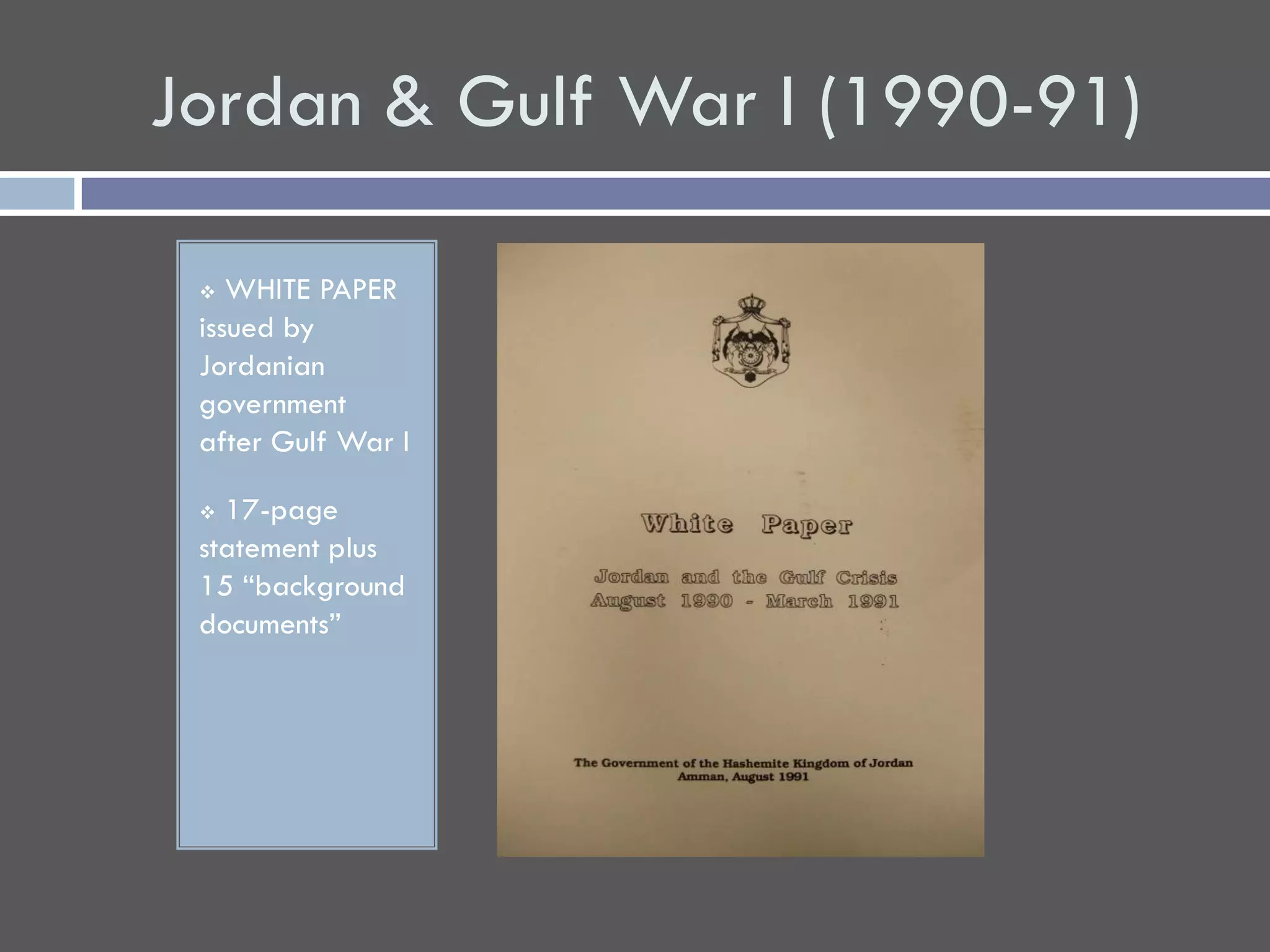
Jordan & Gulf War I (1990-91)

   WHITE PAPER
 issued by
 Jordanian
 government
 after Gulf War I

  17-page
 statement plus
 15 “background
 documents”
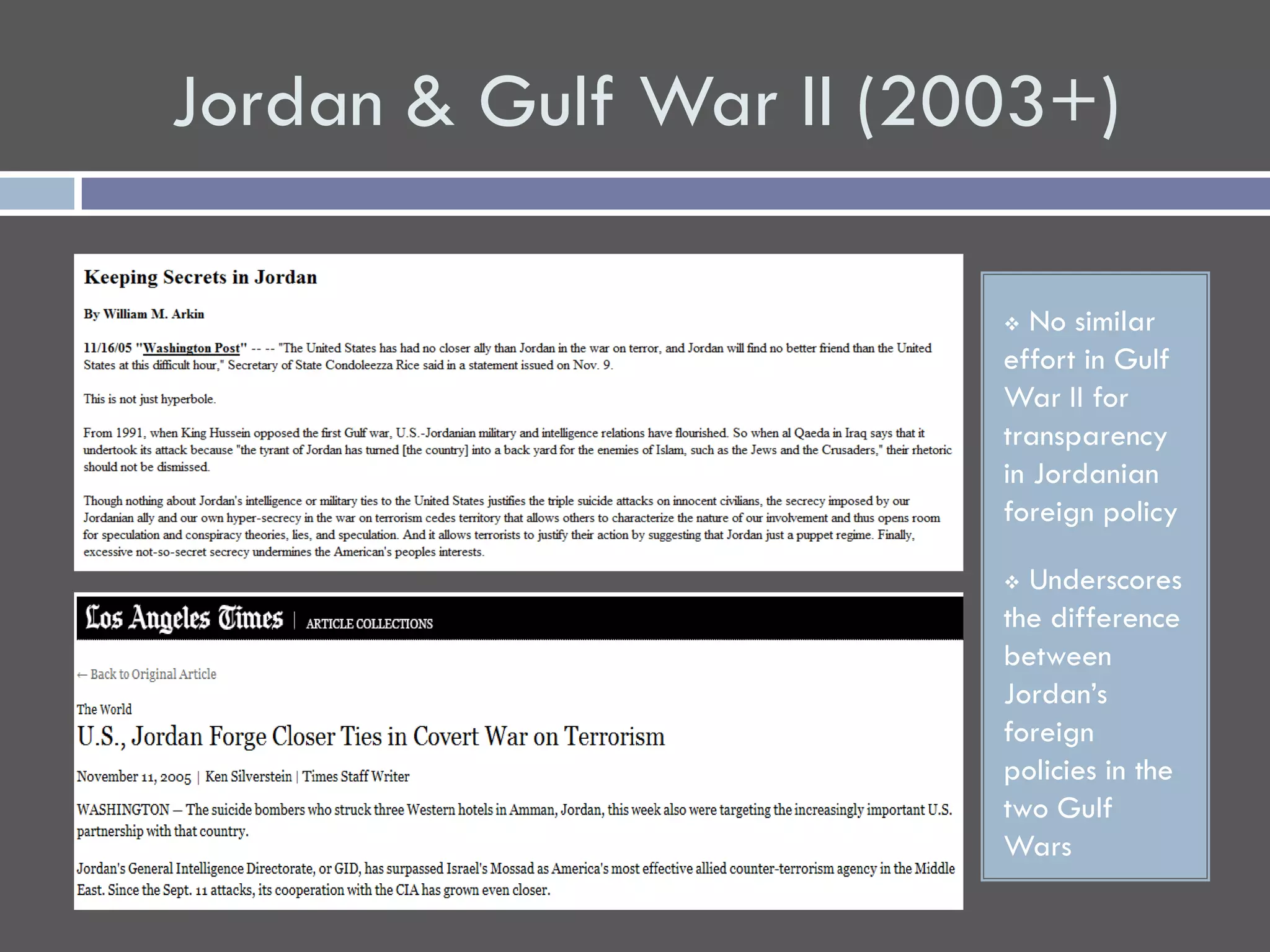
Jordan & Gulf War II (2003+)

                          No similar
                        effort in Gulf
                        War II for
                        transparency
                        in Jordanian
                        foreign policy

                         Underscores
                        the difference
                        between
                        Jordan’s
                        foreign
                        policies in the
                        two Gulf
                        Wars
Outline of the Talk
   Background
   What is at stake?
   My Argument: Regime Survival Strategy and
    Foreign Policy
   Jordan in the Gulf Wars
   Conclusion / Implications
Background
The Gulf Wars in Context
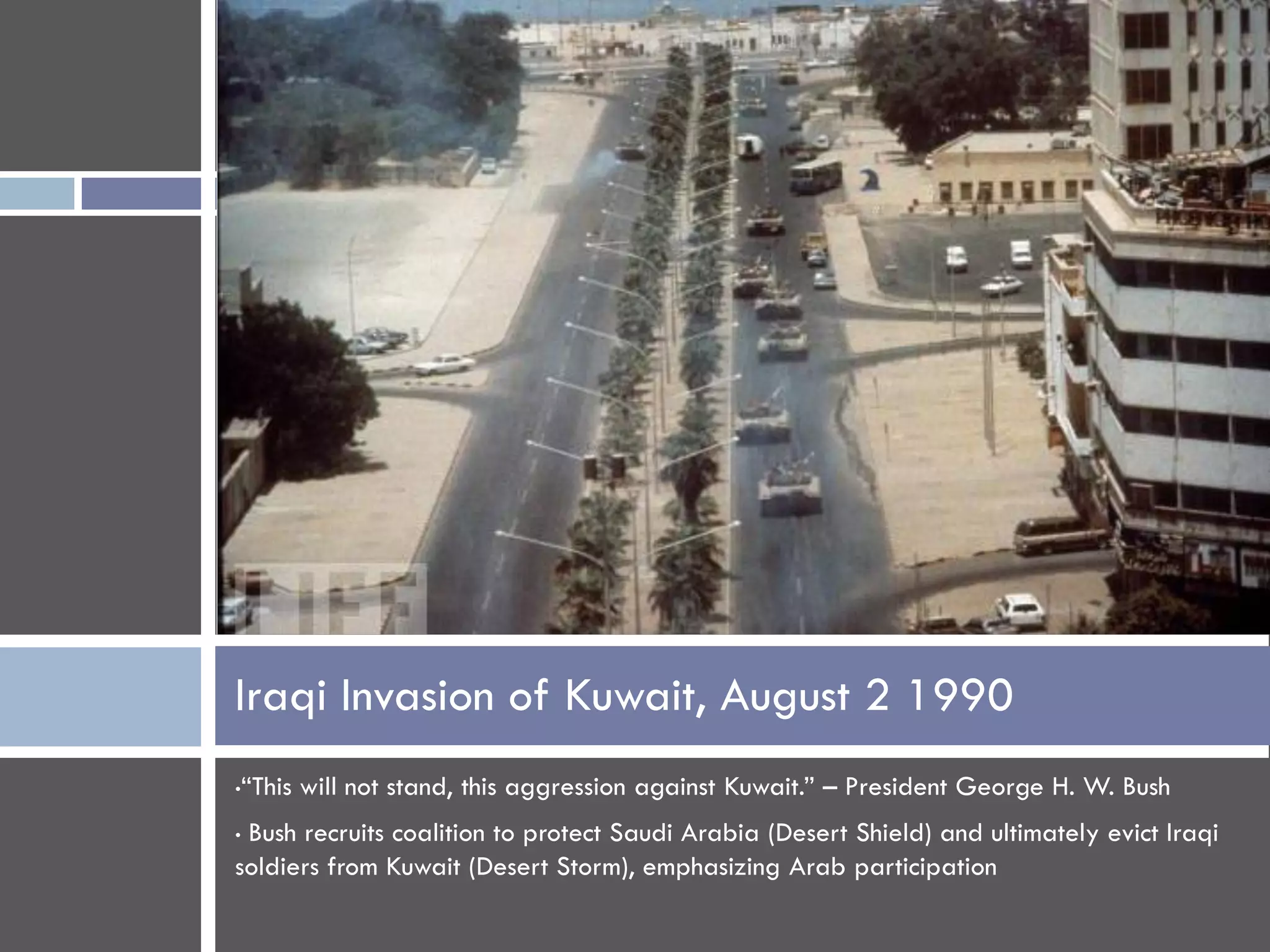
Iraqi Invasion of Kuwait, August 2 1990
•“This will not stand, this aggression against Kuwait.” – President George H. W. Bush
•Bush recruits coalition to protect Saudi Arabia (Desert Shield) and ultimately evict Iraqi
soldiers from Kuwait (Desert Storm), emphasizing Arab participation
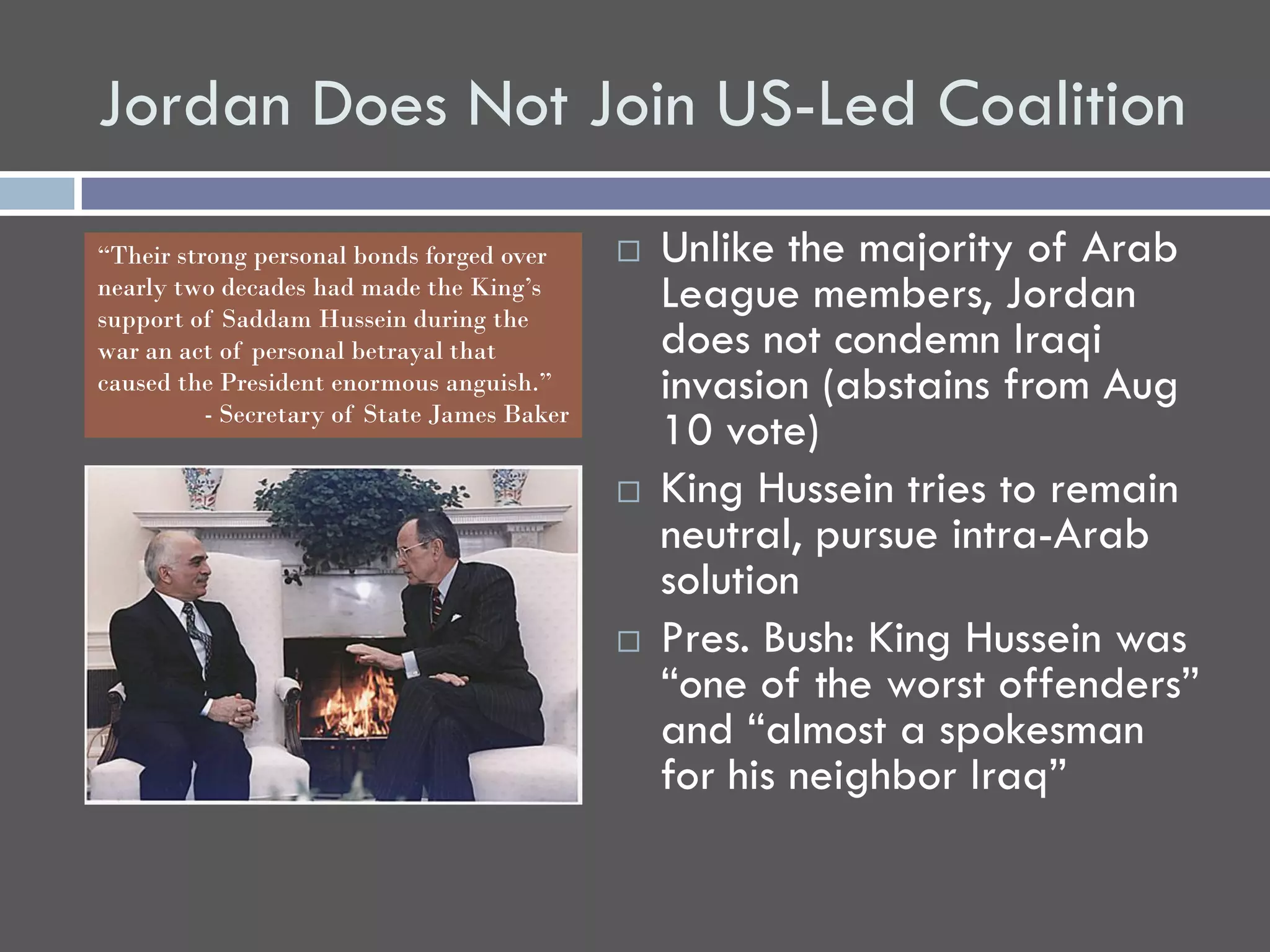
Jordan Does Not Join US-Led Coalition
“Their strong personal bonds forged over        Unlike the majority of Arab
nearly two decades had made the King’s
support of Saddam Hussein during the
                                                 League members, Jordan
war an act of personal betrayal that             does not condemn Iraqi
caused the President enormous anguish.”
          - Secretary of State James Baker
                                                 invasion (abstains from Aug
                                                 10 vote)
                                                King Hussein tries to remain
                                                 neutral, pursue intra-Arab
                                                 solution
                                                Pres. Bush: King Hussein was
                                                 “one of the worst offenders”
                                                 and “almost a spokesman
                                                 for his neighbor Iraq”
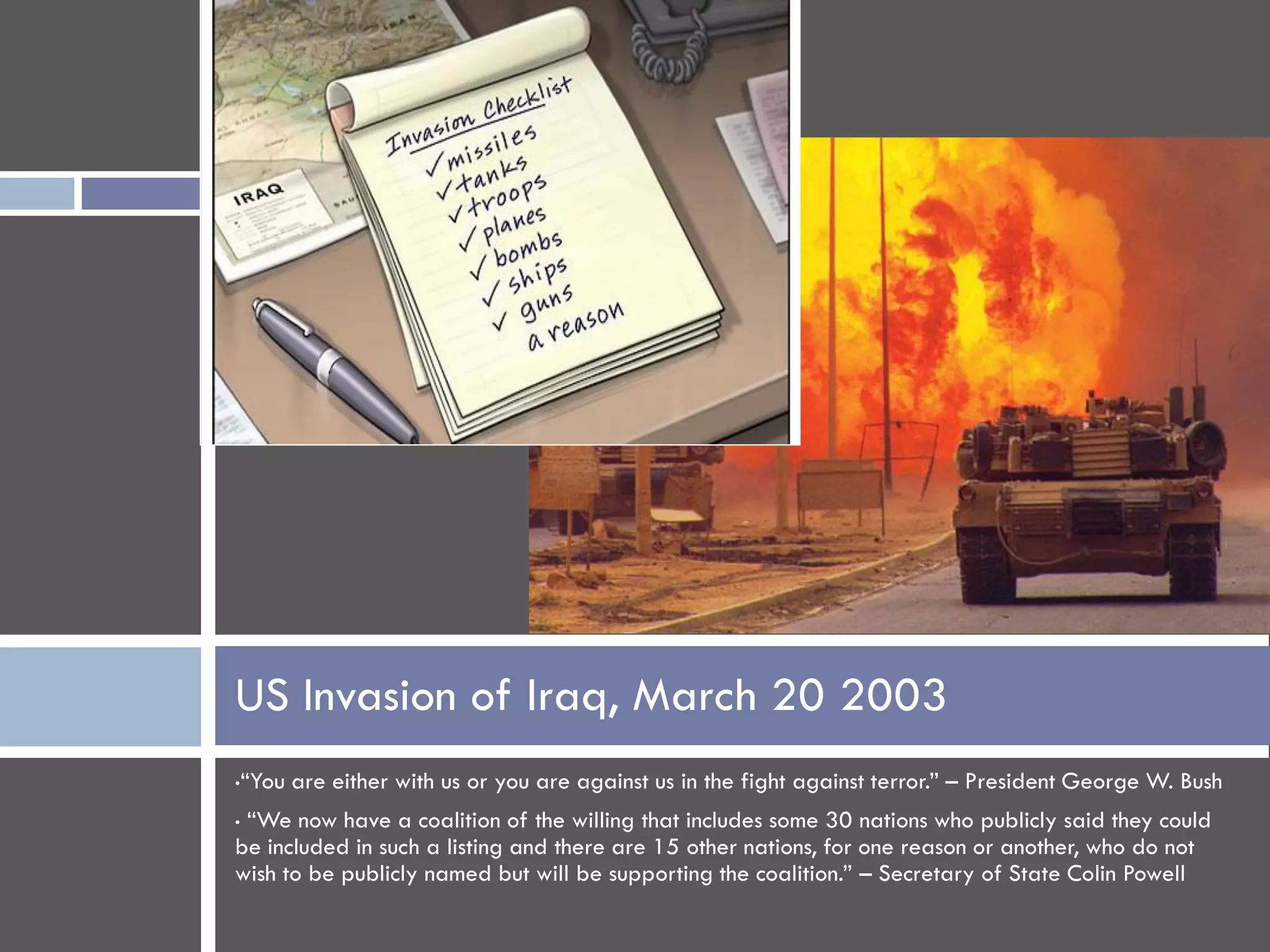
US Invasion of Iraq, March 20 2003
•   “You are either with us or you are against us in the fight against terror.” – President George W. Bush
•“We now have a coalition of the willing that includes some 30 nations who publicly said they could
be included in such a listing and there are 15 other nations, for one reason or another, who do not
wish to be publicly named but will be supporting the coalition.” – Secretary of State Colin Powell
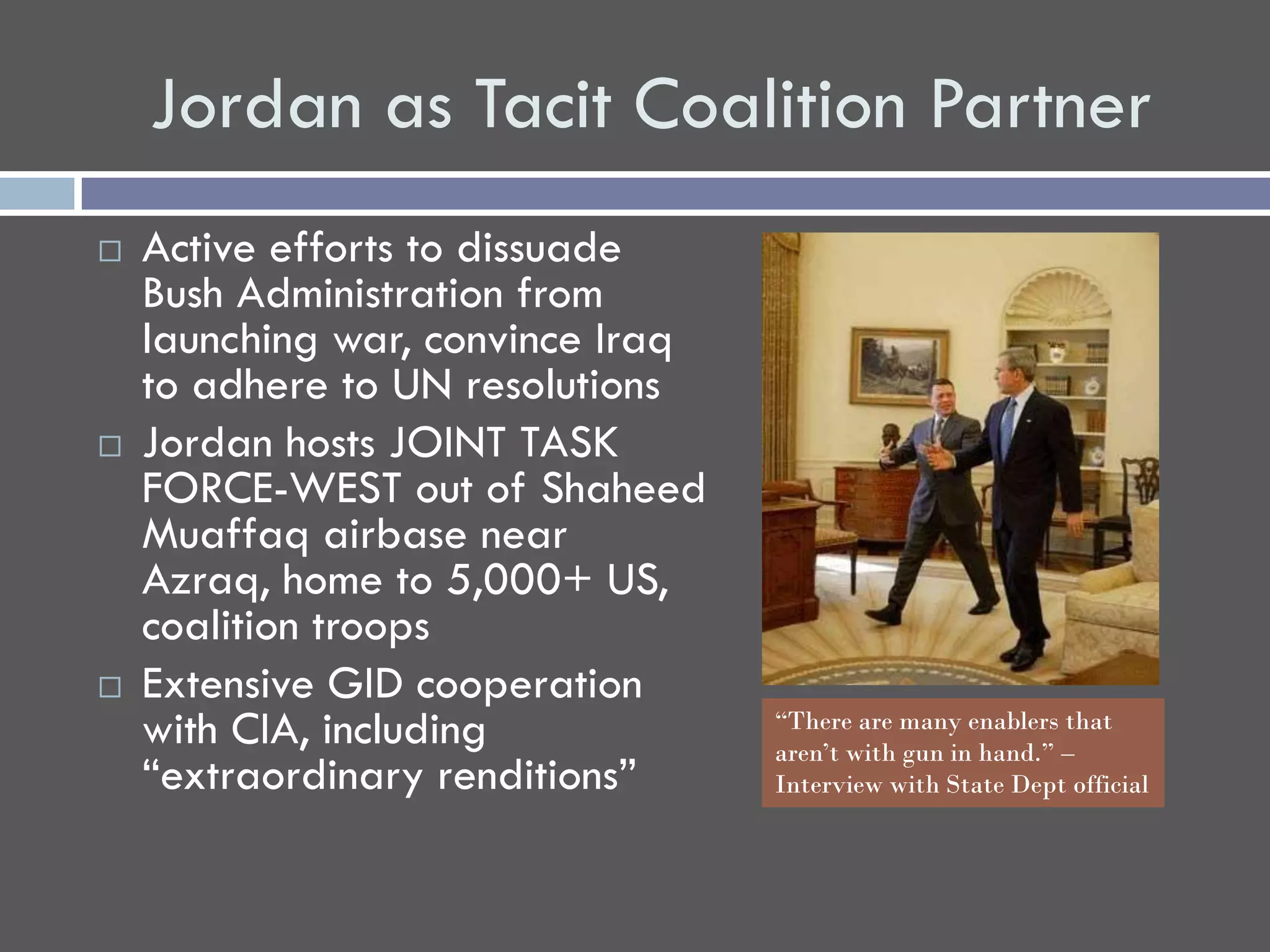
Jordan as Tacit Coalition Partner
   Active efforts to dissuade
    Bush Administration from
    launching war, convince Iraq
    to adhere to UN resolutions
   Jordan hosts JOINT TASK
    FORCE-WEST out of Shaheed
    Muaffaq airbase near
    Azraq, home to 5,000+ US,
    coalition troops
   Extensive GID cooperation
    with CIA, including            “There are many enablers that
                                   aren’t with gun in hand.” –
    “extraordinary renditions”     Interview with State Dept official
What is at stake?
Why study Jordanian foreign policy in the Gulf Wars?
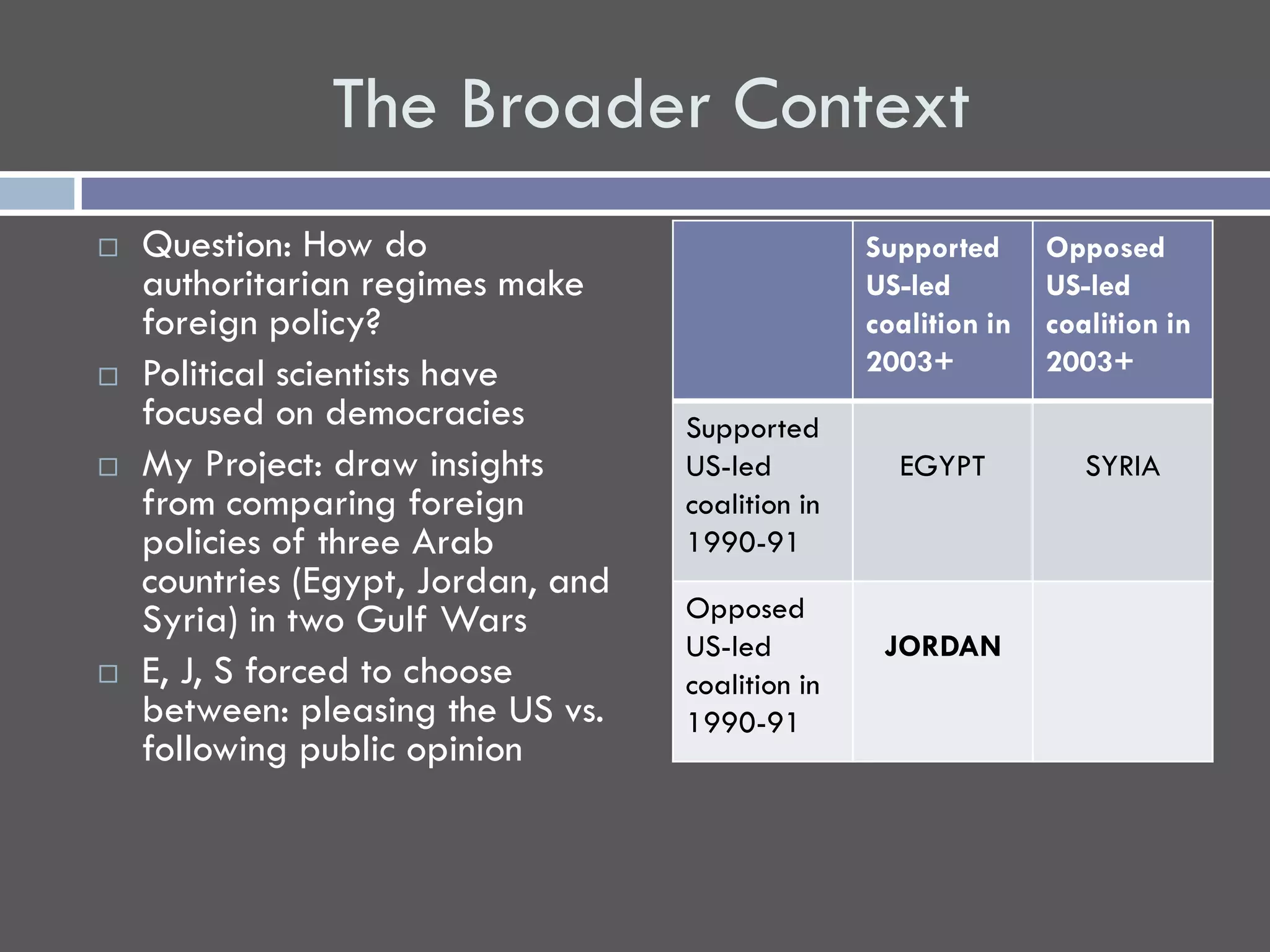
The Broader Context
   Question: How do                               Supported      Opposed
    authoritarian regimes make                     US-led         US-led
    foreign policy?                                coalition in   coalition in
   Political scientists have                      2003+          2003+
    focused on democracies          Supported
   My Project: draw insights       US-led           EGYPT           SYRIA
    from comparing foreign          coalition in
    policies of three Arab          1990-91
    countries (Egypt, Jordan, and
    Syria) in two Gulf Wars         Opposed
                                    US-led          JORDAN
   E, J, S forced to choose        coalition in
    between: pleasing the US vs.    1990-91
    following public opinion
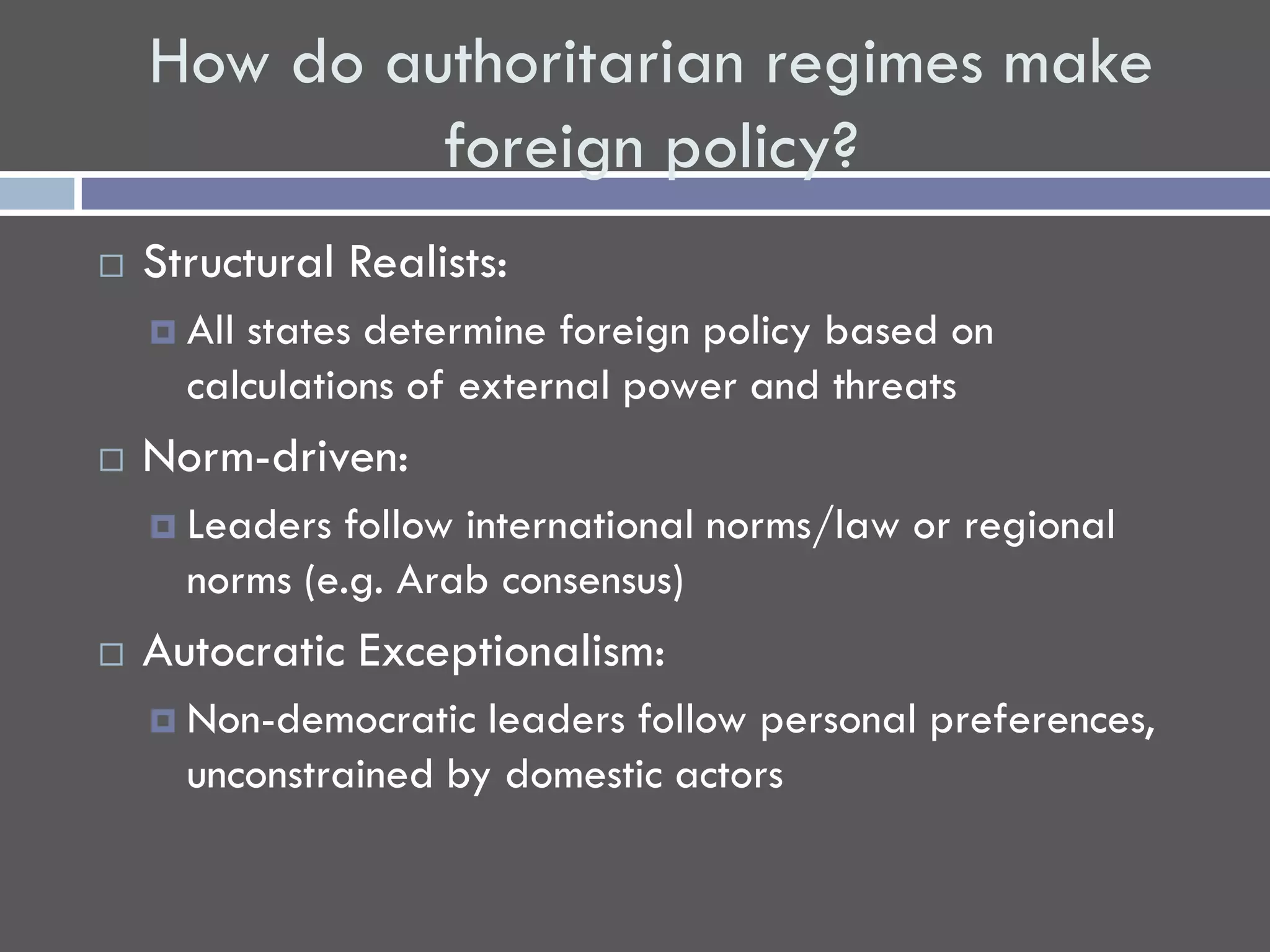
How do authoritarian regimes make
             foreign policy?
   Structural Realists:
     Allstates determine foreign policy based on
      calculations of external power and threats
   Norm-driven:
     Leaders follow international norms/law or regional
      norms (e.g. Arab consensus)
   Autocratic Exceptionalism:
     Non-democratic  leaders follow personal preferences,
      unconstrained by domestic actors
My Argument
1) Leaders care first and foremost about
retaining power.
2) They have regime survival strategies, based
on maintaining the support of key backers
(“winning coalition”).
3) Leaders choose foreign policies according to
their regime survival strategies, calculated to
keep them in power at home.
Focus on Domestic Politics
   Challenge to the conventional wisdom about the
    insignificance of domestic politics in non-
    democracies
   Assumption that leaders’ primary goal is retaining
    power
     In democracy: focus is on winning coalition for next
      election
     In autocracy: need to please winning coalition to
      maintain stable rule, prevent overthrow
   Key issues: ECONOMICS and PUBLIC OPINION
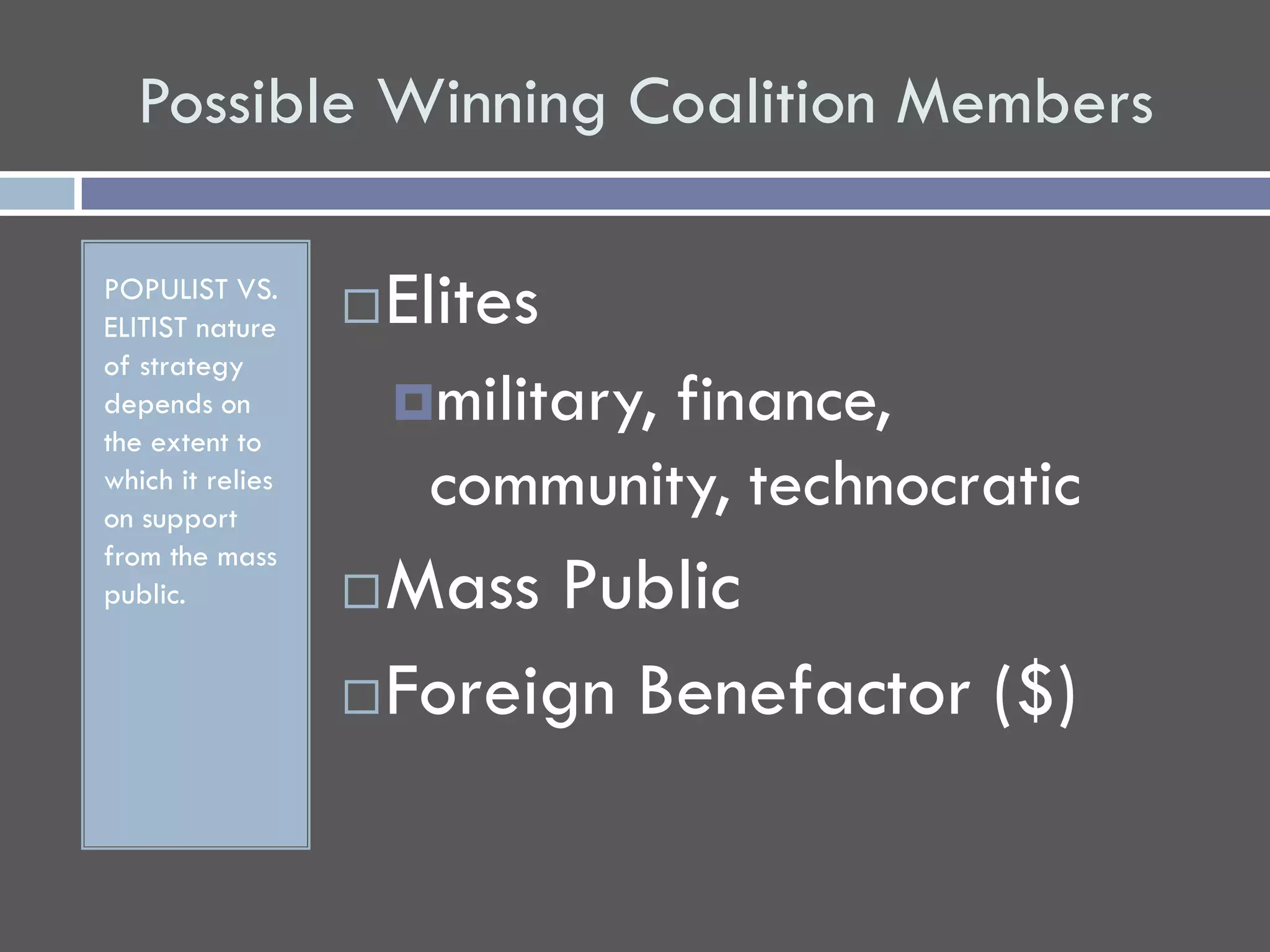
Possible Winning Coalition Members

POPULIST VS.
ELITIST nature       Elites
of strategy
depends on            military,
                               finance,
the extent to
which it relies
on support
                       community, technocratic
from the mass
public.            Mass Public
                   Foreign Benefactor ($)
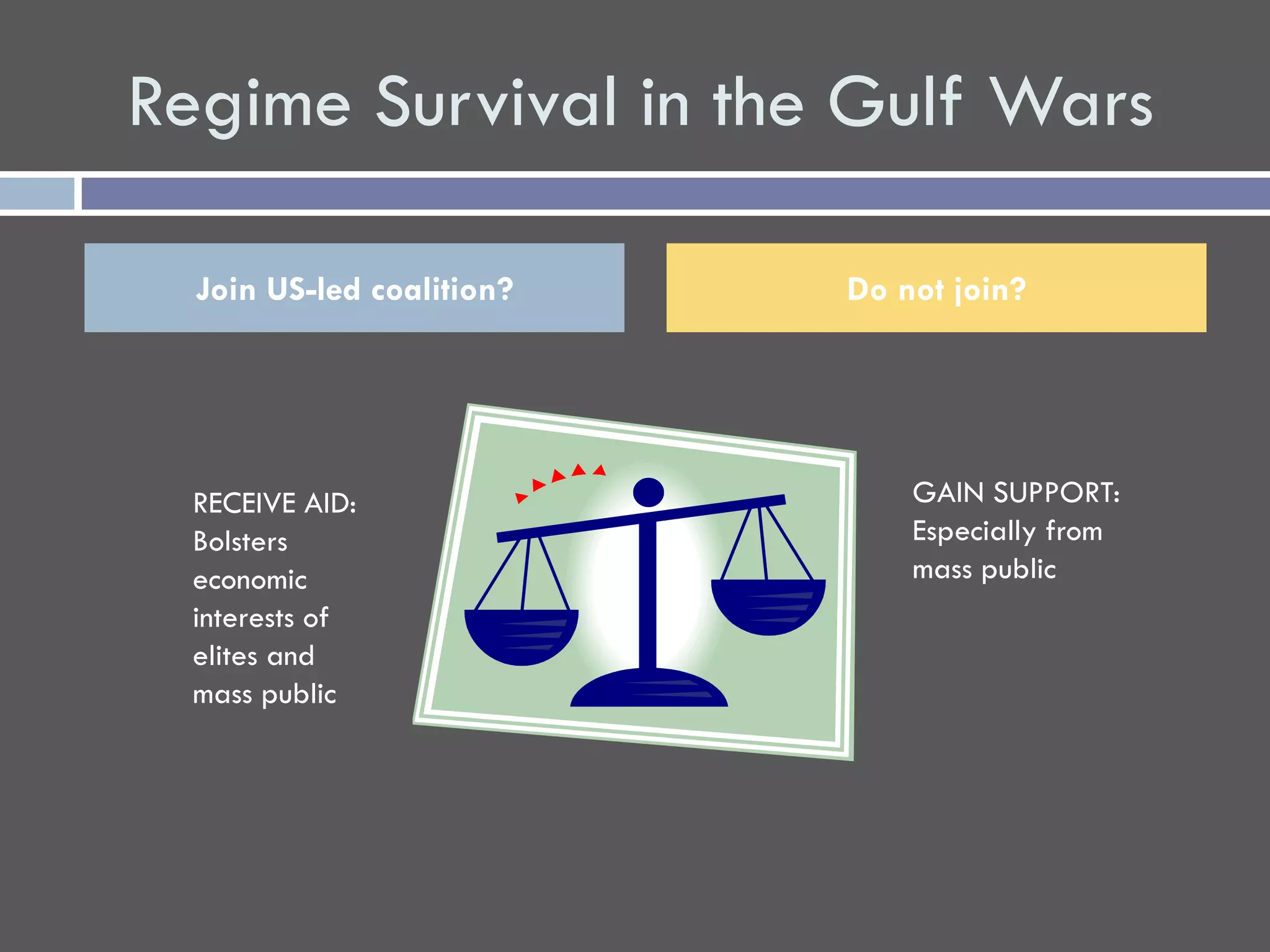
Regime Survival in the Gulf Wars

  Join US-led coalition?   Do not join?


  RECEIVE AID:                 GAIN SUPPORT:
  Bolsters                     Especially from
  economic                     mass public
  interests of
  elites and
  mass public
Understanding Jordanian Foreign
Policy in the Gulf Wars
Gulf War I: Economic Considerations

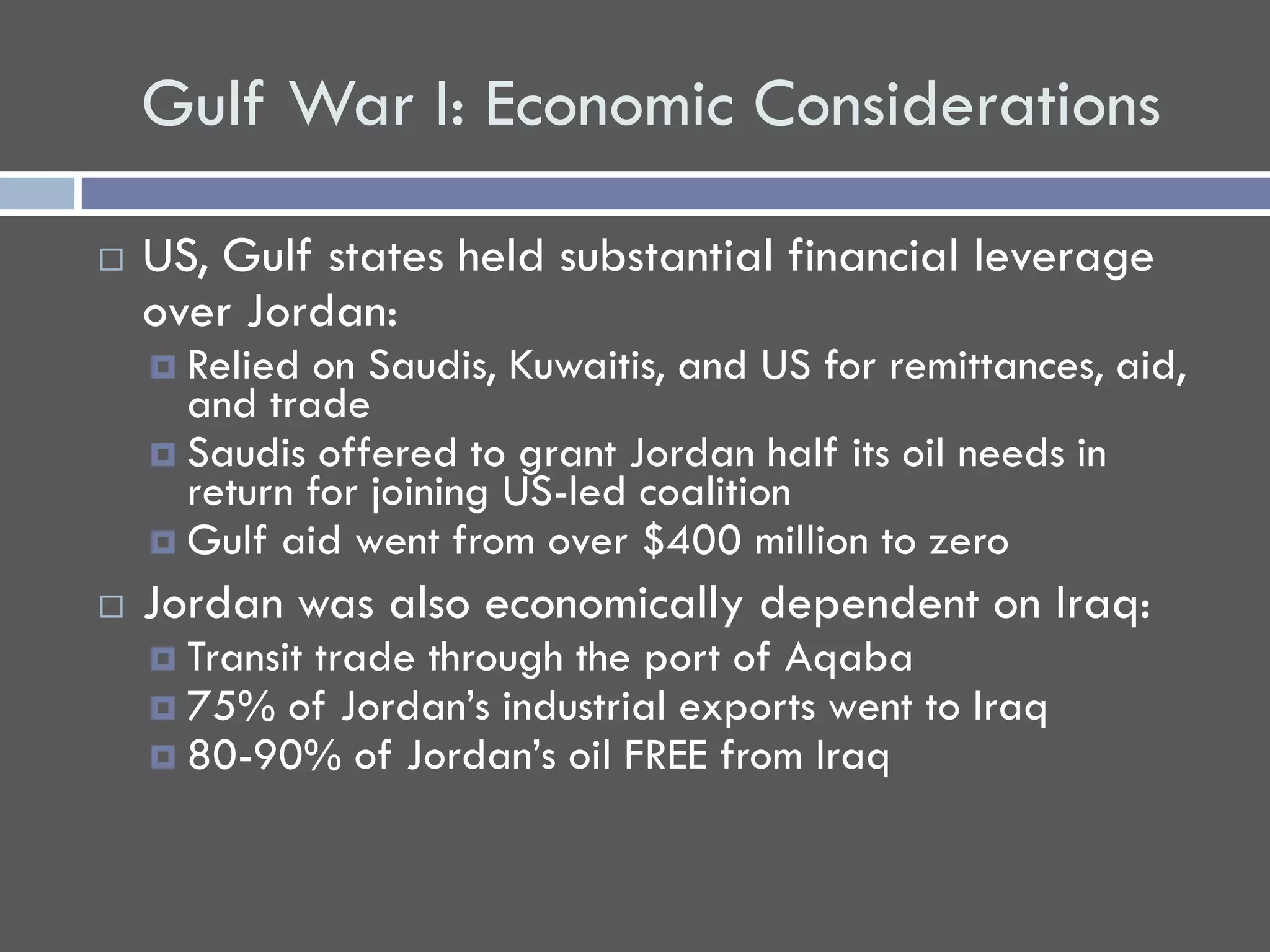
   US, Gulf states held substantial financial leverage
    over Jordan:
     Relied on Saudis, Kuwaitis, and US for remittances, aid,
      and trade
     Saudis offered to grant Jordan half its oil needs in
      return for joining US-led coalition
     Gulf aid went from over $400 million to zero
   Jordan was also economically dependent on Iraq:
     Transit
           trade through the port of Aqaba
     75% of Jordan’s industrial exports went to Iraq
     80-90% of Jordan’s oil FREE from Iraq
GW1: Role of Mass Public Opinion
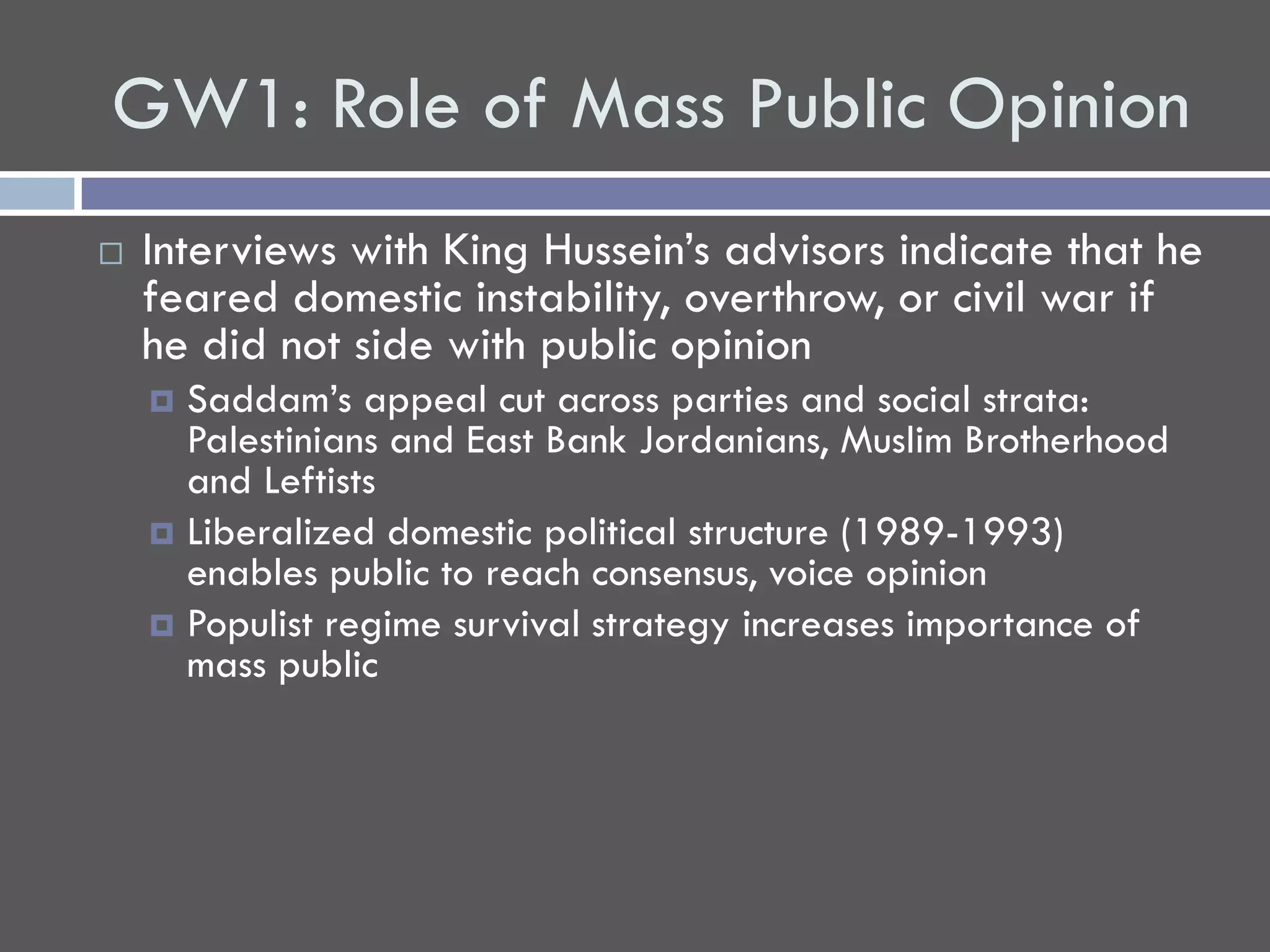
   Interviews with King Hussein’s advisors indicate that he
    feared domestic instability, overthrow, or civil war if
    he did not side with public opinion
     Saddam’s appeal cut across parties and social strata:
      Palestinians and East Bank Jordanians, Muslim Brotherhood
      and Leftists
     Liberalized domestic political structure (1989-1993)
      enables public to reach consensus, voice opinion
     Populist regime survival strategy increases importance of
      mass public
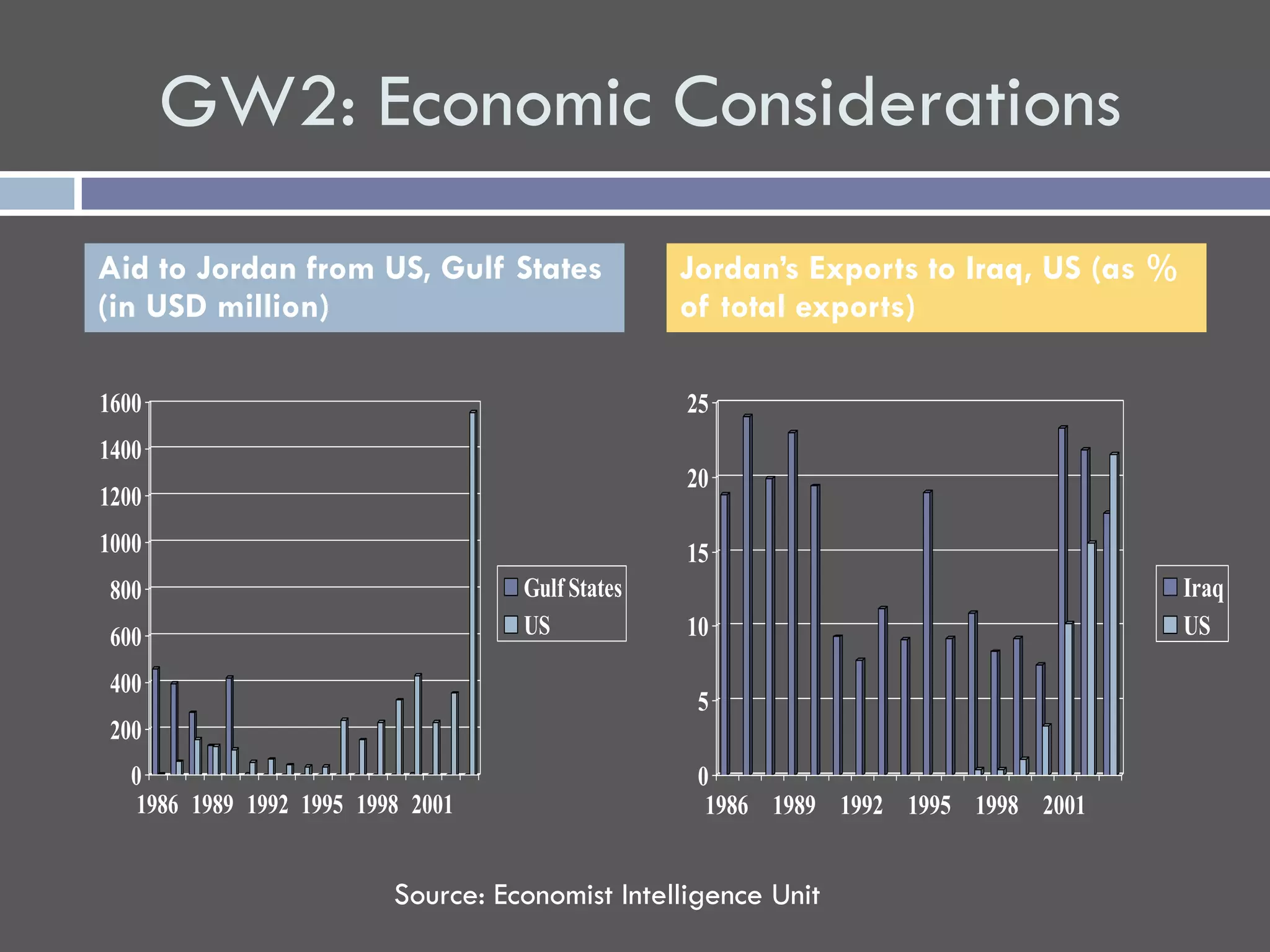
GW2: Economic Considerations
   Cost-benefit analysis was clear, due to stronger aid,
    trade relations with US
     Jordan  signed FTA with US in 2000, making US #1
      destination for Jordanian exports in 2003
     Jordan has become 4th-largest recipient of US aid
     US added $1.1 bn to Jordan’s annual aid ($450 mil) in
      2003 as thanks for support in GW2
   Post-GW1 Turning Point: King Hussein adopts less
    populist regime survival strategy, signs Wadi Araba
    peace treaty with Israel
     King   Abdullah’s economic focus
GW2: Economic Considerations
Aid to Jordan from US, Gulf States               Jordan’s Exports to Iraq, US (as %
(in USD million)                                 of total exports)

1600                                             25
1400
                                                 20
1200
1000                                             15
 800                               Gulf States                                        Iraq
 600                               US            10                                   US

 400
                                                  5
 200
  0                                               0
  1986 1989 1992 1995 1998 2001                    1986 1989 1992 1995 1998 2001


                         Source: Economist Intelligence Unit
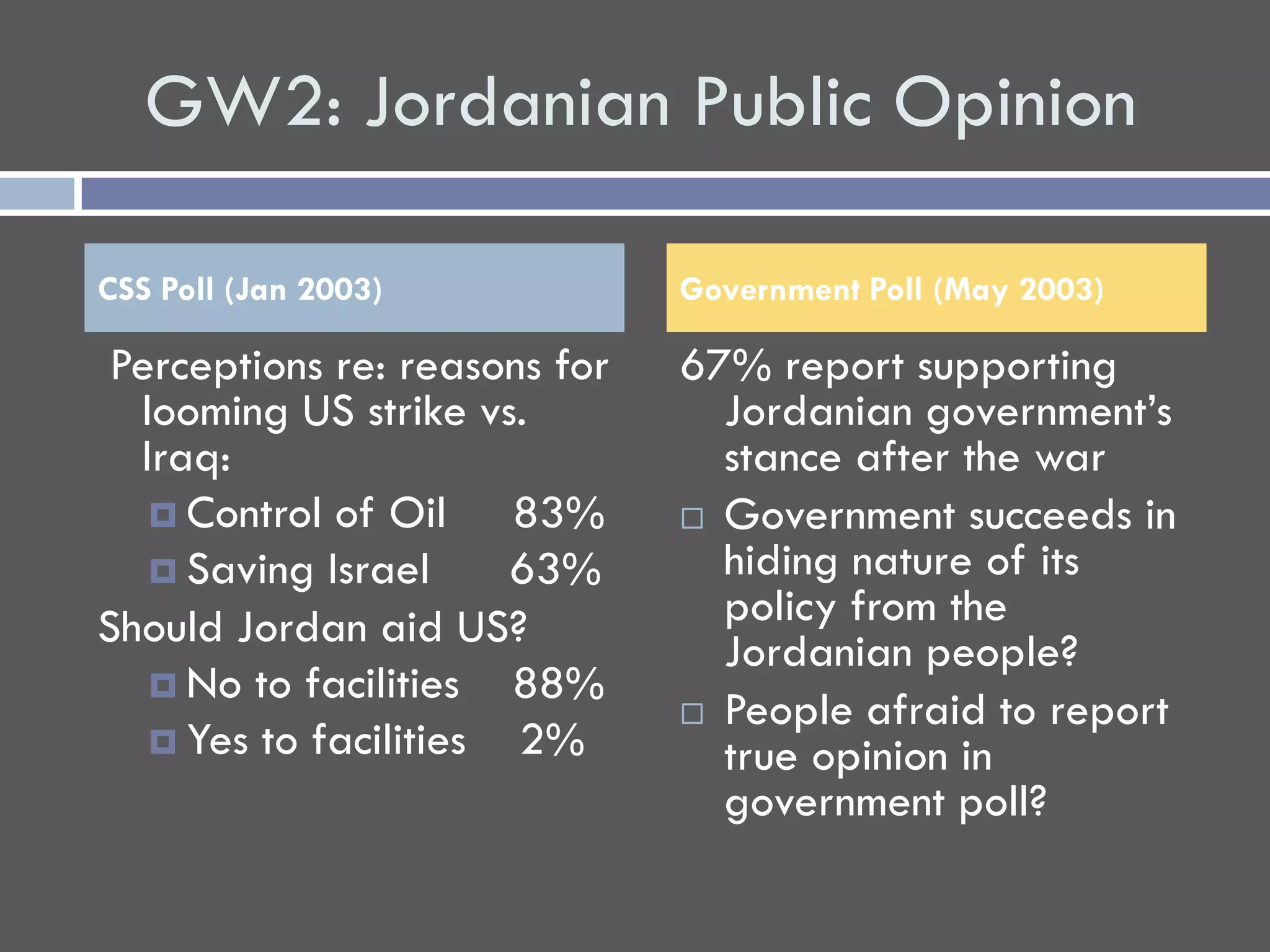
GW2: Jordanian Public Opinion

CSS Poll (Jan 2003)            Government Poll (May 2003)

 Perceptions re: reasons for   67% report supporting
  looming US strike vs.          Jordanian government’s
  Iraq:                          stance after the war
    Control of Oil    83%      Government succeeds in
    Saving Israel     63%       hiding nature of its
Should Jordan aid US?            policy from the
                                 Jordanian people?
    No to facilities  88%
                                People afraid to report
    Yes to facilities 2%        true opinion in
                                 government poll?
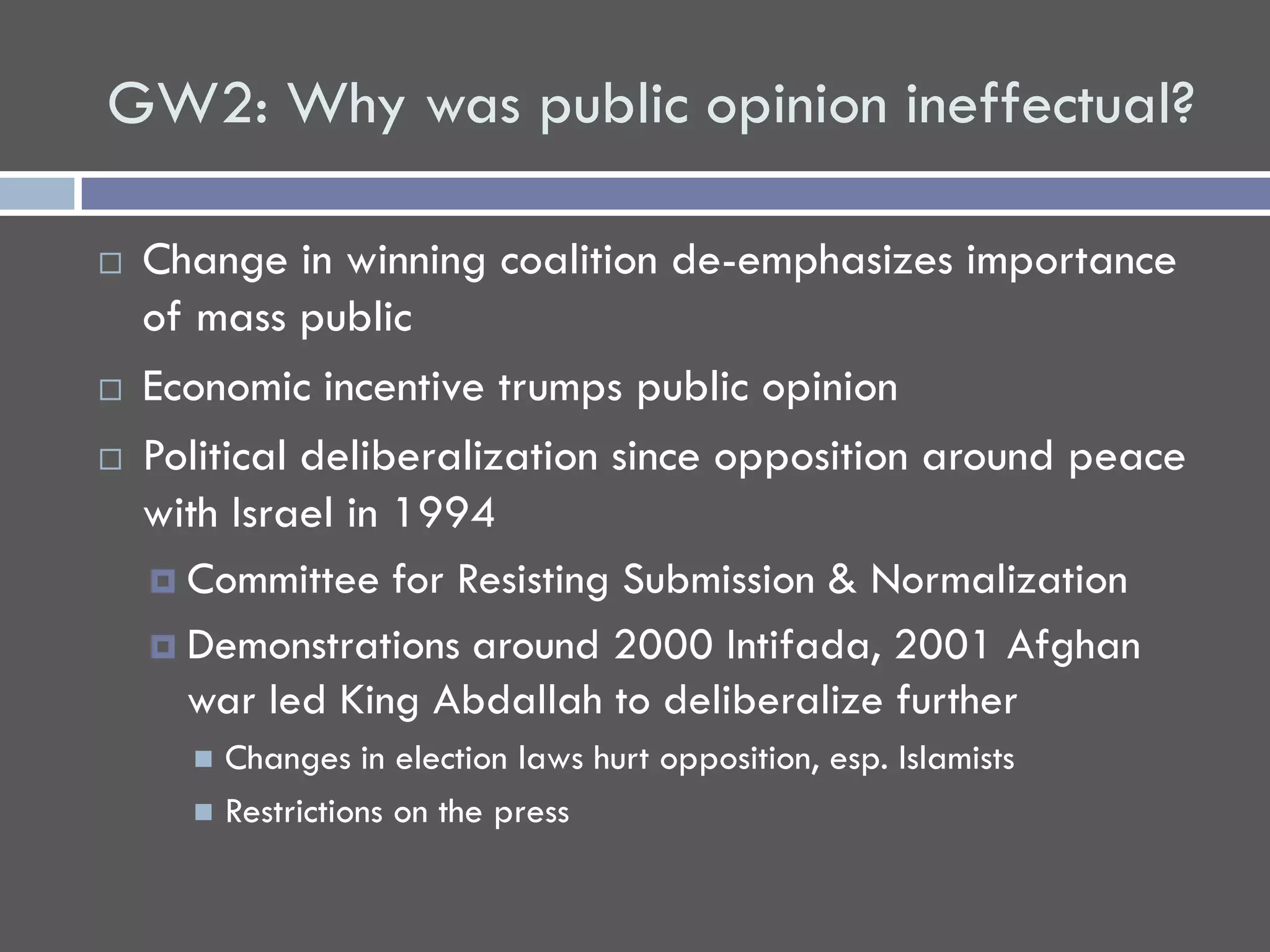
GW2: Why was public opinion ineffectual?

   Change in winning coalition de-emphasizes importance
    of mass public
   Economic incentive trumps public opinion
   Political deliberalization since opposition around peace
    with Israel in 1994
     Committee for Resisting Submission & Normalization

     Demonstrations around 2000 Intifada, 2001 Afghan
      war led King Abdallah to deliberalize further
       Changes in election laws hurt opposition, esp. Islamists
       Restrictions on the press
Conclusion / Implications
Demystifying the Autocratic State
   Importance of domestic politics
   The key is to elaborate how they matter
   Differences among non-democratic states
   Centrality of economic interests in foreign policy
   Public opinion: How can we best gauge it? How do
    regimes estimate it? How often does the mass public
    feel strongly about foreign policy, and on what
    issues?
JORDAN IN THE GULF WARS:
     FOREIGN POLICY &
          REGIME SURVIVAL
Debra Shushan, CIRS, Georgetown University

Debra shushan monthly dialogue dec 1, 2010 slides

  • 1.
    JORDAN IN THEGULF WARS: FOREIGN POLICY & REGIME SURVIVAL Debra Shushan, CIRS, Georgetown University
  • 2.
    Jordan & GulfWar I (1990-91)  WHITE PAPER issued by Jordanian government after Gulf War I  17-page statement plus 15 “background documents”
  • 3.
    Jordan & GulfWar II (2003+)  No similar effort in Gulf War II for transparency in Jordanian foreign policy  Underscores the difference between Jordan’s foreign policies in the two Gulf Wars
  • 4.
    Outline of theTalk  Background  What is at stake?  My Argument: Regime Survival Strategy and Foreign Policy  Jordan in the Gulf Wars  Conclusion / Implications
  • 5.
  • 6.
    Iraqi Invasion ofKuwait, August 2 1990 •“This will not stand, this aggression against Kuwait.” – President George H. W. Bush •Bush recruits coalition to protect Saudi Arabia (Desert Shield) and ultimately evict Iraqi soldiers from Kuwait (Desert Storm), emphasizing Arab participation
  • 7.
    Jordan Does NotJoin US-Led Coalition “Their strong personal bonds forged over  Unlike the majority of Arab nearly two decades had made the King’s support of Saddam Hussein during the League members, Jordan war an act of personal betrayal that does not condemn Iraqi caused the President enormous anguish.” - Secretary of State James Baker invasion (abstains from Aug 10 vote)  King Hussein tries to remain neutral, pursue intra-Arab solution  Pres. Bush: King Hussein was “one of the worst offenders” and “almost a spokesman for his neighbor Iraq”
  • 8.
    US Invasion ofIraq, March 20 2003 • “You are either with us or you are against us in the fight against terror.” – President George W. Bush •“We now have a coalition of the willing that includes some 30 nations who publicly said they could be included in such a listing and there are 15 other nations, for one reason or another, who do not wish to be publicly named but will be supporting the coalition.” – Secretary of State Colin Powell
  • 9.
    Jordan as TacitCoalition Partner  Active efforts to dissuade Bush Administration from launching war, convince Iraq to adhere to UN resolutions  Jordan hosts JOINT TASK FORCE-WEST out of Shaheed Muaffaq airbase near Azraq, home to 5,000+ US, coalition troops  Extensive GID cooperation with CIA, including “There are many enablers that aren’t with gun in hand.” – “extraordinary renditions” Interview with State Dept official
  • 10.
    What is atstake? Why study Jordanian foreign policy in the Gulf Wars?
  • 11.
    The Broader Context  Question: How do Supported Opposed authoritarian regimes make US-led US-led foreign policy? coalition in coalition in  Political scientists have 2003+ 2003+ focused on democracies Supported  My Project: draw insights US-led EGYPT SYRIA from comparing foreign coalition in policies of three Arab 1990-91 countries (Egypt, Jordan, and Syria) in two Gulf Wars Opposed US-led JORDAN  E, J, S forced to choose coalition in between: pleasing the US vs. 1990-91 following public opinion
  • 12.
    How do authoritarianregimes make foreign policy?  Structural Realists:  Allstates determine foreign policy based on calculations of external power and threats  Norm-driven:  Leaders follow international norms/law or regional norms (e.g. Arab consensus)  Autocratic Exceptionalism:  Non-democratic leaders follow personal preferences, unconstrained by domestic actors
  • 13.
    My Argument 1) Leaderscare first and foremost about retaining power. 2) They have regime survival strategies, based on maintaining the support of key backers (“winning coalition”). 3) Leaders choose foreign policies according to their regime survival strategies, calculated to keep them in power at home.
  • 14.
    Focus on DomesticPolitics  Challenge to the conventional wisdom about the insignificance of domestic politics in non- democracies  Assumption that leaders’ primary goal is retaining power  In democracy: focus is on winning coalition for next election  In autocracy: need to please winning coalition to maintain stable rule, prevent overthrow  Key issues: ECONOMICS and PUBLIC OPINION
  • 15.
    Possible Winning CoalitionMembers POPULIST VS. ELITIST nature  Elites of strategy depends on military, finance, the extent to which it relies on support community, technocratic from the mass public.  Mass Public  Foreign Benefactor ($)
  • 16.
    Regime Survival inthe Gulf Wars Join US-led coalition? Do not join? RECEIVE AID: GAIN SUPPORT: Bolsters Especially from economic mass public interests of elites and mass public
  • 17.
  • 18.
    Gulf War I:Economic Considerations  US, Gulf states held substantial financial leverage over Jordan:  Relied on Saudis, Kuwaitis, and US for remittances, aid, and trade  Saudis offered to grant Jordan half its oil needs in return for joining US-led coalition  Gulf aid went from over $400 million to zero  Jordan was also economically dependent on Iraq:  Transit trade through the port of Aqaba  75% of Jordan’s industrial exports went to Iraq  80-90% of Jordan’s oil FREE from Iraq
  • 19.
    GW1: Role ofMass Public Opinion  Interviews with King Hussein’s advisors indicate that he feared domestic instability, overthrow, or civil war if he did not side with public opinion  Saddam’s appeal cut across parties and social strata: Palestinians and East Bank Jordanians, Muslim Brotherhood and Leftists  Liberalized domestic political structure (1989-1993) enables public to reach consensus, voice opinion  Populist regime survival strategy increases importance of mass public
  • 20.
    GW2: Economic Considerations  Cost-benefit analysis was clear, due to stronger aid, trade relations with US  Jordan signed FTA with US in 2000, making US #1 destination for Jordanian exports in 2003  Jordan has become 4th-largest recipient of US aid  US added $1.1 bn to Jordan’s annual aid ($450 mil) in 2003 as thanks for support in GW2  Post-GW1 Turning Point: King Hussein adopts less populist regime survival strategy, signs Wadi Araba peace treaty with Israel  King Abdullah’s economic focus
  • 21.
    GW2: Economic Considerations Aidto Jordan from US, Gulf States Jordan’s Exports to Iraq, US (as % (in USD million) of total exports) 1600 25 1400 20 1200 1000 15 800 Gulf States Iraq 600 US 10 US 400 5 200 0 0 1986 1989 1992 1995 1998 2001 1986 1989 1992 1995 1998 2001 Source: Economist Intelligence Unit
  • 22.
    GW2: Jordanian PublicOpinion CSS Poll (Jan 2003) Government Poll (May 2003) Perceptions re: reasons for 67% report supporting looming US strike vs. Jordanian government’s Iraq: stance after the war  Control of Oil 83%  Government succeeds in  Saving Israel 63% hiding nature of its Should Jordan aid US? policy from the Jordanian people?  No to facilities 88%  People afraid to report  Yes to facilities 2% true opinion in government poll?
  • 23.
    GW2: Why waspublic opinion ineffectual?  Change in winning coalition de-emphasizes importance of mass public  Economic incentive trumps public opinion  Political deliberalization since opposition around peace with Israel in 1994  Committee for Resisting Submission & Normalization  Demonstrations around 2000 Intifada, 2001 Afghan war led King Abdallah to deliberalize further  Changes in election laws hurt opposition, esp. Islamists  Restrictions on the press
  • 24.
  • 25.
    Demystifying the AutocraticState  Importance of domestic politics  The key is to elaborate how they matter  Differences among non-democratic states  Centrality of economic interests in foreign policy  Public opinion: How can we best gauge it? How do regimes estimate it? How often does the mass public feel strongly about foreign policy, and on what issues?
  • 26.
    JORDAN IN THEGULF WARS: FOREIGN POLICY & REGIME SURVIVAL Debra Shushan, CIRS, Georgetown University