Improving access to digital collections by
semantic enrichment
Theo van Veen and Juliette Lonij, Semantics 2017, 12-09-2017
Overview
• Motivation and approach
• Entity linking
• Presentation
• Semantic search
• User feedback
• Wikidata as thesaurus
• Conclusions and next steps
T. v. Veen and J. Lonij, Semantics 2017
Motivation and approach
T. v. Veen and J. Lonij, Semantics 2017
Motivation
• Improving discovery and usability requires intelligent
connection of content to the outside world.
• Content contains “knowledge” requiring intelligent
preprocessing to be found.
• Knowledge should be offered to the user more or less
unsolicited
• Our software should have read, analyzed and
enriched our content completely prior to the user!!
T. v. Veen and J. Lonij, Semantics 2017
Enrichment: purpose and approach
• making content better findable and usable,
especially newspaper articles
• by enriching text and names in the text with links to
related information
• which is in most cases linked data (links to Wikidata,
Polygoon news reels, images)
• and which enables advanced queries and presentation
of context information
T. v. Veen and J. Lonij, Semantics 2017
How?
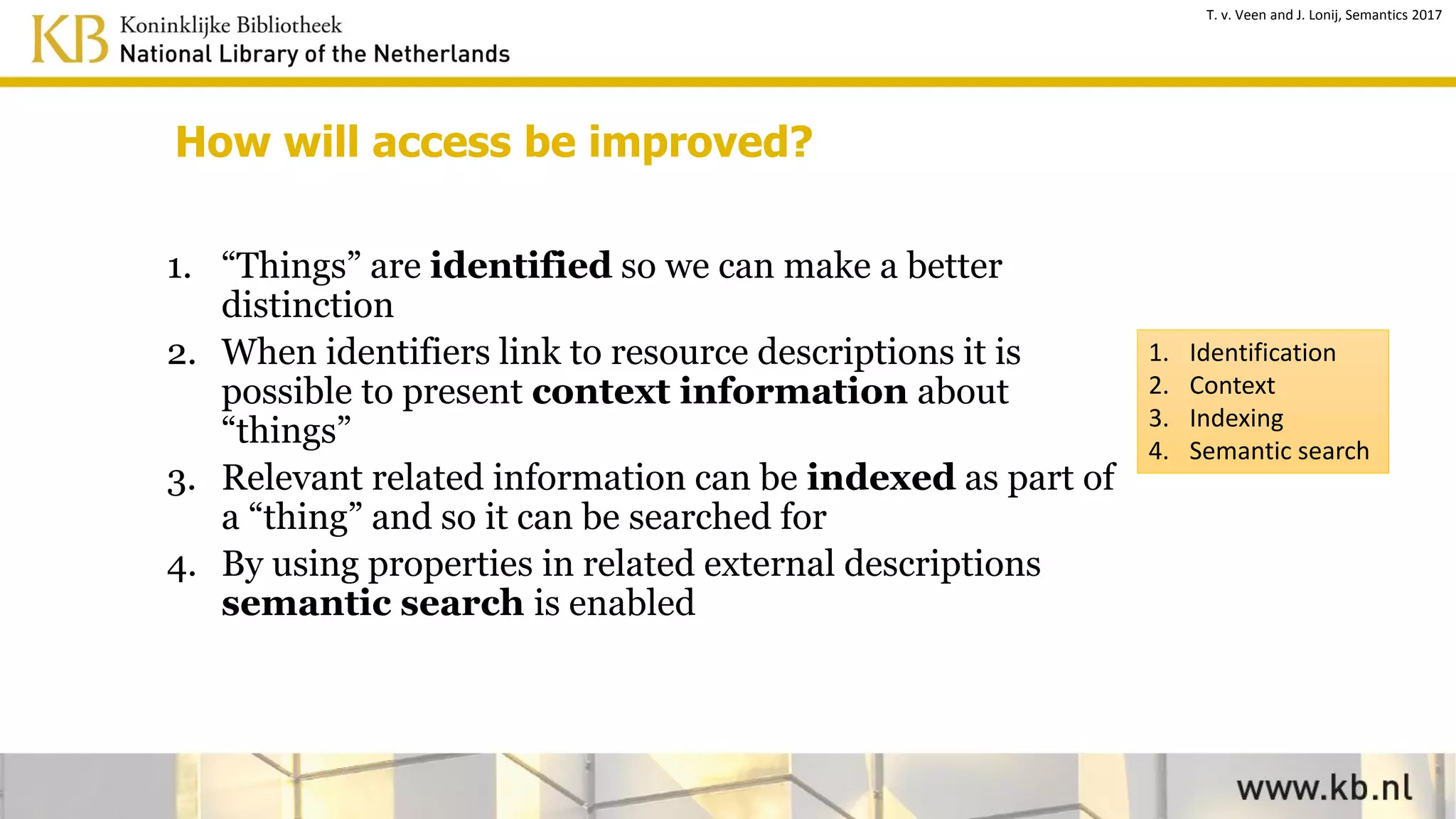
• “Things” in text have to be uniquely identified
• When identifiers link to resource descriptions it is
possible to present context information about
“things”
• Relevant context information can be indexed as part of
a “thing” and so it can be searched for
• Using properties in external resource descriptions enable
semantic search
1. Identification
2. Context
3. Indexing
4. Semantic search
T. v. Veen and J. Lonij, Semantics 2017
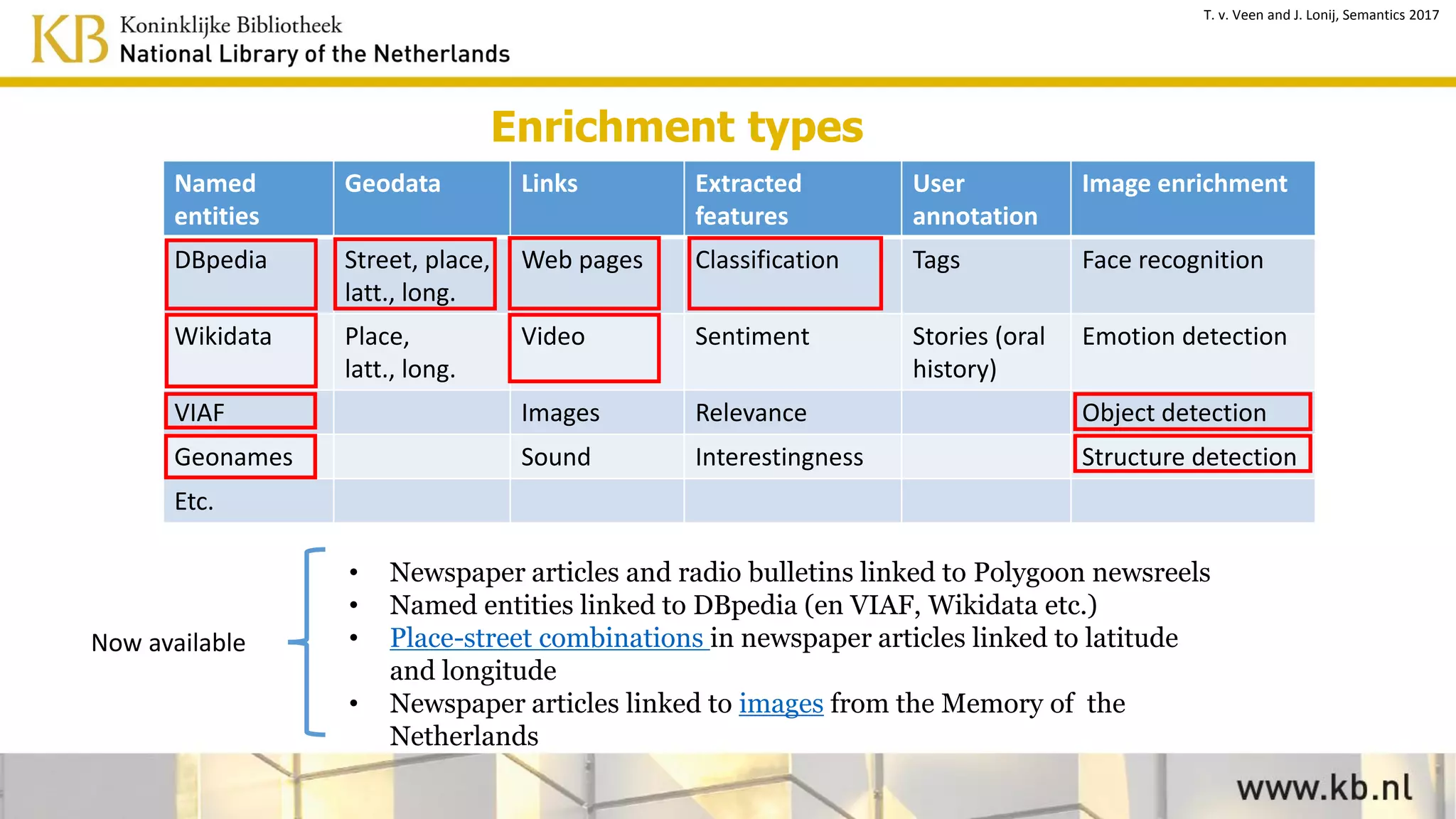
Enrichment types
• Newspaper articles and radio bulletins linked to Polygoon newsreels
• Named entities linked to DBpedia (and Wikidata, VIAF etc.)
• Place-street combinations in newspaper articles linked to latitude
and longitude
• Newspaper articles linked to images from the Memory of the
Netherlands
Named
entities
Geodata Links Extracted
features
User
annotation
Image enrichment
DBpedia Street, place,
latt., long.
Web pages Classification Tags Face recognition
Wikidata Place,
latt., long.
Video Sentiment Stories (oral
history)
Emotion detection
VIAF Images Relevance Object detection
Geonames Sound Interestingness Structure detection
Etc.
Now available
T. v. Veen and J. Lonij, Semantics 2017
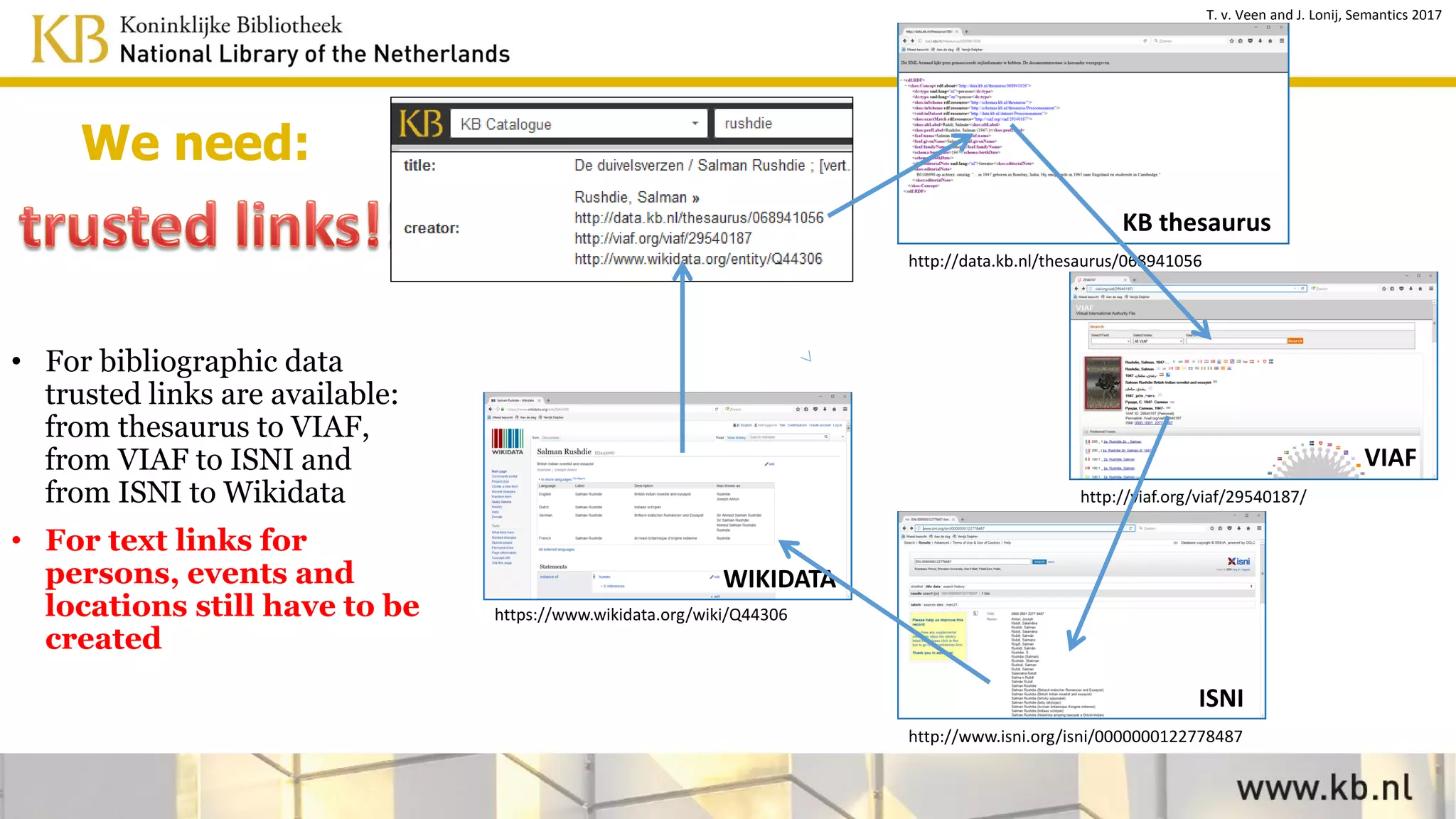
https://www.wikidata.org/wiki/Q44306
WIKIDATA
http://viaf.org/viaf/29540187/
VIAF
http://www.isni.org/isni/0000000122778487
ISNI
http://data.kb.nl/thesaurus/068941056
KB thesaurus
• For bibliographic data
trusted links are available:
from thesaurus to VIAF,
from VIAF to ISNI and
from ISNI to Wikidata
• For persons, events and
locations in text the
links have to be created
T. v. Veen and J. Lonij, Semantics 2017
We need:
How do we deal with names in text?
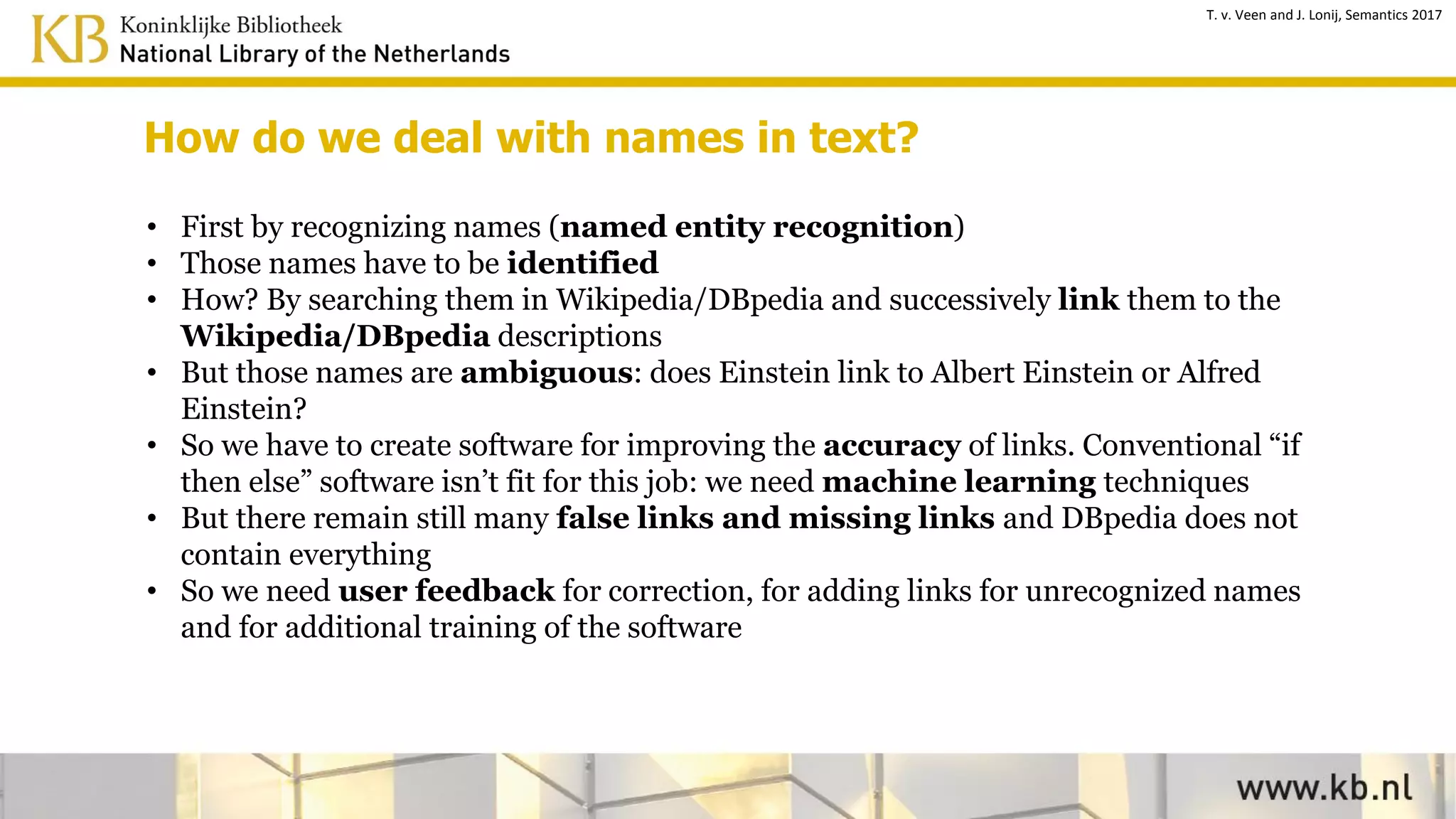
• Recognize names (named entity recognition)
• Identify names by searching them in DBpedia and link the names
to the DBpedia descriptions
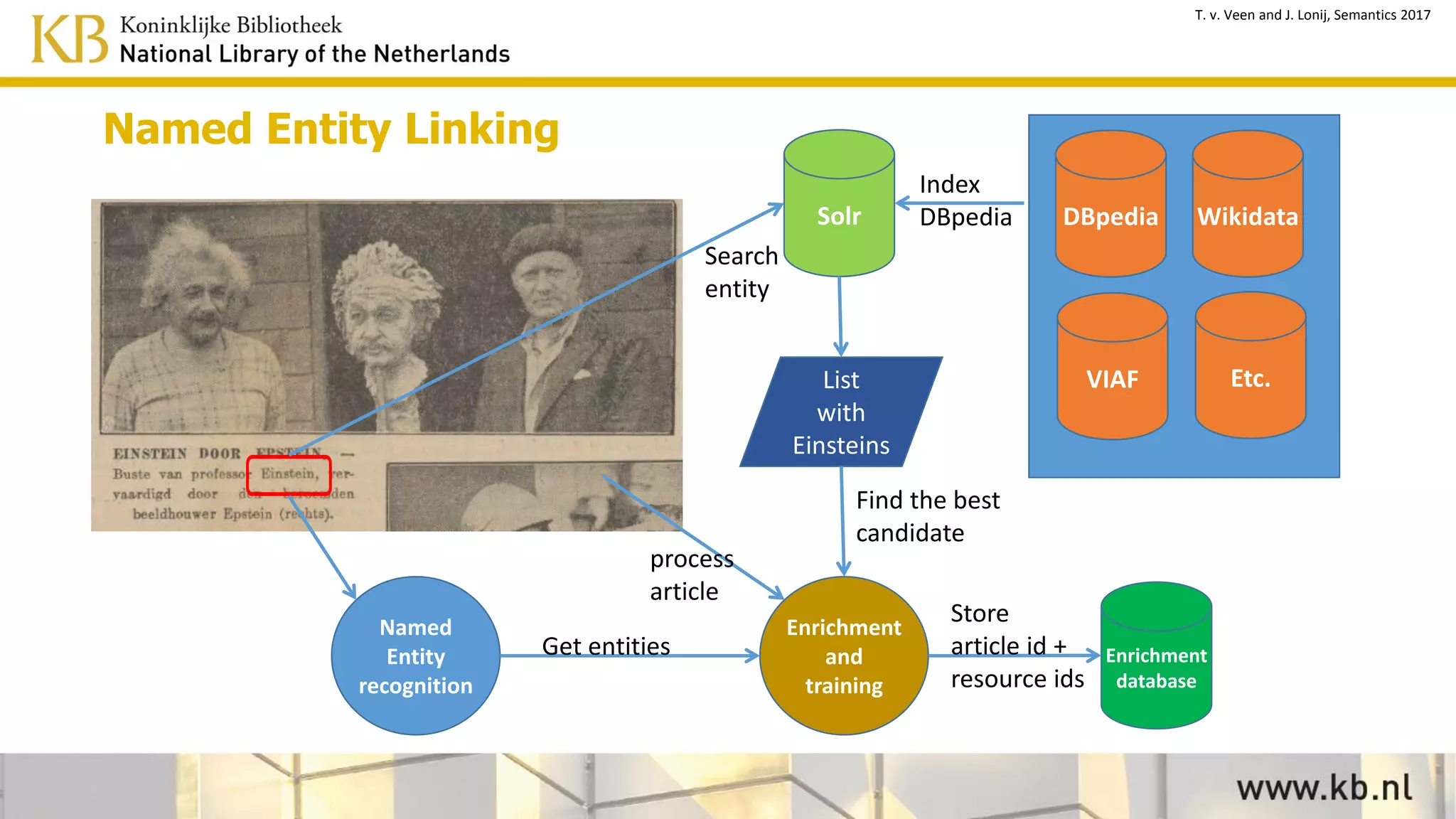
• Those names are ambiguous: does Einstein link to Albert Einstein
or Alfred Einstein? We need disambiguation algorithms.
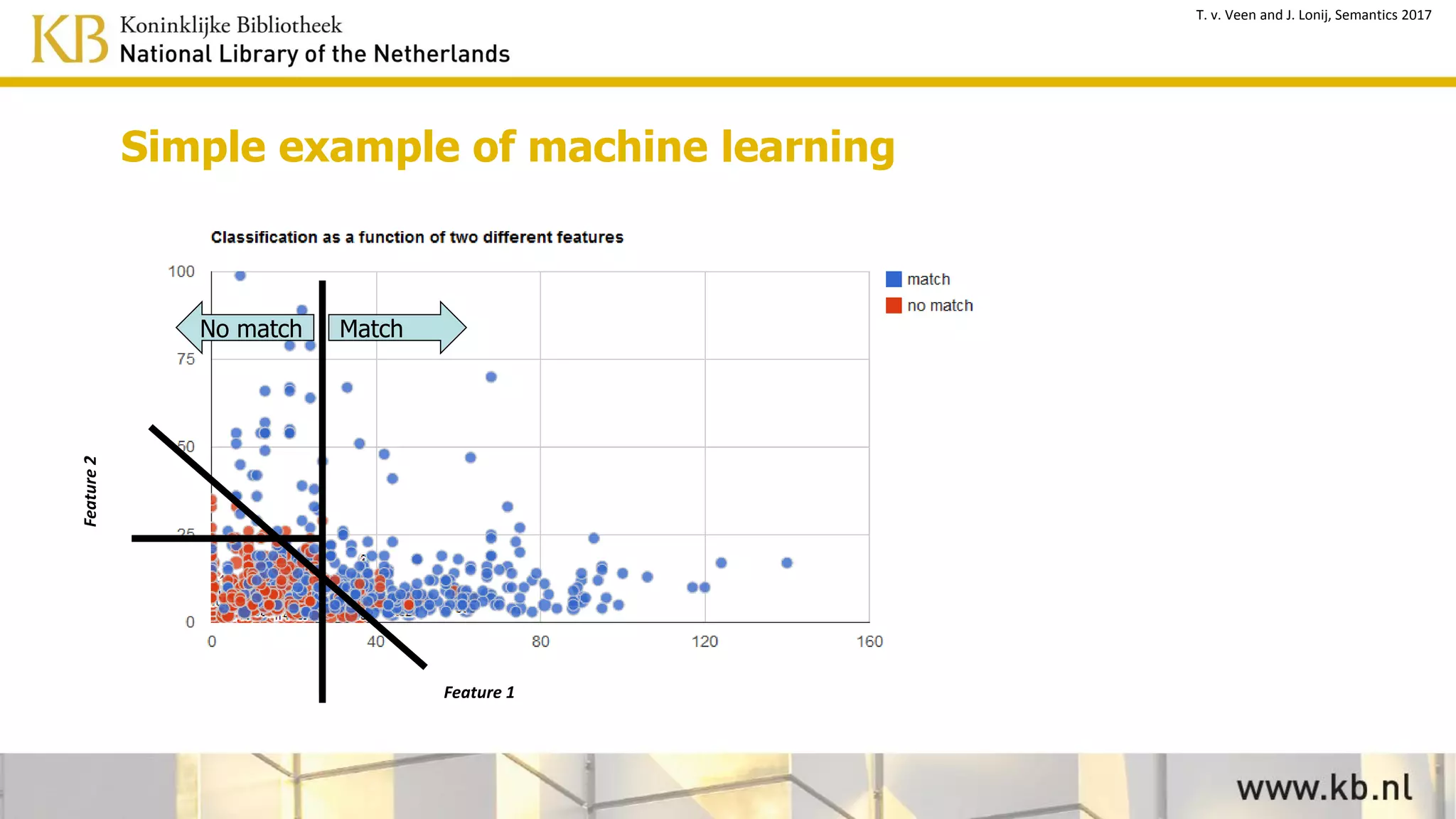
• The accuracy of the links will be improved by machine learning
techniques; conventional “if then else” software isn’t fit for this job
• We need user feedback to correct false links or add missing
links and this will be used for additional training
T. v. Veen and J. Lonij, Semantics 2017
Entity linking
T. v. Veen and J. Lonij, Semantics 2017
Named Entity Linking
DBpediaSolr
Index
DBpedia
Search
entity
Named
Entity
recognition
List
with
Einsteins
Enrichment
database
Enrichment
and
training
process
article
Get entities
Store
article id +
resource ids
Find the best
candidate
VIAF
Wikidata
Etc.
T. v. Veen and J. Lonij, Semantics 2017
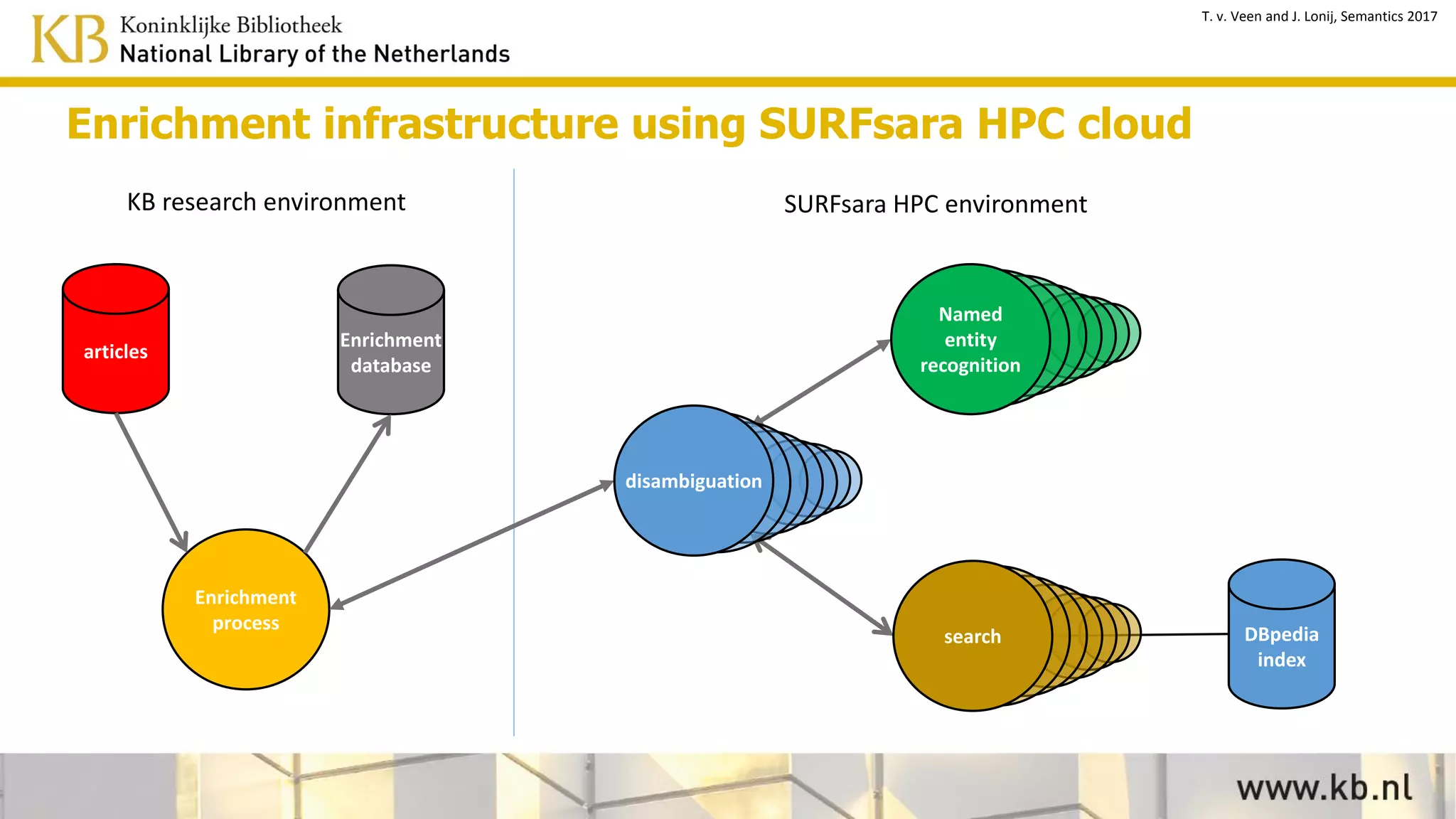
Enrichment
process
articles
Enrichment
database
KB research environment SURFsara HPC environment
DBpedia
index
Enrichment infrastructure using SURFsara HPC cloud
disambiguation
Named
entity
recognition
search
T. v. Veen and J. Lonij, Semantics 2017
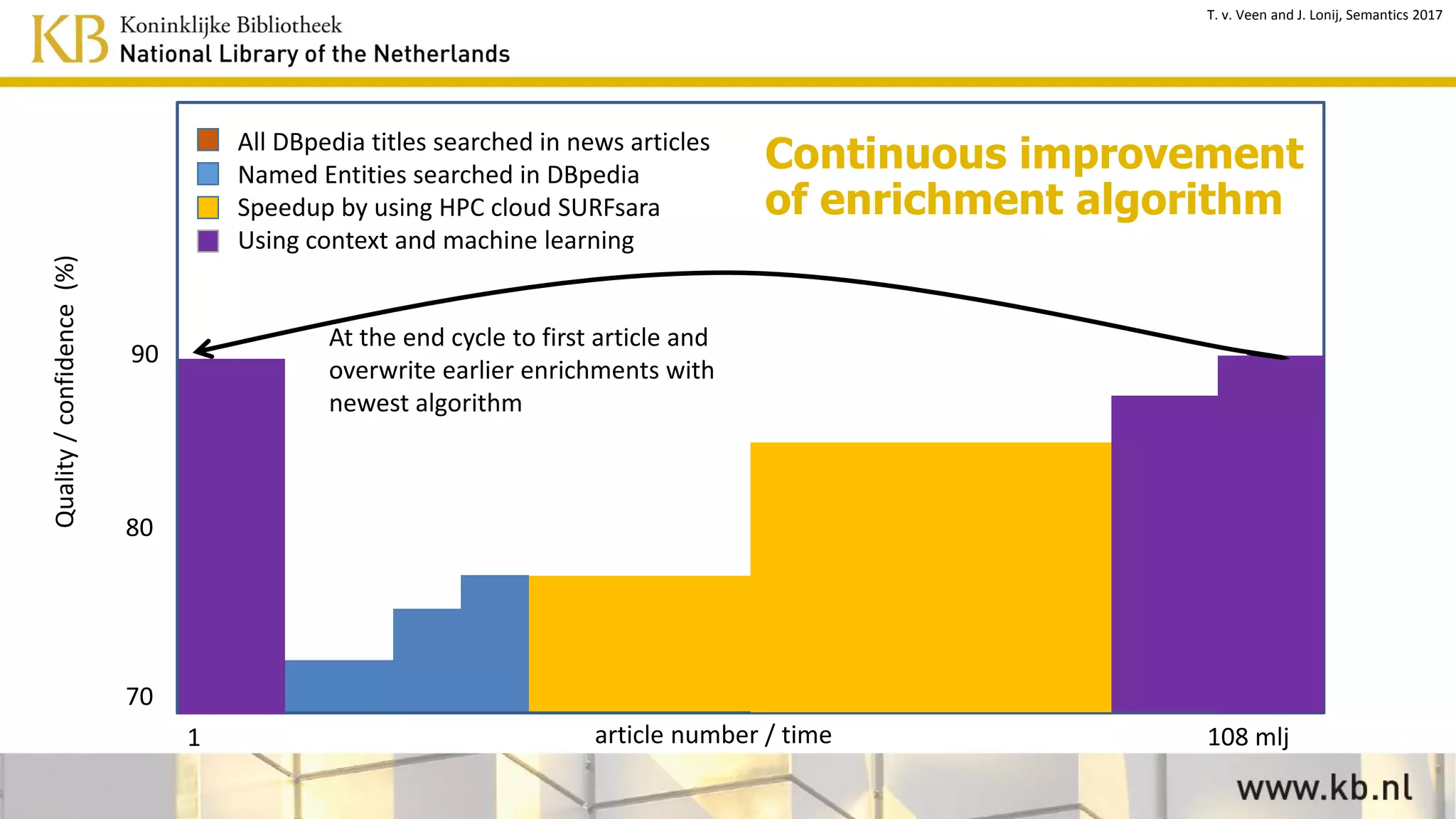
Continuous improvement
of enrichment algorithm
article number / time
80
1 108 mlj
• All DBpedia titles searched in news articles
• Named Entities searched in DBpedia
• Speedup by using HPC cloud SURFsara
• Using context and machine learning
Quality/confidence(%)
70
T. v. Veen and J. Lonij, Semantics 2017
90
At the end cycle to first article and
overwrite earlier enrichments with
newest algorithm
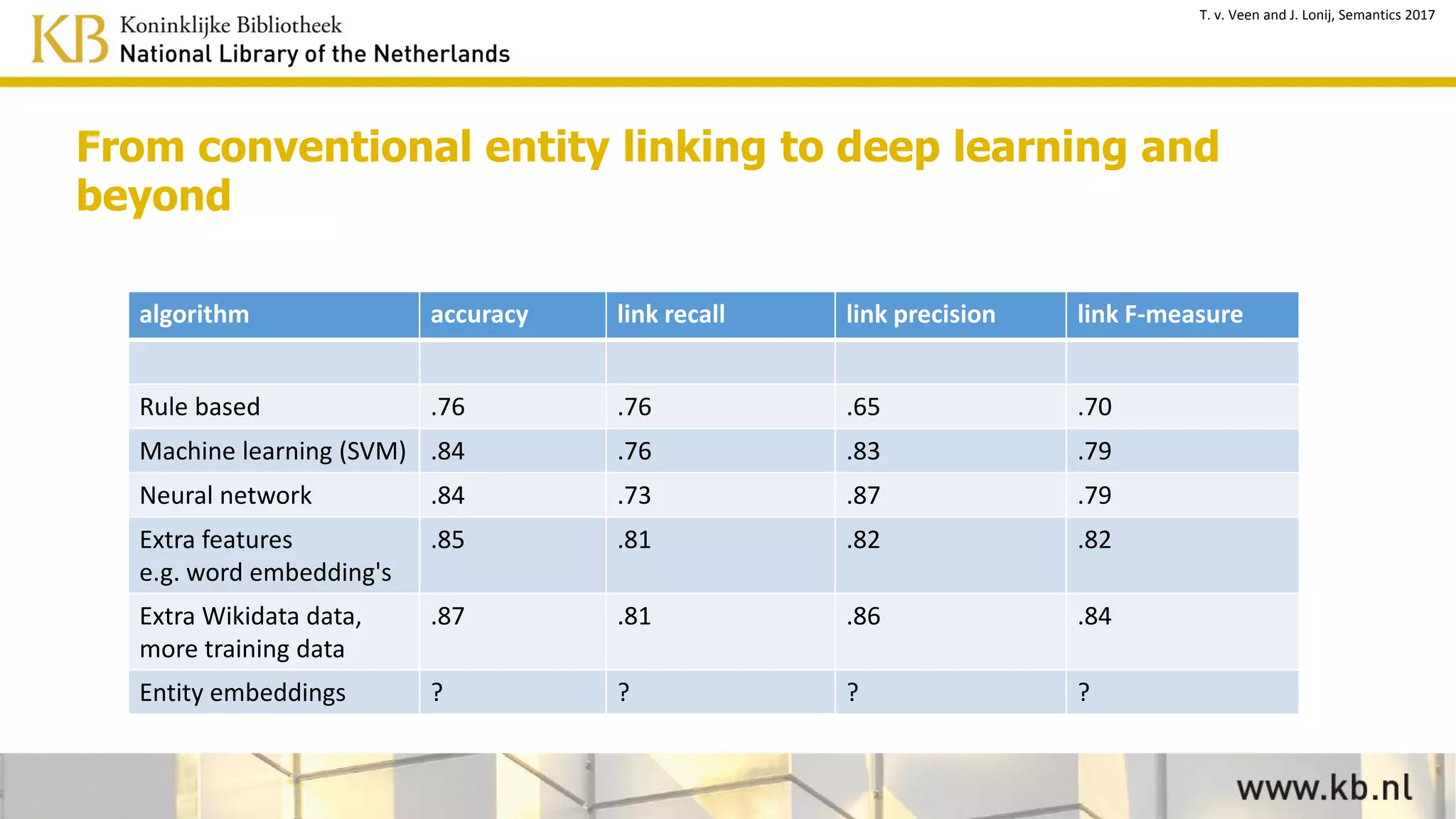
algorithm accuracy link recall link precision link F-measure
Rule based .76 .76 .65 .70
Machine learning (SVM) .84 .76 .83 .79
Neural network .84 .73 .87 .79
Extra features
e.g. word embedding
.85 .81 .82 .82
Extra Wikidata data,
more training data
.87 .81 .86 .84
Entity embedding .88 .86 .85 .85
From conventional entity linking to deep learning and
beyond
T. v. Veen and J. Lonij, Semantics 2017
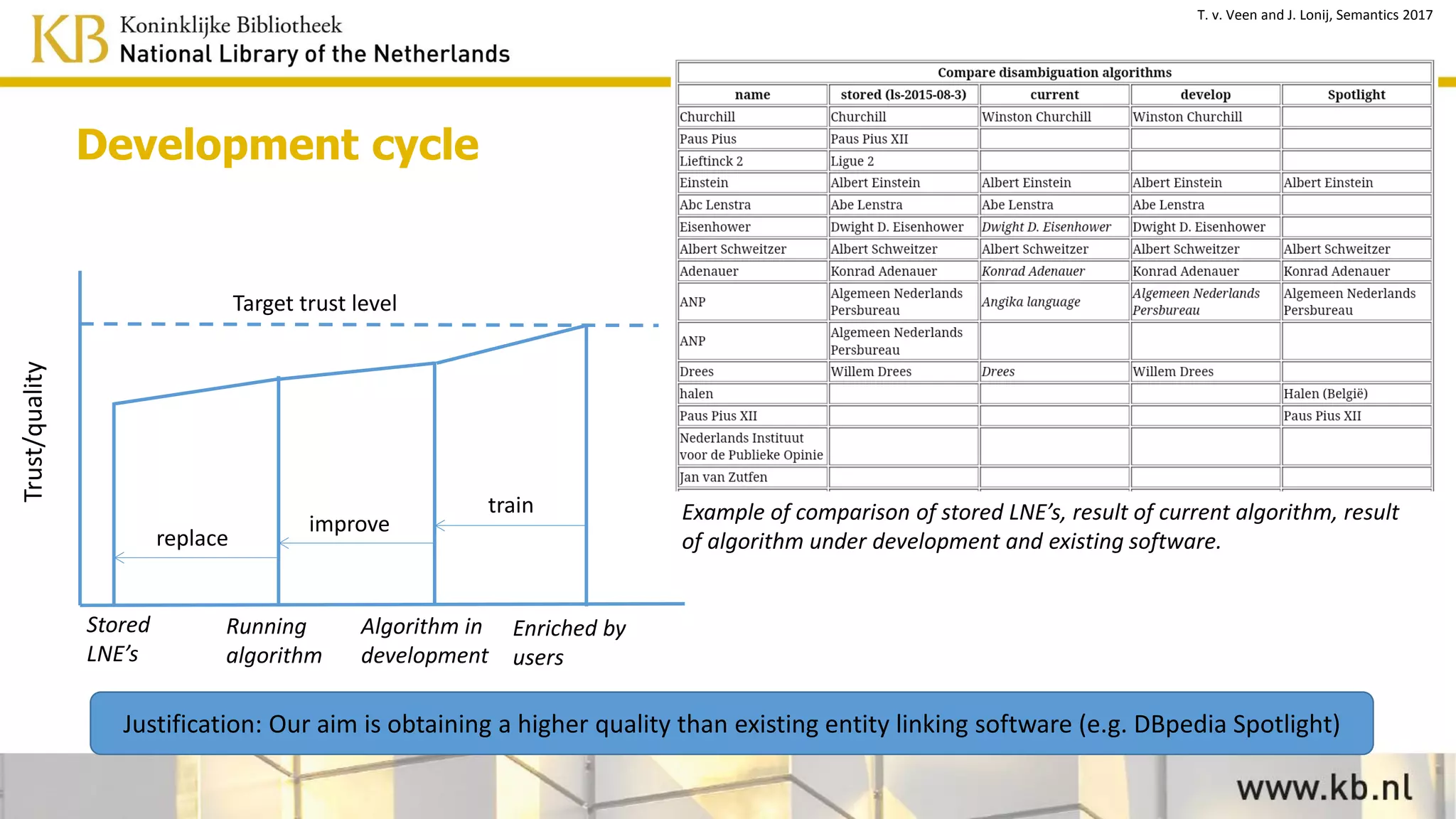
Development cycle
Justification: Our aim is obtaining a higher quality than existing entity linking software (e.g. DBpedia Spotlight)
Trust/quality
Stored
LNE’s
Running
algorithm
Algorithm in
development
Enriched by
users
Target trust level
T. v. Veen and J. Lonij, Semantics 2017
train
replace
improve Example of comparison of stored LNE’s, result of current algorithm, result
of algorithm under development and existing software.
Presentation
T. v. Veen and J. Lonij, Semantics 2017
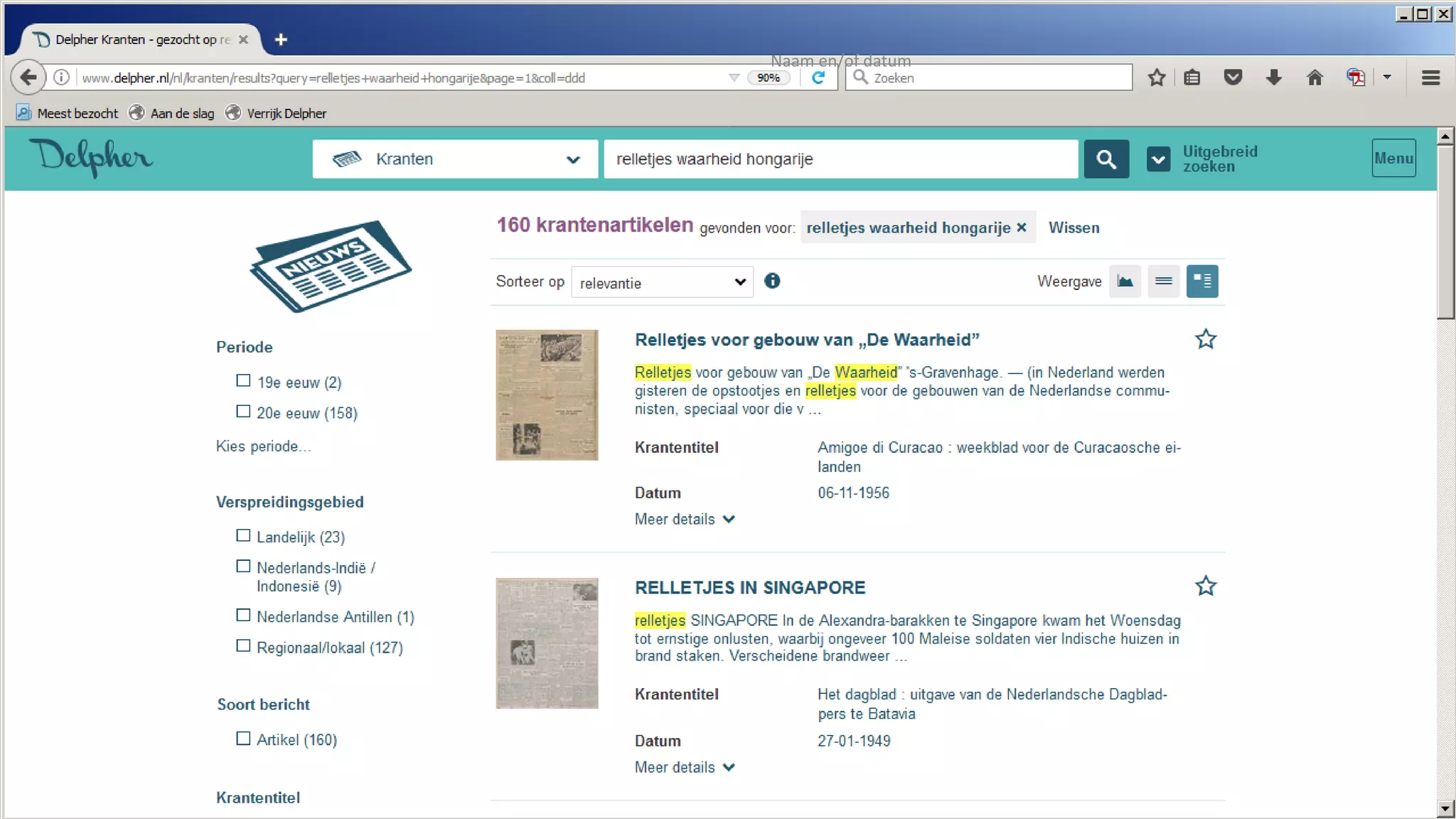
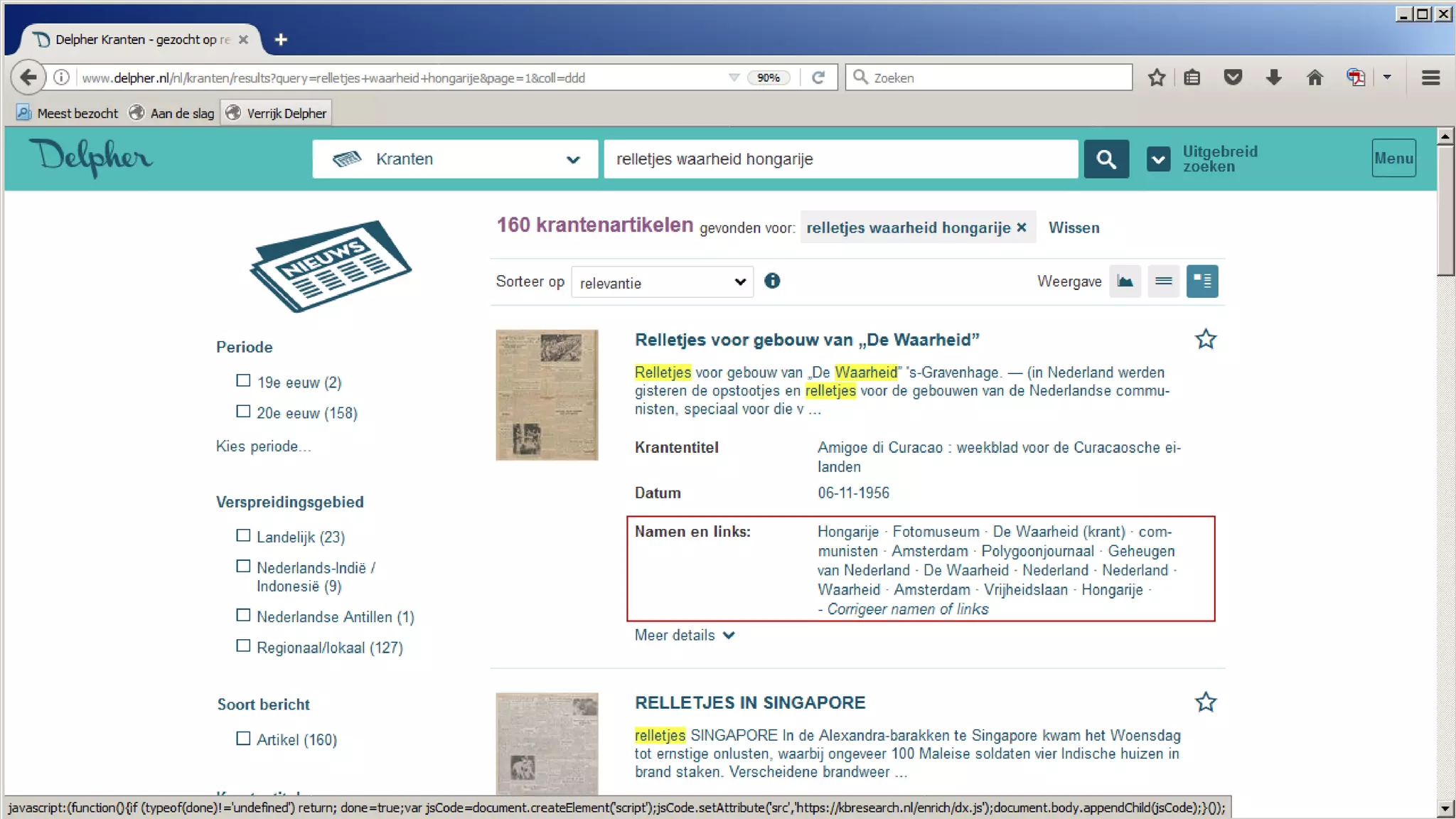
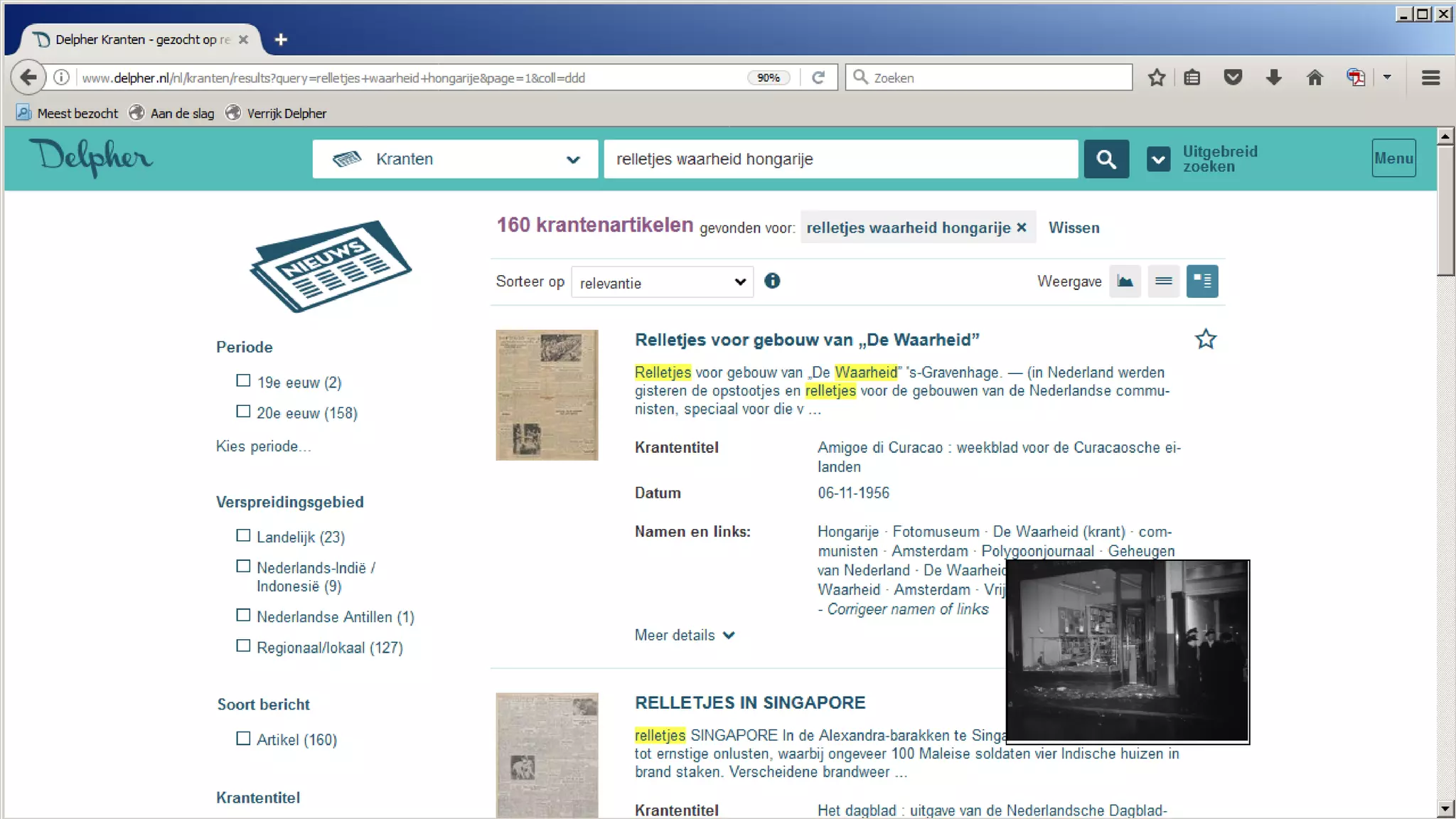
Naam en/of datum
Naam en/of datum
• Theo van Veen, 16-6-2016
Research portal
Identified names (LNE)
and other enrichments
Configurable services
Context information
and extra navigation
options for a name
Semantic search
T. v. Veen and J. Lonij, Semantics 2017
Sematic search:
index resource identifiers
Newspaper
index
Text + Viaf id +
Wikidata id etc.
Enrichment
database
Indexing
Get text for
article X Get enrichments
for article X
search articles with
wikidata id’s
Wikidata Semantic search (SPARQL)
providing wikidata id’s
T. v. Veen and J. Lonij, Semantics 2017
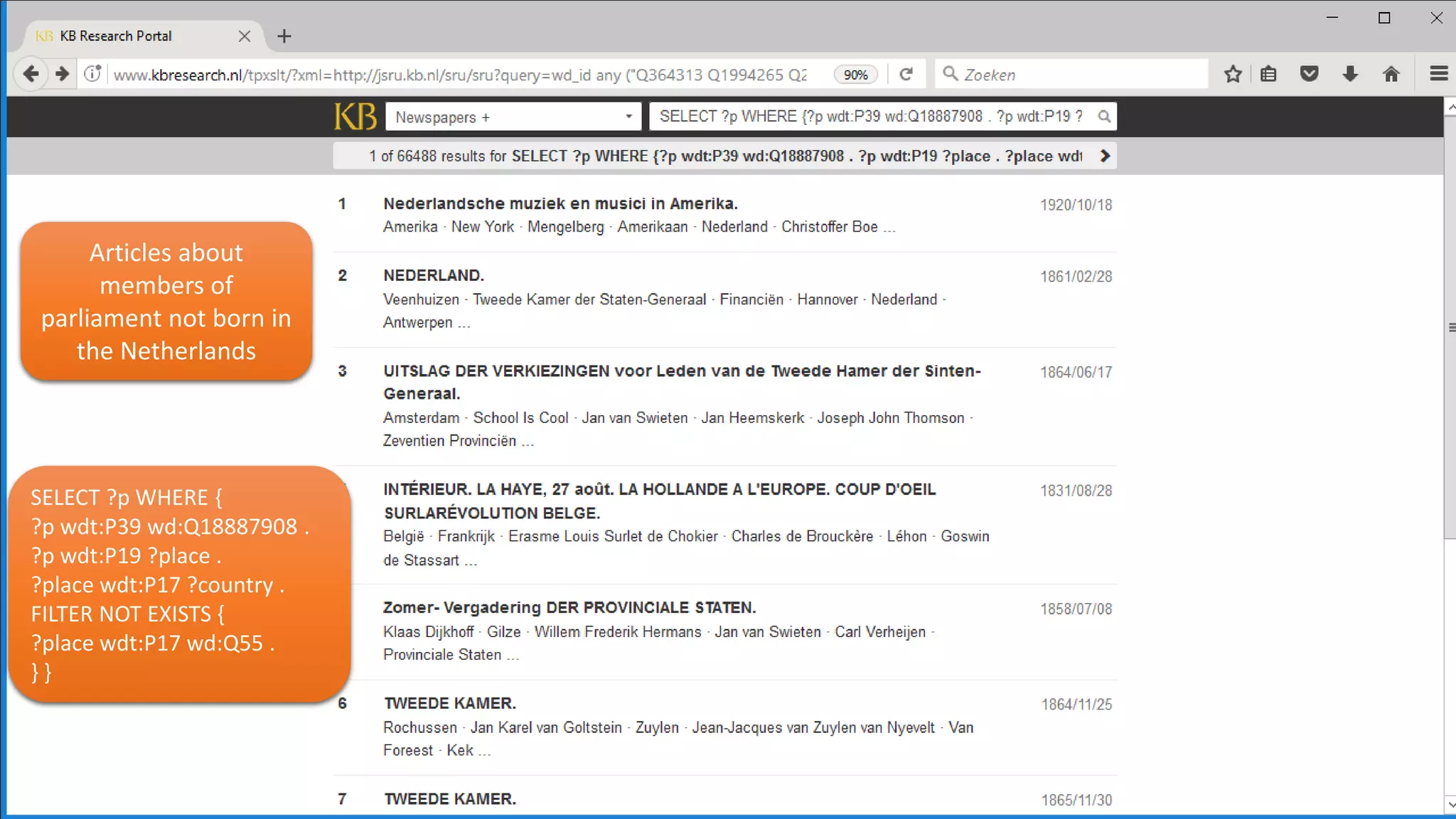
Articles mentioning
members of
parliament not born in
the Netherlands
SELECT ?p WHERE {
?p wdt:P39 wd:Q18887908 .
?p wdt:P19 ?place .
?place wdt:P17 ?country .
FILTER NOT EXISTS {
?place wdt:P17 wd:Q55 .
} }
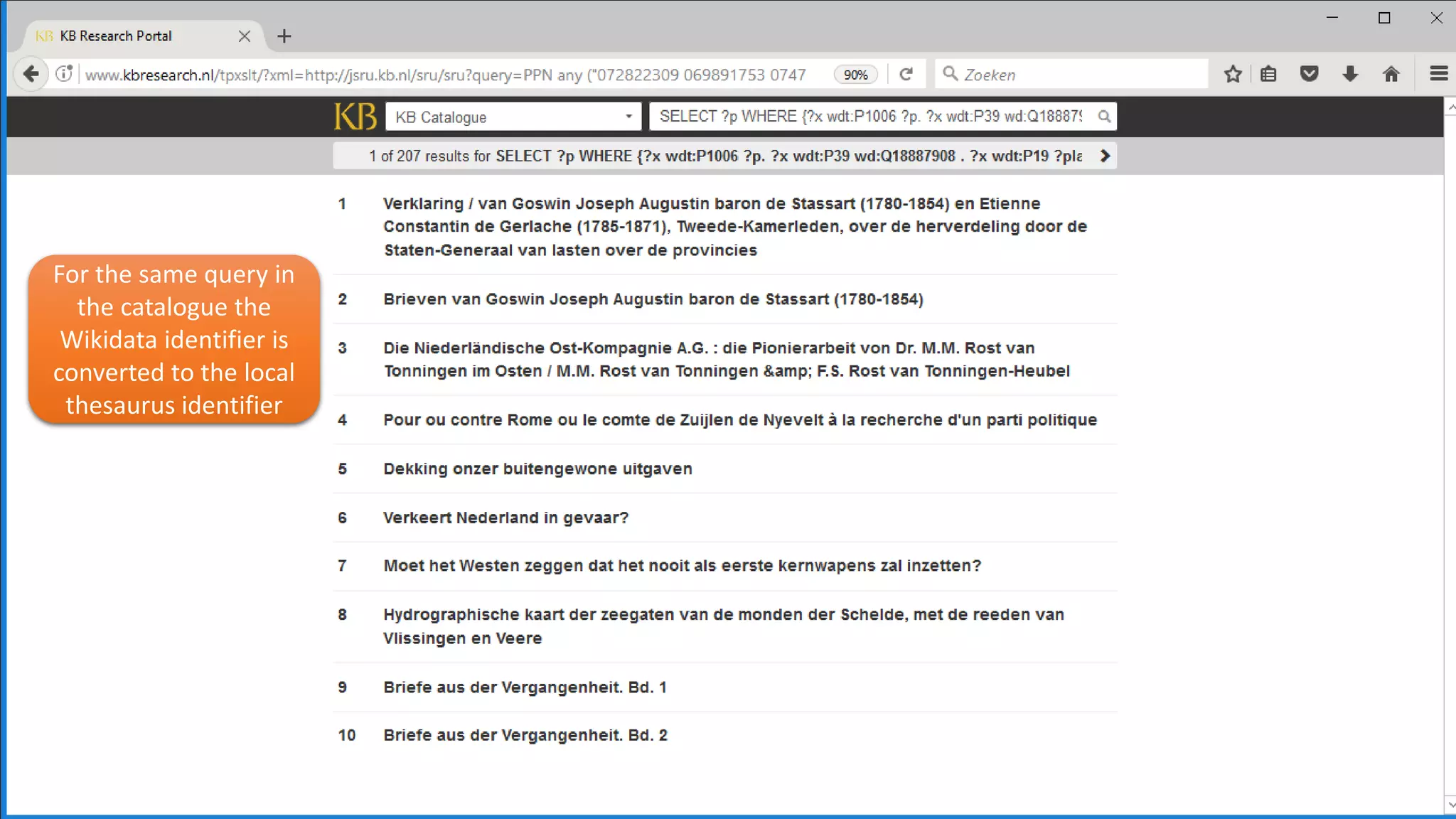
For the same query in
the catalogue the
Wikidata identifier is
converted to the local
thesaurus identifier
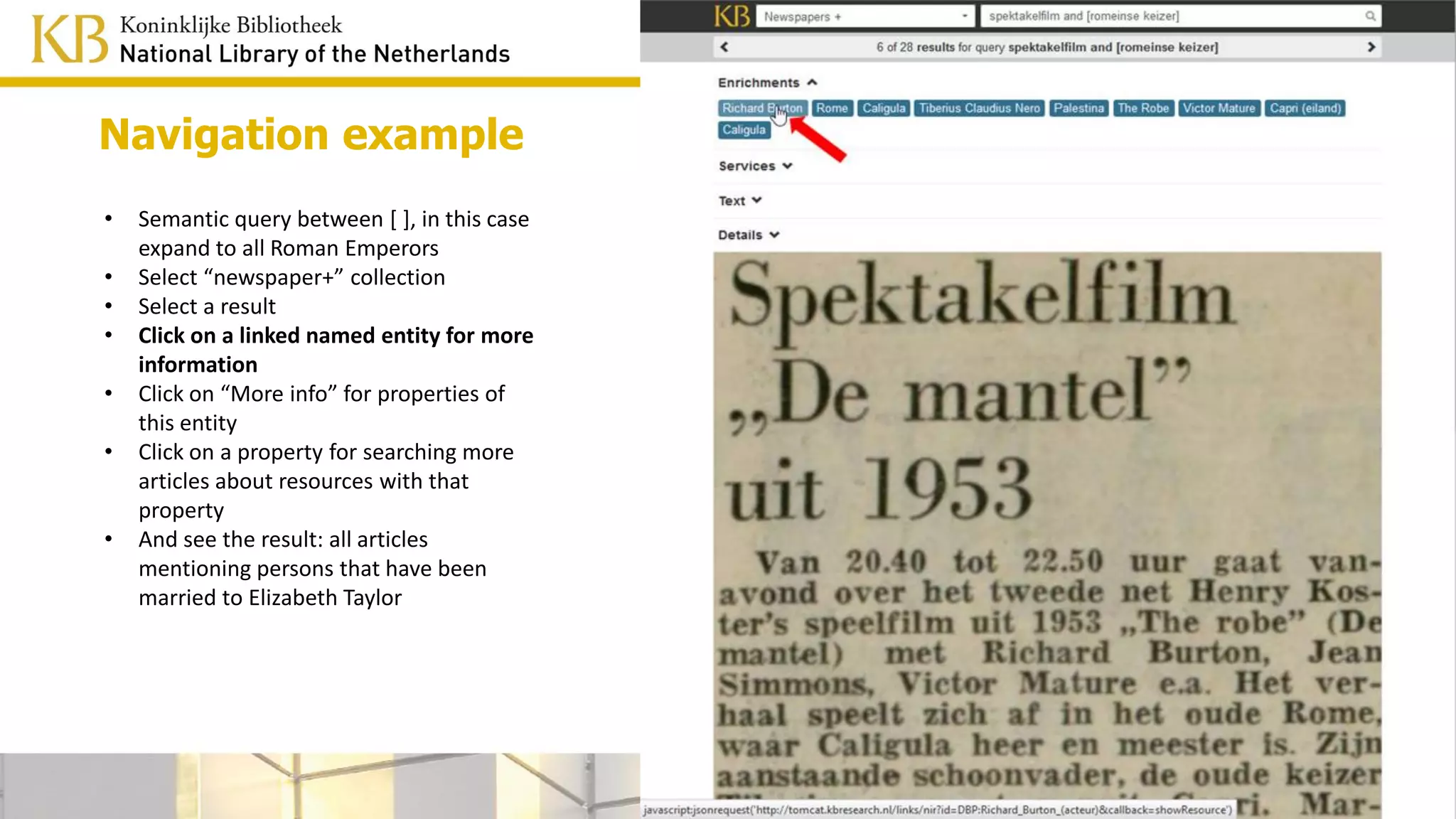
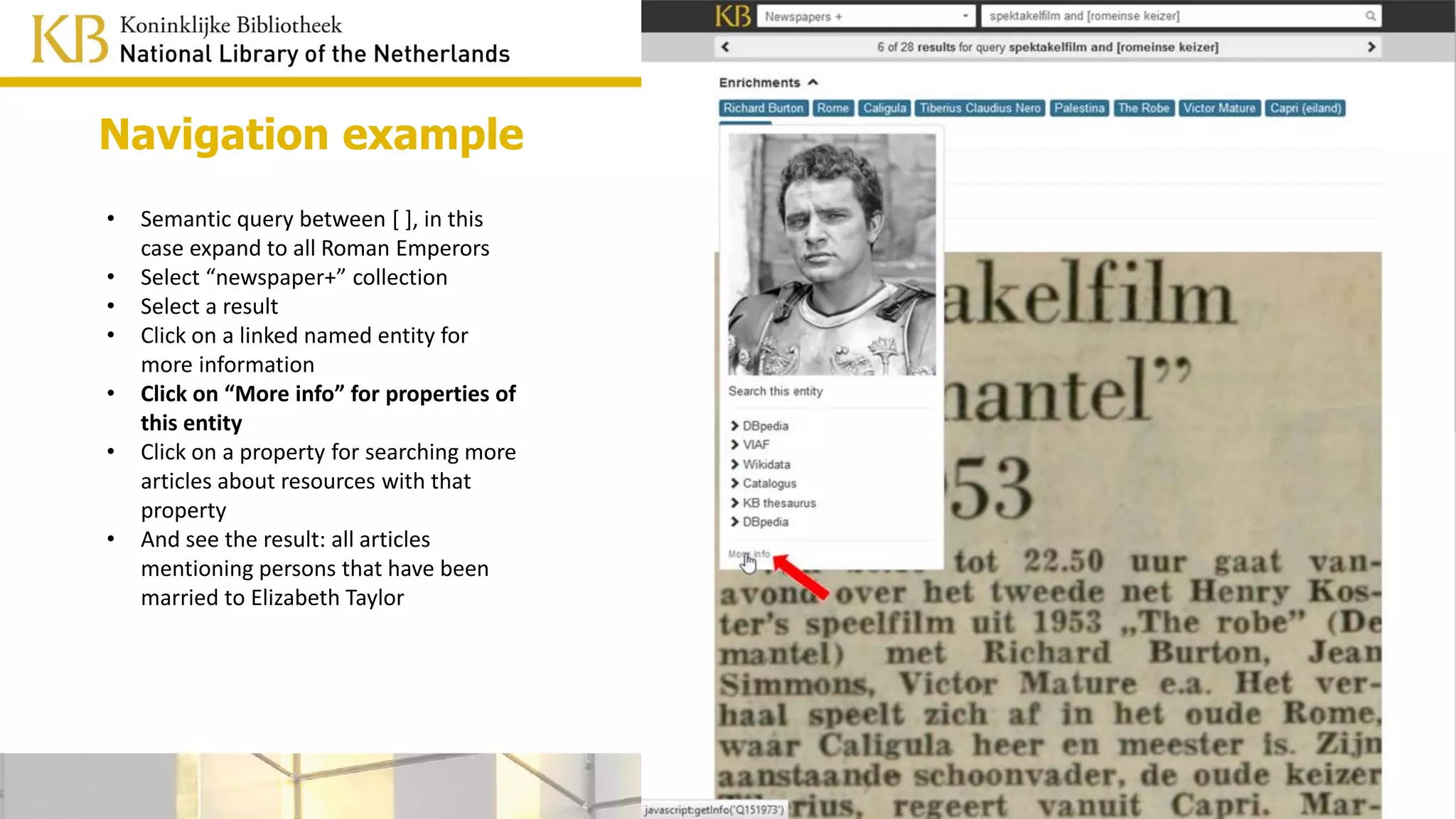
• Semantic query between [ ], in this
case expand to all Roman Emperors
• Select “newspaper+” collection
• Select a result
• Click on a linked named entity for more
information
• Click on “More info” for properties of
this entity
• Click on a property for searching more
articles about resources with that
property
• And see the result: all articles
mentioning persons that have been
married to Elizabeth Taylor
Navigation example Using square brackets the
software tries a few
Wikidata SPARQL queries
and replaces this string
by the Wikidata results.
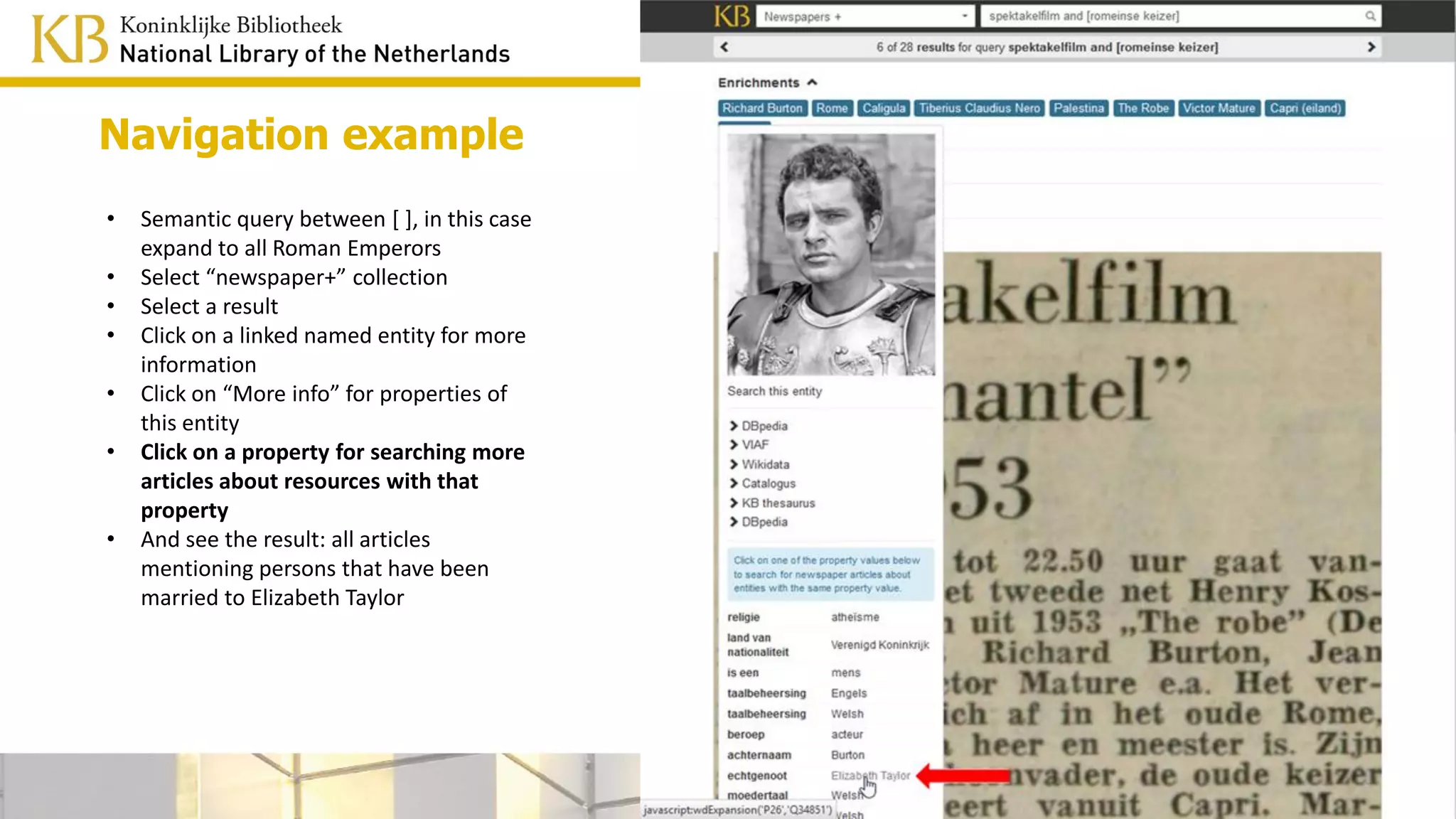
• Semantic query between [ ], in this case
expand to all Roman Emperors
• Select “newspaper+” collection
• Select a result
• Click on a linked named entity for more
information
• Click on “More info” for properties of
this entity
• Click on a property for searching more
articles about resources with that
property
• And see the result: all articles
mentioning persons that have been
married to Elizabeth Taylor
Navigation example
• Semantic query between [ ], in this case
expand to all Roman Emperors
• Select “newspaper+” collection
• Select a result
• Click on a linked named entity for more
information
• Click on “More info” for properties of
this entity
• Click on a property for searching more
articles about resources with that
property
• And see the result: all articles
mentioning persons that have been
married to Elizabeth Taylor
Navigation example
• Semantic query between [ ], in this
case expand to all Roman Emperors
• Select “newspaper+” collection
• Select a result
• Click on a linked named entity for
more information
• Click on “More info” for properties of
this entity
• Click on a property for searching more
articles about resources with that
property
• And see the result: all articles
mentioning persons that have been
married to Elizabeth Taylor
Navigation example
• Semantic query between [ ], in this case
expand to all Roman Emperors
• Select “newspaper+” collection
• Select a result
• Click on a linked named entity for more
information
• Click on “More info” for properties of
this entity
• Click on a property for searching more
articles about resources with that
property
• And see the result: all articles
mentioning persons that have been
married to Elizabeth Taylor
Navigation example
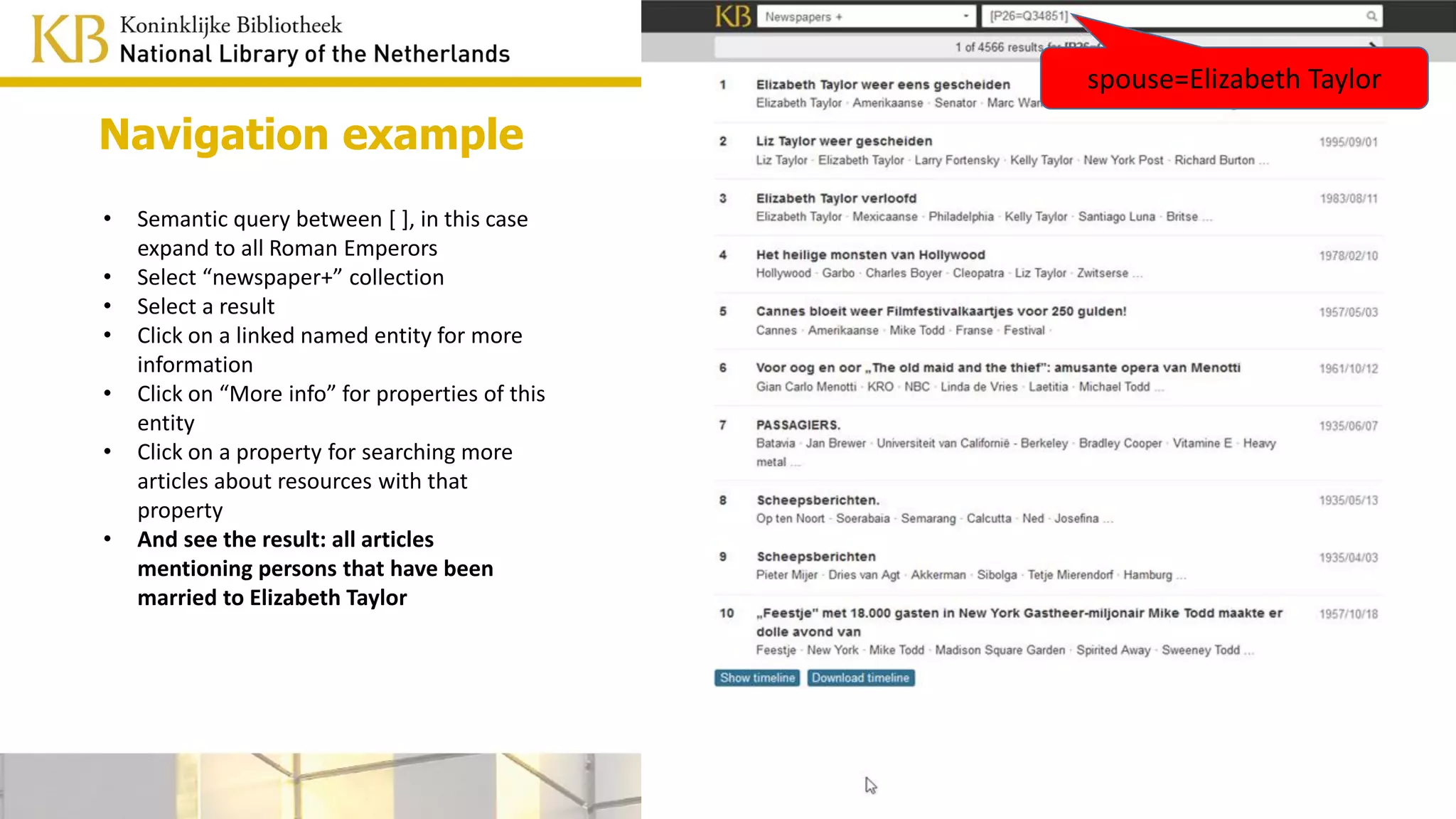
spouse=Elizabeth Taylor
• Semantic query between [ ], in this case
expand to all Roman Emperors
• Select “newspaper+” collection
• Select a result
• Click on a linked named entity for more
information
• Click on “More info” for properties of this
entity
• Click on a property for searching more
articles about resources with that
property
• And see the result: all articles
mentioning persons that have been
married to Elizabeth Taylor
Navigation example
User feedback
T. v. Veen and J. Lonij, Semantics 2017
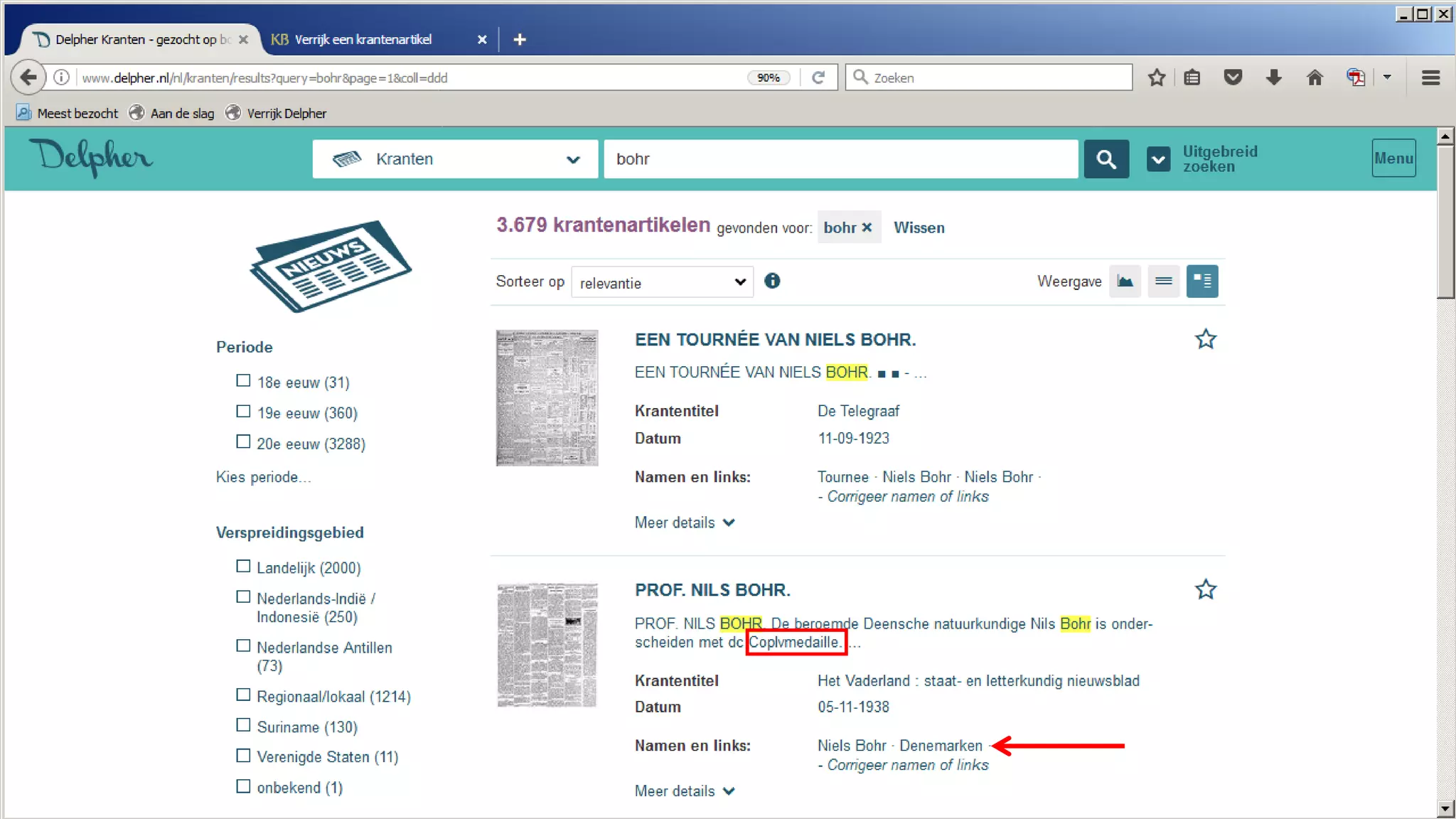
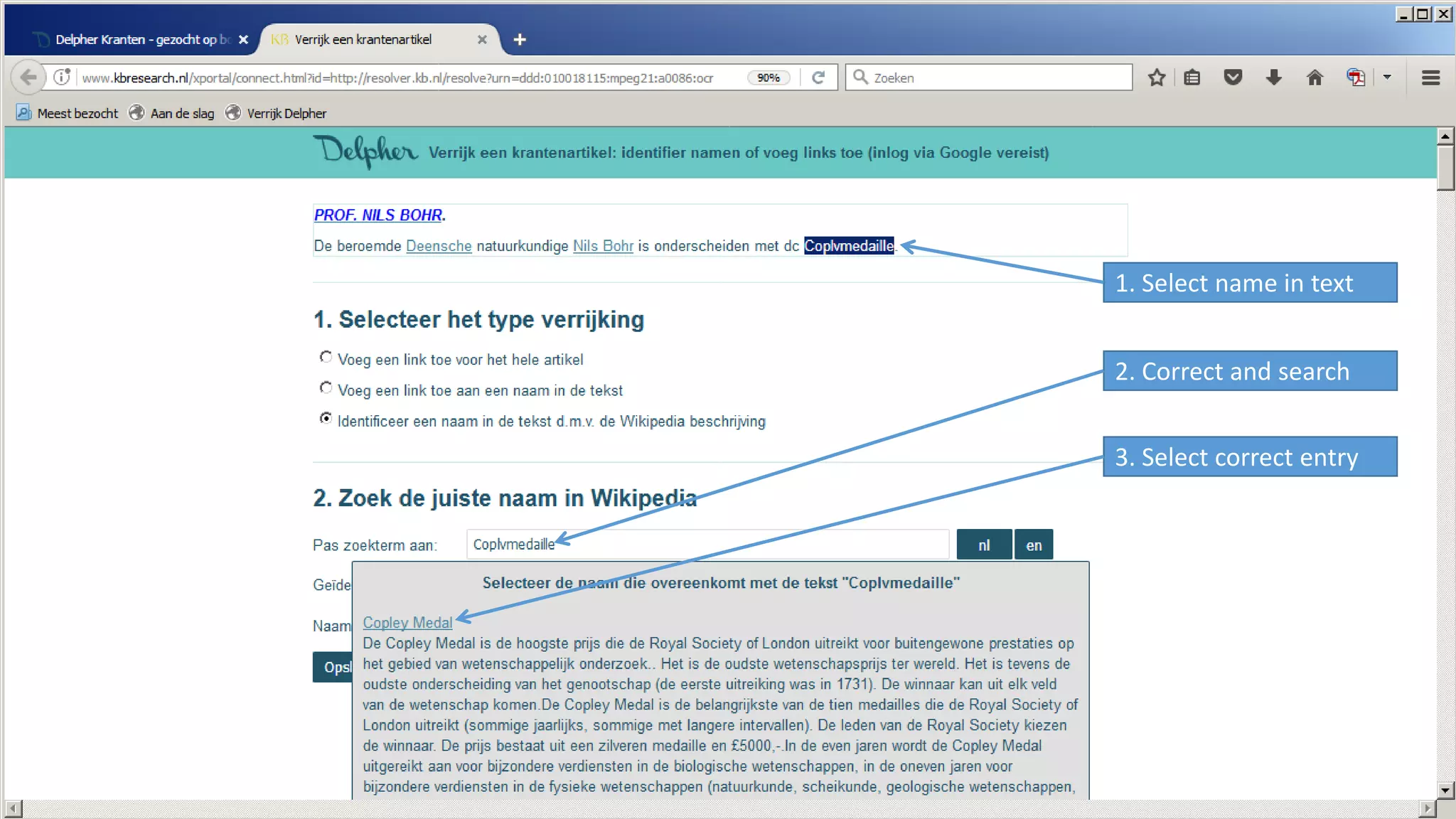
User feedback is needed
for correcting false links
and adding new links!
This feedback serves as
additional training data
for the disambiguation
software
Wikidata as thesaurus
T. v. Veen and J. Lonij, Semantics 2017
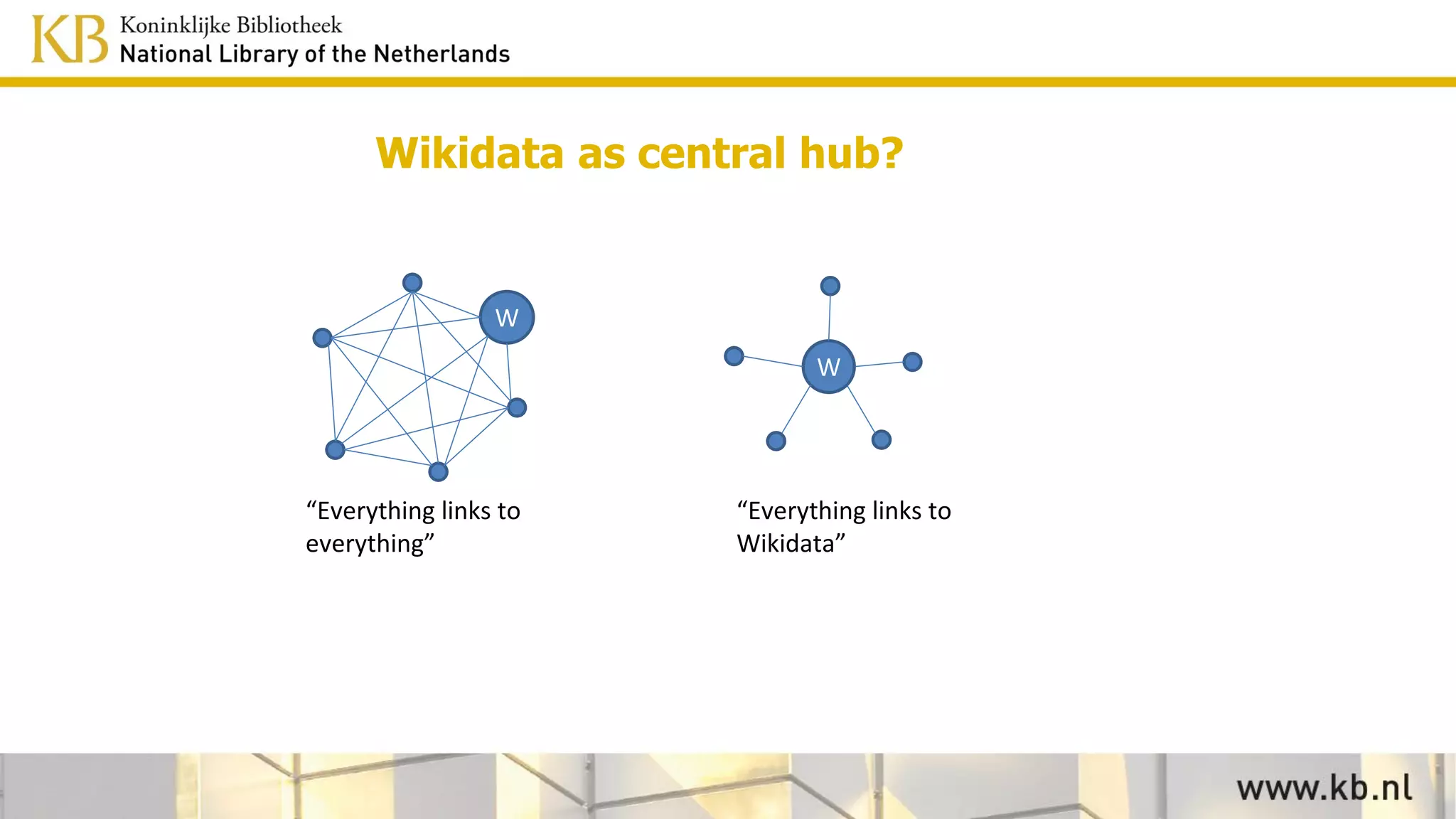
Wikidata as central hub?
W
W
“Everything links to
everything”
“Everything links to
Wikidata”
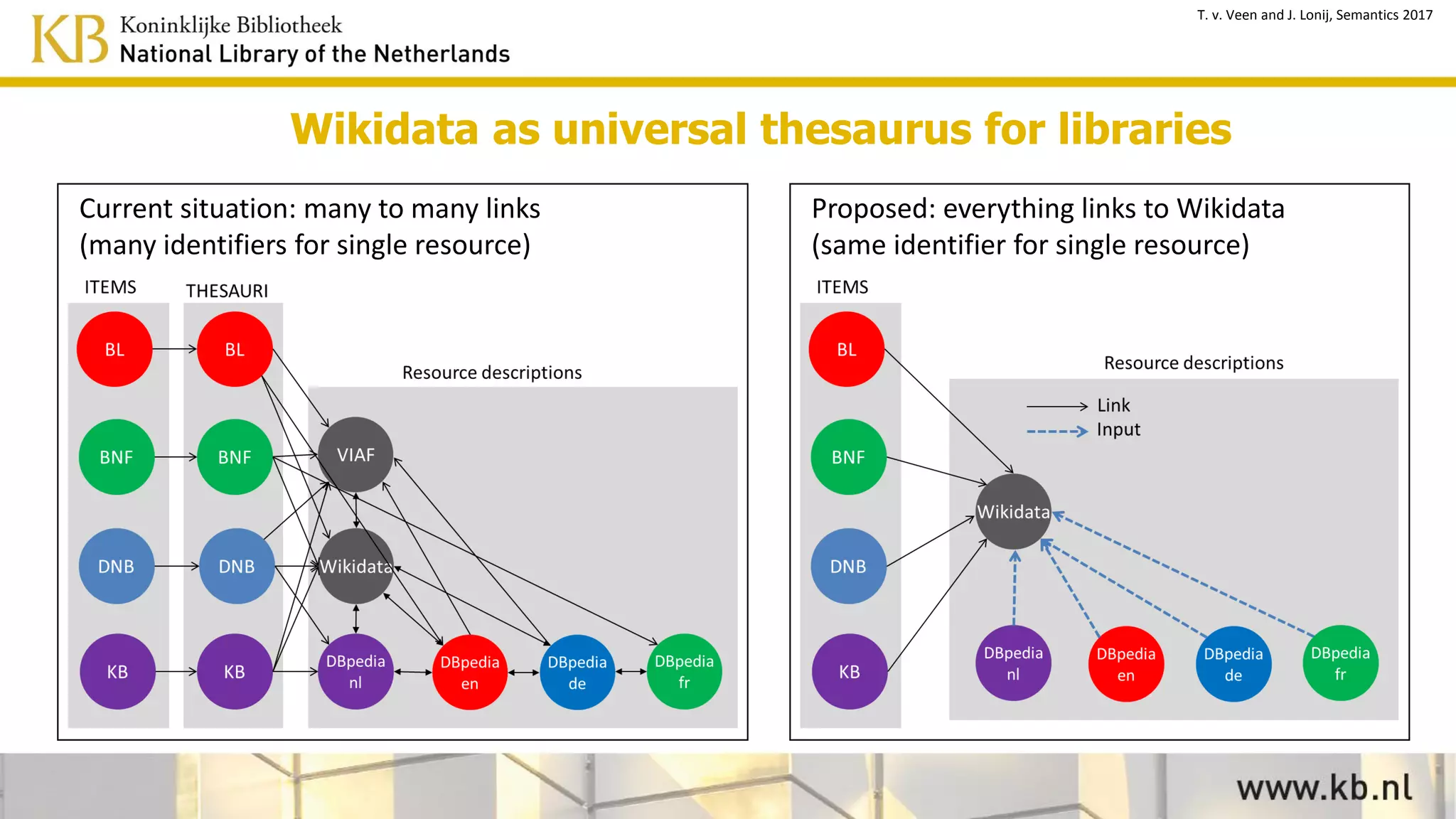
Current situation: many to many links
(many identifiers for single resource)
Proposed: everything links to Wikidata
(same identifier for single resource)
Wikidata as universal thesaurus for libraries
T. v. Veen and J. Lonij, Semantics 2017
Conclusions and next steps
T. v. Veen and J. Lonij, Semantics 2017
Conclusions and next steps
• Entity linking combining machine learning and domain knowledge is
promising and we still have ideas for improvements
• We have shown the added value of linking named entities to
Wikidata/DBpedia: it improves findability and usability of content as
demonstrated with the research portal
• Our aim is to increase the confidence of links so users can trust them
“enough” for using them for searching and research
• User feedback provides additional training data and needs to be
deployed on a larger scale
T. v. Veen and J. Lonij, Semantics 2017
Any questions?
theo.vanveen@kb.nl
juliette.lonij@kb.nl
http://www.kbresearch.nl/xportal

Session 1.2 improving access to digital content by semantic enrichment

  • 1.
    Improving access todigital collections by semantic enrichment Theo van Veen and Juliette Lonij, Semantics 2017, 12-09-2017
  • 2.
    Overview • Motivation andapproach • Entity linking • Presentation • Semantic search • User feedback • Wikidata as thesaurus • Conclusions and next steps T. v. Veen and J. Lonij, Semantics 2017
  • 3.
    Motivation and approach T.v. Veen and J. Lonij, Semantics 2017
  • 4.
    Motivation • Improving discoveryand usability requires intelligent connection of content to the outside world. • Content contains “knowledge” requiring intelligent preprocessing to be found. • Knowledge should be offered to the user more or less unsolicited • Our software should have read, analyzed and enriched our content completely prior to the user!! T. v. Veen and J. Lonij, Semantics 2017
  • 5.
    Enrichment: purpose andapproach • making content better findable and usable, especially newspaper articles • by enriching text and names in the text with links to related information • which is in most cases linked data (links to Wikidata, Polygoon news reels, images) • and which enables advanced queries and presentation of context information T. v. Veen and J. Lonij, Semantics 2017
  • 6.
    How? • “Things” intext have to be uniquely identified • When identifiers link to resource descriptions it is possible to present context information about “things” • Relevant context information can be indexed as part of a “thing” and so it can be searched for • Using properties in external resource descriptions enable semantic search 1. Identification 2. Context 3. Indexing 4. Semantic search T. v. Veen and J. Lonij, Semantics 2017
  • 7.
    Enrichment types • Newspaperarticles and radio bulletins linked to Polygoon newsreels • Named entities linked to DBpedia (and Wikidata, VIAF etc.) • Place-street combinations in newspaper articles linked to latitude and longitude • Newspaper articles linked to images from the Memory of the Netherlands Named entities Geodata Links Extracted features User annotation Image enrichment DBpedia Street, place, latt., long. Web pages Classification Tags Face recognition Wikidata Place, latt., long. Video Sentiment Stories (oral history) Emotion detection VIAF Images Relevance Object detection Geonames Sound Interestingness Structure detection Etc. Now available T. v. Veen and J. Lonij, Semantics 2017
  • 8.
    https://www.wikidata.org/wiki/Q44306 WIKIDATA http://viaf.org/viaf/29540187/ VIAF http://www.isni.org/isni/0000000122778487 ISNI http://data.kb.nl/thesaurus/068941056 KB thesaurus • Forbibliographic data trusted links are available: from thesaurus to VIAF, from VIAF to ISNI and from ISNI to Wikidata • For persons, events and locations in text the links have to be created T. v. Veen and J. Lonij, Semantics 2017 We need:
  • 9.
    How do wedeal with names in text? • Recognize names (named entity recognition) • Identify names by searching them in DBpedia and link the names to the DBpedia descriptions • Those names are ambiguous: does Einstein link to Albert Einstein or Alfred Einstein? We need disambiguation algorithms. • The accuracy of the links will be improved by machine learning techniques; conventional “if then else” software isn’t fit for this job • We need user feedback to correct false links or add missing links and this will be used for additional training T. v. Veen and J. Lonij, Semantics 2017
  • 10.
    Entity linking T. v.Veen and J. Lonij, Semantics 2017
  • 11.
    Named Entity Linking DBpediaSolr Index DBpedia Search entity Named Entity recognition List with Einsteins Enrichment database Enrichment and training process article Getentities Store article id + resource ids Find the best candidate VIAF Wikidata Etc. T. v. Veen and J. Lonij, Semantics 2017
  • 12.
    Enrichment process articles Enrichment database KB research environmentSURFsara HPC environment DBpedia index Enrichment infrastructure using SURFsara HPC cloud disambiguation Named entity recognition search T. v. Veen and J. Lonij, Semantics 2017
  • 13.
    Continuous improvement of enrichmentalgorithm article number / time 80 1 108 mlj • All DBpedia titles searched in news articles • Named Entities searched in DBpedia • Speedup by using HPC cloud SURFsara • Using context and machine learning Quality/confidence(%) 70 T. v. Veen and J. Lonij, Semantics 2017 90 At the end cycle to first article and overwrite earlier enrichments with newest algorithm
  • 14.
    algorithm accuracy linkrecall link precision link F-measure Rule based .76 .76 .65 .70 Machine learning (SVM) .84 .76 .83 .79 Neural network .84 .73 .87 .79 Extra features e.g. word embedding .85 .81 .82 .82 Extra Wikidata data, more training data .87 .81 .86 .84 Entity embedding .88 .86 .85 .85 From conventional entity linking to deep learning and beyond T. v. Veen and J. Lonij, Semantics 2017
  • 15.
    Development cycle Justification: Ouraim is obtaining a higher quality than existing entity linking software (e.g. DBpedia Spotlight) Trust/quality Stored LNE’s Running algorithm Algorithm in development Enriched by users Target trust level T. v. Veen and J. Lonij, Semantics 2017 train replace improve Example of comparison of stored LNE’s, result of current algorithm, result of algorithm under development and existing software.
  • 16.
    Presentation T. v. Veenand J. Lonij, Semantics 2017
  • 17.
  • 18.
    Naam en/of datum •Theo van Veen, 16-6-2016
  • 20.
    Research portal Identified names(LNE) and other enrichments Configurable services Context information and extra navigation options for a name
  • 21.
    Semantic search T. v.Veen and J. Lonij, Semantics 2017
  • 22.
    Sematic search: index resourceidentifiers Newspaper index Text + Viaf id + Wikidata id etc. Enrichment database Indexing Get text for article X Get enrichments for article X search articles with wikidata id’s Wikidata Semantic search (SPARQL) providing wikidata id’s T. v. Veen and J. Lonij, Semantics 2017
  • 23.
    Articles mentioning members of parliamentnot born in the Netherlands SELECT ?p WHERE { ?p wdt:P39 wd:Q18887908 . ?p wdt:P19 ?place . ?place wdt:P17 ?country . FILTER NOT EXISTS { ?place wdt:P17 wd:Q55 . } }
  • 24.
    For the samequery in the catalogue the Wikidata identifier is converted to the local thesaurus identifier
  • 25.
    • Semantic querybetween [ ], in this case expand to all Roman Emperors • Select “newspaper+” collection • Select a result • Click on a linked named entity for more information • Click on “More info” for properties of this entity • Click on a property for searching more articles about resources with that property • And see the result: all articles mentioning persons that have been married to Elizabeth Taylor Navigation example Using square brackets the software tries a few Wikidata SPARQL queries and replaces this string by the Wikidata results.
  • 26.
    • Semantic querybetween [ ], in this case expand to all Roman Emperors • Select “newspaper+” collection • Select a result • Click on a linked named entity for more information • Click on “More info” for properties of this entity • Click on a property for searching more articles about resources with that property • And see the result: all articles mentioning persons that have been married to Elizabeth Taylor Navigation example
  • 27.
    • Semantic querybetween [ ], in this case expand to all Roman Emperors • Select “newspaper+” collection • Select a result • Click on a linked named entity for more information • Click on “More info” for properties of this entity • Click on a property for searching more articles about resources with that property • And see the result: all articles mentioning persons that have been married to Elizabeth Taylor Navigation example
  • 28.
    • Semantic querybetween [ ], in this case expand to all Roman Emperors • Select “newspaper+” collection • Select a result • Click on a linked named entity for more information • Click on “More info” for properties of this entity • Click on a property for searching more articles about resources with that property • And see the result: all articles mentioning persons that have been married to Elizabeth Taylor Navigation example
  • 29.
    • Semantic querybetween [ ], in this case expand to all Roman Emperors • Select “newspaper+” collection • Select a result • Click on a linked named entity for more information • Click on “More info” for properties of this entity • Click on a property for searching more articles about resources with that property • And see the result: all articles mentioning persons that have been married to Elizabeth Taylor Navigation example
  • 30.
    spouse=Elizabeth Taylor • Semanticquery between [ ], in this case expand to all Roman Emperors • Select “newspaper+” collection • Select a result • Click on a linked named entity for more information • Click on “More info” for properties of this entity • Click on a property for searching more articles about resources with that property • And see the result: all articles mentioning persons that have been married to Elizabeth Taylor Navigation example
  • 31.
    User feedback T. v.Veen and J. Lonij, Semantics 2017
  • 32.
    User feedback isneeded for correcting false links and adding new links!
  • 36.
    This feedback servesas additional training data for the disambiguation software
  • 37.
    Wikidata as thesaurus T.v. Veen and J. Lonij, Semantics 2017
  • 38.
    Wikidata as centralhub? W W “Everything links to everything” “Everything links to Wikidata”
  • 39.
    Current situation: manyto many links (many identifiers for single resource) Proposed: everything links to Wikidata (same identifier for single resource) Wikidata as universal thesaurus for libraries T. v. Veen and J. Lonij, Semantics 2017
  • 40.
    Conclusions and nextsteps T. v. Veen and J. Lonij, Semantics 2017
  • 41.
    Conclusions and nextsteps • Entity linking combining machine learning and domain knowledge is promising and we still have ideas for improvements • We have shown the added value of linking named entities to Wikidata/DBpedia: it improves findability and usability of content as demonstrated with the research portal • Our aim is to increase the confidence of links so users can trust them “enough” for using them for searching and research • User feedback provides additional training data and needs to be deployed on a larger scale T. v. Veen and J. Lonij, Semantics 2017
  • 42.