Towards an Administrative Data
Census – the story so far
Andy Teague, Becky Tinsley
Admin Data Census Project
Census Transformation Programme
1
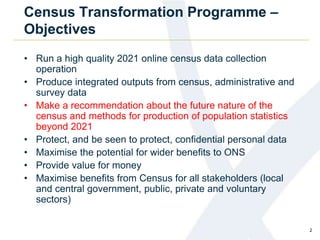
Census Transformation Programme –
Objectives
• Run a high quality 2021 online census data collection
operation
• Produce integrated outputs from census, administrative and
survey data
• Make a recommendation about the future nature of the
census and methods for production of population statistics
beyond 2021
• Protect, and be seen to protect, confidential personal data
• Maximise the potential for wider benefits to ONS
• Provide value for money
• Maximise benefits from Census for all stakeholders (local
and central government, public, private and voluntary
sectors)
2
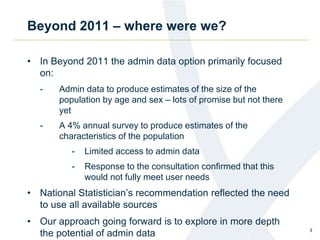
Beyond 2011 – where were we?
• In Beyond 2011 the admin data option primarily focused
on:
- Admin data to produce estimates of the size of the
population by age and sex – lots of promise but not there
yet
- A 4% annual survey to produce estimates of the
characteristics of the population
- Limited access to admin data
- Response to the consultation confirmed that this
would not fully meet user needs
• National Statistician’s recommendation reflected the need
to use all available sources
• Our approach going forward is to explore in more depth
the potential of admin data 3
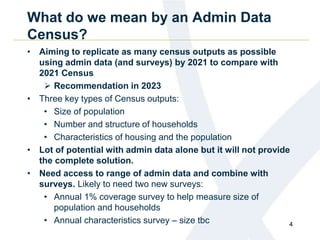
What do we mean by an Admin Data
Census?
• Aiming to replicate as many census outputs as possible
using admin data (and surveys) by 2021 to compare with
2021 Census
 Recommendation in 2023
• Three key types of Census outputs:
• Size of population
• Number and structure of households
• Characteristics of housing and the population
• Lot of potential with admin data alone but it will not provide
the complete solution.
• Need access to range of admin data and combine with
surveys. Likely to need two new surveys:
• Annual 1% coverage survey to help measure size of
population and households
• Annual characteristics survey – size tbc 4
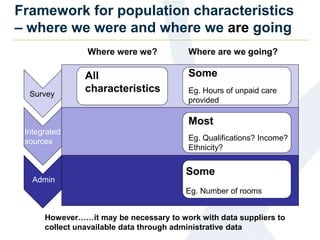
Framework for population characteristics
– where we were and where we are going
Where were we? Where are we going?
Some
Eg. Number of rooms
Most
Eg. Qualifications? Income?
Ethnicity?
Some
Eg. Hours of unpaid care
provided
Survey
Integrated
sources
Admin
However……it may be necessary to work with data suppliers to
collect unavailable data through administrative data
All
characteristics
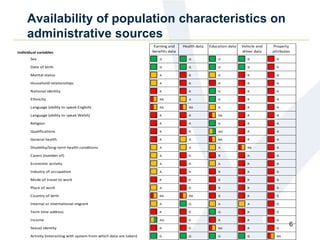
Availability of population characteristics on
administrative sources
6
Individual variables
Sex 5 5 G 5 5 G 5 5 G 5 5 G 1 1 R
Date of birth 5 5 G 5 5 G 5 5 G 5 5 G 1 1 R
Marital status 3 3 A 1 1 R 3 3 A 1 1 R 1 1 R
Household relationships 3 3 A 1 1 R 1 1 R 1 1 R 1 1 R
National identity 1 1 R 1 1 R 5 5 G 1 1 R 1 1 R
Ethnicity 2 2 RA 3 3 A 5 5 G 1 1 R 1 1 R
Language (ability to speak English) 2 2 RA 2 2 RA 3 3 A 1 1 R 1 1 R
Language (ability to speak Welsh) 1 1 R 1 1 R 2 2 RA 1 1 R 1 1 R
Religion 1 1 R 1 1 R 5 5 G 1 1 R 1 1 R
Qualifications 1 1 R 1 1 R 4 4 AG 1 1 R 1 1 R
General health 1 1 R 3 3 A 2 2 RA 1 1 R 1 1 R
Disability/long-term health conditions 3 3 A 3 3 A 3 3 A 2 2 RA 1 1 R
Carers (number of) 3 3 A 1 1 R 1 1 R 1 1 R 1 1 R
Economic activity 3 3 A 1 1 R 3 3 A 1 1 R 1 1 R
Industry of occupation 3 3 A 1 1 R 1 1 R 1 1 R 1 1 R
Mode of travel to work 1 1 R 1 1 R 1 1 R 1 1 R 1 1 R
Place of work 3 3 A 1 1 R 1 1 R 1 1 R 1 1 R
Country of birth 2 2 RA 2 2 RA 1 1 R 1 1 R 1 1 R
Internal or international migrant 3 3 A 5 5 G 3 3 A 3 3 A 1 1 R
Term time address 1 1 R 1 1 R 5 5 G 1 1 R 1 1 R
Income 4 4 AG 1 1 R 1 1 R 1 1 R 1 1 R
Sexual identity 1 1 R 1 1 R 2 2 RA 1 1 R 1 1 R
Activity (interacting with system from which data are taken) 5 5 G 5 5 G 5 5 G 5 5 G 2 2 RA
Earning and
benefits data
Health data Education data Vehicle and
driver data
Property
attributes
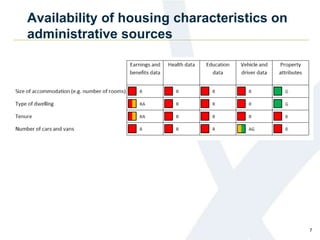
Availability of housing characteristics on
administrative sources
7
Key public and private sector data
required
• DWP/HMRC – have access to basic demographic data on those with a
NINO and limited activity and income data but need more.
• Health data (HSCIC/DH/PHE) and Welsh equivalents – have access to
GP register data but need more activity data and information on health
conditions
• eg information on those attending hospital appointments,
prescription data and a health index (eg good, average, poor
health)
• Education data – pursuing access to joint BIS/HESA/DFE education
dataset (and will need Welsh equivalent)
• Housing data – access to feasibility dataset from VOA. Private sector
data such as Zoopla may also be useful eg tenure
• DVLA data – numbers of cars/vans plus driver and vehicle registration
activity data: initial discussions
• Mobile phone data may be able to provide statistics on commuting
patterns – initial stages of procuring some non-identifiable data
• Electoral Roll and Council Tax data
• Other locally held data eg activity data indicating use of local services
8
Outputs
Linked
data
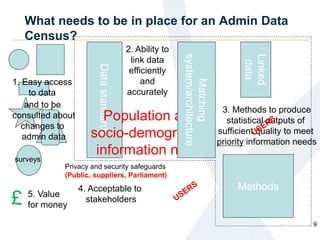
What needs to be in place for an Admin Data
Census?
9
Linked
data
surveys
Privacy and security safeguards
(Public, suppliers, Parliament)
£
4. Acceptable to
stakeholders
2. Ability to
link data
efficiently
and
accurately
1. Easy access
to data
and to be
consulted about
changes to
admin data
3. Methods to produce
statistical outputs of
sufficient quality to meet
priority information needs
Datastandards
Population and
socio-demographic
information needs
5. Value
for money
Methods
Matching
system/architecture
How will we know if we’re ready to
move?
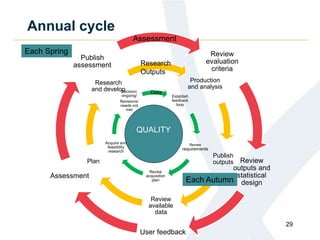
• Annual cycle
• Research outputs every Autumn (first: 22
October 2015)
• expanding the accuracy and/or breadth and/or
detail each year
• Assessment every Spring (first: 16 May 2016)
• Using five high level criteria
• where we are now
• where we expect to be by 2023 10
Access to data
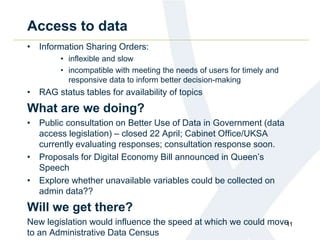
• Information Sharing Orders:
• inflexible and slow
• incompatible with meeting the needs of users for timely and
responsive data to inform better decision-making
• RAG status tables for availability of topics
What are we doing?
• Public consultation on Better Use of Data in Government (data
access legislation) – closed 22 April; Cabinet Office/UKSA
currently evaluating responses; consultation response soon.
• Proposals for Digital Economy Bill announced in Queen’s
Speech
• Explore whether unavailable variables could be collected on
admin data??
Will we get there?
New legislation would influence the speed at which we could move
to an Administrative Data Census
11
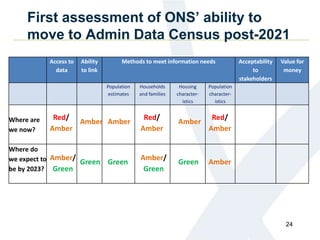
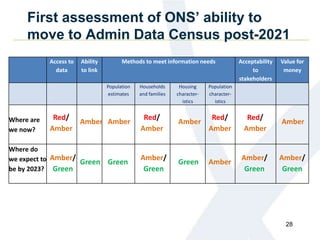
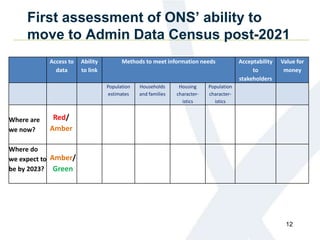
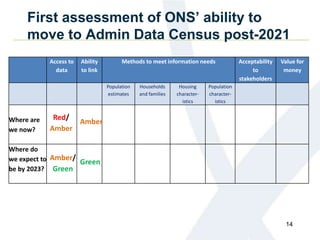
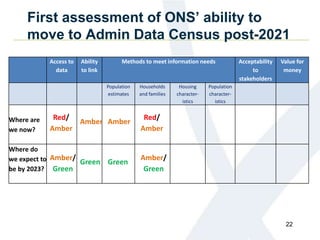
First assessment of ONS’ ability to
move to Admin Data Census post-2021
Access to
data
Ability
to link
Methods to meet information needs Acceptability
to
stakeholders
Value for
money
Population
estimates
Households
and families
Housing
character-
istics
Population
character-
istics
Where are
we now?
Where do
we expect to
be by 2023?
12
Amber/
Green
Red/
Amber
Linkage
• Anonymous matching methods developed in Beyond 2011
• Offer efficient approach to linking large data sets
• Demonstrated level of quality that could be achieved
• Offered a solution to privacy and security concerns
• HOWEVER as we link more and more data together, the
linkage error resulting from this approach will compound
What are we doing?
• Reviewing our longer term approach to privacy and data linkage
but continue to build on methodological research to date
• Exploring how harmonised principles, common approaches to
cleaning/ processing and formats could improve efficiency and
accuracy of linking, eg. UPRN at source
13
First assessment of ONS’ ability to
move to Admin Data Census post-2021
Access to
data
Ability
to link
Methods to meet information needs Acceptability
to
stakeholders
Value for
money
Population
estimates
Households
and families
Housing
character-
istics
Population
character-
istics
Where are
we now?
Where do
we expect to
be by 2023?
14
Amber/
Green
Green
Red/
Amber
Amber
What have we done so far?
Size of the population
• Linked NHS Patient Register, DWP/HMRC national insurance
data and student data
• Published Research Outputs (October 2015) for 2011, 2013 and
2014 at LA level by 5-year age and sex – shows a lot of promise
15
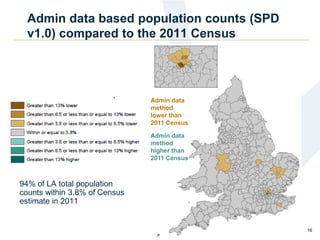
Admin data based population counts (SPD
v1.0) compared to the 2011 Census
94% of LA total population
counts within 3.8% of Census
estimate in 2011
16
Admin data
method
lower than
2011 Census
Admin data
method
higher than
2011 Census
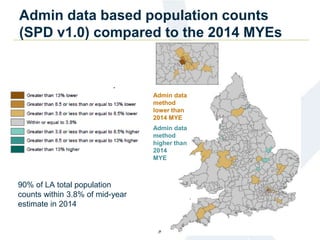
Admin data based population counts
(SPD v1.0) compared to the 2014 MYEs
90% of LA total population
counts within 3.8% of mid-year
estimate in 2014
Admin data
method
lower than
2014 MYE
Admin data
method
higher than
2014
MYE
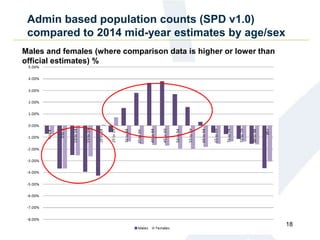
Admin based population counts (SPD v1.0)
compared to 2014 mid-year estimates by age/sex
18
Males and females (where comparison data is higher or lower than
official estimates) %
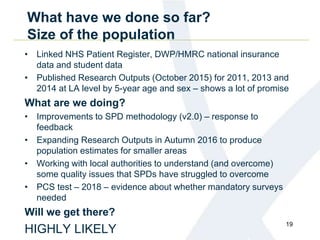
What have we done so far?
Size of the population
• Linked NHS Patient Register, DWP/HMRC national insurance
data and student data
• Published Research Outputs (October 2015) for 2011, 2013 and
2014 at LA level by 5-year age and sex – shows a lot of promise
What are we doing?
• Improvements to SPD methodology (v2.0) – response to
feedback
• Expanding Research Outputs in Autumn 2016 to produce
population estimates for smaller areas
• Working with local authorities to understand (and overcome)
some quality issues that SPDs have struggled to overcome
• PCS test – 2018 – evidence about whether mandatory surveys
needed
Will we get there?
HIGHLY LIKELY
19
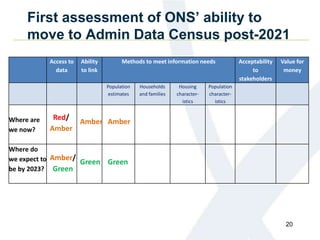
First assessment of ONS’ ability to
move to Admin Data Census post-2021
Access to
data
Ability
to link
Methods to meet information needs Acceptability
to
stakeholders
Value for
money
Population
estimates
Households
and families
Housing
character-
istics
Population
character-
istics
Where are
we now?
Where do
we expect to
be by 2023?
20
Amber/
Green
Green Green
Red/
Amber
Amber Amber
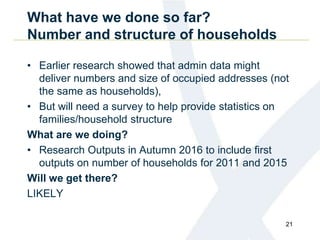
What have we done so far?
Number and structure of households
• Earlier research showed that admin data might
deliver numbers and size of occupied addresses (not
the same as households),
• But will need a survey to help provide statistics on
families/household structure
What are we doing?
• Research Outputs in Autumn 2016 to include first
outputs on number of households for 2011 and 2015
Will we get there?
LIKELY
21
First assessment of ONS’ ability to
move to Admin Data Census post-2021
Access to
data
Ability
to link
Methods to meet information needs Acceptability
to
stakeholders
Value for
money
Population
estimates
Households
and families
Housing
character-
istics
Population
character-
istics
Where are
we now?
Where do
we expect to
be by 2023?
22
Amber/
Green
Amber/
Green
Green Green
Red/
Amber
Red/
Amber
Amber Amber
Housing and population characteristics
What are we doing?
• Publishing Research Outputs on income (PAYE and Benefits data) in
Autumn 2016
• Future Research Outputs from combining admin data with existing
surveys e.g. [dependent on data access and statistical quality]
• Joint ONS/DWP Modelled income estimates - 2017
• Number of rooms and floor-space using VOA data – 2017
• Qualifications using admin data from BIS/DfE – 2017?
• Commuter flows from mobile phone data – 2018?
• Aim to expand accuracy, breadth and detail of outputs each year
Will we get there?
A MIXED PICTURE
Some topics - yes, others may be limited in terms of geographical
granularity, such as number of hours of unpaid care provided 23
First assessment of ONS’ ability to
move to Admin Data Census post-2021
Access to
data
Ability
to link
Methods to meet information needs Acceptability
to
stakeholders
Value for
money
Population
estimates
Households
and families
Housing
character-
istics
Population
character-
istics
Where are
we now?
Where do
we expect to
be by 2023?
24
Amber/
Green
Amber/
Green
Green Green Green
Red/
Amber
Red/
Amber
Red/
Amber
Amber Amber Amber
Amber
Acceptability to stakeholders
What are we doing?
Users – offering opportunity to provide feedback on
each iteration of Research Outputs, Research
Conference, user working groups
Data suppliers – developing relationships with data
suppliers, DSG, statistical quality feedback
Public – exploring alternative matching approaches,
public acceptability research, consultation in 2023,
open and transparent about what we’re doing
Will we get there?
LIKELY – but heavily dependent on meeting user needs
with outputs – and there will be trade offs 25
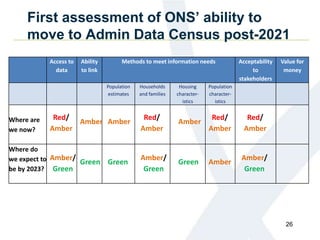
First assessment of ONS’ ability to
move to Admin Data Census post-2021
Access to
data
Ability
to link
Methods to meet information needs Acceptability
to
stakeholders
Value for
money
Population
estimates
Households
and families
Housing
character-
istics
Population
character-
istics
Where are
we now?
Where do
we expect to
be by 2023?
26
Amber/
Green
Amber/
Green
Amber/
Green
Green Green Green
Red/
Amber
Red/
Amber
Red/
Amber
Red/
Amber
Amber Amber Amber
Amber
Value for money
What are we doing?
• Refining benefit quantification analysis to take
account of new outputs that could be provided (for
example, fuel poverty, income, housing affordability)
and increased frequency/timeliness
• Trade off: improvements described above vs. level of
detail/quality that can be provided
eg. Hours of unpaid caring by ethnic group for small areas
Will we get there?
Likely – but heavily dependent on meeting user needs
and trade offs
27
First assessment of ONS’ ability to
move to Admin Data Census post-2021
Access to
data
Ability
to link
Methods to meet information needs Acceptability
to
stakeholders
Value for
money
Population
estimates
Households
and families
Housing
character-
istics
Population
character-
istics
Where are
we now?
Where do
we expect to
be by 2023?
28
Amber/
Green
Amber/
Green
Amber/
Green
Amber/
Green
Green Green Green
Red/
Amber
Red/
Amber
Red/
Amber
Red/
Amber
AmberAmber Amber Amber
Amber
Review
evaluation
criteria
Review
outputs and
statistical
design
User feedback
Assessment
Publish
assessment
Production
and analysis
Publish
outputs
Review
available
data
Plan
Research
and develop
Establish
feedback
loop
Review
requirements
Revise
acquisition
plan
Acquire and
feasibility
research
Decision:
ongoing/
Revisions/
needs not
met
Annual cycle
29
Assessment
Each Autumn
Research
Outputs
Data
QUALITY
Each Spring
Contacts
Andy Teague– Admin Data Census,
Census Transformation Programme
Andy.Teague@ons.gov.uk
Becky Tinsley– Admin Data Census,
Census Transformation Programme
Becky.Tinsley@ons.gov.uk
Towards an administrative data census   the story so far

Towards an administrative data census the story so far

  • 1.
    Towards an AdministrativeData Census – the story so far Andy Teague, Becky Tinsley Admin Data Census Project Census Transformation Programme 1
  • 2.
    Census Transformation Programme– Objectives • Run a high quality 2021 online census data collection operation • Produce integrated outputs from census, administrative and survey data • Make a recommendation about the future nature of the census and methods for production of population statistics beyond 2021 • Protect, and be seen to protect, confidential personal data • Maximise the potential for wider benefits to ONS • Provide value for money • Maximise benefits from Census for all stakeholders (local and central government, public, private and voluntary sectors) 2
  • 3.
    Beyond 2011 –where were we? • In Beyond 2011 the admin data option primarily focused on: - Admin data to produce estimates of the size of the population by age and sex – lots of promise but not there yet - A 4% annual survey to produce estimates of the characteristics of the population - Limited access to admin data - Response to the consultation confirmed that this would not fully meet user needs • National Statistician’s recommendation reflected the need to use all available sources • Our approach going forward is to explore in more depth the potential of admin data 3
  • 4.
    What do wemean by an Admin Data Census? • Aiming to replicate as many census outputs as possible using admin data (and surveys) by 2021 to compare with 2021 Census  Recommendation in 2023 • Three key types of Census outputs: • Size of population • Number and structure of households • Characteristics of housing and the population • Lot of potential with admin data alone but it will not provide the complete solution. • Need access to range of admin data and combine with surveys. Likely to need two new surveys: • Annual 1% coverage survey to help measure size of population and households • Annual characteristics survey – size tbc 4
  • 5.
    Framework for populationcharacteristics – where we were and where we are going Where were we? Where are we going? Some Eg. Number of rooms Most Eg. Qualifications? Income? Ethnicity? Some Eg. Hours of unpaid care provided Survey Integrated sources Admin However……it may be necessary to work with data suppliers to collect unavailable data through administrative data All characteristics
  • 6.
    Availability of populationcharacteristics on administrative sources 6 Individual variables Sex 5 5 G 5 5 G 5 5 G 5 5 G 1 1 R Date of birth 5 5 G 5 5 G 5 5 G 5 5 G 1 1 R Marital status 3 3 A 1 1 R 3 3 A 1 1 R 1 1 R Household relationships 3 3 A 1 1 R 1 1 R 1 1 R 1 1 R National identity 1 1 R 1 1 R 5 5 G 1 1 R 1 1 R Ethnicity 2 2 RA 3 3 A 5 5 G 1 1 R 1 1 R Language (ability to speak English) 2 2 RA 2 2 RA 3 3 A 1 1 R 1 1 R Language (ability to speak Welsh) 1 1 R 1 1 R 2 2 RA 1 1 R 1 1 R Religion 1 1 R 1 1 R 5 5 G 1 1 R 1 1 R Qualifications 1 1 R 1 1 R 4 4 AG 1 1 R 1 1 R General health 1 1 R 3 3 A 2 2 RA 1 1 R 1 1 R Disability/long-term health conditions 3 3 A 3 3 A 3 3 A 2 2 RA 1 1 R Carers (number of) 3 3 A 1 1 R 1 1 R 1 1 R 1 1 R Economic activity 3 3 A 1 1 R 3 3 A 1 1 R 1 1 R Industry of occupation 3 3 A 1 1 R 1 1 R 1 1 R 1 1 R Mode of travel to work 1 1 R 1 1 R 1 1 R 1 1 R 1 1 R Place of work 3 3 A 1 1 R 1 1 R 1 1 R 1 1 R Country of birth 2 2 RA 2 2 RA 1 1 R 1 1 R 1 1 R Internal or international migrant 3 3 A 5 5 G 3 3 A 3 3 A 1 1 R Term time address 1 1 R 1 1 R 5 5 G 1 1 R 1 1 R Income 4 4 AG 1 1 R 1 1 R 1 1 R 1 1 R Sexual identity 1 1 R 1 1 R 2 2 RA 1 1 R 1 1 R Activity (interacting with system from which data are taken) 5 5 G 5 5 G 5 5 G 5 5 G 2 2 RA Earning and benefits data Health data Education data Vehicle and driver data Property attributes
  • 7.
    Availability of housingcharacteristics on administrative sources 7
  • 8.
    Key public andprivate sector data required • DWP/HMRC – have access to basic demographic data on those with a NINO and limited activity and income data but need more. • Health data (HSCIC/DH/PHE) and Welsh equivalents – have access to GP register data but need more activity data and information on health conditions • eg information on those attending hospital appointments, prescription data and a health index (eg good, average, poor health) • Education data – pursuing access to joint BIS/HESA/DFE education dataset (and will need Welsh equivalent) • Housing data – access to feasibility dataset from VOA. Private sector data such as Zoopla may also be useful eg tenure • DVLA data – numbers of cars/vans plus driver and vehicle registration activity data: initial discussions • Mobile phone data may be able to provide statistics on commuting patterns – initial stages of procuring some non-identifiable data • Electoral Roll and Council Tax data • Other locally held data eg activity data indicating use of local services 8
  • 9.
    Outputs Linked data What needs tobe in place for an Admin Data Census? 9 Linked data surveys Privacy and security safeguards (Public, suppliers, Parliament) £ 4. Acceptable to stakeholders 2. Ability to link data efficiently and accurately 1. Easy access to data and to be consulted about changes to admin data 3. Methods to produce statistical outputs of sufficient quality to meet priority information needs Datastandards Population and socio-demographic information needs 5. Value for money Methods Matching system/architecture
  • 10.
    How will weknow if we’re ready to move? • Annual cycle • Research outputs every Autumn (first: 22 October 2015) • expanding the accuracy and/or breadth and/or detail each year • Assessment every Spring (first: 16 May 2016) • Using five high level criteria • where we are now • where we expect to be by 2023 10
  • 11.
    Access to data •Information Sharing Orders: • inflexible and slow • incompatible with meeting the needs of users for timely and responsive data to inform better decision-making • RAG status tables for availability of topics What are we doing? • Public consultation on Better Use of Data in Government (data access legislation) – closed 22 April; Cabinet Office/UKSA currently evaluating responses; consultation response soon. • Proposals for Digital Economy Bill announced in Queen’s Speech • Explore whether unavailable variables could be collected on admin data?? Will we get there? New legislation would influence the speed at which we could move to an Administrative Data Census 11
  • 12.
    First assessment ofONS’ ability to move to Admin Data Census post-2021 Access to data Ability to link Methods to meet information needs Acceptability to stakeholders Value for money Population estimates Households and families Housing character- istics Population character- istics Where are we now? Where do we expect to be by 2023? 12 Amber/ Green Red/ Amber
  • 13.
    Linkage • Anonymous matchingmethods developed in Beyond 2011 • Offer efficient approach to linking large data sets • Demonstrated level of quality that could be achieved • Offered a solution to privacy and security concerns • HOWEVER as we link more and more data together, the linkage error resulting from this approach will compound What are we doing? • Reviewing our longer term approach to privacy and data linkage but continue to build on methodological research to date • Exploring how harmonised principles, common approaches to cleaning/ processing and formats could improve efficiency and accuracy of linking, eg. UPRN at source 13
  • 14.
    First assessment ofONS’ ability to move to Admin Data Census post-2021 Access to data Ability to link Methods to meet information needs Acceptability to stakeholders Value for money Population estimates Households and families Housing character- istics Population character- istics Where are we now? Where do we expect to be by 2023? 14 Amber/ Green Green Red/ Amber Amber
  • 15.
    What have wedone so far? Size of the population • Linked NHS Patient Register, DWP/HMRC national insurance data and student data • Published Research Outputs (October 2015) for 2011, 2013 and 2014 at LA level by 5-year age and sex – shows a lot of promise 15
  • 16.
    Admin data basedpopulation counts (SPD v1.0) compared to the 2011 Census 94% of LA total population counts within 3.8% of Census estimate in 2011 16 Admin data method lower than 2011 Census Admin data method higher than 2011 Census
  • 17.
    Admin data basedpopulation counts (SPD v1.0) compared to the 2014 MYEs 90% of LA total population counts within 3.8% of mid-year estimate in 2014 Admin data method lower than 2014 MYE Admin data method higher than 2014 MYE
  • 18.
    Admin based populationcounts (SPD v1.0) compared to 2014 mid-year estimates by age/sex 18 Males and females (where comparison data is higher or lower than official estimates) %
  • 19.
    What have wedone so far? Size of the population • Linked NHS Patient Register, DWP/HMRC national insurance data and student data • Published Research Outputs (October 2015) for 2011, 2013 and 2014 at LA level by 5-year age and sex – shows a lot of promise What are we doing? • Improvements to SPD methodology (v2.0) – response to feedback • Expanding Research Outputs in Autumn 2016 to produce population estimates for smaller areas • Working with local authorities to understand (and overcome) some quality issues that SPDs have struggled to overcome • PCS test – 2018 – evidence about whether mandatory surveys needed Will we get there? HIGHLY LIKELY 19
  • 20.
    First assessment ofONS’ ability to move to Admin Data Census post-2021 Access to data Ability to link Methods to meet information needs Acceptability to stakeholders Value for money Population estimates Households and families Housing character- istics Population character- istics Where are we now? Where do we expect to be by 2023? 20 Amber/ Green Green Green Red/ Amber Amber Amber
  • 21.
    What have wedone so far? Number and structure of households • Earlier research showed that admin data might deliver numbers and size of occupied addresses (not the same as households), • But will need a survey to help provide statistics on families/household structure What are we doing? • Research Outputs in Autumn 2016 to include first outputs on number of households for 2011 and 2015 Will we get there? LIKELY 21
  • 22.
    First assessment ofONS’ ability to move to Admin Data Census post-2021 Access to data Ability to link Methods to meet information needs Acceptability to stakeholders Value for money Population estimates Households and families Housing character- istics Population character- istics Where are we now? Where do we expect to be by 2023? 22 Amber/ Green Amber/ Green Green Green Red/ Amber Red/ Amber Amber Amber
  • 23.
    Housing and populationcharacteristics What are we doing? • Publishing Research Outputs on income (PAYE and Benefits data) in Autumn 2016 • Future Research Outputs from combining admin data with existing surveys e.g. [dependent on data access and statistical quality] • Joint ONS/DWP Modelled income estimates - 2017 • Number of rooms and floor-space using VOA data – 2017 • Qualifications using admin data from BIS/DfE – 2017? • Commuter flows from mobile phone data – 2018? • Aim to expand accuracy, breadth and detail of outputs each year Will we get there? A MIXED PICTURE Some topics - yes, others may be limited in terms of geographical granularity, such as number of hours of unpaid care provided 23
  • 24.
    First assessment ofONS’ ability to move to Admin Data Census post-2021 Access to data Ability to link Methods to meet information needs Acceptability to stakeholders Value for money Population estimates Households and families Housing character- istics Population character- istics Where are we now? Where do we expect to be by 2023? 24 Amber/ Green Amber/ Green Green Green Green Red/ Amber Red/ Amber Red/ Amber Amber Amber Amber Amber
  • 25.
    Acceptability to stakeholders Whatare we doing? Users – offering opportunity to provide feedback on each iteration of Research Outputs, Research Conference, user working groups Data suppliers – developing relationships with data suppliers, DSG, statistical quality feedback Public – exploring alternative matching approaches, public acceptability research, consultation in 2023, open and transparent about what we’re doing Will we get there? LIKELY – but heavily dependent on meeting user needs with outputs – and there will be trade offs 25
  • 26.
    First assessment ofONS’ ability to move to Admin Data Census post-2021 Access to data Ability to link Methods to meet information needs Acceptability to stakeholders Value for money Population estimates Households and families Housing character- istics Population character- istics Where are we now? Where do we expect to be by 2023? 26 Amber/ Green Amber/ Green Amber/ Green Green Green Green Red/ Amber Red/ Amber Red/ Amber Red/ Amber Amber Amber Amber Amber
  • 27.
    Value for money Whatare we doing? • Refining benefit quantification analysis to take account of new outputs that could be provided (for example, fuel poverty, income, housing affordability) and increased frequency/timeliness • Trade off: improvements described above vs. level of detail/quality that can be provided eg. Hours of unpaid caring by ethnic group for small areas Will we get there? Likely – but heavily dependent on meeting user needs and trade offs 27
  • 28.
    First assessment ofONS’ ability to move to Admin Data Census post-2021 Access to data Ability to link Methods to meet information needs Acceptability to stakeholders Value for money Population estimates Households and families Housing character- istics Population character- istics Where are we now? Where do we expect to be by 2023? 28 Amber/ Green Amber/ Green Amber/ Green Amber/ Green Green Green Green Red/ Amber Red/ Amber Red/ Amber Red/ Amber AmberAmber Amber Amber Amber
  • 29.
    Review evaluation criteria Review outputs and statistical design User feedback Assessment Publish assessment Production andanalysis Publish outputs Review available data Plan Research and develop Establish feedback loop Review requirements Revise acquisition plan Acquire and feasibility research Decision: ongoing/ Revisions/ needs not met Annual cycle 29 Assessment Each Autumn Research Outputs Data QUALITY Each Spring
  • 30.
    Contacts Andy Teague– AdminData Census, Census Transformation Programme Andy.Teague@ons.gov.uk Becky Tinsley– Admin Data Census, Census Transformation Programme Becky.Tinsley@ons.gov.uk

Editor's Notes

  • #10 ***Animation – best viewed in slideshow mode**