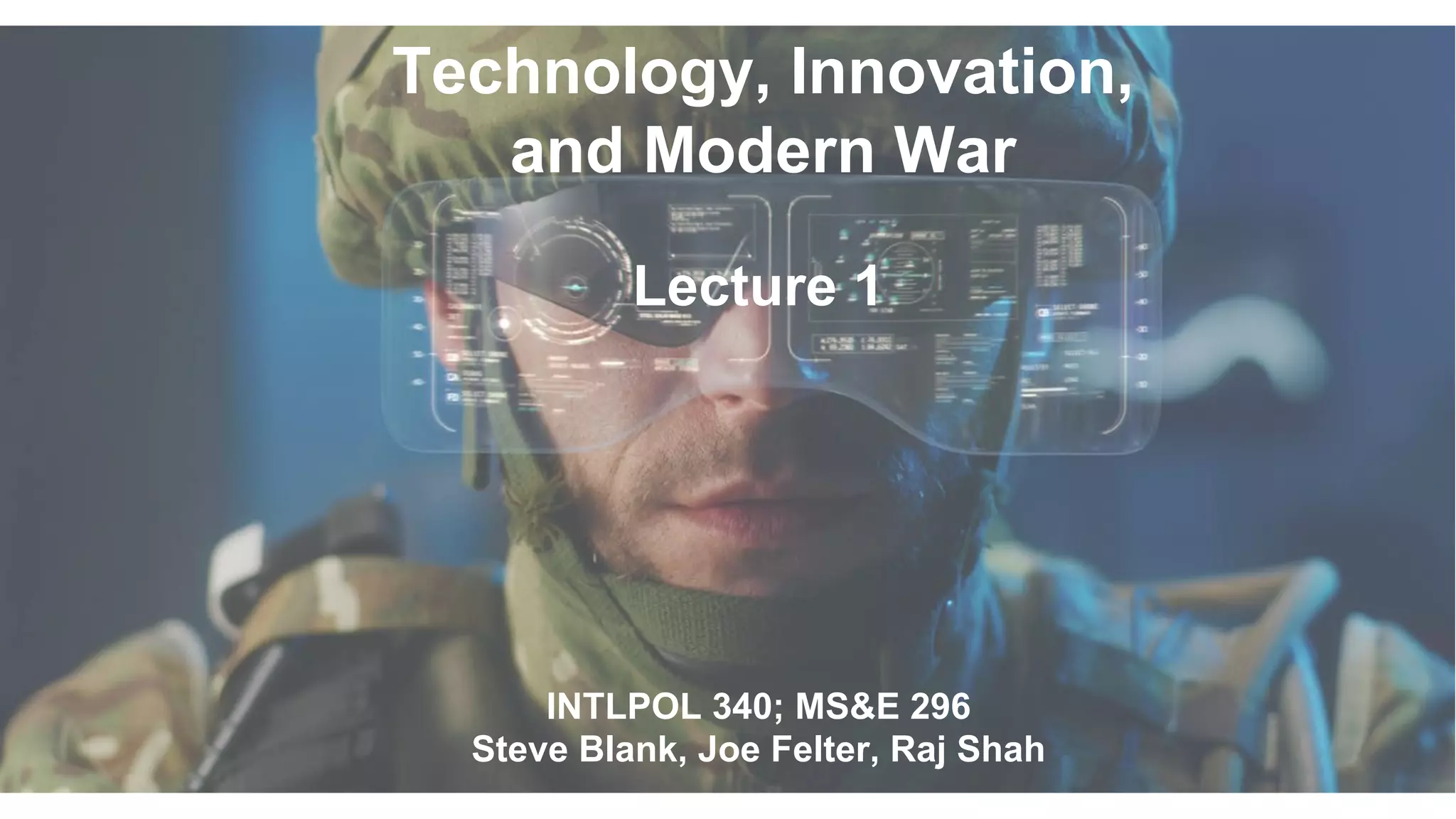
Technology, Innovation,
and Modern War
INTLPOL 340; MS&E 296
Steve Blank, Joe Felter, Raj Shah
Lecture 1
“The problem is not lack of money, lack of technology,
and certainly not lack of capable and committed people
in the US government, military and private industry.
No, the real problem is a lack of imagination.”
Christian Brose, Kill Chain 2020
Agenda
• Teaching Team
• Class Logistics
• The Course at A Glance
• Ash Carter
• Lesson 2 - coming attractions
Student Intro
Name, Discipline, Interest
Teaching Team
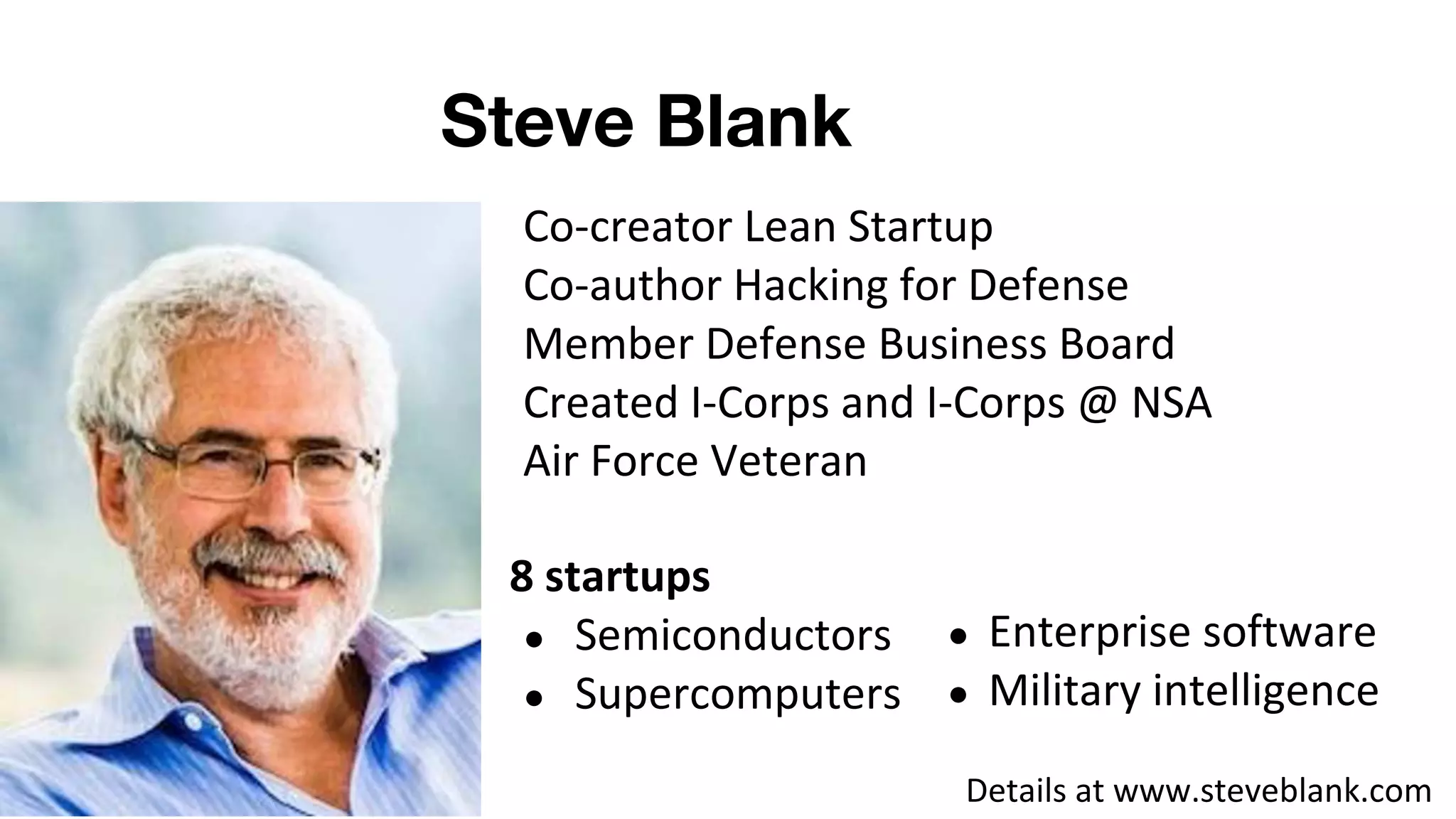
Steve Blank
Co-creator Lean Startup
Co-author Hacking for Defense
Member Defense Business Board
Created I-Corps and I-Corps @ NSA
Air Force Veteran
8 startups
● Semiconductors
● Supercomputers
Details at www.steveblank.com
● Enterprise software
● Military intelligence
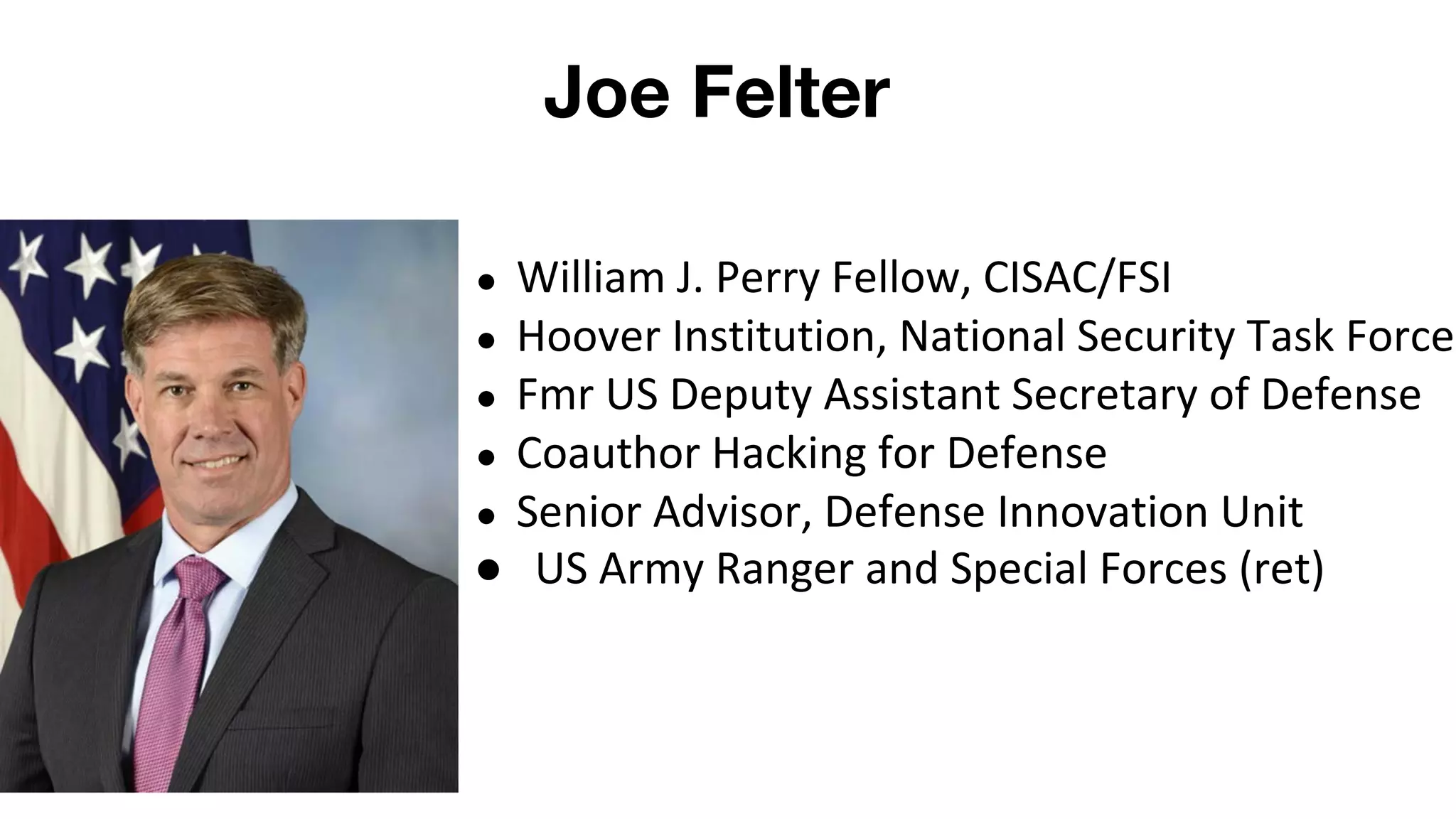
Joe Felter
● William J. Perry Fellow, CISAC/FSI
● Hoover Institution, National Security Task Force
● Fmr US Deputy Assistant Secretary of Defense
● Coauthor Hacking for Defense
● Senior Advisor, Defense Innovation Unit
● US Army Ranger and Special Forces (ret)
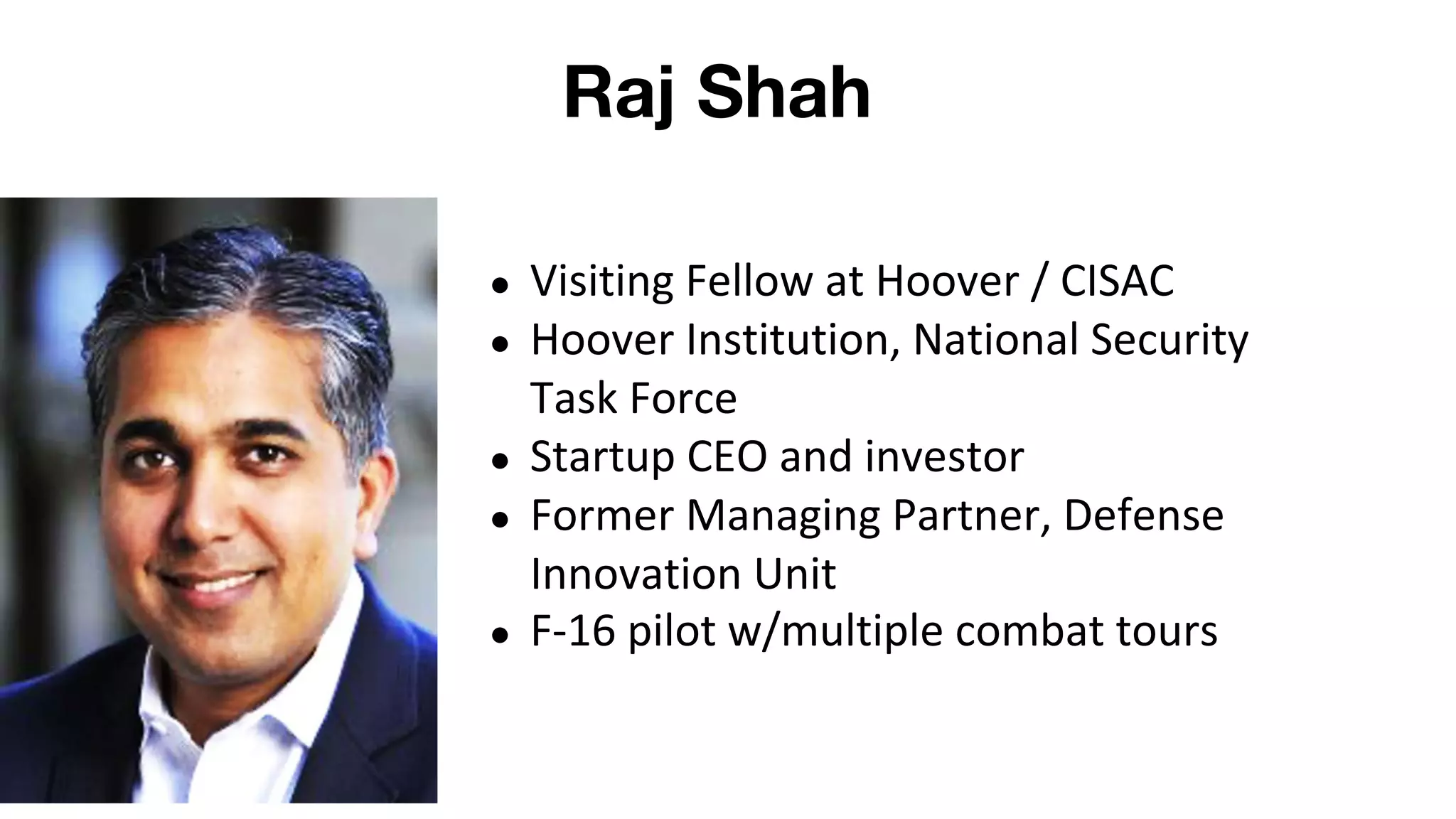
Raj Shah
● Visiting Fellow at Hoover / CISAC
● Hoover Institution, National Security
Task Force
● Startup CEO and investor
● Former Managing Partner, Defense
Innovation Unit
● F-16 pilot w/multiple combat tours
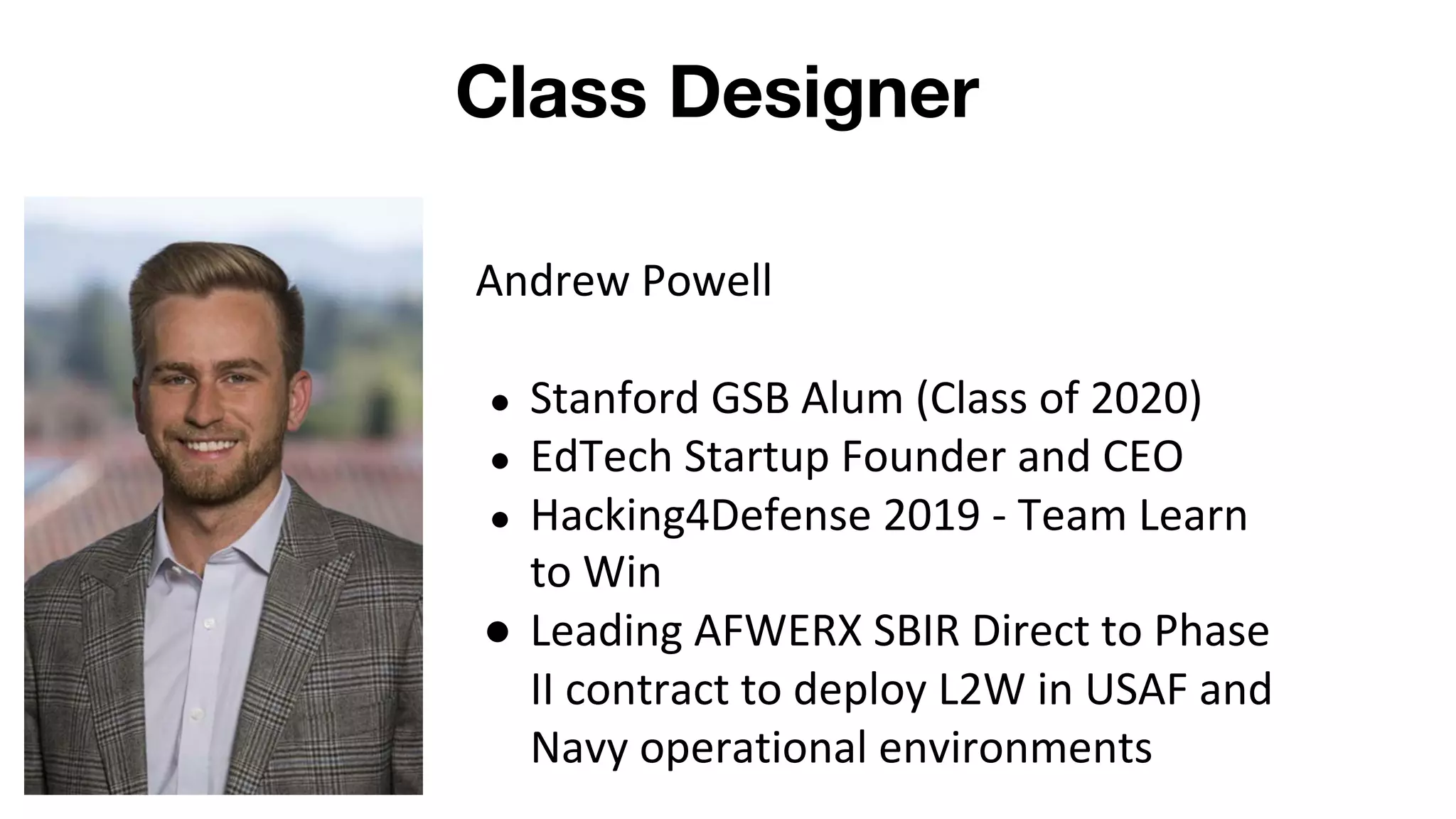
Class Designer
Andrew Powell
● Stanford GSB Alum (Class of 2020)
● EdTech Startup Founder and CEO
● Hacking4Defense 2019 - Team Learn
to Win
● Leading AFWERX SBIR Direct to Phase
II contract to deploy L2W in USAF and
Navy operational environments
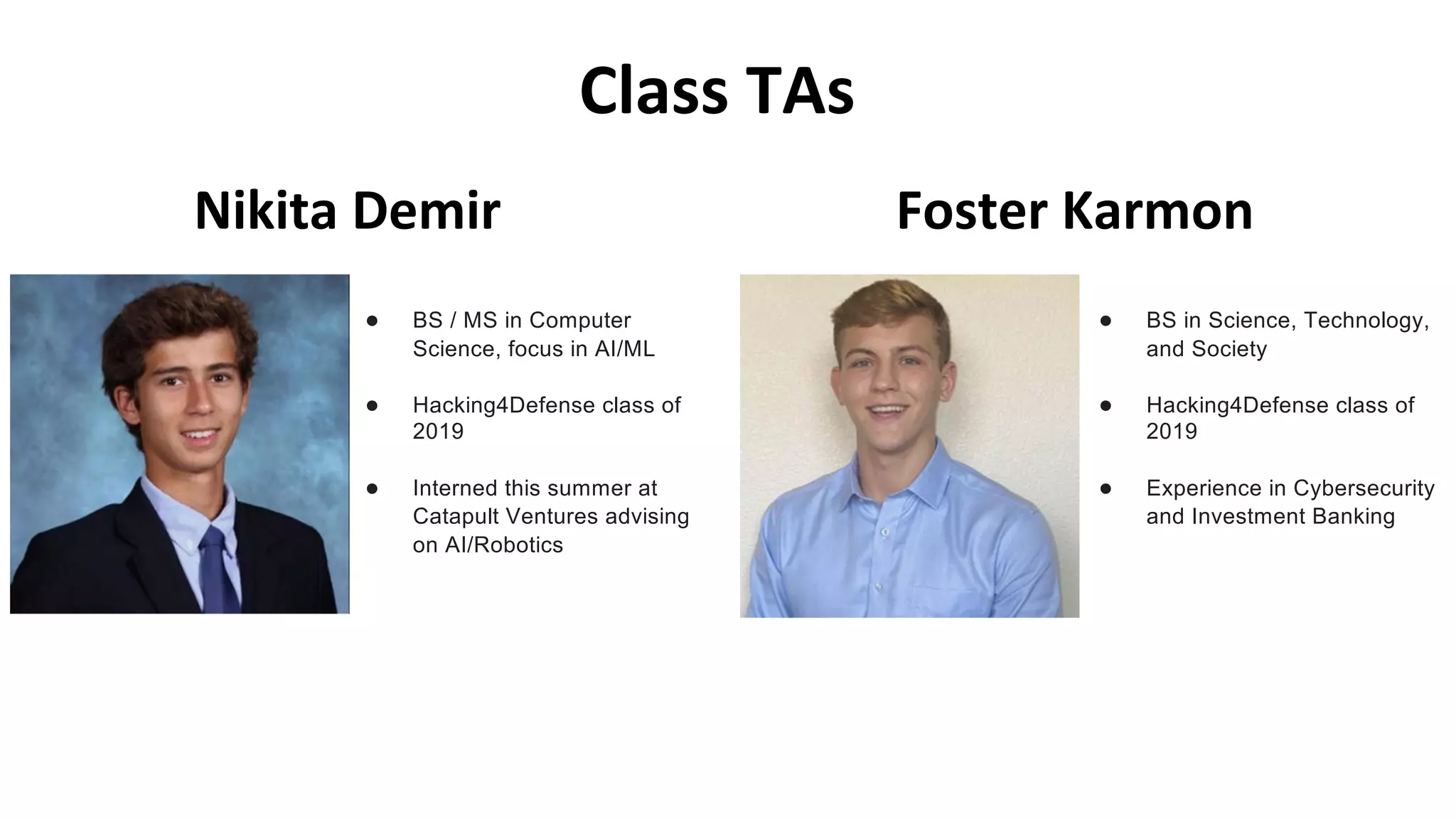
Class TAs
Nikita Demir
● BS / MS in Computer
Science, focus in AI/ML
● Hacking4Defense class of
2019
● Interned this summer at
Catapult Ventures advising
on AI/Robotics
● BS in Science, Technology,
and Society
● Hacking4Defense class of
2019
● Experience in Cybersecurity
and Investment Banking
Foster Karmon
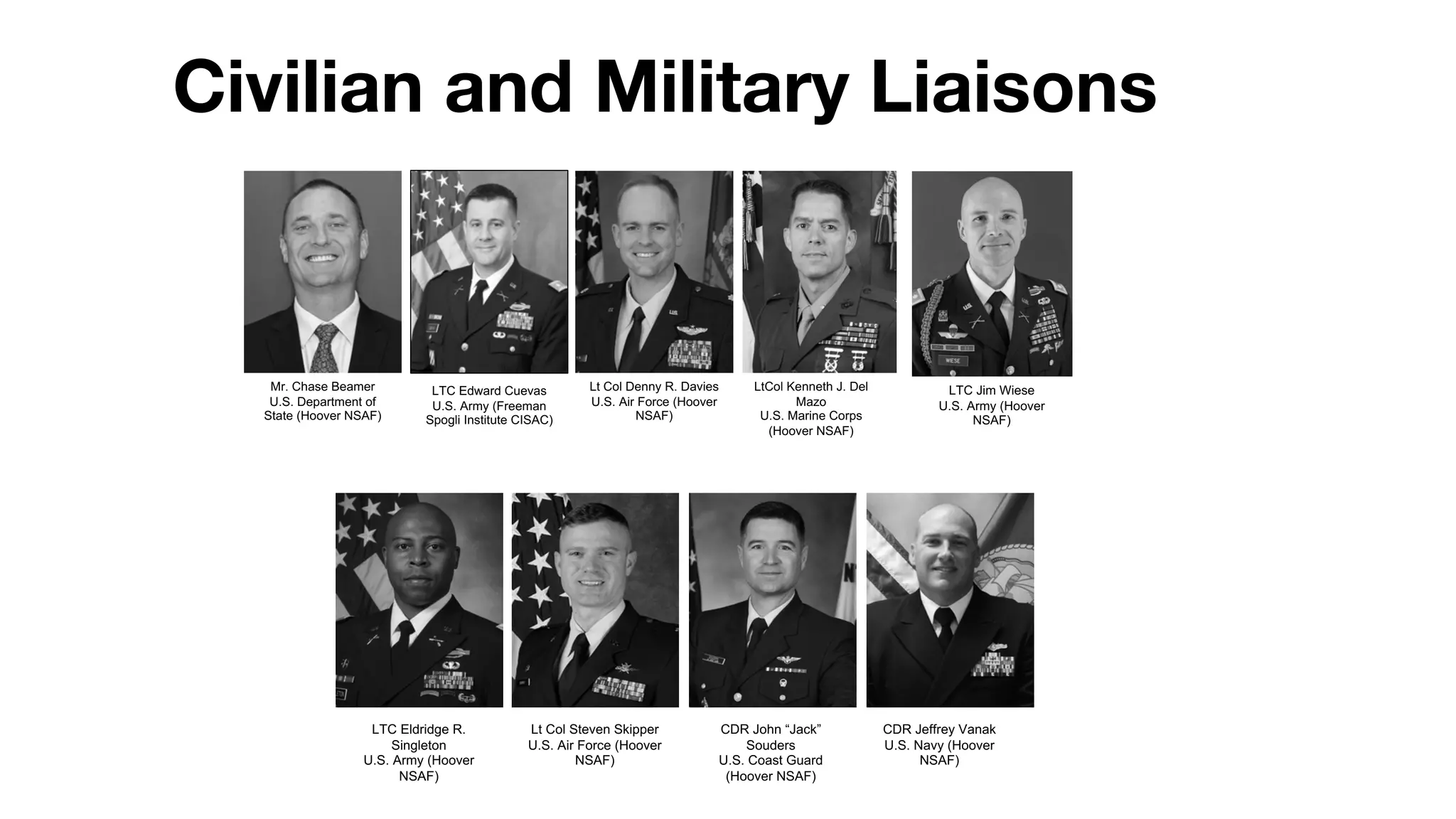
Civilian and Military Liaisons
Lt Col Denny R. Davies
U.S. Air Force (Hoover
NSAF)
LtCol Kenneth J. Del
Mazo
U.S. Marine Corps
(Hoover NSAF)
Mr. Chase Beamer
U.S. Department of
State (Hoover NSAF)
LTC Edward Cuevas
U.S. Army (Freeman
Spogli Institute CISAC)
LTC Eldridge R.
Singleton
U.S. Army (Hoover
NSAF)
Lt Col Steven Skipper
U.S. Air Force (Hoover
NSAF)
CDR John “Jack”
Souders
U.S. Coast Guard
(Hoover NSAF)
CDR Jeffrey Vanak
U.S. Navy (Hoover
NSAF)
LTC Jim Wiese
U.S. Army (Hoover
NSAF)
Class Logistics
Recording/Guests
This Zoom Class will be recorded
Guests
• All potential virtual guests require prior approval. Please an
email to Joe Felter with the guest’s name, affiliation and
visit purpose
• If you’re online now and not a student please use the chat
room to introduce yourself now: Name, affiliation and who
invited you.
Class Facts
• Tuesdays and Thursday 4:30 - 5:50 pm Pacific
• Sept 15 – Nov 19th
• Office hours by appointment
• 4 credits
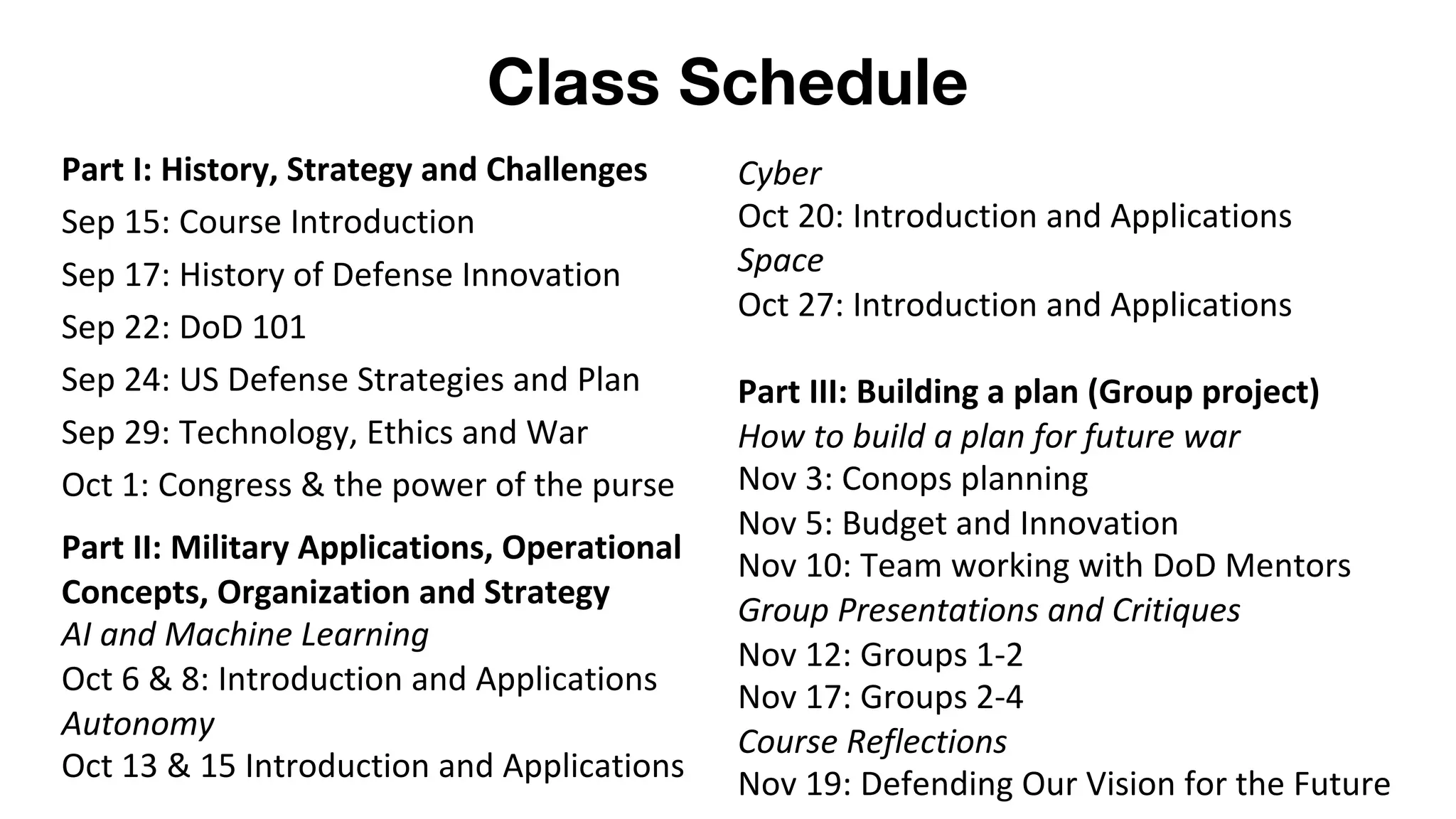
Class Schedule
Part I: History, Strategy and Challenges
Sep 15: Course Introduction
Sep 17: History of Defense Innovation
Sep 22: DoD 101
Sep 24: US Defense Strategies and Plan
Sep 29: Technology, Ethics and War
Oct 1: Congress & the power of the purse
Part II: Military Applications, Operational
Concepts, Organization and Strategy
AI and Machine Learning
Oct 6 & 8: Introduction and Applications
Autonomy
Oct 13 & 15 Introduction and Applications
Cyber
Oct 20: Introduction and Applications
Space
Oct 27: Introduction and Applications
Part III: Building a plan (Group project)
How to build a plan for future war
Nov 3: Conops planning
Nov 5: Budget and Innovation
Nov 10: Team working with DoD Mentors
Group Presentations and Critiques
Nov 12: Groups 1-2
Nov 17: Groups 2-4
Course Reflections
Nov 19: Defending Our Vision for the Future
The Big Picture
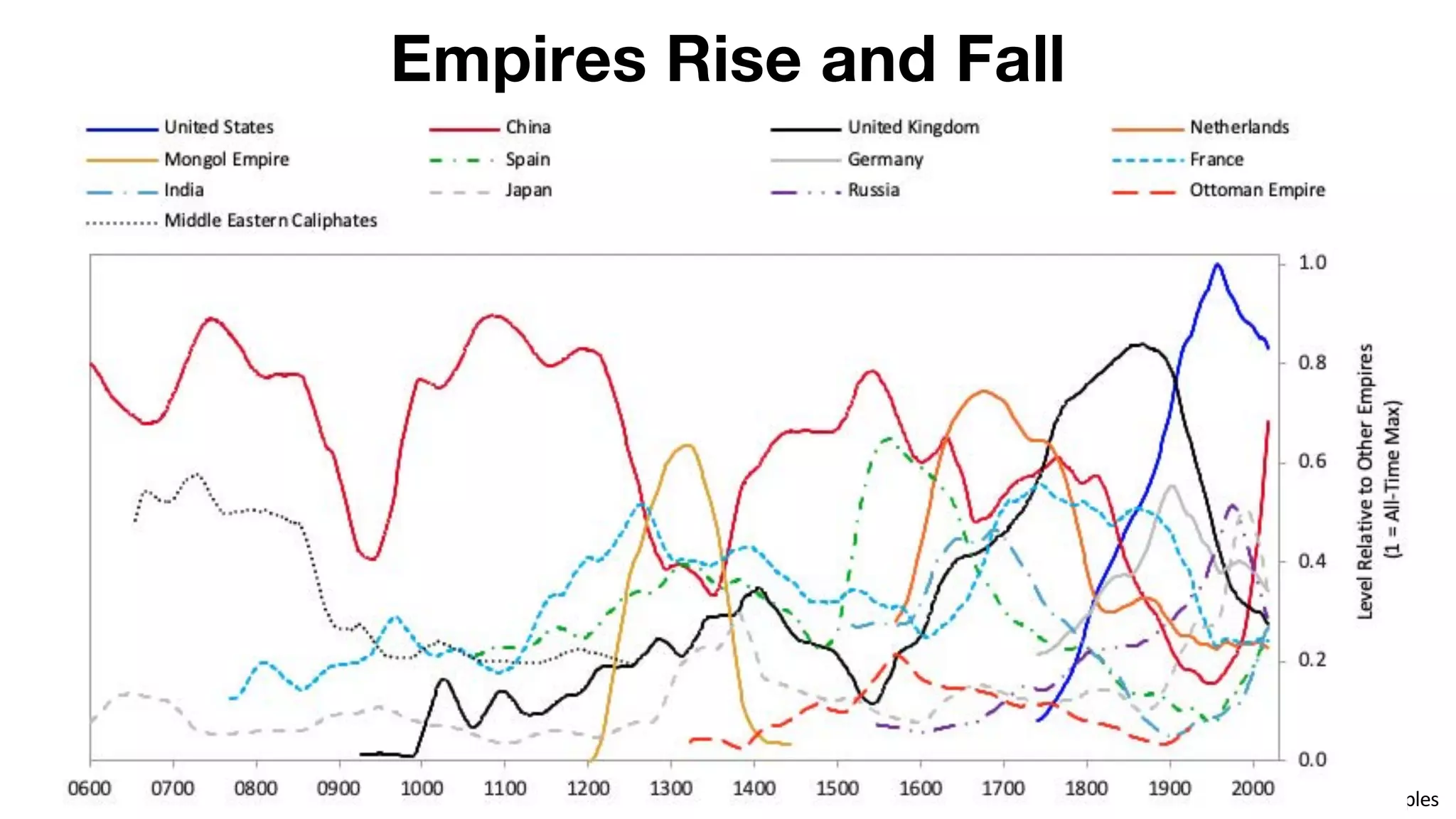
Empires Rise and Fall
Source: Ray Dalio Principles
National Power
• Diplomacy
• Information
• Military
• Economics
• Acronym is DIME
Definition of a Weapons System
• In the 20th century it typically meant a gun, tank, plane, ship,
missile, bomb, spacecraft
• Most often something designed to have a kinetic affect
• In the 21st century – and in this class – weapons systems will
often be non-kinetic – cyber, disinformation, AI & machine
learning, autonomy, space
• All which can win wars without killing people
• How will they be used to sustain the other parts of DIME?
National Dominance Is Transient
• 1945 -1991 Bipolar world – U.S. and Soviet Union
• 1992 -2018 25+ years U.S. as the dominant global power
• 2018 - National Defense Strategy 2+3
How Is Dominance Lost?
• Lose a War
• Miss a technology transition
• Miss new operational concepts
• Lose Allies
• Declining economic power
• Declining interest in global affairs
• Internal/civil conflicts
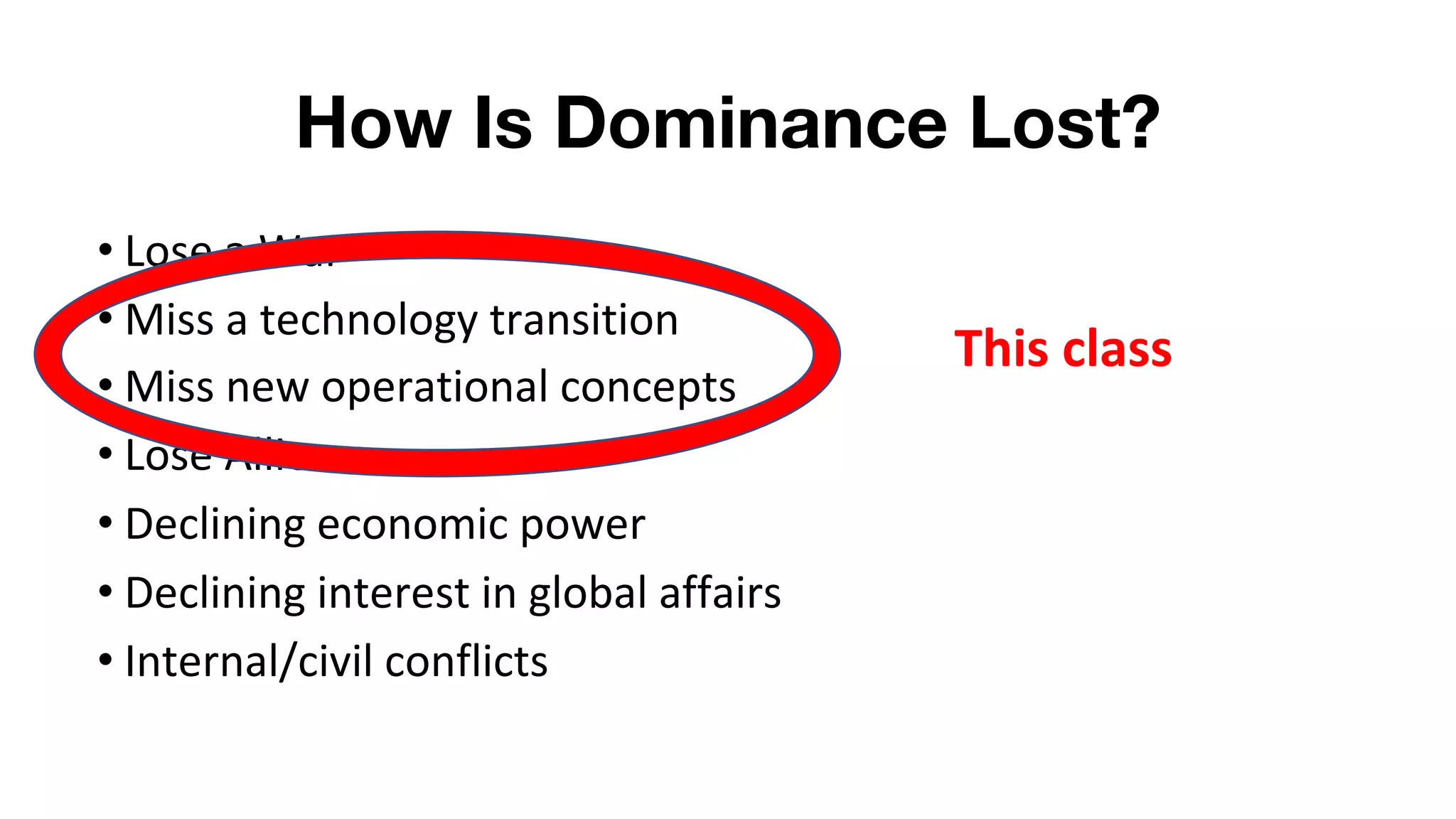
How Is Dominance Lost?
• Lose a War
• Miss a technology transition
• Miss new operational concepts
• Lose Allies
• Declining economic power
• Declining interest in global affairs
• Internal/civil conflicts
This class
Why Do We Care?
Why Do We Care?
Crimea, Eastern Ukraine, Tibet, Hong Kong
or ask the Uyghurs
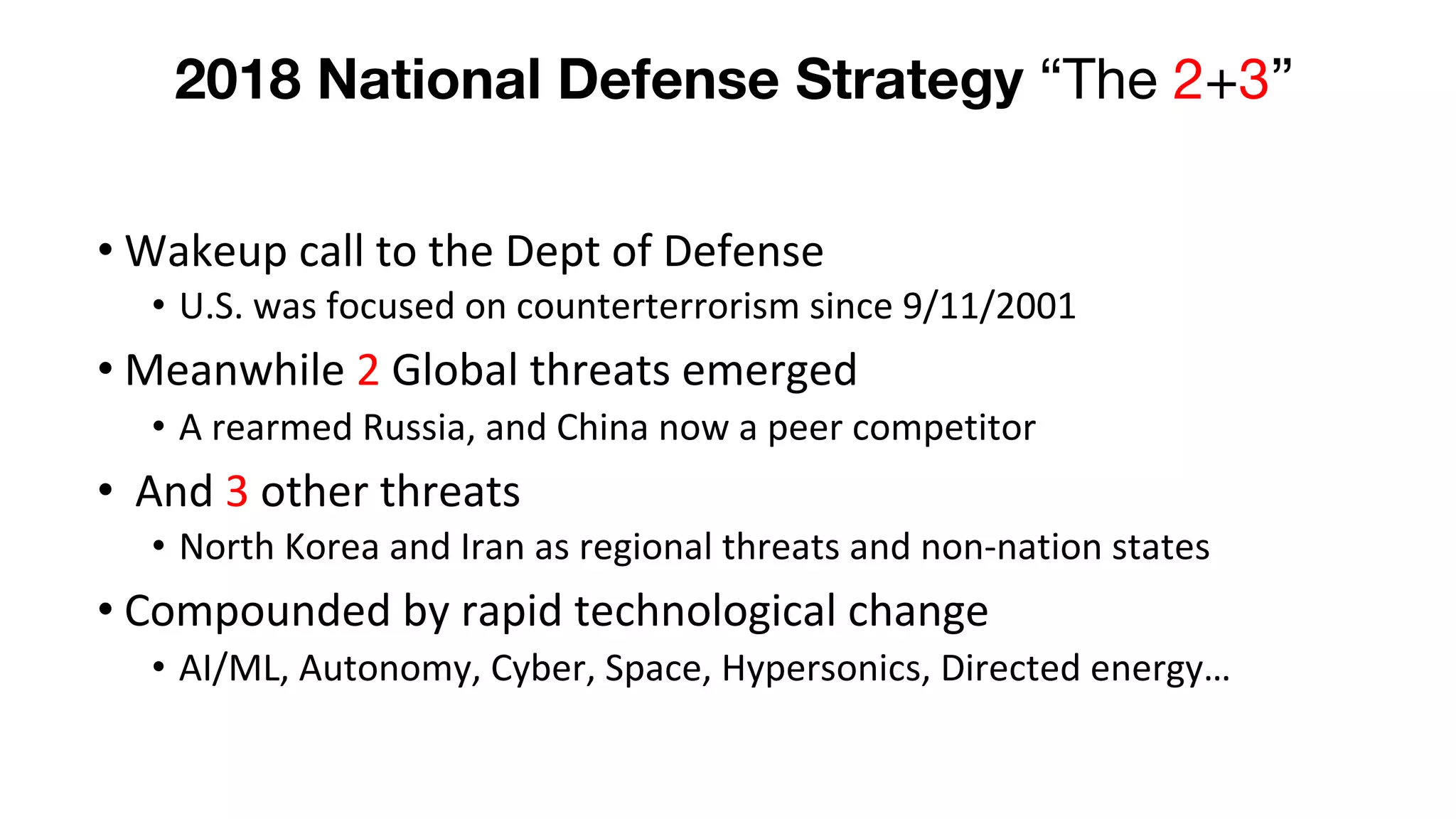
2018 National Defense Strategy “The 2+3”
• Wakeup call to the Dept of Defense
• U.S. was focused on counterterrorism since 9/11/2001
• Meanwhile 2 Global threats emerged
• A rearmed Russia, and China now a peer competitor
• And 3 other threats
• North Korea and Iran as regional threats and non-nation states
• Compounded by rapid technological change
• AI/ML, Autonomy, Cyber, Space, Hypersonics, Directed energy…
The Course At A Glance
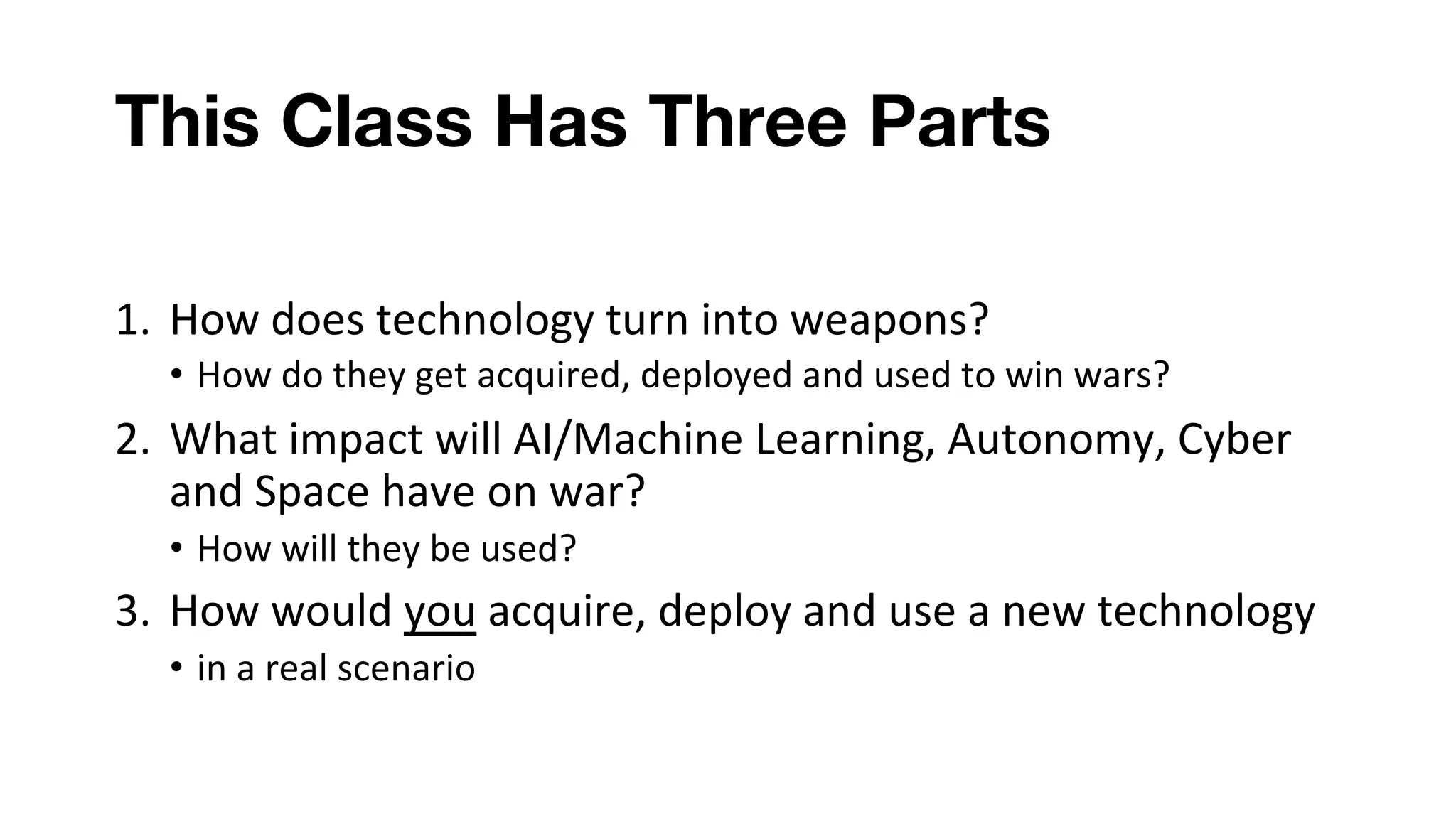
This Class Has Three Parts
1. How does technology turn into weapons?
• How do they get acquired, deployed and used to win wars?
2. What impact will AI/Machine Learning, Autonomy, Cyber
and Space have on war?
• How will they be used?
3. How would you acquire, deploy and use a new technology
• in a real scenario
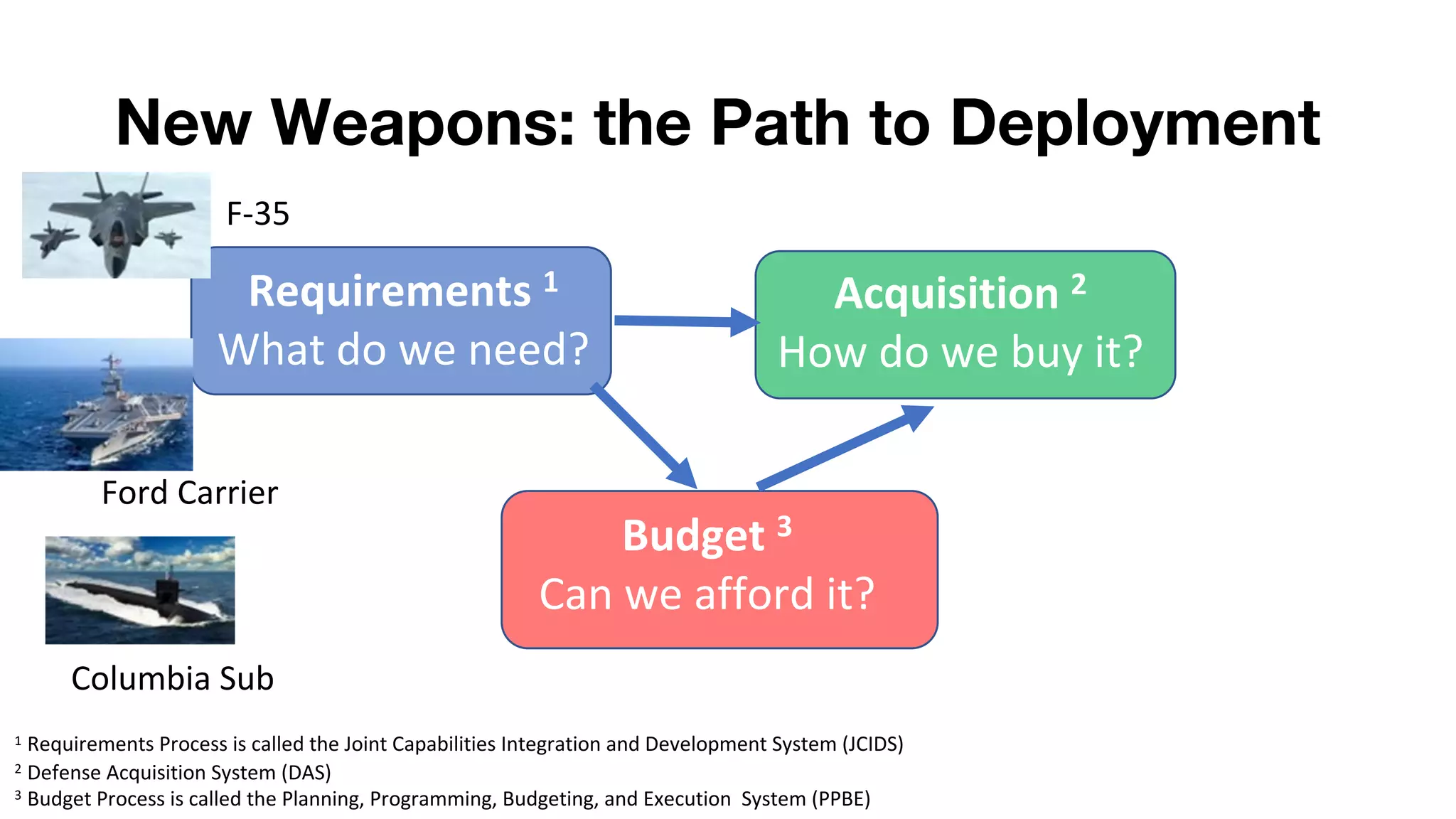
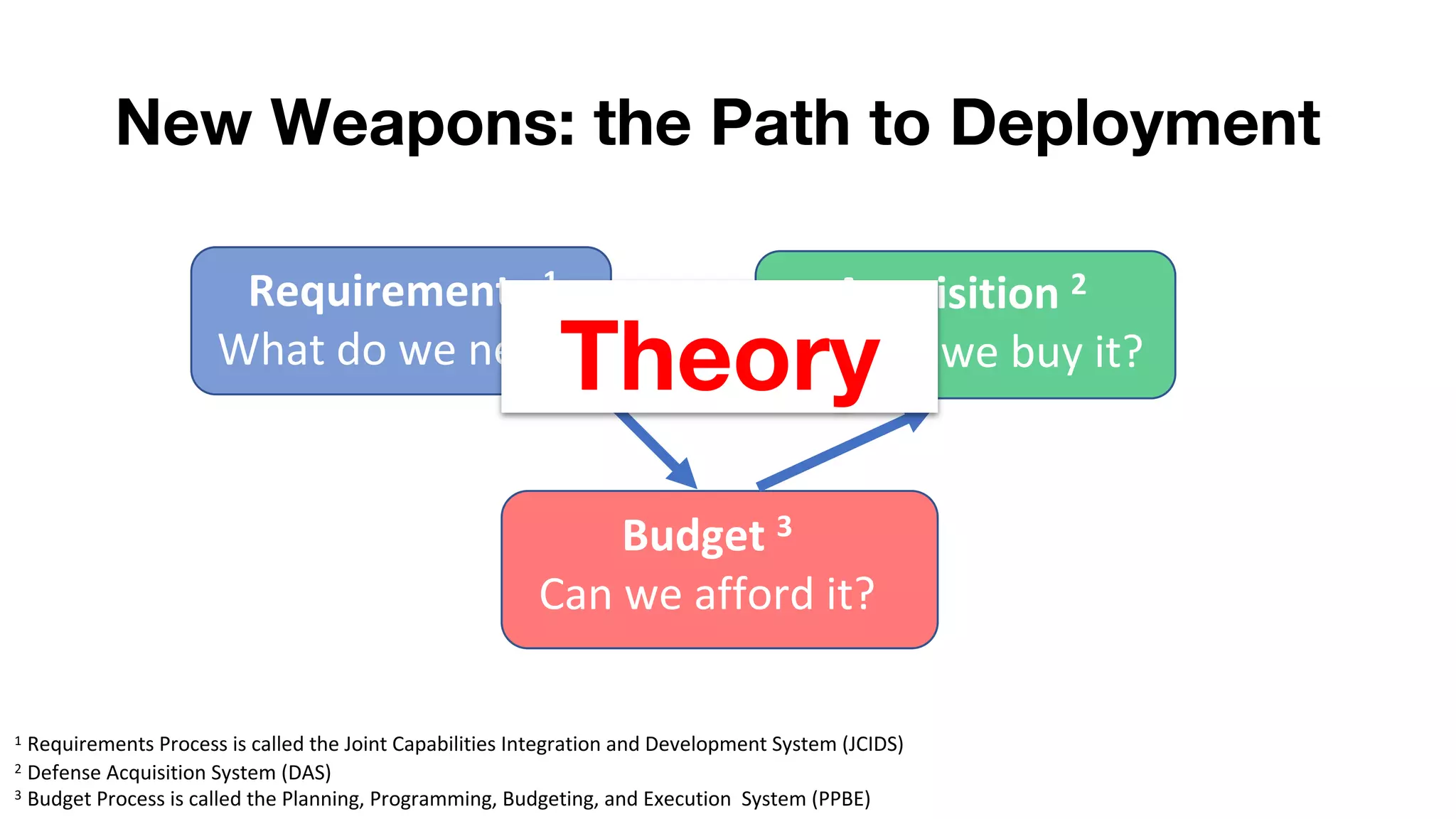
New Weapons: the Path to Deployment
Budget 3
Can we afford it?
1 Requirements Process is called the Joint Capabilities Integration and Development System (JCIDS)
2 Defense Acquisition System (DAS)
3 Budget Process is called the Planning, Programming, Budgeting, and Execution System (PPBE)
Requirements 1
What do we need?
Acquisition 2
How do we buy it?
F-35
Ford Carrier
Columbia Sub
New Weapons: the Path to Deployment
Budget 3
Can we afford it?
1 Requirements Process is called the Joint Capabilities Integration and Development System (JCIDS)
2 Defense Acquisition System (DAS)
3 Budget Process is called the Planning, Programming, Budgeting, and Execution System (PPBE)
Requirements 1
What do we need?
Acquisition 2
How do we buy it?Theory
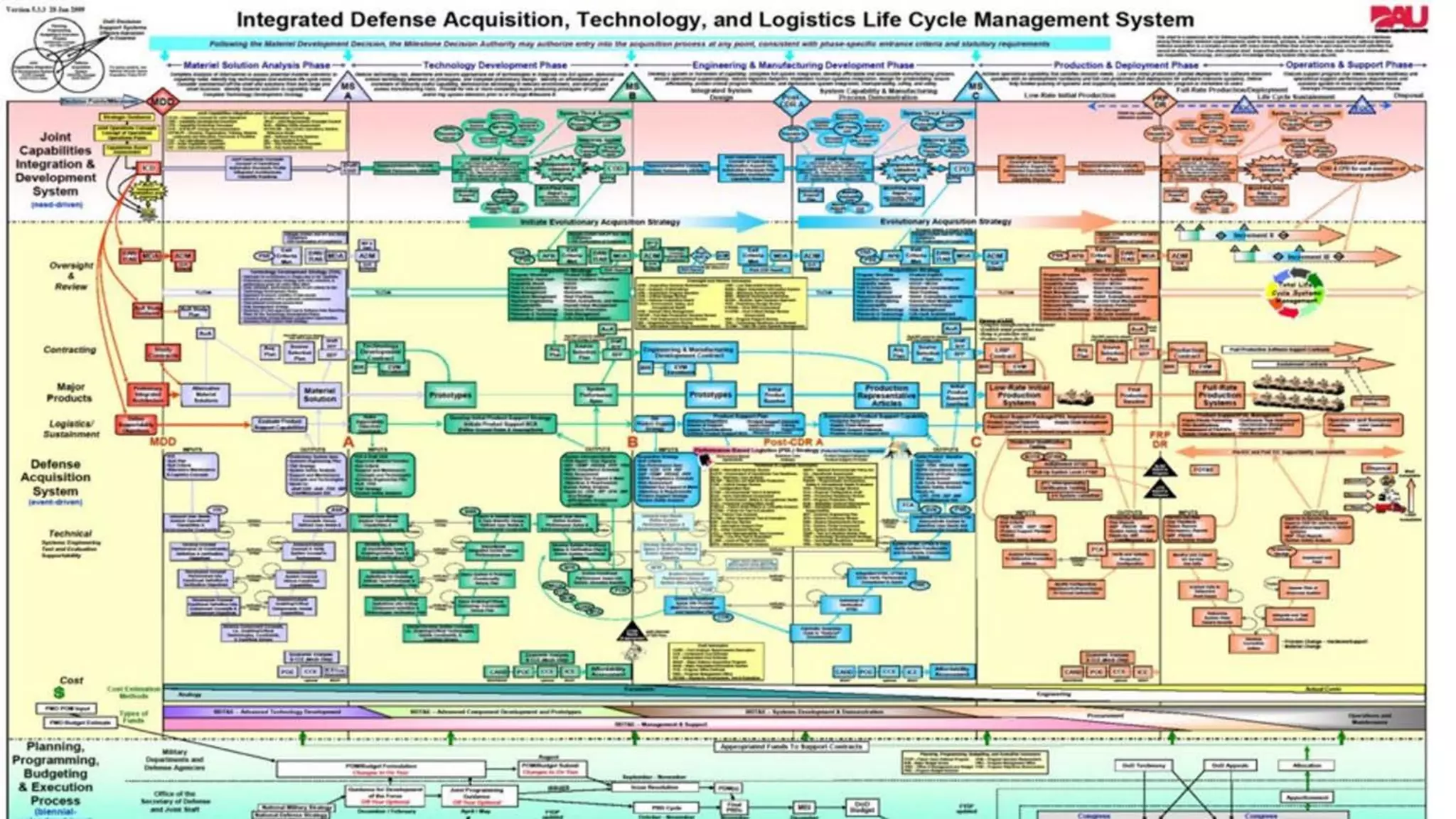
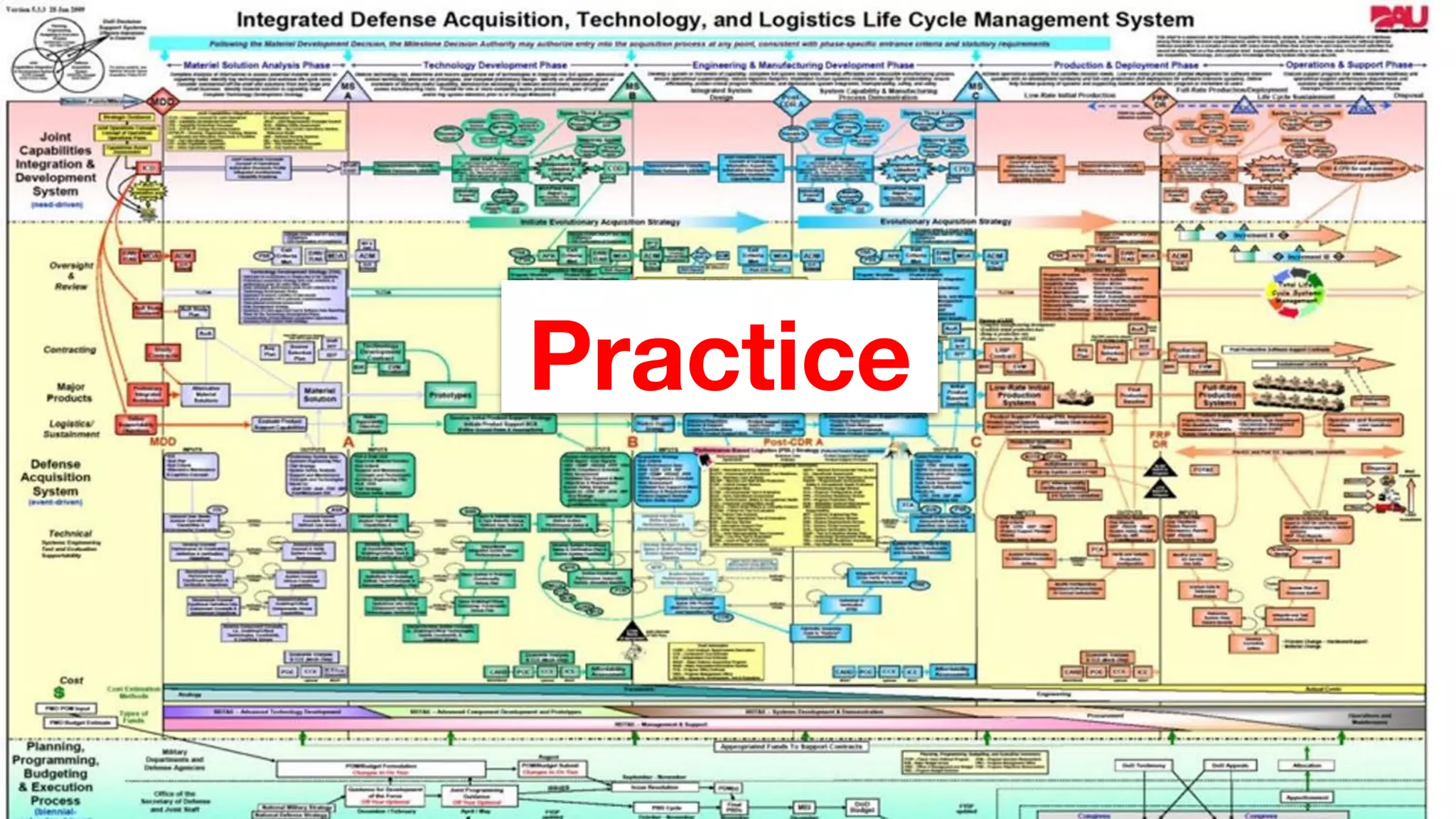
Practice
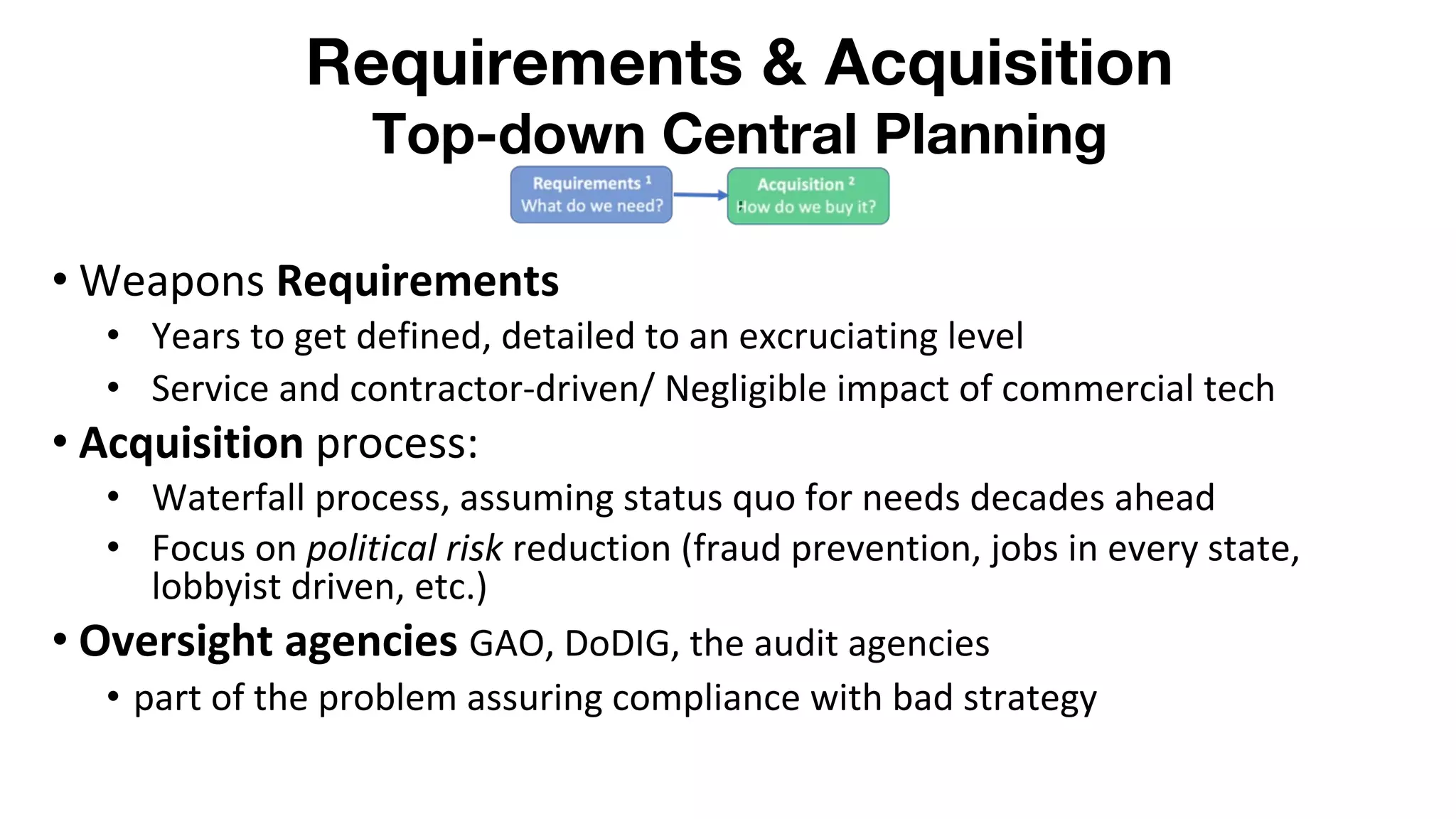
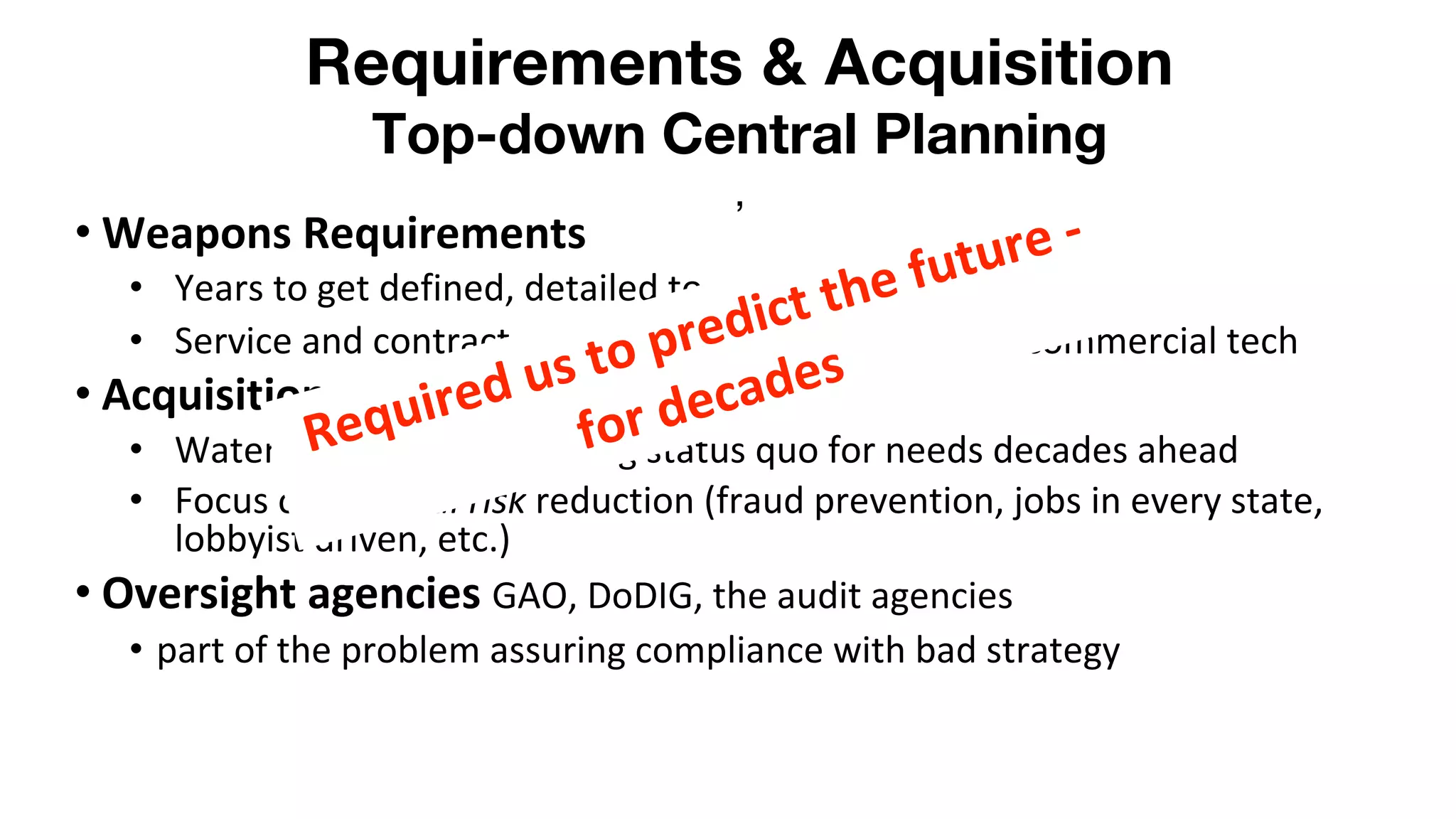
Requirements & Acquisition
Top-down Central Planning
,
• Weapons Requirements
• Years to get defined, detailed to an excruciating level
• Service and contractor-driven/ Negligible impact of commercial tech
• Acquisition process:
• Waterfall process, assuming status quo for needs decades ahead
• Focus on political risk reduction (fraud prevention, jobs in every state,
lobbyist driven, etc.)
• Oversight agencies GAO, DoDIG, the audit agencies
• part of the problem assuring compliance with bad strategy
Requirements & Acquisition
Top-down Central Planning
,
• Weapons Requirements
• Years to get defined, detailed to an excruciating level
• Service and contractor-driven/ Negligible impact of commercial tech
• Acquisition process:
• Waterfall process, assuming status quo for needs decades ahead
• Focus on political risk reduction (fraud prevention, jobs in every state,
lobbyist driven, etc.)
• Oversight agencies GAO, DoDIG, the audit agencies
• part of the problem assuring compliance with bad strategy
Required us to predict the future -
for decades
Doctrine and Operational Concepts
• Having an existing weapon doesn’t describe how they are used to fight
or win a war
• How weapons are used are described in Doctrine
• Doctrine provides the basis of operationalizing the use of a weapon. Not just
how, but who mans it, how do you sustain it, etc..
• Operational concepts are the Minimum Viable Products of the practical
application of a doctrine against a specific enemy in a specific environment.
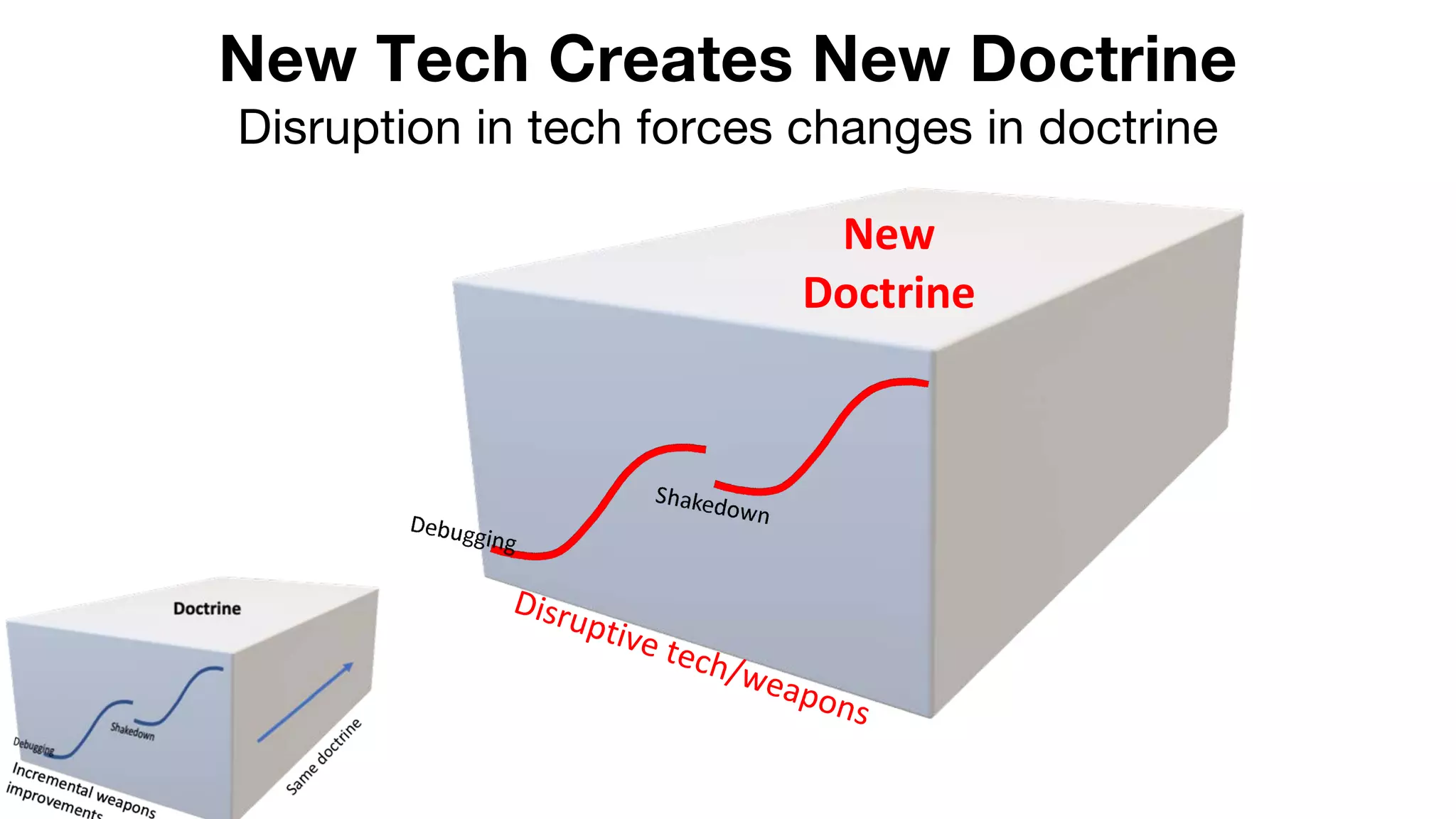
• New adversaries can create the need for a new doctrine
• ie. 2006 Counterinsurgency doctrine
• New classes of disruptive tech/weapons can create the need for new
doctrine
• We can’t create doctrine against new technology fast enough
Monopoly on Power + War on Terror =
Strategic Complacency
• 1992 -2001 Unipower
• 2001- 2018 War on Terror
• Our adversaries had less capable weapons
• Existing Strategic Doctrine/Operational Concepts
• New tactical doctrine – Counterinsurgency
• No national economic sacrifice
• Incremental strategic weapons Improvements
• F-35/Ford-class carriers/B-21/Columbia SSBN
• Innovative tactical improvements
• Reaper/Predator, etc.
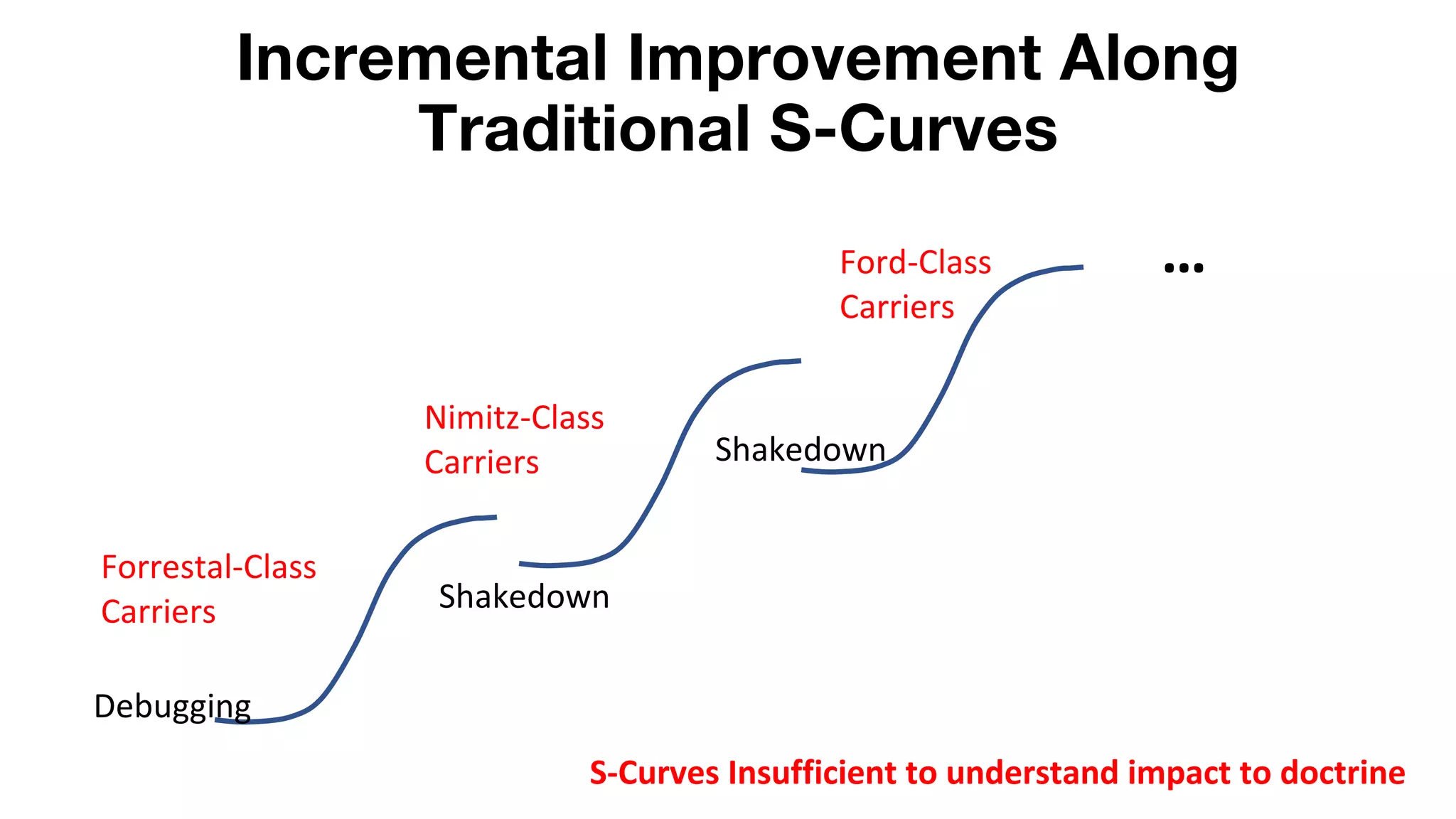
Incremental Improvement Along
Traditional S-Curves
Debugging
Shakedown
Forrestal-Class
Carriers
Nimitz-Class
Carriers
Ford-Class
Carriers
Shakedown
…
S-Curves Insufficient to understand impact to doctrine
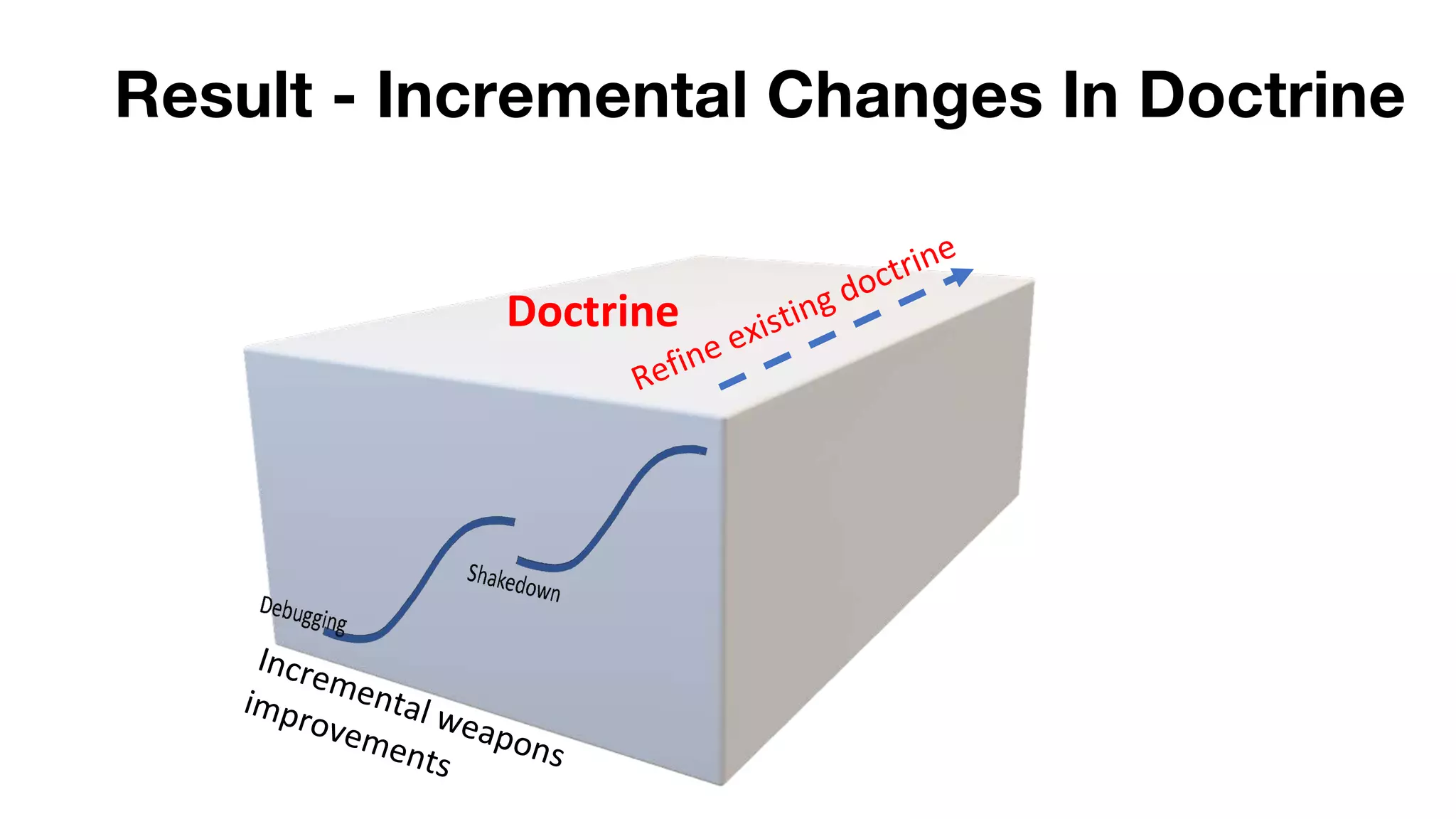
Result - Incremental Changes In Doctrine
Doctrine
Incremental weapons
improvements
Refine existing doctrine
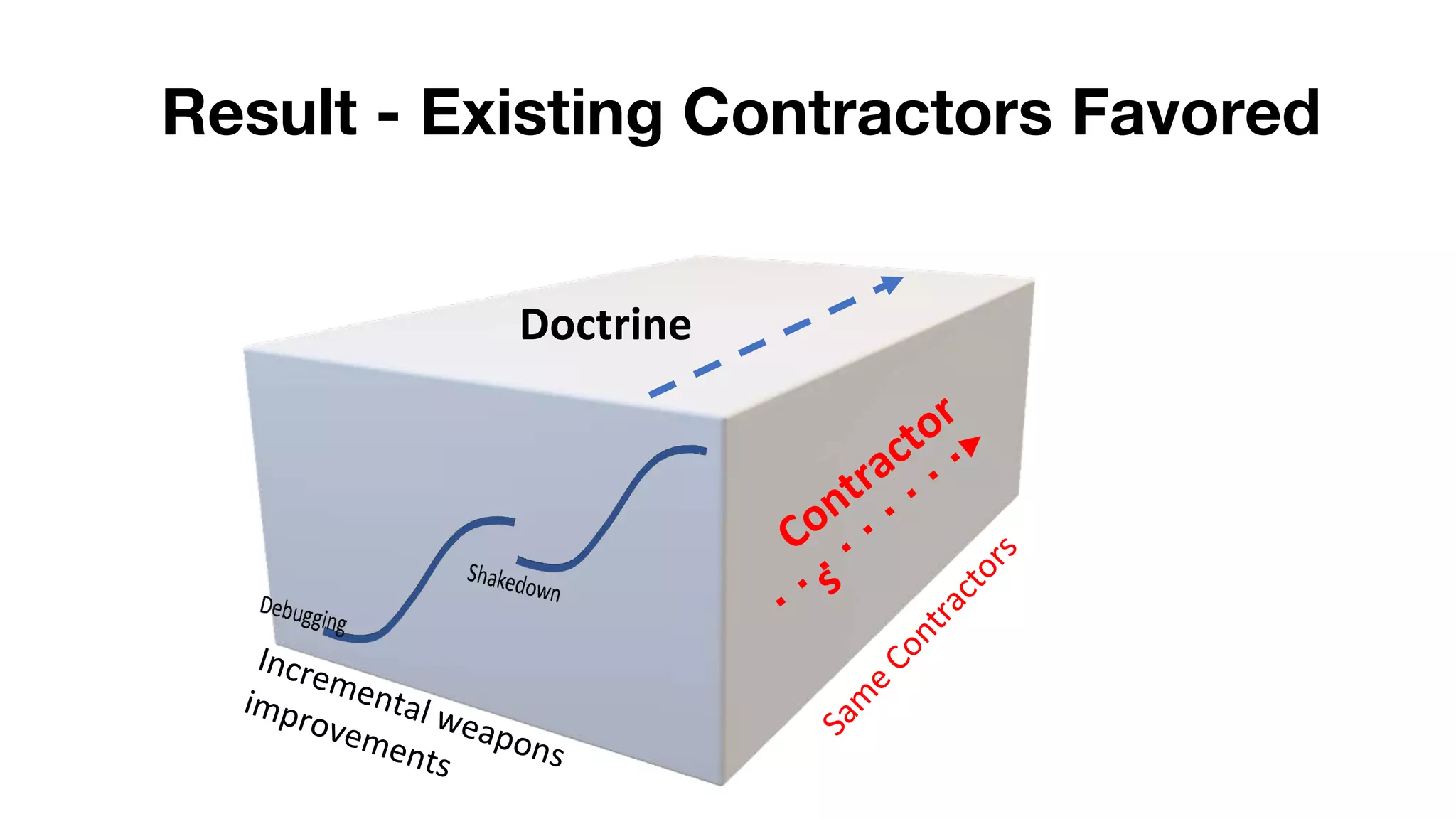
Result - Existing Contractors Favored
Doctrine
Sam
e
Contractors
Incremental weapons
improvements
Contractor
s
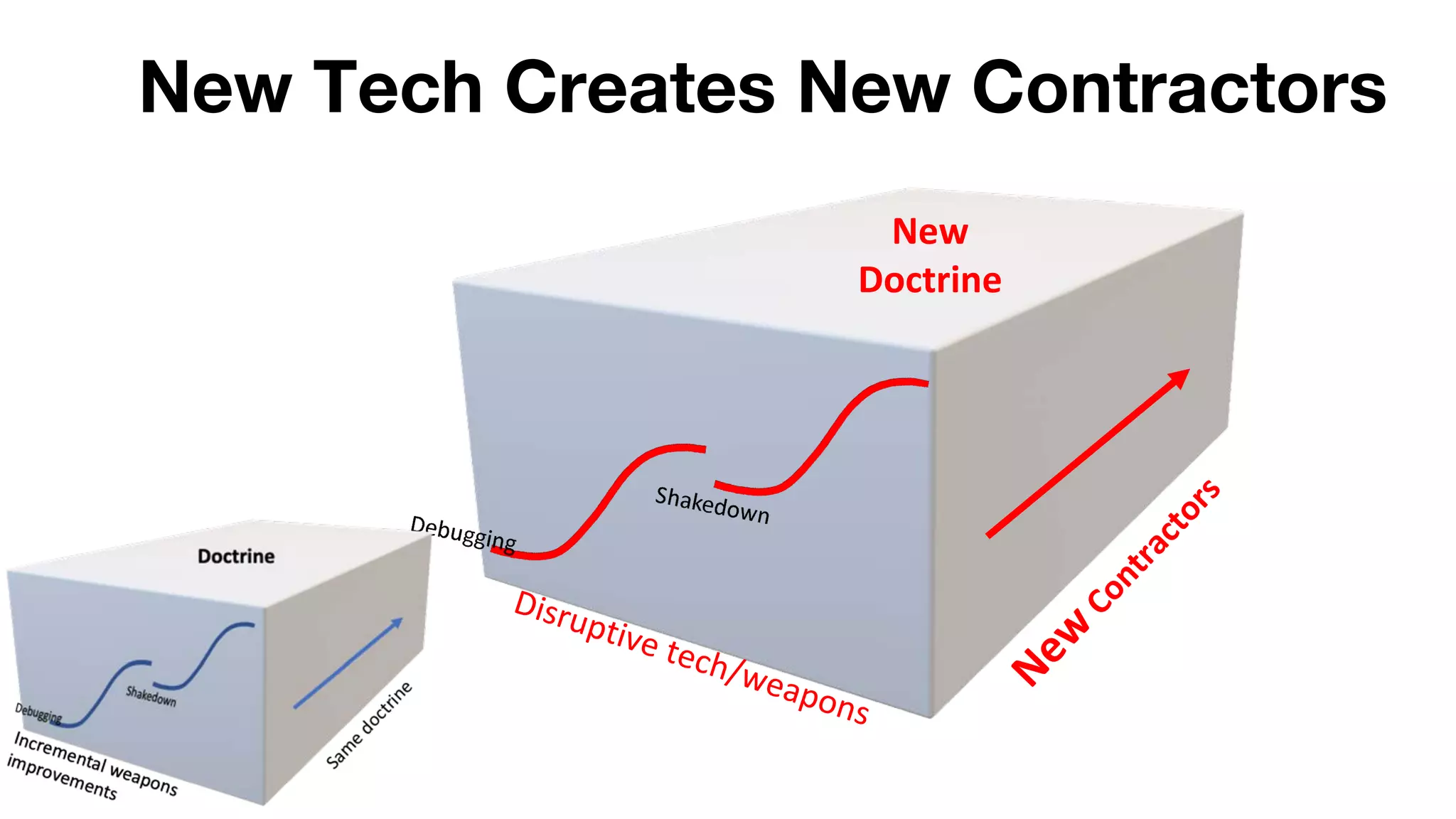
New Tech Creates New Doctrine
Disruption in tech forces changes in doctrine
New
Doctrine
Disruptive tech/weapons
New Tech Creates New Contractors
New
Doctrine
New
Contractors
Disruptive tech/weapons
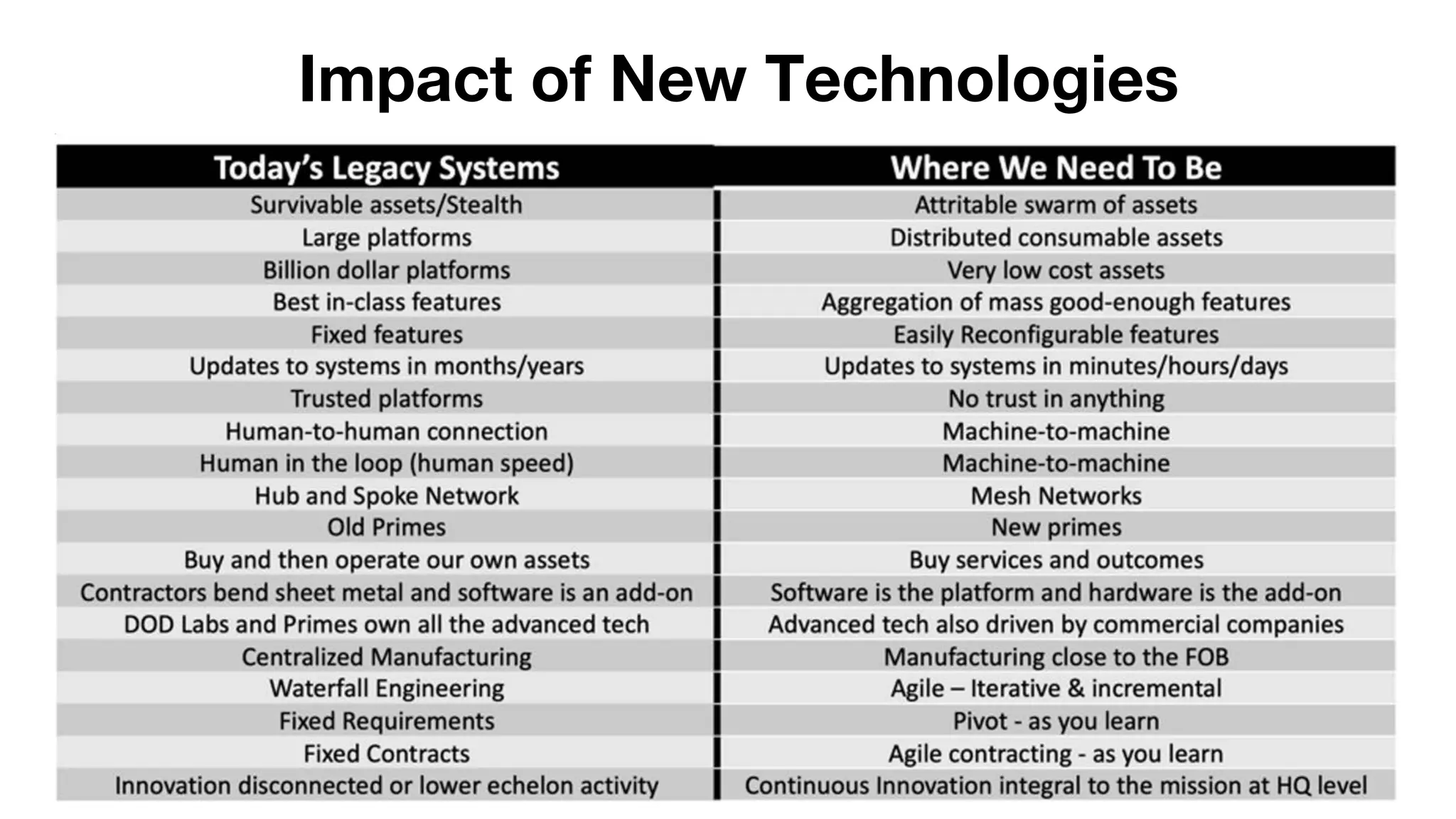
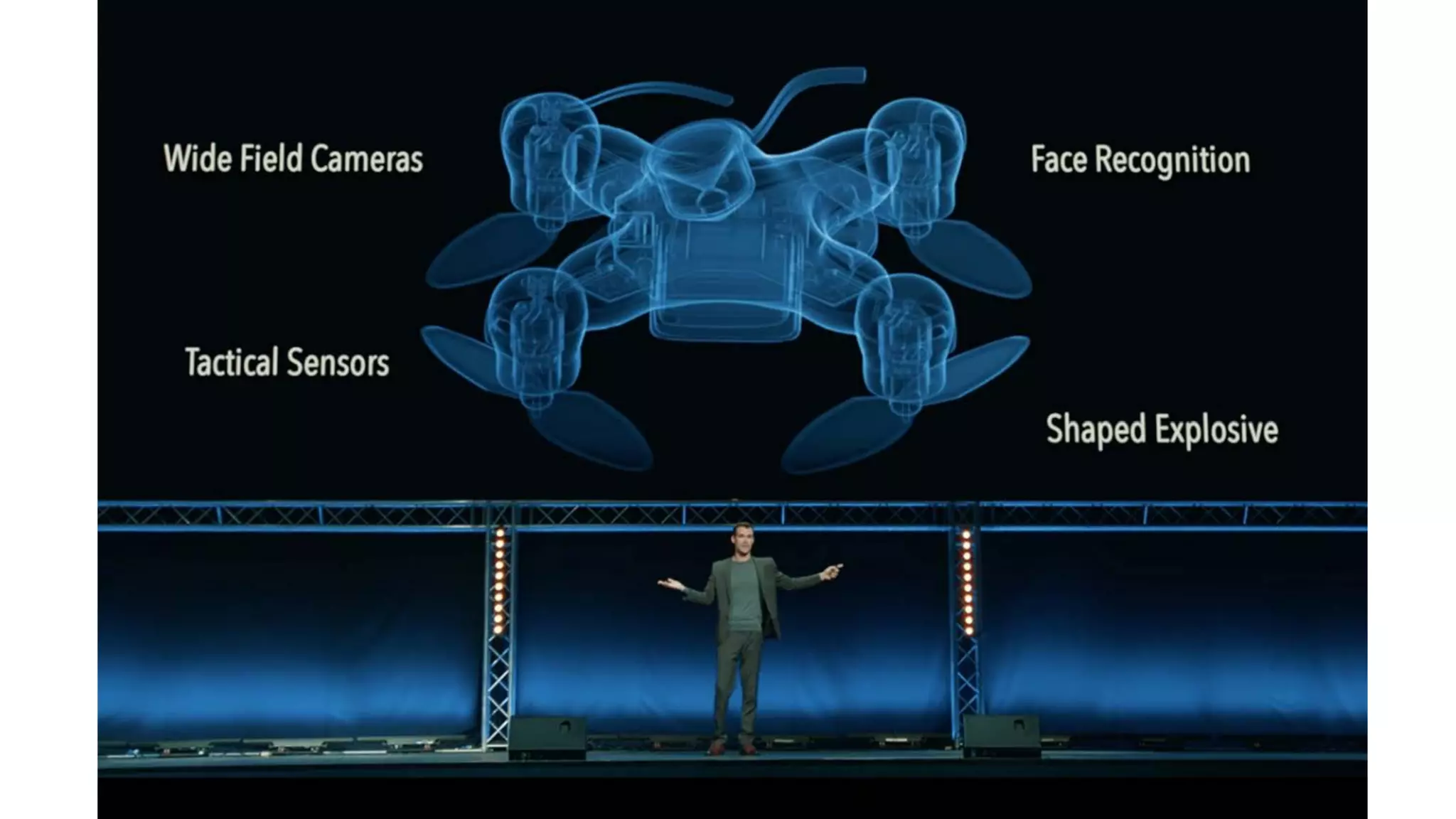
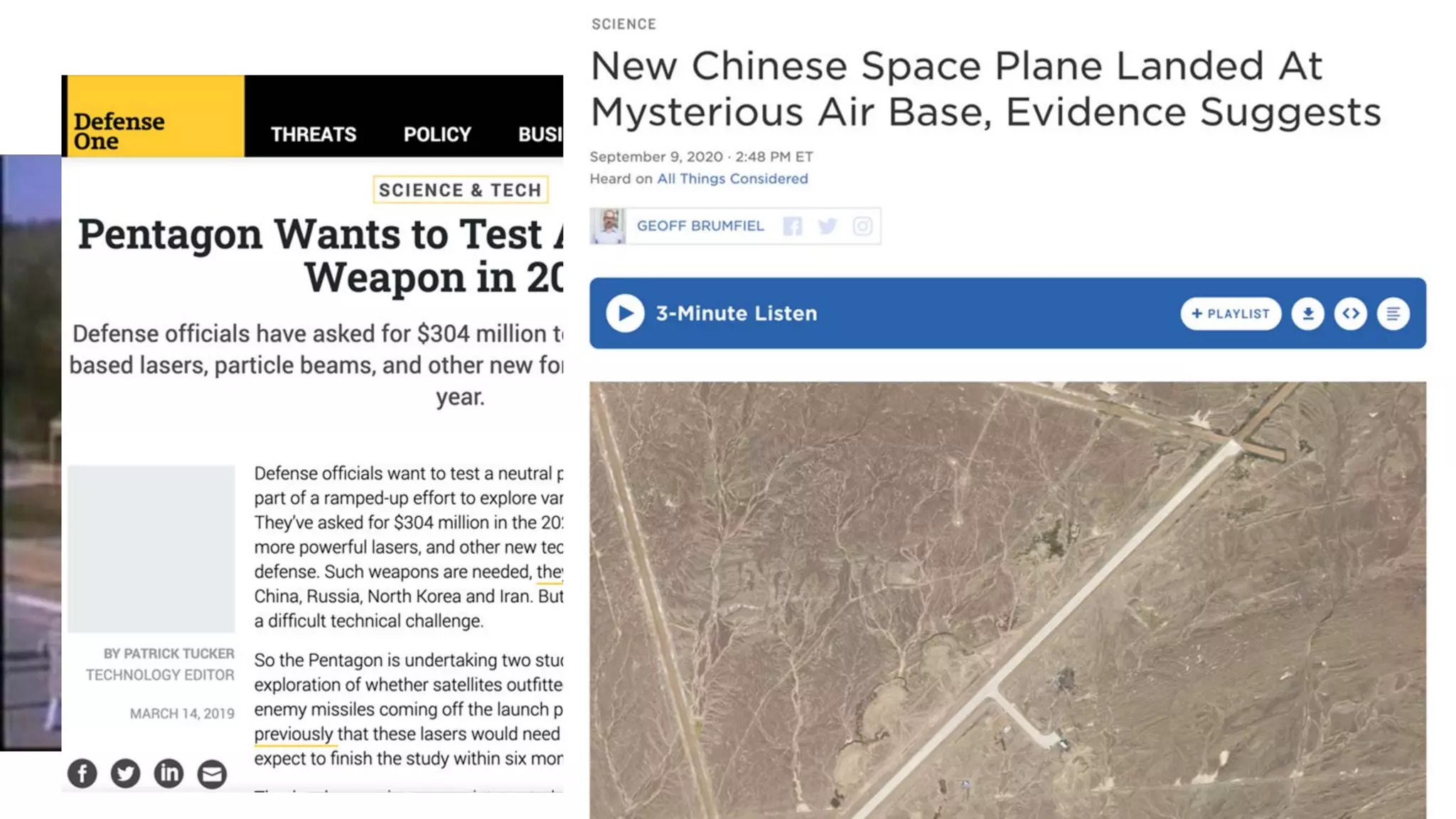
Impact of New Technologies
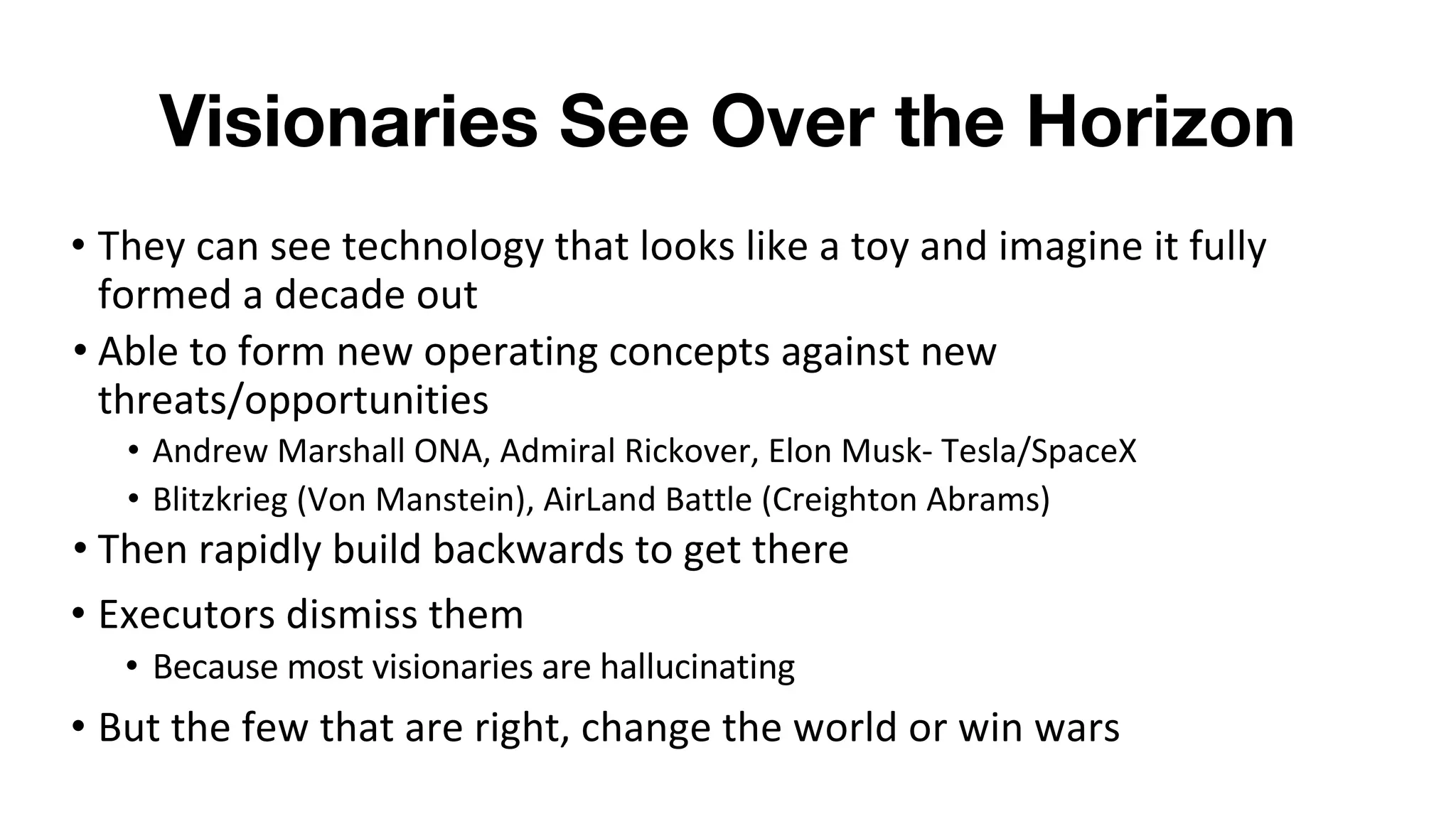
Visionaries See Over the Horizon
• They can see technology that looks like a toy and imagine it fully
formed a decade out
• Able to form new operating concepts against new
threats/opportunities
• Andrew Marshall ONA, Admiral Rickover, Elon Musk- Tesla/SpaceX
• Blitzkrieg (Von Manstein), AirLand Battle (Creighton Abrams)
• Then rapidly build backwards to get there
• Executors dismiss them
• Because most visionaries are hallucinating
• But the few that are right, change the world or win wars
The Course At A Glance
Part 2: What Impact will AI/Machine Learning,
Autonomy, Cyber and Space have on war?
And where do we find and acquire that tech?
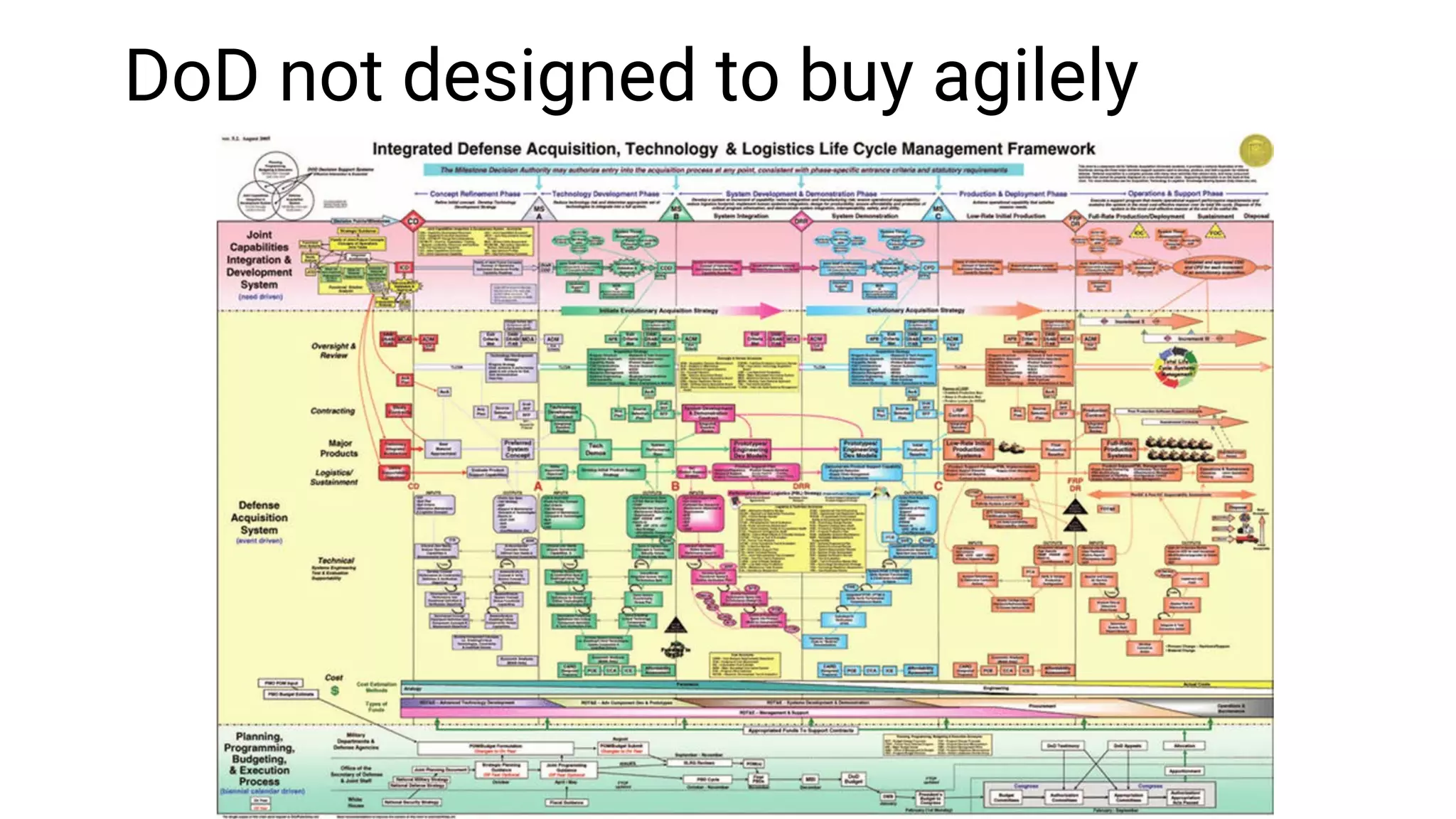
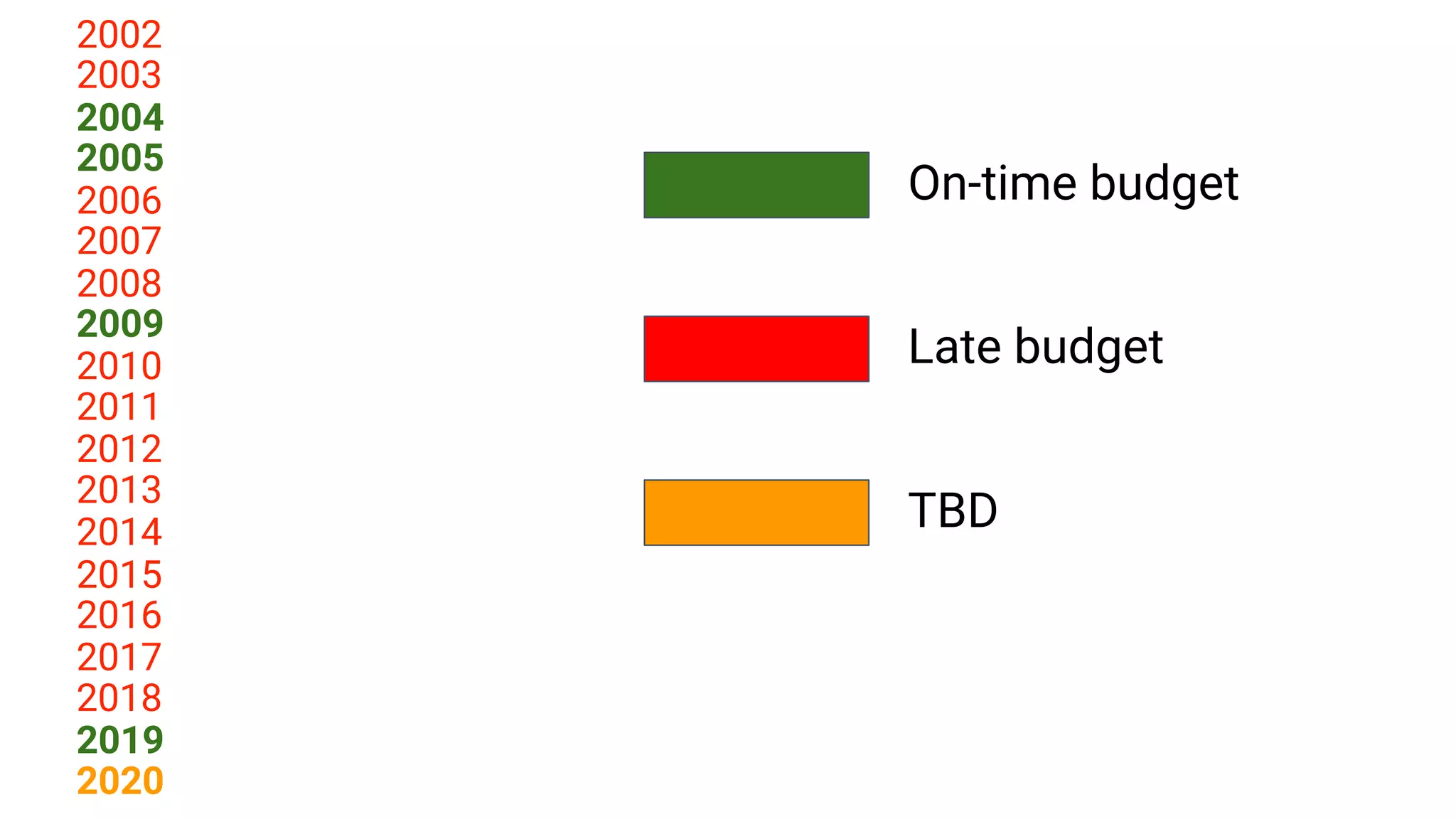
DoD not designed to buy agilely
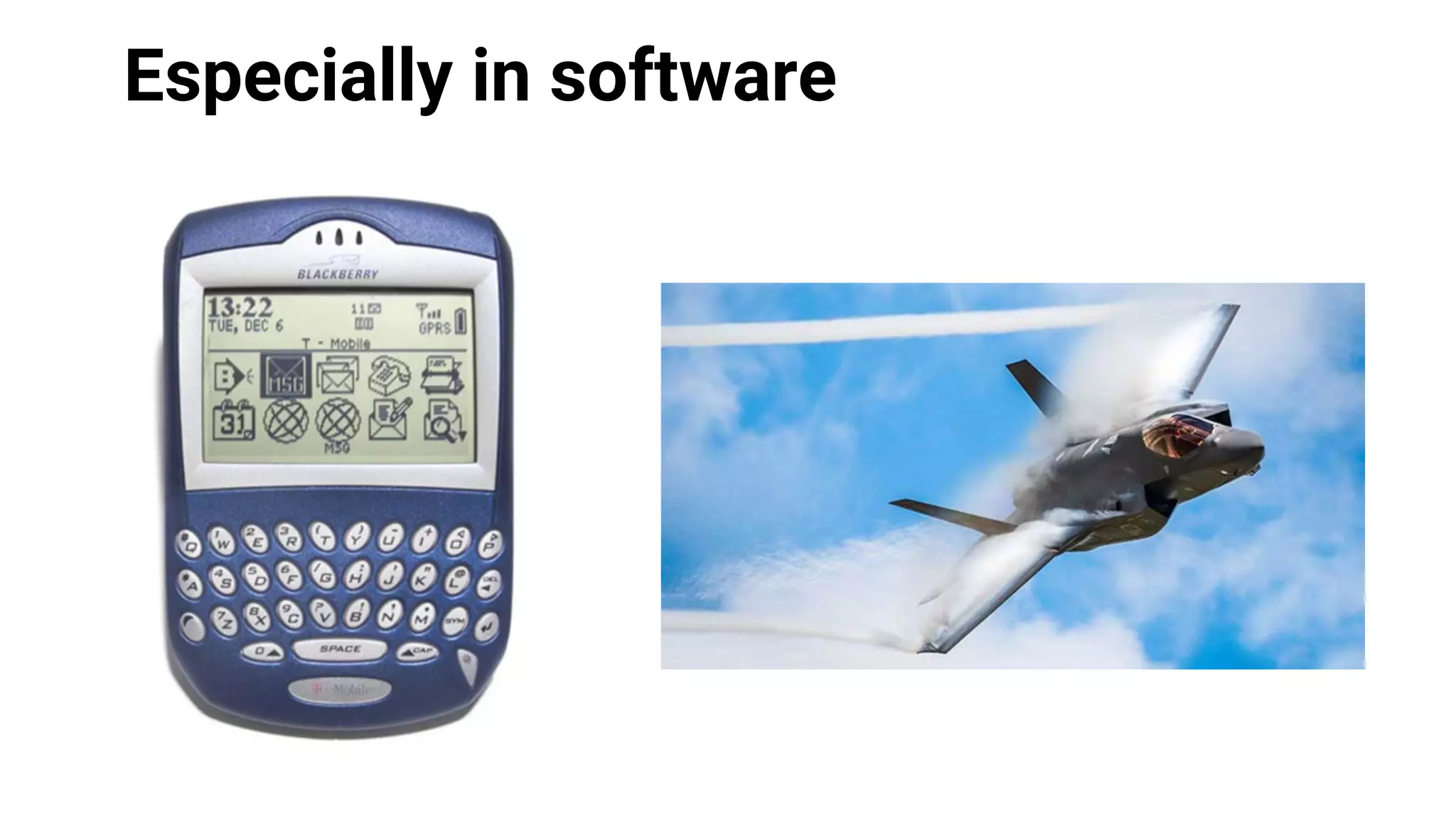
Especially in software
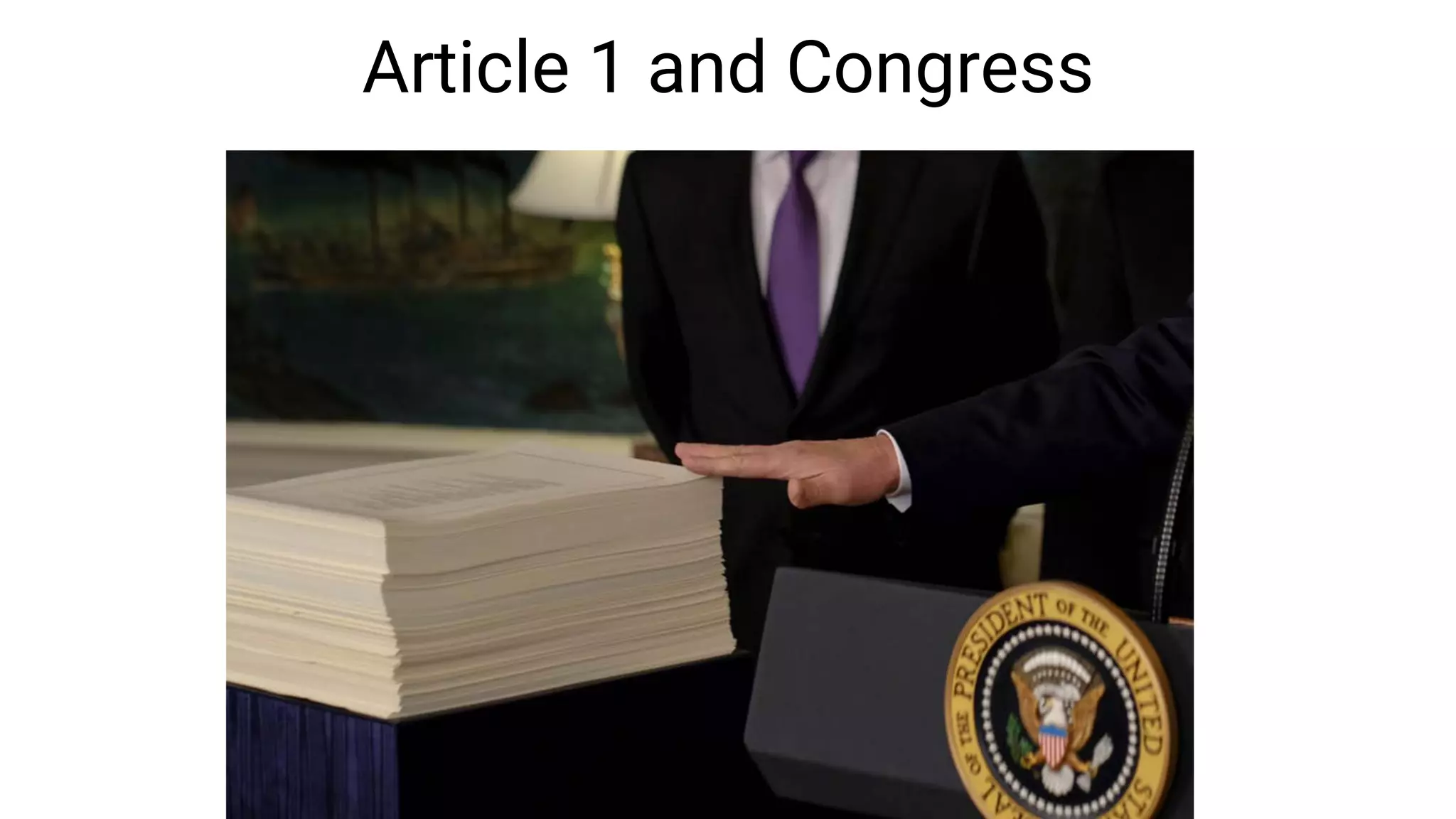
Article 1 and Congress
2002
2003
2004
2005
2006
2007
2008
2009
2010
2011
2012
2013
2014
2015
2016
2017
2018
2019
2020
2002
2003
2004
2005
2006
2007
2008
2009
2010
2011
2012
2013
2014
2015
2016
2017
2018
2019
2020
On-time budget
Late budget
TBD
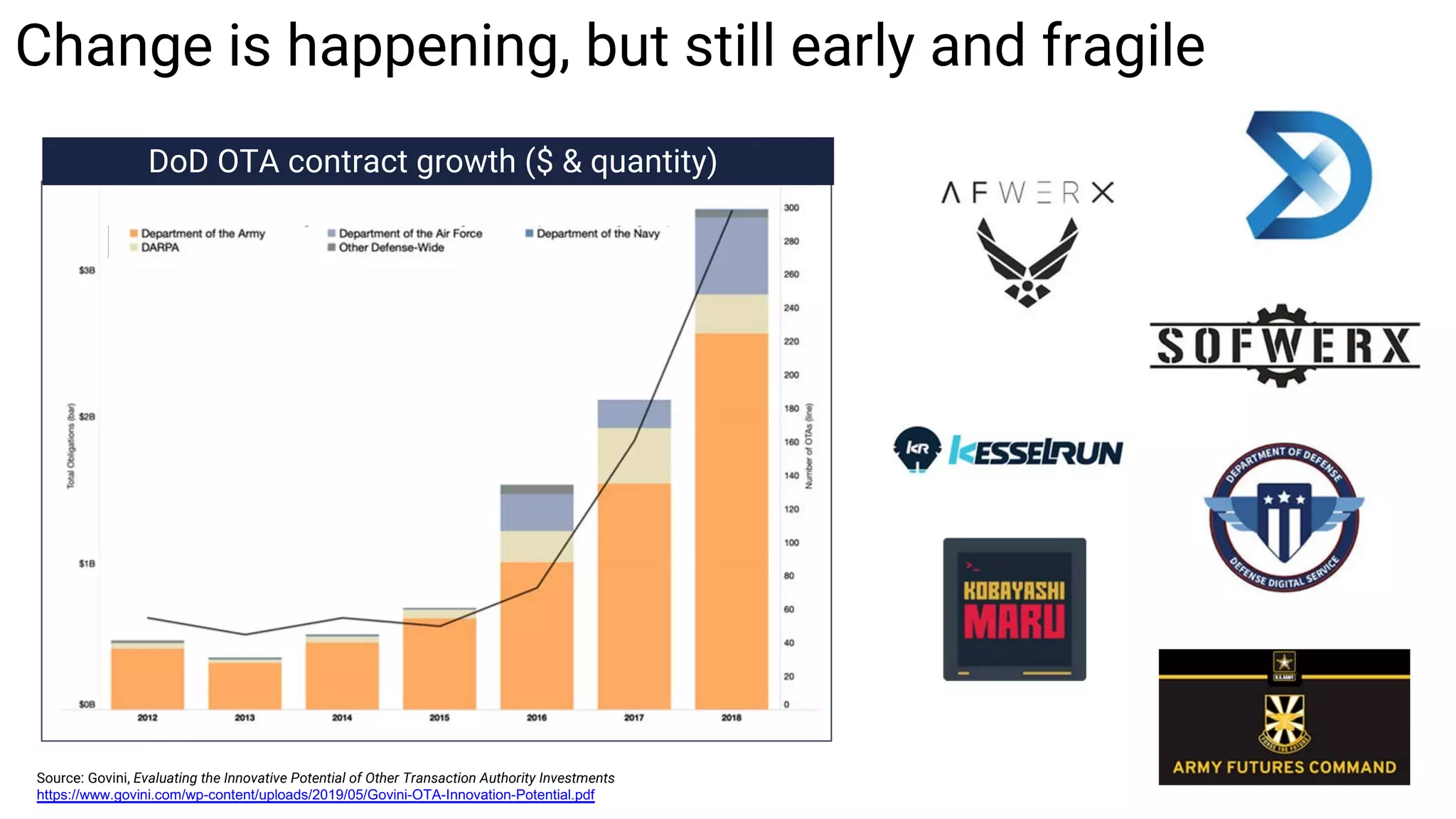
Change is happening, but still early and fragile
Source: Govini, Evaluating the Innovative Potential of Other Transaction Authority Investments
https://www.govini.com/wp-content/uploads/2019/05/Govini-OTA-Innovation-Potential.pdf
DoD OTA contract growth ($ & quantity)
The Course At A Glance
Part 3: New Operational Concepts
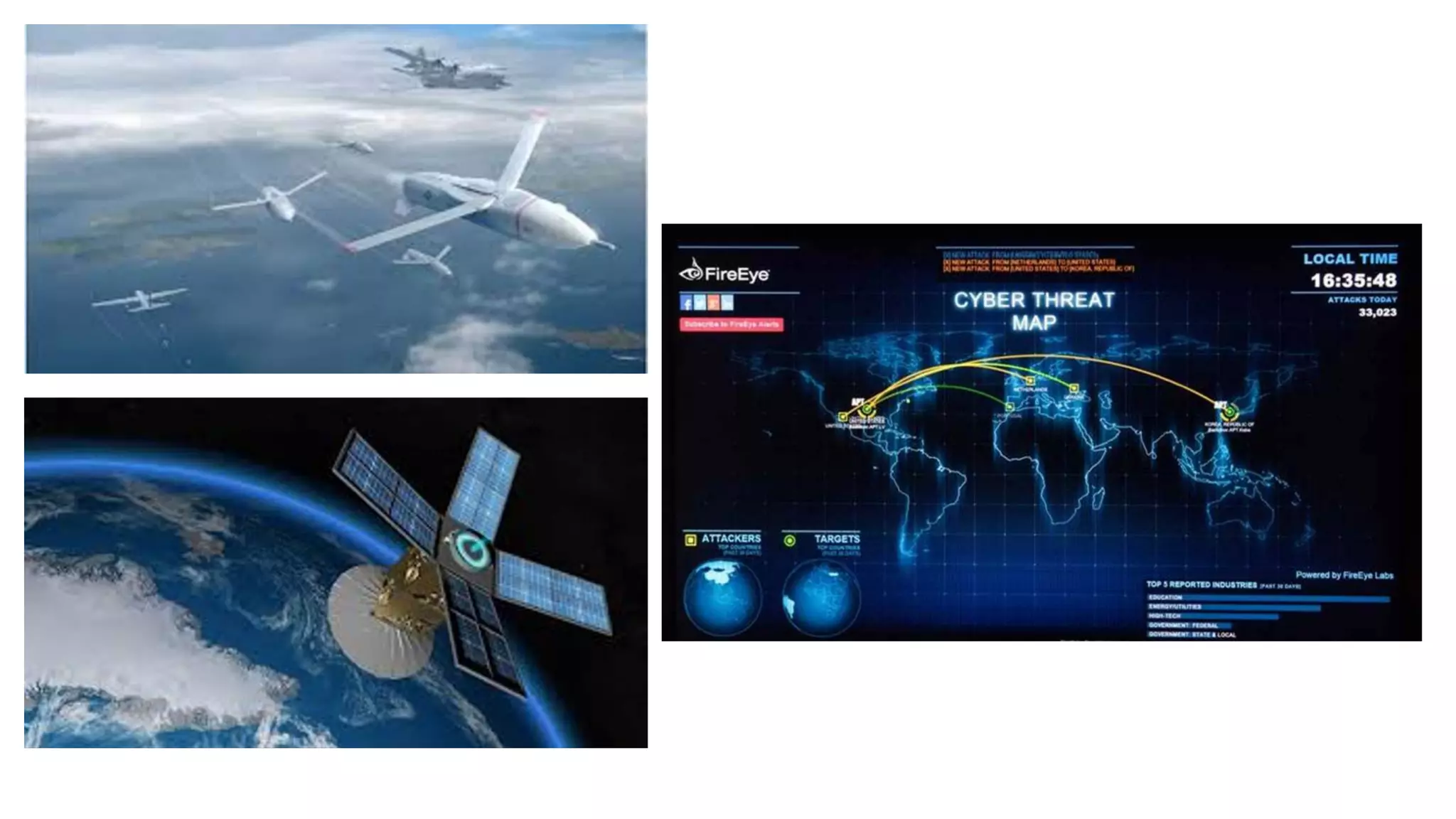
New Technologies and Applications
Artificial Intelligence
Machine Learning
Autonomy
Cyber
Space
Commercial Applications
Military Applications
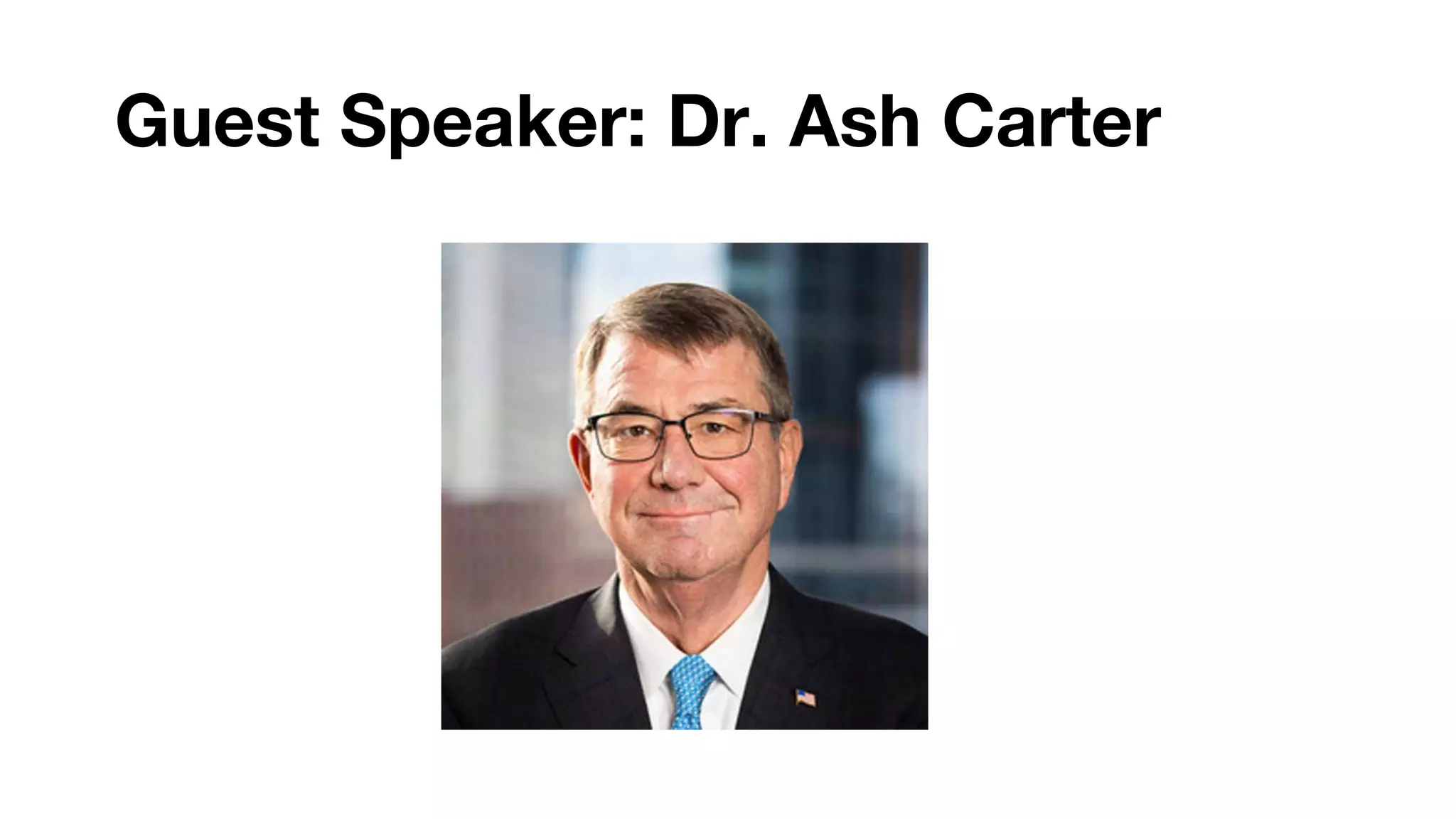
Guest Speaker: Dr. Ash Carter

Lecture 1-Technology, Innovation and Modern War

  • 1.
    Technology, Innovation, and ModernWar INTLPOL 340; MS&E 296 Steve Blank, Joe Felter, Raj Shah Lecture 1
  • 2.
    “The problem isnot lack of money, lack of technology, and certainly not lack of capable and committed people in the US government, military and private industry. No, the real problem is a lack of imagination.” Christian Brose, Kill Chain 2020
  • 3.
    Agenda • Teaching Team •Class Logistics • The Course at A Glance • Ash Carter • Lesson 2 - coming attractions
  • 4.
  • 5.
  • 6.
    Steve Blank Co-creator LeanStartup Co-author Hacking for Defense Member Defense Business Board Created I-Corps and I-Corps @ NSA Air Force Veteran 8 startups ● Semiconductors ● Supercomputers Details at www.steveblank.com ● Enterprise software ● Military intelligence
  • 7.
    Joe Felter ● WilliamJ. Perry Fellow, CISAC/FSI ● Hoover Institution, National Security Task Force ● Fmr US Deputy Assistant Secretary of Defense ● Coauthor Hacking for Defense ● Senior Advisor, Defense Innovation Unit ● US Army Ranger and Special Forces (ret)
  • 8.
    Raj Shah ● VisitingFellow at Hoover / CISAC ● Hoover Institution, National Security Task Force ● Startup CEO and investor ● Former Managing Partner, Defense Innovation Unit ● F-16 pilot w/multiple combat tours
  • 9.
    Class Designer Andrew Powell ●Stanford GSB Alum (Class of 2020) ● EdTech Startup Founder and CEO ● Hacking4Defense 2019 - Team Learn to Win ● Leading AFWERX SBIR Direct to Phase II contract to deploy L2W in USAF and Navy operational environments
  • 10.
    Class TAs Nikita Demir ●BS / MS in Computer Science, focus in AI/ML ● Hacking4Defense class of 2019 ● Interned this summer at Catapult Ventures advising on AI/Robotics ● BS in Science, Technology, and Society ● Hacking4Defense class of 2019 ● Experience in Cybersecurity and Investment Banking Foster Karmon
  • 11.
    Civilian and MilitaryLiaisons Lt Col Denny R. Davies U.S. Air Force (Hoover NSAF) LtCol Kenneth J. Del Mazo U.S. Marine Corps (Hoover NSAF) Mr. Chase Beamer U.S. Department of State (Hoover NSAF) LTC Edward Cuevas U.S. Army (Freeman Spogli Institute CISAC) LTC Eldridge R. Singleton U.S. Army (Hoover NSAF) Lt Col Steven Skipper U.S. Air Force (Hoover NSAF) CDR John “Jack” Souders U.S. Coast Guard (Hoover NSAF) CDR Jeffrey Vanak U.S. Navy (Hoover NSAF) LTC Jim Wiese U.S. Army (Hoover NSAF)
  • 12.
  • 13.
    Recording/Guests This Zoom Classwill be recorded Guests • All potential virtual guests require prior approval. Please an email to Joe Felter with the guest’s name, affiliation and visit purpose • If you’re online now and not a student please use the chat room to introduce yourself now: Name, affiliation and who invited you.
  • 14.
    Class Facts • Tuesdaysand Thursday 4:30 - 5:50 pm Pacific • Sept 15 – Nov 19th • Office hours by appointment • 4 credits
  • 15.
    Class Schedule Part I:History, Strategy and Challenges Sep 15: Course Introduction Sep 17: History of Defense Innovation Sep 22: DoD 101 Sep 24: US Defense Strategies and Plan Sep 29: Technology, Ethics and War Oct 1: Congress & the power of the purse Part II: Military Applications, Operational Concepts, Organization and Strategy AI and Machine Learning Oct 6 & 8: Introduction and Applications Autonomy Oct 13 & 15 Introduction and Applications Cyber Oct 20: Introduction and Applications Space Oct 27: Introduction and Applications Part III: Building a plan (Group project) How to build a plan for future war Nov 3: Conops planning Nov 5: Budget and Innovation Nov 10: Team working with DoD Mentors Group Presentations and Critiques Nov 12: Groups 1-2 Nov 17: Groups 2-4 Course Reflections Nov 19: Defending Our Vision for the Future
  • 16.
  • 17.
    Empires Rise andFall Source: Ray Dalio Principles
  • 18.
    National Power • Diplomacy •Information • Military • Economics • Acronym is DIME
  • 19.
    Definition of aWeapons System • In the 20th century it typically meant a gun, tank, plane, ship, missile, bomb, spacecraft • Most often something designed to have a kinetic affect • In the 21st century – and in this class – weapons systems will often be non-kinetic – cyber, disinformation, AI & machine learning, autonomy, space • All which can win wars without killing people • How will they be used to sustain the other parts of DIME?
  • 20.
    National Dominance IsTransient • 1945 -1991 Bipolar world – U.S. and Soviet Union • 1992 -2018 25+ years U.S. as the dominant global power • 2018 - National Defense Strategy 2+3
  • 21.
    How Is DominanceLost? • Lose a War • Miss a technology transition • Miss new operational concepts • Lose Allies • Declining economic power • Declining interest in global affairs • Internal/civil conflicts
  • 22.
    How Is DominanceLost? • Lose a War • Miss a technology transition • Miss new operational concepts • Lose Allies • Declining economic power • Declining interest in global affairs • Internal/civil conflicts This class
  • 23.
    Why Do WeCare?
  • 24.
    Why Do WeCare? Crimea, Eastern Ukraine, Tibet, Hong Kong or ask the Uyghurs
  • 25.
    2018 National DefenseStrategy “The 2+3” • Wakeup call to the Dept of Defense • U.S. was focused on counterterrorism since 9/11/2001 • Meanwhile 2 Global threats emerged • A rearmed Russia, and China now a peer competitor • And 3 other threats • North Korea and Iran as regional threats and non-nation states • Compounded by rapid technological change • AI/ML, Autonomy, Cyber, Space, Hypersonics, Directed energy…
  • 26.
    The Course AtA Glance
  • 27.
    This Class HasThree Parts 1. How does technology turn into weapons? • How do they get acquired, deployed and used to win wars? 2. What impact will AI/Machine Learning, Autonomy, Cyber and Space have on war? • How will they be used? 3. How would you acquire, deploy and use a new technology • in a real scenario
  • 28.
    New Weapons: thePath to Deployment Budget 3 Can we afford it? 1 Requirements Process is called the Joint Capabilities Integration and Development System (JCIDS) 2 Defense Acquisition System (DAS) 3 Budget Process is called the Planning, Programming, Budgeting, and Execution System (PPBE) Requirements 1 What do we need? Acquisition 2 How do we buy it? F-35 Ford Carrier Columbia Sub
  • 29.
    New Weapons: thePath to Deployment Budget 3 Can we afford it? 1 Requirements Process is called the Joint Capabilities Integration and Development System (JCIDS) 2 Defense Acquisition System (DAS) 3 Budget Process is called the Planning, Programming, Budgeting, and Execution System (PPBE) Requirements 1 What do we need? Acquisition 2 How do we buy it?Theory
  • 31.
  • 32.
    Requirements & Acquisition Top-downCentral Planning , • Weapons Requirements • Years to get defined, detailed to an excruciating level • Service and contractor-driven/ Negligible impact of commercial tech • Acquisition process: • Waterfall process, assuming status quo for needs decades ahead • Focus on political risk reduction (fraud prevention, jobs in every state, lobbyist driven, etc.) • Oversight agencies GAO, DoDIG, the audit agencies • part of the problem assuring compliance with bad strategy
  • 33.
    Requirements & Acquisition Top-downCentral Planning , • Weapons Requirements • Years to get defined, detailed to an excruciating level • Service and contractor-driven/ Negligible impact of commercial tech • Acquisition process: • Waterfall process, assuming status quo for needs decades ahead • Focus on political risk reduction (fraud prevention, jobs in every state, lobbyist driven, etc.) • Oversight agencies GAO, DoDIG, the audit agencies • part of the problem assuring compliance with bad strategy Required us to predict the future - for decades
  • 34.
    Doctrine and OperationalConcepts • Having an existing weapon doesn’t describe how they are used to fight or win a war • How weapons are used are described in Doctrine • Doctrine provides the basis of operationalizing the use of a weapon. Not just how, but who mans it, how do you sustain it, etc.. • Operational concepts are the Minimum Viable Products of the practical application of a doctrine against a specific enemy in a specific environment. • New adversaries can create the need for a new doctrine • ie. 2006 Counterinsurgency doctrine • New classes of disruptive tech/weapons can create the need for new doctrine • We can’t create doctrine against new technology fast enough
  • 35.
    Monopoly on Power+ War on Terror = Strategic Complacency • 1992 -2001 Unipower • 2001- 2018 War on Terror • Our adversaries had less capable weapons • Existing Strategic Doctrine/Operational Concepts • New tactical doctrine – Counterinsurgency • No national economic sacrifice • Incremental strategic weapons Improvements • F-35/Ford-class carriers/B-21/Columbia SSBN • Innovative tactical improvements • Reaper/Predator, etc.
  • 36.
    Incremental Improvement Along TraditionalS-Curves Debugging Shakedown Forrestal-Class Carriers Nimitz-Class Carriers Ford-Class Carriers Shakedown … S-Curves Insufficient to understand impact to doctrine
  • 37.
    Result - IncrementalChanges In Doctrine Doctrine Incremental weapons improvements Refine existing doctrine
  • 38.
    Result - ExistingContractors Favored Doctrine Sam e Contractors Incremental weapons improvements Contractor s
  • 39.
    New Tech CreatesNew Doctrine Disruption in tech forces changes in doctrine New Doctrine Disruptive tech/weapons
  • 40.
    New Tech CreatesNew Contractors New Doctrine New Contractors Disruptive tech/weapons
  • 41.
    Impact of NewTechnologies
  • 42.
    Visionaries See Overthe Horizon • They can see technology that looks like a toy and imagine it fully formed a decade out • Able to form new operating concepts against new threats/opportunities • Andrew Marshall ONA, Admiral Rickover, Elon Musk- Tesla/SpaceX • Blitzkrieg (Von Manstein), AirLand Battle (Creighton Abrams) • Then rapidly build backwards to get there • Executors dismiss them • Because most visionaries are hallucinating • But the few that are right, change the world or win wars
  • 43.
    The Course AtA Glance Part 2: What Impact will AI/Machine Learning, Autonomy, Cyber and Space have on war? And where do we find and acquire that tech?
  • 48.
    DoD not designedto buy agilely
  • 49.
  • 50.
    Article 1 andCongress
  • 51.
  • 52.
  • 53.
    Change is happening,but still early and fragile Source: Govini, Evaluating the Innovative Potential of Other Transaction Authority Investments https://www.govini.com/wp-content/uploads/2019/05/Govini-OTA-Innovation-Potential.pdf DoD OTA contract growth ($ & quantity)
  • 54.
    The Course AtA Glance Part 3: New Operational Concepts
  • 55.
    New Technologies andApplications Artificial Intelligence Machine Learning Autonomy Cyber Space Commercial Applications Military Applications
  • 58.