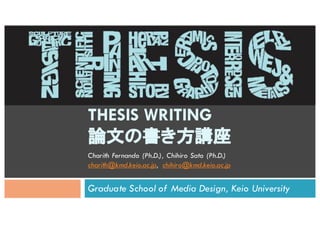
THESIS WRITING
論文の書き方講座
Graduate School of Media Design, Keio University
Charith Fernando (Ph.D.), Chihiro Sato (Ph.D.)
charith@kmd.keio.ac.jp, chihiro@kmd.keio.ac.jp
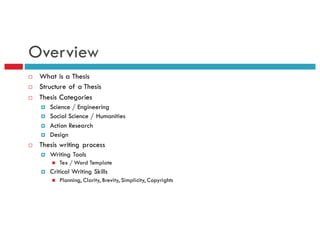
Overview
¨ What is a Thesis
¨ Structure of a Thesis
¨ Thesis Categories
¤ Science / Engineering
¤ Social Science / Humanities
¤ Action Research
¤ Design
¨ Thesis writing process
¤ Writing Tools
n Tex / Word Template
¤ Critical Writing Skills
n Planning, Clarity, Brevity, Simplicity, Copyrights
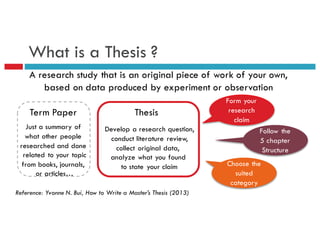
What is a Thesis ?
Reference: Yvonne N. Bui, How to Write a Master’s Thesis (2013)
A research study that is an original piece of work of your own,
based on data produced by experiment or observation
Term Paper Thesis
Just a summary of
what other people
researched and done
related to your topic
from books, journals,
or articles…
Develop a research question,
conduct literature review,
collect original data,
analyze what you found
to state your claim
Follow the
5 chapter
Structure
Form your
research
claim
Choose the
suited
category
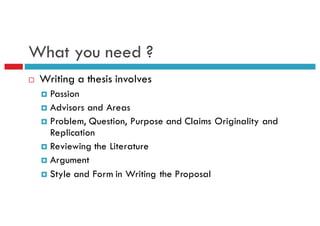
What you need ?
¨ Writing a thesis involves
¤ Passion
¤ Advisors and Areas
¤ Problem, Question, Purpose and Claims Originality and
Replication
¤ Reviewing the Literature
¤ Argument
¤ Style and Form in Writing the Proposal
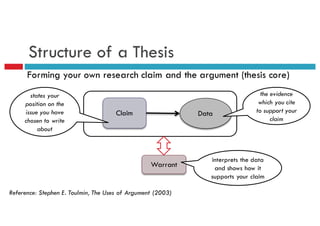
Structure of a Thesis
Reference: Stephen E. Toulmin, The Uses of Argument (2003)
Forming your own research claim and the argument (thesis core)
Claim Data
Warrant
states your
position on the
issue you have
chosen to write
about
the evidence
which you cite
to support your
claim
interprets the data
and shows how it
supports your claim
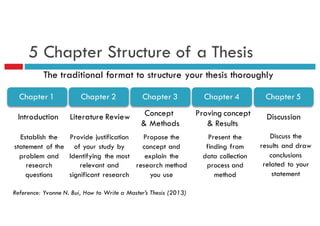
5 Chapter Structure of a Thesis
Literature ReviewIntroduction
Establish the
statement of the
problem and
research
questions
Reference: Yvonne N. Bui, How to Write a Master’s Thesis (2013)
Chapter 1 Chapter 2 Chapter 3 Chapter 4
The traditional format to structure your thesis thoroughly
Chapter 5
Proving concept
& Results
Concept
& Methods
Discussion
Provide justification
of your study by
Identifying the most
relevant and
significant research
Propose the
concept and
explain the
research method
you use
Present the
finding from
data collection
process and
method
Discuss the
results and draw
conclusions
related to your
statement
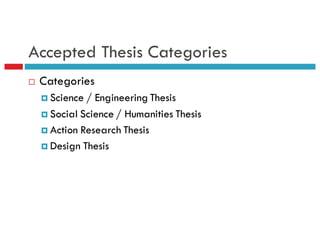
Accepted Thesis Categories
¨ Categories
¤ Science / Engineering Thesis
¤ Social Science / Humanities Thesis
¤ Action Research Thesis
¤ Design Thesis
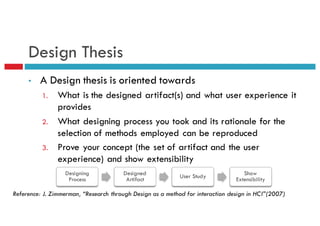
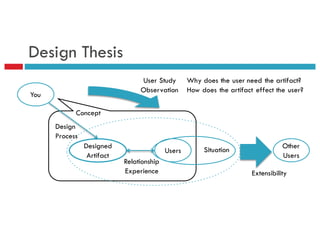
Design Thesis
• A Design thesis is oriented towards
1. What is the designed artifact(s) and what user experience it
provides
2. What designing process you took and its rationale for the
selection of methods employed can be reproduced
3. Prove your concept (the set of artifact and the user
experience) and show extensibility
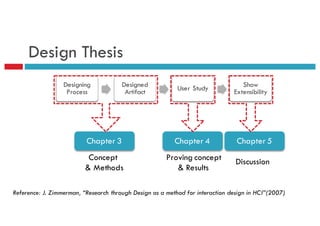
Reference: J. Zimmerman, “Research through Design as a method for interaction design in HCI”(2007)
Designing
Process
Designed
Artifact
User Study Show
Extensibility
Design Thesis
You
Designed
Artifact
Design
Process
Users
Relationship
Experience
Concept
User Study
Observation
Situation
Extensibility
Other
Users
Why does the user need the artifact?
How does the artifact effect the user?
Design Thesis
Reference: J. Zimmerman, “Research through Design as a method for interaction design in HCI”(2007)
Designing
Process
Designed
Artifact
User Study Show
Extensibility
Chapter 3
Concept
& Methods
Chapter 4
Proving concept
& Results
Chapter 5
Discussion
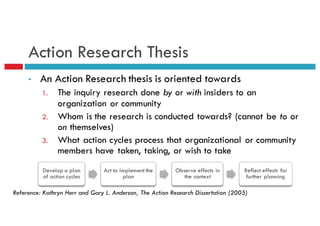
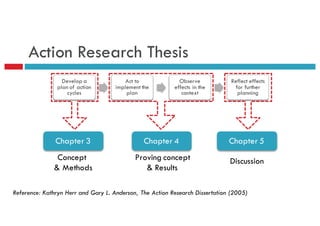
Action Research Thesis
• An Action Research thesis is oriented towards
1. The inquiry research done by or with insiders to an
organization or community
2. Whom is the research is conducted towards? (cannot be to or
on themselves)
3. What action cycles process that organizational or community
members have taken, taking, or wish to take
Reference: Kathryn Herr and Gary L. Anderson, The Action Research Dissertation (2005)
Develop a plan
of action cycles
Act to implement the
plan
Observe effects in
the context
Reflect effects for
further planning
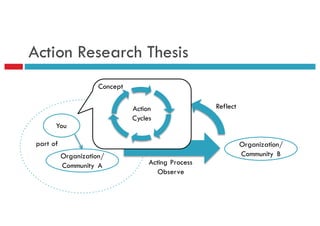
Action Research Thesis
You
Organization/
Community A
part of
Action
Cycles
Acting Process
Observe
Reflect
Organization/
Community B
Concept
Action Research Thesis
Reference: Kathryn Herr and Gary L. Anderson, The Action Research Dissertation (2005)
Develop a
plan of action
cycles
Act to
implement the
plan
Observe
effects in the
context
Reflect effects
for further
planning
Chapter 3
Concept
& Methods
Chapter 4
Proving concept
& Results
Chapter 5
Discussion
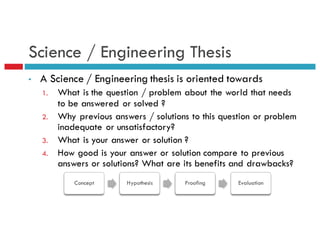
Science / Engineering Thesis
• A Science / Engineering thesis is oriented towards
1. What is the question / problem about the world that needs
to be answered or solved ?
2. Why previous answers / solutions to this question or problem
inadequate or unsatisfactory?
3. What is your answer or solution ?
4. How good is your answer or solution compare to previous
answers or solutions? What are its benefits and drawbacks?
Concept Hypothesis Proofing Evaluation
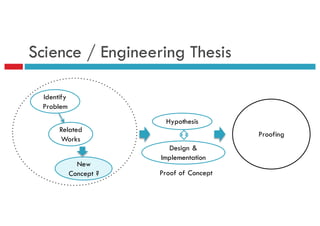
Science / Engineering Thesis
New
Concept ? Proof of Concept
Design &
Implementation
Identify
Problem
Related
Works
Proofing
Hypothesis
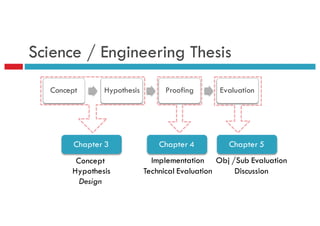
Science / Engineering Thesis
Concept Hypothesis Proofing Evaluation
Chapter 3
Concept
Hypothesis
Design
Chapter 4
Implementation
Technical Evaluation
Chapter 5
Obj /Sub Evaluation
Discussion
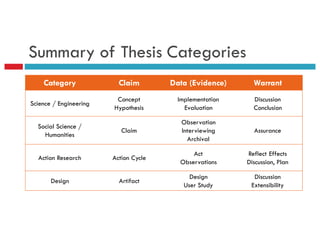
Summary of Thesis Categories
Category Claim Data (Evidence) Warrant
Science / Engineering
Concept
Hypothesis
Implementation
Evaluation
Discussion
Conclusion
Social Science /
Humanities
Claim
Observation
Interviewing
Archival
Assurance
Action Research Action Cycle
Act
Observations
Reflect Effects
Discussion, Plan
Design Artifact
Design
User Study
Discussion
Extensibility
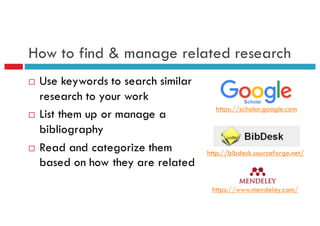
How to find & manage related research
¨ Use keywords to search similar
research to your work
¨ List them up or manage a
bibliography
¨ Read and categorize them
based on how they are related
https://scholar.google.com
http://bibdesk.sourceforge.net/
https://www.mendeley.com/
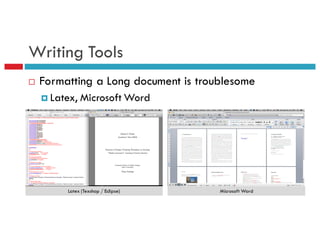
Writing Tools
¨ Formatting a Long document is troublesome
¤ Latex, Microsoft Word
Latex (Texshop / Eclipse) Microsoft Word
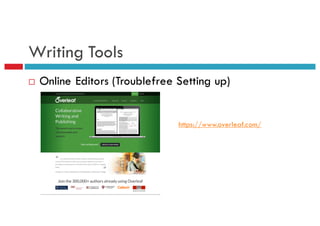
Writing Tools
¨ Online Editors (Troublefree Setting up)
https://www.overleaf.com/
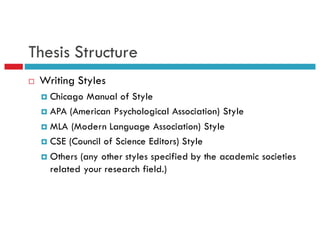
Thesis Structure
¨ Writing Styles
¤ Chicago Manual of Style
¤ APA (American Psychological Association) Style
¤ MLA (Modern Language Association) Style
¤ CSE (Council of Science Editors) Style
¤ Others (any other styles specified by the academic societies
related your research field.)
Critical Writing Skills
¨ The fundamental purpose of thesis is not the mere
presentation of information and thought but rather
it’s actual communication
§ George Gopen and Judith Swan
The Science of Scientific Writing
Process of Thesis Writing
¨ Good writing doesn’t happen overnight
¤ planning, drafting (first draft, revised draft, final draft), rereading,
revising, and editing
¨ Learning and improvement requires
¤ self-review, peer-review, subject-matterexpert feedback, and practice
¨ Good writing is a habit that takes time
¤ There are no shortcuts
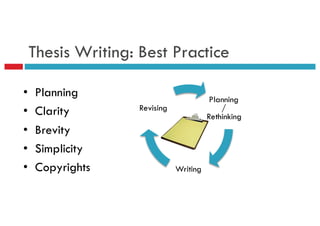
Thesis Writing: Best Practice
Planning
/
Rethinking
Writing
Revising
• Planning
• Clarity
• Brevity
• Simplicity
• Copyrights
Planning
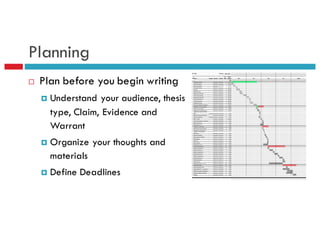
¨ Plan before you begin writing
¤ Understand your audience, thesis
type, Claim, Evidence and
Warrant
¤ Organize your thoughts and
materials
¤ Define Deadlines
Clarity
¨ Avoid Jargons
¤ Abbreviations, Slang
n If needs to abbreviate, define the term in its first occurrence.
n Ex: Keio Media Design (KMD)
¨ Citation and Quotation
¤ Cite the work of others to strengthen your arguments
¤ Quote properly when Copying someone else's explanation
¤ Acknowledge the source
Clarity
¨ Use audience familiarity words
¤ Ex: The materials friction coefficient seems adequate
for the outer design. (Design Thesis)
¨ Avoid too long sentences
Brevity
¨ Most Important First
¤ Place key information in the main clause
¨ Less Is More
¤ Pare your language down to the essential message you want to get
across to your readers
¨ Use words efficiently & Remove Redundancy
¤ Never use two words when one word will do
¤ Combine overlapping sentences when possible
Simplicity
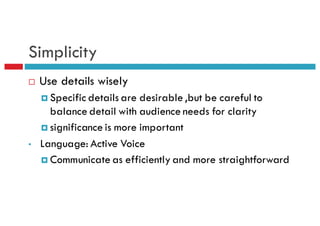
¨ Use details wisely
¤ Specific details are desirable ,but be careful to
balance detail with audience needs for clarity
¤ significance is more important
• Language: Active Voice
¤ Communicate as efficiently and more straightforward
Simplicity
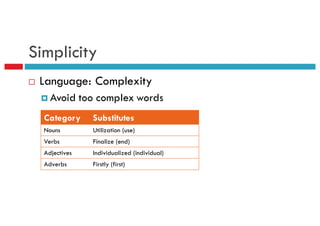
¨ Language: Complexity
¤ Avoid too complex words
Category Substitutes
Nouns Utilization (use)
Verbs Finalize (end)
Adjectives Individualized (individual)
Adverbs Firstly (first)
Simplicity
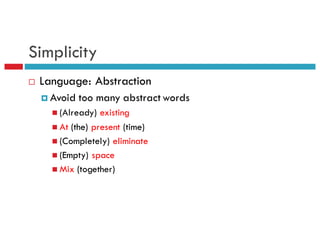
¨ Language: Abstraction
¤ Avoid too many abstract words
n (Already) existing
n At (the) present (time)
n (Completely) eliminate
n (Empty) space
n Mix (together)
Simplicity
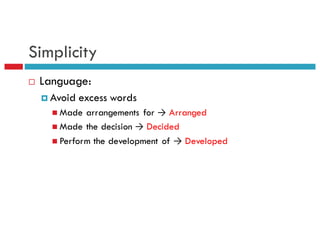
¨ Language:
¤ Avoid excess words
n Made arrangements for → Arranged
n Made the decision → Decided
n Perform the development of → Developed
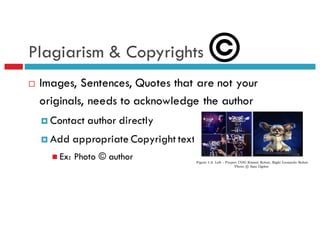
Plagiarism & Copyrights
¨ Images, Sentences, Quotes that are not your
originals, needs to acknowledge the author
¤ Contact author directly
¤ Add appropriate Copyright text
n Ex: Photo © author
Tips & Tricks
1. Decide when to start
2. Decide when to stop
3. Set Milestones (deadlines for each chapter)
4. Set easy targets for each day
5. Create a comfortable, distraction free environment
6. Only turn on the computer when you know exactly what you’re going to write
7. Check email only after you’ve done at least 2 hours work
8. Work for 25 minutes at a time (5min break)
9. Get away from the computer when you aren’t working
10. Look after yourself
Q&A

How to Write a Thesis

  • 1.
    THESIS WRITING 論文の書き方講座 Graduate Schoolof Media Design, Keio University Charith Fernando (Ph.D.), Chihiro Sato (Ph.D.) charith@kmd.keio.ac.jp, chihiro@kmd.keio.ac.jp
  • 2.
    Overview ¨ What isa Thesis ¨ Structure of a Thesis ¨ Thesis Categories ¤ Science / Engineering ¤ Social Science / Humanities ¤ Action Research ¤ Design ¨ Thesis writing process ¤ Writing Tools n Tex / Word Template ¤ Critical Writing Skills n Planning, Clarity, Brevity, Simplicity, Copyrights
  • 3.
    What is aThesis ? Reference: Yvonne N. Bui, How to Write a Master’s Thesis (2013) A research study that is an original piece of work of your own, based on data produced by experiment or observation Term Paper Thesis Just a summary of what other people researched and done related to your topic from books, journals, or articles… Develop a research question, conduct literature review, collect original data, analyze what you found to state your claim Follow the 5 chapter Structure Form your research claim Choose the suited category
  • 4.
    What you need? ¨ Writing a thesis involves ¤ Passion ¤ Advisors and Areas ¤ Problem, Question, Purpose and Claims Originality and Replication ¤ Reviewing the Literature ¤ Argument ¤ Style and Form in Writing the Proposal
  • 5.
    Structure of aThesis Reference: Stephen E. Toulmin, The Uses of Argument (2003) Forming your own research claim and the argument (thesis core) Claim Data Warrant states your position on the issue you have chosen to write about the evidence which you cite to support your claim interprets the data and shows how it supports your claim
  • 6.
    5 Chapter Structureof a Thesis Literature ReviewIntroduction Establish the statement of the problem and research questions Reference: Yvonne N. Bui, How to Write a Master’s Thesis (2013) Chapter 1 Chapter 2 Chapter 3 Chapter 4 The traditional format to structure your thesis thoroughly Chapter 5 Proving concept & Results Concept & Methods Discussion Provide justification of your study by Identifying the most relevant and significant research Propose the concept and explain the research method you use Present the finding from data collection process and method Discuss the results and draw conclusions related to your statement
  • 7.
    Accepted Thesis Categories ¨Categories ¤ Science / Engineering Thesis ¤ Social Science / Humanities Thesis ¤ Action Research Thesis ¤ Design Thesis
  • 8.
    Design Thesis • ADesign thesis is oriented towards 1. What is the designed artifact(s) and what user experience it provides 2. What designing process you took and its rationale for the selection of methods employed can be reproduced 3. Prove your concept (the set of artifact and the user experience) and show extensibility Reference: J. Zimmerman, “Research through Design as a method for interaction design in HCI”(2007) Designing Process Designed Artifact User Study Show Extensibility
  • 9.
  • 10.
    Design Thesis Reference: J.Zimmerman, “Research through Design as a method for interaction design in HCI”(2007) Designing Process Designed Artifact User Study Show Extensibility Chapter 3 Concept & Methods Chapter 4 Proving concept & Results Chapter 5 Discussion
  • 11.
    Action Research Thesis •An Action Research thesis is oriented towards 1. The inquiry research done by or with insiders to an organization or community 2. Whom is the research is conducted towards? (cannot be to or on themselves) 3. What action cycles process that organizational or community members have taken, taking, or wish to take Reference: Kathryn Herr and Gary L. Anderson, The Action Research Dissertation (2005) Develop a plan of action cycles Act to implement the plan Observe effects in the context Reflect effects for further planning
  • 12.
    Action Research Thesis You Organization/ CommunityA part of Action Cycles Acting Process Observe Reflect Organization/ Community B Concept
  • 13.
    Action Research Thesis Reference:Kathryn Herr and Gary L. Anderson, The Action Research Dissertation (2005) Develop a plan of action cycles Act to implement the plan Observe effects in the context Reflect effects for further planning Chapter 3 Concept & Methods Chapter 4 Proving concept & Results Chapter 5 Discussion
  • 14.
    Science / EngineeringThesis • A Science / Engineering thesis is oriented towards 1. What is the question / problem about the world that needs to be answered or solved ? 2. Why previous answers / solutions to this question or problem inadequate or unsatisfactory? 3. What is your answer or solution ? 4. How good is your answer or solution compare to previous answers or solutions? What are its benefits and drawbacks? Concept Hypothesis Proofing Evaluation
  • 15.
    Science / EngineeringThesis New Concept ? Proof of Concept Design & Implementation Identify Problem Related Works Proofing Hypothesis
  • 16.
    Science / EngineeringThesis Concept Hypothesis Proofing Evaluation Chapter 3 Concept Hypothesis Design Chapter 4 Implementation Technical Evaluation Chapter 5 Obj /Sub Evaluation Discussion
  • 17.
    Summary of ThesisCategories Category Claim Data (Evidence) Warrant Science / Engineering Concept Hypothesis Implementation Evaluation Discussion Conclusion Social Science / Humanities Claim Observation Interviewing Archival Assurance Action Research Action Cycle Act Observations Reflect Effects Discussion, Plan Design Artifact Design User Study Discussion Extensibility
  • 18.
    How to find& manage related research ¨ Use keywords to search similar research to your work ¨ List them up or manage a bibliography ¨ Read and categorize them based on how they are related https://scholar.google.com http://bibdesk.sourceforge.net/ https://www.mendeley.com/
  • 19.
    Writing Tools ¨ Formattinga Long document is troublesome ¤ Latex, Microsoft Word Latex (Texshop / Eclipse) Microsoft Word
  • 20.
    Writing Tools ¨ OnlineEditors (Troublefree Setting up) https://www.overleaf.com/
  • 21.
    Thesis Structure ¨ WritingStyles ¤ Chicago Manual of Style ¤ APA (American Psychological Association) Style ¤ MLA (Modern Language Association) Style ¤ CSE (Council of Science Editors) Style ¤ Others (any other styles specified by the academic societies related your research field.)
  • 22.
    Critical Writing Skills ¨The fundamental purpose of thesis is not the mere presentation of information and thought but rather it’s actual communication § George Gopen and Judith Swan The Science of Scientific Writing
  • 23.
    Process of ThesisWriting ¨ Good writing doesn’t happen overnight ¤ planning, drafting (first draft, revised draft, final draft), rereading, revising, and editing ¨ Learning and improvement requires ¤ self-review, peer-review, subject-matterexpert feedback, and practice ¨ Good writing is a habit that takes time ¤ There are no shortcuts
  • 24.
    Thesis Writing: BestPractice Planning / Rethinking Writing Revising • Planning • Clarity • Brevity • Simplicity • Copyrights
  • 25.
    Planning ¨ Plan beforeyou begin writing ¤ Understand your audience, thesis type, Claim, Evidence and Warrant ¤ Organize your thoughts and materials ¤ Define Deadlines
  • 26.
    Clarity ¨ Avoid Jargons ¤Abbreviations, Slang n If needs to abbreviate, define the term in its first occurrence. n Ex: Keio Media Design (KMD) ¨ Citation and Quotation ¤ Cite the work of others to strengthen your arguments ¤ Quote properly when Copying someone else's explanation ¤ Acknowledge the source
  • 27.
    Clarity ¨ Use audiencefamiliarity words ¤ Ex: The materials friction coefficient seems adequate for the outer design. (Design Thesis) ¨ Avoid too long sentences
  • 28.
    Brevity ¨ Most ImportantFirst ¤ Place key information in the main clause ¨ Less Is More ¤ Pare your language down to the essential message you want to get across to your readers ¨ Use words efficiently & Remove Redundancy ¤ Never use two words when one word will do ¤ Combine overlapping sentences when possible
  • 29.
    Simplicity ¨ Use detailswisely ¤ Specific details are desirable ,but be careful to balance detail with audience needs for clarity ¤ significance is more important • Language: Active Voice ¤ Communicate as efficiently and more straightforward
  • 30.
    Simplicity ¨ Language: Complexity ¤Avoid too complex words Category Substitutes Nouns Utilization (use) Verbs Finalize (end) Adjectives Individualized (individual) Adverbs Firstly (first)
  • 31.
    Simplicity ¨ Language: Abstraction ¤Avoid too many abstract words n (Already) existing n At (the) present (time) n (Completely) eliminate n (Empty) space n Mix (together)
  • 32.
    Simplicity ¨ Language: ¤ Avoidexcess words n Made arrangements for → Arranged n Made the decision → Decided n Perform the development of → Developed
  • 33.
    Plagiarism & Copyrights ¨Images, Sentences, Quotes that are not your originals, needs to acknowledge the author ¤ Contact author directly ¤ Add appropriate Copyright text n Ex: Photo © author
  • 34.
    Tips & Tricks 1.Decide when to start 2. Decide when to stop 3. Set Milestones (deadlines for each chapter) 4. Set easy targets for each day 5. Create a comfortable, distraction free environment 6. Only turn on the computer when you know exactly what you’re going to write 7. Check email only after you’ve done at least 2 hours work 8. Work for 25 minutes at a time (5min break) 9. Get away from the computer when you aren’t working 10. Look after yourself
  • 35.