By
SATHISHKUMAR G
(sathishsak111@gmail.com)
INTRODUCTION
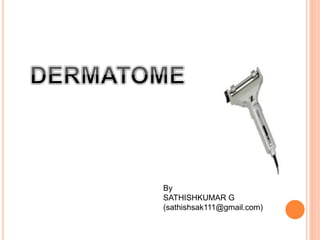
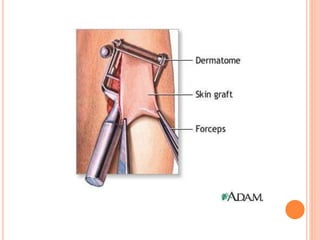
A dermatome is a surgical instrument used to produce thin slices
of skin from a donor area, in order to use them for making skin grafts. One of
its main applications is for reconstituting skin areas damaged by grade
3 burns or trauma.
Dermatomes can be operated either manually or electrically. The first
drum dermatomes, developed in the 1930s, were manually operated.
Afterwards, dermatomes which were operated by air pressure, such as the
Brown dermatome, achieved higher speed and precision. Electrical
dermatomes are better for cutting out thinner and longer strips of skin with a
more homogeneous thickness.
Dermatomes Anatomy
The surface of the skin is divided into specific areas called
dermatomes, which are derived from the cells of a SOMITE. These
cells differentiate into the following 3 regions: (1) MYOTOME, which
forms some of the skeletal muscle; (2) dermatome, which forms the
connective tissues, including the dermis; and (3) SCLEROTOME,
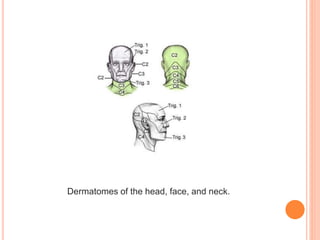
which gives rise to the vertebrae. A dermatome is an area of skin in
which sensory nerves derive from a single spinal nerve root (see the
following image).
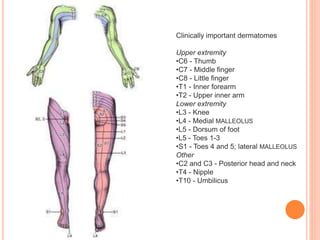
Dermatomes of the head, face, and neck.
Clinically important dermatomes
Upper extremity
•C6 - Thumb
•C7 - Middle finger
•C8 - Little finger
•T1 - Inner forearm
•T2 - Upper inner arm
Lower extremity
•L3 - Knee
•L4 - Medial MALLEOLUS
•L5 - Dorsum of foot
•L5 - Toes 1-3
•S1 - Toes 4 and 5; lateral MALLEOLUS
Other
•C2 and C3 - Posterior head and neck
•T4 - Nipple
•T10 - Umbilicus
DERMATOME INSTRUMENTS
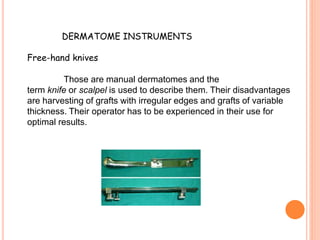
Free-hand knives
Those are manual dermatomes and the
term knife or scalpel is used to describe them. Their disadvantages
are harvesting of grafts with irregular edges and grafts of variable
thickness. Their operator has to be experienced in their use for
optimal results.
Types of dermatomes
There are several types of dermatomes, usually named after their
inventor
Knives
 Drum
Electric
Air
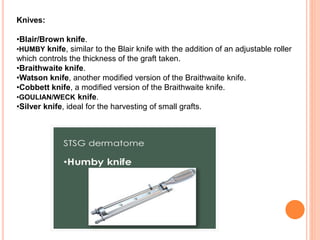
Knives:
•Blair/Brown knife.
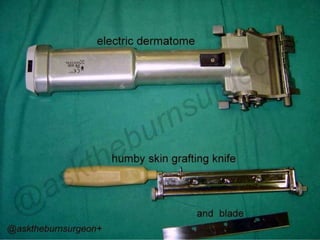
•HUMBY knife, similar to the Blair knife with the addition of an adjustable roller
which controls the thickness of the graft taken.
•Braithwaite knife.
•Watson knife, another modified version of the Braithwaite knife.
•Cobbett knife, a modified version of the Braithwaite knife.
•GOULIAN/WECK knife.
•Silver knife, ideal for the harvesting of small grafts.
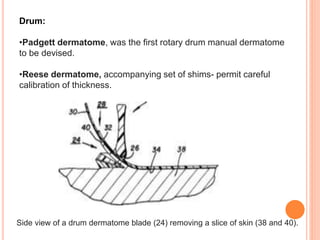
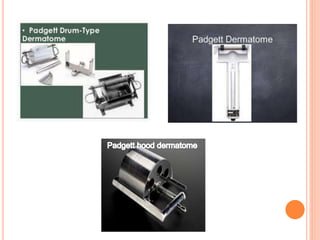
Drum:
•Padgett dermatome, was the first rotary drum manual dermatome
to be devised.
•Reese dermatome, accompanying set of shims- permit careful
calibration of thickness.
Side view of a drum dermatome blade (24) removing a slice of skin (38 and 40).
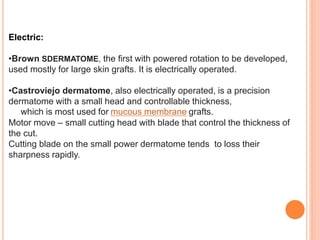
Electric:
•Brown SDERMATOME, the first with powered rotation to be developed,
used mostly for large skin grafts. It is electrically operated.
•Castroviejo dermatome, also electrically operated, is a precision
dermatome with a small head and controllable thickness,
which is most used for mucous membrane grafts.
Motor move – small cutting head with blade that control the thickness of
the cut.
Cutting blade on the small power dermatome tends to loss their
sharpness rapidly.
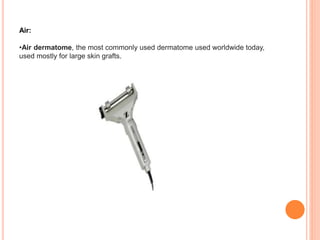
Air:
•Air dermatome, the most commonly used dermatome used worldwide today,
used mostly for large skin grafts.
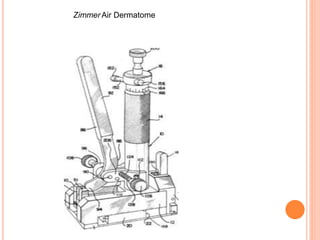
Zimmer Air Dermatome
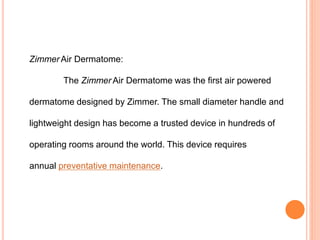
Zimmer Air Dermatome:
The Zimmer Air Dermatome was the first air powered
dermatome designed by Zimmer. The small diameter handle and
lightweight design has become a trusted device in hundreds of
operating rooms around the world. This device requires
annual preventative maintenance.
Advantage
• Ideal for the harvesting of small grafts
• Exceptional maneuverability with less hand fatigue
•Graft thicknesses up to .030 inch (0.76mm) in easily adjustable .002
inch (0.05mm) increments
•Safety lever to help prevent accidental activation
•Width plates range from one to four inches (2.5 to 10cm) in one inch
increments
•Blades are supplied sterile and don’t require lubrication
5,000 – 6,000 cycles/minute high speed cutting action
•Includes nitrogen hose that exhausts 10 ft. away from surgical site
Disadvantage
• If the graft is too thick or thins, it is difficult to change the calibration
in the middle of a skin graft removal
• once the procedure is over remove the disposable blade to avoid
injury to the operator
• Graft I removed by gentle rubbing with a sponge gauze soaked in
normal saline solution
• cutting blade on the small power dermatome tend to loss their
sharpness rapidly
Freehand with a knife:
• Graft with irregular edges and varying thickness
Application
One of its main applications is for reconstituting skin
areas damaged by grade 3 burns or trauma.
Dermatome used in skin graft such a plastic surgery,
etc
THANK YOU…….
ANY
QUERIES?....

DERMATOME

  • 1.
  • 2.
    INTRODUCTION A dermatome isa surgical instrument used to produce thin slices of skin from a donor area, in order to use them for making skin grafts. One of its main applications is for reconstituting skin areas damaged by grade 3 burns or trauma. Dermatomes can be operated either manually or electrically. The first drum dermatomes, developed in the 1930s, were manually operated. Afterwards, dermatomes which were operated by air pressure, such as the Brown dermatome, achieved higher speed and precision. Electrical dermatomes are better for cutting out thinner and longer strips of skin with a more homogeneous thickness.
  • 3.
    Dermatomes Anatomy The surfaceof the skin is divided into specific areas called dermatomes, which are derived from the cells of a SOMITE. These cells differentiate into the following 3 regions: (1) MYOTOME, which forms some of the skeletal muscle; (2) dermatome, which forms the connective tissues, including the dermis; and (3) SCLEROTOME, which gives rise to the vertebrae. A dermatome is an area of skin in which sensory nerves derive from a single spinal nerve root (see the following image).
  • 4.
    Dermatomes of thehead, face, and neck.
  • 5.
    Clinically important dermatomes Upperextremity •C6 - Thumb •C7 - Middle finger •C8 - Little finger •T1 - Inner forearm •T2 - Upper inner arm Lower extremity •L3 - Knee •L4 - Medial MALLEOLUS •L5 - Dorsum of foot •L5 - Toes 1-3 •S1 - Toes 4 and 5; lateral MALLEOLUS Other •C2 and C3 - Posterior head and neck •T4 - Nipple •T10 - Umbilicus
  • 6.
    DERMATOME INSTRUMENTS Free-hand knives Thoseare manual dermatomes and the term knife or scalpel is used to describe them. Their disadvantages are harvesting of grafts with irregular edges and grafts of variable thickness. Their operator has to be experienced in their use for optimal results.
  • 7.
    Types of dermatomes Thereare several types of dermatomes, usually named after their inventor Knives  Drum Electric Air
  • 8.
    Knives: •Blair/Brown knife. •HUMBY knife,similar to the Blair knife with the addition of an adjustable roller which controls the thickness of the graft taken. •Braithwaite knife. •Watson knife, another modified version of the Braithwaite knife. •Cobbett knife, a modified version of the Braithwaite knife. •GOULIAN/WECK knife. •Silver knife, ideal for the harvesting of small grafts.
  • 9.
    Drum: •Padgett dermatome, wasthe first rotary drum manual dermatome to be devised. •Reese dermatome, accompanying set of shims- permit careful calibration of thickness. Side view of a drum dermatome blade (24) removing a slice of skin (38 and 40).
  • 11.
    Electric: •Brown SDERMATOME, thefirst with powered rotation to be developed, used mostly for large skin grafts. It is electrically operated. •Castroviejo dermatome, also electrically operated, is a precision dermatome with a small head and controllable thickness, which is most used for mucous membrane grafts. Motor move – small cutting head with blade that control the thickness of the cut. Cutting blade on the small power dermatome tends to loss their sharpness rapidly.
  • 13.
    Air: •Air dermatome, themost commonly used dermatome used worldwide today, used mostly for large skin grafts.
  • 14.
  • 15.
    Zimmer Air Dermatome: TheZimmer Air Dermatome was the first air powered dermatome designed by Zimmer. The small diameter handle and lightweight design has become a trusted device in hundreds of operating rooms around the world. This device requires annual preventative maintenance.
  • 17.
    Advantage • Ideal forthe harvesting of small grafts • Exceptional maneuverability with less hand fatigue •Graft thicknesses up to .030 inch (0.76mm) in easily adjustable .002 inch (0.05mm) increments •Safety lever to help prevent accidental activation •Width plates range from one to four inches (2.5 to 10cm) in one inch increments •Blades are supplied sterile and don’t require lubrication 5,000 – 6,000 cycles/minute high speed cutting action •Includes nitrogen hose that exhausts 10 ft. away from surgical site
  • 18.
    Disadvantage • If thegraft is too thick or thins, it is difficult to change the calibration in the middle of a skin graft removal • once the procedure is over remove the disposable blade to avoid injury to the operator • Graft I removed by gentle rubbing with a sponge gauze soaked in normal saline solution • cutting blade on the small power dermatome tend to loss their sharpness rapidly Freehand with a knife: • Graft with irregular edges and varying thickness
  • 19.
    Application One of itsmain applications is for reconstituting skin areas damaged by grade 3 burns or trauma. Dermatome used in skin graft such a plastic surgery, etc
  • 20.
  • 21.