Unit G325 Critical Media
      Perspectives
      Postmodern TV
Lesson Objectives
• To revise some postmodern theory.

• To know how to discuss TV and film as a
  postmodern medium.

• To understand how to incorporate theory
  into an essay on postmodernism.
Definition of post modernism


                          3
Theorists
• John Belton identifies 3 characteristics of post
  modern cinema: (don’t relate these to TV!)
• It is based on a pastiche (borrowing and re-using
  in another context without changing) of
  traditional generic material
• It is an imitation of images from the past, offered
  as nostalgic substitutes for any real exploration of
  either the past or for the present.
• This referencing the past reflects the fact that for
  the modern film maker, there isn’t much that
  hasn’t already been said.
                                                     4
John Belton

•    What was John Belton trying to say
    about pomo film?

• Can you think of three examples where
  you could relate John Belton’s thoery
  with pomo films you have studied?


                                          5
TV as a Postmodern Medium
• In its resistance to simplification or generalisation, TV
  is sometimes seen as one of the clearest embodiments
  of postmodernism.
• TV provides a constant turnover of images and
  symbols.
• TV is seen as central to the explosion of consumer
  culture – unlike Modernist Art, which was thought to
  be characterised by “integrity, authenticity and
  originality” and therefore stood against capitalism and
  consumerism, TV often focuses on these ideologies.
• Jim Collins said about TV: “TV is frequently referred to
  as one of the main kinds of postmodern culture.”
Jim Collins
    Film as a Postmodern Medium


• He analysed films by saying:

• There is a new divide in Hollywood today, between
• the eclectic or ‘hybrid’ film one one hand, smart and
  ‘knowing’ and
• a more traditional kind of film keen to endorse ‘authentic’
  values and a solid, traditional sense of reality, as opposed
  to a playful sense of representations.
Jim Collins

•   Say that different films operate on different levels:


•   Says that some explore a character adventure
•   And some make the text very self referential and ‘knowing’
    and in that sense the journey is the texts’ journey.

•   The ‘text’s adventure’ can mean different signifiers from different
    genres, disconnected from their typical narrative structures.
•   Often there is a ‘knowingness’, a self-consciousness in deploying
    generic features and on the part of the spectators in interpreting
    them.
•

                                                                         8
2 layers to post modern media
• Jim Collins was talking about films, not
  TV programmes, and said you read a film
  or TV programme on two levels:

• One is the straight narrative layer
• The other is the post modern layer which
  is filled with meaning, pastiche, parody,
  intertexual references, irony, humour and
  knowingness.

                                            9
Hyperconsciousness
• Simply – a text’s awareness of itself, its
  status, function and history.
• A term used by theorist Jim Collins.
• A hyper awareness on the part of the text
  itself of its cultural status, function and
  history, as well as how it will be received by
  an audience.
• Jim Collins makes a distinction between the
  ‘knowing’ po mo text, the hybrid and the
  solid traditional film.
TASK
• What did Jim Collins say about pomo
  TV?
• What did Jim Collins say about pomo
  film?
• Can you write a paragraph about how
  post modern film is different to normal
  film and relate this thought to Jim
  Collins theory?

                                       11
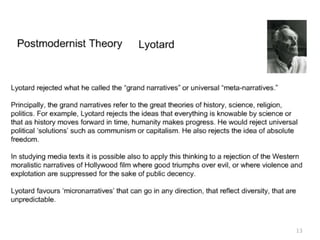
Jean-Francois Lyotard
• He suggests that grand narratives like
  religion, science, Marxism, capitalism no
  longer have the same importance in our
  lives. The concept of progress and the
  arts, technology, medicine and knowledge
  would progress to a greater good is now
  seen to be questionable.
• The ‘death’ of the grand narrative, as it is
  known, is explored in ‘Children of Men’

                                                 12
13
TASK

• Why do pomo directors
  reinforce the idea of the death
  of the grand narrative in their
  films?
• What examples can you think
  of that do this?
• More importantly - why?
                                    14
Postmodern theory: Marshall
           McLuhan
• As a background to postmodern theory
  it’s useful to look at the media theorist
  Marshall McLuhan (he wasn’t specifically
  a pomo theorist)
• In 1964 McLuhan coined the phrase “the
  medium is the message”.
• By this he means the way any message
  is communicated is more important than
  the message itself.
                                          15
16
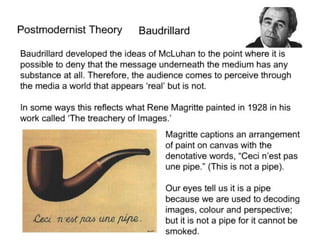
Baudrillard and simulacra
• Simulacra - copies of historical events or
  landmarks.
• Fantasyland at Disneyland - copies various
  Disney films and books, eg Peter Pan, Alice
  in Wonderland, King Arthur, Pinocchio.
• Umberton Eco said that ‘we enjoy a perfect
  imitation, we also enjoy the conviction that
  imitation has reached its peak and
  afterwards reality will always be inferior to
  it.”
                                              17
Disneyland and Simulacra and
               simulation
•   Both Umberto Eco and Jean Baudrillard refer to Disneyland as an exemplar
    of hyperreality. Eco believes that Disneyland with its settings such as Main
    Street and full sized houses has been created to look "absolutely
    realistic," taking visitors' imagination to a "fantastic past."
•   This false reality creates an illusion and makes it more desirable for
    people to buy this reality. The fake animals such as alligators and
    hippopotamuses are all available to people in Disneyland and for
    everyone to see. The "fake nature" of Disneyland satisfies our imagination
    and daydream fantasies in real life. Therefore, they seem more admirable
    and attractive.
•   In his work Simulacra and Simulation, Baudrillard argues the "imaginary
    world" of Disneyland magnetizes people inside and has been presented as
    "imaginary" to make people believe that all its surroundings are "real". But
    he believes that the Los Angeles area is not real; thus it is hyperreal.


                                                                              18
Baudrillard
• What was Baudrillard saying about
  reality and reproduction or about the
  blurring of reality and fiction?
• His ideas are known to be very
  controversial. What do you think of his
  ideas - do you agree or would you
  challenge his theory?


                                        19
Hyperreality
•   From Wikipedia:
•   Some examples are the McDonald's "M" arches which signify the material promise of
    endless amounts of identical food. In "reality" the "M" represents nothing, and the
    food is neither identical nor infinite.
•   Hyperreality relates to consumerism, in respect of its reliance on signs.
•   Eg. Abercrombie and Fitch shows that one is fashionable
•   A Mercedes indicates one's wealth.
•   These can be seen to create hyperreality
•   Hyperreality tricks the consciousness so it doesn’t emotionally engage, and people
    enjoy artificial simulation, and endless reproductions without meaning. Essentially.
•   Fulfillment or happiness is found through simulation and imitation of a transient
    simulacrum of reality, rather than any interaction with any "real" reality.
•   Interacting in a hyperreal place like a casino gives the subject the impression that
    one is walking through a fantasy world where everyone is playing along. The decor
    isn't authentic, everything is a copy, and the whole thing feels like a dream.


                                                                                       20
Jean Baudrillard


• Hyper reality is an exaggeration of something
  that existed into something that is so perfect its
  a fantasy. EG Disneyland
• And he believed that the media reality is now
  the ‘reality’ of today. We all want an Xmas tree
  for Xmas, but not a ruffled pine tree from the
  forest, but a perfect one with perfect leaves.
• We see images of women in magazines who
  have been Photo shop’d and touched up, so that
  you have a fantasy woman that is very far
  removed from what real women are like.

                                                  21
Jean Baudrillard
• In the post modern world, media texts
  make visible and challenge ideas of
  truth and reality removing the illusion
  that films, music videos or any media
  text can ever accurately or neutrally
  reproduce reality or truth.
• There are competing versions of truth
  and post modern film explores this.

                                            22
Other examples of hyper reality
•   Films in which characters and settings are either digitally enhanced or created
    entirely from CGI (e.g.: 300, where the entire film was shot in front of a blue/green
    screen, with all settings super-imposed).
•   A well manicured garden (nature as hyperreal).
•   Professional sports athletes as super, invincible versions of the human beings.
•   Many fake places around the world: Disney World; Dubai; Celebration, Florida; and
    Las Vegas.
•   TV and film in general (especially "reality" TV), due to its creation of a world of
    fantasy and its dependence that the viewer will engage with these fantasy worlds.
    The current trend is to glamorize the mundane using histrionics.
•   A retail store that looks completely stocked and perfect due to facing, creating a
    world of endless identical products.
•   A life which cannot be (e.g. the perfect facsimile of a celebrity's invented persona).
•   A high end sex doll used as a simulacrum of an unattainable partner.[7]
•   A newly made building or item designed to look old, or to recreate or reproduce an
    older artifact, by simulating the feel of age or aging.


                                                                                         23
Hyper reality
• What is hyper reality?
• What does it mean?
• Why is it relevant for us to study it in
  relation to pomo film?
• What do you believe about
  Baudrillard’s theories on hyper reality?


                                             24
Umberto Eco – Neo TV
• In an essay on Postmodern TV written in
  1984, Umberto Eco argued that TV had
  become so self-absorbed that it had
  almost turned its back on the real world.
•
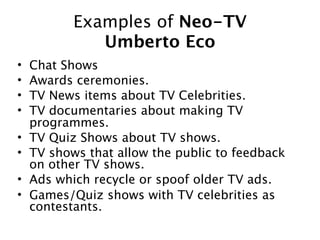
Examples of Neo-TV
              Umberto Eco
•   Chat Shows
•   Awards ceremonies.
•   TV News items about TV Celebrities.
•   TV documentaries about making TV
    programmes.
•   TV Quiz Shows about TV shows.
•   TV shows that allow the public to feedback
    on other TV shows.
•   Ads which recycle or spoof older TV ads.
•   Games/Quiz shows with TV celebrities as
    contestants.
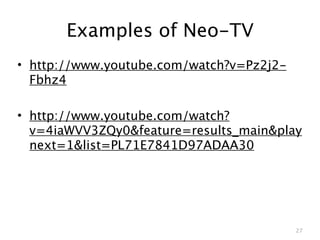
Examples of Neo-TV
• http://www.youtube.com/watch?v=Pz2j2-
  Fbhz4

• http://www.youtube.com/watch?
  v=4iaWVV3ZQy0&feature=results_main&play
  next=1&list=PL71E7841D97ADAA30


                                          27
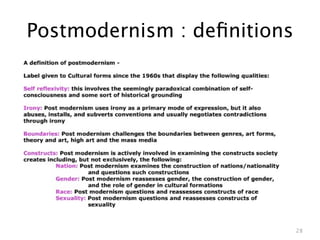
Postmodernism : definitions


                             28

Post modern theory revision

  • 1.
    Unit G325 CriticalMedia Perspectives Postmodern TV
  • 2.
    Lesson Objectives • Torevise some postmodern theory. • To know how to discuss TV and film as a postmodern medium. • To understand how to incorporate theory into an essay on postmodernism.
  • 3.
  • 4.
    Theorists • John Beltonidentifies 3 characteristics of post modern cinema: (don’t relate these to TV!) • It is based on a pastiche (borrowing and re-using in another context without changing) of traditional generic material • It is an imitation of images from the past, offered as nostalgic substitutes for any real exploration of either the past or for the present. • This referencing the past reflects the fact that for the modern film maker, there isn’t much that hasn’t already been said. 4
  • 5.
    John Belton • What was John Belton trying to say about pomo film? • Can you think of three examples where you could relate John Belton’s thoery with pomo films you have studied? 5
  • 6.
    TV as aPostmodern Medium • In its resistance to simplification or generalisation, TV is sometimes seen as one of the clearest embodiments of postmodernism. • TV provides a constant turnover of images and symbols. • TV is seen as central to the explosion of consumer culture – unlike Modernist Art, which was thought to be characterised by “integrity, authenticity and originality” and therefore stood against capitalism and consumerism, TV often focuses on these ideologies. • Jim Collins said about TV: “TV is frequently referred to as one of the main kinds of postmodern culture.”
  • 7.
    Jim Collins Film as a Postmodern Medium • He analysed films by saying: • There is a new divide in Hollywood today, between • the eclectic or ‘hybrid’ film one one hand, smart and ‘knowing’ and • a more traditional kind of film keen to endorse ‘authentic’ values and a solid, traditional sense of reality, as opposed to a playful sense of representations.
  • 8.
    Jim Collins • Say that different films operate on different levels: • Says that some explore a character adventure • And some make the text very self referential and ‘knowing’ and in that sense the journey is the texts’ journey. • The ‘text’s adventure’ can mean different signifiers from different genres, disconnected from their typical narrative structures. • Often there is a ‘knowingness’, a self-consciousness in deploying generic features and on the part of the spectators in interpreting them. • 8
  • 9.
    2 layers topost modern media • Jim Collins was talking about films, not TV programmes, and said you read a film or TV programme on two levels: • One is the straight narrative layer • The other is the post modern layer which is filled with meaning, pastiche, parody, intertexual references, irony, humour and knowingness. 9
  • 10.
    Hyperconsciousness • Simply –a text’s awareness of itself, its status, function and history. • A term used by theorist Jim Collins. • A hyper awareness on the part of the text itself of its cultural status, function and history, as well as how it will be received by an audience. • Jim Collins makes a distinction between the ‘knowing’ po mo text, the hybrid and the solid traditional film.
  • 11.
    TASK • What didJim Collins say about pomo TV? • What did Jim Collins say about pomo film? • Can you write a paragraph about how post modern film is different to normal film and relate this thought to Jim Collins theory? 11
  • 12.
    Jean-Francois Lyotard • Hesuggests that grand narratives like religion, science, Marxism, capitalism no longer have the same importance in our lives. The concept of progress and the arts, technology, medicine and knowledge would progress to a greater good is now seen to be questionable. • The ‘death’ of the grand narrative, as it is known, is explored in ‘Children of Men’ 12
  • 13.
  • 14.
    TASK • Why dopomo directors reinforce the idea of the death of the grand narrative in their films? • What examples can you think of that do this? • More importantly - why? 14
  • 15.
    Postmodern theory: Marshall McLuhan • As a background to postmodern theory it’s useful to look at the media theorist Marshall McLuhan (he wasn’t specifically a pomo theorist) • In 1964 McLuhan coined the phrase “the medium is the message”. • By this he means the way any message is communicated is more important than the message itself. 15
  • 16.
  • 17.
    Baudrillard and simulacra •Simulacra - copies of historical events or landmarks. • Fantasyland at Disneyland - copies various Disney films and books, eg Peter Pan, Alice in Wonderland, King Arthur, Pinocchio. • Umberton Eco said that ‘we enjoy a perfect imitation, we also enjoy the conviction that imitation has reached its peak and afterwards reality will always be inferior to it.” 17
  • 18.
    Disneyland and Simulacraand simulation • Both Umberto Eco and Jean Baudrillard refer to Disneyland as an exemplar of hyperreality. Eco believes that Disneyland with its settings such as Main Street and full sized houses has been created to look "absolutely realistic," taking visitors' imagination to a "fantastic past." • This false reality creates an illusion and makes it more desirable for people to buy this reality. The fake animals such as alligators and hippopotamuses are all available to people in Disneyland and for everyone to see. The "fake nature" of Disneyland satisfies our imagination and daydream fantasies in real life. Therefore, they seem more admirable and attractive. • In his work Simulacra and Simulation, Baudrillard argues the "imaginary world" of Disneyland magnetizes people inside and has been presented as "imaginary" to make people believe that all its surroundings are "real". But he believes that the Los Angeles area is not real; thus it is hyperreal. 18
  • 19.
    Baudrillard • What wasBaudrillard saying about reality and reproduction or about the blurring of reality and fiction? • His ideas are known to be very controversial. What do you think of his ideas - do you agree or would you challenge his theory? 19
  • 20.
    Hyperreality • From Wikipedia: • Some examples are the McDonald's "M" arches which signify the material promise of endless amounts of identical food. In "reality" the "M" represents nothing, and the food is neither identical nor infinite. • Hyperreality relates to consumerism, in respect of its reliance on signs. • Eg. Abercrombie and Fitch shows that one is fashionable • A Mercedes indicates one's wealth. • These can be seen to create hyperreality • Hyperreality tricks the consciousness so it doesn’t emotionally engage, and people enjoy artificial simulation, and endless reproductions without meaning. Essentially. • Fulfillment or happiness is found through simulation and imitation of a transient simulacrum of reality, rather than any interaction with any "real" reality. • Interacting in a hyperreal place like a casino gives the subject the impression that one is walking through a fantasy world where everyone is playing along. The decor isn't authentic, everything is a copy, and the whole thing feels like a dream. 20
  • 21.
    Jean Baudrillard • Hyperreality is an exaggeration of something that existed into something that is so perfect its a fantasy. EG Disneyland • And he believed that the media reality is now the ‘reality’ of today. We all want an Xmas tree for Xmas, but not a ruffled pine tree from the forest, but a perfect one with perfect leaves. • We see images of women in magazines who have been Photo shop’d and touched up, so that you have a fantasy woman that is very far removed from what real women are like. 21
  • 22.
    Jean Baudrillard • Inthe post modern world, media texts make visible and challenge ideas of truth and reality removing the illusion that films, music videos or any media text can ever accurately or neutrally reproduce reality or truth. • There are competing versions of truth and post modern film explores this. 22
  • 23.
    Other examples ofhyper reality • Films in which characters and settings are either digitally enhanced or created entirely from CGI (e.g.: 300, where the entire film was shot in front of a blue/green screen, with all settings super-imposed). • A well manicured garden (nature as hyperreal). • Professional sports athletes as super, invincible versions of the human beings. • Many fake places around the world: Disney World; Dubai; Celebration, Florida; and Las Vegas. • TV and film in general (especially "reality" TV), due to its creation of a world of fantasy and its dependence that the viewer will engage with these fantasy worlds. The current trend is to glamorize the mundane using histrionics. • A retail store that looks completely stocked and perfect due to facing, creating a world of endless identical products. • A life which cannot be (e.g. the perfect facsimile of a celebrity's invented persona). • A high end sex doll used as a simulacrum of an unattainable partner.[7] • A newly made building or item designed to look old, or to recreate or reproduce an older artifact, by simulating the feel of age or aging. 23
  • 24.
    Hyper reality • Whatis hyper reality? • What does it mean? • Why is it relevant for us to study it in relation to pomo film? • What do you believe about Baudrillard’s theories on hyper reality? 24
  • 25.
    Umberto Eco –Neo TV • In an essay on Postmodern TV written in 1984, Umberto Eco argued that TV had become so self-absorbed that it had almost turned its back on the real world. •
  • 26.
    Examples of Neo-TV Umberto Eco • Chat Shows • Awards ceremonies. • TV News items about TV Celebrities. • TV documentaries about making TV programmes. • TV Quiz Shows about TV shows. • TV shows that allow the public to feedback on other TV shows. • Ads which recycle or spoof older TV ads. • Games/Quiz shows with TV celebrities as contestants.
  • 27.
    Examples of Neo-TV •http://www.youtube.com/watch?v=Pz2j2- Fbhz4 • http://www.youtube.com/watch? v=4iaWVV3ZQy0&feature=results_main&play next=1&list=PL71E7841D97ADAA30 27
  • 28.