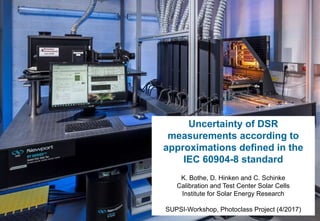
Uncertainty of DSR
measurements according to
approximations defined in the
IEC 60904-8 standard
K. Bothe, D. Hinken and C. Schinke
Calibration and Test Center Solar Cells
Institute for Solar Energy Research
SUPSI-Workshop, Photoclass Project (4/2017)
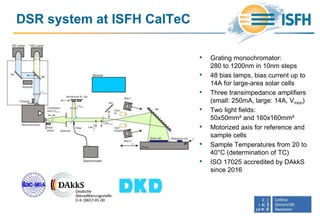
DSR system at ISFH CalTeC
• Grating monochromator:
280 to 1200nm in 10nm steps
• 48 bias lamps, bias current up to
14A for large-area solar cells
• Three transimpedance amplifiers
(small: 250mA, large: 14A, Vmon)
• Two light fields:
50x50mm² and 160x160mm²
• Motorized axis for reference and
sample cells
• Sample Temperatures from 20 to
40°C (determination of TC)
• ISO 17025 accredited by DAkkS
since 2016
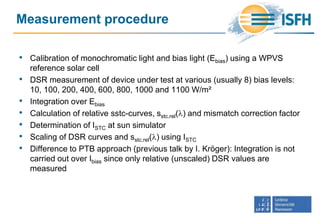
Measurement procedure
• Calibration of monochromatic light and bias light (Ebias) using a WPVS
reference solar cell
• DSR measurement of device under test at various (usually 8) bias levels:
10, 100, 200, 400, 600, 800, 1000 and 1100 W/m²
• Integration over Ebias
• Calculation of relative sstc-curves, sstc.rel(l) and mismatch correction factor
• Determination of ISTC at sun simulator
• Scaling of DSR curves and sstc.rel(l) using ISTC
• Difference to PTB approach (previous talk by I. Kröger): Integration is not
carried out over Ibias since only relative (unscaled) DSR values are
measured
Measurement uncertainty
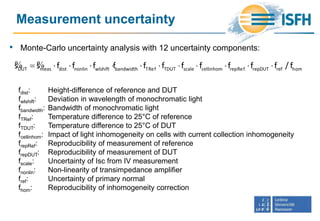
• Monte-Carlo uncertainty analysis with 12 uncertainty components:
fdist: Height-difference of reference and DUT
fwlshift: Deviation in wavelength of monochromatic light
fbandwidth: Bandwidth of monochromatic light
fTRef: Temperature difference to 25°C of reference
fTDUT: Temperature difference to 25°C of DUT
fcellinhom: Impact of light inhomogeneity on cells with current collection inhomogeneity
frepRef: Reproducibility of measurement of reference
frepDUT: Reproducibility of measurement of DUT
fscale: Uncertainty of Isc from IV measurement
fnonlin: Non-linearity of transimpedance amplifier
fref: Uncertainty of primary normal
fhom: Reproducibility of inhomogeneity correction
DUT meas dist nonlin wlshift bandwidth TRef TDUT scale cellinhom repRef repDUT ref homs s f f f f f f f f f f f / f           % %
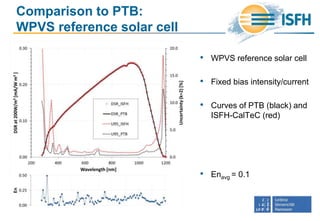
Comparison to PTB:
WPVS reference solar cell
• WPVS reference solar cell
• Fixed bias intensity/current
• Curves of PTB (black) and
ISFH-CalTeC (red)
• Enavg = 0.1
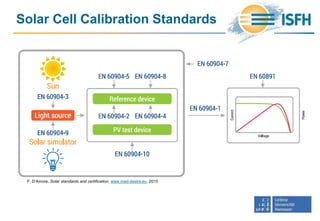
Solar Cell Calibration Standards
F. D‘Amore, Solar standards and certification, www.med-desire.eu, 2015
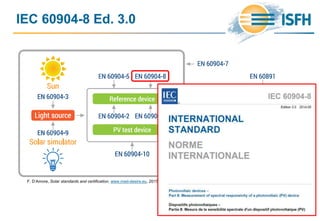
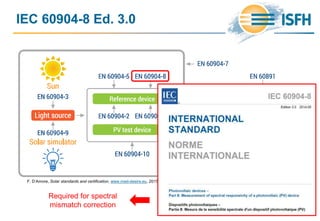
IEC 60904-8 Ed. 3.0
F. D‘Amore, Solar standards and certification, www.med-desire.eu, 2015
IEC 60904-8 Ed. 3.0
F. D‘Amore, Solar standards and certification, www.med-desire.eu, 2015
Required for spectral
mismatch correction
IEC 60904-8 Ed. 3.0
 complete DSR procedure
Definition of the requirements for the measurement of the spectral responsivity of
linear and non-linear photovoltaic devices:
For highest accuracy, the differential spectral responsivity 𝑠 𝜆, 𝐼bias has to be
measured under at least 5 different bias light irradiances resulting in short
circuit currents 𝐼SC between 5% and 110% of the short circuit current under
standard test conditions 𝐼SC.STC. The spectral responsivity 𝑠STC 𝜆 is calculated
by integrating over 𝐼bias.
 complete differential spectral responsivity (DSR) procedure
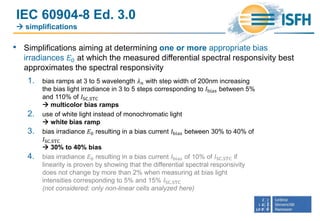
IEC 60904-8 Ed. 3.0
 simplifications
• Simplifications aiming at determining one or more appropriate bias
irradiances 𝐸0 at which the measured differential spectral responsivity best
approximates the spectral responsivity
1. bias ramps at 3 to 5 wavelength 𝜆 𝑛 with step width of 200nm increasing
the bias light irradiance in 3 to 5 steps corresponding to 𝐼bias between 5%
and 110% of 𝐼SC.STC
 multicolor bias ramps
2. use of white light instead of monochromatic light
 white bias ramp
3. bias irradiance 𝐸0 resulting in a bias current 𝐼bias between 30% to 40% of
𝐼SC.STC
 30% to 40% bias
4. bias irradiance 𝐸0 resulting in a bias current 𝐼bias of 10% of 𝐼SC.STC if
linearity is proven by showing that the differential spectral responsivity
does not change by more than 2% when measuring at bias light
intensities corresponding to 5% and 15% 𝐼SC.STC
(not considered: only non-linear cells analyzed here)
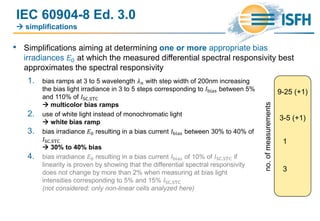
IEC 60904-8 Ed. 3.0
 simplifications
• Simplifications aiming at determining one or more appropriate bias
irradiances 𝐸0 at which the measured differential spectral responsivity best
approximates the spectral responsivity
1. bias ramps at 3 to 5 wavelength 𝜆 𝑛 with step width of 200nm increasing
the bias light irradiance in 3 to 5 steps corresponding to 𝐼bias between 5%
and 110% of 𝐼SC.STC
 multicolor bias ramps
2. use of white light instead of monochromatic light
 white bias ramp
3. bias irradiance 𝐸0 resulting in a bias current 𝐼bias between 30% to 40% of
𝐼SC.STC
 30% to 40% bias
4. bias irradiance 𝐸0 resulting in a bias current 𝐼bias of 10% of 𝐼SC.STC if
linearity is proven by showing that the differential spectral responsivity
does not change by more than 2% when measuring at bias light
intensities corresponding to 5% and 15% 𝐼SC.STC
(not considered: only non-linear cells analyzed here)
9-25 (+1)
3-5 (+1)
1
3
no.ofmeasurements
Deviations of simplifications compared
to complete DSR procedure
1. Simulation of the DSR of a non-linear c-Si solar cell and analysis according
to the complete DSR procedure as well as simplifications 1 to 3
2. Measurement of the DSR of a non-linear c-Si solar cell and analysis
according to the complete DSR procedure as well as simplifications 1 to 3
Simulation approach
Wavelength [nm]
400 600 800 1000 1200
Measureddifferential
spectralresponsivitys[mA/Wm
2
]
0.0
0.2
0.4
0.6
0.8
900 950 1000 1050 1100
0.4
0.5
0.6
0.7
0,10,25 & 50
W/m
2
100
200
300
400
600-1200
SR
~
Bias intensity [W/m2
]
0 200 400 600 800 1000
Differentialsandintegrated
spectralresponsivitys[mA/Wm
2
]
0.0
0.2
0.4
0.6
0.8
300nm
500nm
1100nm
700nm
900nm
286 317
305
bias ramp
~
s~
s
p-type Cz Si
τSRH,n0 = 80 µs
τSRH,p0 = 800 µs
J0r,c = 790 fA/cm²
J0e = 59 fA/cm²
SiOSn = 1.22×104 cm/s
Sp = 5.92 cm/s
• FEM simulation of a PERC c-Si solar
cell using SENTAURUS DEVICE
• Silicon dioxide dielectric layer at the
rear side with very high interface
defect density of 3×1010 cm-2
• 𝑠 𝜆, 𝐸bias curves show high non-
linearity
• Bias ramps at different wavelengths
yield bias intensity setpoints E0 from
286 to 317 W/m²
Impact of bias ramp wavelength
and bias irradiance
• How much do the simplifications
deviate from the complete DSR
method?
• Simplification 1 (Multicolor bias ramps):
Deviations below -1.3%
• Simplification 2 (White bias ramp):
Deviations below 4.6%
• Simplification 3 (30% bias):
Deviations below 3.9%
Wavelength [nm]
200 400 600 800 1000 1200
DeviationofsfromsSTC[%]
-2
-1
0
1
2
3
4
5
bias intensity
fixed bias irradiance
E0=300 W/m
2
white bias ramp
E0=304 W/m
2
multicolor ramp
adjusted bias irradiance
~
Measurement
Wavelength [nm]
400 600 800 1000 1200
Measureddifferential
spectralresponsivitys[mA/Wm
2
]
0.00
0.01
0.02
0.03
0.04
0.05
800 900 1000 1100
0.30
0.35
0.40
0.45
0.50
10 W/m
2
100
20
200
900
1100
~
Bias intensity [W/m2
]
0 200 400 600 800 1000 1200
Differentialsandintegrated
spectralresponsivitys[mA/Wm
2
]
0.01
0.02
0.03
0.04
0.05
300nm
500nm
1100nm
700nm
900nm
E0=287 301
s
bias ramp
~
s~
Si3N4
p-type Cz Si
• p-type Cz Si without AlOx but with SiN
• 𝑠 𝜆, 𝐸bias curves show high non-
linearity
• Bias ramps at different wavelengths
yield bias intensity setpoints from 287
to 301 W/m²
(Simulation: 286 – 317 W/m²)
Impact of bias ramp wavelength
and bias irradiance
• How much do the simplifications
deviate from the complete DSR
method?
• Simplification 1 (Multicolor bias ramps):
Deviations below -0.2%
• Simplification 2 (White bias ramp):
Deviations below -1%
• Simplification 3 (30% bias):
Deviations below -1%
Wavelength [nm]
200 400 600 800 1000 1200 1400
DeviationofsfromsSTC[%]
-10
-8
-6
-4
-2
0
2
4
bias ramp wavelength
and corresponding bias intensity
500nm / 169 W/m
2
700nm / 126 W/m
2
1100nm / 353 W/m
2
~
900nm / 301 W/m
2
300nm / 146 W/m
2
Wavelength [nm]
200 400 600 800 1000 1200
DeviationofsfromsSTC[%]
-2
-1
0
1
2
3
multicolor ramp
adjusted bias irradiance
fixed bias irradiance
E0=300 W/m
2
~ bias intensity
white bias ramp / E0=314 W/m
2
Summary
• Analysis of non-linear c-Si solar cell (simulation and measurement).
• Deviations below 5% were determined from solar cell device
simulations for all approximations.
• Simplification 1 (Multicolor-biasramps) was the most robust approach
(deviations below 1.3%).
• Simplification 2 (White-biasramp) showed deviations below 4.6%.
• Simplification 3 (30% bias) showed deviations below 3.9%.
• For non-linear solar cells: Use the complete DSR procedure if
possible.
• If a simplification is required, use the multicolor-biasramps approach if
possible.
Thank you for your attention!
Bias light intensities
0
500
1000
BiasIntensity[W/m
2
]
0
500
1000
Wavelength [nm]
300 700700 900900 1200
0
500
1000
0.5%
accepted deviation
of DSR from SR
1.0%
5.0%
280 - 290
290
250 - 350
W/m2
W/m2
W/m2

20 supsi workshop schinke

  • 1.
    Uncertainty of DSR measurementsaccording to approximations defined in the IEC 60904-8 standard K. Bothe, D. Hinken and C. Schinke Calibration and Test Center Solar Cells Institute for Solar Energy Research SUPSI-Workshop, Photoclass Project (4/2017)
  • 2.
    DSR system atISFH CalTeC • Grating monochromator: 280 to 1200nm in 10nm steps • 48 bias lamps, bias current up to 14A for large-area solar cells • Three transimpedance amplifiers (small: 250mA, large: 14A, Vmon) • Two light fields: 50x50mm² and 160x160mm² • Motorized axis for reference and sample cells • Sample Temperatures from 20 to 40°C (determination of TC) • ISO 17025 accredited by DAkkS since 2016
  • 3.
    Measurement procedure • Calibrationof monochromatic light and bias light (Ebias) using a WPVS reference solar cell • DSR measurement of device under test at various (usually 8) bias levels: 10, 100, 200, 400, 600, 800, 1000 and 1100 W/m² • Integration over Ebias • Calculation of relative sstc-curves, sstc.rel(l) and mismatch correction factor • Determination of ISTC at sun simulator • Scaling of DSR curves and sstc.rel(l) using ISTC • Difference to PTB approach (previous talk by I. Kröger): Integration is not carried out over Ibias since only relative (unscaled) DSR values are measured
  • 4.
    Measurement uncertainty • Monte-Carlouncertainty analysis with 12 uncertainty components: fdist: Height-difference of reference and DUT fwlshift: Deviation in wavelength of monochromatic light fbandwidth: Bandwidth of monochromatic light fTRef: Temperature difference to 25°C of reference fTDUT: Temperature difference to 25°C of DUT fcellinhom: Impact of light inhomogeneity on cells with current collection inhomogeneity frepRef: Reproducibility of measurement of reference frepDUT: Reproducibility of measurement of DUT fscale: Uncertainty of Isc from IV measurement fnonlin: Non-linearity of transimpedance amplifier fref: Uncertainty of primary normal fhom: Reproducibility of inhomogeneity correction DUT meas dist nonlin wlshift bandwidth TRef TDUT scale cellinhom repRef repDUT ref homs s f f f f f f f f f f f / f           % %
  • 5.
    Comparison to PTB: WPVSreference solar cell • WPVS reference solar cell • Fixed bias intensity/current • Curves of PTB (black) and ISFH-CalTeC (red) • Enavg = 0.1
  • 6.
    Solar Cell CalibrationStandards F. D‘Amore, Solar standards and certification, www.med-desire.eu, 2015
  • 7.
    IEC 60904-8 Ed.3.0 F. D‘Amore, Solar standards and certification, www.med-desire.eu, 2015
  • 8.
    IEC 60904-8 Ed.3.0 F. D‘Amore, Solar standards and certification, www.med-desire.eu, 2015 Required for spectral mismatch correction
  • 9.
    IEC 60904-8 Ed.3.0  complete DSR procedure Definition of the requirements for the measurement of the spectral responsivity of linear and non-linear photovoltaic devices: For highest accuracy, the differential spectral responsivity 𝑠 𝜆, 𝐼bias has to be measured under at least 5 different bias light irradiances resulting in short circuit currents 𝐼SC between 5% and 110% of the short circuit current under standard test conditions 𝐼SC.STC. The spectral responsivity 𝑠STC 𝜆 is calculated by integrating over 𝐼bias.  complete differential spectral responsivity (DSR) procedure
  • 10.
    IEC 60904-8 Ed.3.0  simplifications • Simplifications aiming at determining one or more appropriate bias irradiances 𝐸0 at which the measured differential spectral responsivity best approximates the spectral responsivity 1. bias ramps at 3 to 5 wavelength 𝜆 𝑛 with step width of 200nm increasing the bias light irradiance in 3 to 5 steps corresponding to 𝐼bias between 5% and 110% of 𝐼SC.STC  multicolor bias ramps 2. use of white light instead of monochromatic light  white bias ramp 3. bias irradiance 𝐸0 resulting in a bias current 𝐼bias between 30% to 40% of 𝐼SC.STC  30% to 40% bias 4. bias irradiance 𝐸0 resulting in a bias current 𝐼bias of 10% of 𝐼SC.STC if linearity is proven by showing that the differential spectral responsivity does not change by more than 2% when measuring at bias light intensities corresponding to 5% and 15% 𝐼SC.STC (not considered: only non-linear cells analyzed here)
  • 11.
    IEC 60904-8 Ed.3.0  simplifications • Simplifications aiming at determining one or more appropriate bias irradiances 𝐸0 at which the measured differential spectral responsivity best approximates the spectral responsivity 1. bias ramps at 3 to 5 wavelength 𝜆 𝑛 with step width of 200nm increasing the bias light irradiance in 3 to 5 steps corresponding to 𝐼bias between 5% and 110% of 𝐼SC.STC  multicolor bias ramps 2. use of white light instead of monochromatic light  white bias ramp 3. bias irradiance 𝐸0 resulting in a bias current 𝐼bias between 30% to 40% of 𝐼SC.STC  30% to 40% bias 4. bias irradiance 𝐸0 resulting in a bias current 𝐼bias of 10% of 𝐼SC.STC if linearity is proven by showing that the differential spectral responsivity does not change by more than 2% when measuring at bias light intensities corresponding to 5% and 15% 𝐼SC.STC (not considered: only non-linear cells analyzed here) 9-25 (+1) 3-5 (+1) 1 3 no.ofmeasurements
  • 12.
    Deviations of simplificationscompared to complete DSR procedure 1. Simulation of the DSR of a non-linear c-Si solar cell and analysis according to the complete DSR procedure as well as simplifications 1 to 3 2. Measurement of the DSR of a non-linear c-Si solar cell and analysis according to the complete DSR procedure as well as simplifications 1 to 3
  • 13.
    Simulation approach Wavelength [nm] 400600 800 1000 1200 Measureddifferential spectralresponsivitys[mA/Wm 2 ] 0.0 0.2 0.4 0.6 0.8 900 950 1000 1050 1100 0.4 0.5 0.6 0.7 0,10,25 & 50 W/m 2 100 200 300 400 600-1200 SR ~ Bias intensity [W/m2 ] 0 200 400 600 800 1000 Differentialsandintegrated spectralresponsivitys[mA/Wm 2 ] 0.0 0.2 0.4 0.6 0.8 300nm 500nm 1100nm 700nm 900nm 286 317 305 bias ramp ~ s~ s p-type Cz Si τSRH,n0 = 80 µs τSRH,p0 = 800 µs J0r,c = 790 fA/cm² J0e = 59 fA/cm² SiOSn = 1.22×104 cm/s Sp = 5.92 cm/s • FEM simulation of a PERC c-Si solar cell using SENTAURUS DEVICE • Silicon dioxide dielectric layer at the rear side with very high interface defect density of 3×1010 cm-2 • 𝑠 𝜆, 𝐸bias curves show high non- linearity • Bias ramps at different wavelengths yield bias intensity setpoints E0 from 286 to 317 W/m²
  • 14.
    Impact of biasramp wavelength and bias irradiance • How much do the simplifications deviate from the complete DSR method? • Simplification 1 (Multicolor bias ramps): Deviations below -1.3% • Simplification 2 (White bias ramp): Deviations below 4.6% • Simplification 3 (30% bias): Deviations below 3.9% Wavelength [nm] 200 400 600 800 1000 1200 DeviationofsfromsSTC[%] -2 -1 0 1 2 3 4 5 bias intensity fixed bias irradiance E0=300 W/m 2 white bias ramp E0=304 W/m 2 multicolor ramp adjusted bias irradiance ~
  • 15.
    Measurement Wavelength [nm] 400 600800 1000 1200 Measureddifferential spectralresponsivitys[mA/Wm 2 ] 0.00 0.01 0.02 0.03 0.04 0.05 800 900 1000 1100 0.30 0.35 0.40 0.45 0.50 10 W/m 2 100 20 200 900 1100 ~ Bias intensity [W/m2 ] 0 200 400 600 800 1000 1200 Differentialsandintegrated spectralresponsivitys[mA/Wm 2 ] 0.01 0.02 0.03 0.04 0.05 300nm 500nm 1100nm 700nm 900nm E0=287 301 s bias ramp ~ s~ Si3N4 p-type Cz Si • p-type Cz Si without AlOx but with SiN • 𝑠 𝜆, 𝐸bias curves show high non- linearity • Bias ramps at different wavelengths yield bias intensity setpoints from 287 to 301 W/m² (Simulation: 286 – 317 W/m²)
  • 16.
    Impact of biasramp wavelength and bias irradiance • How much do the simplifications deviate from the complete DSR method? • Simplification 1 (Multicolor bias ramps): Deviations below -0.2% • Simplification 2 (White bias ramp): Deviations below -1% • Simplification 3 (30% bias): Deviations below -1% Wavelength [nm] 200 400 600 800 1000 1200 1400 DeviationofsfromsSTC[%] -10 -8 -6 -4 -2 0 2 4 bias ramp wavelength and corresponding bias intensity 500nm / 169 W/m 2 700nm / 126 W/m 2 1100nm / 353 W/m 2 ~ 900nm / 301 W/m 2 300nm / 146 W/m 2 Wavelength [nm] 200 400 600 800 1000 1200 DeviationofsfromsSTC[%] -2 -1 0 1 2 3 multicolor ramp adjusted bias irradiance fixed bias irradiance E0=300 W/m 2 ~ bias intensity white bias ramp / E0=314 W/m 2
  • 17.
    Summary • Analysis ofnon-linear c-Si solar cell (simulation and measurement). • Deviations below 5% were determined from solar cell device simulations for all approximations. • Simplification 1 (Multicolor-biasramps) was the most robust approach (deviations below 1.3%). • Simplification 2 (White-biasramp) showed deviations below 4.6%. • Simplification 3 (30% bias) showed deviations below 3.9%. • For non-linear solar cells: Use the complete DSR procedure if possible. • If a simplification is required, use the multicolor-biasramps approach if possible. Thank you for your attention!
  • 18.
    Bias light intensities 0 500 1000 BiasIntensity[W/m 2 ] 0 500 1000 Wavelength[nm] 300 700700 900900 1200 0 500 1000 0.5% accepted deviation of DSR from SR 1.0% 5.0% 280 - 290 290 250 - 350 W/m2 W/m2 W/m2