Estrogen
• Seminar created by:kumar samudra gupta
kaushik
• Roll no.-20
Physiological functions
• Developemnt of female reproductive tract
• Developemnt of female secondary sex characters
• Stimulation of proliferative phase of
endometrium
• Vasodilation
• Cardioprotection
• Maintain integrity of skeleton in reproductive age
Classification:
Natural Estrogens: Estradiol, estriol,estrone
Synthetic estrogen:
Steroidal: Ethinylestradiol,mestranol
Non steroidal: Diethylstilbestrol, hexestrol,
dienestrol
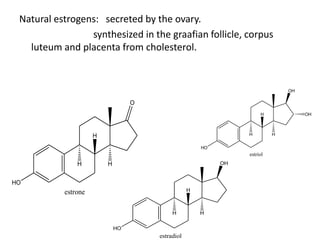
Natural estrogens: secreted by the ovary.
synthesized in the graafian follicle, corpus
luteum and placenta from cholesterol.
HO
O
H
H
H
estrone
HO
OH
OH
H
H
H
estriol
HO
OH
H
H
H
estradiol
Synthetic estrogen: long duration of action
slow metabolic rate.
O
OH
H
H
H
ethynylestradiol
HO
OH
diethylstilbestrol
HO
OH
hexestrol
Structure Activity Relation Ships:
– Aromatic ring with C-3-OH is essential
for activity.
– Steroidal structures is not essential for
activity.
– Alkylation of the aromatic ring decrease
the activity.
– The 17b-hydroxyl with constant distance
from 3-OH is essential for activity.
– The group between the two hydroxyl
must be hydrophobic.
– Unsaturation of ring B decreases the
activity.
– 17a- and 16 position when modified
enhance the activity.
HO
OH
H
H
H
estradiol
NATURAL ESTROGENS
1. Estradiol – known also as 17β – estradiol
– Principle estrogen in premenopausal women
2. Estrone – 1/3 the estrogenic potency of Estradiol
– Primary circulating estrogen after menopause
3. Estriol – significantly less potent than estradiol
– Present in significant amounts during pregnancy,
because its principal estrogen produced by
placenta.
Synthesis of Estrogen
Cholesterol Androstenodione Estrone
Aromatase
enzyme
Testosterone
Cholesterol Androstenodione Estrone
Aromatase
enzyme
Estradiol
EstriolEstrone
Testosterone
Androstenedione
Aromatase
Aromatase
Synthesis of Estrogen
Estrogen receptors
• The steroid receptor complex undergoes changes and binds with
estrogen responsive element located on target gene where it brings
about changes in transcription..
• 2 estrogen – receptor subtypes mediate the effects of the hormone
1. α receptor – the classic Estrogen Receptor. Found in
breasts,hypothalamus,endothelial cells and vascular smooth
muscle.
2. β receptor – highly homologous to the α receptor.found in
bone, brain, ovaries
– α receptor
N - terminal portion of receptor contains a region that Promotes
transcription activation.
– β receptor
contains a Repressor Domain
ACTIONS
ON SEX ORGANS:
 Estrogens bring about pubertal changes in the female
including growth of uterus, fallopian tubes and vagina.
 It suppress the activity of FSH, and stimulate the secretion of
LH by direct action on pituitary as well as through
hypothalamus.
 It enhances the rhythmic contraction of the fallopian tubes
and uterus and induce a watery alkaline secretion from the
cervix.
METABOLIC EFFECTS:
 Estrogen is important in maintaining bone mass primarialy by retarding
bone resorption. Osteoclast pit formation is inhibited bone matrix
proteins increase such as osteonectin,osteocalcin,collagen etc.
 It controls the action of parathormone , hormone which intake calcium
ions from bones and teeth, thus maintaing a positive calcium balance.
 Cause salt and water retention edema
 Estrogens decrease plasma LDL cholesterol while HDL and triglycerides
levels are raised atherosclerosis in premenopausal women.
 Blood coagulation is increased due to the formation of various clotting
factors.
 It promotes vasodilation by induce secretion of nitric oxide synthase(NO)
and PGI2.
Therapeutic uses
1. Contraception
2. HORMONE REPLACEMENT THERAPY: In women after
menopause due to the cessation of ovarian function as
estrogen- progestin HRT therapy suppression of
vasomotor instability
3. Osteoporosis
4. Senile vaginitis: can change vaginal cytology and effective in
preventing atrophic vaginitis in elderly women.
Adverse Effects
• Most common estrogen therapy
1. Nausea
2. Breast tenderness
• Post menopausal uterine bleeding may occur
• There is increased risk of :
1. Myocardial infarction
2. Breast cancer
3. Endometrial cancer
• Other effects
1. Headache
2. Peripheral edema
3. Hypertension
Referance
• Razdan Balkishen, Medicinal Chemistry,First Edition:2010,CBS
publishers & Distributors Pvt. Ltd., Page No.-497-500.
• Tripathi KD, Essentials of Medical Pharmacology,Seventh
Edition:2013, Jaypee Brothers medical Publishers (P) Ltd, Page
no-306-311.
• Pharmacology and pharmacotherapeutics by r.s satoskar,21st
edition,2012,popular prakashan,935-942.

Estrogen

  • 1.
    Estrogen • Seminar createdby:kumar samudra gupta kaushik • Roll no.-20
  • 2.
    Physiological functions • Developemntof female reproductive tract • Developemnt of female secondary sex characters • Stimulation of proliferative phase of endometrium • Vasodilation • Cardioprotection • Maintain integrity of skeleton in reproductive age
  • 3.
    Classification: Natural Estrogens: Estradiol,estriol,estrone Synthetic estrogen: Steroidal: Ethinylestradiol,mestranol Non steroidal: Diethylstilbestrol, hexestrol, dienestrol
  • 4.
    Natural estrogens: secretedby the ovary. synthesized in the graafian follicle, corpus luteum and placenta from cholesterol. HO O H H H estrone HO OH OH H H H estriol HO OH H H H estradiol
  • 5.
    Synthetic estrogen: longduration of action slow metabolic rate. O OH H H H ethynylestradiol HO OH diethylstilbestrol HO OH hexestrol
  • 6.
    Structure Activity RelationShips: – Aromatic ring with C-3-OH is essential for activity. – Steroidal structures is not essential for activity. – Alkylation of the aromatic ring decrease the activity. – The 17b-hydroxyl with constant distance from 3-OH is essential for activity. – The group between the two hydroxyl must be hydrophobic. – Unsaturation of ring B decreases the activity. – 17a- and 16 position when modified enhance the activity. HO OH H H H estradiol
  • 7.
    NATURAL ESTROGENS 1. Estradiol– known also as 17β – estradiol – Principle estrogen in premenopausal women 2. Estrone – 1/3 the estrogenic potency of Estradiol – Primary circulating estrogen after menopause 3. Estriol – significantly less potent than estradiol – Present in significant amounts during pregnancy, because its principal estrogen produced by placenta.
  • 8.
    Synthesis of Estrogen CholesterolAndrostenodione Estrone Aromatase enzyme Testosterone Cholesterol Androstenodione Estrone Aromatase enzyme
  • 9.
  • 10.
    Estrogen receptors • Thesteroid receptor complex undergoes changes and binds with estrogen responsive element located on target gene where it brings about changes in transcription.. • 2 estrogen – receptor subtypes mediate the effects of the hormone 1. α receptor – the classic Estrogen Receptor. Found in breasts,hypothalamus,endothelial cells and vascular smooth muscle. 2. β receptor – highly homologous to the α receptor.found in bone, brain, ovaries – α receptor N - terminal portion of receptor contains a region that Promotes transcription activation. – β receptor contains a Repressor Domain
  • 11.
    ACTIONS ON SEX ORGANS: Estrogens bring about pubertal changes in the female including growth of uterus, fallopian tubes and vagina.  It suppress the activity of FSH, and stimulate the secretion of LH by direct action on pituitary as well as through hypothalamus.  It enhances the rhythmic contraction of the fallopian tubes and uterus and induce a watery alkaline secretion from the cervix.
  • 12.
    METABOLIC EFFECTS:  Estrogenis important in maintaining bone mass primarialy by retarding bone resorption. Osteoclast pit formation is inhibited bone matrix proteins increase such as osteonectin,osteocalcin,collagen etc.  It controls the action of parathormone , hormone which intake calcium ions from bones and teeth, thus maintaing a positive calcium balance.  Cause salt and water retention edema  Estrogens decrease plasma LDL cholesterol while HDL and triglycerides levels are raised atherosclerosis in premenopausal women.  Blood coagulation is increased due to the formation of various clotting factors.  It promotes vasodilation by induce secretion of nitric oxide synthase(NO) and PGI2.
  • 13.
    Therapeutic uses 1. Contraception 2.HORMONE REPLACEMENT THERAPY: In women after menopause due to the cessation of ovarian function as estrogen- progestin HRT therapy suppression of vasomotor instability 3. Osteoporosis 4. Senile vaginitis: can change vaginal cytology and effective in preventing atrophic vaginitis in elderly women.
  • 14.
    Adverse Effects • Mostcommon estrogen therapy 1. Nausea 2. Breast tenderness • Post menopausal uterine bleeding may occur • There is increased risk of : 1. Myocardial infarction 2. Breast cancer 3. Endometrial cancer • Other effects 1. Headache 2. Peripheral edema 3. Hypertension
  • 15.
    Referance • Razdan Balkishen,Medicinal Chemistry,First Edition:2010,CBS publishers & Distributors Pvt. Ltd., Page No.-497-500. • Tripathi KD, Essentials of Medical Pharmacology,Seventh Edition:2013, Jaypee Brothers medical Publishers (P) Ltd, Page no-306-311. • Pharmacology and pharmacotherapeutics by r.s satoskar,21st edition,2012,popular prakashan,935-942.