EDB003
Social Justice
Mikeely Roberts: n8582793
Shannon Luke: n7535023
Jonathan Dore: n8593477
Sam Joppich: n8546282
Alex Nicholson: n8309663
Basic Principles of social
justice
• Access
• Equity
• Participation
• Rights
• Social/Cultural Capital
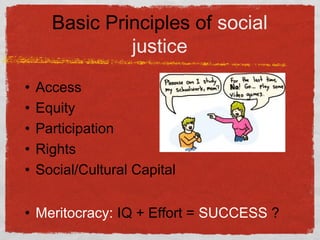
• Meritocracy: IQ + Effort = SUCCESS ?
Group Activity 1
SOCIAL JUSTICE TRIVIA
* In groups, participants are to answer the following trivia
questions based on Social Justice.
*ONE (1) point will be awarded per
correct answer.
Q1: According to a study by the American Association
of Physicians for Human Rights, what percentage of
physicians report witnessing a colleague giving reduced
care or refusing care to lesbian, gay, or bisexual
patients?
12%
32%
52%
72%
82%
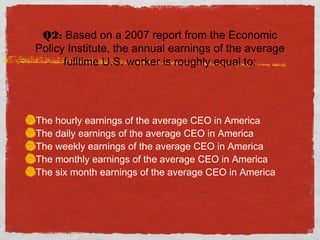
Q2: Based on a 2007 report from the Economic
Policy Institute, the annual earnings of the average
fulltime U.S. worker is roughly equal to:
The hourly earnings of the average CEO in America
The daily earnings of the average CEO in America
The weekly earnings of the average CEO in America
The monthly earnings of the average CEO in America
The six month earnings of the average CEO in America
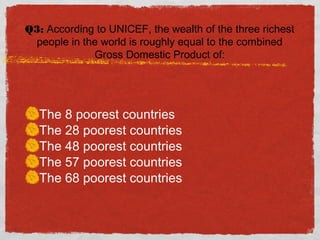
Q3: According to UNICEF, the wealth of the three richest
people in the world is roughly equal to the combined
Gross Domestic Product of:
The 8 poorest countries
The 28 poorest countries
The 48 poorest countries
The 57 poorest countries
The 68 poorest countries
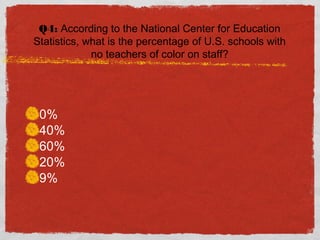
Q4: According to the National Center for Education
Statistics, what is the percentage of U.S. schools with
no teachers of color on staff?
0%
40%
60%
20%
9%
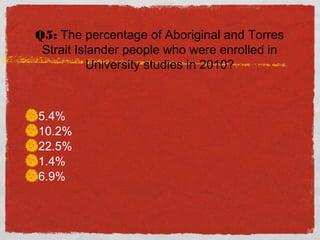
Q5: The percentage of Aboriginal and Torres
Strait Islander people who were enrolled in
University studies in 2010?
5.4%
10.2%
22.5%
1.4%
6.9%
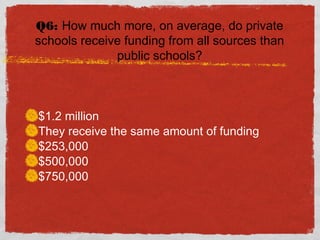
Q6: How much more, on average, do private
schools receive funding from all sources than
public schools?
$1.2 million
They receive the same amount of funding
$253,000
$500,000
$750,000
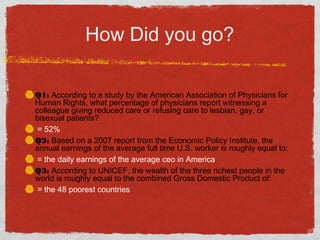
How Did you go?
Q1: According to a study by the American Association of Physicians for
Human Rights, what percentage of physicians report witnessing a
colleague giving reduced care or refusing care to lesbian, gay, or
bisexual patients?
= 52%
Q2: Based on a 2007 report from the Economic Policy Institute, the
annual earnings of the average full time U.S. worker is roughly equal to:
= the daily earnings of the average ceo in America
Q3: According to UNICEF, the wealth of the three richest people in the
world is roughly equal to the combined Gross Domestic Product of:
= the 48 poorest countries
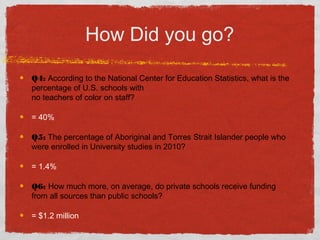
How Did you go?
Q4: According to the National Center for Education Statistics, what is the
percentage of U.S. schools with
no teachers of color on staff?
= 40%
Q5: The percentage of Aboriginal and Torres Strait Islander people who
were enrolled in University studies in 2010?
= 1.4%
Q6: How much more, on average, do private schools receive funding
from all sources than public schools?
= $1.2 million
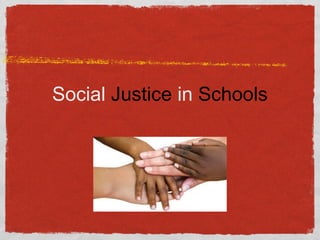
Social Justice in Schools
Is the education program in Australia
socially just?
Article from Sydney Morning Herald: Private schools reap
government funding at expense of public schools (January 28th
,
2014)
A new Productivity Commission report shows private schools on
average get $1.2 million a year more funding from all sources than
public schools.
Private schools generally grew higher than inflation each year, while
spending on public schools was mostly below inflation.
In 2012, nearly 85 per cent of all indigenous students and almost three-
quarters of all students with a disability attended public schools.
Example of Social Justice in Schools
St. Joseph’s Nudgee College
http://www.nudgee.com/foundation
Ed's Shed - the aim of this appeal is to provide funds or 'in kind' support for the
construction of a new facility providing a dedicated venue and hub for the
College's community outreach activities of Big Brekky, Big BBQ and Street
Swags.
Nudgee College Herd - providing financial support to families from the bush.
Indigenous Bursary Program- catering for the educational needs of Aboriginal
and Torres Strait Islander students.
Jack Ross Fellowship Program- an initiative of the Nudgee College Old Boys
Association in providing financial assistance to families who son/s may not
otherwise benefit from a Nudgee College education.
Group Activity 2: All about Social Justice
Programs in School.
In groups you are to research one of the below Social Justice programs and find
what the program is about, as well as the aims and objectives associated with it.
Group 1: Antipodeans
Group 2: Meals on Wheels
Group 3: Project Abroad
Group 4: 40 Hour Famine
Group 5: Red Shield Appeal
Activity: All about Social Justice
Programs in School
Example: Street Swags
About: A bag with room for extra belongings, the street swag is made of super
lightweight waterproofed canvas with a high-density foam mattress.
Aims: Street Swags Limited provides practical support to alleviate the
hardships of homeless people by offering a comfortable and durable form of
bedding to every person in need.
Objectives: To provide homeless people with “street swags” in order to reduce
the negative effects of sleeping outdoors without adequate protection from the
elements.
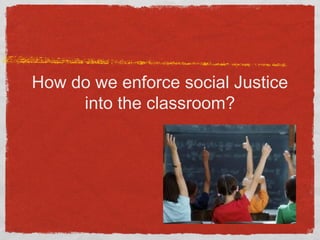
How do we enforce social Justice
into the classroom?
What we need to facilitate as
teachers?
For Teachers: an engaging or CORE pedagogy should ensure that what
teachers and students do is:
•Connecting—to and engaging with the students’ cultural knowledge
•Owning—all students should be able to see themselves as represented in
the work
•Responding—to students’ lived experiences and actively and consciously
critiquing that experience
•Empowering—students with a belief that what they do will make a
difference to their lives and the opportunity to voice and discover their own
authentic and authoritative life.
What Pedagogy would ensure
such things?
Cochran-Smiths six principles
• Principle 1: Enable significant work within the
communities of learning.
• Principle 2: Build on what students bring to school with
them - knowledge and interests, cultural and linguistic
resources
• Principle 3: Teach skills, bridge gaps
• Principle 4: Work with (not against) individuals, families
and communities
• Principle 5: Diversify forms of assessment
• Principle 6: Make inequity, power and activism parts of
the curriculum
Activity 3
• Splitting up into 6 groups (one for each
principle), design an in-class activity or
strategy which you feel would be
appropriate when enforcing your groups
principle into a classroom setting.
“The world changes according to the
way people see it, and if you can
alter, even by a millimeter, the way
people look at reality, then you can
change the world”. – James Baldwin
For more resources, please like and visit the
Facebook page below.
REFERENCES
Universities Australia. (2014). Indigenous Higher Education. Available:
https://www.universitiesaustralia.edu.au/uni-participation-quality/Indigenous-Higher
School Education (2014). Report on Government Services. Available:
http://www.pc.gov.au/__data/assets/pdf_file/0015/132306/rogs-2014-
volumeb-chapter4.pdf
Marilyn Cochran‐Sm
ith (2004). Defining the outcomes of teacher education: what's social justice got t
o with it? Asia-Pacific Journal of Teacher Education. 32:3, 193-212, DOI:
10.1080/1359866042000295370
Zyngier, D. (2007). Reconceptualising student engagement: Doing
education not doing time. Monash University, Victoria.

Social Justice Presentation EDB003 06/08/14

  • 1.
    EDB003 Social Justice Mikeely Roberts:n8582793 Shannon Luke: n7535023 Jonathan Dore: n8593477 Sam Joppich: n8546282 Alex Nicholson: n8309663
  • 2.
    Basic Principles ofsocial justice • Access • Equity • Participation • Rights • Social/Cultural Capital • Meritocracy: IQ + Effort = SUCCESS ?
  • 3.
    Group Activity 1 SOCIALJUSTICE TRIVIA * In groups, participants are to answer the following trivia questions based on Social Justice. *ONE (1) point will be awarded per correct answer.
  • 4.
    Q1: According toa study by the American Association of Physicians for Human Rights, what percentage of physicians report witnessing a colleague giving reduced care or refusing care to lesbian, gay, or bisexual patients? 12% 32% 52% 72% 82%
  • 5.
    Q2: Based ona 2007 report from the Economic Policy Institute, the annual earnings of the average fulltime U.S. worker is roughly equal to: The hourly earnings of the average CEO in America The daily earnings of the average CEO in America The weekly earnings of the average CEO in America The monthly earnings of the average CEO in America The six month earnings of the average CEO in America
  • 6.
    Q3: According toUNICEF, the wealth of the three richest people in the world is roughly equal to the combined Gross Domestic Product of: The 8 poorest countries The 28 poorest countries The 48 poorest countries The 57 poorest countries The 68 poorest countries
  • 7.
    Q4: According tothe National Center for Education Statistics, what is the percentage of U.S. schools with no teachers of color on staff? 0% 40% 60% 20% 9%
  • 8.
    Q5: The percentageof Aboriginal and Torres Strait Islander people who were enrolled in University studies in 2010? 5.4% 10.2% 22.5% 1.4% 6.9%
  • 9.
    Q6: How muchmore, on average, do private schools receive funding from all sources than public schools? $1.2 million They receive the same amount of funding $253,000 $500,000 $750,000
  • 10.
    How Did yougo? Q1: According to a study by the American Association of Physicians for Human Rights, what percentage of physicians report witnessing a colleague giving reduced care or refusing care to lesbian, gay, or bisexual patients? = 52% Q2: Based on a 2007 report from the Economic Policy Institute, the annual earnings of the average full time U.S. worker is roughly equal to: = the daily earnings of the average ceo in America Q3: According to UNICEF, the wealth of the three richest people in the world is roughly equal to the combined Gross Domestic Product of: = the 48 poorest countries
  • 11.
    How Did yougo? Q4: According to the National Center for Education Statistics, what is the percentage of U.S. schools with no teachers of color on staff? = 40% Q5: The percentage of Aboriginal and Torres Strait Islander people who were enrolled in University studies in 2010? = 1.4% Q6: How much more, on average, do private schools receive funding from all sources than public schools? = $1.2 million
  • 12.
  • 13.
    Is the educationprogram in Australia socially just? Article from Sydney Morning Herald: Private schools reap government funding at expense of public schools (January 28th , 2014) A new Productivity Commission report shows private schools on average get $1.2 million a year more funding from all sources than public schools. Private schools generally grew higher than inflation each year, while spending on public schools was mostly below inflation. In 2012, nearly 85 per cent of all indigenous students and almost three- quarters of all students with a disability attended public schools.
  • 14.
    Example of SocialJustice in Schools St. Joseph’s Nudgee College http://www.nudgee.com/foundation Ed's Shed - the aim of this appeal is to provide funds or 'in kind' support for the construction of a new facility providing a dedicated venue and hub for the College's community outreach activities of Big Brekky, Big BBQ and Street Swags. Nudgee College Herd - providing financial support to families from the bush. Indigenous Bursary Program- catering for the educational needs of Aboriginal and Torres Strait Islander students. Jack Ross Fellowship Program- an initiative of the Nudgee College Old Boys Association in providing financial assistance to families who son/s may not otherwise benefit from a Nudgee College education.
  • 15.
    Group Activity 2:All about Social Justice Programs in School. In groups you are to research one of the below Social Justice programs and find what the program is about, as well as the aims and objectives associated with it. Group 1: Antipodeans Group 2: Meals on Wheels Group 3: Project Abroad Group 4: 40 Hour Famine Group 5: Red Shield Appeal
  • 16.
    Activity: All aboutSocial Justice Programs in School Example: Street Swags About: A bag with room for extra belongings, the street swag is made of super lightweight waterproofed canvas with a high-density foam mattress. Aims: Street Swags Limited provides practical support to alleviate the hardships of homeless people by offering a comfortable and durable form of bedding to every person in need. Objectives: To provide homeless people with “street swags” in order to reduce the negative effects of sleeping outdoors without adequate protection from the elements.
  • 17.
    How do weenforce social Justice into the classroom?
  • 18.
    What we needto facilitate as teachers? For Teachers: an engaging or CORE pedagogy should ensure that what teachers and students do is: •Connecting—to and engaging with the students’ cultural knowledge •Owning—all students should be able to see themselves as represented in the work •Responding—to students’ lived experiences and actively and consciously critiquing that experience •Empowering—students with a belief that what they do will make a difference to their lives and the opportunity to voice and discover their own authentic and authoritative life.
  • 19.
    What Pedagogy wouldensure such things?
  • 20.
    Cochran-Smiths six principles •Principle 1: Enable significant work within the communities of learning. • Principle 2: Build on what students bring to school with them - knowledge and interests, cultural and linguistic resources • Principle 3: Teach skills, bridge gaps • Principle 4: Work with (not against) individuals, families and communities • Principle 5: Diversify forms of assessment • Principle 6: Make inequity, power and activism parts of the curriculum
  • 21.
    Activity 3 • Splittingup into 6 groups (one for each principle), design an in-class activity or strategy which you feel would be appropriate when enforcing your groups principle into a classroom setting.
  • 22.
    “The world changesaccording to the way people see it, and if you can alter, even by a millimeter, the way people look at reality, then you can change the world”. – James Baldwin
  • 23.
    For more resources,please like and visit the Facebook page below.
  • 24.
    REFERENCES Universities Australia. (2014).Indigenous Higher Education. Available: https://www.universitiesaustralia.edu.au/uni-participation-quality/Indigenous-Higher School Education (2014). Report on Government Services. Available: http://www.pc.gov.au/__data/assets/pdf_file/0015/132306/rogs-2014- volumeb-chapter4.pdf Marilyn Cochran‐Sm ith (2004). Defining the outcomes of teacher education: what's social justice got t o with it? Asia-Pacific Journal of Teacher Education. 32:3, 193-212, DOI: 10.1080/1359866042000295370 Zyngier, D. (2007). Reconceptualising student engagement: Doing education not doing time. Monash University, Victoria.