Teaching for social justice . . .
PGCE
31st October 2013
#sjt
Professor Howard Stevenson
howard.stevenson@nottingham.ac.uk

Tuesday, October 29, 2013

Event Name and Venue

1
Session outline . . .

•
•
•
•
•

Purposes of education
Pictures of inequality
Reflections on social justice
Explanations for social injustice
Things to think about and remember . . .

Tuesday, October 29, 2013

Event Name and Venue

2
What is education for . . . ?
•
•
•
•

Transmission of culture
Preparation for work
Preparation for effective citizenship
Preparation for life/personal development

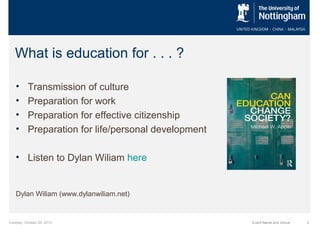
• Listen to Dylan Wiliam here

Dylan Wiliam (www.dylanwiliam.net)

Tuesday, October 29, 2013

Event Name and Venue

3
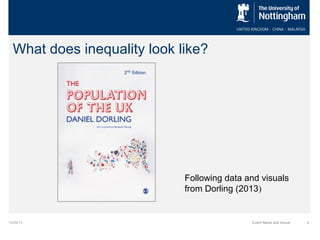
What does inequality look like?

Following data and visuals
from Dorling (2013)

10/29/13

Event Name and Venue

4
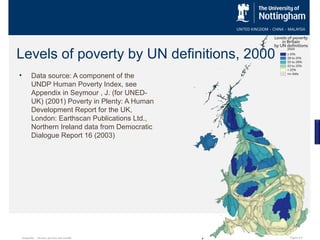
Levels of poverty by UN definitions, 2000
•

Data source: A component of the
UNDP Human Poverty Index, see
Appendix in Seymour , J. (for UNEDUK) (2001) Poverty in Plenty: A Human
Development Report for the UK,
London: Earthscan Publications Ltd.,
Northern Ireland data from Democratic
Dialogue Report 16 (2003)

Inequality…income, poverty and wealth

Figure 6.6
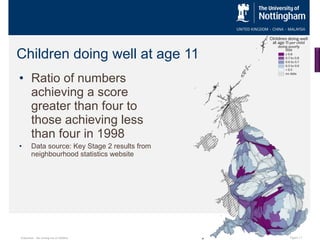
Children doing well at age 11
• Ratio of numbers
achieving a score
greater than four to
those achieving less
than four in 1998
•

Data source: Key Stage 2 results from
neighbourhood statistics website

Education…the sorting out of children

Figure 3.1
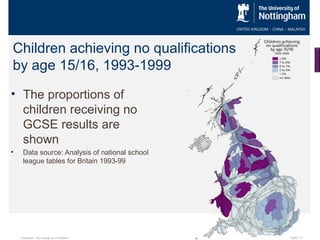
Children achieving no qualifications
by age 15/16, 1993-1999
• The proportions of
children receiving no
GCSE results are
shown
•

Data source: Analysis of national school
league tables for Britain 1993-99

Education…the sorting out of children

Figure 3.2
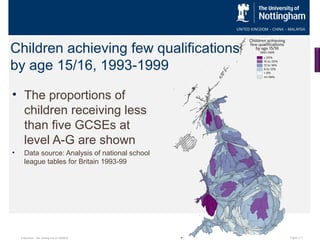
Children achieving few qualifications
by age 15/16, 1993-1999
• The proportions of
children receiving less
than five GCSEs at
level A-G are shown
•

Data source: Analysis of national school
league tables for Britain 1993-99

Education…the sorting out of children

Figure 3.3
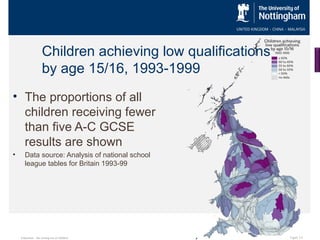
Children achieving low qualifications
by age 15/16, 1993-1999
• The proportions of all
children receiving fewer
than five A-C GCSE
results are shown
•

Data source: Analysis of national school
league tables for Britain 1993-99

Education…the sorting out of children

Figure 3.4
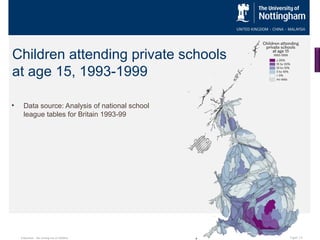
Children attending private schools
at age 15, 1993-1999
•

Data source: Analysis of national school
league tables for Britain 1993-99

Education…the sorting out of children

Figure 3.6
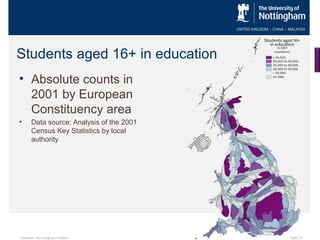
Students aged 16+ in education
• Absolute counts in
2001 by European
Constituency area
•

Data source: Analysis of the 2001
Census Key Statistics by local
authority

Education…the sorting out of children

Figure 3.8
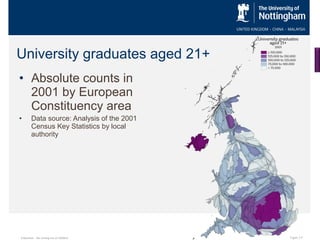
University graduates aged 21+
• Absolute counts in
2001 by European
Constituency area
•

Data source: Analysis of the 2001
Census Key Statistics by local
authority

Education…the sorting out of children

Figure 3.9
Dorling’s key point summary . . .
•

Most children in Britain either fail at school or are

labelled second class at university
•

The type of school a child in Britain attends has a huge

influence on his or her exam results
•

Getting high exam results is more about social sorting

than about being clever
http://www.dannydorling.org/
Education…the sorting out of children
Plural conceptions of social justice . . .
• Distributive justice
– absence of exploitation, economic marginalisation and
deprivation
• Cultural justice
– absence of cultural domination, respect and nonrecognition
• Associational justice
– absence of structures and networks that deny some
people access to decision-making processes that
impact their lives
Gewirtz and Cribb (2003:502-503)

Tuesday, October 29, 2013

Event Name and Venue

14
Bourdieu on Capital…
… is what makes the games of society – not least, the economic
game – something other than simple games of chance offering at
every moment the possibility of a miracle. Roulette, which holds out
the opportunity of winning a lot of money in a short space of time,
and therefore of changing one’s social status quasiinstantaneously, and in which the winning of the previous spin of
the wheel can be staked and lost at every new spin, gives a fairly
accurate image of this imaginary universe of perfect competition or
perfect equality of opportunity, a world without inertia, without
accumulation, without heredity or acquired properties, in which
every moment is perfectly independent of the previous one, every
soldier has a marshal’s baton in his knapsack, and every prize can
be attained, instantaneously, by everyone, so that at each moment
anyone can become anything.
Bourdieu (1983) in Halsey et al (1997) p 46

Tuesday, October 29, 2013

Event Name and Venue

15
Bourdieu and the forms of capital . . .
• Economic
• Cultural
– embodied
– objectified
– institutionalised

• Social
– membership of a group ‘which provides each of its
members with the backing of the collectivity’ (ibid, p51)
Tuesday, October 29, 2013

Event Name and Venue

16
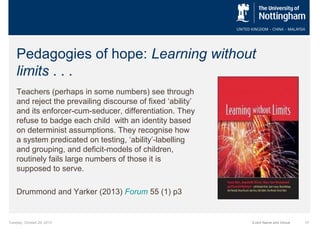
Pedagogies of hope: Learning without
limits . . .
Teachers (perhaps in some numbers) see through
and reject the prevailing discourse of fixed ‘ability’
and its enforcer-cum-seducer, differentiation. They
refuse to badge each child with an identity based
on determinist assumptions. They recognise how
a system predicated on testing, ‘ability’-labelling
and grouping, and deficit-models of children,
routinely fails large numbers of those it is
supposed to serve.
Drummond and Yarker (2013) Forum 55 (1) p3

Tuesday, October 29, 2013

Event Name and Venue

17
The ideological move to construct education as a
market place holds both systemic and economic
implications for schools, teachers, children and
parents and may involve policies . . . based on
‘educational’ values being marginalized in favour of
those lodged in market imperatives. Significant
amongst them is the necessity for schools to
promote a positive image of themselves in terms of
performance indicators of product/output.
(McNamara et al 2000:475)
A talking head . . .

10/29/13

Dimmock et al, (2005)
Event Name and Venue

19
We have few students because
parents are understandably
concerned about the low level of
GCSE results – we’re bottom in the
county, and therefore we receive
very few students at the ‘top end’.
It’s absolutely essential to keep sight of the
individual, because even within minority ethnic
groups there is huge diversity. You cannot lump
groups together. As a school we’ve learned
you’ve got to treat people as individuals. There
are sensitivities about how you put in place
strategies for groups, when actually you are
concerned about individuals.
That is a hard thing to manage when you are
being hammered for your exam results and
you’re telling staff to get the results, get the
value-added, but if you get refugee children
then they often come for six weeks then
they’re re-located. You put all that effort in,
you get to know a child – and then they move
on.
I make no bones about it – teaching is hard.
Teaching seven lessons a day, especially in a
school in challenging circumstances is hard
work and anything that makes it harder is not
going to be welcomed with open arms. It
takes as long to prepare a lesson in these
types of schools as it does to deliver it.
People despair – that is not too hard a word
a for it. You get someone in your lesson who
hardly speaks any english, and you have to
meet those needs. You get support, but it is
yet another need in an already needy
situation. A lot of staff will run with it, but
convincing them is a permanent sales job –
‘this is good for the children . . . this is what
we are here to do’.
Social inclusion is a misnomer – what you
get is parental preference driving social
division. It’s not academic division – it is
social division. You’ve got ‘I don’t want my
child going with that type of child’. Parental
preferences increase division – that gap is
getting wider.
We co-operate as local heads very well, but actually
when it comes to the survival of your school would
you rather have my agenda or would you rather have
a settled, over-subscribed totally supportive
population of white parents? I get rung up by other
heads in the town who say ‘we’re having difficulty
with this difficult child, you’ve got some spare places
– would you like them?’ If it went to appeal we
couldn’t say no anyway
I’d like to see the first school on 93% 5
A-Cs going into special measures for a
lack of inclusion. I’d love to see the
government bite that bullet. Some
schools select out people and won’t
include them when the OFSTED
Framework clearly says inclusion is a
priority – but they won’t do that.
I have some personal friends, nice people, they play
cricket with my husband and when I asked them if
they would send their children to my school they
would say ‘No – you’ve got that mix of children there’
– and we’re going to send them somewhere else
because we’re not sure about the ethnic mix – that is
what they were really saying. They had stereotyped
views and they did not see it as appropriate for their
child. It is interesting how rigid the majority
population’s views are about minority ethnic groups
because they don’t know. They have very fixed
stereotypes.
Interviewer: Do you think you have been penalised for
being an effective inclusive school?
Headteacher: I wouldn’t say penalised, because I love
what we do. But I have no doubt in my mind, having
gone down the inclusion route that affects people’s
perceptions of what we are, and we do not get the
‘top end’. I do think that is a consequence of how
the school has chosen to present itself, to welcome
everybody.
Tough choices are, typically, those that
pit one right value against another. The
really tough choices don’t centre upon
right versus wrong. They involve right
versus right. They are genuine dilemmas
precisely because each side is firmly
rooted in . . . core values.
(Kidder 1995, quoted in Duignan and Collins 2003:283)
The Professional Values and Personal Commitment core to being a teacher are:

Social justice

Embracing locally and globally the educational and social values of sustainability, equality and justice
and recognising the rights and responsibilities of future as well as current generations
.
Committing to the principles of democracy and social justice through fair, transparent, inclusive and
sustainable policies and practices in relation to: age, disability, gender and gender identity, race,
ethnicity, religion and belief and sexual orientation.

Valuing as well as respecting social, cultural and ecological diversity and promoting the principles and
10/29/13

practices of local and global citizenship for all learners.

Event Name and Venue

31
Acting with passion . . .
… is not for the faint-hearted; it requires commitment,
courage and determination. This kind of work involves
high levels of emotional energy, it demands that
participants believe strongly in their convictions and
have the best interests of the group clearly in mind.
Sachs (2003:149)

Tuesday, October 29, 2013

Event Name and Venue

32
Dispositions of resistance . . .
• Understand and critique . . . . (the present)
• Re-frame and articulate . . . . (the alternative)
• Organise and challenge . . . . (challenge the present
to create the future)
Stevenson (2014)

Tuesday, October 29, 2013

Event Name and Venue

33
The activist professional . . .
Principles and practices of activist professionals . . .
provide systematic ways of thinking and acting in the
best interests of all those involved in education. At the
heart of these principles and practices are
partnerships and practitioner research, or what I refer
to as systematic enquiry, which in turn involves various
processes of advocacy, network facilitation and
mobilization.
Sachs (2003:149)
Tuesday, October 29, 2013

Event Name and Venue

34
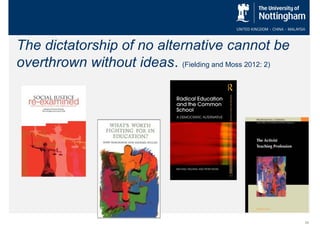
The dictatorship of no alternative cannot be
overthrown without ideas. (Fielding and Moss 2012: 2)

35
Five things to think about . . .
• ‘What is education for?’ – you can never ask this
question too often.
• All students can exceed our expectations – open up,
don’t close down (educability)
• Your professional judgements reflect your values –
do (you do) what you believe in (?)
• Work inside, and outside, the classroom.
• You make a difference every day – but you make
more difference when you work with others.
Tuesday, October 29, 2013

Event Name and Venue

36
Three things to remember . . .
• Children start school unequally and inequalities
persist . . .
• Schools often reproduce inequalities, and indeed
increase them . . .
• ‘Teachers affect eternity; they can never tell where
their influence stops.’ (Brighouse and Woods, 1999:105)
Tuesday, October 29, 2013

Event Name and Venue

37
One final thought . . .
Democratic educators seek not simply to
lessen the harshness of social inequities in
school, but to change the conditions that create
them.
Apple and Beane, 1999:13
… and don’t forget Billy McBone . . .
Billy McBone
Had a mind of his own,
Which he mostly kept under his hat.
The teachers all thought
That he couldn't be taught,
But Bill didn't seem to mind that.
Billy McBone
Had a mind of his own,
Which his teachers had searched for years.
Trying test after test,
They still never guessed
It was hidden between his ears.

(by Allan Ahlberg)
10/29/13

Billy McBone
Had a mind of his own,
Which only his friends ever saw.
When the teacher said, 'Bill,
Whereabouts is Brazil?'
He just shuffled and stared at the floor.
Billy McBone
Had a mind of his own,
Which he kept under lock and key.
While the teachers in vain
Tried to burgle his brain,
Bill's thoughts were off Event Name and Venue free.
wandering
39

Social justice teaching - PGCE lecture

  • 1.
    Teaching for socialjustice . . . PGCE 31st October 2013 #sjt Professor Howard Stevenson howard.stevenson@nottingham.ac.uk Tuesday, October 29, 2013 Event Name and Venue 1
  • 2.
    Session outline .. . • • • • • Purposes of education Pictures of inequality Reflections on social justice Explanations for social injustice Things to think about and remember . . . Tuesday, October 29, 2013 Event Name and Venue 2
  • 3.
    What is educationfor . . . ? • • • • Transmission of culture Preparation for work Preparation for effective citizenship Preparation for life/personal development • Listen to Dylan Wiliam here Dylan Wiliam (www.dylanwiliam.net) Tuesday, October 29, 2013 Event Name and Venue 3
  • 4.
    What does inequalitylook like? Following data and visuals from Dorling (2013) 10/29/13 Event Name and Venue 4
  • 5.
    Levels of povertyby UN definitions, 2000 • Data source: A component of the UNDP Human Poverty Index, see Appendix in Seymour , J. (for UNEDUK) (2001) Poverty in Plenty: A Human Development Report for the UK, London: Earthscan Publications Ltd., Northern Ireland data from Democratic Dialogue Report 16 (2003) Inequality…income, poverty and wealth Figure 6.6
  • 6.
    Children doing wellat age 11 • Ratio of numbers achieving a score greater than four to those achieving less than four in 1998 • Data source: Key Stage 2 results from neighbourhood statistics website Education…the sorting out of children Figure 3.1
  • 7.
    Children achieving noqualifications by age 15/16, 1993-1999 • The proportions of children receiving no GCSE results are shown • Data source: Analysis of national school league tables for Britain 1993-99 Education…the sorting out of children Figure 3.2
  • 8.
    Children achieving fewqualifications by age 15/16, 1993-1999 • The proportions of children receiving less than five GCSEs at level A-G are shown • Data source: Analysis of national school league tables for Britain 1993-99 Education…the sorting out of children Figure 3.3
  • 9.
    Children achieving lowqualifications by age 15/16, 1993-1999 • The proportions of all children receiving fewer than five A-C GCSE results are shown • Data source: Analysis of national school league tables for Britain 1993-99 Education…the sorting out of children Figure 3.4
  • 10.
    Children attending privateschools at age 15, 1993-1999 • Data source: Analysis of national school league tables for Britain 1993-99 Education…the sorting out of children Figure 3.6
  • 11.
    Students aged 16+in education • Absolute counts in 2001 by European Constituency area • Data source: Analysis of the 2001 Census Key Statistics by local authority Education…the sorting out of children Figure 3.8
  • 12.
    University graduates aged21+ • Absolute counts in 2001 by European Constituency area • Data source: Analysis of the 2001 Census Key Statistics by local authority Education…the sorting out of children Figure 3.9
  • 13.
    Dorling’s key pointsummary . . . • Most children in Britain either fail at school or are labelled second class at university • The type of school a child in Britain attends has a huge influence on his or her exam results • Getting high exam results is more about social sorting than about being clever http://www.dannydorling.org/ Education…the sorting out of children
  • 14.
    Plural conceptions ofsocial justice . . . • Distributive justice – absence of exploitation, economic marginalisation and deprivation • Cultural justice – absence of cultural domination, respect and nonrecognition • Associational justice – absence of structures and networks that deny some people access to decision-making processes that impact their lives Gewirtz and Cribb (2003:502-503) Tuesday, October 29, 2013 Event Name and Venue 14
  • 15.
    Bourdieu on Capital… …is what makes the games of society – not least, the economic game – something other than simple games of chance offering at every moment the possibility of a miracle. Roulette, which holds out the opportunity of winning a lot of money in a short space of time, and therefore of changing one’s social status quasiinstantaneously, and in which the winning of the previous spin of the wheel can be staked and lost at every new spin, gives a fairly accurate image of this imaginary universe of perfect competition or perfect equality of opportunity, a world without inertia, without accumulation, without heredity or acquired properties, in which every moment is perfectly independent of the previous one, every soldier has a marshal’s baton in his knapsack, and every prize can be attained, instantaneously, by everyone, so that at each moment anyone can become anything. Bourdieu (1983) in Halsey et al (1997) p 46 Tuesday, October 29, 2013 Event Name and Venue 15
  • 16.
    Bourdieu and theforms of capital . . . • Economic • Cultural – embodied – objectified – institutionalised • Social – membership of a group ‘which provides each of its members with the backing of the collectivity’ (ibid, p51) Tuesday, October 29, 2013 Event Name and Venue 16
  • 17.
    Pedagogies of hope:Learning without limits . . . Teachers (perhaps in some numbers) see through and reject the prevailing discourse of fixed ‘ability’ and its enforcer-cum-seducer, differentiation. They refuse to badge each child with an identity based on determinist assumptions. They recognise how a system predicated on testing, ‘ability’-labelling and grouping, and deficit-models of children, routinely fails large numbers of those it is supposed to serve. Drummond and Yarker (2013) Forum 55 (1) p3 Tuesday, October 29, 2013 Event Name and Venue 17
  • 18.
    The ideological moveto construct education as a market place holds both systemic and economic implications for schools, teachers, children and parents and may involve policies . . . based on ‘educational’ values being marginalized in favour of those lodged in market imperatives. Significant amongst them is the necessity for schools to promote a positive image of themselves in terms of performance indicators of product/output. (McNamara et al 2000:475)
  • 19.
    A talking head. . . 10/29/13 Dimmock et al, (2005) Event Name and Venue 19
  • 20.
    We have fewstudents because parents are understandably concerned about the low level of GCSE results – we’re bottom in the county, and therefore we receive very few students at the ‘top end’.
  • 21.
    It’s absolutely essentialto keep sight of the individual, because even within minority ethnic groups there is huge diversity. You cannot lump groups together. As a school we’ve learned you’ve got to treat people as individuals. There are sensitivities about how you put in place strategies for groups, when actually you are concerned about individuals.
  • 22.
    That is ahard thing to manage when you are being hammered for your exam results and you’re telling staff to get the results, get the value-added, but if you get refugee children then they often come for six weeks then they’re re-located. You put all that effort in, you get to know a child – and then they move on.
  • 23.
    I make nobones about it – teaching is hard. Teaching seven lessons a day, especially in a school in challenging circumstances is hard work and anything that makes it harder is not going to be welcomed with open arms. It takes as long to prepare a lesson in these types of schools as it does to deliver it.
  • 24.
    People despair –that is not too hard a word a for it. You get someone in your lesson who hardly speaks any english, and you have to meet those needs. You get support, but it is yet another need in an already needy situation. A lot of staff will run with it, but convincing them is a permanent sales job – ‘this is good for the children . . . this is what we are here to do’.
  • 25.
    Social inclusion isa misnomer – what you get is parental preference driving social division. It’s not academic division – it is social division. You’ve got ‘I don’t want my child going with that type of child’. Parental preferences increase division – that gap is getting wider.
  • 26.
    We co-operate aslocal heads very well, but actually when it comes to the survival of your school would you rather have my agenda or would you rather have a settled, over-subscribed totally supportive population of white parents? I get rung up by other heads in the town who say ‘we’re having difficulty with this difficult child, you’ve got some spare places – would you like them?’ If it went to appeal we couldn’t say no anyway
  • 27.
    I’d like tosee the first school on 93% 5 A-Cs going into special measures for a lack of inclusion. I’d love to see the government bite that bullet. Some schools select out people and won’t include them when the OFSTED Framework clearly says inclusion is a priority – but they won’t do that.
  • 28.
    I have somepersonal friends, nice people, they play cricket with my husband and when I asked them if they would send their children to my school they would say ‘No – you’ve got that mix of children there’ – and we’re going to send them somewhere else because we’re not sure about the ethnic mix – that is what they were really saying. They had stereotyped views and they did not see it as appropriate for their child. It is interesting how rigid the majority population’s views are about minority ethnic groups because they don’t know. They have very fixed stereotypes.
  • 29.
    Interviewer: Do youthink you have been penalised for being an effective inclusive school? Headteacher: I wouldn’t say penalised, because I love what we do. But I have no doubt in my mind, having gone down the inclusion route that affects people’s perceptions of what we are, and we do not get the ‘top end’. I do think that is a consequence of how the school has chosen to present itself, to welcome everybody.
  • 30.
    Tough choices are,typically, those that pit one right value against another. The really tough choices don’t centre upon right versus wrong. They involve right versus right. They are genuine dilemmas precisely because each side is firmly rooted in . . . core values. (Kidder 1995, quoted in Duignan and Collins 2003:283)
  • 31.
    The Professional Valuesand Personal Commitment core to being a teacher are: Social justice Embracing locally and globally the educational and social values of sustainability, equality and justice and recognising the rights and responsibilities of future as well as current generations . Committing to the principles of democracy and social justice through fair, transparent, inclusive and sustainable policies and practices in relation to: age, disability, gender and gender identity, race, ethnicity, religion and belief and sexual orientation. Valuing as well as respecting social, cultural and ecological diversity and promoting the principles and 10/29/13 practices of local and global citizenship for all learners. Event Name and Venue 31
  • 32.
    Acting with passion. . . … is not for the faint-hearted; it requires commitment, courage and determination. This kind of work involves high levels of emotional energy, it demands that participants believe strongly in their convictions and have the best interests of the group clearly in mind. Sachs (2003:149) Tuesday, October 29, 2013 Event Name and Venue 32
  • 33.
    Dispositions of resistance. . . • Understand and critique . . . . (the present) • Re-frame and articulate . . . . (the alternative) • Organise and challenge . . . . (challenge the present to create the future) Stevenson (2014) Tuesday, October 29, 2013 Event Name and Venue 33
  • 34.
    The activist professional. . . Principles and practices of activist professionals . . . provide systematic ways of thinking and acting in the best interests of all those involved in education. At the heart of these principles and practices are partnerships and practitioner research, or what I refer to as systematic enquiry, which in turn involves various processes of advocacy, network facilitation and mobilization. Sachs (2003:149) Tuesday, October 29, 2013 Event Name and Venue 34
  • 35.
    The dictatorship ofno alternative cannot be overthrown without ideas. (Fielding and Moss 2012: 2) 35
  • 36.
    Five things tothink about . . . • ‘What is education for?’ – you can never ask this question too often. • All students can exceed our expectations – open up, don’t close down (educability) • Your professional judgements reflect your values – do (you do) what you believe in (?) • Work inside, and outside, the classroom. • You make a difference every day – but you make more difference when you work with others. Tuesday, October 29, 2013 Event Name and Venue 36
  • 37.
    Three things toremember . . . • Children start school unequally and inequalities persist . . . • Schools often reproduce inequalities, and indeed increase them . . . • ‘Teachers affect eternity; they can never tell where their influence stops.’ (Brighouse and Woods, 1999:105) Tuesday, October 29, 2013 Event Name and Venue 37
  • 38.
    One final thought. . . Democratic educators seek not simply to lessen the harshness of social inequities in school, but to change the conditions that create them. Apple and Beane, 1999:13
  • 39.
    … and don’tforget Billy McBone . . . Billy McBone Had a mind of his own, Which he mostly kept under his hat. The teachers all thought That he couldn't be taught, But Bill didn't seem to mind that. Billy McBone Had a mind of his own, Which his teachers had searched for years. Trying test after test, They still never guessed It was hidden between his ears. (by Allan Ahlberg) 10/29/13 Billy McBone Had a mind of his own, Which only his friends ever saw. When the teacher said, 'Bill, Whereabouts is Brazil?' He just shuffled and stared at the floor. Billy McBone Had a mind of his own, Which he kept under lock and key. While the teachers in vain Tried to burgle his brain, Bill's thoughts were off Event Name and Venue free. wandering 39

Editor's Notes

  • #30 Talk through programme Focus on most common research methods with questionnaires at top of list as these are one which are often most problematic Talk through textbook situation . . . Show: Course texts Judith Bell Cohen and Mannion Moser and Kalton
  • #39 Brainstorm – why recruit. Key point – must be strategic – not simply recruit to replace