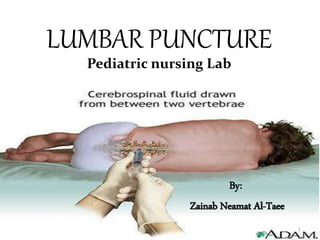
LUMBAR PUNCTURE
Pediatric nursing Lab
1
By:
Zainab Neamat Al-Taee
CSF Facts
• Clear, colourless fluid
• Found in sub-arachnoid space within the brain
(ventricles) and spinal cord
• Produced by choroid plexus and cerebral
vessels at rate of 500ml/day
• Reabsorbed into venous sinus blood via
arachnoid granulations
• Choroid creates, arachnoid absorbs!
• Production matches reabsorption so total
circulating CSF at any time is around 130ml 2
Definition
A Lumbar puncture (or LP, and known as a
spinal tap) is a diagnostic and therapeutic medical
procedure.
Lumbar puncture is the insertion of a specialized
needle into the lumbar subarachnoid space to gain
access to the cerebrospinal fluid.
3
Indication
• Diagnosis :
– CNS infection, eg. meningitis, encephalitis and CNS syphilis
– Subarachnoid hemorrhage (SAH)
– Normal pressure hydrocephalus
• Evaluation and diagnosis of inflammatory CNS processes:
– Multiple sclerosis
– Guillain-Barré syndrome
• Infusion of anesthetic, chemotherapy, or contrast agents
into the spinal canal
• Treatment of idiopathic intracranial hypertension
4
Contraindication
1. Idiopathic or Suspicion of increased ICP d/t
cerebral mass
• Brain tumor
• Cerebral hemorrhage
• Abscesses
• Epidural or subdural hematomas
– Rationale: LP in increased ICP may cause uncal
herniation
– Exception: Therapeutic use of LP to reduce ICP
– Precaution: CT brain is advocated
Signs of Increase ICP:
• Decreased levels of consciousness
• Focal neurological signs
• Papilloedema
5
6
2. Bleeding diathesis
• Uncorrected Coagulopathy
• Clotting defects such as (DIC) disseminated intravascular
coagulation, hemophilia or thrombocytopenia (<50 x 109/L)
• Heparin, Warfarin
3. Skin infection
– Skin infection near the site of the lumbar puncture >
increases the risk of carrying the infection into the CSF with
the LP needle >sepsis
4. Abnormal respiratory pattern
5. Hypertension with bradycardia and deteriorating
consciousness.
6. Vertebral deformities (scoliosis or kyphosis),
7. Acute spinal trauma 7
8
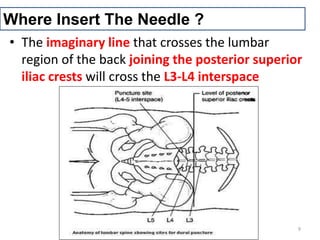
Where Insert The Needle ?
• The imaginary line that crosses the lumbar
region of the back joining the posterior superior
iliac crests will cross the L3-L4 interspace
9
10
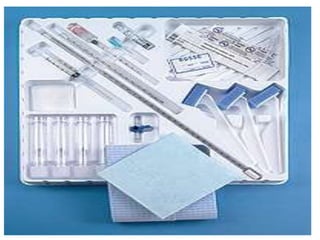
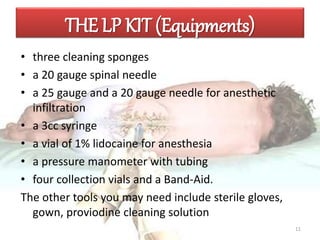
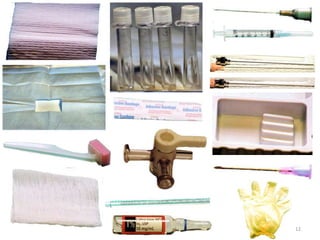
THE LP KIT (Equipments)
• three cleaning sponges
• a 20 gauge spinal needle
• a 25 gauge and a 20 gauge needle for anesthetic
infiltration
• a 3cc syringe
• a vial of 1% lidocaine for anesthesia
• a pressure manometer with tubing
• four collection vials and a Band-Aid.
The other tools you may need include sterile gloves,
gown, proviodine cleaning solution
11
12
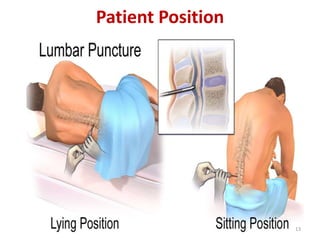
Patient Position
13
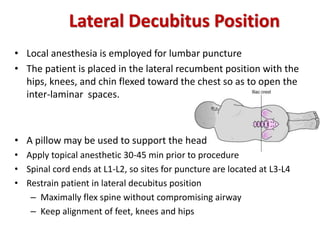
Lateral Decubitus Position
• Local anesthesia is employed for lumbar puncture
• The patient is placed in the lateral recumbent position with the
hips, knees, and chin flexed toward the chest so as to open the
inter-laminar spaces.
• A pillow may be used to support the head
• Apply topical anesthetic 30-45 min prior to procedure
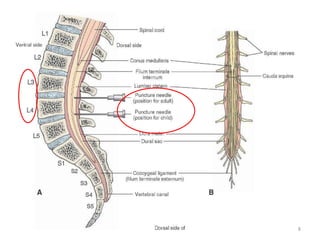
• Spinal cord ends at L1-L2, so sites for puncture are located at L3-L4
• Restrain patient in lateral decubitus position
– Maximally flex spine without compromising airway
– Keep alignment of feet, knees and hips
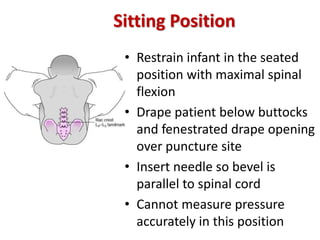
Sitting Position
• Restrain infant in the seated
position with maximal spinal
flexion
• Drape patient below buttocks
and fenestrated drape opening
over puncture site
• Insert needle so bevel is
parallel to spinal cord
• Cannot measure pressure
accurately in this position
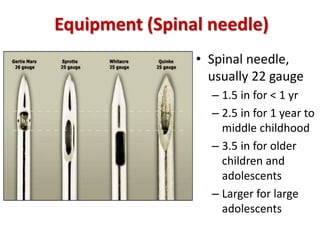
Equipment (Spinal needle)
• Spinal needle,
usually 22 gauge
– 1.5 in for < 1 yr
– 2.5 in for 1 year to
middle childhood
– 3.5 in for older
children and
adolescents
– Larger for large
adolescents
Procedure
• Cleanse skin with povidone iodine from puncture
site radially out to 10 cm and ALLOW TO DRY
• Drape below patient and around site with
fenestrated drape
• Anesthetize with lidocaine
• Insert spinal needle with stylet with bevel up to
keep cutting edge
• Aim towards umbilicus directing needle slightly
cephalad
• Hold needle firmly
17
Procedure
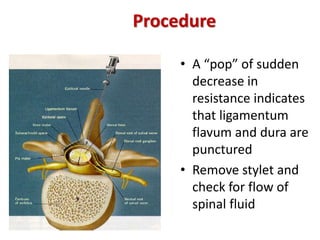
• A “pop” of sudden
decrease in
resistance indicates
that ligamentum
flavum and dura are
punctured
• Remove stylet and
check for flow of
spinal fluid
Procedure
• If no fluid, then:
– Rotate needle 90°
– Reinsert stylet and advance needle slowly checking
frequently for CSF
• Jugular vein compression can increase CSF
pressure in low flow situations
• If bony resistance is felt immediately then you are
not in the spinal interspace
• If bony resistance is felt deeply, then withdraw
needle to the skin surface and redirect more
cephalad and increase patient flexion
• If bloody fluid that does not clear or that clots
results, then withdraw needle and reattempt at a
different interspace 19
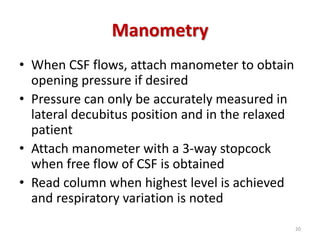
Manometry
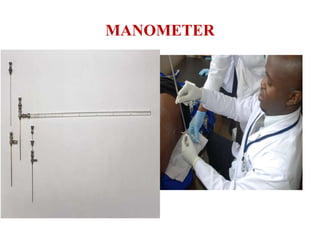
• When CSF flows, attach manometer to obtain
opening pressure if desired
• Pressure can only be accurately measured in
lateral decubitus position and in the relaxed
patient
• Attach manometer with a 3-way stopcock
when free flow of CSF is obtained
• Read column when highest level is achieved
and respiratory variation is noted
20
MANOMETER
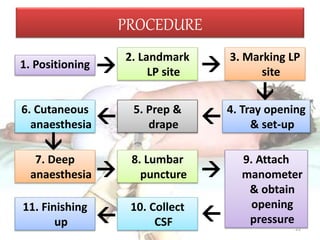
PROCEDURE
1. Positioning
2. Landmark
LP site
3. Marking LP
site
4. Tray opening
& set-up
5. Prep &
drape
6. Cutaneous
anaesthesia
7. Deep
anaesthesia
8. Lumbar
puncture
9. Attach
manometer
& obtain
opening
pressure
10. Collect
CSF
11. Finishing
up
 
 
 
 


22
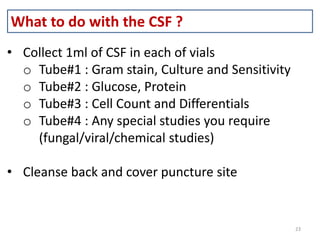
What to do with the CSF ?
• Collect 1ml of CSF in each of vials
o Tube#1 : Gram stain, Culture and Sensitivity
o Tube#2 : Glucose, Protein
o Tube#3 : Cell Count and Differentials
o Tube#4 : Any special studies you require
(fungal/viral/chemical studies)
• Cleanse back and cover puncture site
23
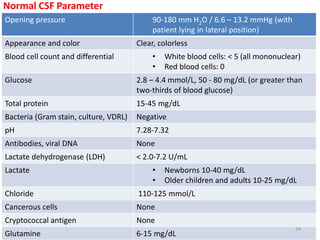
Opening pressure 90-180 mm H2O / 6.6 – 13.2 mmHg (with
patient lying in lateral position)
Appearance and color Clear, colorless
Blood cell count and differential • White blood cells: < 5 (all mononuclear)
• Red blood cells: 0
Glucose 2.8 – 4.4 mmol/L, 50 - 80 mg/dL (or greater than
two-thirds of blood glucose)
Total protein 15-45 mg/dL
Bacteria (Gram stain, culture, VDRL) Negative
pH 7.28-7.32
Antibodies, viral DNA None
Lactate dehydrogenase (LDH) < 2.0-7.2 U/mL
Lactate • Newborns 10-40 mg/dL
• Older children and adults 10-25 mg/dL
Chloride 110-125 mmol/L
Cancerous cells None
Cryptococcal antigen None
Glutamine 6-15 mg/dL
Normal CSF Parameter
24
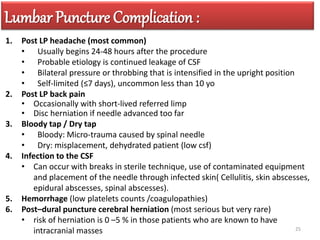
Lumbar Puncture Complication :
1. Post LP headache (most common)
• Usually begins 24-48 hours after the procedure
• Probable etiology is continued leakage of CSF
• Bilateral pressure or throbbing that is intensified in the upright position
• Self-limited (≤7 days), uncommon less than 10 yo
2. Post LP back pain
• Occasionally with short-lived referred limp
• Disc herniation if needle advanced too far
3. Bloody tap / Dry tap
• Bloody: Micro-trauma caused by spinal needle
• Dry: misplacement, dehydrated patient (low csf)
4. Infection to the CSF
• Can occur with breaks in sterile technique, use of contaminated equipment
and placement of the needle through infected skin( Cellulitis, skin abscesses,
epidural abscesses, spinal abscesses).
5. Hemorrhage (low platelets counts /coagulopathies)
6. Post–dural puncture cerebral herniation (most serious but very rare)
• risk of herniation is 0 –5 % in those patients who are known to have
intracranial masses 25
Post LP headache or Spinal Headache
• Most common complication
• Risk factors:
– female
– age 18-30
– lower BMI
– hx of Headache
• Bilateral Headache, improves when supine
• Can last hours to weeks
• Treatment
– Supine position for at least 2 hours
– Hydration
– Caffeine either PO or IV
• Prevention:
– Can avoid by:
• Passing needle bevel parallel to longitudinal fibers of dura
• Replacing stylet before removing needle
• Using small diameter needles
• Using atraumatic needles 26
27
References
 http:// www.wekipedia.org
 Brunner and suddarths text book of medical-surgical nursing
edited by :Suzanne c.smeltzer; Brenda G.Bare; Janice L.Hinkle;
Kerry H.cheever. unit14 ,chapter60 ,page 2157.
 Clinical nursing practices. Edited by: Elizabeth M.jamieson; Lesley
A. Whyte; Janice M.mchal, practice 23,p.p.199_201).
28

Pediatric lumbar puncture

  • 1.
    LUMBAR PUNCTURE Pediatric nursingLab 1 By: Zainab Neamat Al-Taee
  • 2.
    CSF Facts • Clear,colourless fluid • Found in sub-arachnoid space within the brain (ventricles) and spinal cord • Produced by choroid plexus and cerebral vessels at rate of 500ml/day • Reabsorbed into venous sinus blood via arachnoid granulations • Choroid creates, arachnoid absorbs! • Production matches reabsorption so total circulating CSF at any time is around 130ml 2
  • 3.
    Definition A Lumbar puncture(or LP, and known as a spinal tap) is a diagnostic and therapeutic medical procedure. Lumbar puncture is the insertion of a specialized needle into the lumbar subarachnoid space to gain access to the cerebrospinal fluid. 3
  • 4.
    Indication • Diagnosis : –CNS infection, eg. meningitis, encephalitis and CNS syphilis – Subarachnoid hemorrhage (SAH) – Normal pressure hydrocephalus • Evaluation and diagnosis of inflammatory CNS processes: – Multiple sclerosis – Guillain-Barré syndrome • Infusion of anesthetic, chemotherapy, or contrast agents into the spinal canal • Treatment of idiopathic intracranial hypertension 4
  • 5.
    Contraindication 1. Idiopathic orSuspicion of increased ICP d/t cerebral mass • Brain tumor • Cerebral hemorrhage • Abscesses • Epidural or subdural hematomas – Rationale: LP in increased ICP may cause uncal herniation – Exception: Therapeutic use of LP to reduce ICP – Precaution: CT brain is advocated Signs of Increase ICP: • Decreased levels of consciousness • Focal neurological signs • Papilloedema 5
  • 6.
  • 7.
    2. Bleeding diathesis •Uncorrected Coagulopathy • Clotting defects such as (DIC) disseminated intravascular coagulation, hemophilia or thrombocytopenia (<50 x 109/L) • Heparin, Warfarin 3. Skin infection – Skin infection near the site of the lumbar puncture > increases the risk of carrying the infection into the CSF with the LP needle >sepsis 4. Abnormal respiratory pattern 5. Hypertension with bradycardia and deteriorating consciousness. 6. Vertebral deformities (scoliosis or kyphosis), 7. Acute spinal trauma 7
  • 8.
  • 9.
    Where Insert TheNeedle ? • The imaginary line that crosses the lumbar region of the back joining the posterior superior iliac crests will cross the L3-L4 interspace 9
  • 10.
  • 11.
    THE LP KIT(Equipments) • three cleaning sponges • a 20 gauge spinal needle • a 25 gauge and a 20 gauge needle for anesthetic infiltration • a 3cc syringe • a vial of 1% lidocaine for anesthesia • a pressure manometer with tubing • four collection vials and a Band-Aid. The other tools you may need include sterile gloves, gown, proviodine cleaning solution 11
  • 12.
  • 13.
  • 14.
    Lateral Decubitus Position •Local anesthesia is employed for lumbar puncture • The patient is placed in the lateral recumbent position with the hips, knees, and chin flexed toward the chest so as to open the inter-laminar spaces. • A pillow may be used to support the head • Apply topical anesthetic 30-45 min prior to procedure • Spinal cord ends at L1-L2, so sites for puncture are located at L3-L4 • Restrain patient in lateral decubitus position – Maximally flex spine without compromising airway – Keep alignment of feet, knees and hips
  • 15.
    Sitting Position • Restraininfant in the seated position with maximal spinal flexion • Drape patient below buttocks and fenestrated drape opening over puncture site • Insert needle so bevel is parallel to spinal cord • Cannot measure pressure accurately in this position
  • 16.
    Equipment (Spinal needle) •Spinal needle, usually 22 gauge – 1.5 in for < 1 yr – 2.5 in for 1 year to middle childhood – 3.5 in for older children and adolescents – Larger for large adolescents
  • 17.
    Procedure • Cleanse skinwith povidone iodine from puncture site radially out to 10 cm and ALLOW TO DRY • Drape below patient and around site with fenestrated drape • Anesthetize with lidocaine • Insert spinal needle with stylet with bevel up to keep cutting edge • Aim towards umbilicus directing needle slightly cephalad • Hold needle firmly 17
  • 18.
    Procedure • A “pop”of sudden decrease in resistance indicates that ligamentum flavum and dura are punctured • Remove stylet and check for flow of spinal fluid
  • 19.
    Procedure • If nofluid, then: – Rotate needle 90° – Reinsert stylet and advance needle slowly checking frequently for CSF • Jugular vein compression can increase CSF pressure in low flow situations • If bony resistance is felt immediately then you are not in the spinal interspace • If bony resistance is felt deeply, then withdraw needle to the skin surface and redirect more cephalad and increase patient flexion • If bloody fluid that does not clear or that clots results, then withdraw needle and reattempt at a different interspace 19
  • 20.
    Manometry • When CSFflows, attach manometer to obtain opening pressure if desired • Pressure can only be accurately measured in lateral decubitus position and in the relaxed patient • Attach manometer with a 3-way stopcock when free flow of CSF is obtained • Read column when highest level is achieved and respiratory variation is noted 20
  • 21.
  • 22.
    PROCEDURE 1. Positioning 2. Landmark LPsite 3. Marking LP site 4. Tray opening & set-up 5. Prep & drape 6. Cutaneous anaesthesia 7. Deep anaesthesia 8. Lumbar puncture 9. Attach manometer & obtain opening pressure 10. Collect CSF 11. Finishing up           22
  • 23.
    What to dowith the CSF ? • Collect 1ml of CSF in each of vials o Tube#1 : Gram stain, Culture and Sensitivity o Tube#2 : Glucose, Protein o Tube#3 : Cell Count and Differentials o Tube#4 : Any special studies you require (fungal/viral/chemical studies) • Cleanse back and cover puncture site 23
  • 24.
    Opening pressure 90-180mm H2O / 6.6 – 13.2 mmHg (with patient lying in lateral position) Appearance and color Clear, colorless Blood cell count and differential • White blood cells: < 5 (all mononuclear) • Red blood cells: 0 Glucose 2.8 – 4.4 mmol/L, 50 - 80 mg/dL (or greater than two-thirds of blood glucose) Total protein 15-45 mg/dL Bacteria (Gram stain, culture, VDRL) Negative pH 7.28-7.32 Antibodies, viral DNA None Lactate dehydrogenase (LDH) < 2.0-7.2 U/mL Lactate • Newborns 10-40 mg/dL • Older children and adults 10-25 mg/dL Chloride 110-125 mmol/L Cancerous cells None Cryptococcal antigen None Glutamine 6-15 mg/dL Normal CSF Parameter 24
  • 25.
    Lumbar Puncture Complication: 1. Post LP headache (most common) • Usually begins 24-48 hours after the procedure • Probable etiology is continued leakage of CSF • Bilateral pressure or throbbing that is intensified in the upright position • Self-limited (≤7 days), uncommon less than 10 yo 2. Post LP back pain • Occasionally with short-lived referred limp • Disc herniation if needle advanced too far 3. Bloody tap / Dry tap • Bloody: Micro-trauma caused by spinal needle • Dry: misplacement, dehydrated patient (low csf) 4. Infection to the CSF • Can occur with breaks in sterile technique, use of contaminated equipment and placement of the needle through infected skin( Cellulitis, skin abscesses, epidural abscesses, spinal abscesses). 5. Hemorrhage (low platelets counts /coagulopathies) 6. Post–dural puncture cerebral herniation (most serious but very rare) • risk of herniation is 0 –5 % in those patients who are known to have intracranial masses 25
  • 26.
    Post LP headacheor Spinal Headache • Most common complication • Risk factors: – female – age 18-30 – lower BMI – hx of Headache • Bilateral Headache, improves when supine • Can last hours to weeks • Treatment – Supine position for at least 2 hours – Hydration – Caffeine either PO or IV • Prevention: – Can avoid by: • Passing needle bevel parallel to longitudinal fibers of dura • Replacing stylet before removing needle • Using small diameter needles • Using atraumatic needles 26
  • 27.
  • 28.
    References  http:// www.wekipedia.org Brunner and suddarths text book of medical-surgical nursing edited by :Suzanne c.smeltzer; Brenda G.Bare; Janice L.Hinkle; Kerry H.cheever. unit14 ,chapter60 ,page 2157.  Clinical nursing practices. Edited by: Elizabeth M.jamieson; Lesley A. Whyte; Janice M.mchal, practice 23,p.p.199_201). 28