The Origins 
of Language
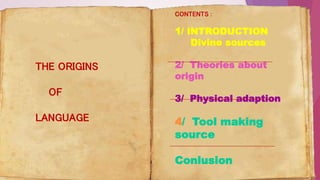
THE ORIGINS 
OF 
LANGUAGE 
CONTENTS : 
1/ INTRODUCTION 
Divine sources 
2/ Theories about 
origin 
3/ Physical adaption 
4/ Tool making 
source 
Conlusion
The 
Divine 
Source
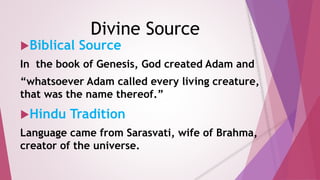
Divine Source 
Biblical Source 
In the book of Genesis, God created Adam and 
“whatsoever Adam called every living creature, 
that was the name thereof.” 
Hindu Tradition 
Language came from Sarasvati, wife of Brahma, 
creator of the universe.
Basic assumption of Divine Source 
Theory 
 If human infants were allowed to grow up 
without hearing any language around them, 
then they would spontaneously begin using 
the original God-given language.
Story of an Egyptian Pharaoh 
 The Greek writer Herodotus reported the story of an Egyptian pharaoh named 
Psammetichus (or Psamtik) who tried the experiment with two newborn babies more 
than 2,500 years ago. After two years of isolation except for the company of goats and a 
mute shepherd, the children were reported to have spontaneously uttered, not an 
Egyptian word, but something that was identified as the Phrygian word bekos,meaning 
bread.” The pharaoh concluded that Phrygian, an older language spoken in part of what 
Is modern Turkey, must be the original language. That seems very unlikely. The children 
may not have picked up this “word” from any human source, but as several commenta-tors 
have pointed out, they must have heard what the goats were saying. (First remove 
the -kos ending, which was added in the Greek version of the story, then pronounce be-as 
you would the English word bed without -d at the end. Can you hear a goat?)
King James’ experiment 
King James the Fourth of Scotland carried out 
a similar experiment around the year 1500 
and the children were reported to have 
spontaneously started speaking Hebrew, 
confirming the King’s belief that Hebrew had 
indeed been the language of the Garden of 
Eden.
The natural 
sound source
Some Theories 
 Natural evolution 
Invention/imitation hypotheses: 
“ding-dong” hypothesis 
“pooh-pooh” hypothesis 
“bow-wow” hypothesis 
“ta-ta” hypothesis
Necessity Theories of 
Language Invention 
• Warning hypothesis 
•“yo-he-ho” hypothesis 
• Lying hypothesis
Natural Evolution Hypothesis 
 Humans evolved a Language Acquisition Device . The simple 
vocalizations and gestures inherited from our primitive ancestors 
quickly gave way to a creative system of language – perhaps in a 
single generation or two due to a genetic mutation that produced 
advantageous results. 
 One theory suggests this perhaps gave Homo sapiens an 
advantage over Homo neatherthal is, whose vocalizations were 
limited by a less developed vocal tract. Studies of Neanderthal 
skulls indicate that they were only able to produce fricative 
sounds, like /f/ and /v/. 
 “Homo loquens” – the speaking human!
Invention Hypotheses (Ding Dong) 
 “Ding-Dong” – humans named objects, actions and 
phenomena after a recognizable sound associated 
with it. The first human words were a type of ICON, 
a sign whose form is an exact image of its meaning: 
Boom = explosion (English) 
Tun-tun = heart (Chinook Indian) 
Ai-ai = knife (Basque, literally “ouch-ouch”)
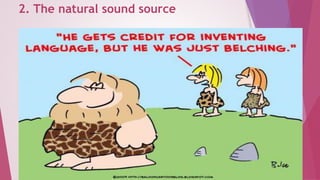
2. The natural sound source
Invention Hypotheses (Pooh – Pooh) 
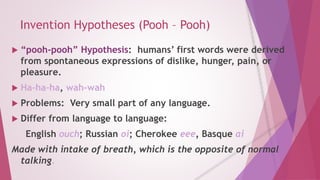
 “pooh-pooh” Hypothesis: humans’ first words were derived 
from spontaneous expressions of dislike, hunger, pain, or 
pleasure. 
 Ha-ha-ha, wah-wah 
 Problems: Very small part of any language. 
 Differ from language to language: 
English ouch; Russian oi; Cherokee eee, Basque ai 
Made with intake of breath, which is the opposite of normal 
talking.
Invention Hypotheses 
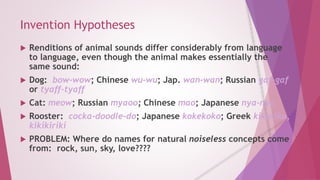
 Renditions of animal sounds differ considerably from language 
to language, even though the animal makes essentially the 
same sound: 
 Dog: bow-wow; Chinese wu-wu; Jap. wan-wan; Russian gaf-gaf 
or tyaff-tyaff 
 Cat: meow; Russian myaoo; Chinese mao; Japanese nya-nya 
 Rooster: cocka-doodle-do; Japanese kokekoko; Greek kikuriku, 
kikikiriki 
 PROBLEM: Where do names for natural noiseless concepts come 
from: rock, sun, sky, love????
The basic assumption(Bow-wow) 
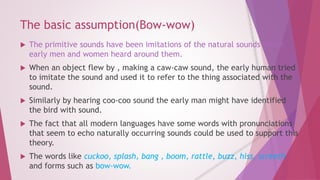
 The primitive sounds have been imitations of the natural sounds which 
early men and women heard around them. 
 When an object flew by , making a caw-caw sound, the early human tried 
to imitate the sound and used it to refer to the thing associated with the 
sound. 
 Similarly by hearing coo-coo sound the early man might have identified 
the bird with sound. 
 The fact that all modern languages have some words with pronunciations 
that seem to echo naturally occurring sounds could be used to support this 
theory. 
 The words like cuckoo, splash, bang , boom, rattle, buzz, hiss, screech 
and forms such as bow-wow.
Bow-Wow theory of language 
This view of language origin has 
been called the “ Bow-wow 
theory.
This theory is only acceptable in regard to 
onomatopoeic words. While we know that 
not all the words are onomatopoeic. 
This theory does not explain the origin of 
abstract word in language. 
The function of language is not just to 
name the words.
Natural Cries of emotion 
 Another theory suggests that the 
original sounds of language may 
have come from natural cries of 
emotion such as pain, anger and 
joy.
The theory can be refuted on the following 
grounds: 
 But Ouch! and other interjections such as 
Ah!,Ooh!,Wow! or Yuck!, are usually produced with 
sudden intakes of breath, which is the opposite of 
ordinary talk. We normally produce spoken language 
on exhaled breath. 
 Basically, the expressive noises people make in 
emotional reactions contain sounds that are not 
otherwise used in speech production and 
consequently would seem to be rather unlikely 
candidates as source sounds for language
Invention Hypotheses (ta-ta) 
 “ta-ta” Hypothesis. Charles Darwin theorized that speech may 
have developed as a sort of mouth pantomime – the organs of 
speech were used to imitate the gestures of the hand. The first 
words were lip icons of hand gestures. 
 Same problem as for onomatopoeia – different gestures in 
different cultures: crossing fingers for good luck in English 
versus Russian “fig” gesture; nodding “no” in Greek versus “yes” 
in English 
 Even Darwin himself thought this was a little implausible.
Necessity Hypotheses 
 Necessity is the mother of invention” 
Warning Hypothesis. Language evolved from the 
warning signals used by animals. Perhaps language 
started with a warning sound to others, that 
signified “HELP!” or “RUN!” to alert other members 
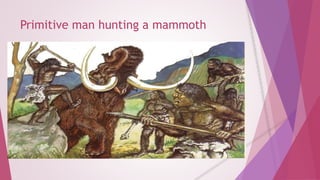
to the approach of a lumbering hairy mammoth or 
hungry saber-tooth tiger. 
 Other first words could have been hunting 
instructions.
Necessity Hypotheses 
 The “Lying” Hypothesis: Sturtevant argued that since 
all our real intentions or emotions get involuntarily 
expressed by gesture, look, or sound, voluntary 
communication must have been invented in order to lie 
or deceive. He believed that the need to deceive and 
lie – to use language in contrast to reality for selfish 
ends – was the social prompting that got language 
started. 
 Seems pretty far-fetched.
Yo-he-ho theory 
 Another proposal involving natural sound 
has been called the “ yo-he-ho” theory. The 
idea is that the sounds of a person involved 
in physical effort could be the source our 
language, especially when that physical 
effort involved several people and the 
interaction had to be coordinated.
So, a group of early humans might have 
developed a set of hums, grunts, 
groans and curses that were used when 
they were lifting and carrying large bits 
of trees or lifeless hairy mammoths.
Primitive man hunting a mammoth
Appeal of the theory 
 The appeal of this theory lies in its emphasis on 
social context. 
 Language we know is a social phenomenon and it 
must have been originated in groups. 
 Early people must have lived in groups, if only 
because larger groups offered better protection 
from attack. Groups are necessarily social 
organizations and ,to maintain those 
organizations, some form of communication is 
required, even if it is just grunts and curses.
Weaker point of the theory 
But the theory does not fully answer 
our question as we see same kind of 
sounds produced by different animals 
but these grunts and groans do not 
develop into a fully fledged 
communicative language.
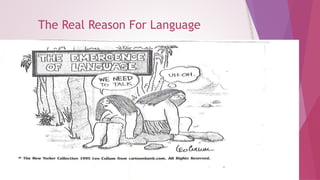
The Real Reason For Language
The Physical 
Adaptation 
Source
Basic Assumption 
Physical features humans 
possess, especially those that are 
distinct from other creatures, 
may have been able to support 
speech production.
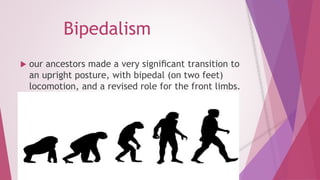
Bipedalism 
 our ancestors made a very significant transition to 
an upright posture, with bipedal (on two feet) 
locomotion, and a revised role for the front limbs.
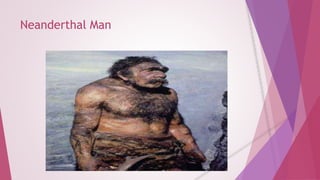
Neanderthal Man
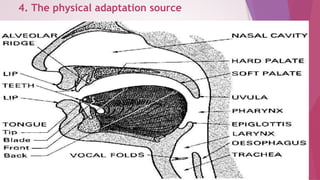
4. The physical adaptation source
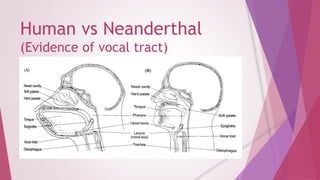
Human vs Neanderthal 
(Evidence of vocal tract)
The reconstructed vocal tract 
of a Neanderthal suggests that 
some consonant-like sound 
distinctions would have been 
possible.
 In the study of evolutionary development, there 
are certain physical features, best thought of as 
partial adaptations, which appear to be relevant 
for speech. They are streamlined versions of 
features found in other primates. By themselves, 
such features would not necessarily lead to 
speech production, but they are good clues that a 
creature possessing such features probably has 
the capacity for speech.
Teeth 
 Human teeth are upright, not slanting outwards like those of apes, and they 
are roughly even in height. Such characteristics are not very useful for ripping 
or tearing food and seem better adapted for grinding and chewing. They are 
also very helpful in making sounds such as f or v.
Lips, Mouth and Tongue 
 Human lips have more intricate muscle 
interlacing than is found in other primates 
and their resulting flexibility certainly helps 
in making sounds like p or b. 
 The human mouth is relatively small 
compared to other primates, can be opened 
and closed rapidly, and contains a smaller, 
thicker and more muscular tongue which can 
be used to shape a wide variety of sounds 
inside the oral cavity.
 In addition, unlike other primates, humans can 
close off the airway through the nose to create 
more air pressure in the mouth. The overall effect 
of these small differences taken together is a face 
with more intricate muscle interlacing in the lips 
and mouth, capable of a wider range of shapes 
and a more rapid and powerful delivery of sounds 
produced through these different shapes.
The tool-making 
source
Other Sources of Language 
The tool-making source: As early humans’ hands 
became occupied with tool use, they were less able to 
use hand gestures, so speech became a necessity 
 Preferential right-handedness 
 Lateralized brain: each hemisphere of brain has its 
own functions alternatively 
 Speech and tool-making abilities are very close to 
one another in the left hemisphere
Other Sources of Language 
The Genetic Source: a crucial genetic mutation arose which 
gave humans the unique ability to produce and understand 
language. This means that language is 
 Innate 
Hard-wired like in a computer 
 Pre-programmed 
Universal in form 
 The innateness hypothesis states that language is endemic to all 
humans.
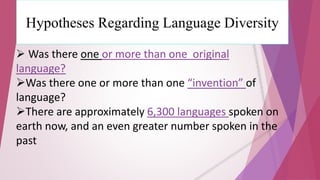
Hypotheses Regarding Language Diversity 
 Was there one or more than one original 
language? 
Was there one or more than one “invention” of 
language? 
There are approximately 6,300 languages spoken on 
earth now, and an even greater number spoken in the 
past
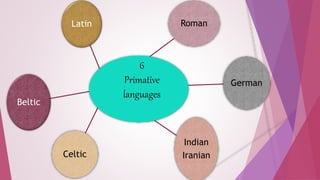
Latin Roman 
German 
Indian 
Celtic Iranian 
Beltic 
6 
Primative 
languages
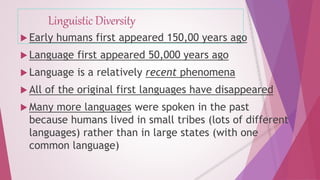
Linguistic Diversity 
 Early humans first appeared 150,00 years ago 
 Language first appeared 50,000 years ago 
 Language is a relatively recent phenomena 
 All of the original first languages have disappeared 
 Many more languages were spoken in the past 
because humans lived in small tribes (lots of different 
languages) rather than in large states (with one 
common language)
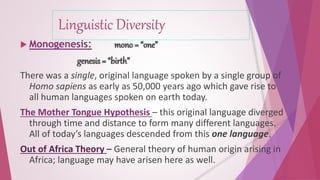
Linguistic Diversity 
 Monogenesis: mono = “one” 
genesis = “birth” 
There was a single, original language spoken by a single group of 
Homo sapiens as early as 50,000 years ago which gave rise to 
all human languages spoken on earth today. 
The Mother Tongue Hypothesis – this original language diverged 
through time and distance to form many different languages. 
All of today’s languages descended from this one language. 
Out of Africa Theory – General theory of human origin arising in 
Africa; language may have arisen here as well.
Linguistic Diversity 
Polygenesis: poly = “many” 
genesis = “birth” 
The Candelabra Hypothesis: 
The hypothesis of parallel evolution of language in 
more than one place and by more than one group 
of Homo sapiens. Each of these languages would 
have diverged into many forms. 
The major language groups of today would be 
descended from these separate mother tongues.
Comparative and Anthropological Linguistics 
 Comparative linguists try to trace the original mother 
tongue (or tongues). Scholars compare modern 
languages and try to reconstruct ancient ones. 
 Anthropological linguists see language as a window 
into the past. Language changes much more slowly 
than the environment in which it is spoken, so you can 
learn a lot about the cultural history of the people who 
speak a language.
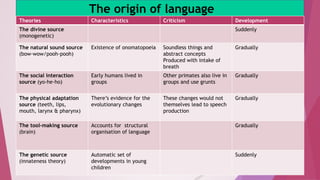
The origin of language 
Theories Characteristics Criticism Development 
The divine source 
Suddenly 
(monogenetic) 
The natural sound source 
(bow-wow/pooh-pooh) 
Existence of onomatopoeia Soundless things and 
abstract concepts 
Produced with intake of 
breath 
Gradually 
The social interaction 
source (yo-he-ho) 
Early humans lived in 
groups 
Other primates also live in 
groups and use grunts 
Gradually 
The physical adaptation 
source (teeth, lips, 
mouth, larynx & pharynx) 
There’s evidence for the 
evolutionary changes 
These changes would not 
themselves lead to speech 
production 
Gradually 
The tool-making source 
(brain) 
Accounts for structural 
organisation of language 
Gradually 
The genetic source 
(innateness theory) 
Automatic set of 
developments in young 
children 
Suddenly
ANY
Origin of language

Origin of language

  • 1.
  • 2.
    THE ORIGINS OF LANGUAGE CONTENTS : 1/ INTRODUCTION Divine sources 2/ Theories about origin 3/ Physical adaption 4/ Tool making source Conlusion
  • 3.
  • 4.
    Divine Source BiblicalSource In the book of Genesis, God created Adam and “whatsoever Adam called every living creature, that was the name thereof.” Hindu Tradition Language came from Sarasvati, wife of Brahma, creator of the universe.
  • 6.
    Basic assumption ofDivine Source Theory  If human infants were allowed to grow up without hearing any language around them, then they would spontaneously begin using the original God-given language.
  • 7.
    Story of anEgyptian Pharaoh  The Greek writer Herodotus reported the story of an Egyptian pharaoh named Psammetichus (or Psamtik) who tried the experiment with two newborn babies more than 2,500 years ago. After two years of isolation except for the company of goats and a mute shepherd, the children were reported to have spontaneously uttered, not an Egyptian word, but something that was identified as the Phrygian word bekos,meaning bread.” The pharaoh concluded that Phrygian, an older language spoken in part of what Is modern Turkey, must be the original language. That seems very unlikely. The children may not have picked up this “word” from any human source, but as several commenta-tors have pointed out, they must have heard what the goats were saying. (First remove the -kos ending, which was added in the Greek version of the story, then pronounce be-as you would the English word bed without -d at the end. Can you hear a goat?)
  • 8.
    King James’ experiment King James the Fourth of Scotland carried out a similar experiment around the year 1500 and the children were reported to have spontaneously started speaking Hebrew, confirming the King’s belief that Hebrew had indeed been the language of the Garden of Eden.
  • 9.
  • 10.
    Some Theories Natural evolution Invention/imitation hypotheses: “ding-dong” hypothesis “pooh-pooh” hypothesis “bow-wow” hypothesis “ta-ta” hypothesis
  • 11.
    Necessity Theories of Language Invention • Warning hypothesis •“yo-he-ho” hypothesis • Lying hypothesis
  • 12.
    Natural Evolution Hypothesis  Humans evolved a Language Acquisition Device . The simple vocalizations and gestures inherited from our primitive ancestors quickly gave way to a creative system of language – perhaps in a single generation or two due to a genetic mutation that produced advantageous results.  One theory suggests this perhaps gave Homo sapiens an advantage over Homo neatherthal is, whose vocalizations were limited by a less developed vocal tract. Studies of Neanderthal skulls indicate that they were only able to produce fricative sounds, like /f/ and /v/.  “Homo loquens” – the speaking human!
  • 13.
    Invention Hypotheses (DingDong)  “Ding-Dong” – humans named objects, actions and phenomena after a recognizable sound associated with it. The first human words were a type of ICON, a sign whose form is an exact image of its meaning: Boom = explosion (English) Tun-tun = heart (Chinook Indian) Ai-ai = knife (Basque, literally “ouch-ouch”)
  • 14.
    2. The naturalsound source
  • 15.
    Invention Hypotheses (Pooh– Pooh)  “pooh-pooh” Hypothesis: humans’ first words were derived from spontaneous expressions of dislike, hunger, pain, or pleasure.  Ha-ha-ha, wah-wah  Problems: Very small part of any language.  Differ from language to language: English ouch; Russian oi; Cherokee eee, Basque ai Made with intake of breath, which is the opposite of normal talking.
  • 16.
    Invention Hypotheses Renditions of animal sounds differ considerably from language to language, even though the animal makes essentially the same sound:  Dog: bow-wow; Chinese wu-wu; Jap. wan-wan; Russian gaf-gaf or tyaff-tyaff  Cat: meow; Russian myaoo; Chinese mao; Japanese nya-nya  Rooster: cocka-doodle-do; Japanese kokekoko; Greek kikuriku, kikikiriki  PROBLEM: Where do names for natural noiseless concepts come from: rock, sun, sky, love????
  • 17.
    The basic assumption(Bow-wow)  The primitive sounds have been imitations of the natural sounds which early men and women heard around them.  When an object flew by , making a caw-caw sound, the early human tried to imitate the sound and used it to refer to the thing associated with the sound.  Similarly by hearing coo-coo sound the early man might have identified the bird with sound.  The fact that all modern languages have some words with pronunciations that seem to echo naturally occurring sounds could be used to support this theory.  The words like cuckoo, splash, bang , boom, rattle, buzz, hiss, screech and forms such as bow-wow.
  • 18.
    Bow-Wow theory oflanguage This view of language origin has been called the “ Bow-wow theory.
  • 19.
    This theory isonly acceptable in regard to onomatopoeic words. While we know that not all the words are onomatopoeic. This theory does not explain the origin of abstract word in language. The function of language is not just to name the words.
  • 20.
    Natural Cries ofemotion  Another theory suggests that the original sounds of language may have come from natural cries of emotion such as pain, anger and joy.
  • 21.
    The theory canbe refuted on the following grounds:  But Ouch! and other interjections such as Ah!,Ooh!,Wow! or Yuck!, are usually produced with sudden intakes of breath, which is the opposite of ordinary talk. We normally produce spoken language on exhaled breath.  Basically, the expressive noises people make in emotional reactions contain sounds that are not otherwise used in speech production and consequently would seem to be rather unlikely candidates as source sounds for language
  • 22.
    Invention Hypotheses (ta-ta)  “ta-ta” Hypothesis. Charles Darwin theorized that speech may have developed as a sort of mouth pantomime – the organs of speech were used to imitate the gestures of the hand. The first words were lip icons of hand gestures.  Same problem as for onomatopoeia – different gestures in different cultures: crossing fingers for good luck in English versus Russian “fig” gesture; nodding “no” in Greek versus “yes” in English  Even Darwin himself thought this was a little implausible.
  • 23.
    Necessity Hypotheses Necessity is the mother of invention” Warning Hypothesis. Language evolved from the warning signals used by animals. Perhaps language started with a warning sound to others, that signified “HELP!” or “RUN!” to alert other members to the approach of a lumbering hairy mammoth or hungry saber-tooth tiger.  Other first words could have been hunting instructions.
  • 24.
    Necessity Hypotheses The “Lying” Hypothesis: Sturtevant argued that since all our real intentions or emotions get involuntarily expressed by gesture, look, or sound, voluntary communication must have been invented in order to lie or deceive. He believed that the need to deceive and lie – to use language in contrast to reality for selfish ends – was the social prompting that got language started.  Seems pretty far-fetched.
  • 25.
    Yo-he-ho theory Another proposal involving natural sound has been called the “ yo-he-ho” theory. The idea is that the sounds of a person involved in physical effort could be the source our language, especially when that physical effort involved several people and the interaction had to be coordinated.
  • 26.
    So, a groupof early humans might have developed a set of hums, grunts, groans and curses that were used when they were lifting and carrying large bits of trees or lifeless hairy mammoths.
  • 27.
  • 28.
    Appeal of thetheory  The appeal of this theory lies in its emphasis on social context.  Language we know is a social phenomenon and it must have been originated in groups.  Early people must have lived in groups, if only because larger groups offered better protection from attack. Groups are necessarily social organizations and ,to maintain those organizations, some form of communication is required, even if it is just grunts and curses.
  • 29.
    Weaker point ofthe theory But the theory does not fully answer our question as we see same kind of sounds produced by different animals but these grunts and groans do not develop into a fully fledged communicative language.
  • 30.
    The Real ReasonFor Language
  • 31.
  • 32.
    Basic Assumption Physicalfeatures humans possess, especially those that are distinct from other creatures, may have been able to support speech production.
  • 33.
    Bipedalism  ourancestors made a very significant transition to an upright posture, with bipedal (on two feet) locomotion, and a revised role for the front limbs.
  • 34.
  • 35.
    4. The physicaladaptation source
  • 36.
    Human vs Neanderthal (Evidence of vocal tract)
  • 37.
    The reconstructed vocaltract of a Neanderthal suggests that some consonant-like sound distinctions would have been possible.
  • 38.
     In thestudy of evolutionary development, there are certain physical features, best thought of as partial adaptations, which appear to be relevant for speech. They are streamlined versions of features found in other primates. By themselves, such features would not necessarily lead to speech production, but they are good clues that a creature possessing such features probably has the capacity for speech.
  • 39.
    Teeth  Humanteeth are upright, not slanting outwards like those of apes, and they are roughly even in height. Such characteristics are not very useful for ripping or tearing food and seem better adapted for grinding and chewing. They are also very helpful in making sounds such as f or v.
  • 40.
    Lips, Mouth andTongue  Human lips have more intricate muscle interlacing than is found in other primates and their resulting flexibility certainly helps in making sounds like p or b.  The human mouth is relatively small compared to other primates, can be opened and closed rapidly, and contains a smaller, thicker and more muscular tongue which can be used to shape a wide variety of sounds inside the oral cavity.
  • 41.
     In addition,unlike other primates, humans can close off the airway through the nose to create more air pressure in the mouth. The overall effect of these small differences taken together is a face with more intricate muscle interlacing in the lips and mouth, capable of a wider range of shapes and a more rapid and powerful delivery of sounds produced through these different shapes.
  • 42.
  • 43.
    Other Sources ofLanguage The tool-making source: As early humans’ hands became occupied with tool use, they were less able to use hand gestures, so speech became a necessity  Preferential right-handedness  Lateralized brain: each hemisphere of brain has its own functions alternatively  Speech and tool-making abilities are very close to one another in the left hemisphere
  • 44.
    Other Sources ofLanguage The Genetic Source: a crucial genetic mutation arose which gave humans the unique ability to produce and understand language. This means that language is  Innate Hard-wired like in a computer  Pre-programmed Universal in form  The innateness hypothesis states that language is endemic to all humans.
  • 45.
    Hypotheses Regarding LanguageDiversity  Was there one or more than one original language? Was there one or more than one “invention” of language? There are approximately 6,300 languages spoken on earth now, and an even greater number spoken in the past
  • 46.
    Latin Roman German Indian Celtic Iranian Beltic 6 Primative languages
  • 47.
    Linguistic Diversity Early humans first appeared 150,00 years ago  Language first appeared 50,000 years ago  Language is a relatively recent phenomena  All of the original first languages have disappeared  Many more languages were spoken in the past because humans lived in small tribes (lots of different languages) rather than in large states (with one common language)
  • 48.
    Linguistic Diversity Monogenesis: mono = “one” genesis = “birth” There was a single, original language spoken by a single group of Homo sapiens as early as 50,000 years ago which gave rise to all human languages spoken on earth today. The Mother Tongue Hypothesis – this original language diverged through time and distance to form many different languages. All of today’s languages descended from this one language. Out of Africa Theory – General theory of human origin arising in Africa; language may have arisen here as well.
  • 49.
    Linguistic Diversity Polygenesis:poly = “many” genesis = “birth” The Candelabra Hypothesis: The hypothesis of parallel evolution of language in more than one place and by more than one group of Homo sapiens. Each of these languages would have diverged into many forms. The major language groups of today would be descended from these separate mother tongues.
  • 50.
    Comparative and AnthropologicalLinguistics  Comparative linguists try to trace the original mother tongue (or tongues). Scholars compare modern languages and try to reconstruct ancient ones.  Anthropological linguists see language as a window into the past. Language changes much more slowly than the environment in which it is spoken, so you can learn a lot about the cultural history of the people who speak a language.
  • 51.
    The origin oflanguage Theories Characteristics Criticism Development The divine source Suddenly (monogenetic) The natural sound source (bow-wow/pooh-pooh) Existence of onomatopoeia Soundless things and abstract concepts Produced with intake of breath Gradually The social interaction source (yo-he-ho) Early humans lived in groups Other primates also live in groups and use grunts Gradually The physical adaptation source (teeth, lips, mouth, larynx & pharynx) There’s evidence for the evolutionary changes These changes would not themselves lead to speech production Gradually The tool-making source (brain) Accounts for structural organisation of language Gradually The genetic source (innateness theory) Automatic set of developments in young children Suddenly
  • 52.