YAML
Date : 10-Mar-2017 By:
Sabarinath Gnanasekar
What is YAML?
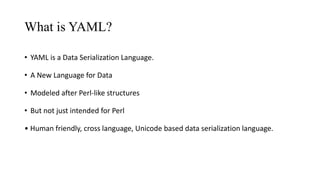
• YAML is a Data Serialization Language.
• A New Language for Data
• Modeled after Perl-like structures
• But not just intended for Perl
• Human friendly, cross language, Unicode based data serialization language.
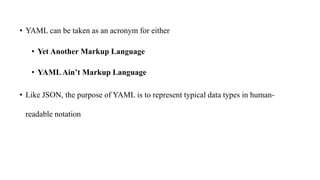
• YAML can be taken as an acronym for either
• Yet Another Markup Language
• YAMLAin’t Markup Language
• Like JSON, the purpose of YAML is to represent typical data types in human-
readable notation
Why YAML if XML?
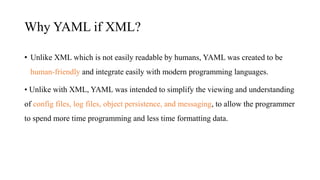
• Unlike XML which is not easily readable by humans, YAML was created to be
human-friendly and integrate easily with modern programming languages.
• Unlike with XML, YAML was intended to simplify the viewing and understanding
of config files, log files, object persistence, and messaging, to allow the programmer
to spend more time programming and less time formatting data.
YAML Design Goals
YAML design goals:
• - YAML documents are very readable by humans.
• - YAML interacts well with scripting languages.
• - YAML uses host languages native data structures.
• - YAML has a consistent information model.
• - YAML enables stream-based processing.
• - YAML is expressive and extensible.
• - YAML is easy to implement.
Design consideration
• To achieve Human/Computer easy processing
• High Data/Markup (Signal/Noise) Ratio
• To be the world's best Data::Dumper
• To be great for Configs, Caches, and Logs
• Unicode based
• Speedy parsing
• Alternative to XML (for some applications)
Basic YAML Syntax Rules
• Documents begin with --- and end with …
• Indentation of lines denotes the structure within the document.
• Comments begin with #
• Members of lists begin with –
• Key value pairs use the following syntax <key>:value>
• YAML files should end in .yaml
• YAML is case sensitive.
• YAML does not allow the use of tabs. Spaces are used instead as tabs are not
universally supported.
YAML Syntax Basics
• Collections
• Streams and Documents
• Mappings (hashes / dictionaries)
• Sequences (arrays / lists)
• Comments
Contd..
• Scalars (strings,integers, dates and other atomic data types)
oSimple
oQuoted
oBlock ( |)
oFolded
oWiki
oEscaping
• Anchors & Aliases (&,*)
• Tags (Data types)(“!”)
• Nodes -YAML nodes have content of one of three kinds: scalar, sequence, or
mapping. In addition, each node has a tag which serves to restrict the set of
possible values which the node's content can have.
Collections:
• YAML's block collections use indentation for scope and begin each
entry on its own line.
Structures – Streams & Documents
YAML uses three dashes (“---”) to separate documents within a stream. Three
dots ( “...”) indicate the end of a document without starting a new one
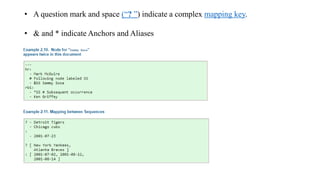
• A question mark and space (“? ”) indicate a complex mapping key.
• & and * indicate Anchors and Aliases
Mappings
• A YAML mapping is like a Perl hash
• Unordered Key/Value pairs
• Separated by ': ' (space is mandatory)
---
name: Benjamin
rank: Private
serial number: 1234567890
12:34 PM: My favorite time
Sequences
• A YAML sequence is like a Perl array
• An ordered collection of data
• YAML has a bullet like syntax '- '
---
- red
- white
- blue
- pinko
Examples
---
Fruits:
- Apples
- Tomatoes
Veggies:
- Spinach
- Broccoli
Meats:
- Burgers
- Shrimp
Household:
- Candles
- Incense
- Toilet Duck
Ex2:The Matrix
---
-
- 3
- 5
- 7
-
- 0
- 0
- 7
-
- 9
- 1
- 1
Comments
• Comments/blank lines can go almost anywhere
• Must not be ambiguous with content
• Comments begin '# '
# comment before document
--- #DIRECTIVE # comment
foo: bar # inline comment
phone: number #555-1234
### Comment
fact: fiction
---
blue: bird
# Comment
Scalars
• A YAML scalar is strings,integers, dates and other atomic data
types.
• YAML has many scalar forms.
---
simple: look ma, no quotes
quoted:
- 'Single quoted. Like Perl, no escapes'
- "Double quotes.nLike Perl, has escapes"
- |
A YAML block scalar.
Much like Perl's
here-document.
Scalar content can be written in block form using a literal style (“|”) where all line
breaks count. Or they can be written with the folded style (“>”) where each line
break is folded to a space unless it ends an empty or a “more indented” line.
Tags
• http://yaml.org/type/
• YAML Pros:
• Cleaner format
• Safe deserialization
• Hashes sorted by default
• Supports GLOB(*.txt), Regexp
• Interacts with Ruby, Python, Java etc
Demo
https://gsabarinath91@bitbucket.org/gsabarinath91/serialisation.git
References:
• https://learnxinyminutes.com/docs/yaml/
• http://pyyaml.org/wiki/PyYAMLDocumentation
• http://yaml.org/refcard.html
• http://sangsoonam.github.io/2017/03/13/yaml-vs-json.html

Yaml

  • 1.
    YAML Date : 10-Mar-2017By: Sabarinath Gnanasekar
  • 2.
    What is YAML? •YAML is a Data Serialization Language. • A New Language for Data • Modeled after Perl-like structures • But not just intended for Perl • Human friendly, cross language, Unicode based data serialization language.
  • 3.
    • YAML canbe taken as an acronym for either • Yet Another Markup Language • YAMLAin’t Markup Language • Like JSON, the purpose of YAML is to represent typical data types in human- readable notation
  • 4.
    Why YAML ifXML? • Unlike XML which is not easily readable by humans, YAML was created to be human-friendly and integrate easily with modern programming languages. • Unlike with XML, YAML was intended to simplify the viewing and understanding of config files, log files, object persistence, and messaging, to allow the programmer to spend more time programming and less time formatting data.
  • 5.
    YAML Design Goals YAMLdesign goals: • - YAML documents are very readable by humans. • - YAML interacts well with scripting languages. • - YAML uses host languages native data structures. • - YAML has a consistent information model. • - YAML enables stream-based processing. • - YAML is expressive and extensible. • - YAML is easy to implement.
  • 6.
    Design consideration • Toachieve Human/Computer easy processing • High Data/Markup (Signal/Noise) Ratio • To be the world's best Data::Dumper • To be great for Configs, Caches, and Logs • Unicode based • Speedy parsing • Alternative to XML (for some applications)
  • 7.
    Basic YAML SyntaxRules • Documents begin with --- and end with … • Indentation of lines denotes the structure within the document. • Comments begin with # • Members of lists begin with – • Key value pairs use the following syntax <key>:value> • YAML files should end in .yaml • YAML is case sensitive. • YAML does not allow the use of tabs. Spaces are used instead as tabs are not universally supported.
  • 8.
    YAML Syntax Basics •Collections • Streams and Documents • Mappings (hashes / dictionaries) • Sequences (arrays / lists) • Comments
  • 9.
    Contd.. • Scalars (strings,integers,dates and other atomic data types) oSimple oQuoted oBlock ( |) oFolded oWiki oEscaping • Anchors & Aliases (&,*) • Tags (Data types)(“!”) • Nodes -YAML nodes have content of one of three kinds: scalar, sequence, or mapping. In addition, each node has a tag which serves to restrict the set of possible values which the node's content can have.
  • 10.
    Collections: • YAML's blockcollections use indentation for scope and begin each entry on its own line.
  • 11.
    Structures – Streams& Documents YAML uses three dashes (“---”) to separate documents within a stream. Three dots ( “...”) indicate the end of a document without starting a new one
  • 12.
    • A questionmark and space (“? ”) indicate a complex mapping key. • & and * indicate Anchors and Aliases
  • 13.
    Mappings • A YAMLmapping is like a Perl hash • Unordered Key/Value pairs • Separated by ': ' (space is mandatory) --- name: Benjamin rank: Private serial number: 1234567890 12:34 PM: My favorite time
  • 14.
    Sequences • A YAMLsequence is like a Perl array • An ordered collection of data • YAML has a bullet like syntax '- ' --- - red - white - blue - pinko
  • 15.
    Examples --- Fruits: - Apples - Tomatoes Veggies: -Spinach - Broccoli Meats: - Burgers - Shrimp Household: - Candles - Incense - Toilet Duck
  • 16.
    Ex2:The Matrix --- - - 3 -5 - 7 - - 0 - 0 - 7 - - 9 - 1 - 1
  • 17.
    Comments • Comments/blank linescan go almost anywhere • Must not be ambiguous with content • Comments begin '# ' # comment before document --- #DIRECTIVE # comment foo: bar # inline comment phone: number #555-1234 ### Comment fact: fiction --- blue: bird # Comment
  • 18.
    Scalars • A YAMLscalar is strings,integers, dates and other atomic data types. • YAML has many scalar forms. --- simple: look ma, no quotes quoted: - 'Single quoted. Like Perl, no escapes' - "Double quotes.nLike Perl, has escapes" - | A YAML block scalar. Much like Perl's here-document.
  • 19.
    Scalar content canbe written in block form using a literal style (“|”) where all line breaks count. Or they can be written with the folded style (“>”) where each line break is folded to a space unless it ends an empty or a “more indented” line.
  • 20.
  • 21.
    • YAML Pros: •Cleaner format • Safe deserialization • Hashes sorted by default • Supports GLOB(*.txt), Regexp • Interacts with Ruby, Python, Java etc
  • 25.
  • 26.
    References: • https://learnxinyminutes.com/docs/yaml/ • http://pyyaml.org/wiki/PyYAMLDocumentation •http://yaml.org/refcard.html • http://sangsoonam.github.io/2017/03/13/yaml-vs-json.html