Release
Management
   with
Artifactory
Yoav Landman & Frederic Simon
About us

    ★ Yoav Landman
      • Creator of Artifactory, JFrog’s CTO
    ★ Frederic Simon
      • JFrog’s Chief Architect
    ★ 10+ years experience in commercial enterprise build
       and development environments
    ★ Serving the community since 2006 with OSS tools
       (Artifactory, Jade Maven Plugins and AnnoMojo, Dependency Analyzer,
       Stellarium for Java, IDEA plugins...)


2
Agenda
    ★ Intro
    ★ Configuration tips
    ★ Searches
    ★ Reproducible builds
    ★ Advanced features
    ★ Smart staging and promotion
    ★ Web Start and JavaFX
    ★ Gradle integration


3
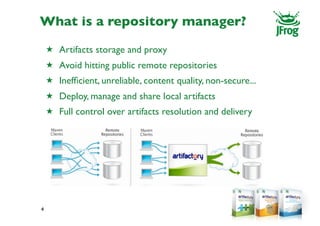
What is a repository manager?
    ★ Artifacts storage and proxy
    ★ Avoid hitting public remote repositories
    ★ Inefficient, unreliable, content quality, non-secure...
    ★ Deploy, manage and share local artifacts
    ★ Full control over artifacts resolution and delivery


4
What is                          ?
    ★ Advanced binaries repository - the binaries’ SCM
    ★ JavaFX and WebStart repository
    ★ Supports REST, Maven*, Gradle*, Ivy/Ant*, Buildr
       * native support

    ★ First “real” web-driven repository manager (2006)
    ★ Upload through UI, indexed searches…
    ★ +80,000 downloads (02/2010)
    ★ OSS | Enterprise PowerPack | Cloud hosting


5
Configuration tips - demo

    ★ Remote repositories sharing via REST
      • Reuse configuration
    ★ Automatically generate the client configuration
      • Maven - settings.xml
      • Gradle plug-in
    ★ Centrally controlled encrypted password
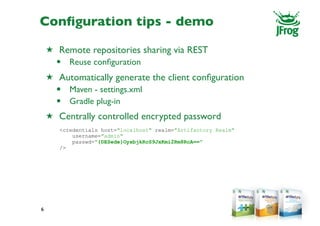
       <credentials host="localhost" realm="Artifactory Realm"
           username="admin"
           passwd="{DESede}OyxbjkRcS9JxKmi2Rm8RcA=="
       />


6
7
Searches
    ★ Search types
      • Quick search (wildcard part of path)
      • GAVC
      • Properties
      • Class/Jar resource
          ‣   See the actual class found!
          ‣   View source + syntax highlighting
      •   XPath - also search inside POM, Ivy.xml content!
    ★ Grouping support
      • E.g. group by repository, groupId etc.
    ★ Always possible to locate the results in the repo tree
       browser

8
9
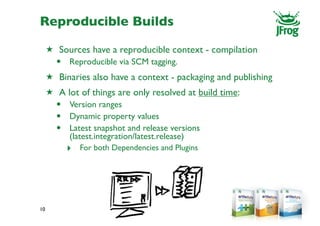
Reproducible Builds
     ★ Sources have a reproducible context - compilation
       • Reproducible via SCM tagging.
     ★ Binaries also have a context - packaging and publishing
     ★ A lot of things are only resolved at build time:
       • Version ranges
       • Dynamic property values
       • Latest snapshot and release versions
          (latest.integration/latest.release)
          ‣   For both Dependencies and Plugins


10
The Role of the CI Server
     ★ Captures all the information needed to reproduce the
        build
     ★ Published module artifacts
     ★ Resolved dependencies of all scopes
     ★ General Build Environment
       • JVM
       • Architecture
       • CI server version
       • General properties
       • Build statistics
       • User who executed the build
       • Etc.
11
Artifactory and Hudson
     ★ Deploy from Hudson to Artifactory
     ★ Navigate the builds in Artifactory
     ★ Link back to Hudson builds
     ★ Relate artifacts to build
     ★ Export/promote/manipulate build artifacts
     ★ More efficient multi-module deployment


12
Build Scenario


13
The build jobs pyramid
     ★ SCM update
     ★ Retrieve
     ★ Test
     ★ Deploy

              Build time       unit tests
                           smoke tests
                           Integ, tests
                               GA         Retrieve/Deploy
     No. of builds


14
15
Advanced repository features
     ★ Checksum-based storage
     ★ Handling download bursts
     ★ Verifying uploaded artifacts
     ★ Locking
     ★ Cleanup bad remote repo references
     ★ Built-in metadata


16
Checksum-based storage
     ★ Many identical artifacts are produced and stored
        numerous times in the repositories
       •   Unique snapshots that are exactly the same between
           subsequent builds
       •   Other artifacts that are copied
           ‣   Mainly needed for more natural security control
     ★ Artifactory uses a checksum-based storage
     ★ Identical artifacts are stored on the server exactly
        once!
       •   No matter how many references are there
     ★ Copy and move are very cheap
       • Pointer operations
17
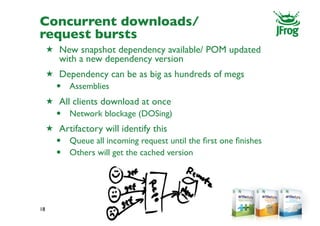
Concurrent downloads/
request bursts
     ★ New snapshot dependency available/ POM updated
        with a new dependency version
     ★ Dependency can be as big as hundreds of megs
       • Assemblies
     ★ All clients download at once
       • Network blockage (DOSing)
     ★ Artifactory will identify this
       • Queue all incoming request until the first one finishes
       • Others will get the cached version


18
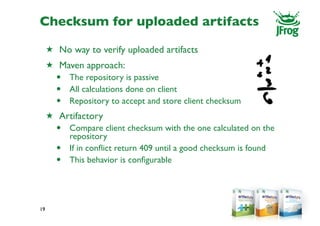
Checksum for uploaded artifacts
     ★ No way to verify uploaded artifacts
     ★ Maven approach:
       • The repository is passive
       • All calculations done on client
       • Repository to accept and store client checksum
     ★ Artifactory
       • Compare client checksum with the one calculated on the
         repository
       • If in conflict return 409 until a good checksum is found
       • This behavior is configurable


19
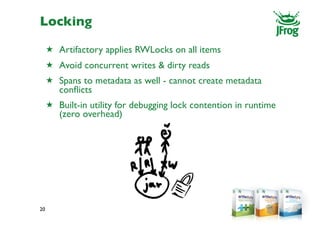
Locking
     ★ Artifactory applies RWLocks on all items
     ★ Avoid concurrent writes & dirty reads
     ★ Spans to metadata as well - cannot create metadata
        conflicts
     ★ Built-in utility for debugging lock contention in runtime
        (zero overhead)


20
POM cleanup
     ★ Many common third party POMs contain remote
        repository references making controlled resolution a
        nightmare
     ★ Global mirroring is not a solution
       • Forces a unified repository for releases/snapshots/plugins
     ★ Artifactory can facade POMs through a Virtual
        Repository
       •   Can configure remote repo references to be removed
       •   Original POM is intact


21
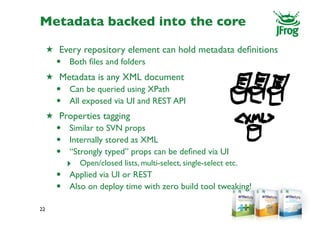
Metadata backed into the core
     ★ Every repository element can hold metadata definitions
       • Both files and folders
     ★ Metadata is any XML document
       • Can be queried using XPath
       • All exposed via UI and REST API
     ★ Properties tagging
       • Similar to SVN props
       • Internally stored as XML
       • “Strongly typed” props can be defined via UI
           ‣   Open/closed lists, multi-select, single-select etc.
       •   Applied via UI or REST
       •   Also on deploy time with zero build tool tweaking!

22
Smart staging and promotion
     ★ Repository has two main roles
       • Proxy remote artifacts
       • Host deployed artifacts
          ‣   Artifacts (should) come from CI server
     ★ Promotion of artifacts starts with a build
     ★ The Binaries Repository & the CI Server are always
        interconnected


23
Search-based management
     ★ Makes bulk artifact management a lot easier
     ★ Shopping-cart of artifacts
     ★ Fill-up the cart by searching and saving the
        search results - any search type!
     ★ Do other searches and add/subtract the results from
        the original
     ★ Can tweak the result manually
       • E.g. remove sources
     ★ Once done move/promote/copy/export the result
     ★ Does not enforce narrow concepts to support only
        specific limited use cases
       •   E.g. promotion
24
25
JavaFX
     ★ JavaFX/JNLP plugin
       • Compiles JavaFX sources
       • Uses standard Maven resources for classpath resolution
       • Creates Web Start JNLP files - standalone and/or browser
     ★ WebStart Virtual Repository
       • Sign jars automatically
       • Transform JNLP file href
       • Provision JNLP files and dependencies


26
27
Gradle integration
     ★ Artifactory and Gradle started a strong technical
        collaboration
     ★ Zero configuration plugin to deploy and resolve from
        Artifactory when using Gradle in enterprise env.
     ★ Extract BuildInfo on the fly
       • Done!
       • Integrating with the Hudson Gradle plug-in
     ★ Gradle shows great potential
       • Zero intrusiveness
       • Ivy for mature resolution and deployments
       • Flexible control
       • Terse and easy to understand configuration
       • Ideal for integrating with a repo manager
28
Thank You!


       Q&A
29

Repository Management with JFrog Artifactory

  • 1.
    Release Management with Artifactory Yoav Landman & Frederic Simon
  • 2.
    About us ★ Yoav Landman • Creator of Artifactory, JFrog’s CTO ★ Frederic Simon • JFrog’s Chief Architect ★ 10+ years experience in commercial enterprise build and development environments ★ Serving the community since 2006 with OSS tools (Artifactory, Jade Maven Plugins and AnnoMojo, Dependency Analyzer, Stellarium for Java, IDEA plugins...) 2
  • 3.
    Agenda ★ Intro ★ Configuration tips ★ Searches ★ Reproducible builds ★ Advanced features ★ Smart staging and promotion ★ Web Start and JavaFX ★ Gradle integration 3
  • 4.
    What is arepository manager? ★ Artifacts storage and proxy ★ Avoid hitting public remote repositories ★ Inefficient, unreliable, content quality, non-secure... ★ Deploy, manage and share local artifacts ★ Full control over artifacts resolution and delivery 4
  • 5.
    What is ? ★ Advanced binaries repository - the binaries’ SCM ★ JavaFX and WebStart repository ★ Supports REST, Maven*, Gradle*, Ivy/Ant*, Buildr * native support ★ First “real” web-driven repository manager (2006) ★ Upload through UI, indexed searches… ★ +80,000 downloads (02/2010) ★ OSS | Enterprise PowerPack | Cloud hosting 5
  • 6.
    Configuration tips -demo ★ Remote repositories sharing via REST • Reuse configuration ★ Automatically generate the client configuration • Maven - settings.xml • Gradle plug-in ★ Centrally controlled encrypted password <credentials host="localhost" realm="Artifactory Realm" username="admin" passwd="{DESede}OyxbjkRcS9JxKmi2Rm8RcA==" /> 6
  • 7.
  • 8.
    Searches ★ Search types • Quick search (wildcard part of path) • GAVC • Properties • Class/Jar resource ‣ See the actual class found! ‣ View source + syntax highlighting • XPath - also search inside POM, Ivy.xml content! ★ Grouping support • E.g. group by repository, groupId etc. ★ Always possible to locate the results in the repo tree browser 8
  • 9.
  • 10.
    Reproducible Builds ★ Sources have a reproducible context - compilation • Reproducible via SCM tagging. ★ Binaries also have a context - packaging and publishing ★ A lot of things are only resolved at build time: • Version ranges • Dynamic property values • Latest snapshot and release versions (latest.integration/latest.release) ‣ For both Dependencies and Plugins 10
  • 11.
    The Role ofthe CI Server ★ Captures all the information needed to reproduce the build ★ Published module artifacts ★ Resolved dependencies of all scopes ★ General Build Environment • JVM • Architecture • CI server version • General properties • Build statistics • User who executed the build • Etc. 11
  • 12.
    Artifactory and Hudson ★ Deploy from Hudson to Artifactory ★ Navigate the builds in Artifactory ★ Link back to Hudson builds ★ Relate artifacts to build ★ Export/promote/manipulate build artifacts ★ More efficient multi-module deployment 12
  • 13.
  • 14.
    The build jobspyramid ★ SCM update ★ Retrieve ★ Test ★ Deploy Build time unit tests smoke tests Integ, tests GA Retrieve/Deploy No. of builds 14
  • 15.
  • 16.
    Advanced repository features ★ Checksum-based storage ★ Handling download bursts ★ Verifying uploaded artifacts ★ Locking ★ Cleanup bad remote repo references ★ Built-in metadata 16
  • 17.
    Checksum-based storage ★ Many identical artifacts are produced and stored numerous times in the repositories • Unique snapshots that are exactly the same between subsequent builds • Other artifacts that are copied ‣ Mainly needed for more natural security control ★ Artifactory uses a checksum-based storage ★ Identical artifacts are stored on the server exactly once! • No matter how many references are there ★ Copy and move are very cheap • Pointer operations 17
  • 18.
    Concurrent downloads/ request bursts ★ New snapshot dependency available/ POM updated with a new dependency version ★ Dependency can be as big as hundreds of megs • Assemblies ★ All clients download at once • Network blockage (DOSing) ★ Artifactory will identify this • Queue all incoming request until the first one finishes • Others will get the cached version 18
  • 19.
    Checksum for uploadedartifacts ★ No way to verify uploaded artifacts ★ Maven approach: • The repository is passive • All calculations done on client • Repository to accept and store client checksum ★ Artifactory • Compare client checksum with the one calculated on the repository • If in conflict return 409 until a good checksum is found • This behavior is configurable 19
  • 20.
    Locking ★ Artifactory applies RWLocks on all items ★ Avoid concurrent writes & dirty reads ★ Spans to metadata as well - cannot create metadata conflicts ★ Built-in utility for debugging lock contention in runtime (zero overhead) 20
  • 21.
    POM cleanup ★ Many common third party POMs contain remote repository references making controlled resolution a nightmare ★ Global mirroring is not a solution • Forces a unified repository for releases/snapshots/plugins ★ Artifactory can facade POMs through a Virtual Repository • Can configure remote repo references to be removed • Original POM is intact 21
  • 22.
    Metadata backed intothe core ★ Every repository element can hold metadata definitions • Both files and folders ★ Metadata is any XML document • Can be queried using XPath • All exposed via UI and REST API ★ Properties tagging • Similar to SVN props • Internally stored as XML • “Strongly typed” props can be defined via UI ‣ Open/closed lists, multi-select, single-select etc. • Applied via UI or REST • Also on deploy time with zero build tool tweaking! 22
  • 23.
    Smart staging andpromotion ★ Repository has two main roles • Proxy remote artifacts • Host deployed artifacts ‣ Artifacts (should) come from CI server ★ Promotion of artifacts starts with a build ★ The Binaries Repository & the CI Server are always interconnected 23
  • 24.
    Search-based management ★ Makes bulk artifact management a lot easier ★ Shopping-cart of artifacts ★ Fill-up the cart by searching and saving the search results - any search type! ★ Do other searches and add/subtract the results from the original ★ Can tweak the result manually • E.g. remove sources ★ Once done move/promote/copy/export the result ★ Does not enforce narrow concepts to support only specific limited use cases • E.g. promotion 24
  • 25.
  • 26.
    JavaFX ★ JavaFX/JNLP plugin • Compiles JavaFX sources • Uses standard Maven resources for classpath resolution • Creates Web Start JNLP files - standalone and/or browser ★ WebStart Virtual Repository • Sign jars automatically • Transform JNLP file href • Provision JNLP files and dependencies 26
  • 27.
  • 28.
    Gradle integration ★ Artifactory and Gradle started a strong technical collaboration ★ Zero configuration plugin to deploy and resolve from Artifactory when using Gradle in enterprise env. ★ Extract BuildInfo on the fly • Done! • Integrating with the Hudson Gradle plug-in ★ Gradle shows great potential • Zero intrusiveness • Ivy for mature resolution and deployments • Flexible control • Terse and easy to understand configuration • Ideal for integrating with a repo manager 28
  • 29.