By Sandip Das
YAML
COURSE
COURSE
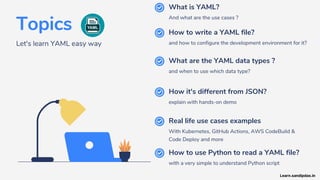
And what are the use cases ?
What is YAML?
Topics
Let's learn YAML easy way and how to configure the development environment for it?
How to write a YAML file?
and when to use which data type?
What are the YAML data types ?
explain with hands-on demo
How it's different from JSON?
With Kubernetes, GitHub Actions, AWS CodeBuild &
Code Deploy and more
Real life use cases examples
with a very simple to understand Python script
How to use Python to read a YAML file?
Learn.sandipdas.in
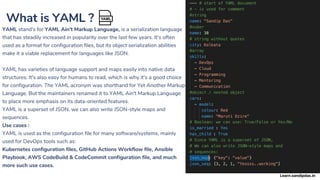
What is YAML ?
Learn.sandipdas.in
YAML stand's for YAML Ain't Markup Language, is a serialization language
that has steadily increased in popularity over the last few years. It's often
used as a format for configuration files, but its object serialization abilities
make it a viable replacement for languages like JSON.
YAML has varieties of language support and maps easily into native data
structures. It's also easy for humans to read, which is why it's a good choice
for configuration. The YAML acronym was shorthand for Yet Another Markup
Language. But the maintainers renamed it to YAML Ain't Markup Language
to place more emphasis on its data-oriented features.
YAML is a superset of JSON, we can also write JSON-style maps and
sequences.
Use cases :
YAML is used as the configuration file for many software/systems, mainly
used for DevOps tools such as:
Kubernetes configuration files, GitHub Actions Workflow file, Ansible
Playbook, AWS CodeBuild & CodeCommit configuration file, and much
more such use cases.
How to Write YAML File?
Point to note before writing
YAML is a data serialization language designed to be
directly writable and readable by humans
Check https://yaml.org for the latest recommendations
YAML is CASE sensitive
End your YAML file with the .yaml or .yml extension
YAML is a superset of JSON
Dev Environment Setup
Best Editors/IDE: VS Code, Atom
Plugins: YAML plugins or language
support or lining available in all major
IDEs, before start writing, should install
the relevant plugin
and how to configure Development environment for it?
Basic Syntax
The file starts with ---
We can write configuration blocks in the YAML in 2 ways:
We can define value like:
named value:
List:
Indented Block and Inline Block e.g.
--- # Indented Block
name: Sandip Das
age: 30
--- # Inline Block
{name: Sandip Das, age: 30}
---
value
sample_key: sample_value
- 1
- 2
- 3
- 'sample string'
Named list:
---
sample_list:
- 1
- 2
- 3
- 'sample string'
Alternative list : (Flow style)
sample_list: [1, 2,3, 'a sample string']
Dictionary:
key1: val1
key2: val2
key3: val3
Named Dictionary:
sample_dict:
key1: val1
key2: val2
key3: val3
Dictionary in flow style:
sample_dict: {key1: val1, key2: val2, key3: val3}
List of Dictionaries:
developers:
- name: Sandip Das
age: 30
- name: James Smith
age: 54
Learn.sandipdas.in
YAML Data Types
Supported Basic Data Types
a: 1 # integer
a: 1.234 # float
b: 'abc' # string
b: "abc"
b: abc
c: false # boolean type
d: 2015-04-05 # date type
Advance Data Types
Array: Either like below or: ["DevOps", "Cloud", "Programming"...]
- DevOps
- Cloud
- Programming
- Mentoring
- Communication
Array of Objects:
cars:
- name: "Maruti Dzire"
colour: Red
- name: "Nexon EV"
colour: Dark
Nested Array of Objects:
cars:
- Model
name: "Maruti Dzire"
colour: Red
- Model:
name: "Nexon EV"
colour: Dark
YAML Anchors and Alias
We can place Anchors (&) on an entity to
mark a multi-line section. We can then use
an Alias (*) call that anchor later in the
document to reference that section. E.g.
some_var: &someVarRef Test Value
some_var_value_referning: *someVarRef
Learn.sandipdas.in
How YAML is different from JSON
What is JSON?
JSON stands for JavaScript Object Notation. It is a lightweight format for storing and transporting data, often used
when data is sent from a server to a web page or server to server or program to program communication, works as a
common standard data format. It is "self-describing" and easy to understand
JSON Example:
{
"name": "Sandip Das",
"age": 30,
"city": "Kolkata",
"skills": [
"DevOps",
"Cloud",
"Programming",
"Mentoring",
"Communication"
]
}
From a User point of view, YAML is more human readable and editable than JSON
Learn.sandipdas.in
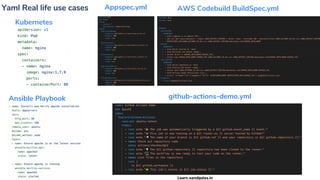
Yaml Real life use cases
Kubernetes
AWS Codebuild BuildSpec.yml
Appspec.yml
github-actions-demo.yml
Ansible Playbook
Learn.sandipdas.in
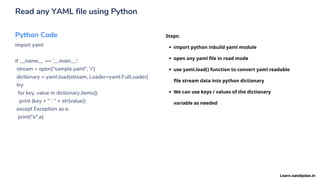
Read any YAML file using Python
Python Code
import yaml
if __name__ == '__main__':
stream = open("sample.yaml", 'r')
dictionary = yaml.load(stream, Loader=yaml.FullLoader)
try:
for key, value in dictionary.items():
print (key + " : " + str(value))
except Exception as e:
print("e",e)
import python inbuild yaml module
open any yaml file in read mode
use yaml.load() function to convert yaml readable
file stream data into python dictionary
We can use keys / values of the dictionary
variable as needed
Steps:
Learn.sandipdas.in
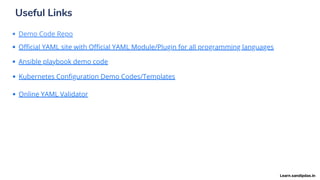
Useful Links
Demo Code Repo
Official YAML site with Official YAML Module/Plugin for all programming languages
Ansible playbook demo code
Kubernetes Configuration Demo Codes/Templates
Online YAML Validator
Learn.sandipdas.in
Contact Me
contact@sandipdas.in
Learn.sandipdas.in
Support My Work
Via Patreon: https://www.patreon.com/learnwithsandip
Via Buy Me a Coffee: https://www.buymeacoffee.com/LearnWSandip

YAML crash COURSE how to write yaml file for adding configuring details

  • 1.
  • 2.
    And what arethe use cases ? What is YAML? Topics Let's learn YAML easy way and how to configure the development environment for it? How to write a YAML file? and when to use which data type? What are the YAML data types ? explain with hands-on demo How it's different from JSON? With Kubernetes, GitHub Actions, AWS CodeBuild & Code Deploy and more Real life use cases examples with a very simple to understand Python script How to use Python to read a YAML file? Learn.sandipdas.in
  • 3.
    What is YAML? Learn.sandipdas.in YAML stand's for YAML Ain't Markup Language, is a serialization language that has steadily increased in popularity over the last few years. It's often used as a format for configuration files, but its object serialization abilities make it a viable replacement for languages like JSON. YAML has varieties of language support and maps easily into native data structures. It's also easy for humans to read, which is why it's a good choice for configuration. The YAML acronym was shorthand for Yet Another Markup Language. But the maintainers renamed it to YAML Ain't Markup Language to place more emphasis on its data-oriented features. YAML is a superset of JSON, we can also write JSON-style maps and sequences. Use cases : YAML is used as the configuration file for many software/systems, mainly used for DevOps tools such as: Kubernetes configuration files, GitHub Actions Workflow file, Ansible Playbook, AWS CodeBuild & CodeCommit configuration file, and much more such use cases.
  • 4.
    How to WriteYAML File? Point to note before writing YAML is a data serialization language designed to be directly writable and readable by humans Check https://yaml.org for the latest recommendations YAML is CASE sensitive End your YAML file with the .yaml or .yml extension YAML is a superset of JSON Dev Environment Setup Best Editors/IDE: VS Code, Atom Plugins: YAML plugins or language support or lining available in all major IDEs, before start writing, should install the relevant plugin and how to configure Development environment for it? Basic Syntax The file starts with --- We can write configuration blocks in the YAML in 2 ways: We can define value like: named value: List: Indented Block and Inline Block e.g. --- # Indented Block name: Sandip Das age: 30 --- # Inline Block {name: Sandip Das, age: 30} --- value sample_key: sample_value - 1 - 2 - 3 - 'sample string' Named list: --- sample_list: - 1 - 2 - 3 - 'sample string' Alternative list : (Flow style) sample_list: [1, 2,3, 'a sample string'] Dictionary: key1: val1 key2: val2 key3: val3 Named Dictionary: sample_dict: key1: val1 key2: val2 key3: val3 Dictionary in flow style: sample_dict: {key1: val1, key2: val2, key3: val3} List of Dictionaries: developers: - name: Sandip Das age: 30 - name: James Smith age: 54 Learn.sandipdas.in
  • 5.
    YAML Data Types SupportedBasic Data Types a: 1 # integer a: 1.234 # float b: 'abc' # string b: "abc" b: abc c: false # boolean type d: 2015-04-05 # date type Advance Data Types Array: Either like below or: ["DevOps", "Cloud", "Programming"...] - DevOps - Cloud - Programming - Mentoring - Communication Array of Objects: cars: - name: "Maruti Dzire" colour: Red - name: "Nexon EV" colour: Dark Nested Array of Objects: cars: - Model name: "Maruti Dzire" colour: Red - Model: name: "Nexon EV" colour: Dark YAML Anchors and Alias We can place Anchors (&) on an entity to mark a multi-line section. We can then use an Alias (*) call that anchor later in the document to reference that section. E.g. some_var: &someVarRef Test Value some_var_value_referning: *someVarRef Learn.sandipdas.in
  • 6.
    How YAML isdifferent from JSON What is JSON? JSON stands for JavaScript Object Notation. It is a lightweight format for storing and transporting data, often used when data is sent from a server to a web page or server to server or program to program communication, works as a common standard data format. It is "self-describing" and easy to understand JSON Example: { "name": "Sandip Das", "age": 30, "city": "Kolkata", "skills": [ "DevOps", "Cloud", "Programming", "Mentoring", "Communication" ] } From a User point of view, YAML is more human readable and editable than JSON Learn.sandipdas.in
  • 7.
    Yaml Real lifeuse cases Kubernetes AWS Codebuild BuildSpec.yml Appspec.yml github-actions-demo.yml Ansible Playbook Learn.sandipdas.in
  • 8.
    Read any YAMLfile using Python Python Code import yaml if __name__ == '__main__': stream = open("sample.yaml", 'r') dictionary = yaml.load(stream, Loader=yaml.FullLoader) try: for key, value in dictionary.items(): print (key + " : " + str(value)) except Exception as e: print("e",e) import python inbuild yaml module open any yaml file in read mode use yaml.load() function to convert yaml readable file stream data into python dictionary We can use keys / values of the dictionary variable as needed Steps: Learn.sandipdas.in
  • 9.
    Useful Links Demo CodeRepo Official YAML site with Official YAML Module/Plugin for all programming languages Ansible playbook demo code Kubernetes Configuration Demo Codes/Templates Online YAML Validator Learn.sandipdas.in
  • 10.
    Contact Me contact@sandipdas.in Learn.sandipdas.in Support MyWork Via Patreon: https://www.patreon.com/learnwithsandip Via Buy Me a Coffee: https://www.buymeacoffee.com/LearnWSandip