May 2017 Update:
Will it blend?
Joint
OpenStack
Kubernetes
Environment
A pragmatic operational assessment about how
Kubernetes can become an underlay for OpenStack.
TL;DR: Yes
and then Kubernetes
wins as the platform.
Video Demo: bit.ly/rebarhelm
Rob Hirschfeld (aka Zehicle online)
In Community: OpenStack Board Member (4 years)
Co-Chair of Kubernetes Cluster Ops SIG
Founder of Digital Rebar & Crowbar Projects
Professional: CEO of RackN - hybrid automation software
Executive at Dell - scale data center ops
Cloud Data Center Ops going back to 1999
Addressing Operators Needs
Operational Success is Essential to Project Success
Operators are not developers!
Simple, Transparent and Stable are key concerns
Becoming a super-user of the platform should not be required to run it
Scale & Upgradability has both internal and external drivers
Generally, Kubernetes has good operational fundamentals
Even more, we need more community operational practices for OpenStack
We’re Talking Underlay, not Overlay
We’re talking about installing Kubernetes first (aka
underlay) and using it to manage the OpenStack control
plane.
Objectives for Kubernetes Underlay:
● Must Work with Kubernetes Primatives
● Not a Dedicated Kubernetes
● Limited Outside Management
Physical Infrastructure
Kubernetes
Underlay
OpenStack
Kubernetes
Overlay
This Talk
Simplest conception of the
K8s OpenStack Sandwich
What is Kubernetes?
Container Scheduler (no, it’s not really Orchestration)
API driven to provide restart, placement, network routing and life-cycle
For Applications designed for Kubernetes
Key Design Elements: Immutable Infrastructure (stateless ops)
12 Factor Configuration
Service Oriented
What is Kubernetes: A Three Tier Application
Client
0
Ready
1
Prereq
2
Control
3
Nodes
etcd
(cluster)
etcd
(cluster)
etcd
(cluster)
API
(cluster)
API
(cluster)
API
(cluster)
Kubelet
KubeCtl
Container Manager
5
Apps
Network CNI
Host
Network
Host
Storage
Host
Init
Pod Pod Pod Pod
4
Add-Ons
Certificate
Authority
Scheduler
(leader)
Heapster
Infrastructure
APIs
Routers,
Storage,
LBs...
Proxy
...
Controller
(leader)
DNS Watcher ...
Together 4ever: API server + Kubelet
Client
0
Ready
1
Prereq
2
Control
3
Nodes
etcd
(cluster)
etcd
(cluster)
etcd
(cluster)
API
(cluster)
API
(cluster)
API
(cluster)
Kubelet
KubeCtl
Container Manager
5
Apps
Network CNI
Host
Network
Host
Storage
Host
Init
Pod Pod Pod Pod
4
Add-Ons
Certificate
Authority
Scheduler
(leader)
Heapster
Infrastructure
APIs
Routers,
Storage,
LBs...
Proxy
...
Controller
(leader)
DNS Watcher ...
Kubernetes = Rainbows?!
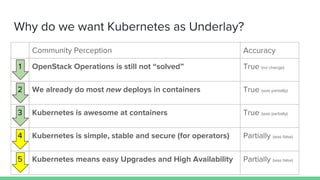
Why do we want Kubernetes as Underlay?
Community Perception Accuracy
1 OpenStack Operations is still not “solved” True (no change)
2 We already do most new deploys in containers True (was partially)
3 Kubernetes is awesome at containers True (was partially)
4 Kubernetes is simple, stable and secure (for operators) Partially (was false)
5 Kubernetes means easy Upgrades and High Availability Partially (was false)
There are REAL Potential Benefits
● Leverage Docker packaging efforts and reduce Python & O/S dependencies
● Upgrades would benefit from Kubernetes built-in processes
● Use of the Kubernetes job scheduler for maintenance
● “Free” fault tolerance of key components
● Easier install if Kubernetes already running on-site
● More constrained options for configuration and operation
BUT REALLY, IT’S ABOUT LOWER FRICTION AND COMMUNITY SIZE...
I expect more people will understand Kubernetes operations than OpenStack
operations because Kubernetes is 1) simpler and 2) cloud and physical.
Kubernetes
Underlay is coming,
So let’s get
pragmatic about it.
Leadership Kudos to
SAP, ATT Comummity Dev, & Port Direct
Issues: Marketing Message is Confusing
Marketing around Kubernetes under OpenStack is a “hot mess”
● People hear “Kubernetes is stable, OpenStack is not”
● Further confuses “OpenStack one platform message”
● Encourages Kubernetes as target instead of OpenStack
Confusion with the Plain Old Container Install (“POCI”) message
● Canonical (Ubuntu Cloud Install),
● Rackspace (OpenStack Ansible)
● Cisco (Kolla)
● Triple O
Key Principle: Containerization vs Kubernetes
Containers can be treated as a) lightweight vms or 2) packaged daemon sets.
● Canonical builds their containers like persistent vms and configures with Juju
● Kolla & OSA treats containers as packaging and configures with Ansible
Kubernetes accepts neither approach – they expect containers to be immutable
and 12 factor configured
● Kubernetes manages the full container life-cycle
● Containers need to be able to handle being added, removed
● Services need to be able to handle IP address changes (or use DNS names)
This work is progressing quickly!
Using Kubernetes v1.5+ Primatives
● Using Kubernetes Helm Charts
● Services are tagged to nodes
● Agents become Daemon sets
● Databases using Stateful sets
● Multiple container sources
Hard work remains….
● Networking, Configuraton & Storage
● OpenStack Projects must handle immutable
container requirements
Physical Infrastructure
Kubernetes + Helm
Underlay
OpenStack
Mgmt
OpenStack
Nodes
Other
Apps
Kubernetes
Workers
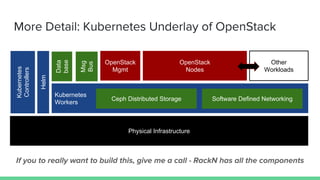
More Detail: Kubernetes Underlay of OpenStack
Physical Infrastructure
Kubernetes
Controllers
OpenStack
Mgmt
OpenStack
Nodes
Data
base
If you to really want to build this, give me a call - RackN has all the components
Msg
Bus
Software Defined NetworkingCeph Distributed Storage
Other
Workloads
Helm
Technical Challenges Remain
This discussion keep kicking the operations & install problems down the field
Kubernetes is much newer than OpenStack, so even less understood
Yet more complexity and some very basic questions:
● Now we have a both a Kubernetes and OpenStack upgrade problem
● We still need tooling to manage OpenStack in Kubernetes
● We still need someone to package the containers (+ multi-platform like ARM)
● Relies on Docker to keep systems running
● Storage and Networking are still being worked out
In summary,
OpenStack operability is not solved via the underlay platform alone.
Technical Leadership motivation required for OpenStack adopting
Kubernetes architecture requirements.
Serious messaging confusion in effort has to be resolved.
However, this collaboration is required for OpenStack
Because Kubernetes will have a larger footprint in Operations
By 2018, this
approach will be
THE install method
Rob Hirschfeld, @zehicle
RackN & Digital Rebar

OpenStack on Kubernetes (BOS Summit / May 2017 update)

  • 1.
    May 2017 Update: Willit blend? Joint OpenStack Kubernetes Environment A pragmatic operational assessment about how Kubernetes can become an underlay for OpenStack.
  • 2.
    TL;DR: Yes and thenKubernetes wins as the platform. Video Demo: bit.ly/rebarhelm
  • 3.
    Rob Hirschfeld (akaZehicle online) In Community: OpenStack Board Member (4 years) Co-Chair of Kubernetes Cluster Ops SIG Founder of Digital Rebar & Crowbar Projects Professional: CEO of RackN - hybrid automation software Executive at Dell - scale data center ops Cloud Data Center Ops going back to 1999
  • 4.
    Addressing Operators Needs OperationalSuccess is Essential to Project Success Operators are not developers! Simple, Transparent and Stable are key concerns Becoming a super-user of the platform should not be required to run it Scale & Upgradability has both internal and external drivers Generally, Kubernetes has good operational fundamentals Even more, we need more community operational practices for OpenStack
  • 5.
    We’re Talking Underlay,not Overlay We’re talking about installing Kubernetes first (aka underlay) and using it to manage the OpenStack control plane. Objectives for Kubernetes Underlay: ● Must Work with Kubernetes Primatives ● Not a Dedicated Kubernetes ● Limited Outside Management Physical Infrastructure Kubernetes Underlay OpenStack Kubernetes Overlay This Talk Simplest conception of the K8s OpenStack Sandwich
  • 6.
    What is Kubernetes? ContainerScheduler (no, it’s not really Orchestration) API driven to provide restart, placement, network routing and life-cycle For Applications designed for Kubernetes Key Design Elements: Immutable Infrastructure (stateless ops) 12 Factor Configuration Service Oriented
  • 7.
    What is Kubernetes:A Three Tier Application Client 0 Ready 1 Prereq 2 Control 3 Nodes etcd (cluster) etcd (cluster) etcd (cluster) API (cluster) API (cluster) API (cluster) Kubelet KubeCtl Container Manager 5 Apps Network CNI Host Network Host Storage Host Init Pod Pod Pod Pod 4 Add-Ons Certificate Authority Scheduler (leader) Heapster Infrastructure APIs Routers, Storage, LBs... Proxy ... Controller (leader) DNS Watcher ...
  • 8.
    Together 4ever: APIserver + Kubelet Client 0 Ready 1 Prereq 2 Control 3 Nodes etcd (cluster) etcd (cluster) etcd (cluster) API (cluster) API (cluster) API (cluster) Kubelet KubeCtl Container Manager 5 Apps Network CNI Host Network Host Storage Host Init Pod Pod Pod Pod 4 Add-Ons Certificate Authority Scheduler (leader) Heapster Infrastructure APIs Routers, Storage, LBs... Proxy ... Controller (leader) DNS Watcher ...
  • 9.
  • 10.
    Why do wewant Kubernetes as Underlay? Community Perception Accuracy 1 OpenStack Operations is still not “solved” True (no change) 2 We already do most new deploys in containers True (was partially) 3 Kubernetes is awesome at containers True (was partially) 4 Kubernetes is simple, stable and secure (for operators) Partially (was false) 5 Kubernetes means easy Upgrades and High Availability Partially (was false)
  • 11.
    There are REALPotential Benefits ● Leverage Docker packaging efforts and reduce Python & O/S dependencies ● Upgrades would benefit from Kubernetes built-in processes ● Use of the Kubernetes job scheduler for maintenance ● “Free” fault tolerance of key components ● Easier install if Kubernetes already running on-site ● More constrained options for configuration and operation BUT REALLY, IT’S ABOUT LOWER FRICTION AND COMMUNITY SIZE... I expect more people will understand Kubernetes operations than OpenStack operations because Kubernetes is 1) simpler and 2) cloud and physical.
  • 12.
    Kubernetes Underlay is coming, Solet’s get pragmatic about it. Leadership Kudos to SAP, ATT Comummity Dev, & Port Direct
  • 13.
    Issues: Marketing Messageis Confusing Marketing around Kubernetes under OpenStack is a “hot mess” ● People hear “Kubernetes is stable, OpenStack is not” ● Further confuses “OpenStack one platform message” ● Encourages Kubernetes as target instead of OpenStack Confusion with the Plain Old Container Install (“POCI”) message ● Canonical (Ubuntu Cloud Install), ● Rackspace (OpenStack Ansible) ● Cisco (Kolla) ● Triple O
  • 14.
    Key Principle: Containerizationvs Kubernetes Containers can be treated as a) lightweight vms or 2) packaged daemon sets. ● Canonical builds their containers like persistent vms and configures with Juju ● Kolla & OSA treats containers as packaging and configures with Ansible Kubernetes accepts neither approach – they expect containers to be immutable and 12 factor configured ● Kubernetes manages the full container life-cycle ● Containers need to be able to handle being added, removed ● Services need to be able to handle IP address changes (or use DNS names)
  • 15.
    This work isprogressing quickly! Using Kubernetes v1.5+ Primatives ● Using Kubernetes Helm Charts ● Services are tagged to nodes ● Agents become Daemon sets ● Databases using Stateful sets ● Multiple container sources Hard work remains…. ● Networking, Configuraton & Storage ● OpenStack Projects must handle immutable container requirements Physical Infrastructure Kubernetes + Helm Underlay OpenStack Mgmt OpenStack Nodes Other Apps
  • 16.
    Kubernetes Workers More Detail: KubernetesUnderlay of OpenStack Physical Infrastructure Kubernetes Controllers OpenStack Mgmt OpenStack Nodes Data base If you to really want to build this, give me a call - RackN has all the components Msg Bus Software Defined NetworkingCeph Distributed Storage Other Workloads Helm
  • 17.
    Technical Challenges Remain Thisdiscussion keep kicking the operations & install problems down the field Kubernetes is much newer than OpenStack, so even less understood Yet more complexity and some very basic questions: ● Now we have a both a Kubernetes and OpenStack upgrade problem ● We still need tooling to manage OpenStack in Kubernetes ● We still need someone to package the containers (+ multi-platform like ARM) ● Relies on Docker to keep systems running ● Storage and Networking are still being worked out
  • 18.
    In summary, OpenStack operabilityis not solved via the underlay platform alone. Technical Leadership motivation required for OpenStack adopting Kubernetes architecture requirements. Serious messaging confusion in effort has to be resolved. However, this collaboration is required for OpenStack Because Kubernetes will have a larger footprint in Operations
  • 19.
    By 2018, this approachwill be THE install method Rob Hirschfeld, @zehicle RackN & Digital Rebar