PSHS 3RD YEAR MATHSession 1
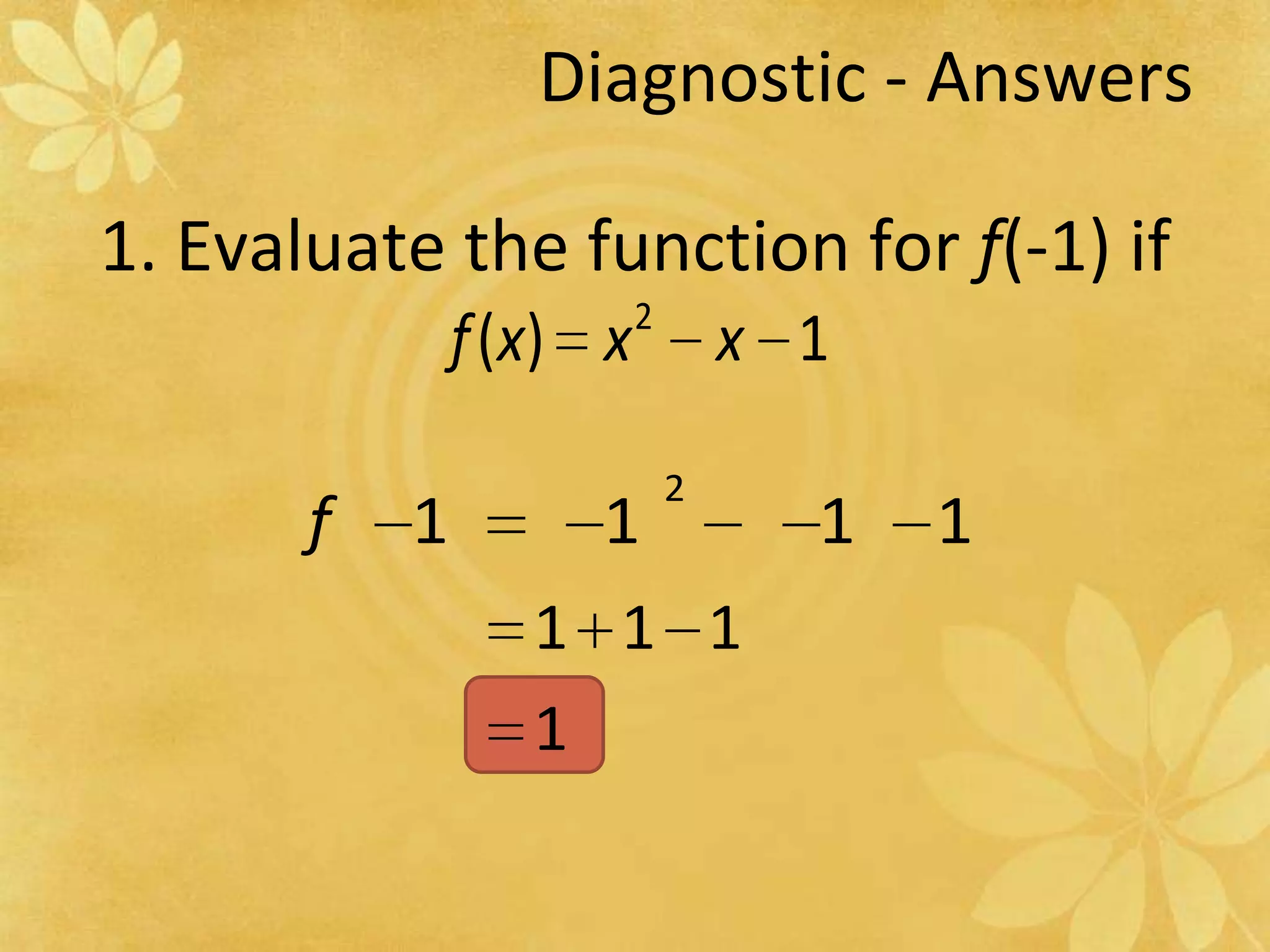
Diagnostic - Answers1. Evaluate the function for f(-1) if
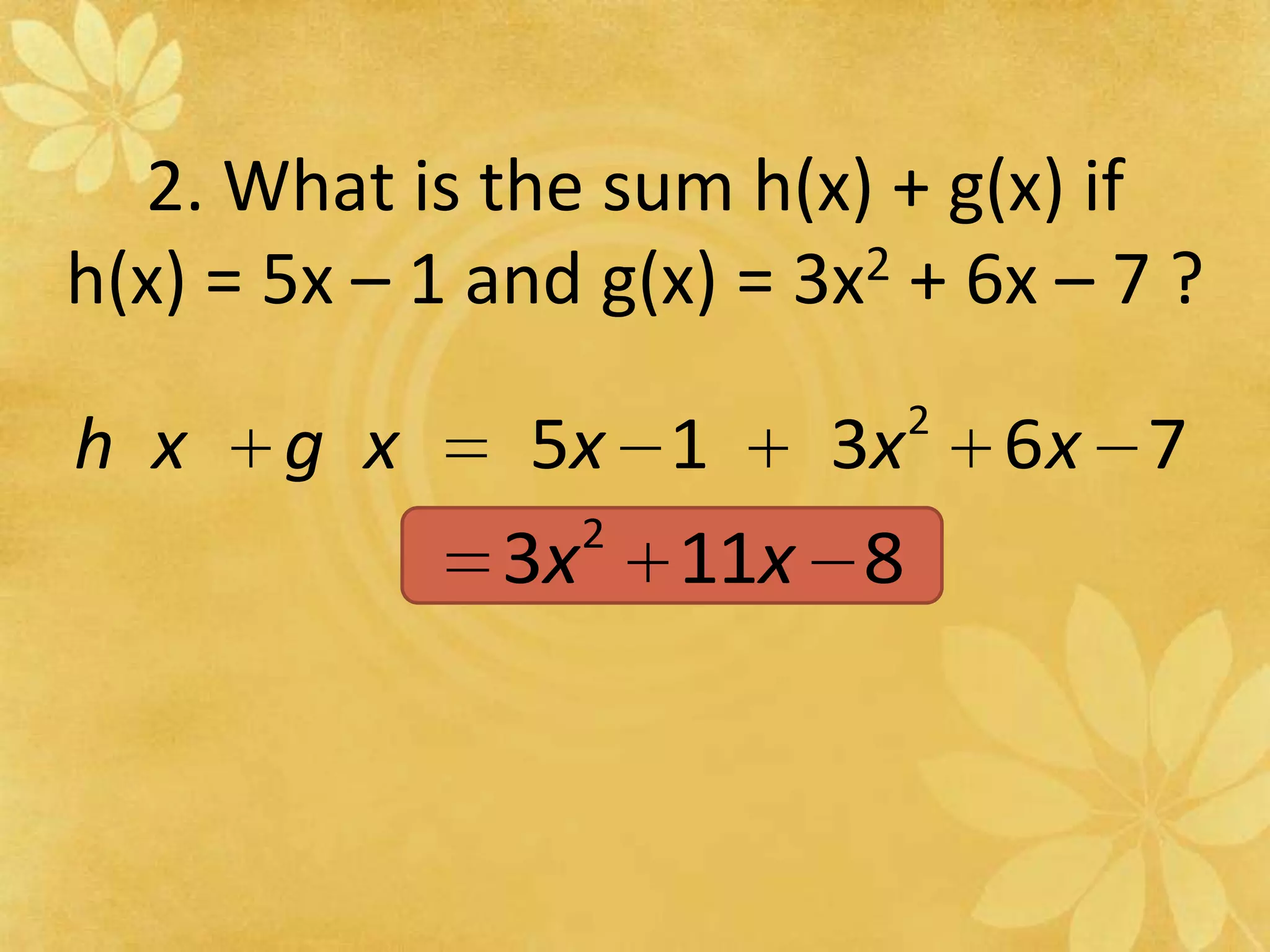
2. What is the sum h(x) + g(x) if h(x) = 5x – 1 and g(x) = 3x2 + 6x – 7 ?
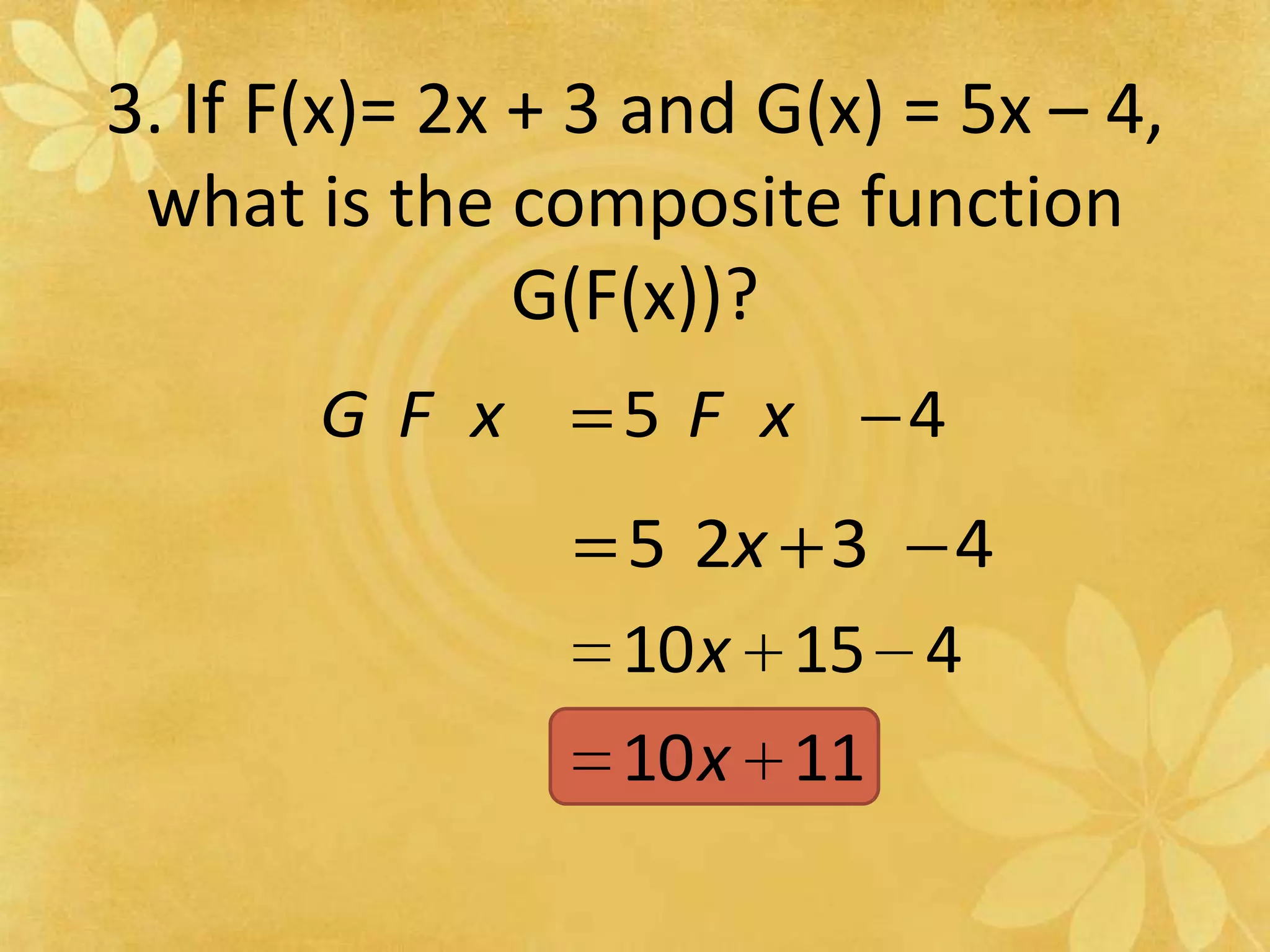
3. If F(x)= 2x + 3 and G(x) = 5x – 4, what is the composite function G(F(x))?
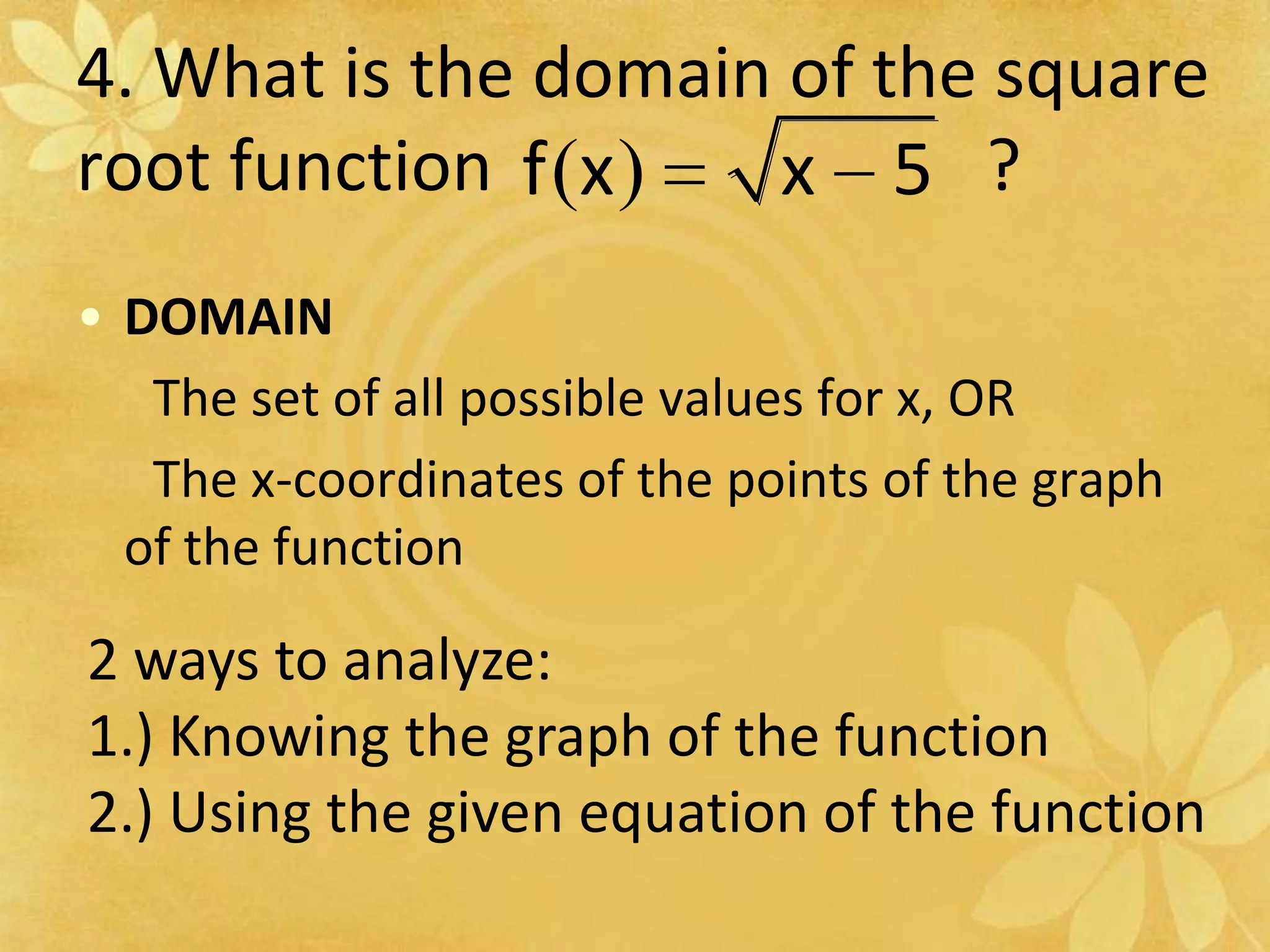
4. What is the domain of the square root function                            ?DOMAIN     The set of all possible values for x, OR     The x-coordinates of the points of the graph of the function2 ways to analyze:1.) Knowing the graph of the function2.) Using the given equation of the function
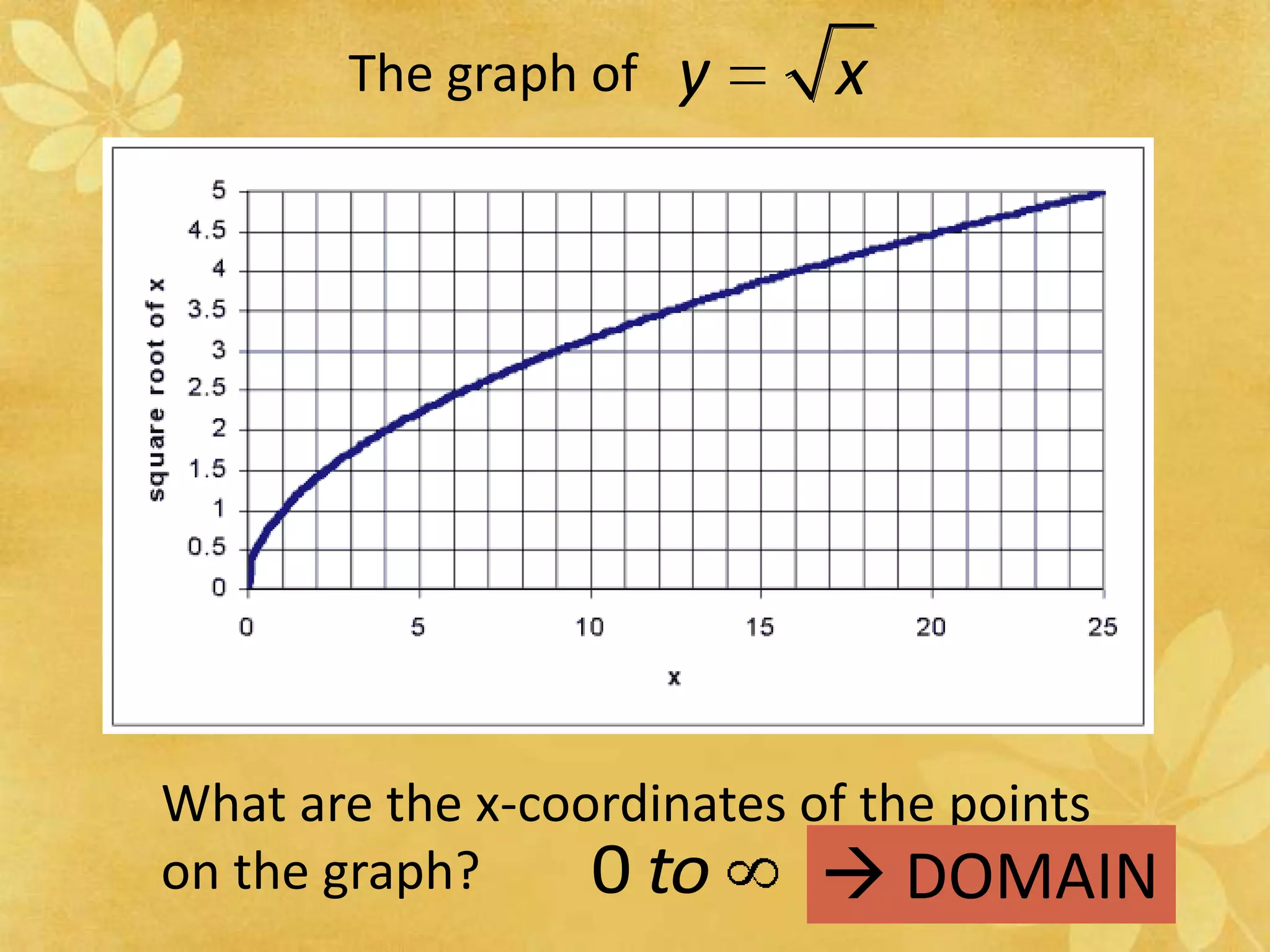
The graph of What are the x-coordinates of the points on the graph? DOMAIN
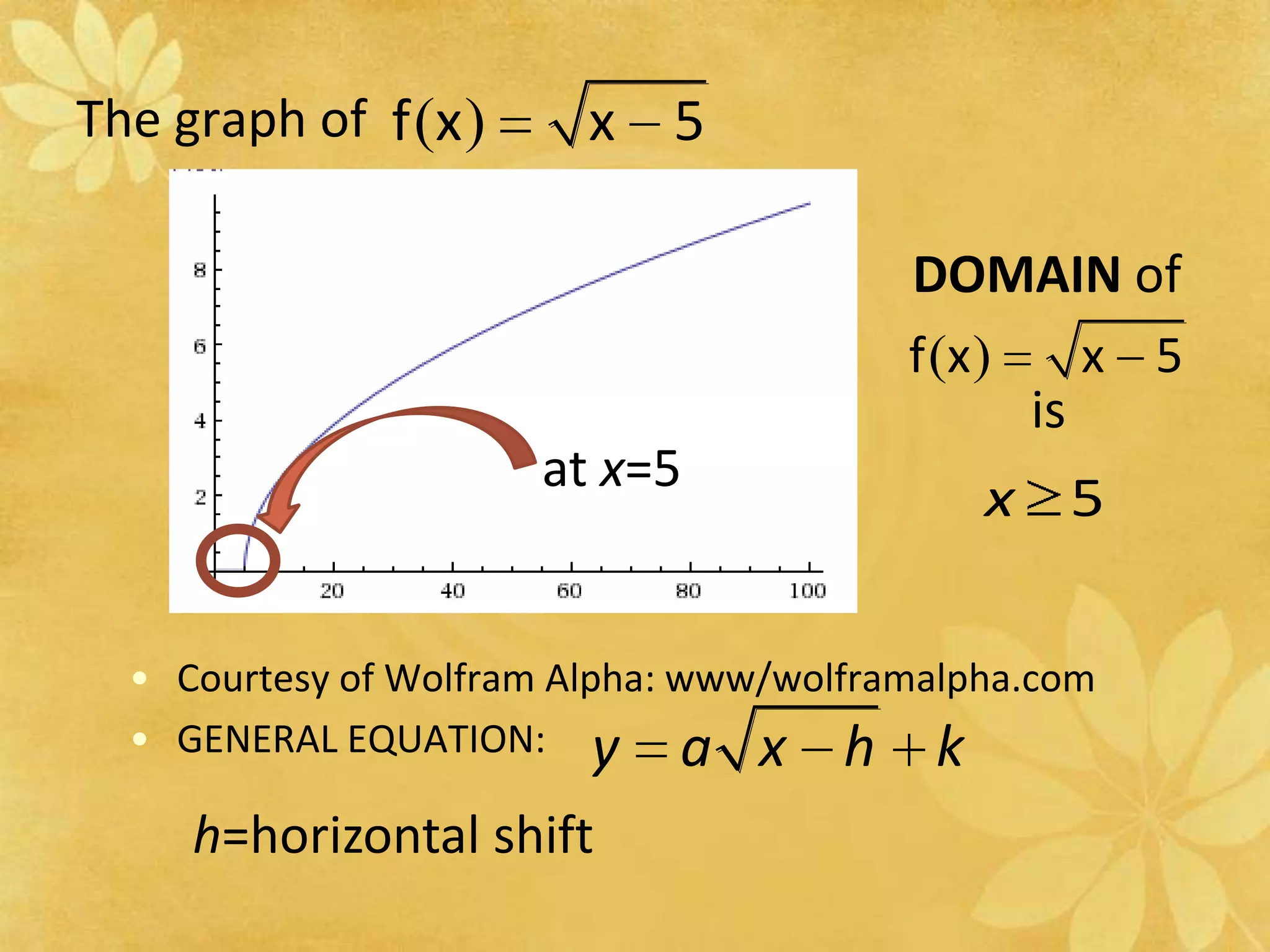
The graph of DOMAIN ofisat x=5Courtesy of Wolfram Alpha: www/wolframalpha.comGENERAL EQUATION: h=horizontal shift
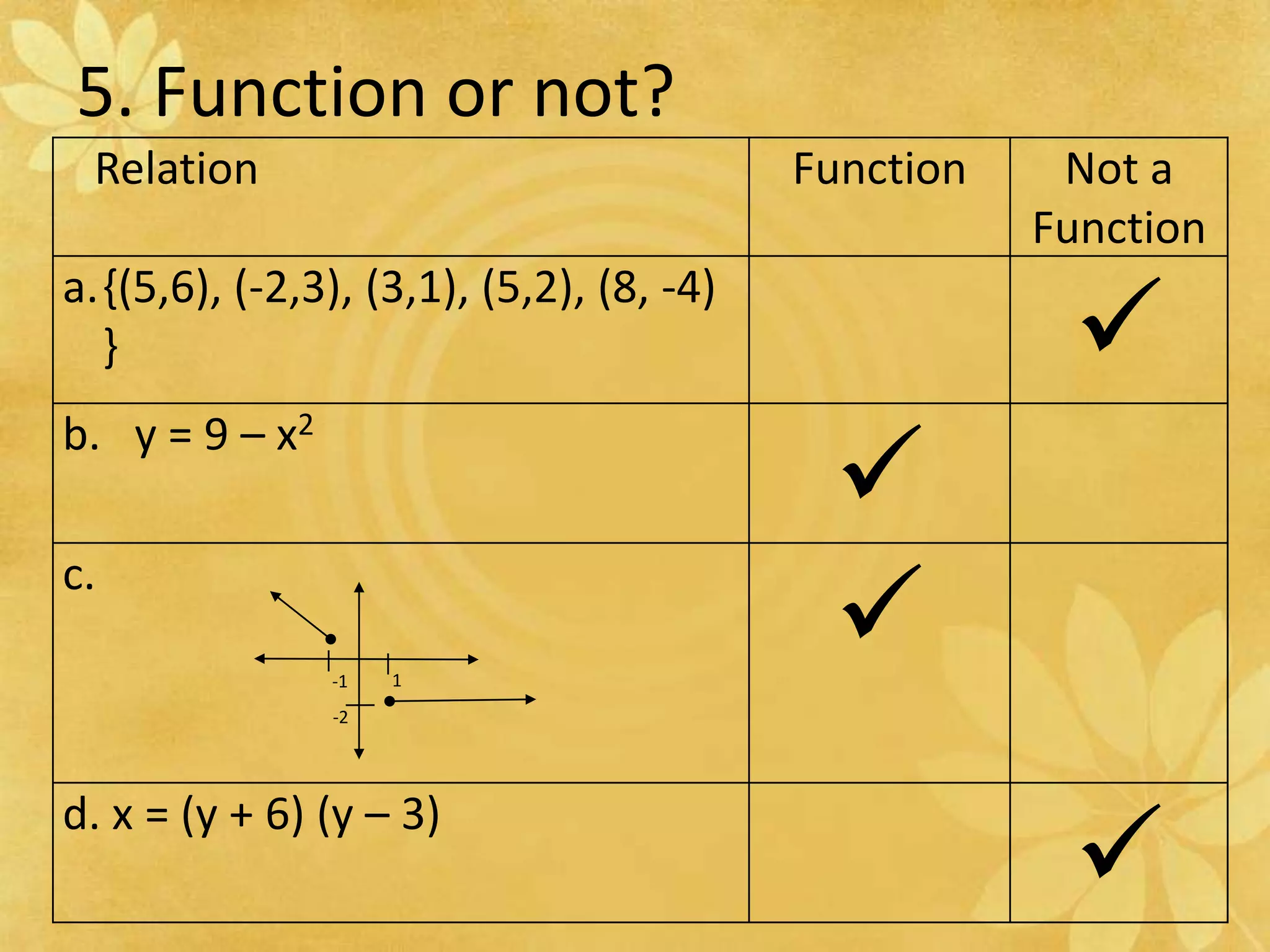
1-1-25. Function or not?
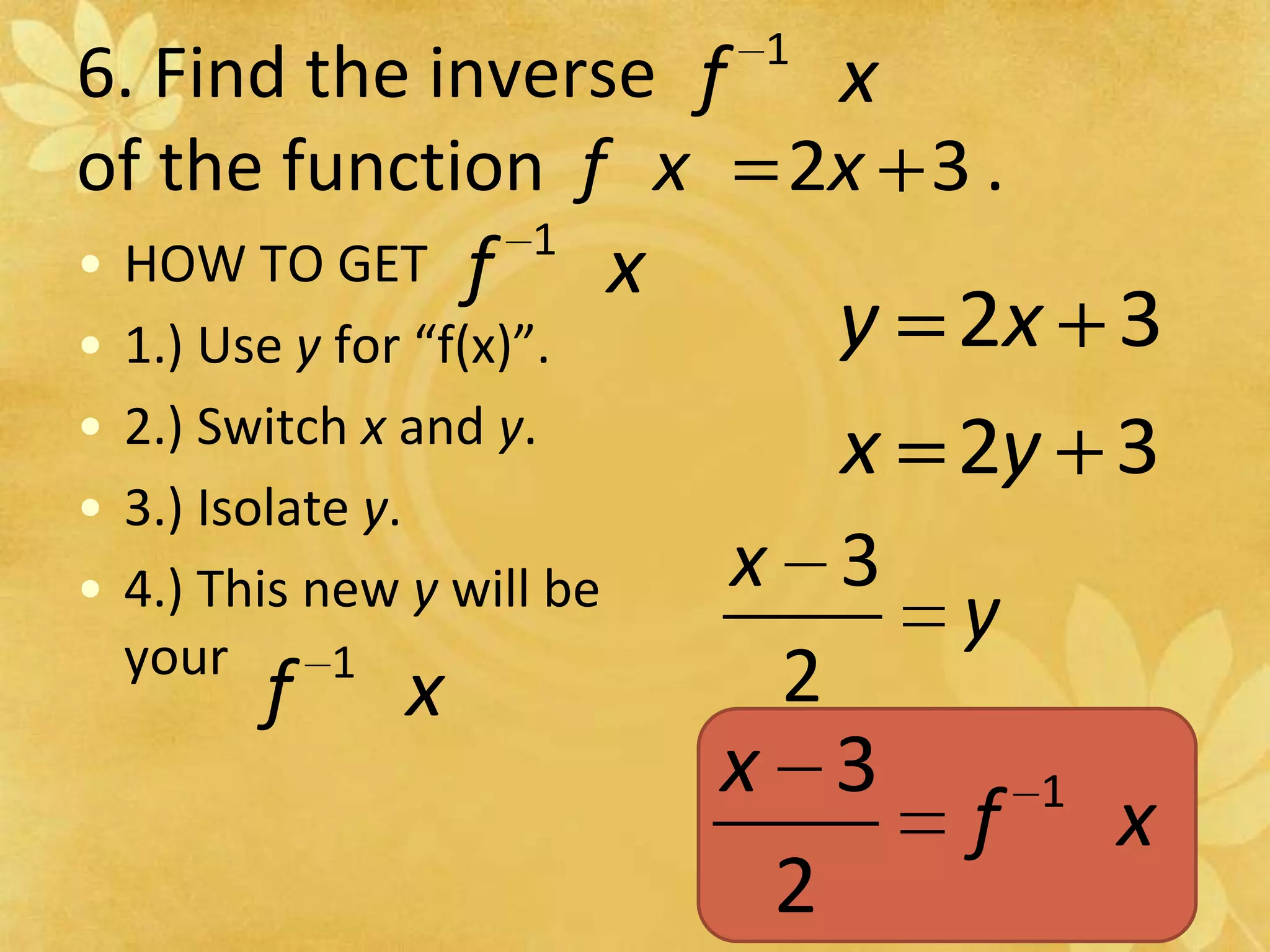
6. Find the inverse of the function                         . HOW TO GET1.) Use y for “f(x)”.2.) Switch x and y.3.) Isolate y.4.) This new y will be your
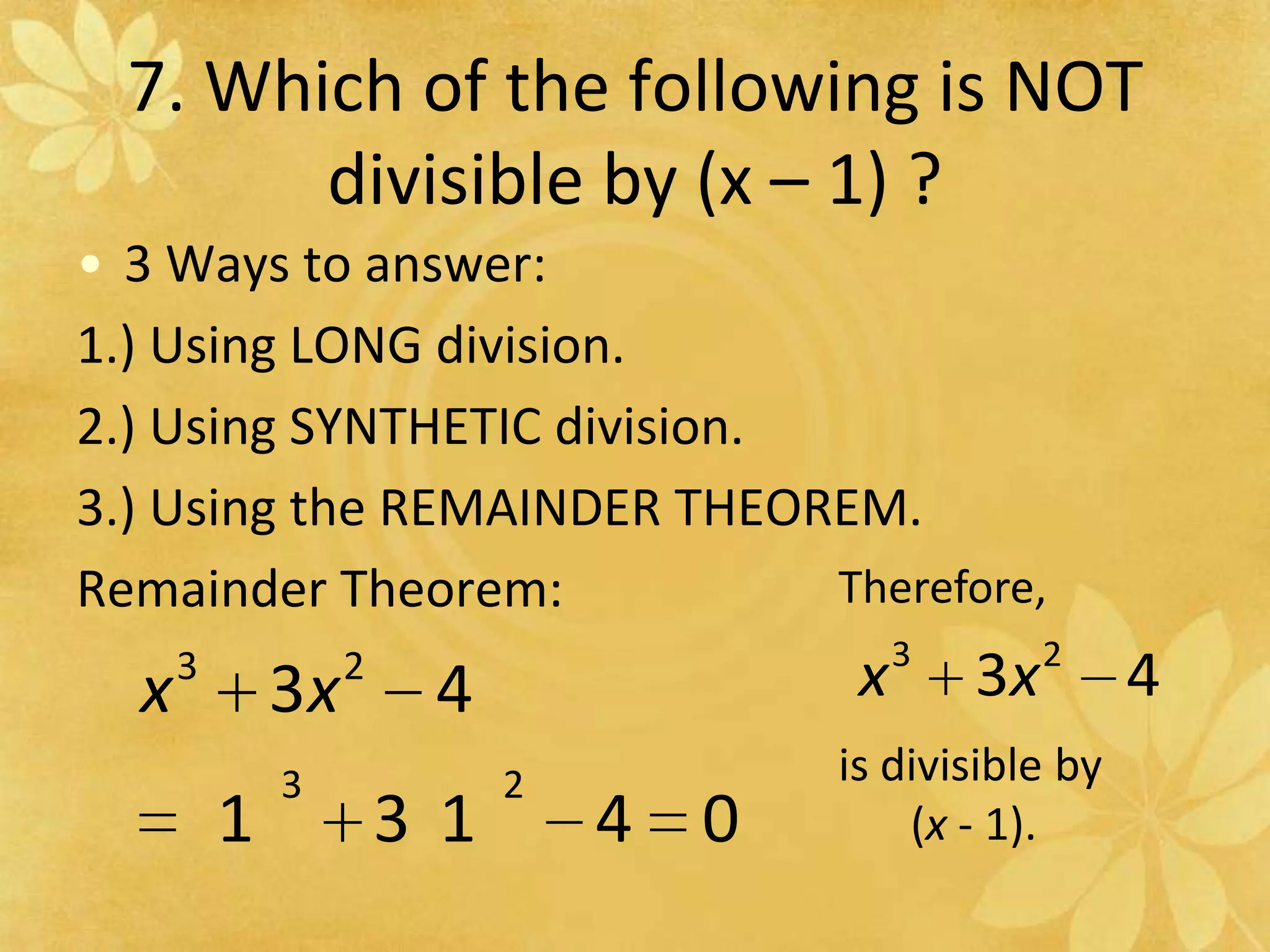
7. Which of the following is NOT divisible by (x – 1) ?3 Ways to answer:1.) Using LONG division.2.) Using SYNTHETIC division.3.) Using the REMAINDER THEOREM.Remainder Theorem:Therefore, is divisible by(x - 1).
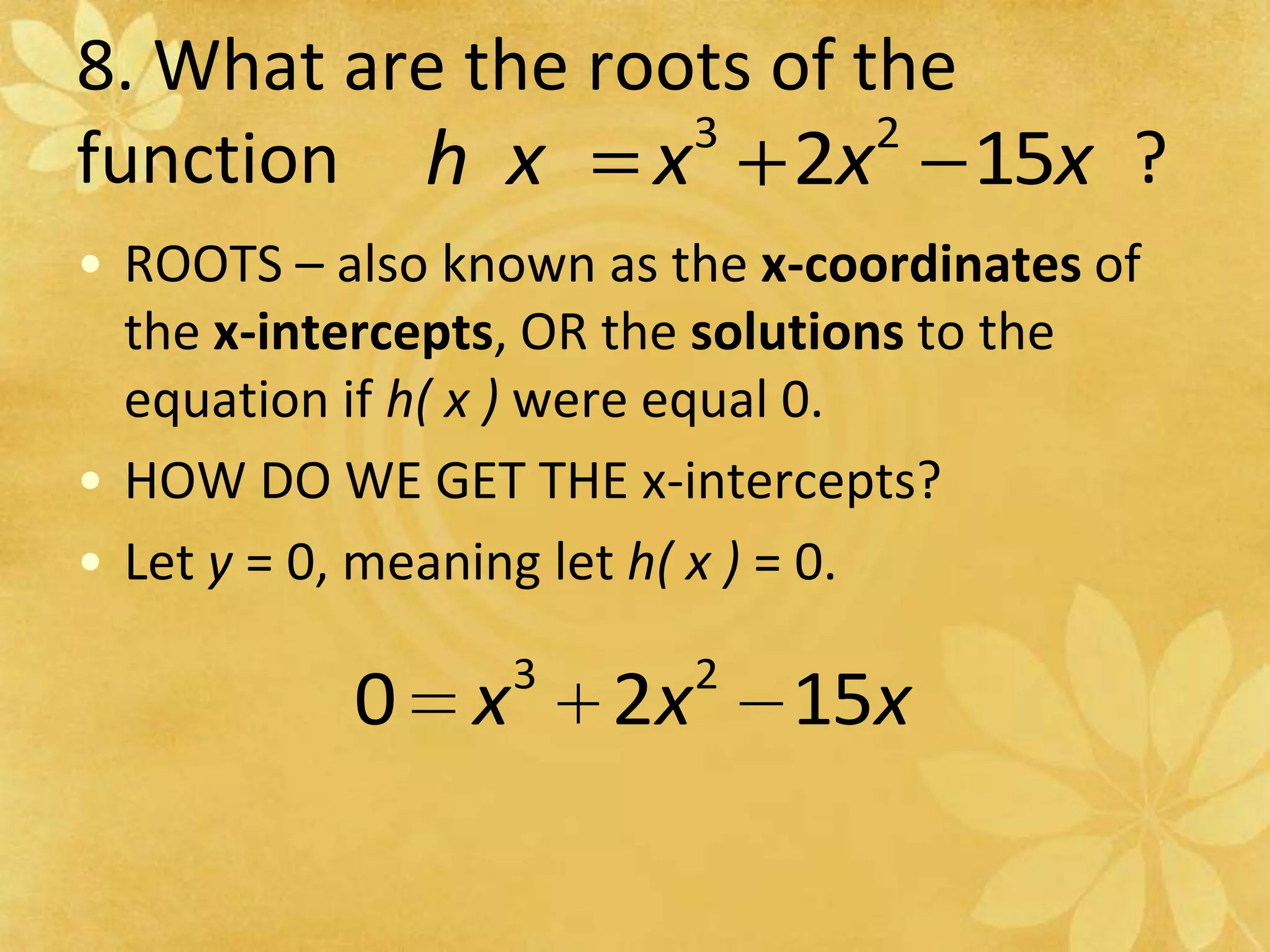
8. What are the roots of the function                                             ?  	ROOTS – also known as the x-coordinates of the x-intercepts, OR the solutions to the equation if h( x ) were equal 0.HOW DO WE GET THE x-intercepts?Let y = 0, meaning let h( x ) = 0.
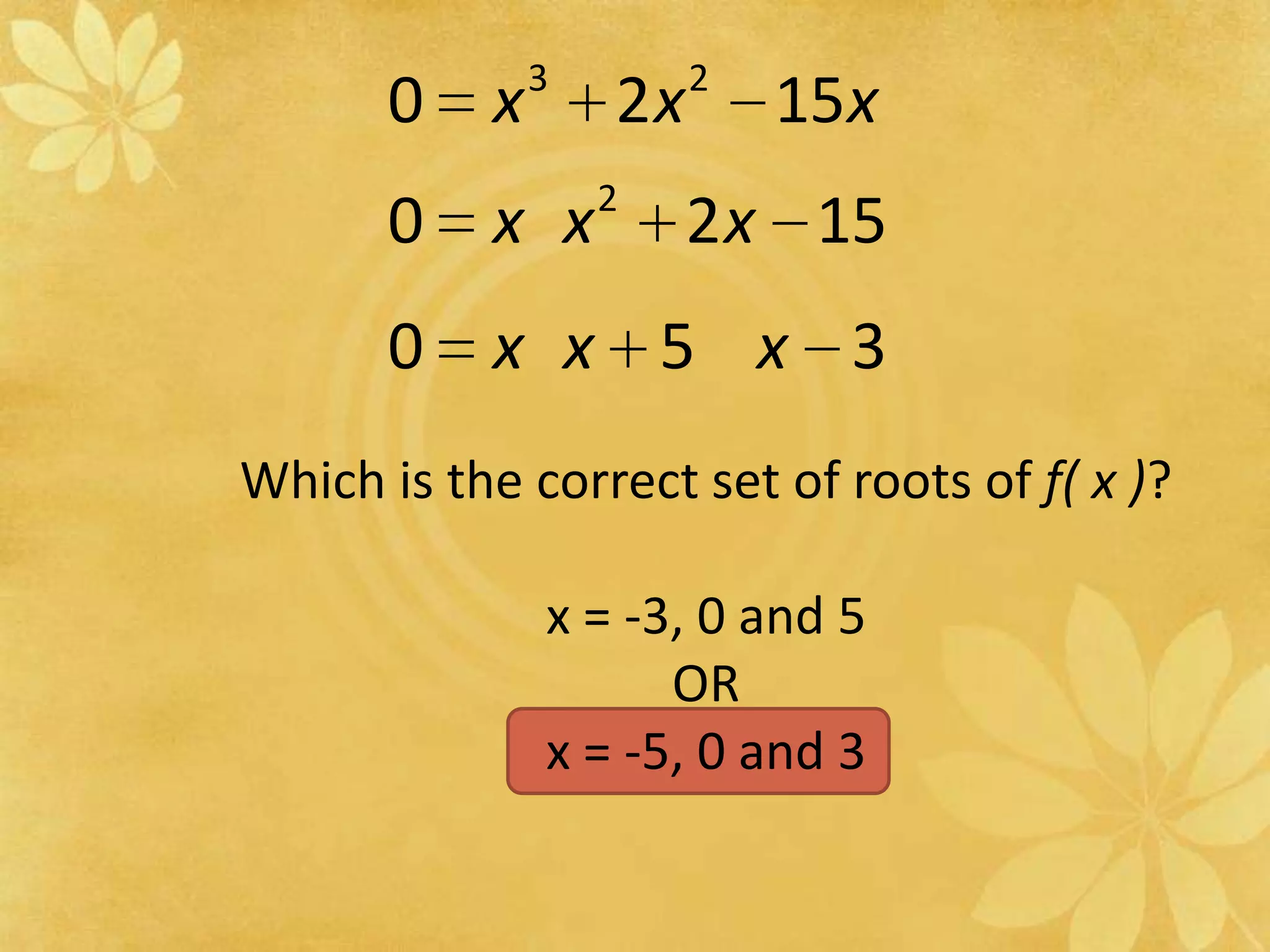
Which is the correct set of roots of f( x )?x = -3, 0 and 5ORx = -5, 0 and 3
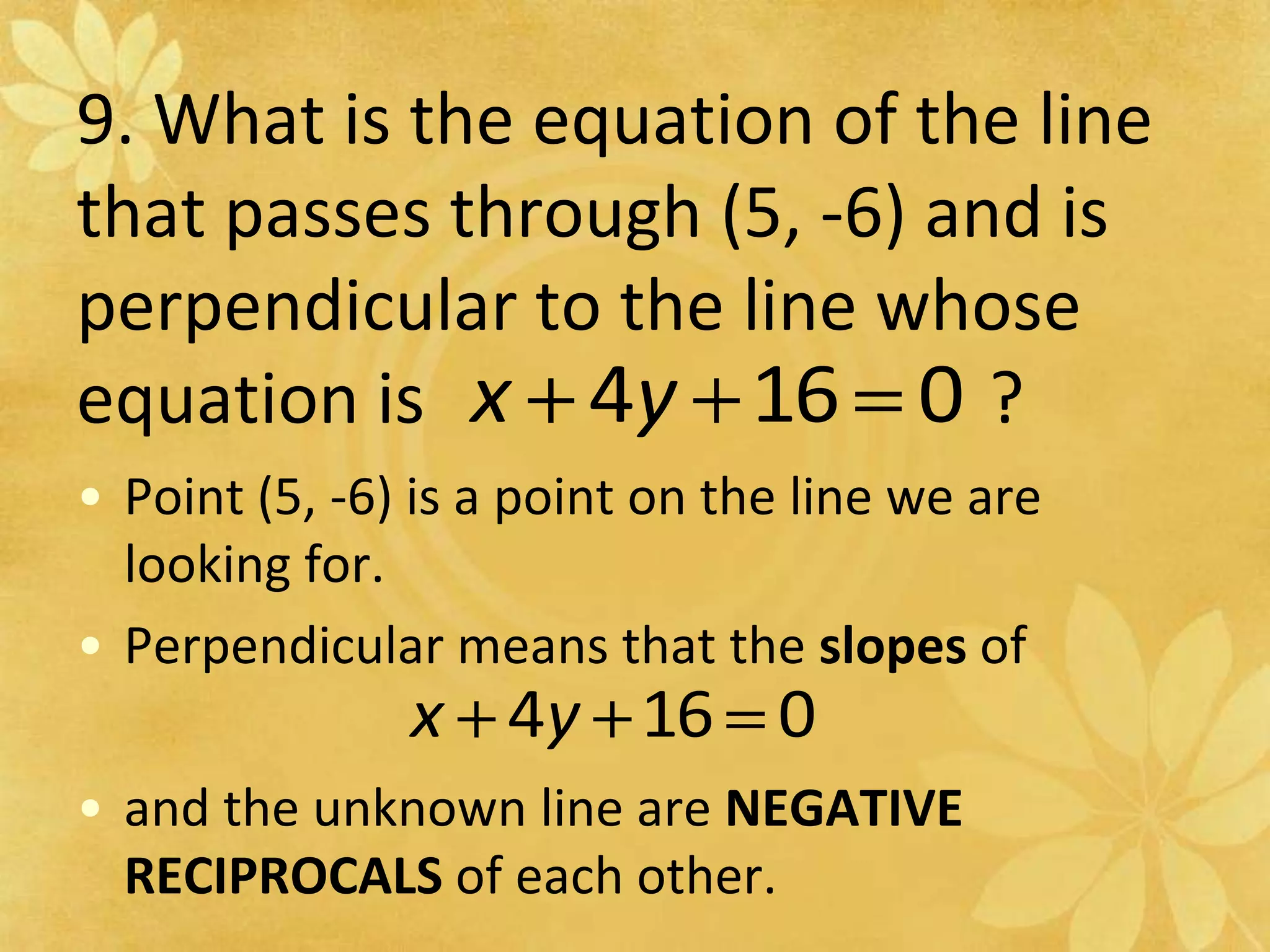
9. What is the equation of the line that passes through (5, -6) and is perpendicular to the line whose equation is                                ?Point (5, -6) is a point on the line we are looking for.Perpendicular means that the slopes of      and the unknown line are NEGATIVE RECIPROCALS of each other.
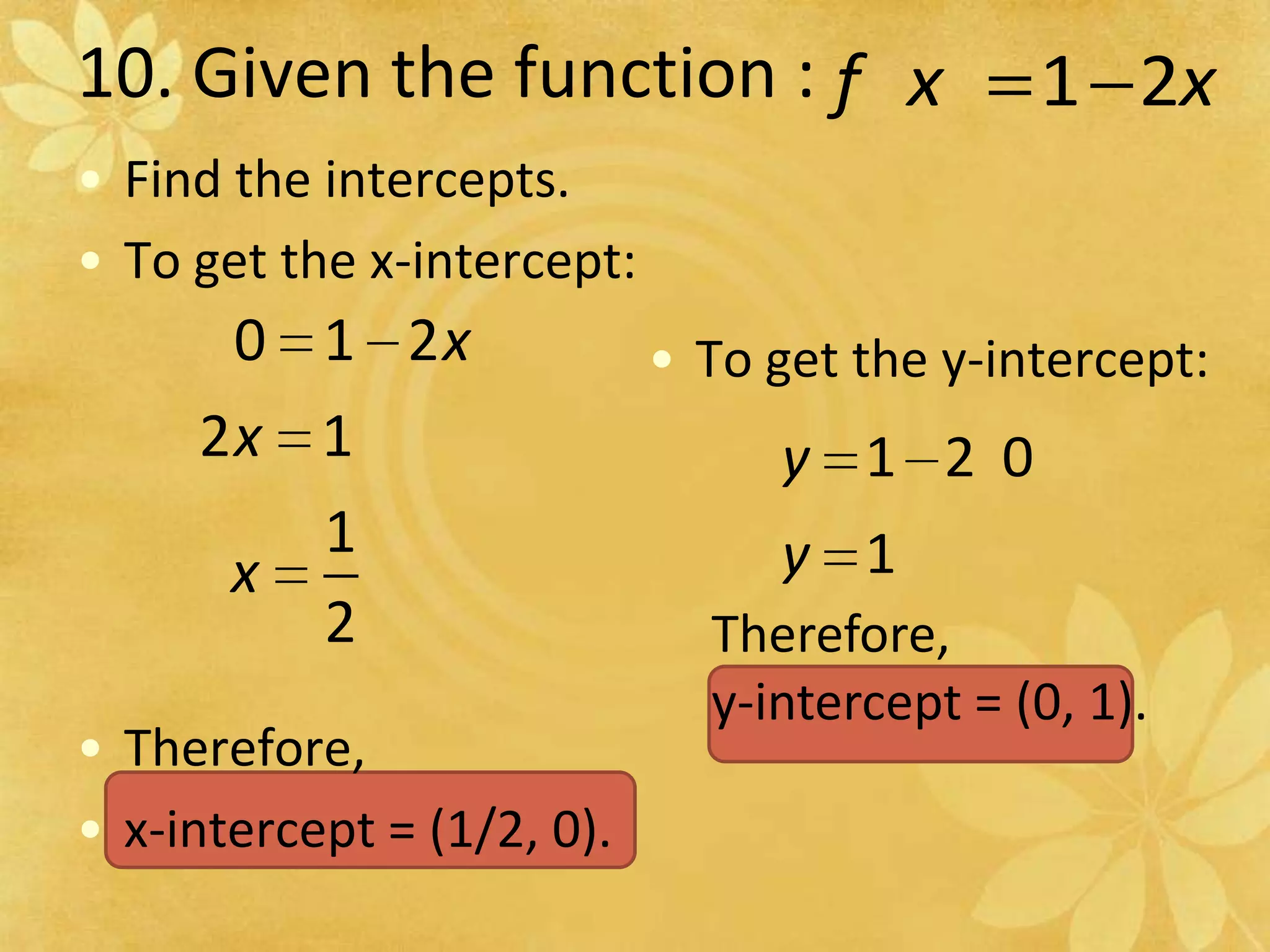
10. Given the function :Find the intercepts.To get the x-intercept:Therefore, x-intercept = (1/2, 0).To get the y-intercept:Therefore, y-intercept = (0, 1).
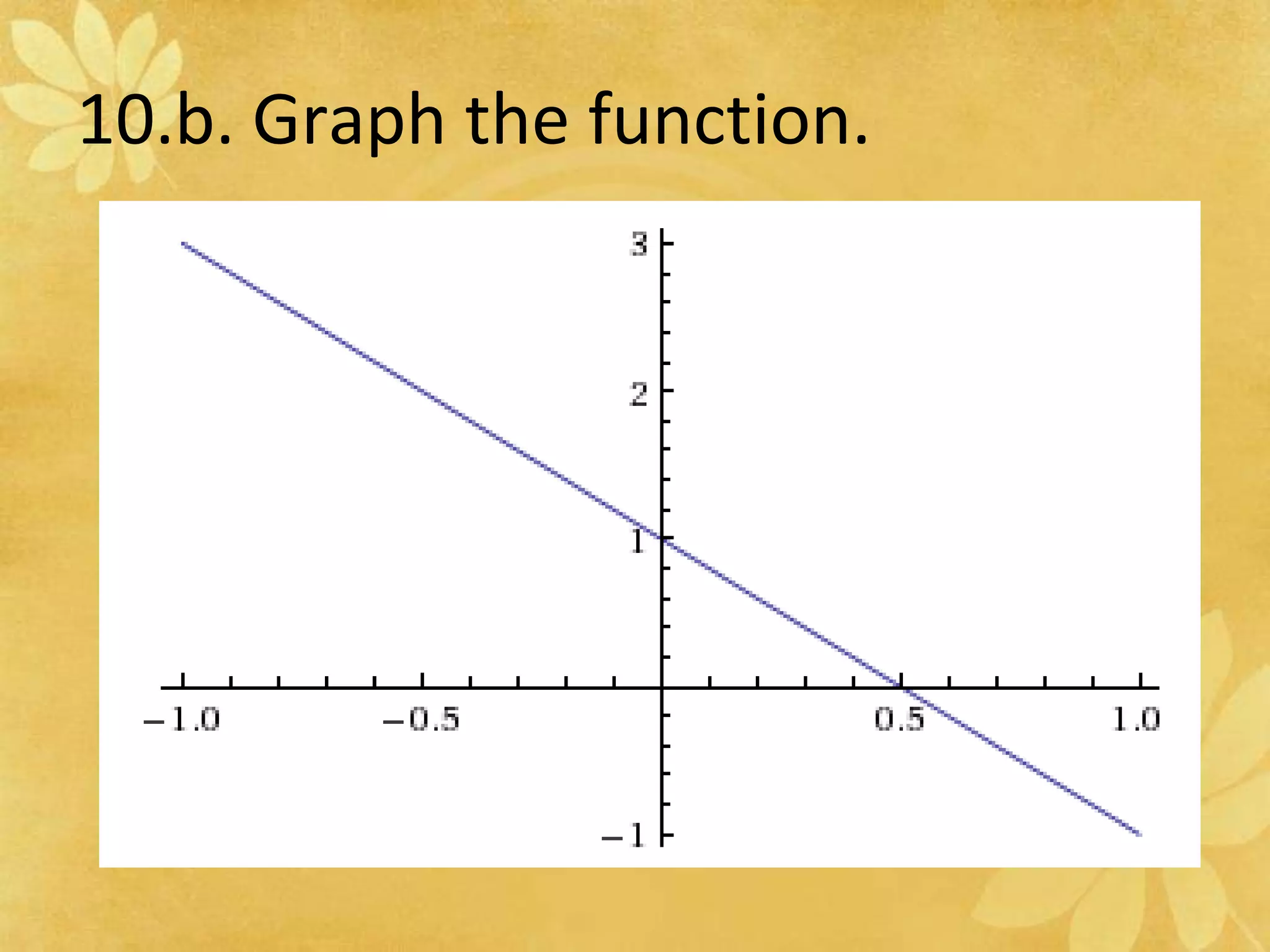
10.b. Graph the function.
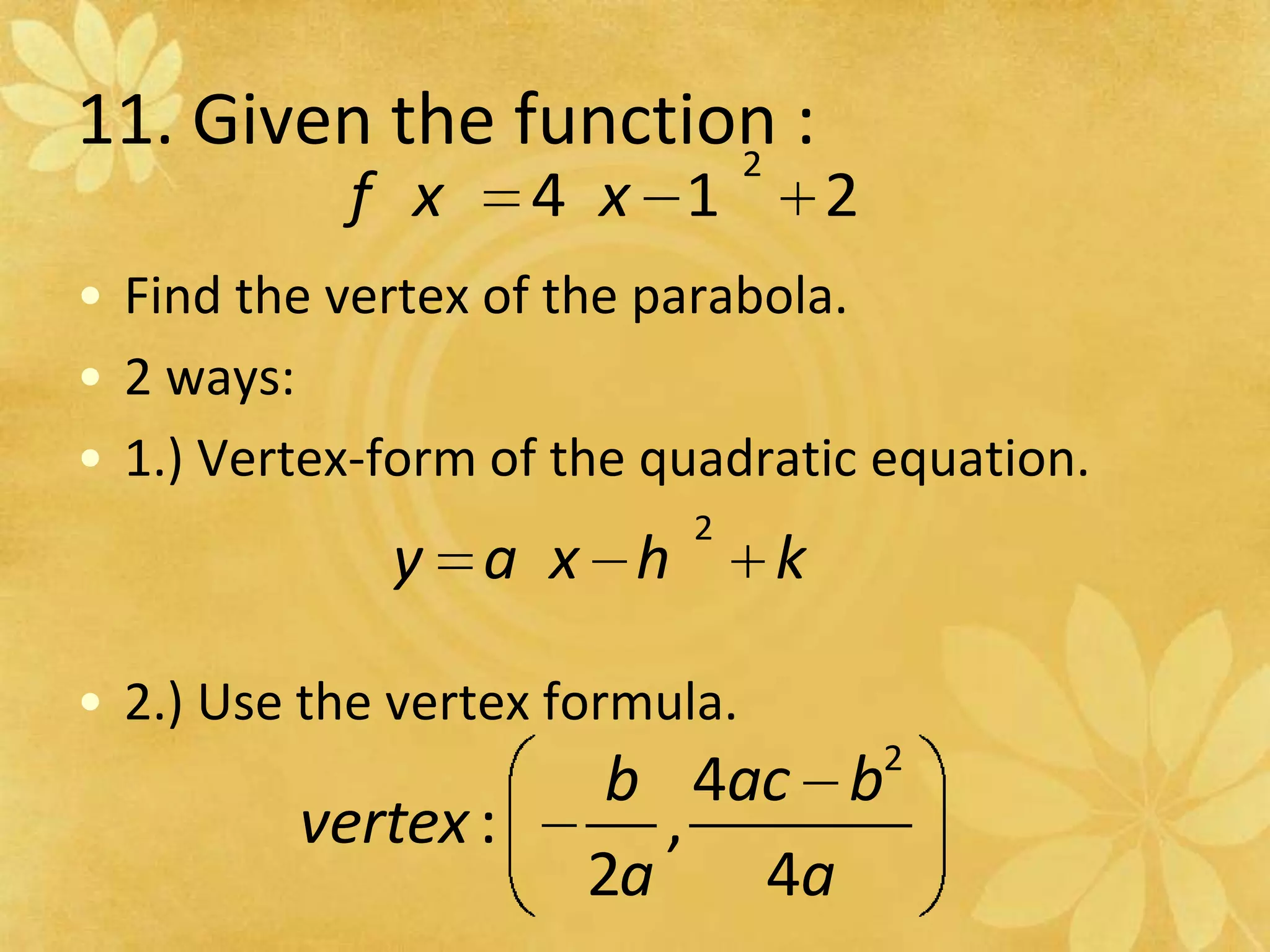
11. Given the function :Find the vertex of the parabola.2 ways:1.) Vertex-form of the quadratic equation.2.) Use the vertex formula.
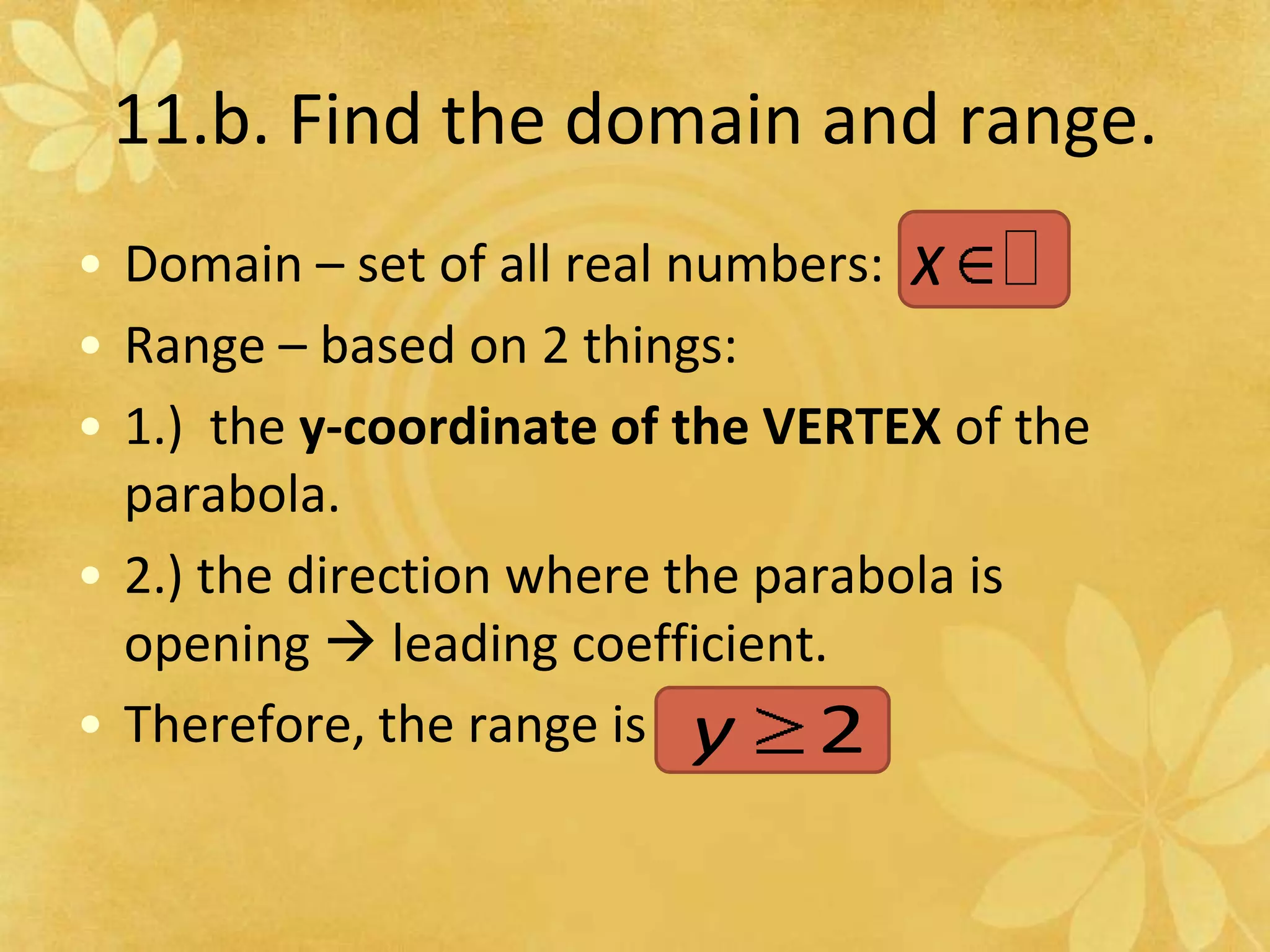
11.b. Find the domain and range.Domain – set of all real numbers: Range – based on 2 things:1.)  the y-coordinate of the VERTEX of the parabola. 2.) the direction where the parabola is opening  leading coefficient.  Therefore, the range is
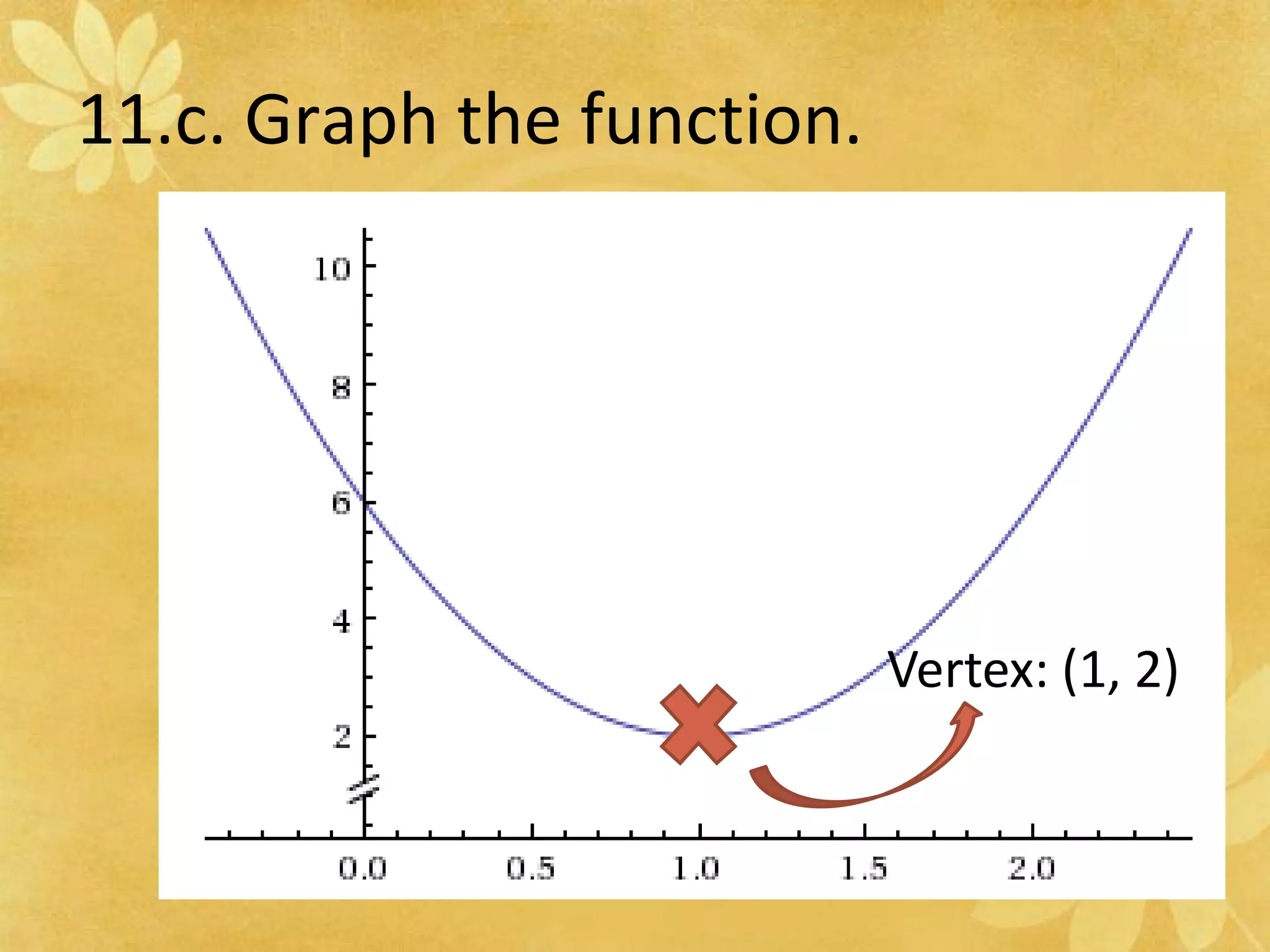
11.c. Graph the function.Vertex: (1, 2)
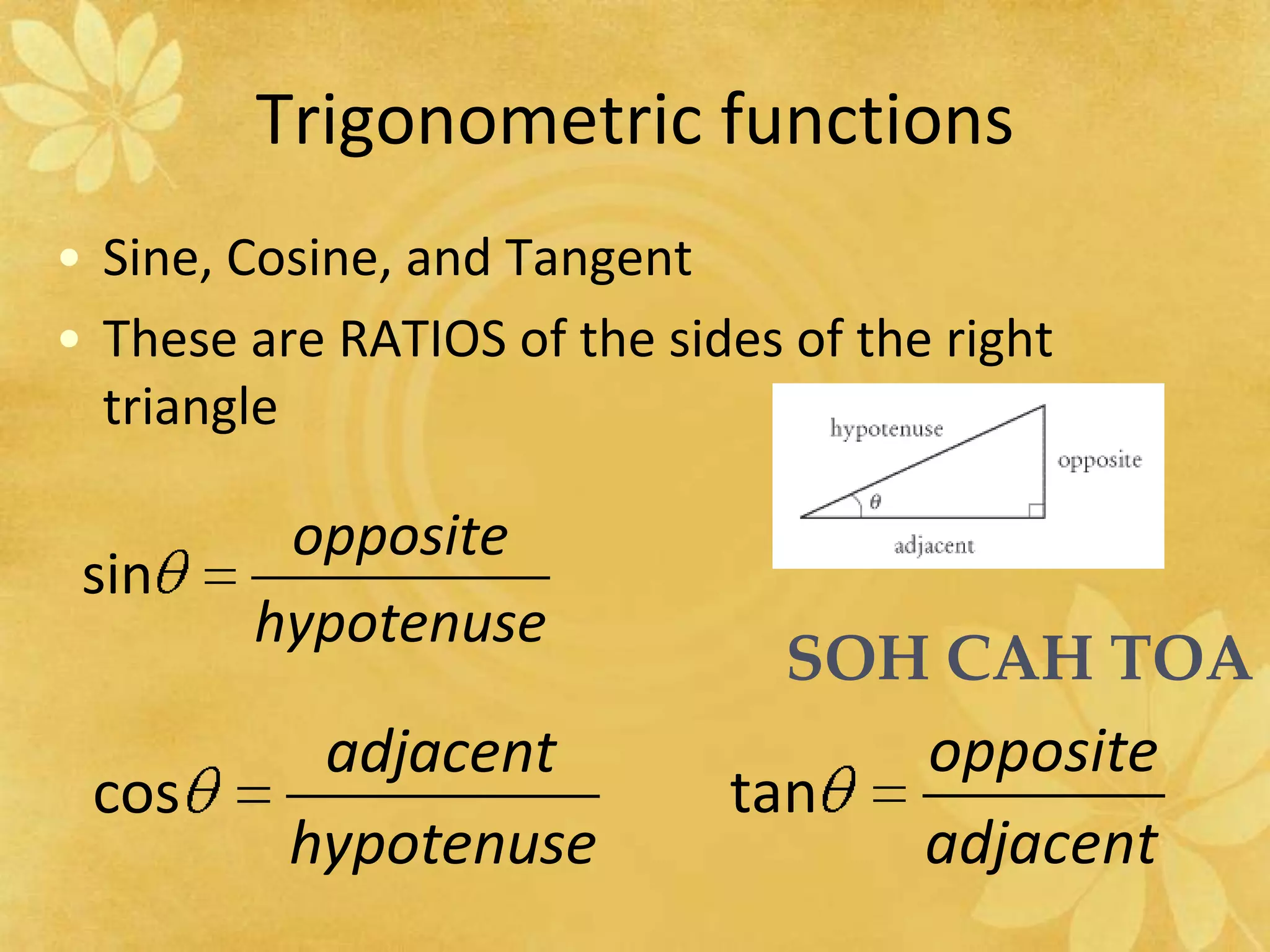
Trigonometric functionsSine, Cosine, and TangentThese are RATIOS of the sides of the right triangleSOH CAH TOA
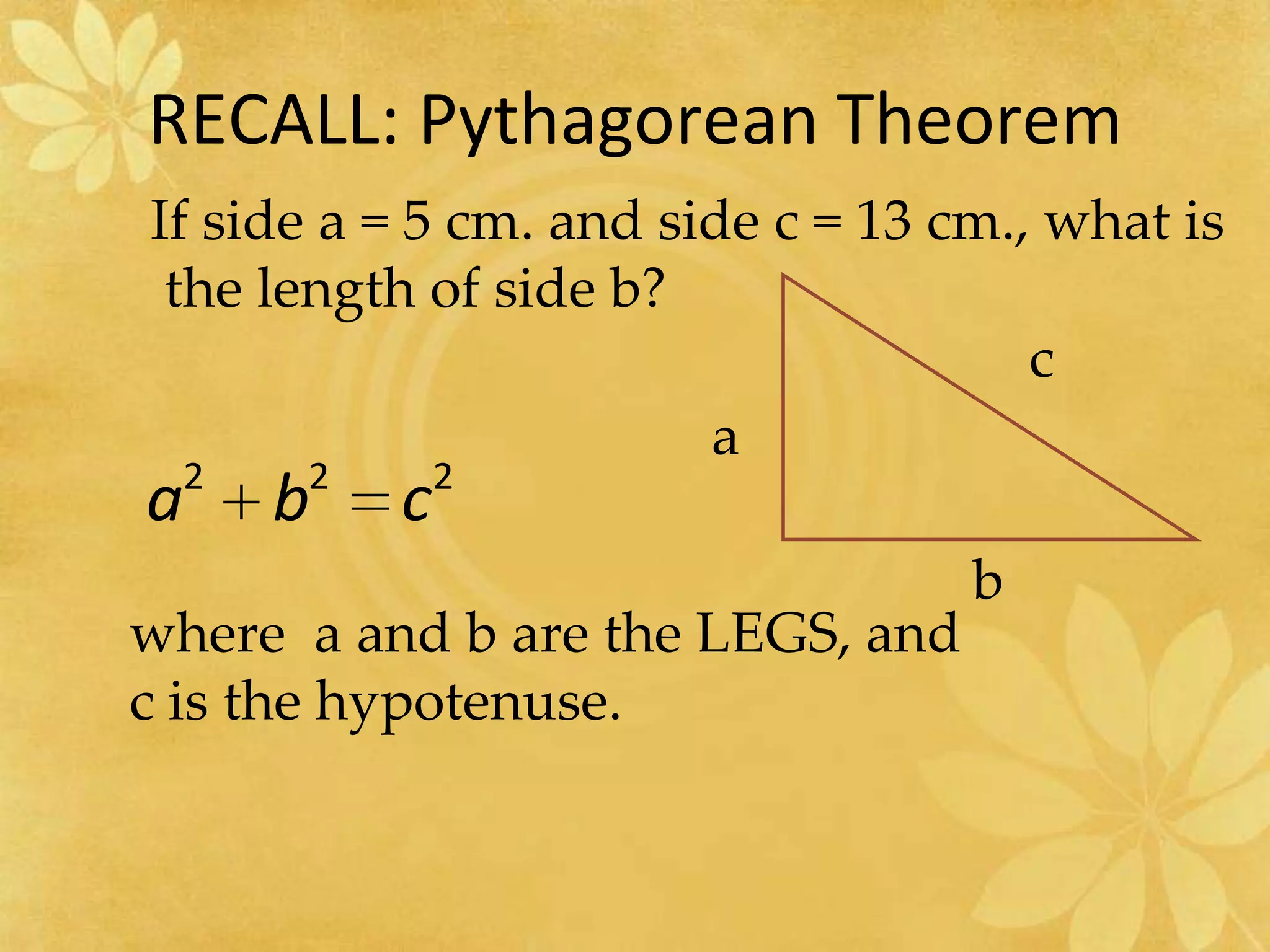
RECALL: Pythagorean TheoremIf side a = 5 cm. and side c = 13 cm., what is the length of side b?cabwhere  a and b are the LEGS, and c is the hypotenuse.
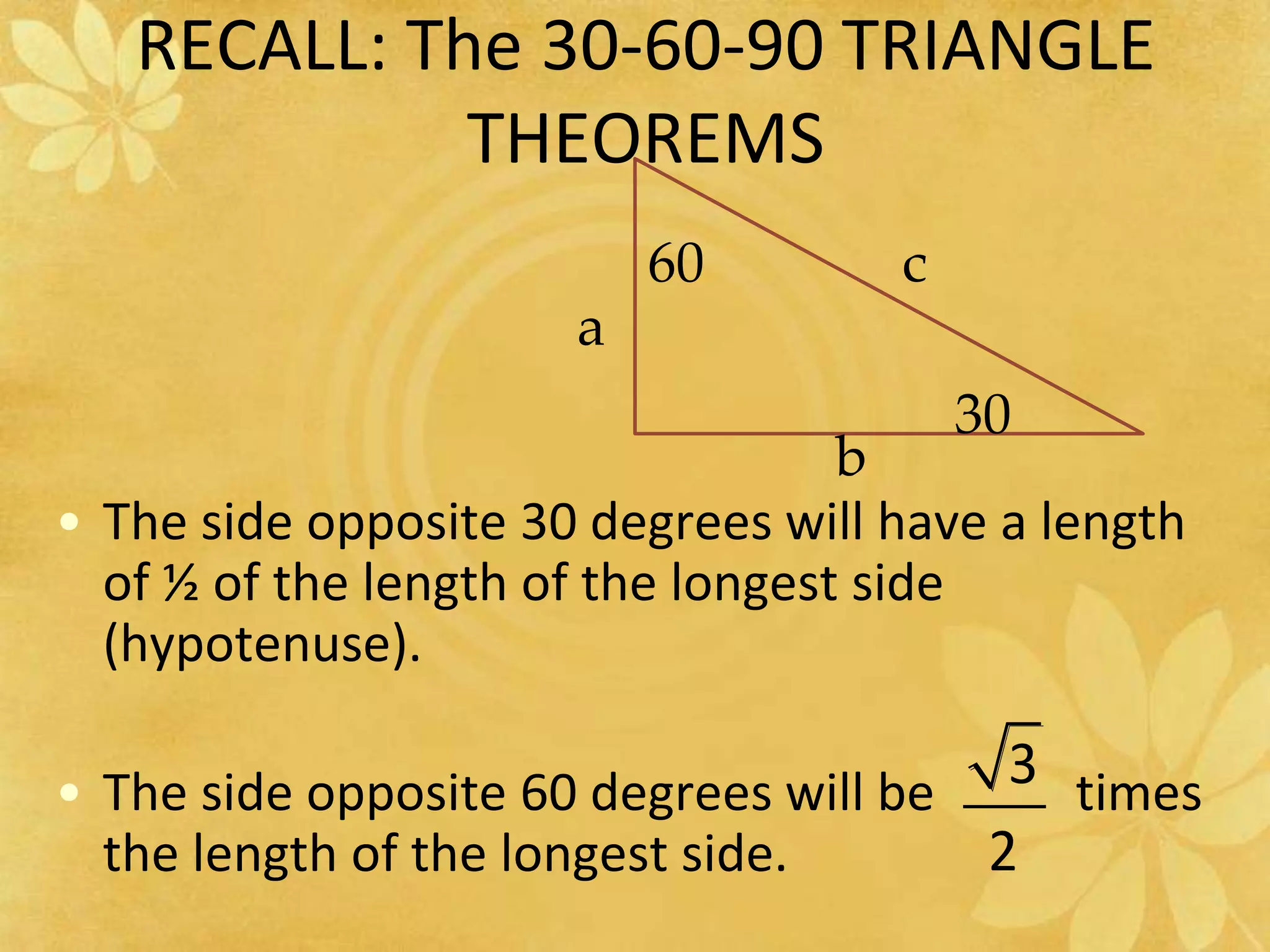
RECALL: The 30-60-90 TRIANGLE THEOREMS60ca30bThe side opposite 30 degrees will have a length of ½ of the length of the longest side (hypotenuse).The side opposite 60 degrees will be           times the length of the longest side.
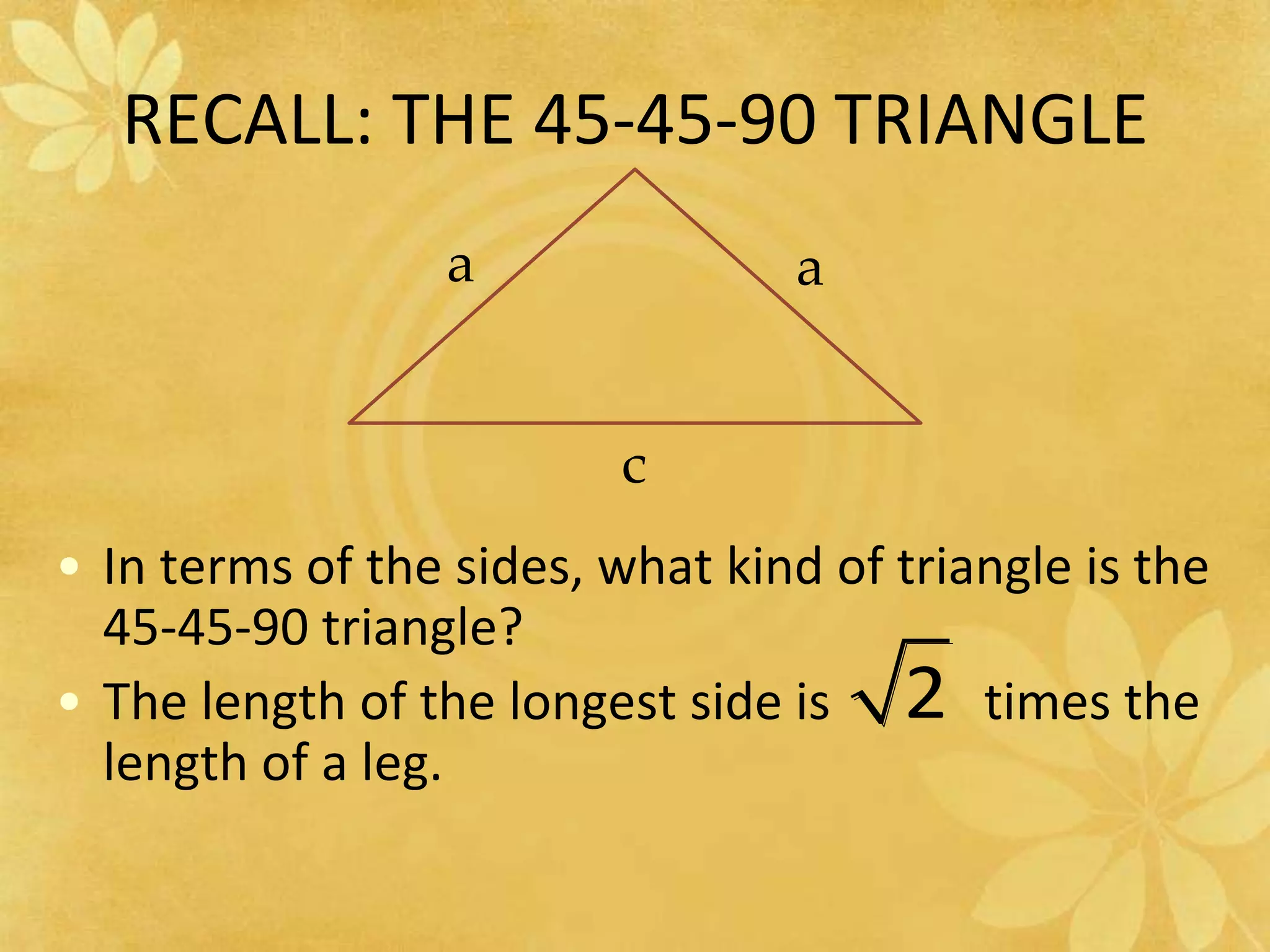
RECALL: THE 45-45-90 TRIANGLEaacIn terms of the sides, what kind of triangle is the 45-45-90 triangle?The length of the longest side is            times the length of a leg.
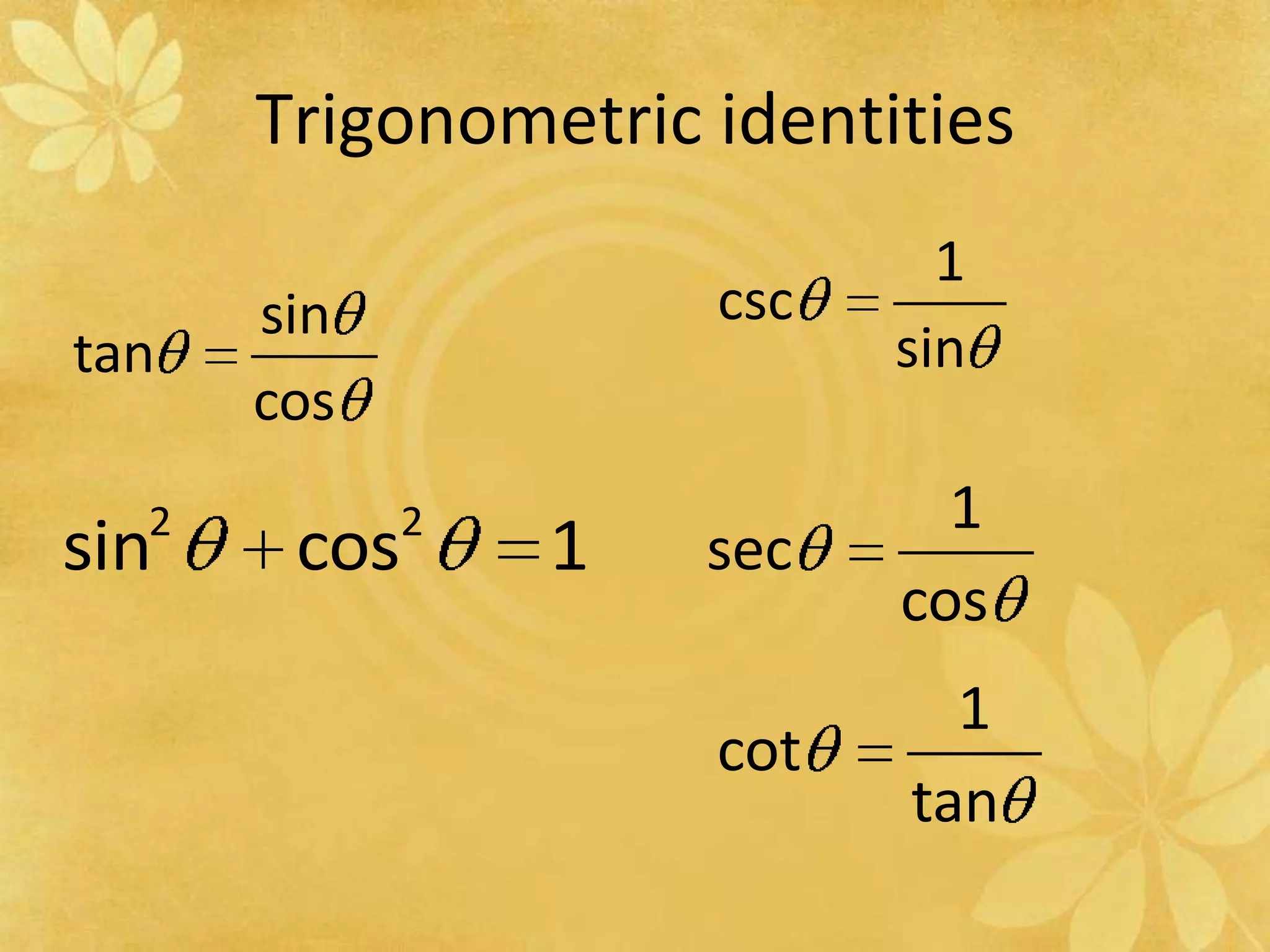
Trigonometric identities
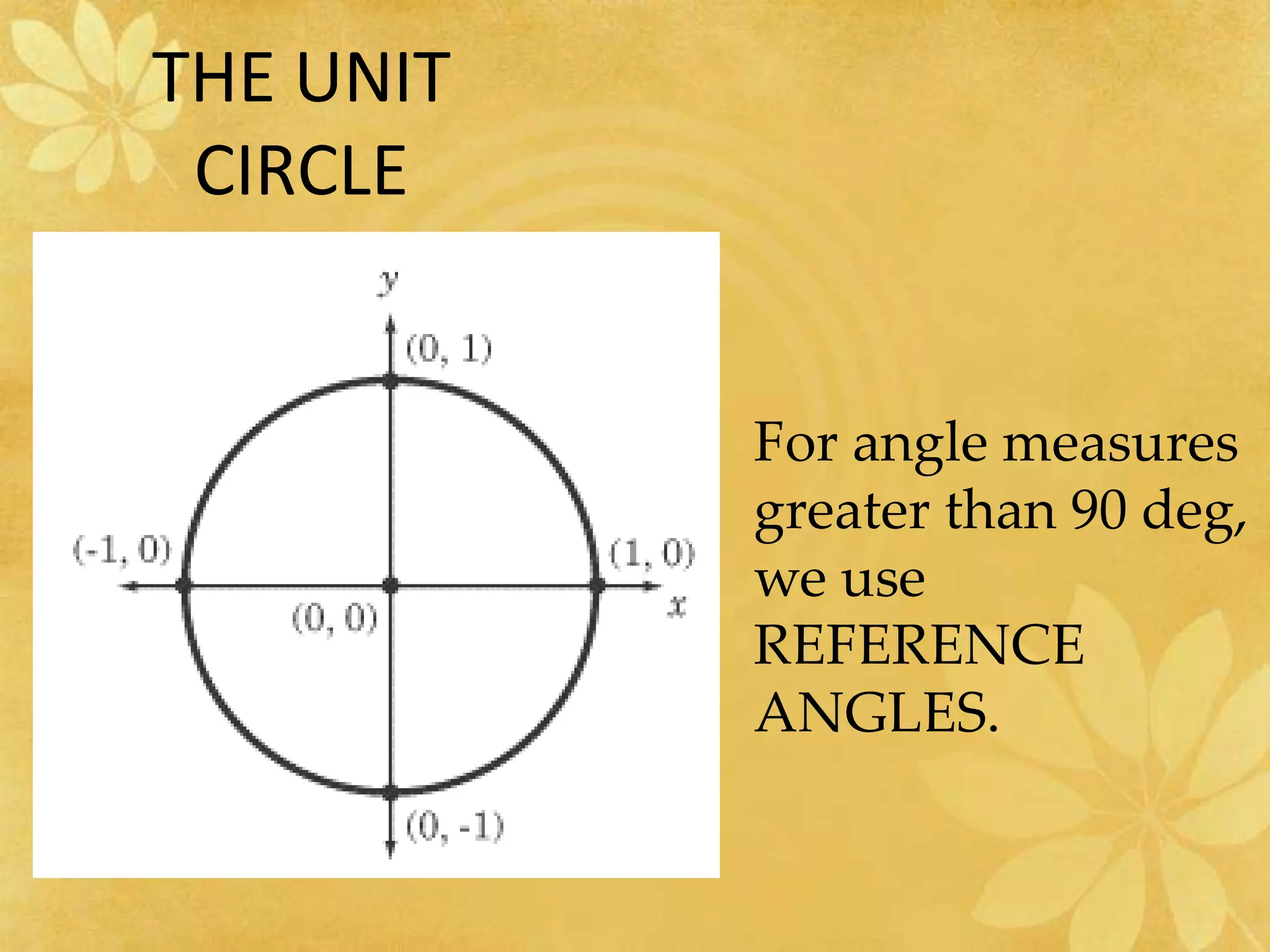
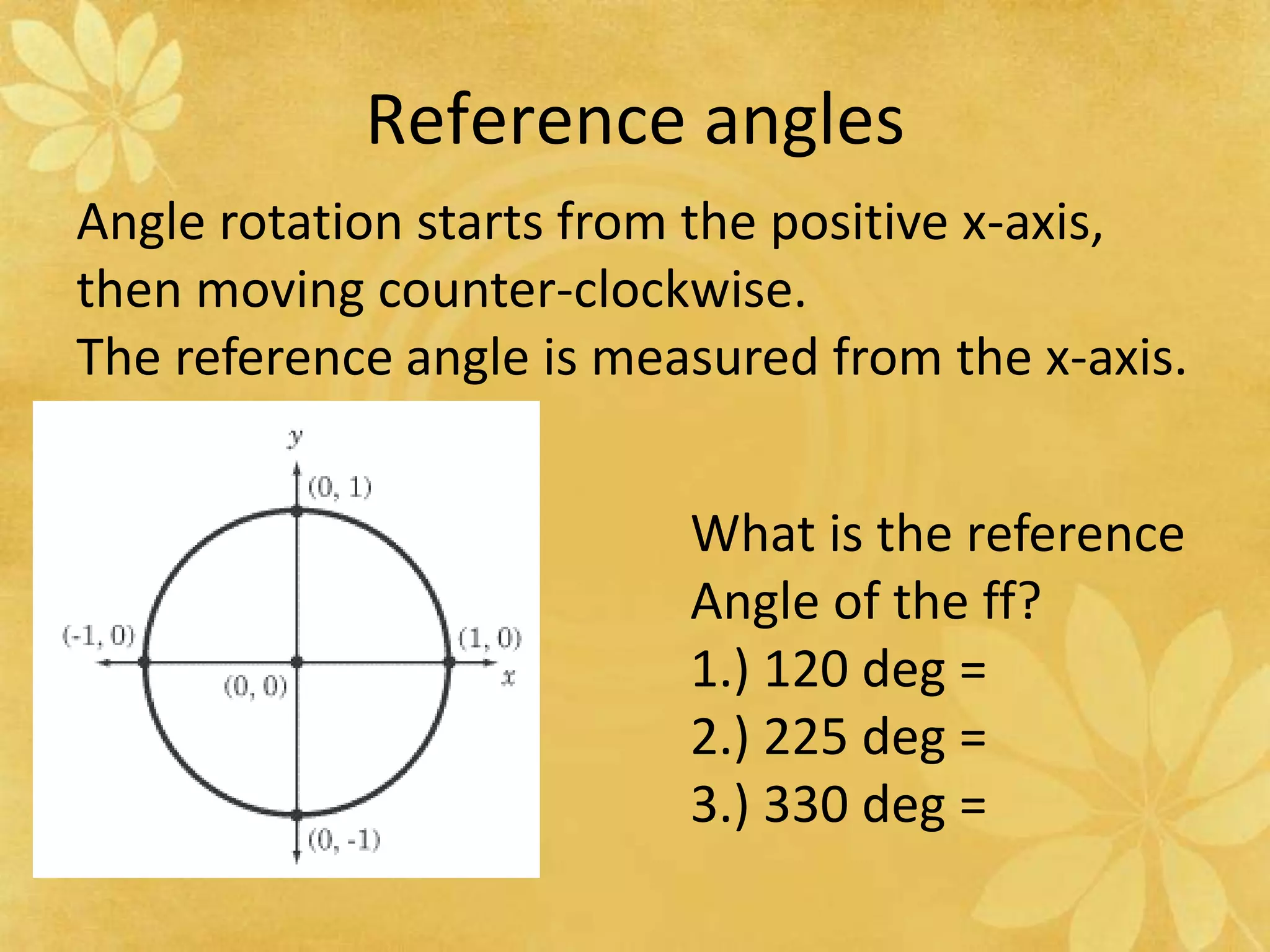
THE UNIT CIRCLEFor angle measuresgreater than 90 deg,we use REFERENCE ANGLES.
Reference anglesAngle rotation starts from the positive x-axis, then moving counter-clockwise.The reference angle is measured from the x-axis.What is the reference Angle of the ff?1.) 120 deg =2.) 225 deg =3.) 330 deg =
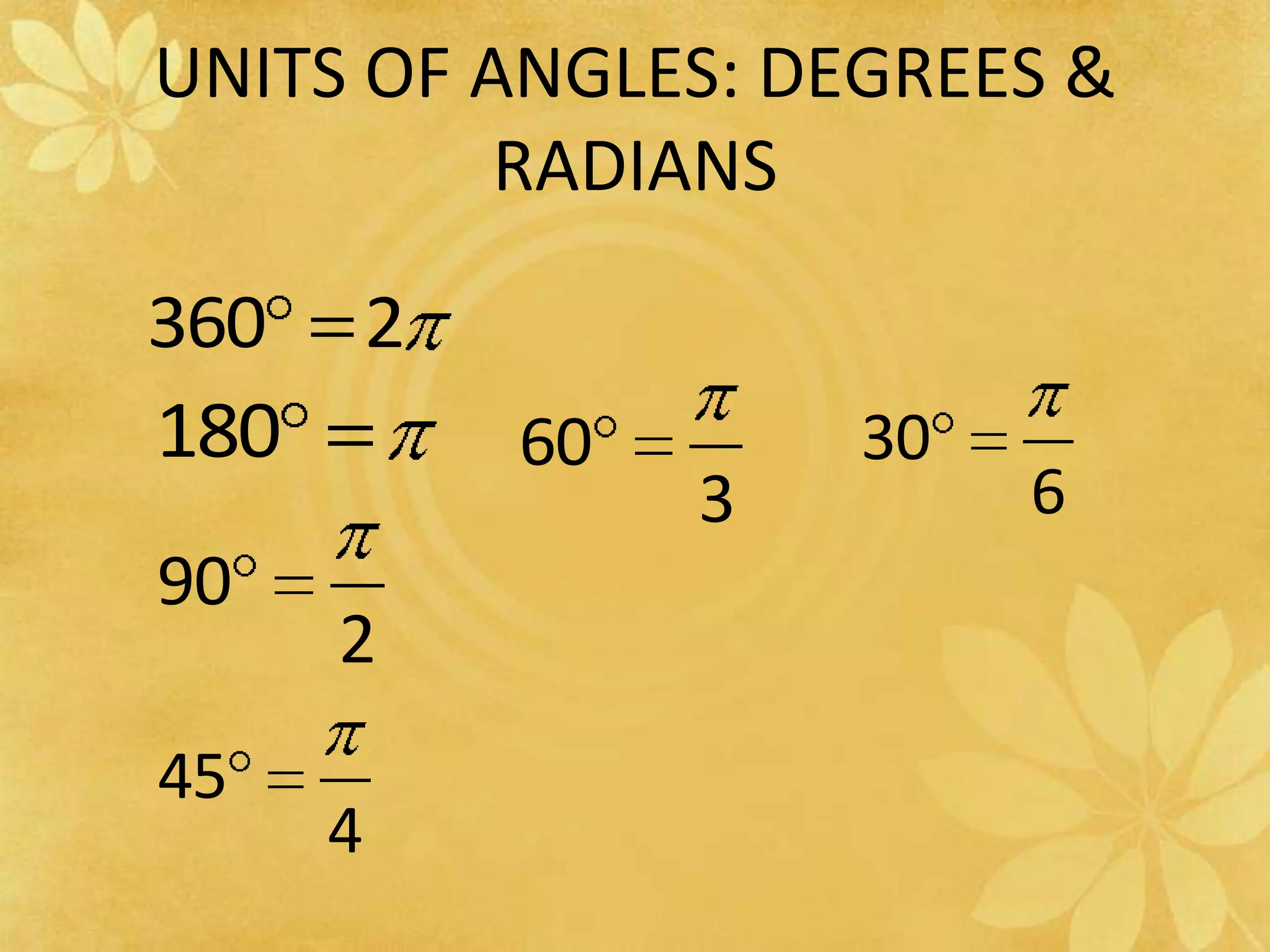
UNITS OF ANGLES: DEGREES & RADIANS
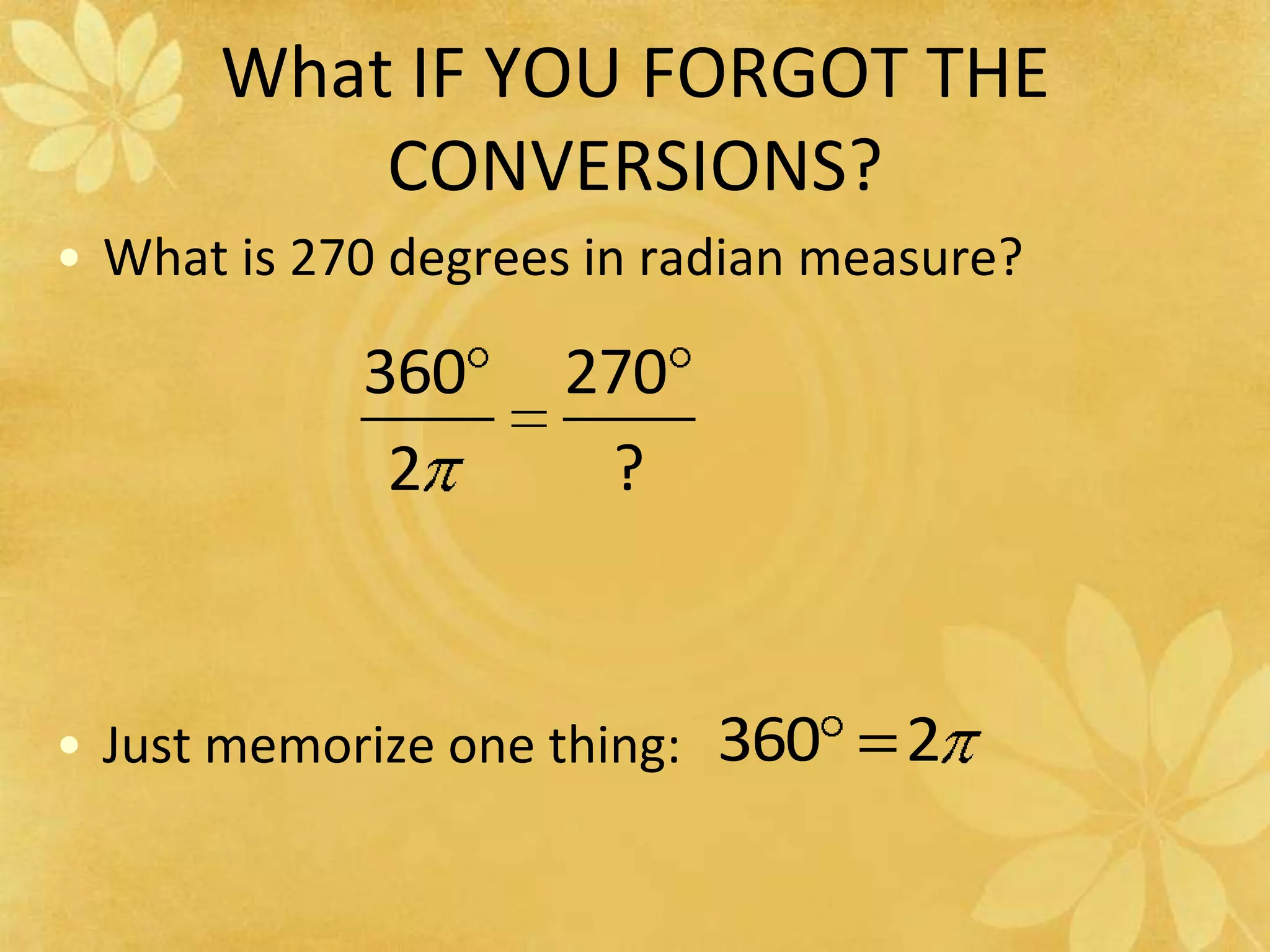
What IF YOU FORGOT THE CONVERSIONS?What is 270 degrees in radian measure?Just memorize one thing:
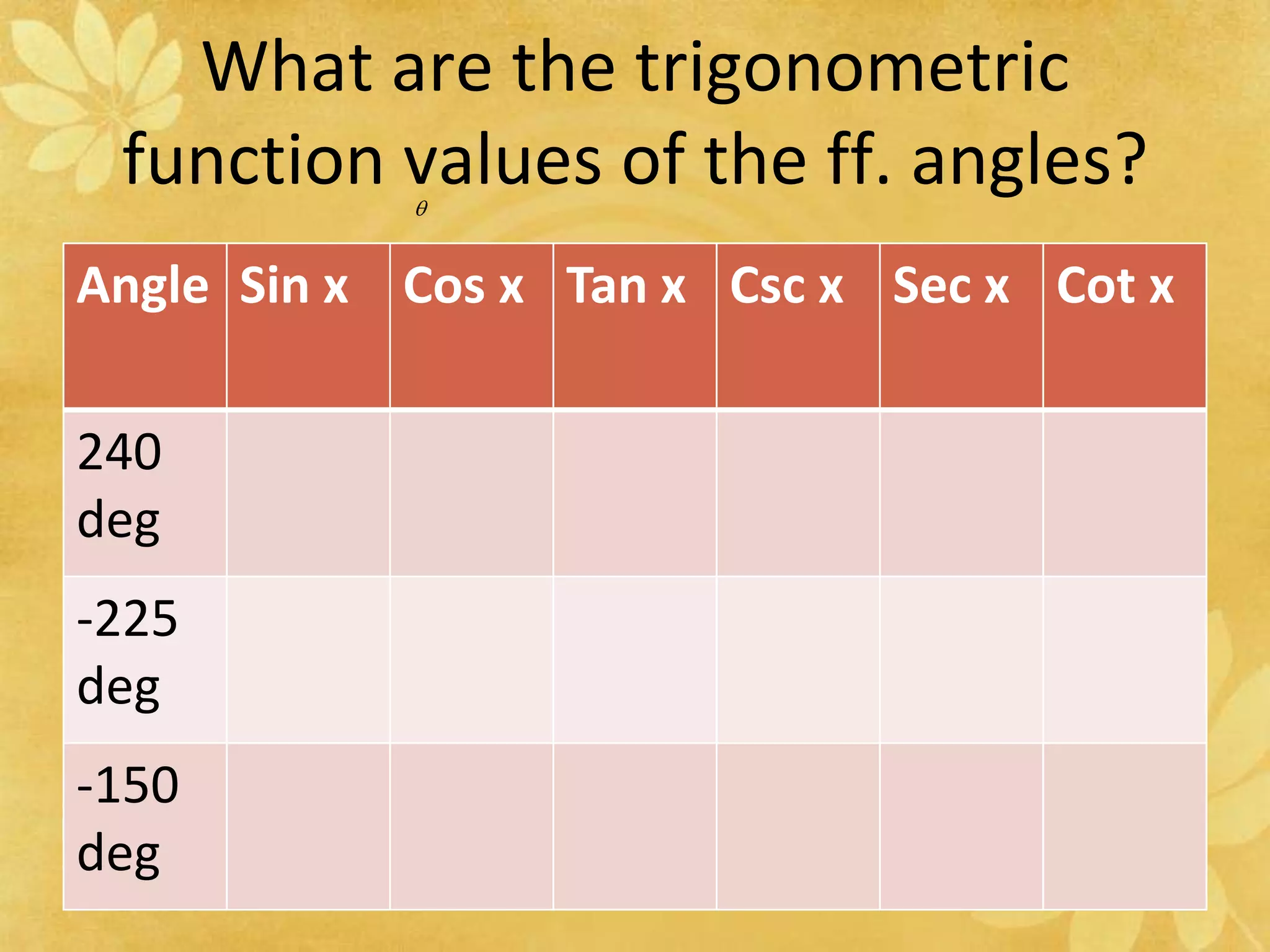
What are the trigonometric function values of the ff. angles?
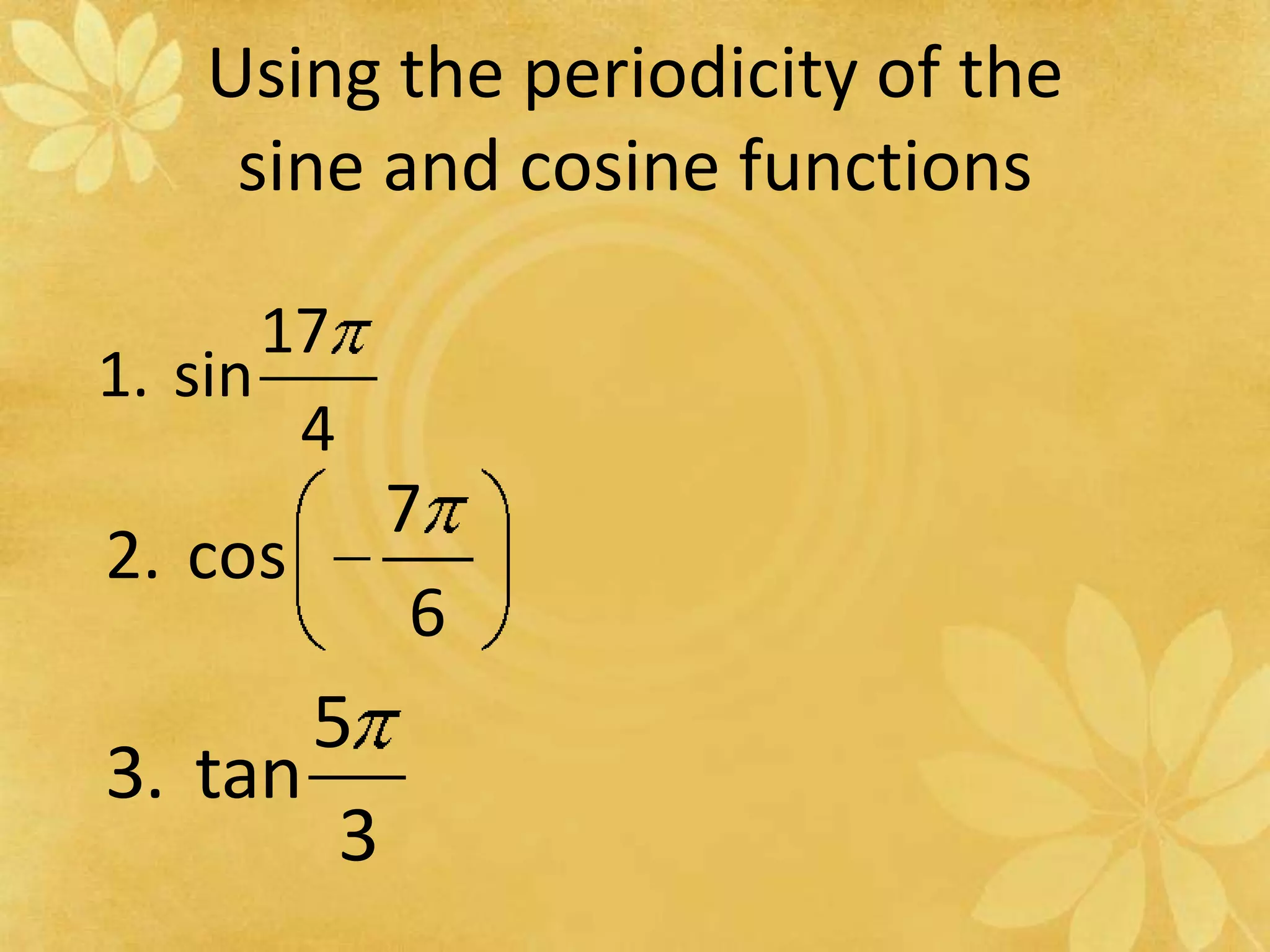
Using the periodicity of the sine and cosine functions
GRAPHS OF THE TRIGONOMETRIC FUNCTIONS
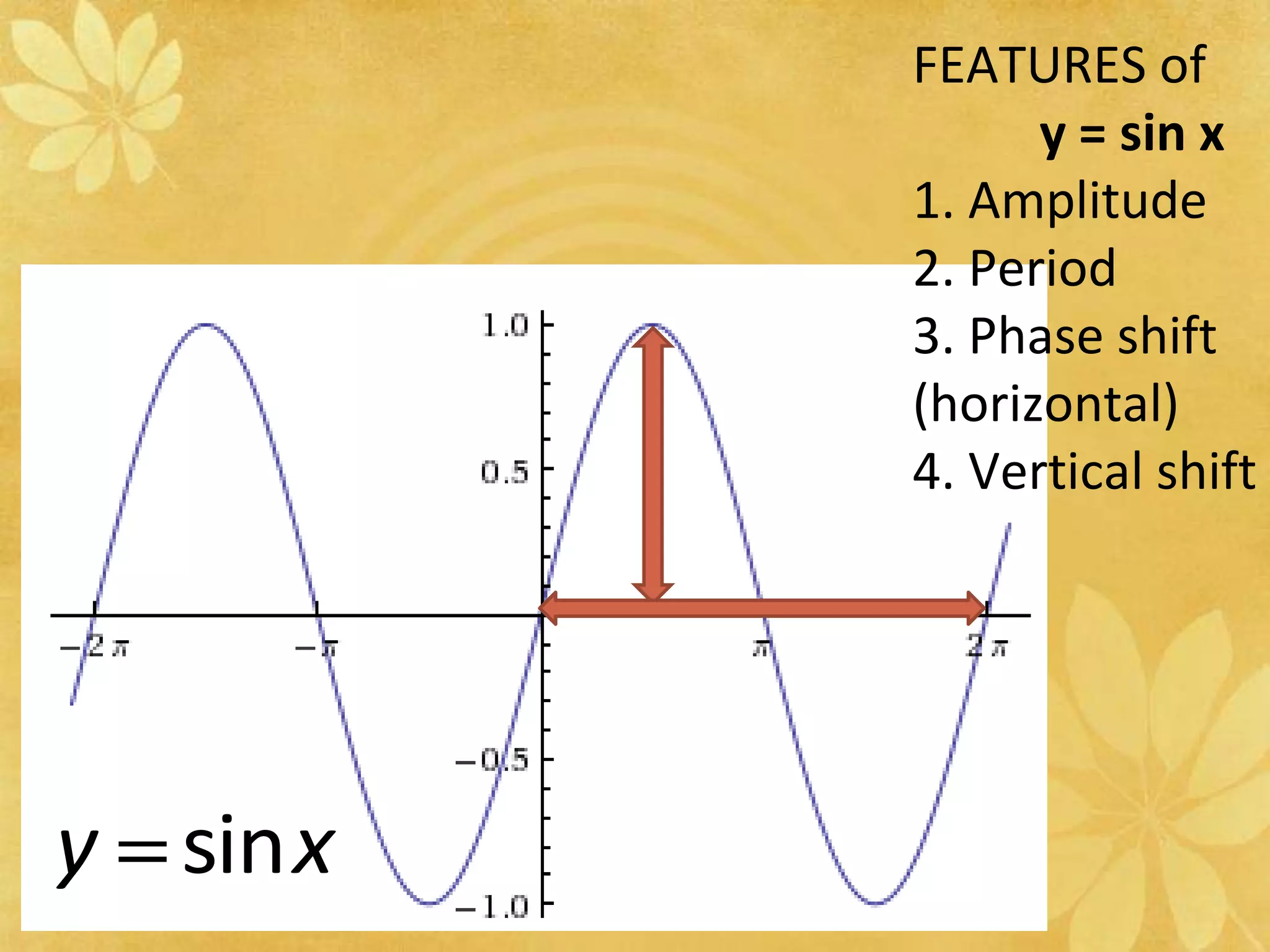
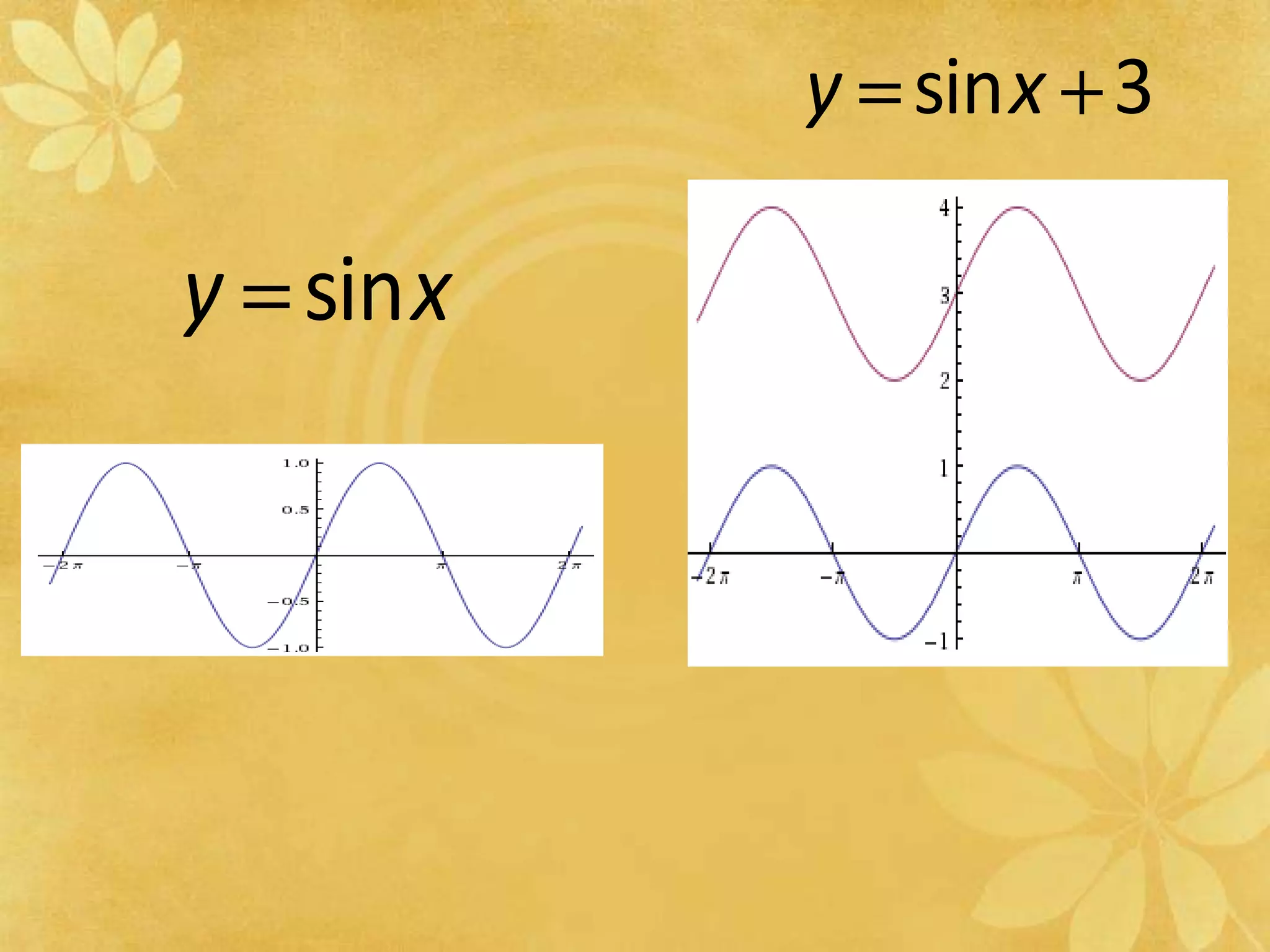
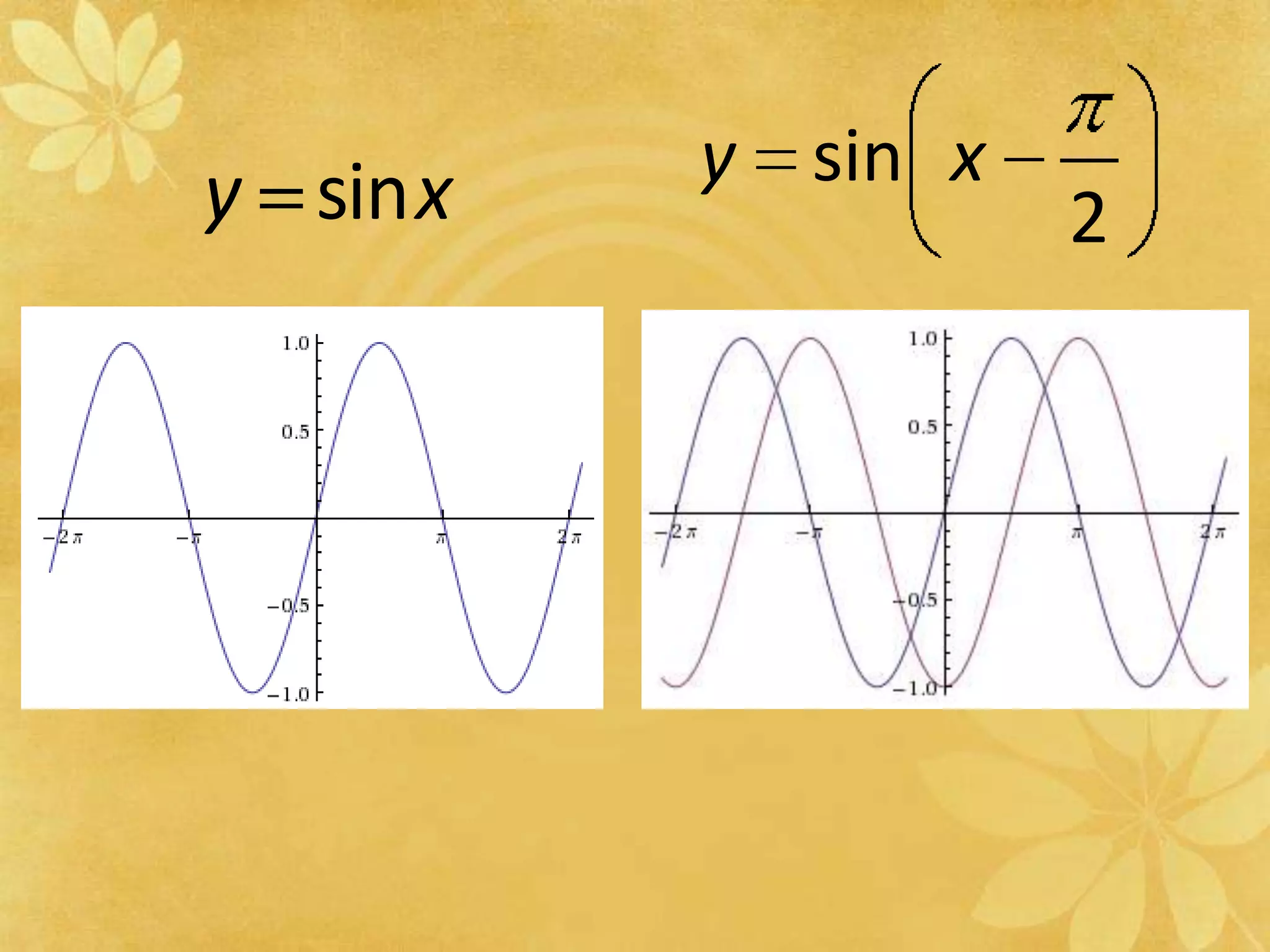
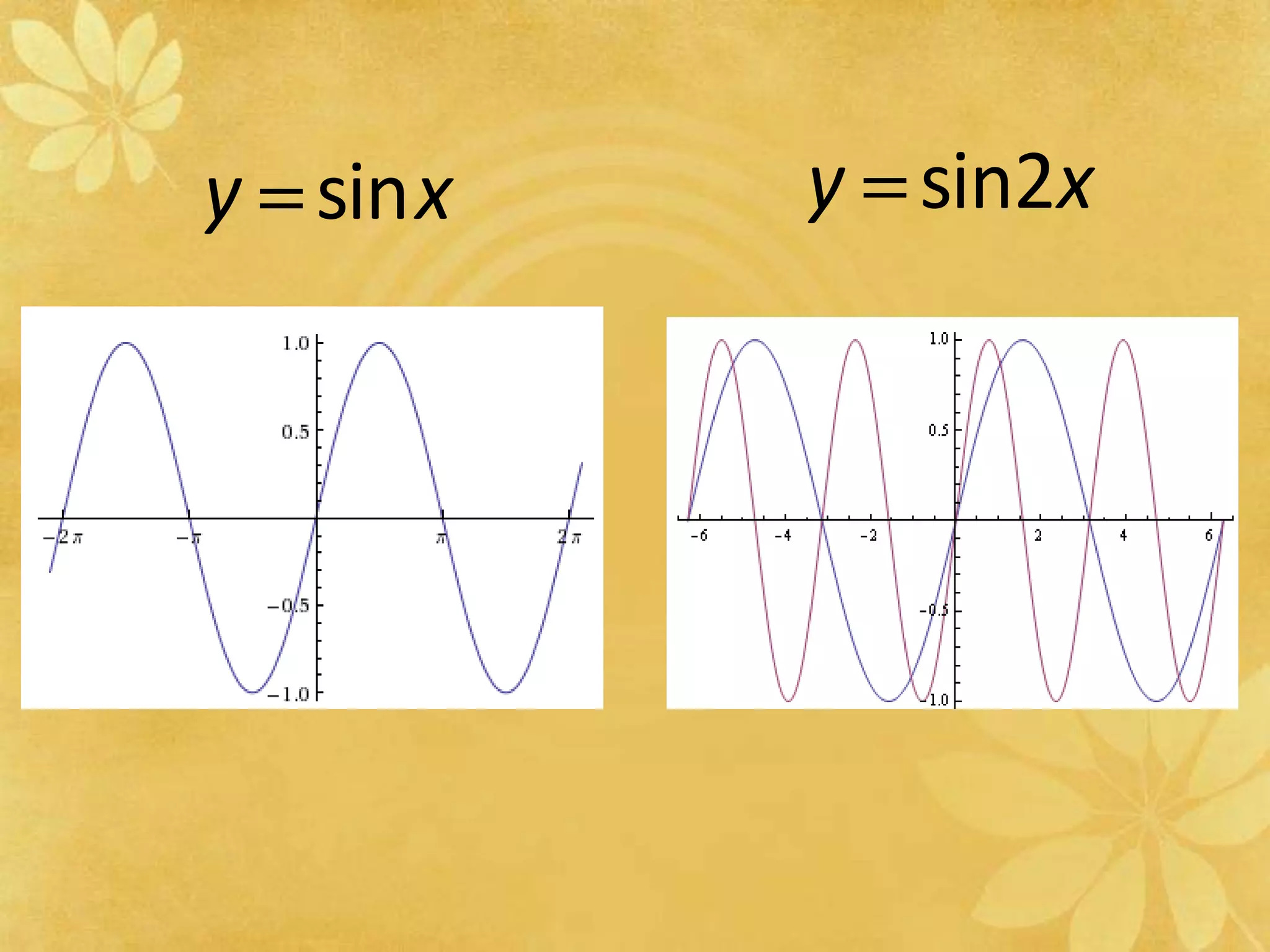
FEATURES of y = sin x1. Amplitude2. Period3. Phase shift (horizontal)4. Vertical shift
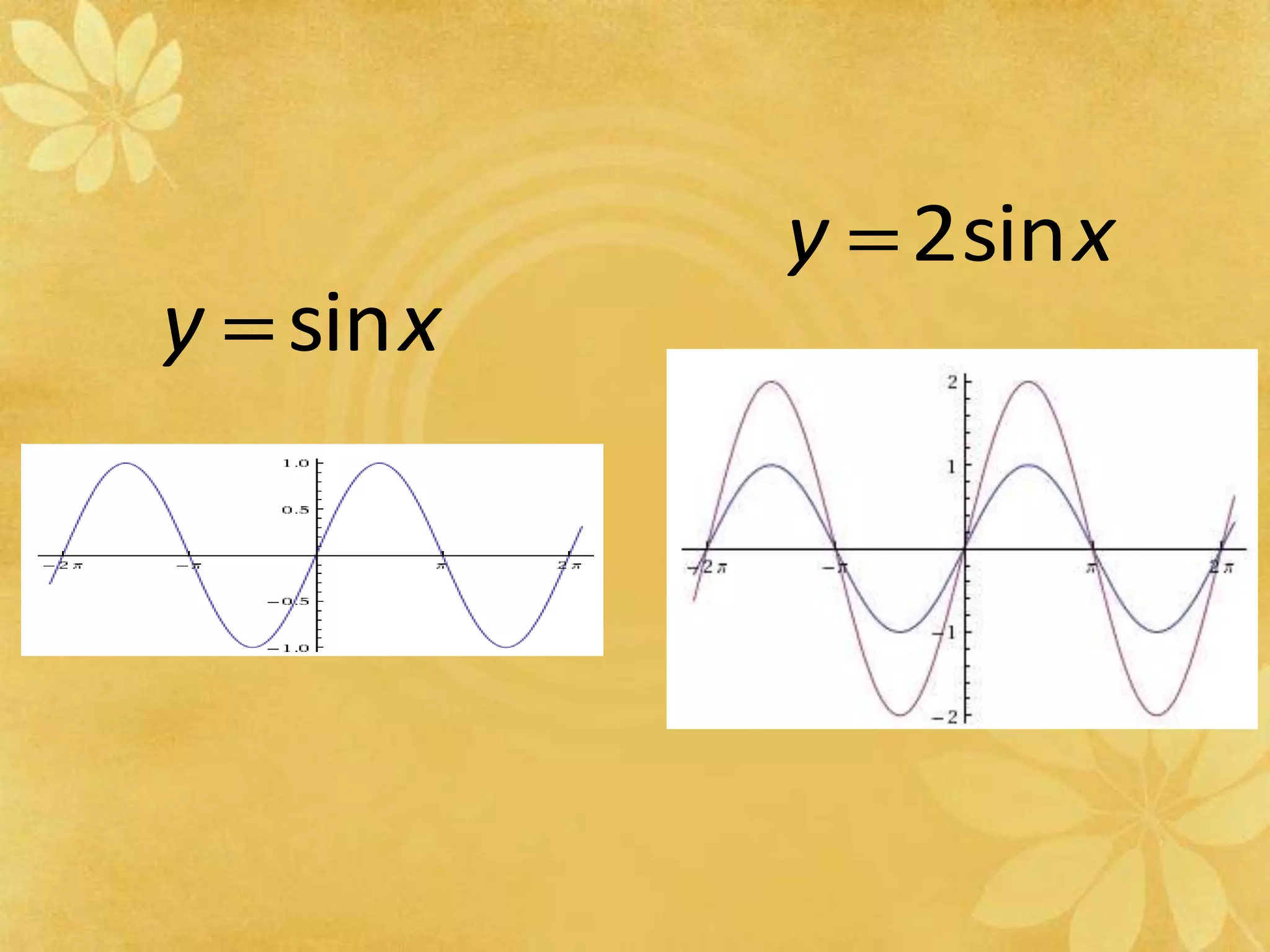
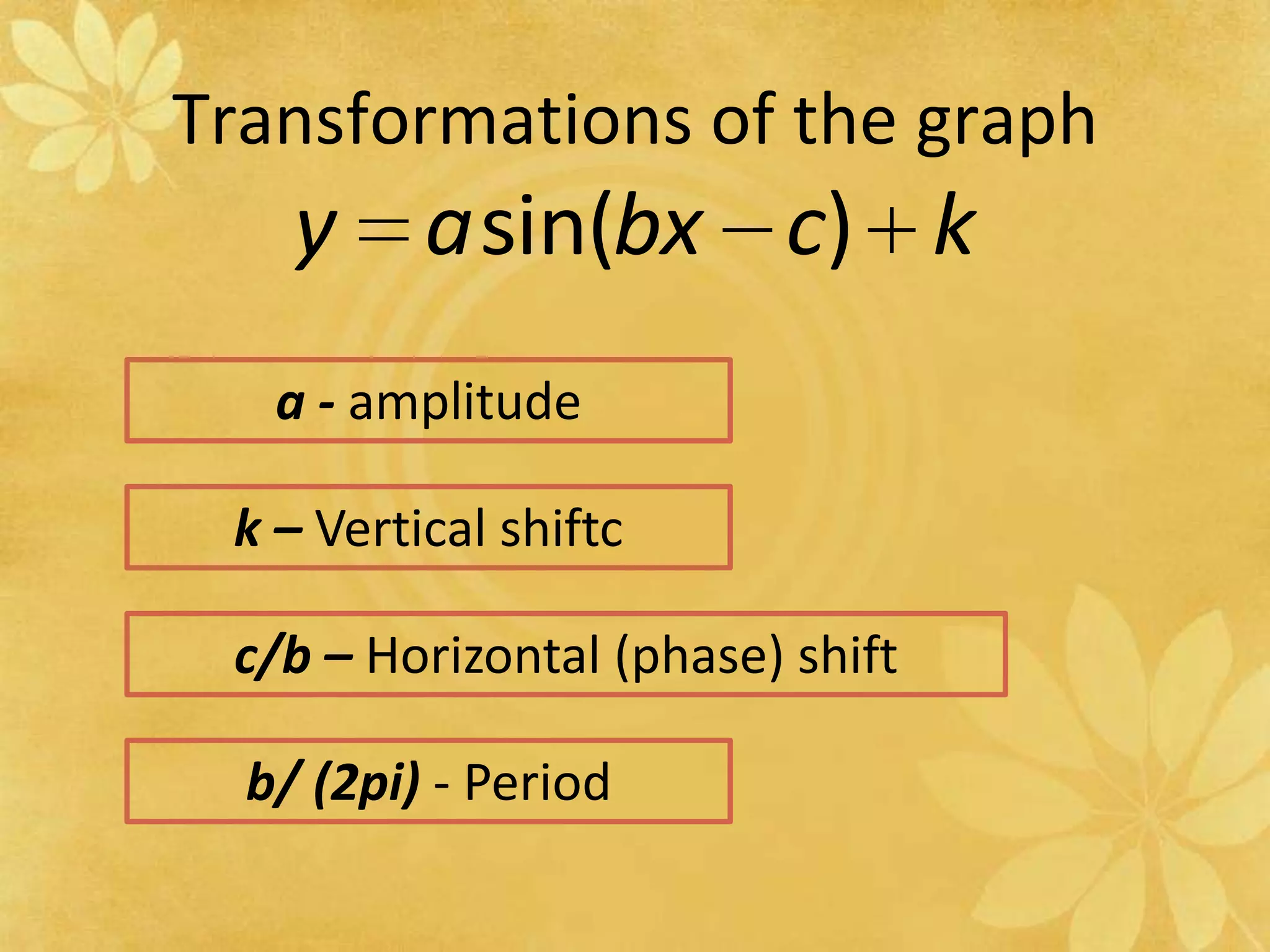
Transformations of the grapha - amplitudek – Vertical shiftcc/b – Horizontal (phase) shiftb/ (2pi) - Period

Pshs 3rd yr_functions

  • 1.
    PSHS 3RD YEARMATHSession 1
  • 2.
    Diagnostic - Answers1.Evaluate the function for f(-1) if
  • 3.
    2. What isthe sum h(x) + g(x) if h(x) = 5x – 1 and g(x) = 3x2 + 6x – 7 ?
  • 4.
    3. If F(x)=2x + 3 and G(x) = 5x – 4, what is the composite function G(F(x))?
  • 5.
    4. What isthe domain of the square root function ?DOMAIN The set of all possible values for x, OR The x-coordinates of the points of the graph of the function2 ways to analyze:1.) Knowing the graph of the function2.) Using the given equation of the function
  • 6.
    The graph ofWhat are the x-coordinates of the points on the graph? DOMAIN
  • 7.
    The graph ofDOMAIN ofisat x=5Courtesy of Wolfram Alpha: www/wolframalpha.comGENERAL EQUATION: h=horizontal shift
  • 8.
  • 9.
    6. Find theinverse of the function . HOW TO GET1.) Use y for “f(x)”.2.) Switch x and y.3.) Isolate y.4.) This new y will be your
  • 10.
    7. Which ofthe following is NOT divisible by (x – 1) ?3 Ways to answer:1.) Using LONG division.2.) Using SYNTHETIC division.3.) Using the REMAINDER THEOREM.Remainder Theorem:Therefore, is divisible by(x - 1).
  • 11.
    8. What arethe roots of the function ? ROOTS – also known as the x-coordinates of the x-intercepts, OR the solutions to the equation if h( x ) were equal 0.HOW DO WE GET THE x-intercepts?Let y = 0, meaning let h( x ) = 0.
  • 12.
    Which is thecorrect set of roots of f( x )?x = -3, 0 and 5ORx = -5, 0 and 3
  • 13.
    9. What isthe equation of the line that passes through (5, -6) and is perpendicular to the line whose equation is ?Point (5, -6) is a point on the line we are looking for.Perpendicular means that the slopes of and the unknown line are NEGATIVE RECIPROCALS of each other.
  • 14.
    10. Given thefunction :Find the intercepts.To get the x-intercept:Therefore, x-intercept = (1/2, 0).To get the y-intercept:Therefore, y-intercept = (0, 1).
  • 15.
  • 16.
    11. Given thefunction :Find the vertex of the parabola.2 ways:1.) Vertex-form of the quadratic equation.2.) Use the vertex formula.
  • 17.
    11.b. Find thedomain and range.Domain – set of all real numbers: Range – based on 2 things:1.) the y-coordinate of the VERTEX of the parabola. 2.) the direction where the parabola is opening  leading coefficient. Therefore, the range is
  • 18.
    11.c. Graph thefunction.Vertex: (1, 2)
  • 19.
    Trigonometric functionsSine, Cosine,and TangentThese are RATIOS of the sides of the right triangleSOH CAH TOA
  • 20.
    RECALL: Pythagorean TheoremIfside a = 5 cm. and side c = 13 cm., what is the length of side b?cabwhere a and b are the LEGS, and c is the hypotenuse.
  • 21.
    RECALL: The 30-60-90TRIANGLE THEOREMS60ca30bThe side opposite 30 degrees will have a length of ½ of the length of the longest side (hypotenuse).The side opposite 60 degrees will be times the length of the longest side.
  • 22.
    RECALL: THE 45-45-90TRIANGLEaacIn terms of the sides, what kind of triangle is the 45-45-90 triangle?The length of the longest side is times the length of a leg.
  • 23.
  • 24.
    THE UNIT CIRCLEForangle measuresgreater than 90 deg,we use REFERENCE ANGLES.
  • 25.
    Reference anglesAngle rotationstarts from the positive x-axis, then moving counter-clockwise.The reference angle is measured from the x-axis.What is the reference Angle of the ff?1.) 120 deg =2.) 225 deg =3.) 330 deg =
  • 26.
    UNITS OF ANGLES:DEGREES & RADIANS
  • 27.
    What IF YOUFORGOT THE CONVERSIONS?What is 270 degrees in radian measure?Just memorize one thing:
  • 28.
    What are thetrigonometric function values of the ff. angles?
  • 29.
    Using the periodicityof the sine and cosine functions
  • 30.
    GRAPHS OF THETRIGONOMETRIC FUNCTIONS
  • 31.
    FEATURES of y= sin x1. Amplitude2. Period3. Phase shift (horizontal)4. Vertical shift
  • 36.
    Transformations of thegrapha - amplitudek – Vertical shiftcc/b – Horizontal (phase) shiftb/ (2pi) - Period