Renee Hobbs
University of Rhode Island
Media Education Lab
Email: hobbs@uri.edu
Twitter: @reneehobbs
CREATE TO LEARN
#digiURI
ACCESS SLIDES: bit.ly/create-learn
Authorship is a creative and collaborative process that involves
experimentation and risk taking. Students take on authority
when they have a real audience and strategic purpose.
When we create, we build upon what we have previously
learned through comprehending & critiquing other media
texts. Authors benefit from laws that enable people to engage
in cultural conversation through using and sharing the ideas of
others.
Digital authorship is a form of social power that enables
people to respond to the increasing diversity of information,
entertainment & persuasion in contemporary society.
PREVIEW
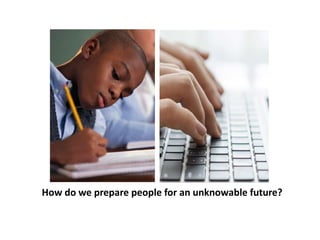
How do we prepare people for an unknowable future?
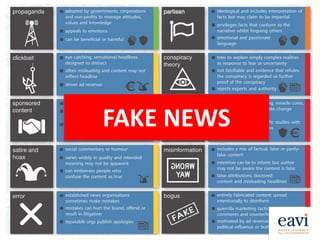
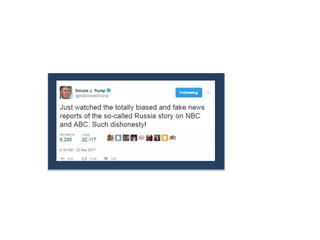
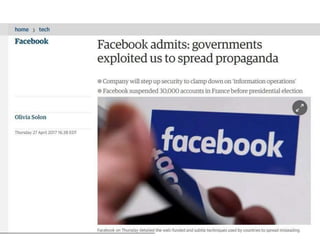
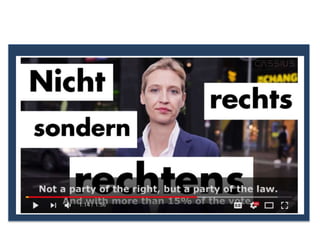
FAKE NEWS
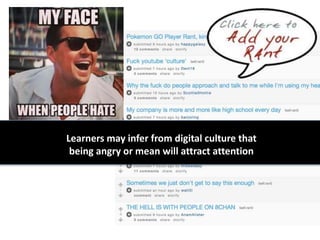
Learners may infer from digital culture that
being angry or mean will attract attention
@reneehobbs
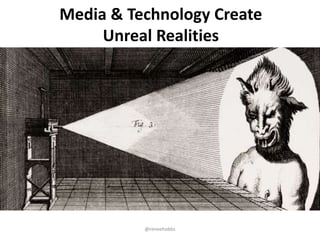
Media & Technology Create
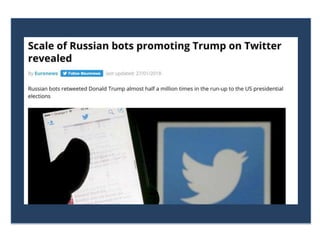
Unreal Realities
…anyone can create media
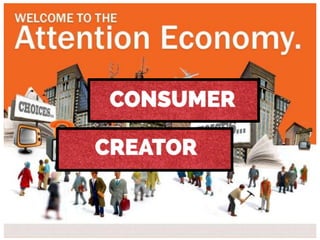
How do we prepare learners for their
social responsibilities as consumers and creators?
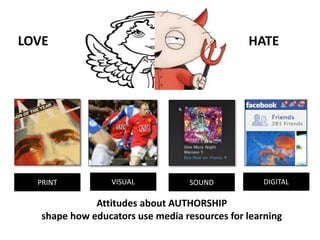
LOVE HATE
PRINT VISUAL SOUND DIGITAL
Attitudes about AUTHORSHIP
shape how educators use media resources for learning
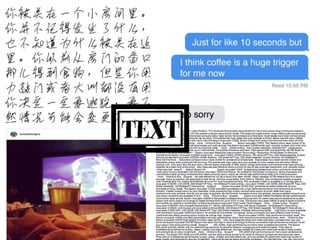
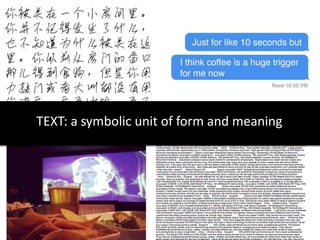
TEXT: a symbolic unit of form and meaning
Authors are the
guardians of
collective
memory
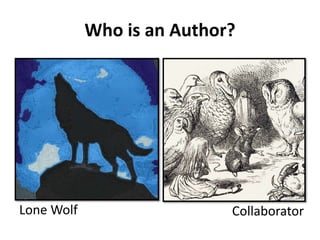
Who is an Author?
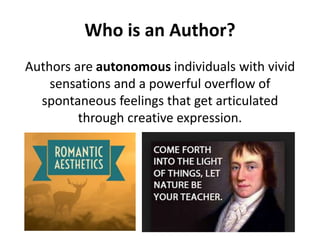
Authors are autonomous individuals with vivid
sensations and a powerful overflow of
spontaneous feelings that get articulated
through creative expression.
Who is an Author?
Who is an Author?
Lone Wolf Collaborator
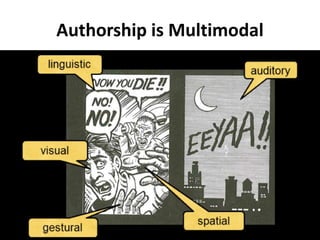
Authorship is Multimodal
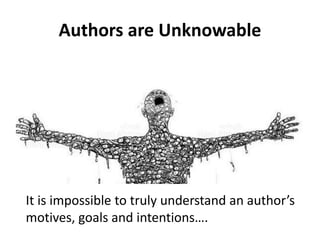
Authors are Unknowable
It is impossible to truly understand an author’s
motives, goals and intentions….
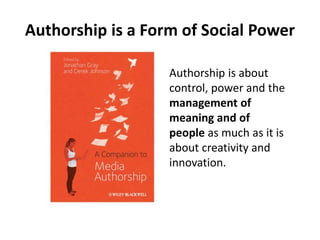
Authorship is about
control, power and the
management of
meaning and of
people as much as it is
about creativity and
innovation.
Authorship is a Form of Social Power
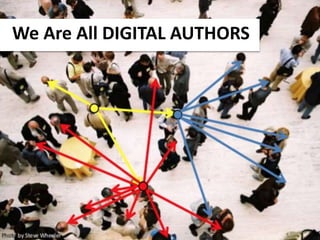
We Are All DIGITAL AUTHORS
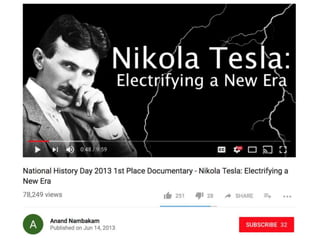
As you watch, consider:
How does this video depict
the the way learners create
media?
DISCUSS:
Why is becoming an author a
transformative experience?
Authorship is a creative and collaborative
process that involves experimentation and
risk taking. Students take on authority
when they have a real audience and
strategic purpose.
We know from Project Information Literacy that
students actively try to reduce the number of
choices they have to make in order to get their
assignments done.
We know from the Citation Project that first year
college students who use sources in their writing
rarely write about them with much understanding.
They don’t summarize sources, they harvest
quotes.
Nearly half the time, the quotes they use are from
the first page of the source.
We
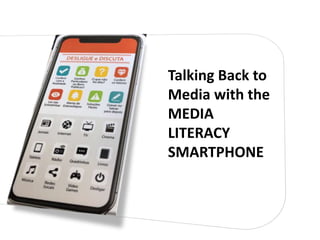
Talking Back to
Media with the
MEDIA
LITERACY
SMARTPHONE
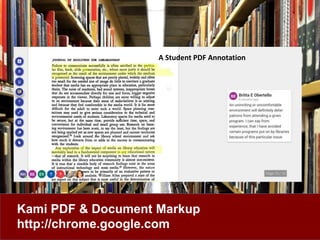
Kami PDF & Document Markup
http://chrome.google.com
A Student PDF Annotation
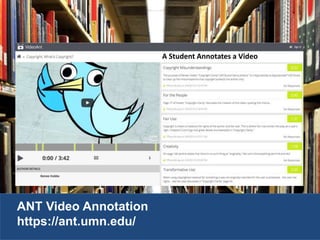
A Student Annotates a Video
ANT Video Annotation
https://ant.umn.edu/
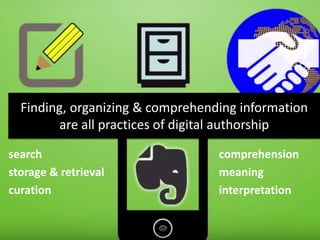
Finding, organizing & comprehending information
are all practices of digital authorship
comprehension
meaning
interpretation
search
storage & retrieval
curation
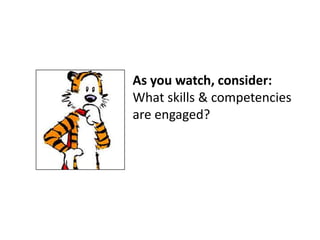
As you watch, consider:
What skills & competencies
are engaged?
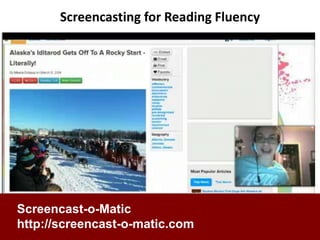
Screencasting for Reading Fluency
Screencast-o-Matic
http://screencast-o-matic.com
As you watch, consider:
What skills & competencies
are engaged?
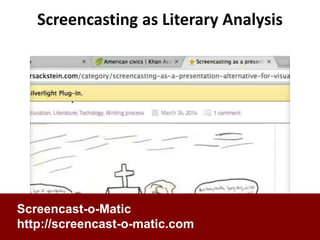
Screencasting as Literary Analysis
Screencast-o-Matic
http://screencast-o-matic.com
How does digital authorship advance intellectual curiosity?
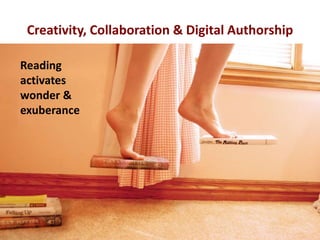
Reading
activates
wonder &
exuberance
Creativity, Collaboration & Digital Authorship
At any moment, the reader is ready
to turn into a writer.
-Walter Benjamin
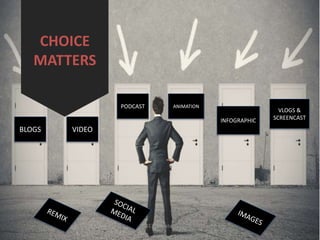
CHOICE
MATTERS
Hobbs, R. (2017). Create to Learn. NY:
Wiley.
BLOGS VIDEO
PODCAST ANIMATION
INFOGRAPHIC
VLOGS &
SCREENCAST
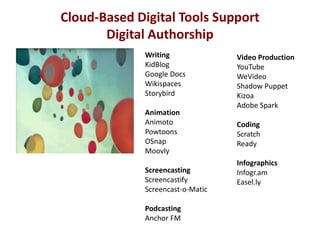
Cloud-Based Digital Tools Support
Digital Authorship
Writing
KidBlog
Google Docs
Wikispaces
Storybird
Animation
Animoto
Powtoons
OSnap
Moovly
Screencasting
Screencastify
Screencast-o-Matic
Podcasting
Anchor FM
Video Production
YouTube
WeVideo
Shadow Puppet
Kizoa
Adobe Spark
Coding
Scratch
Ready
Infographics
Infogr.am
Easel.ly
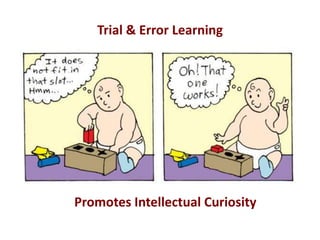
Trial & Error Learning
Promotes Intellectual Curiosity
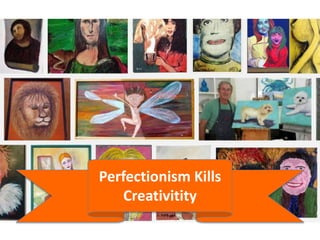
Perfectionism Kills
Creativitity
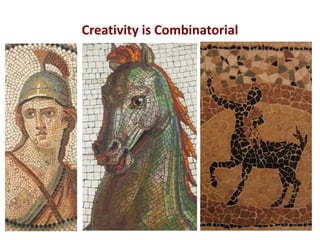
Creativity is Combinatorial
CUT-AND-PASTE
CULTURE
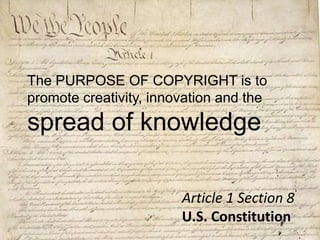
The PURPOSE OF COPYRIGHT is to
promote creativity, innovation and the
spread of knowledge
Article 1 Section 8
U.S. Constitution
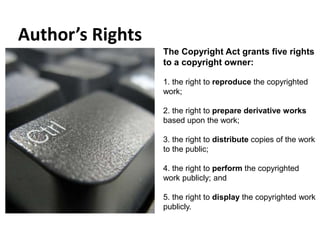
Author’s Rights
1. the right to reproduce the copyrighted
work;
2. the right to prepare derivative works
based upon the work;
3. the right to distribute copies of the work
to the public;
4. the right to perform the copyrighted
work publicly; and
5. the right to display the copyrighted work
publicly.
The Copyright Act grants five rights
to a copyright owner:
EVERYTHING
IS COPYRIGHTED
…but there are exceptions
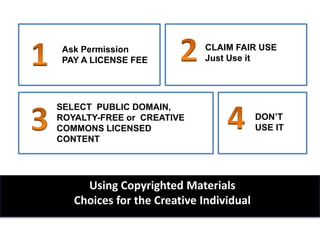
Ask Permission
PAY A LICENSE FEE
CLAIM FAIR USE
Just Use it
DON’T
USE IT
SELECT PUBLIC DOMAIN,
ROYALTY-FREE or CREATIVE
COMMONS LICENSED
CONTENT
Using Copyrighted Materials
Choices for the Creative Individual
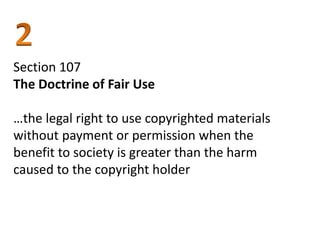
Section 107
The Doctrine of Fair Use
…the legal right to use copyrighted materials
without payment or permission when the
benefit to society is greater than the harm
caused to the copyright holder
Fair Use Creates Balance
OWNERS USERS
USER RIGHTS
SECTION 107
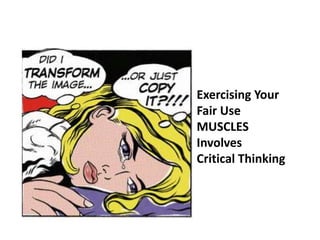
Exercising Your
Fair Use
MUSCLES
Involves
Critical Thinking
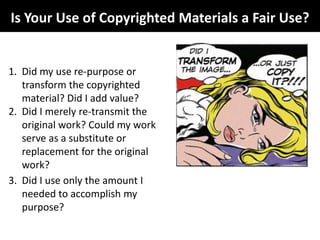
1. Did my use re-purpose or
transform the copyrighted
material? Did I add value?
2. Did I merely re-transmit the
original work? Could my work
serve as a substitute or
replacement for the original
work?
3. Did I use only the amount I
needed to accomplish my
purpose?
Is Your Use of Copyrighted Materials a Fair Use?
When we create, we build upon what we
have previously learned through
comprehending & critiquing other media
texts. Authors benefit from laws that
enable people to engage in cultural
conversation through using, sharing and
building upon the ideas of others.
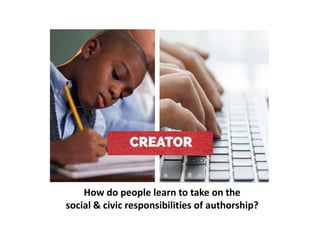
How do people learn to take on the
social & civic responsibilities of authorship?
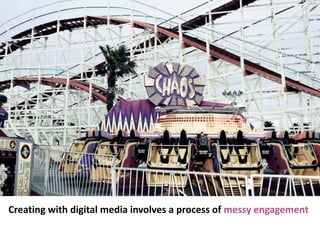
Creating with digital media involves a process of messy engagement
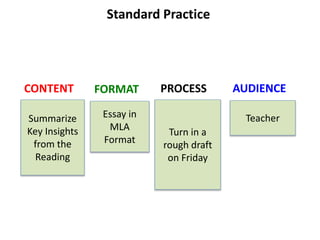
FORMATCONTENT AUDIENCEPROCESS
Standard Practice
Essay in
MLA
Format
Teacher
Turn in a
rough draft
on Friday
Summarize
Key Insights
from the
Reading
FORMATCONTENT AUDIENCEPROCESS
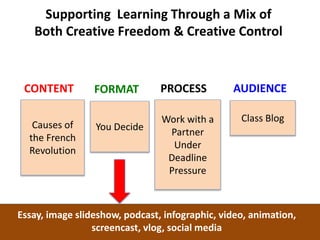
Supporting Learning Through a Mix of
Both Creative Freedom & Creative Control
You Decide
Class BlogWork with a
Partner
Under
Deadline
Pressure
Causes of
the French
Revolution
Essay, image slideshow, podcast, infographic, video, animation,
screencast, vlog, social media
FORMATCONTENT AUDIENCEPROCESS
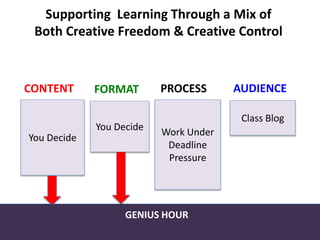
Supporting Learning Through a Mix of
Both Creative Freedom & Creative Control
You Decide
Class Blog
Work Under
Deadline
Pressure
You Decide
GENIUS HOUR
FORMATCONTENT AUDIENCEPROCESS
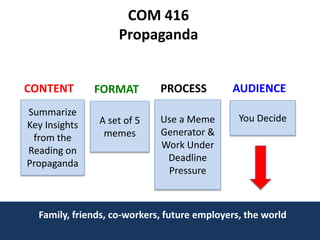
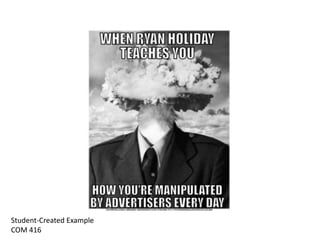
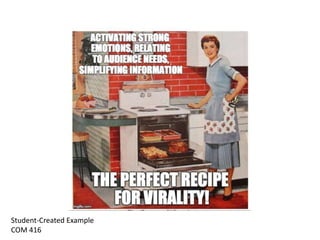
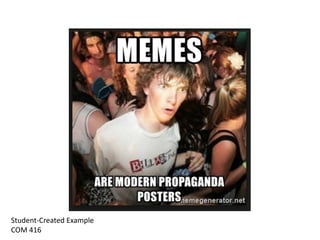
COM 416
Propaganda
A set of 5
memes
You DecideUse a Meme
Generator &
Work Under
Deadline
Pressure
Summarize
Key Insights
from the
Reading on
Propaganda
Family, friends, co-workers, future employers, the world
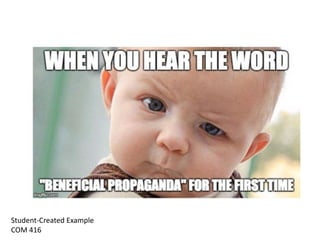
Student-Created Example
COM 416
Student-Created Example
COM 416
Student-Created Example
COM 416
Student-Created Example
COM 416
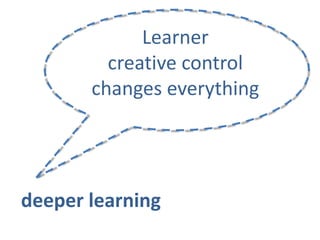
Learner
creative control
changes everything
deeper learning
Digital authorship is a form of
social power that enables people
respond to the increasing
diversity of information,
entertainment & persuasion in
contemporary society
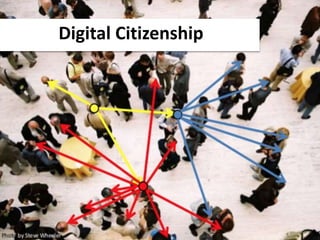
Digital Citizenship
Digital authorship is a creative and collaborative process that
involves experimentation and risk taking. Students take on
authority when they have a real audience and strategic
purpose.
When they create, students build upon what they have
previously learned through comprehending other media
texts. Digital authors benefit from laws that enable people to
engage in cultural conversation through using and sharing the
ideas of others.
Digital authorship is a form of social power that enables
people to respond to the increasing diversity of information,
entertainment & persuasion in contemporary society.
REVIEW
How are your students “creating to
learn” in your classroom?
How are you supporting the
development of students’
authority as digital authors?
What current activities
could be modified so
that students experience
the power of digital
authorship?
What potential impact might these
experiences have for learners?
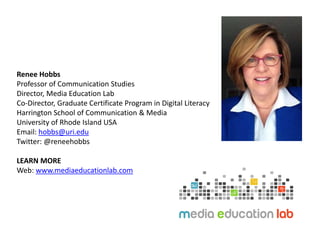
Renee Hobbs
Professor of Communication Studies
Director, Media Education Lab
Co-Director, Graduate Certificate Program in Digital Literacy
Harrington School of Communication & Media
University of Rhode Island USA
Email: hobbs@uri.edu
Twitter: @reneehobbs
LEARN MORE
Web: www.mediaeducationlab.com
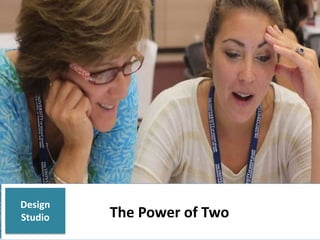
The Power of Two
Design
Studio
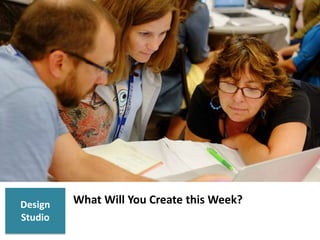
What Will You Create this Week?Design
Studio
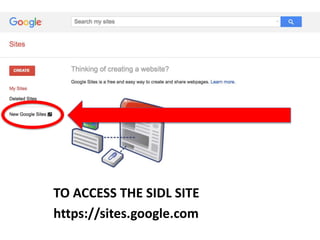
TO ACCESS THE PASSWORD-PROTECTED
SIDL SITE
https://sites.google.com
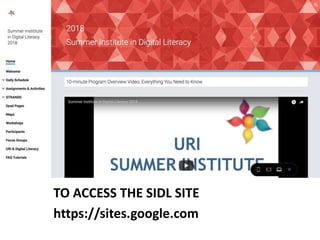
TO ACCESS THE SIDL SITE
https://sites.google.com
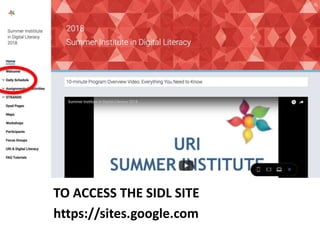
TO ACCESS THE SIDL SITE
https://sites.google.com
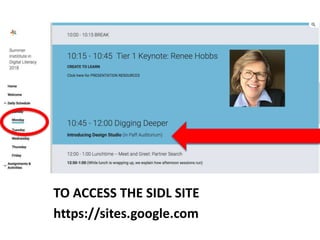
TO ACCESS THE SIDL SITE
https://sites.google.com
TO ACCESS THE SIDL SITE
https://sites.google.com
LEARNING OUTCOMES
FOR THIS SESSION
• have a better understanding of the elements
of Design Studio
• appreciate the creativity involved in the
inquiry process
• see examples of Design Studio projects
created by other educators
• appreciate the value of partnerships for
promoting creativity
• gain familiarity with Adobe Spark
• be inspired to create to learn

Create to Learn 2018 - Hobbs

  • 1.
    Renee Hobbs University ofRhode Island Media Education Lab Email: hobbs@uri.edu Twitter: @reneehobbs CREATE TO LEARN #digiURI ACCESS SLIDES: bit.ly/create-learn
  • 3.
    Authorship is acreative and collaborative process that involves experimentation and risk taking. Students take on authority when they have a real audience and strategic purpose. When we create, we build upon what we have previously learned through comprehending & critiquing other media texts. Authors benefit from laws that enable people to engage in cultural conversation through using and sharing the ideas of others. Digital authorship is a form of social power that enables people to respond to the increasing diversity of information, entertainment & persuasion in contemporary society. PREVIEW
  • 4.
    How do weprepare people for an unknowable future?
  • 5.
  • 10.
    Learners may inferfrom digital culture that being angry or mean will attract attention
  • 12.
    @reneehobbs Media & TechnologyCreate Unreal Realities
  • 13.
  • 14.
    How do weprepare learners for their social responsibilities as consumers and creators?
  • 15.
    LOVE HATE PRINT VISUALSOUND DIGITAL Attitudes about AUTHORSHIP shape how educators use media resources for learning
  • 17.
    TEXT: a symbolicunit of form and meaning
  • 18.
    Authors are the guardiansof collective memory Who is an Author?
  • 19.
    Authors are autonomousindividuals with vivid sensations and a powerful overflow of spontaneous feelings that get articulated through creative expression. Who is an Author?
  • 20.
    Who is anAuthor? Lone Wolf Collaborator
  • 21.
  • 22.
    Authors are Unknowable Itis impossible to truly understand an author’s motives, goals and intentions….
  • 23.
    Authorship is about control,power and the management of meaning and of people as much as it is about creativity and innovation. Authorship is a Form of Social Power
  • 25.
    We Are AllDIGITAL AUTHORS
  • 26.
    As you watch,consider: How does this video depict the the way learners create media?
  • 28.
    DISCUSS: Why is becomingan author a transformative experience?
  • 29.
    Authorship is acreative and collaborative process that involves experimentation and risk taking. Students take on authority when they have a real audience and strategic purpose.
  • 30.
    We know fromProject Information Literacy that students actively try to reduce the number of choices they have to make in order to get their assignments done. We know from the Citation Project that first year college students who use sources in their writing rarely write about them with much understanding. They don’t summarize sources, they harvest quotes. Nearly half the time, the quotes they use are from the first page of the source. We
  • 31.
    Talking Back to Mediawith the MEDIA LITERACY SMARTPHONE
  • 32.
    Kami PDF &Document Markup http://chrome.google.com A Student PDF Annotation
  • 33.
    A Student Annotatesa Video ANT Video Annotation https://ant.umn.edu/
  • 34.
    Finding, organizing &comprehending information are all practices of digital authorship comprehension meaning interpretation search storage & retrieval curation
  • 36.
    As you watch,consider: What skills & competencies are engaged?
  • 37.
    Screencasting for ReadingFluency Screencast-o-Matic http://screencast-o-matic.com
  • 38.
    As you watch,consider: What skills & competencies are engaged?
  • 39.
    Screencasting as LiteraryAnalysis Screencast-o-Matic http://screencast-o-matic.com
  • 40.
    How does digitalauthorship advance intellectual curiosity?
  • 41.
  • 42.
    At any moment,the reader is ready to turn into a writer. -Walter Benjamin
  • 43.
    CHOICE MATTERS Hobbs, R. (2017).Create to Learn. NY: Wiley. BLOGS VIDEO PODCAST ANIMATION INFOGRAPHIC VLOGS & SCREENCAST
  • 44.
    Cloud-Based Digital ToolsSupport Digital Authorship Writing KidBlog Google Docs Wikispaces Storybird Animation Animoto Powtoons OSnap Moovly Screencasting Screencastify Screencast-o-Matic Podcasting Anchor FM Video Production YouTube WeVideo Shadow Puppet Kizoa Adobe Spark Coding Scratch Ready Infographics Infogr.am Easel.ly
  • 45.
    Trial & ErrorLearning Promotes Intellectual Curiosity
  • 46.
  • 47.
  • 49.
  • 50.
    The PURPOSE OFCOPYRIGHT is to promote creativity, innovation and the spread of knowledge Article 1 Section 8 U.S. Constitution
  • 51.
    Author’s Rights 1. theright to reproduce the copyrighted work; 2. the right to prepare derivative works based upon the work; 3. the right to distribute copies of the work to the public; 4. the right to perform the copyrighted work publicly; and 5. the right to display the copyrighted work publicly. The Copyright Act grants five rights to a copyright owner:
  • 52.
  • 53.
    Ask Permission PAY ALICENSE FEE CLAIM FAIR USE Just Use it DON’T USE IT SELECT PUBLIC DOMAIN, ROYALTY-FREE or CREATIVE COMMONS LICENSED CONTENT Using Copyrighted Materials Choices for the Creative Individual
  • 54.
    Section 107 The Doctrineof Fair Use …the legal right to use copyrighted materials without payment or permission when the benefit to society is greater than the harm caused to the copyright holder
  • 55.
    Fair Use CreatesBalance OWNERS USERS USER RIGHTS SECTION 107
  • 56.
  • 57.
    1. Did myuse re-purpose or transform the copyrighted material? Did I add value? 2. Did I merely re-transmit the original work? Could my work serve as a substitute or replacement for the original work? 3. Did I use only the amount I needed to accomplish my purpose? Is Your Use of Copyrighted Materials a Fair Use?
  • 58.
    When we create,we build upon what we have previously learned through comprehending & critiquing other media texts. Authors benefit from laws that enable people to engage in cultural conversation through using, sharing and building upon the ideas of others.
  • 59.
    How do peoplelearn to take on the social & civic responsibilities of authorship?
  • 60.
    Creating with digitalmedia involves a process of messy engagement
  • 61.
    FORMATCONTENT AUDIENCEPROCESS Standard Practice Essayin MLA Format Teacher Turn in a rough draft on Friday Summarize Key Insights from the Reading
  • 62.
    FORMATCONTENT AUDIENCEPROCESS Supporting LearningThrough a Mix of Both Creative Freedom & Creative Control You Decide Class BlogWork with a Partner Under Deadline Pressure Causes of the French Revolution Essay, image slideshow, podcast, infographic, video, animation, screencast, vlog, social media
  • 63.
    FORMATCONTENT AUDIENCEPROCESS Supporting LearningThrough a Mix of Both Creative Freedom & Creative Control You Decide Class Blog Work Under Deadline Pressure You Decide GENIUS HOUR
  • 64.
    FORMATCONTENT AUDIENCEPROCESS COM 416 Propaganda Aset of 5 memes You DecideUse a Meme Generator & Work Under Deadline Pressure Summarize Key Insights from the Reading on Propaganda Family, friends, co-workers, future employers, the world
  • 65.
  • 66.
  • 67.
  • 68.
  • 69.
  • 70.
    Digital authorship isa form of social power that enables people respond to the increasing diversity of information, entertainment & persuasion in contemporary society
  • 71.
  • 72.
    Digital authorship isa creative and collaborative process that involves experimentation and risk taking. Students take on authority when they have a real audience and strategic purpose. When they create, students build upon what they have previously learned through comprehending other media texts. Digital authors benefit from laws that enable people to engage in cultural conversation through using and sharing the ideas of others. Digital authorship is a form of social power that enables people to respond to the increasing diversity of information, entertainment & persuasion in contemporary society. REVIEW
  • 73.
    How are yourstudents “creating to learn” in your classroom? How are you supporting the development of students’ authority as digital authors? What current activities could be modified so that students experience the power of digital authorship? What potential impact might these experiences have for learners?
  • 74.
    Renee Hobbs Professor ofCommunication Studies Director, Media Education Lab Co-Director, Graduate Certificate Program in Digital Literacy Harrington School of Communication & Media University of Rhode Island USA Email: hobbs@uri.edu Twitter: @reneehobbs LEARN MORE Web: www.mediaeducationlab.com
  • 75.
    The Power ofTwo Design Studio
  • 76.
    What Will YouCreate this Week?Design Studio
  • 77.
    TO ACCESS THEPASSWORD-PROTECTED SIDL SITE https://sites.google.com
  • 78.
    TO ACCESS THESIDL SITE https://sites.google.com
  • 79.
    TO ACCESS THESIDL SITE https://sites.google.com
  • 80.
    TO ACCESS THESIDL SITE https://sites.google.com
  • 81.
    TO ACCESS THESIDL SITE https://sites.google.com
  • 82.
    LEARNING OUTCOMES FOR THISSESSION • have a better understanding of the elements of Design Studio • appreciate the creativity involved in the inquiry process • see examples of Design Studio projects created by other educators • appreciate the value of partnerships for promoting creativity • gain familiarity with Adobe Spark • be inspired to create to learn