Kevin R. Burkitt
M.A., EducationalTechnology
MediaTechnician Specialist
Spring 2014
 Merriam-Webster defines Social Media as:
“forms of electronic communication (as web
sites for social networking and
microblogging) through which users create
online communities to share
information, ideas, personal messages, and
other content (as videos).”
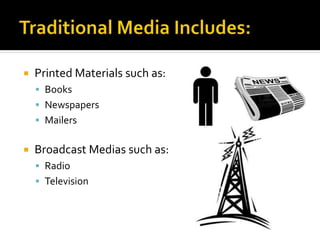
 Printed Materials such as:
 Books
 Newspapers
 Mailers
 Broadcast Medias such as:
 Radio
 Television
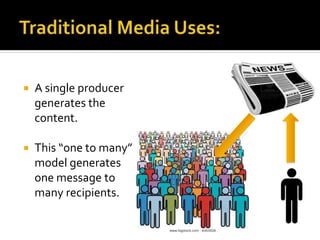
 A single producer
generates the
content.
 This “one to many”
model generates
one message to
many recipients.
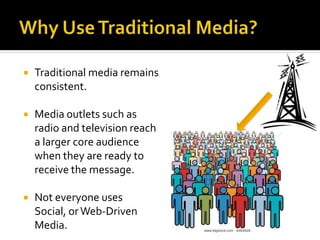
 Traditional media remains
consistent.
 Media outlets such as
radio and television reach
a larger core audience
when they are ready to
receive the message.
 Not everyone uses
Social, orWeb-Driven
Media.
 That traditional media
as we know it is no
longer
viable, effective, or
sufficient.
 However, one can not
ignore the
history, legacy, and
impact of these
mediums.
 Instead of eliminating
them, traditional
media needs to be
blended with new
“social” media
applications to
ensure that the core
audience continues
to be reached
regardless of how
media is consumed.
 That print and
broadcast media have
been adversely
affected by web-based
media.
 That there is time to
re-think how these
mediums are being
utilized and how they
can be re-purposed to
fit with today’s web-
driven models.
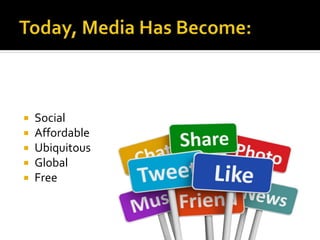
 Social
 Affordable
 Ubiquitous
 Global
 Free
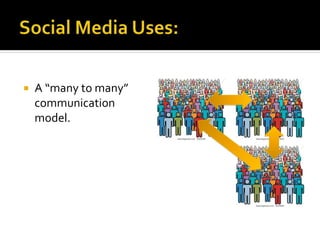
 A “many to many”
communication
model.
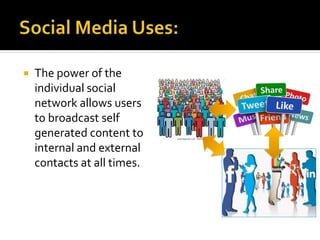
 The power of the
individual social
network allows users
to broadcast self
generated content to
internal and external
contacts at all times.
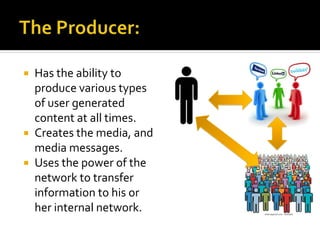
 Has the ability to
produce various types
of user generated
content at all times.
 Creates the media, and
media messages.
 Uses the power of the
network to transfer
information to his or
her internal network.
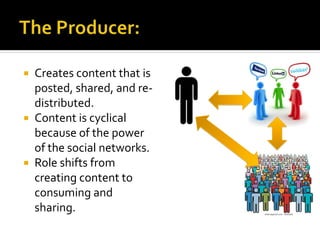
 Creates content that is
posted, shared, and re-
distributed.
 Content is cyclical
because of the power
of the social networks.
 Role shifts from
creating content to
consuming and
sharing.
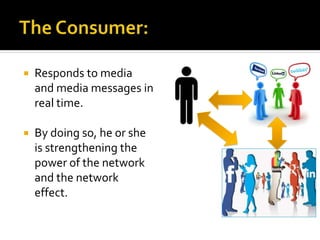
 Responds to media
and media messages in
real time.
 By doing so, he or she
is strengthening the
power of the network
and the network
effect.
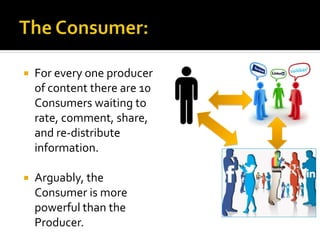
 For every one producer
of content there are 10
Consumers waiting to
rate, comment, share,
and re-distribute
information.
 Arguably, the
Consumer is more
powerful than the
Producer.
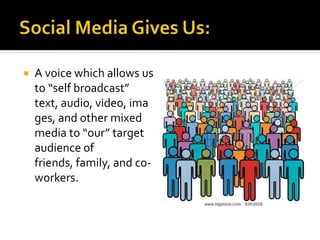
 A voice which allows us
to “self broadcast”
text, audio, video, ima
ges, and other mixed
media to “our” target
audience of
friends, family, and co-
workers.
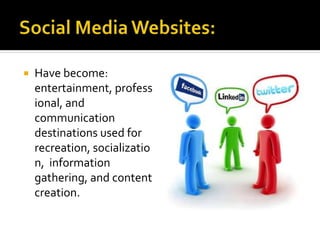
 Have become:
entertainment, profess
ional, and
communication
destinations used for
recreation, socializatio
n, information
gathering, and content
creation.
 The primary way in
which many people
gather non-
vetted, real-time
information about:
social, political, econo
mical, and
entertainment events
which pertain to their
direct interests.
 Arguably, Facebook is
the largest Social
Networking website
used today.
 Facebook’s use of the
open graph, along with
advances in how
information is
shared, makes this site
the most powerful Social
Networking website
being used today.
 However, there are
concerns with how
Facebook uses their
privacy settings and data
gathering methods to
target the end user.
 There is additional
concern with how
Facebook data mines
user information as well.
 In many
respects, Facebook
may become more
than a social network
by becoming a data
haven for targeted
data driven decision
making.
 Instagram started as
an independent mobile
application which
allowed users to take
pictures, stylize
them, and post them
to an independent
social network using
their iPhones.
 After the acquisition of
Instagram, Facebook
changed the
architecture to make
Instagram more like
Twitter, a
microblogging
website.
 Today, 150 million
people access
Instagram monthly.
 16.8 billion photos are
shared each month.
 There are 1.2 billion
likes daily.
 Approximately 55
million photos are
shared daily.
 Started in
2005,YouTube became
the first website which
allowed anyone to
upload video content
to the Internet
regardless of format.
 Users create channels
based on their
individual interests and
build a following based
on the “quality” of
their videos
 TodayYouTube is
owned by Google.
 More than 1 billion
unique users visit
YouTube each month.
 Over 6 billion hours of
video are watched
each month on
YouTube.
 100 hours of video are
uploaded toYouTube
every minute.
 80% ofYouTube traffic
comes from outside
the US.
 YouTube is localized in
61 countries and across
61 languages.
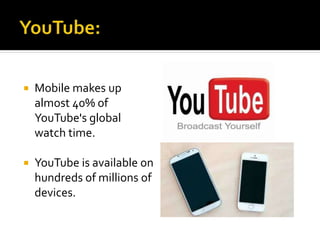
 Mobile makes up
almost 40% of
YouTube's global
watch time.
 YouTube is available on
hundreds of millions of
devices.
 Twitter started in 2006 as
a microblogging service
and was limited to 140
text (txt) characters at a
time.
 There are approximately
645,750,000 registered
users today.
 Since 2006, there have
been approximately 300
billion tweets sent.
 43% of users are using
Twitter on mobile
devices.
 Approximately 135,000
new users sign up for
Twitter every day.
 The average account
has approximately 200
followers.
 Since 2003, LinkedIn
has become the
premier Social
Network for working
professionals.
 Individuals can upload
and share
resumes’, contact
information, and job
postings.
 LinkedIn is used by:
speakers, leaders, cons
ultants, designers, engi
neers, bloggers, organi
zations and even
schools to collaborate
and learn.
 There are approximately
238 million registered
users in 200 countries and
territories world wide.
 There are 84 million users
in the United States.
 LinkedIn supports 1.5
million sub groups.
 In 2012, LinkedIn
purchased
SlideShare, a slide
building website which
allows the user to
create shareable
content online.
 In 2003 WordPress
started as an open
source project to make
blogging easier.
 Over time,WordPress
has become a website
development tool and
content manager
designed to create
both internal and
external websites.
 WordPress requires a
basic hosting service
capable of handling
the back-end
architecture which will
allow the end user to
create just about
anything.
 WordPress is used for
approximately 18.9%
of the top 10 million
websites.
 WordPress is the most
popular blogging
system with more than
60 million active
blogspots.
 “a social media
management system
for businesses and
organizations to
collaboratively execute
campaigns across
multiple social
networks from one
secure, web-based
dashboard.”
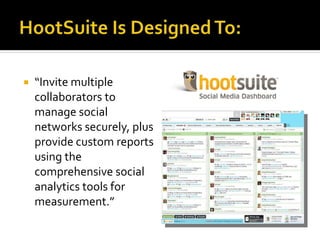
 “Invite multiple
collaborators to
manage social
networks securely, plus
provide custom reports
using the
comprehensive social
analytics tools for
measurement.”
 In 2012, over 700
million messages have
been sent through over
6 million unique social
profiles.
 Currently HootSuite
has 4.5 million
business users.
 The re-distribution of materials using a
blended approach will help to reach a new
core audience of
faculty, staff, students, community members
and constituents.
 Choosing the right Social Media outlet is
critical when reaching and maintaining a
social audience.
 Choosing the right Social Media network
should be application dependent.
 Social Media outlets such asYouTube should
be used to cross promote existing video
content along with new marketing initiatives
presented to Brookdale
Television, faculty, and campus groups.
 Additionally, Social Media outlets such as
Twitter, Instagram, and Facebook should be
used in real time to inform the audience of
happenings and events.
 Subsequently, these same mediums ought to
be be used by Brookdalians to share
information about the campus community
and beyond.
 All of these outlets ought to be used in
conjunction with the Brookdale Newsroom to
promote current projects, events, and
happenings at Brookdale regardless of
physical location.
 Engaging the former audience while building
a new social audience has to be recognized as
a goal of the institution.
 Finally, using tools like HootSuite to generate
content, parse data, and generate reports
based off analytical data will help the College
determine how Social Media implementation
can benefit the institution.
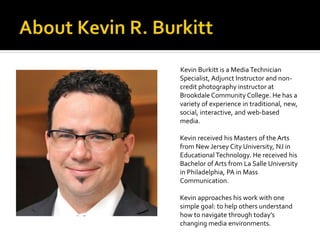
Kevin Burkitt is a Media Technician
Specialist, Adjunct Instructor and non-
credit photography instructor at
Brookdale Community College. He has a
variety of experience in traditional, new,
social, interactive, and web-based
media.
Kevin received his Masters of the Arts
from New Jersey City University, NJ in
Educational Technology. He received his
Bachelor of Arts from La Salle University
in Philadelphia, PA in Mass
Communication.
Kevin approaches his work with one
simple goal: to help others understand
how to navigate through today’s
changing media environments.
 Kevin R. Burkitt, M.A., Educational
Technology
 kburkitt77@gmail.com
 www.linkedin.com/pub/kevin-burkitt/8a/4a0/b50
 http://www.merriam-webster.com/dictionary/social%20media
 MSNBCVideo: The Facebook Obsession
http://www.cnbc.com/id/39618344
 http://instagram.com/press/#
 http://www.youtube.com/yt/press/
 http://www.youtube.com/yt/press/statistics.html
 http://www.statisticbrain.com/twitter-statistics/
 http://expandedramblings.com/index.php/by-the-numbers-a-few-
important-linkedin-stats/#.Uzl0Dl7O5e8
 http://visual.ly/wordpress-statistics-and-numbers-2013
 https://hootsuite.com/company
 http://techcrunch.com/2012/09/06/hootsuite-ceo-were-buying-
seesmic-for-the-customer-base-not-the-tech/

Social Media Relations: Navigating The Shift From Traditional To New Media

  • 1.
    Kevin R. Burkitt M.A.,EducationalTechnology MediaTechnician Specialist Spring 2014
  • 2.
     Merriam-Webster definesSocial Media as: “forms of electronic communication (as web sites for social networking and microblogging) through which users create online communities to share information, ideas, personal messages, and other content (as videos).”
  • 4.
     Printed Materialssuch as:  Books  Newspapers  Mailers  Broadcast Medias such as:  Radio  Television
  • 5.
     A singleproducer generates the content.  This “one to many” model generates one message to many recipients.
  • 6.
     Traditional mediaremains consistent.  Media outlets such as radio and television reach a larger core audience when they are ready to receive the message.  Not everyone uses Social, orWeb-Driven Media.
  • 7.
     That traditionalmedia as we know it is no longer viable, effective, or sufficient.  However, one can not ignore the history, legacy, and impact of these mediums.
  • 8.
     Instead ofeliminating them, traditional media needs to be blended with new “social” media applications to ensure that the core audience continues to be reached regardless of how media is consumed.
  • 9.
     That printand broadcast media have been adversely affected by web-based media.  That there is time to re-think how these mediums are being utilized and how they can be re-purposed to fit with today’s web- driven models.
  • 11.
     Social  Affordable Ubiquitous  Global  Free
  • 12.
     A “manyto many” communication model.
  • 13.
     The powerof the individual social network allows users to broadcast self generated content to internal and external contacts at all times.
  • 14.
     Has theability to produce various types of user generated content at all times.  Creates the media, and media messages.  Uses the power of the network to transfer information to his or her internal network.
  • 15.
     Creates contentthat is posted, shared, and re- distributed.  Content is cyclical because of the power of the social networks.  Role shifts from creating content to consuming and sharing.
  • 16.
     Responds tomedia and media messages in real time.  By doing so, he or she is strengthening the power of the network and the network effect.
  • 17.
     For everyone producer of content there are 10 Consumers waiting to rate, comment, share, and re-distribute information.  Arguably, the Consumer is more powerful than the Producer.
  • 19.
     A voicewhich allows us to “self broadcast” text, audio, video, ima ges, and other mixed media to “our” target audience of friends, family, and co- workers.
  • 20.
     Have become: entertainment,profess ional, and communication destinations used for recreation, socializatio n, information gathering, and content creation.
  • 21.
     The primaryway in which many people gather non- vetted, real-time information about: social, political, econo mical, and entertainment events which pertain to their direct interests.
  • 23.
     Arguably, Facebookis the largest Social Networking website used today.  Facebook’s use of the open graph, along with advances in how information is shared, makes this site the most powerful Social Networking website being used today.
  • 24.
     However, thereare concerns with how Facebook uses their privacy settings and data gathering methods to target the end user.  There is additional concern with how Facebook data mines user information as well.
  • 25.
     In many respects,Facebook may become more than a social network by becoming a data haven for targeted data driven decision making.
  • 26.
     Instagram startedas an independent mobile application which allowed users to take pictures, stylize them, and post them to an independent social network using their iPhones.
  • 27.
     After theacquisition of Instagram, Facebook changed the architecture to make Instagram more like Twitter, a microblogging website.
  • 28.
     Today, 150million people access Instagram monthly.  16.8 billion photos are shared each month.
  • 29.
     There are1.2 billion likes daily.  Approximately 55 million photos are shared daily.
  • 30.
     Started in 2005,YouTubebecame the first website which allowed anyone to upload video content to the Internet regardless of format.
  • 31.
     Users createchannels based on their individual interests and build a following based on the “quality” of their videos  TodayYouTube is owned by Google.
  • 32.
     More than1 billion unique users visit YouTube each month.  Over 6 billion hours of video are watched each month on YouTube.
  • 33.
     100 hoursof video are uploaded toYouTube every minute.  80% ofYouTube traffic comes from outside the US.  YouTube is localized in 61 countries and across 61 languages.
  • 34.
     Mobile makesup almost 40% of YouTube's global watch time.  YouTube is available on hundreds of millions of devices.
  • 35.
     Twitter startedin 2006 as a microblogging service and was limited to 140 text (txt) characters at a time.  There are approximately 645,750,000 registered users today.
  • 36.
     Since 2006,there have been approximately 300 billion tweets sent.  43% of users are using Twitter on mobile devices.
  • 37.
     Approximately 135,000 newusers sign up for Twitter every day.  The average account has approximately 200 followers.
  • 38.
     Since 2003,LinkedIn has become the premier Social Network for working professionals.  Individuals can upload and share resumes’, contact information, and job postings.
  • 39.
     LinkedIn isused by: speakers, leaders, cons ultants, designers, engi neers, bloggers, organi zations and even schools to collaborate and learn.
  • 40.
     There areapproximately 238 million registered users in 200 countries and territories world wide.  There are 84 million users in the United States.  LinkedIn supports 1.5 million sub groups.
  • 41.
     In 2012,LinkedIn purchased SlideShare, a slide building website which allows the user to create shareable content online.
  • 42.
     In 2003WordPress started as an open source project to make blogging easier.  Over time,WordPress has become a website development tool and content manager designed to create both internal and external websites.
  • 43.
     WordPress requiresa basic hosting service capable of handling the back-end architecture which will allow the end user to create just about anything.
  • 44.
     WordPress isused for approximately 18.9% of the top 10 million websites.  WordPress is the most popular blogging system with more than 60 million active blogspots.
  • 45.
     “a socialmedia management system for businesses and organizations to collaboratively execute campaigns across multiple social networks from one secure, web-based dashboard.”
  • 46.
     “Invite multiple collaboratorsto manage social networks securely, plus provide custom reports using the comprehensive social analytics tools for measurement.”
  • 47.
     In 2012,over 700 million messages have been sent through over 6 million unique social profiles.  Currently HootSuite has 4.5 million business users.
  • 49.
     The re-distributionof materials using a blended approach will help to reach a new core audience of faculty, staff, students, community members and constituents.  Choosing the right Social Media outlet is critical when reaching and maintaining a social audience.
  • 50.
     Choosing theright Social Media network should be application dependent.  Social Media outlets such asYouTube should be used to cross promote existing video content along with new marketing initiatives presented to Brookdale Television, faculty, and campus groups.
  • 51.
     Additionally, SocialMedia outlets such as Twitter, Instagram, and Facebook should be used in real time to inform the audience of happenings and events.  Subsequently, these same mediums ought to be be used by Brookdalians to share information about the campus community and beyond.
  • 52.
     All ofthese outlets ought to be used in conjunction with the Brookdale Newsroom to promote current projects, events, and happenings at Brookdale regardless of physical location.  Engaging the former audience while building a new social audience has to be recognized as a goal of the institution.
  • 53.
     Finally, usingtools like HootSuite to generate content, parse data, and generate reports based off analytical data will help the College determine how Social Media implementation can benefit the institution.
  • 54.
    Kevin Burkitt isa Media Technician Specialist, Adjunct Instructor and non- credit photography instructor at Brookdale Community College. He has a variety of experience in traditional, new, social, interactive, and web-based media. Kevin received his Masters of the Arts from New Jersey City University, NJ in Educational Technology. He received his Bachelor of Arts from La Salle University in Philadelphia, PA in Mass Communication. Kevin approaches his work with one simple goal: to help others understand how to navigate through today’s changing media environments.
  • 55.
     Kevin R.Burkitt, M.A., Educational Technology  kburkitt77@gmail.com  www.linkedin.com/pub/kevin-burkitt/8a/4a0/b50
  • 56.
     http://www.merriam-webster.com/dictionary/social%20media  MSNBCVideo:The Facebook Obsession http://www.cnbc.com/id/39618344  http://instagram.com/press/#  http://www.youtube.com/yt/press/  http://www.youtube.com/yt/press/statistics.html  http://www.statisticbrain.com/twitter-statistics/  http://expandedramblings.com/index.php/by-the-numbers-a-few- important-linkedin-stats/#.Uzl0Dl7O5e8  http://visual.ly/wordpress-statistics-and-numbers-2013  https://hootsuite.com/company  http://techcrunch.com/2012/09/06/hootsuite-ceo-were-buying- seesmic-for-the-customer-base-not-the-tech/