Co-Teaching Models Source:  Friend & Cook (2000).  Interactions
Objectives Define co-teaching Describe the rationale for using co-teaching Identify six approaches and examples of co-teaching
Co-teaching Rationale Meets student needs  Provides less fragmented and more contextualized instruction  Reduces stigma Provides opportunities  Creates positive social interactions Fosters sense of support
Characteristics of Co-teaching 2+ Teachers  Shared teaching responsibility Jointly deliver instruction  Curriculum may be modified Diverse group of students  Respond to range of needs Lowers student/teacher ratio Expands expertise Shared classroom space
Co-teaching Approaches One Teach ~ One Observe One Teach ~ One Assist Station Teaching Parallel Teaching Alternative Teaching Team Teaching
One Teach/One Observe Positives Little joint planning time Support teachers can learn about curriculum Effective for teachers new to collaboration Negatives Support teacher can be seen as an assistant *Use no more than 5-10% of the time!
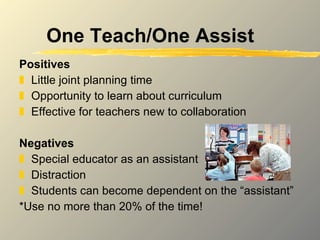
One Teach/One Assist Positives Little joint planning time Opportunity to learn about curriculum  Effective for teachers new to collaboration Negatives Special educator as an assistant Distraction Students can become dependent on the “assistant” *Use no more than 20% of the time!
Station Teaching Positives Each teacher had responsibility for delivering instruction Lower teacher to student ratio Students w/disabilities can be integrated into small groups Negatives Noise level can be distracting Movement can be distracting
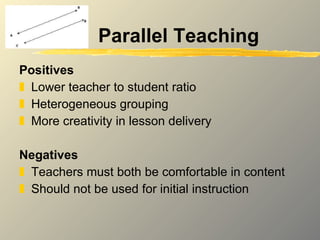
Parallel Teaching Positives Lower teacher to student ratio Heterogeneous grouping More creativity in lesson delivery Negatives Teachers must both be comfortable in content  Should not be used for initial instruction
Alternative Teaching Positives Helps with attention problem students Can re-teach, tutor, or enrich Negatives Stigmatizing Support teacher can be viewed as an assistant
Team Teaching Positives Shared responsibility Creativity in lesson delivery Innovative techniques  Negatives Greatest amount of trust and commitment Most difficult to implement
School-wide Factors that Influence Co-teaching Administrative Support Support Teacher Caseload Voluntary vs. Involuntary Participation Scheduling (for teaching and planning) Problem-solving techniques

Co teaching presentation

  • 1.
    Co-Teaching Models Source: Friend & Cook (2000). Interactions
  • 2.
    Objectives Define co-teachingDescribe the rationale for using co-teaching Identify six approaches and examples of co-teaching
  • 3.
    Co-teaching Rationale Meetsstudent needs Provides less fragmented and more contextualized instruction Reduces stigma Provides opportunities Creates positive social interactions Fosters sense of support
  • 4.
    Characteristics of Co-teaching2+ Teachers Shared teaching responsibility Jointly deliver instruction Curriculum may be modified Diverse group of students Respond to range of needs Lowers student/teacher ratio Expands expertise Shared classroom space
  • 5.
    Co-teaching Approaches OneTeach ~ One Observe One Teach ~ One Assist Station Teaching Parallel Teaching Alternative Teaching Team Teaching
  • 6.
    One Teach/One ObservePositives Little joint planning time Support teachers can learn about curriculum Effective for teachers new to collaboration Negatives Support teacher can be seen as an assistant *Use no more than 5-10% of the time!
  • 7.
    One Teach/One AssistPositives Little joint planning time Opportunity to learn about curriculum Effective for teachers new to collaboration Negatives Special educator as an assistant Distraction Students can become dependent on the “assistant” *Use no more than 20% of the time!
  • 8.
    Station Teaching PositivesEach teacher had responsibility for delivering instruction Lower teacher to student ratio Students w/disabilities can be integrated into small groups Negatives Noise level can be distracting Movement can be distracting
  • 9.
    Parallel Teaching PositivesLower teacher to student ratio Heterogeneous grouping More creativity in lesson delivery Negatives Teachers must both be comfortable in content Should not be used for initial instruction
  • 10.
    Alternative Teaching PositivesHelps with attention problem students Can re-teach, tutor, or enrich Negatives Stigmatizing Support teacher can be viewed as an assistant
  • 11.
    Team Teaching PositivesShared responsibility Creativity in lesson delivery Innovative techniques Negatives Greatest amount of trust and commitment Most difficult to implement
  • 12.
    School-wide Factors thatInfluence Co-teaching Administrative Support Support Teacher Caseload Voluntary vs. Involuntary Participation Scheduling (for teaching and planning) Problem-solving techniques