Alkaloids in Fungi


        Rayeess Ahmad Dar
         MSc. Bioresources
           Semester 3rd
          Roll No. 23352
       University of Kashmir
        Hazratbal Srinagar
Alkaloids

Alkaloids are the cyclic organic compounds
in which nitrogen forms a part of the cycle
system and are physiologically active as
poisons and drugs.
   Alkaloids are mostly produced by plants.
   However, some are derived from bacteria,
    fungi, animals.
   Synthesized from amino acids.
Classification
   1. True (Typical Alkaloids): Derived from amino
    acids and have nitrogen in a heterocyclic ring.
    Atropine.

   2. Protoalkaloids: Derived from amino acids and do
    not have nitrogen in a heterocyclic ring. Ephedrine.
   3. Pseudo alkaloids: Not derived from amino acids
    but have nitrogen in a heterocyclic ring. Caffeine.
   4. False alkaloids: Non alkaloids which give false
    positive reaction with alkaloidal reagents.
Main Functions
   They act as protective agents against insects,
    herbivores due to their bitterness and toxicity.
    So, they can be used as biopesticides and
    bioinsecticides.
   They also act as a source of nitrogen in case of
    nitrogen deficiency.
   Many of them have medicinal properties.
Some of the Alkaloids present in
             Fungi
Alkaloids From Ergot Fungi

   Ergot fungi belong to the Claviceps genera.
   These fungi affect rye (mostly), wheat, barley.
   The fungi produce alkaloids such as
    Ergotamine, Ergometrine, Ergonaline and
    various other Clavine alkaloids.
   Has the biological activity as vasoconstrictors.
Ergotamine

   It has the biological activity as a
    vasoconstrictor.
   It is used medicinally for the treatment of
    acute migrain attacks (sometimes in
    combination with caffeine).
   It has been used to prevent post-partum
    hemorrhage (bleeding after child birth).
   It was first isolated by Arthur Stoll in 1918.
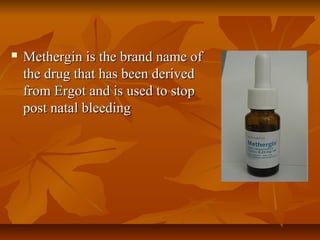
   Methergin is the brand name of
    the drug that has been derived
    from Ergot and is used to stop
    post natal bleeding
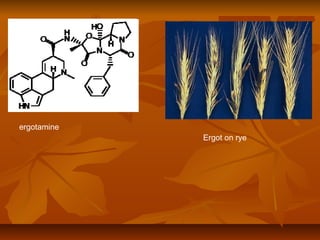
ergotamine
             Ergot on rye
   However, high doses of ergot alkaloids or
    taking the infected grains lead to Ergotism.
   It is characterized by spasms, diarrhea, head
    aches, vomiting etc.
Loline alkaloids
   These are insecticidal and insect-deterrent
    compounds.
   These are produced in grasses infected by
    endophytic fungal symbionts of the genus
    Epichloe and Neotyphodium.
   First isolated from the grass Lolium
    temulentum.
Psilocybin
   Produced by about 200 species of mushrooms
    collectively called psilocybin mushrooms (such as
    Psilocybe azurescens, P. cyanescens and a number of
    other genera).
   When ingested, psilocybin is turned into psilocin
    within the body, which in turn is responsible for
    hallucinations, changes in perception, a distorted
    sense of time and can include possible adverse
    reactions such as nausea and panic attacks.
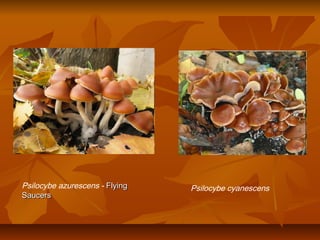
Psilocybe azurescens - Flying   Psilocybe cyanescens
Saucers
Oxaline
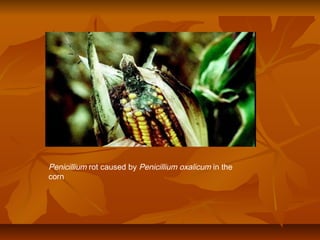
   Derived from Penicillium oxalicum, which
    usually grows on dead and decaying matter.
   This alkaloid was found to arrest the cell cycle
    by inhibition of tubulin polymerisation.
Penicillium rot caused by Penicillium oxalicum in the
corn
Paramine
   Produced by some grass infecting
    Neotyphodium species.
   The alkaloid protects the grass againest
    grazing by mammals and insects.
   This alkaloid can also be used as
    bioinsecticide and biopesticide.

Alkaloids in fungi

  • 1.
    Alkaloids in Fungi Rayeess Ahmad Dar MSc. Bioresources Semester 3rd Roll No. 23352 University of Kashmir Hazratbal Srinagar
  • 2.
    Alkaloids Alkaloids are thecyclic organic compounds in which nitrogen forms a part of the cycle system and are physiologically active as poisons and drugs.
  • 3.
    Alkaloids are mostly produced by plants.  However, some are derived from bacteria, fungi, animals.  Synthesized from amino acids.
  • 4.
    Classification  1. True (Typical Alkaloids): Derived from amino acids and have nitrogen in a heterocyclic ring. Atropine.  2. Protoalkaloids: Derived from amino acids and do not have nitrogen in a heterocyclic ring. Ephedrine.  3. Pseudo alkaloids: Not derived from amino acids but have nitrogen in a heterocyclic ring. Caffeine.  4. False alkaloids: Non alkaloids which give false positive reaction with alkaloidal reagents.
  • 5.
    Main Functions  They act as protective agents against insects, herbivores due to their bitterness and toxicity. So, they can be used as biopesticides and bioinsecticides.  They also act as a source of nitrogen in case of nitrogen deficiency.  Many of them have medicinal properties.
  • 6.
    Some of theAlkaloids present in Fungi
  • 7.
    Alkaloids From ErgotFungi  Ergot fungi belong to the Claviceps genera.  These fungi affect rye (mostly), wheat, barley.  The fungi produce alkaloids such as Ergotamine, Ergometrine, Ergonaline and various other Clavine alkaloids.  Has the biological activity as vasoconstrictors.
  • 8.
    Ergotamine  It has the biological activity as a vasoconstrictor.  It is used medicinally for the treatment of acute migrain attacks (sometimes in combination with caffeine).  It has been used to prevent post-partum hemorrhage (bleeding after child birth).  It was first isolated by Arthur Stoll in 1918.
  • 9.
    Methergin is the brand name of the drug that has been derived from Ergot and is used to stop post natal bleeding
  • 10.
    ergotamine Ergot on rye
  • 11.
    However, high doses of ergot alkaloids or taking the infected grains lead to Ergotism.  It is characterized by spasms, diarrhea, head aches, vomiting etc.
  • 12.
    Loline alkaloids  These are insecticidal and insect-deterrent compounds.  These are produced in grasses infected by endophytic fungal symbionts of the genus Epichloe and Neotyphodium.  First isolated from the grass Lolium temulentum.
  • 13.
    Psilocybin  Produced by about 200 species of mushrooms collectively called psilocybin mushrooms (such as Psilocybe azurescens, P. cyanescens and a number of other genera).  When ingested, psilocybin is turned into psilocin within the body, which in turn is responsible for hallucinations, changes in perception, a distorted sense of time and can include possible adverse reactions such as nausea and panic attacks.
  • 14.
    Psilocybe azurescens -Flying Psilocybe cyanescens Saucers
  • 15.
    Oxaline  Derived from Penicillium oxalicum, which usually grows on dead and decaying matter.  This alkaloid was found to arrest the cell cycle by inhibition of tubulin polymerisation.
  • 16.
    Penicillium rot causedby Penicillium oxalicum in the corn
  • 17.
    Paramine  Produced by some grass infecting Neotyphodium species.  The alkaloid protects the grass againest grazing by mammals and insects.  This alkaloid can also be used as bioinsecticide and biopesticide.