PLANT BIOTECNOLOGY
TOPICS TO BE COVEREDCell Theory Plant Tissue Culture TechniquesCallus Tissue & OrganogenesisPrinciples Of GrowthPlant RegenerationConcept Of Totipotency Of CellsPlant Tissue Culture LabCulture MediaMedia ComponentsAseptic TechniquesSterilization TechniquesPoints To Remember
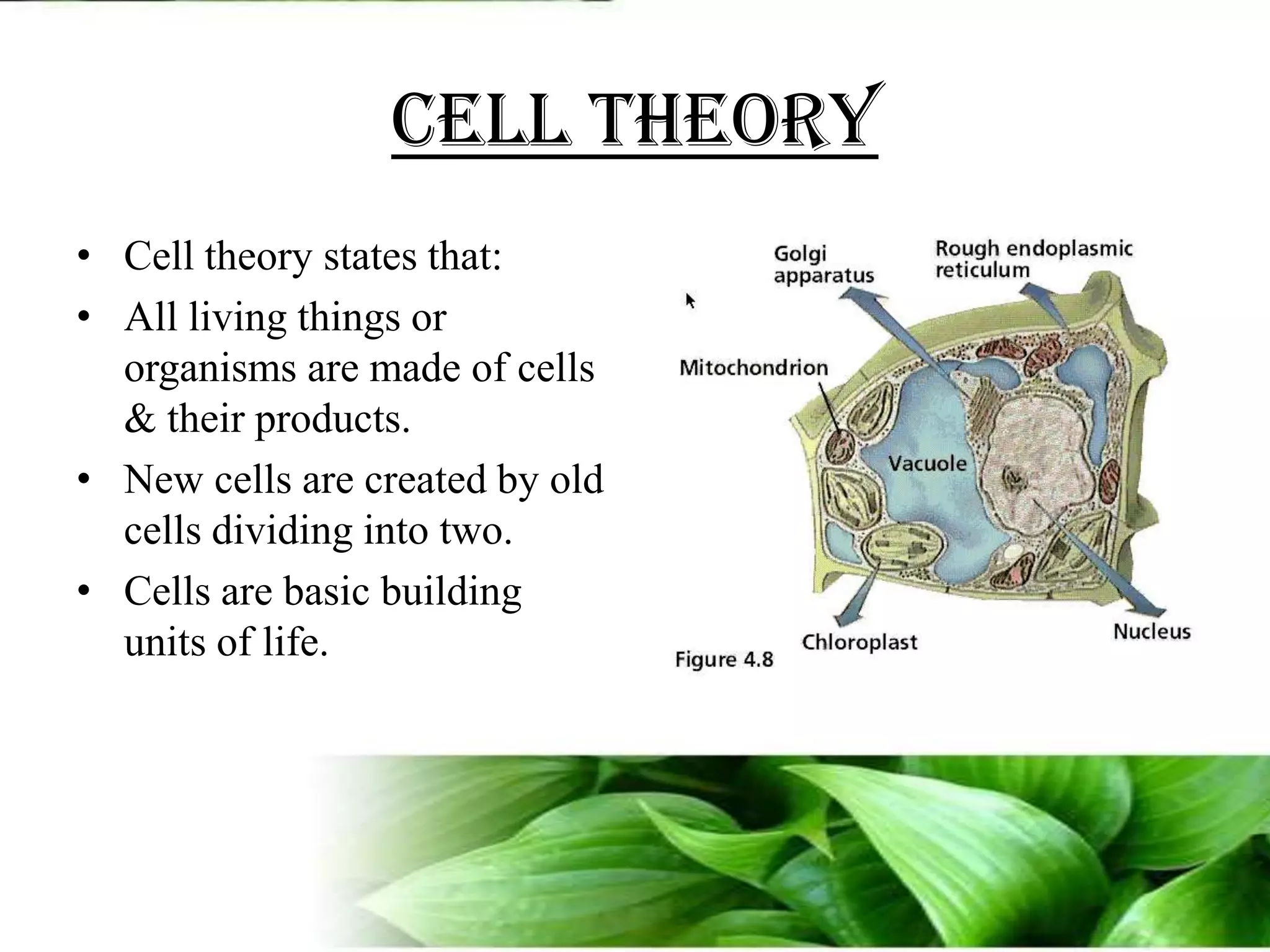
Cell TheoryCell theory states that:All living things or organisms are made of cells & their products.New cells are created by old cells dividing into two.Cells are basic building units of life.
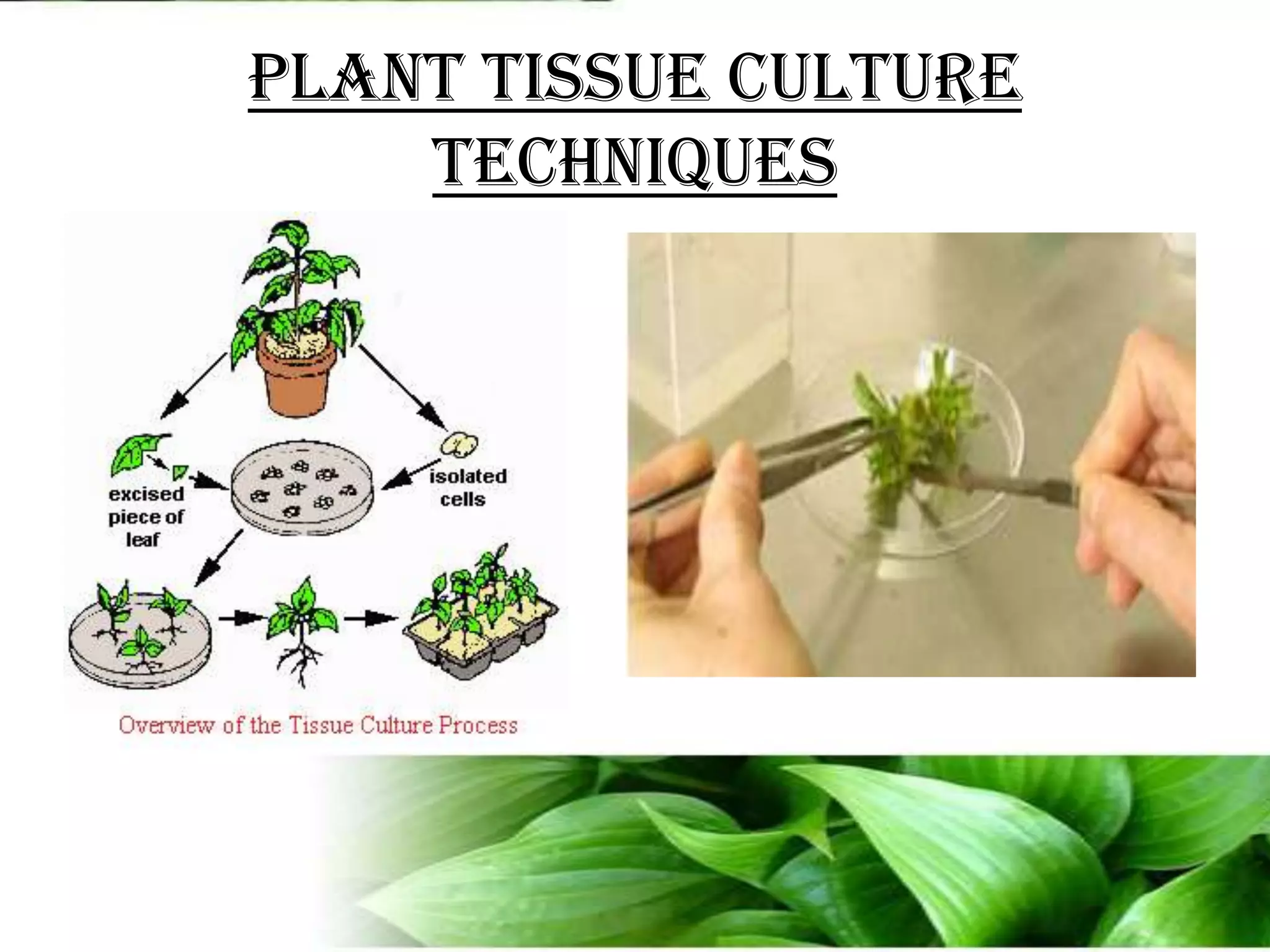
Plant tissue culture techniques
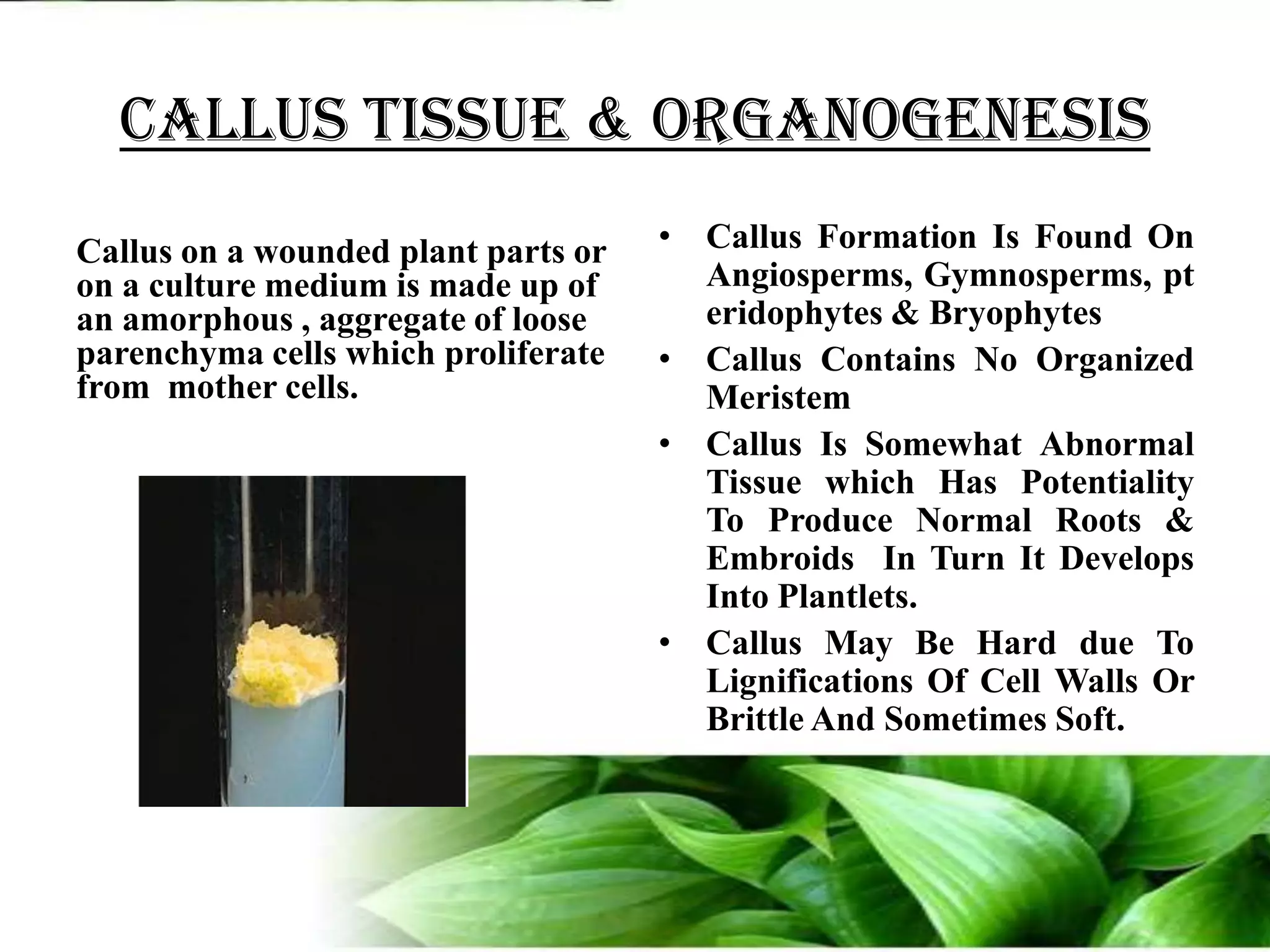
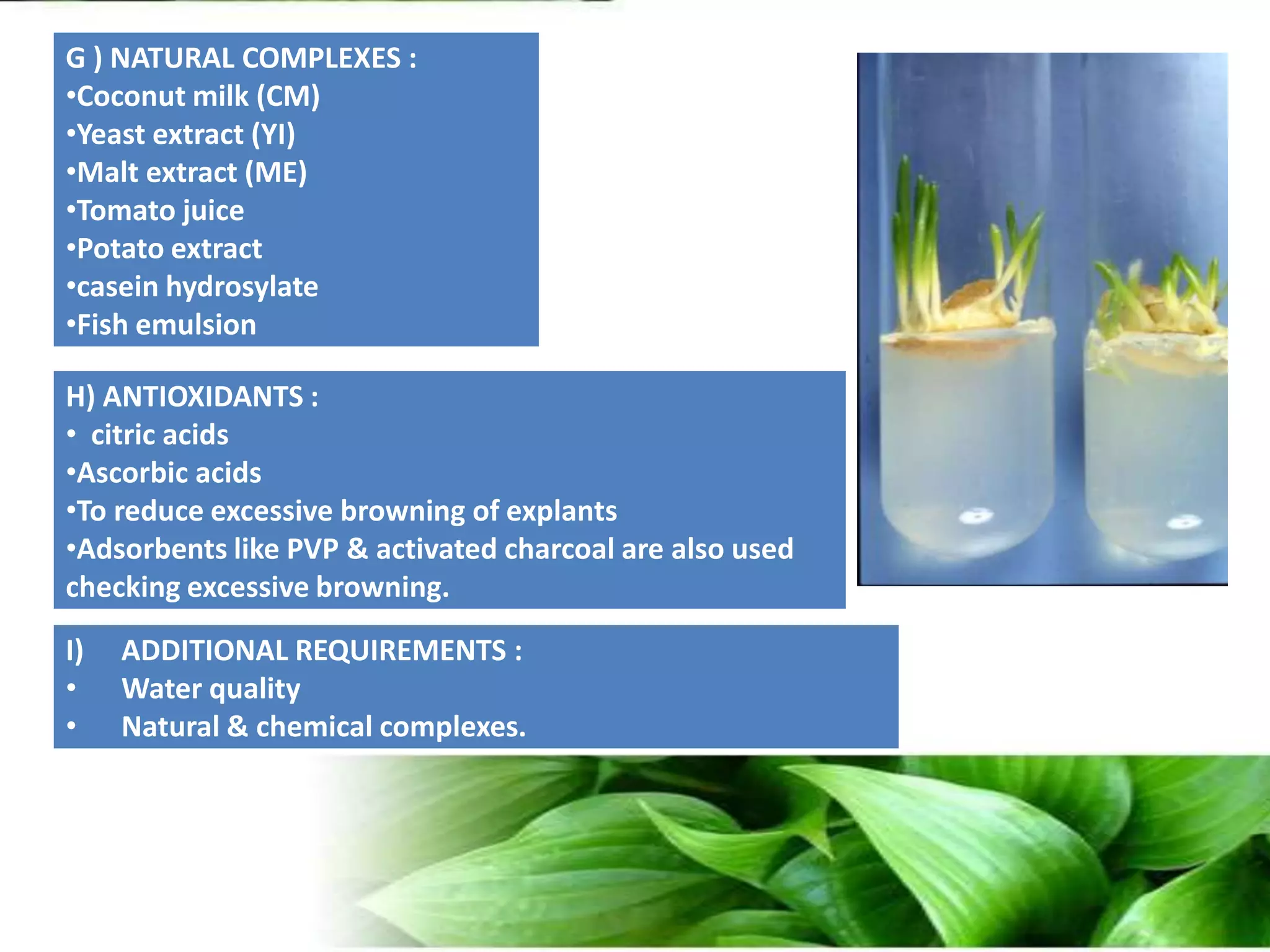
Callus tissue & organogenesisCallus Formation Is Found On Angiosperms, Gymnosperms, pteridophytes& BryophytesCallus Contains No Organized MeristemCallus Is Somewhat Abnormal Tissue which Has Potentiality To Produce Normal Roots & EmbroidsIn Turn It Develops Into Plantlets.Callus May Be Hard due To Lignifications Of Cell Walls Or Brittle And Sometimes Soft.Callus on a wounded plant parts or on a culture medium is made up of an amorphous , aggregate of loose parenchyma cells which proliferate from  mother cells.
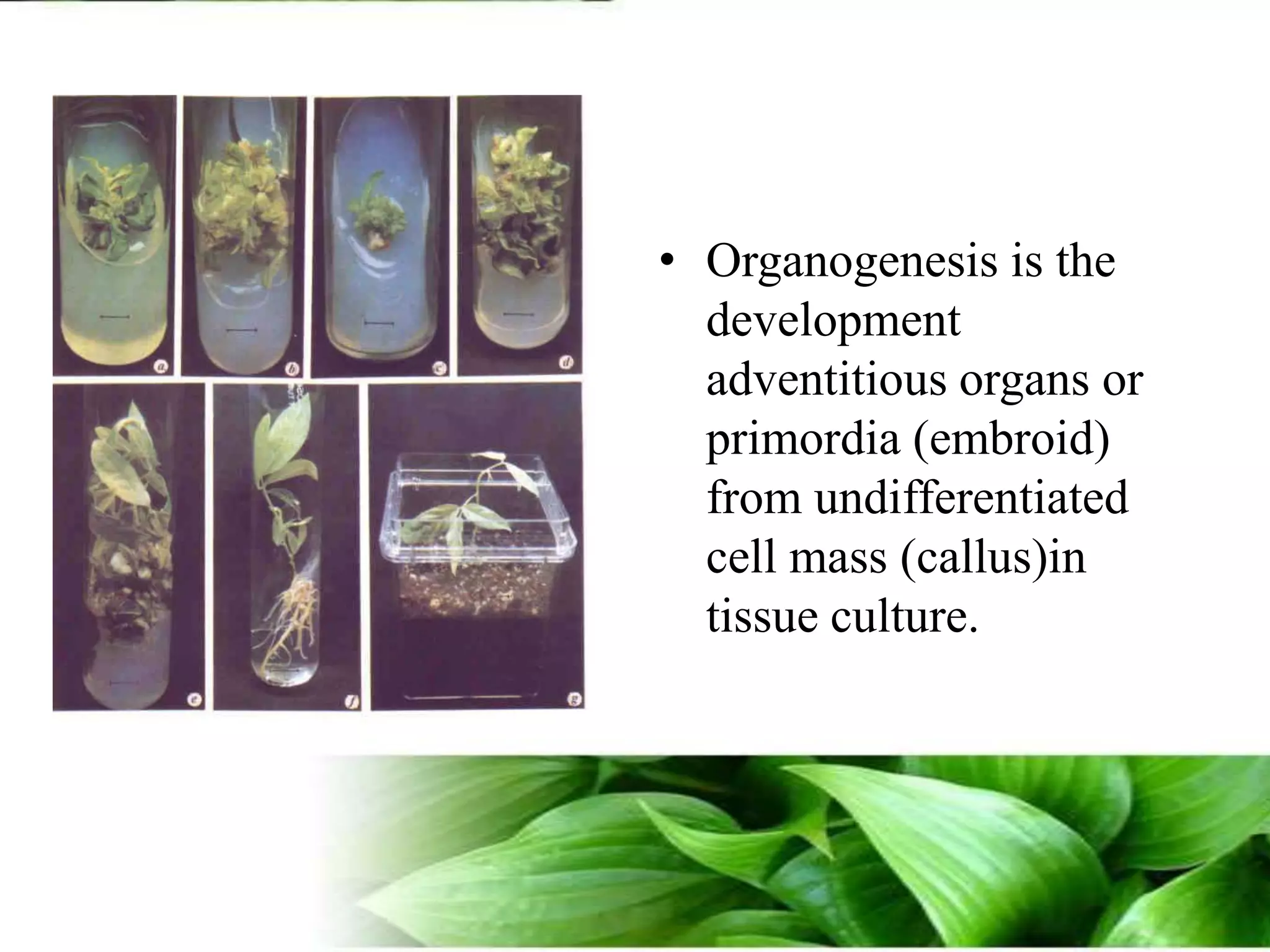
Organogenesis is the development adventitious organs or primordia (embroid) from undifferentiated cell mass (callus)in tissue culture.
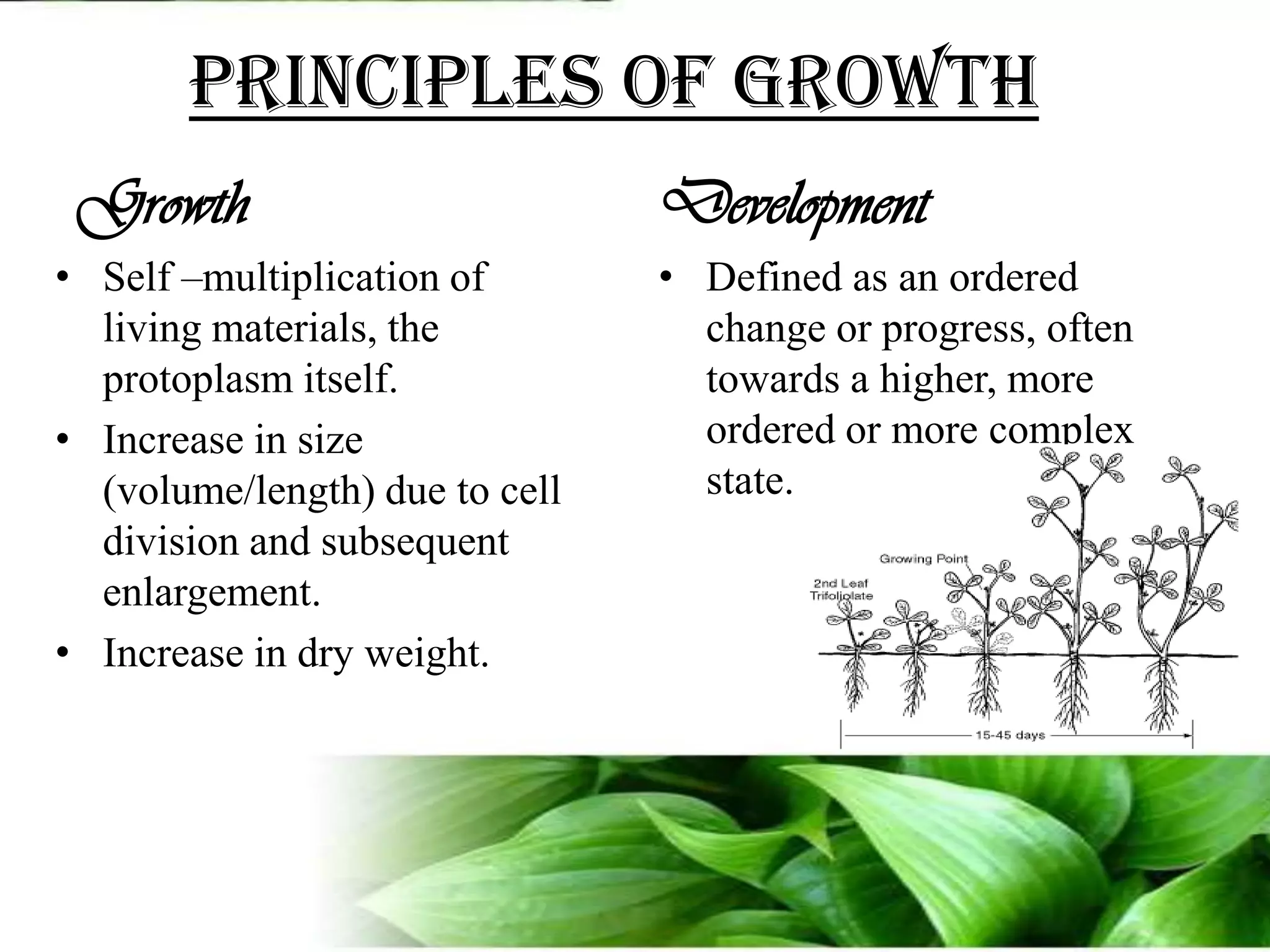
Principles of growthGrowthSelf –multiplication of living materials, the protoplasm itself.Increase in size (volume/length) due to cell division and subsequent enlargement.Increase in dry weight.DevelopmentDefined as an ordered change or progress, often towards a higher, more ordered or more complex state.
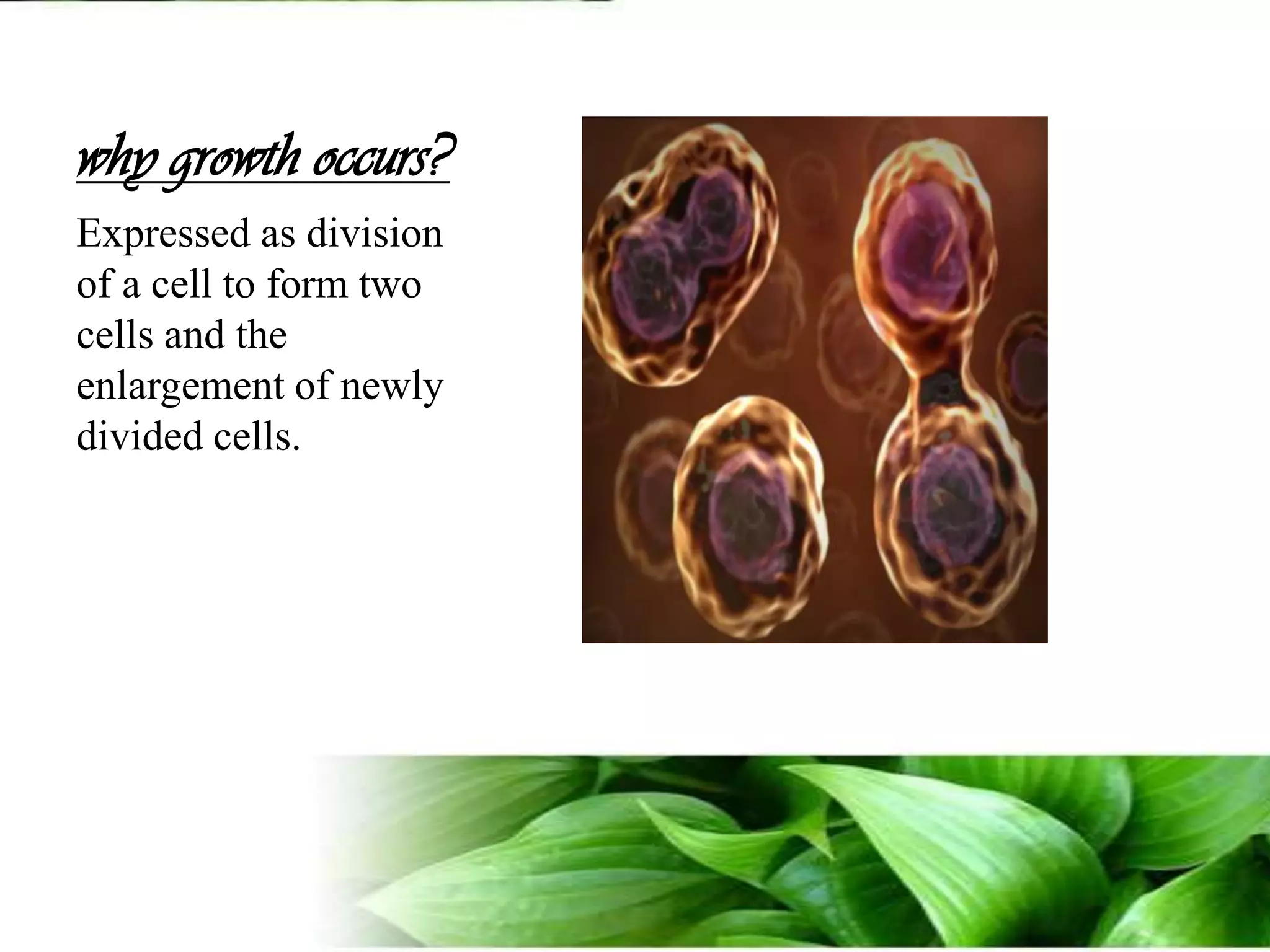
why growth occurs?Expressed as division of a cell to form two cells and the enlargement of newly divided cells.
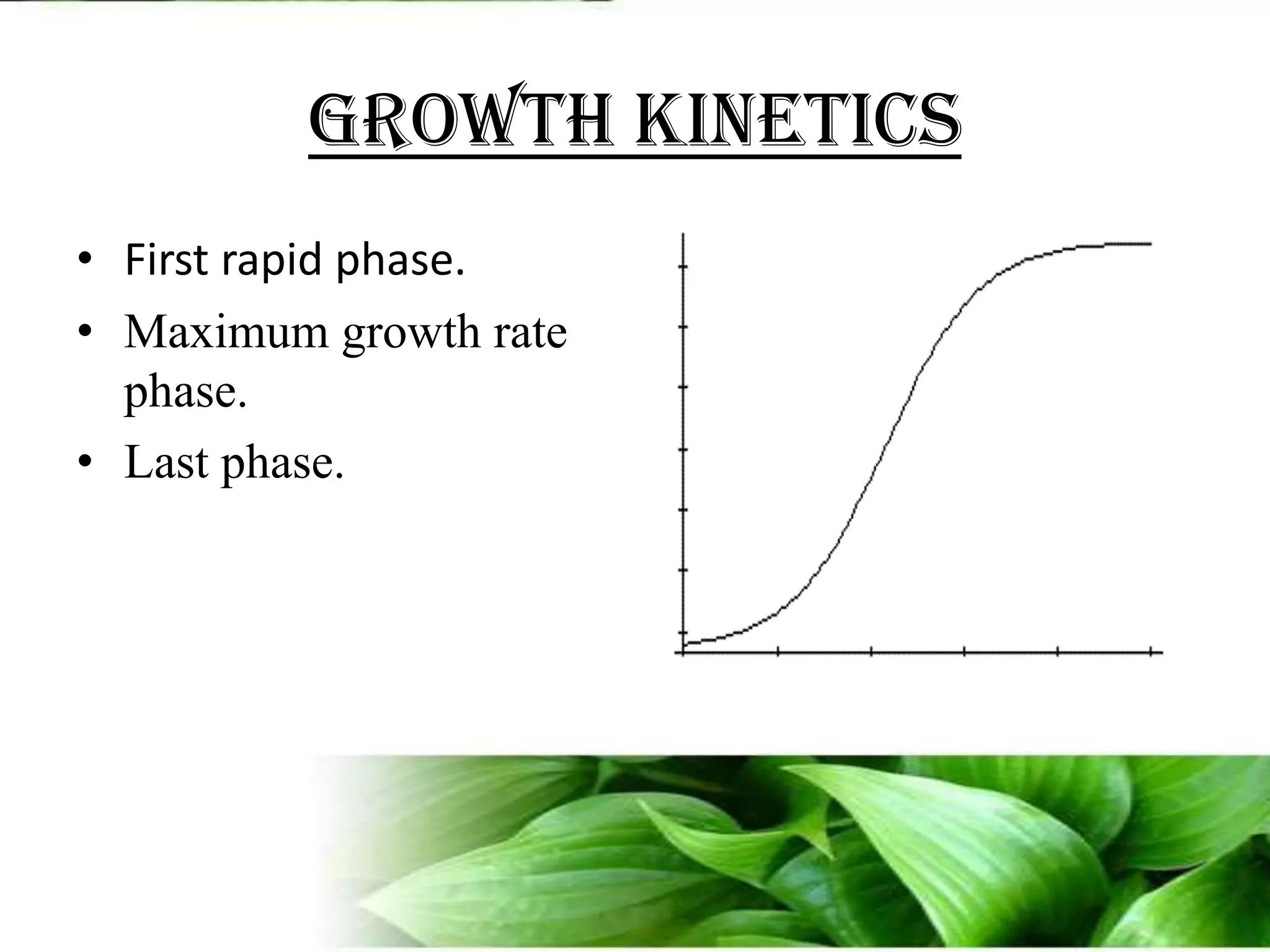
Growth kineticsFirst rapid phase.Maximum growth rate phase.Last phase.
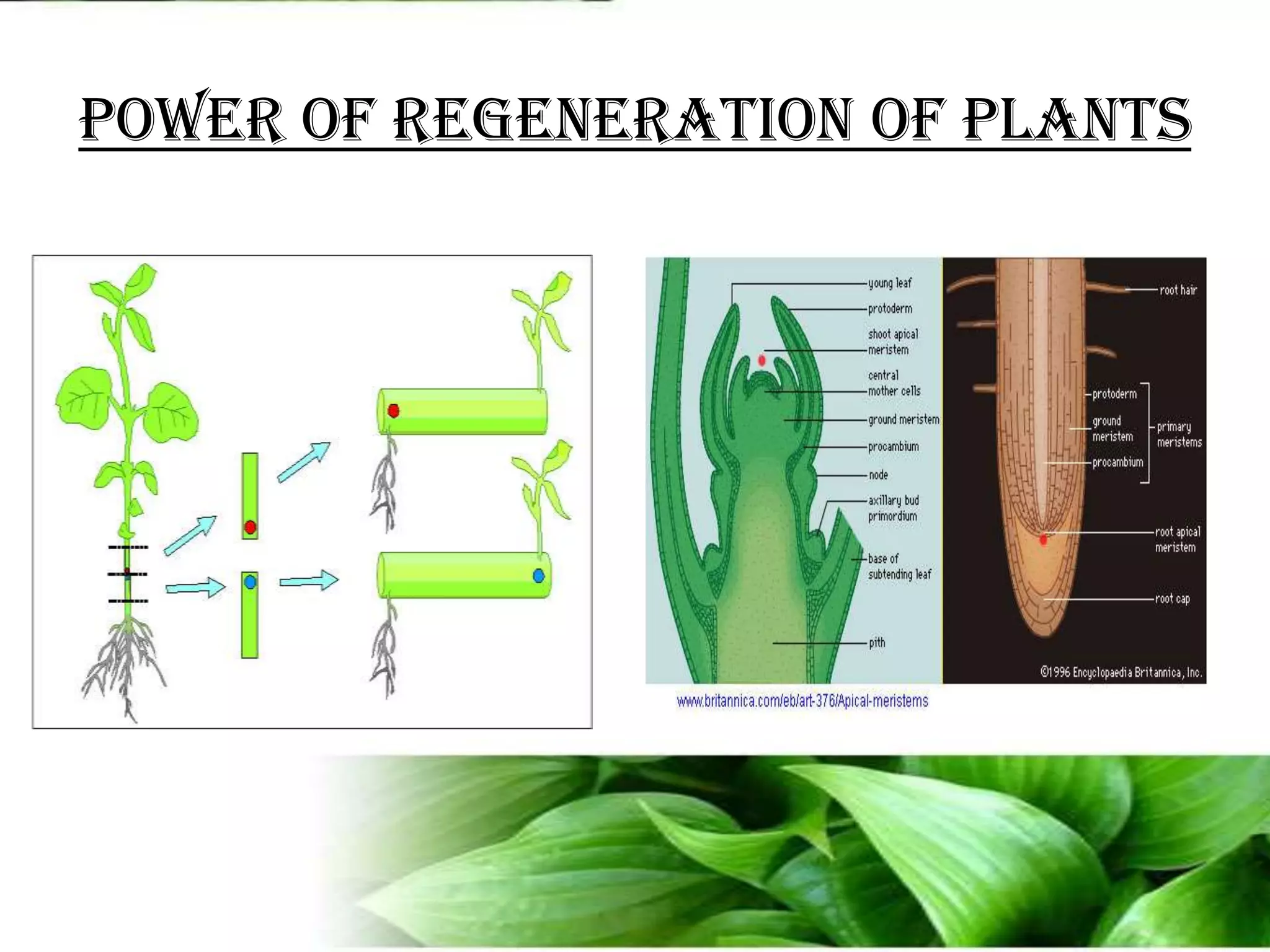
Power of regeneration of plants
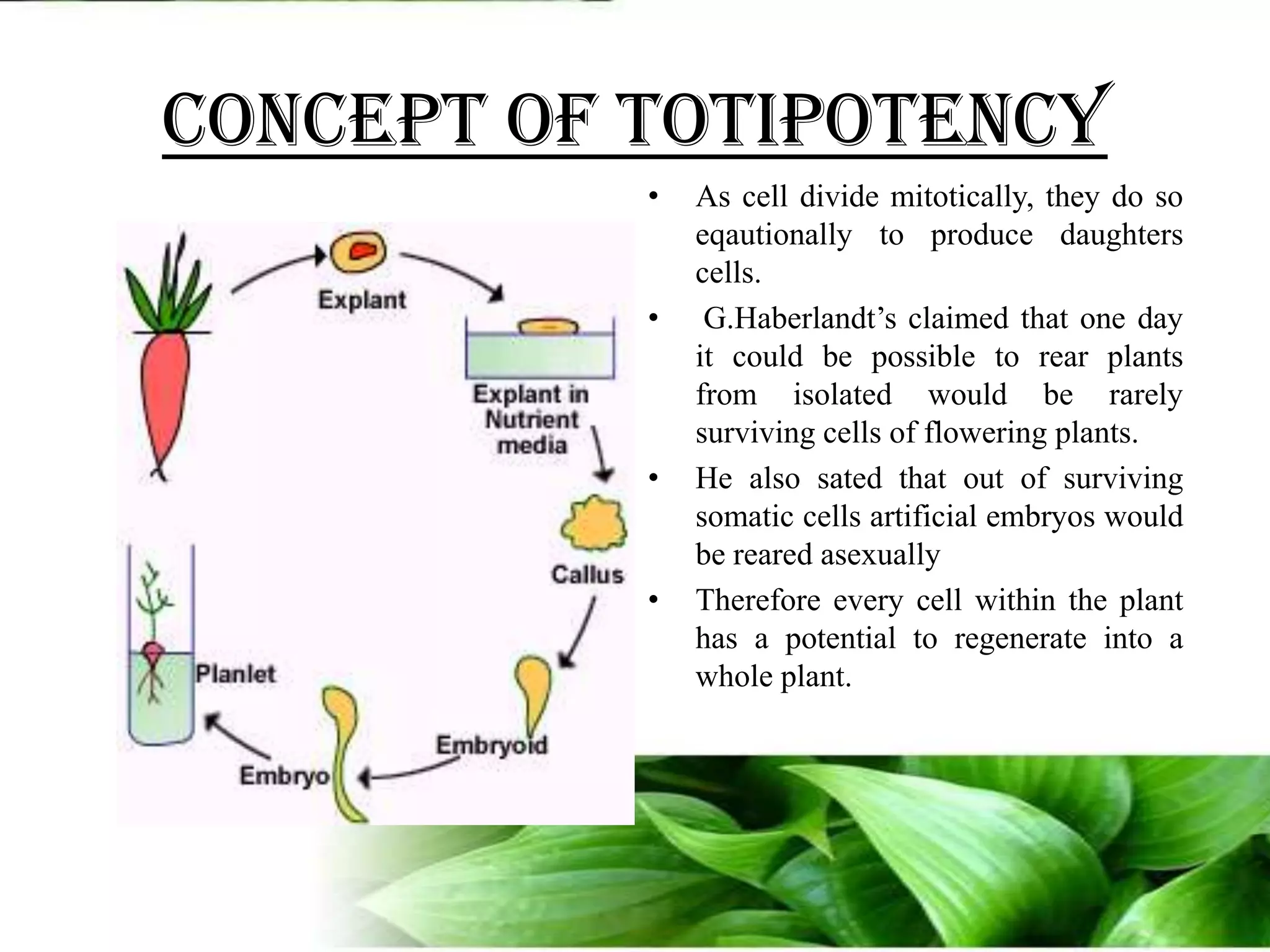
Concept of totipotencyAs cell divide mitotically, they do so eqautionally to produce daughters cells.G.Haberlandt’s claimed that one day it could be possible to rear plants from isolated would be rarely surviving cells of flowering plants.He also sated that out of surviving somatic cells artificial embryos would be reared asexually Therefore every cell within the plant has a potential to regenerate into a whole plant.
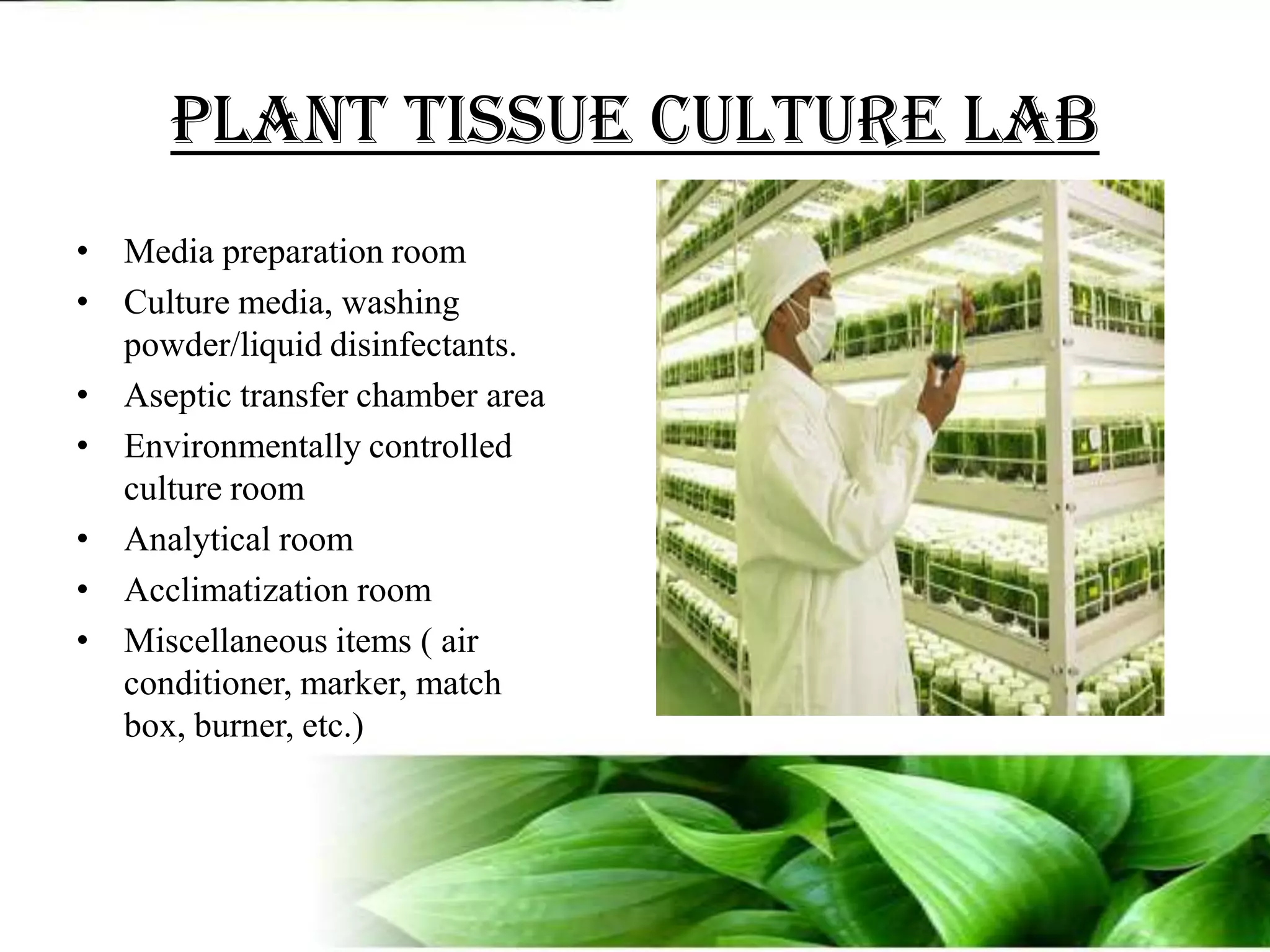
Plant tissue culture labMedia preparation roomCulture media, washing powder/liquid disinfectants.Aseptic transfer chamber areaEnvironmentally controlled culture roomAnalytical roomAcclimatization roomMiscellaneous items ( air conditioner, marker, match box, burner, etc.)
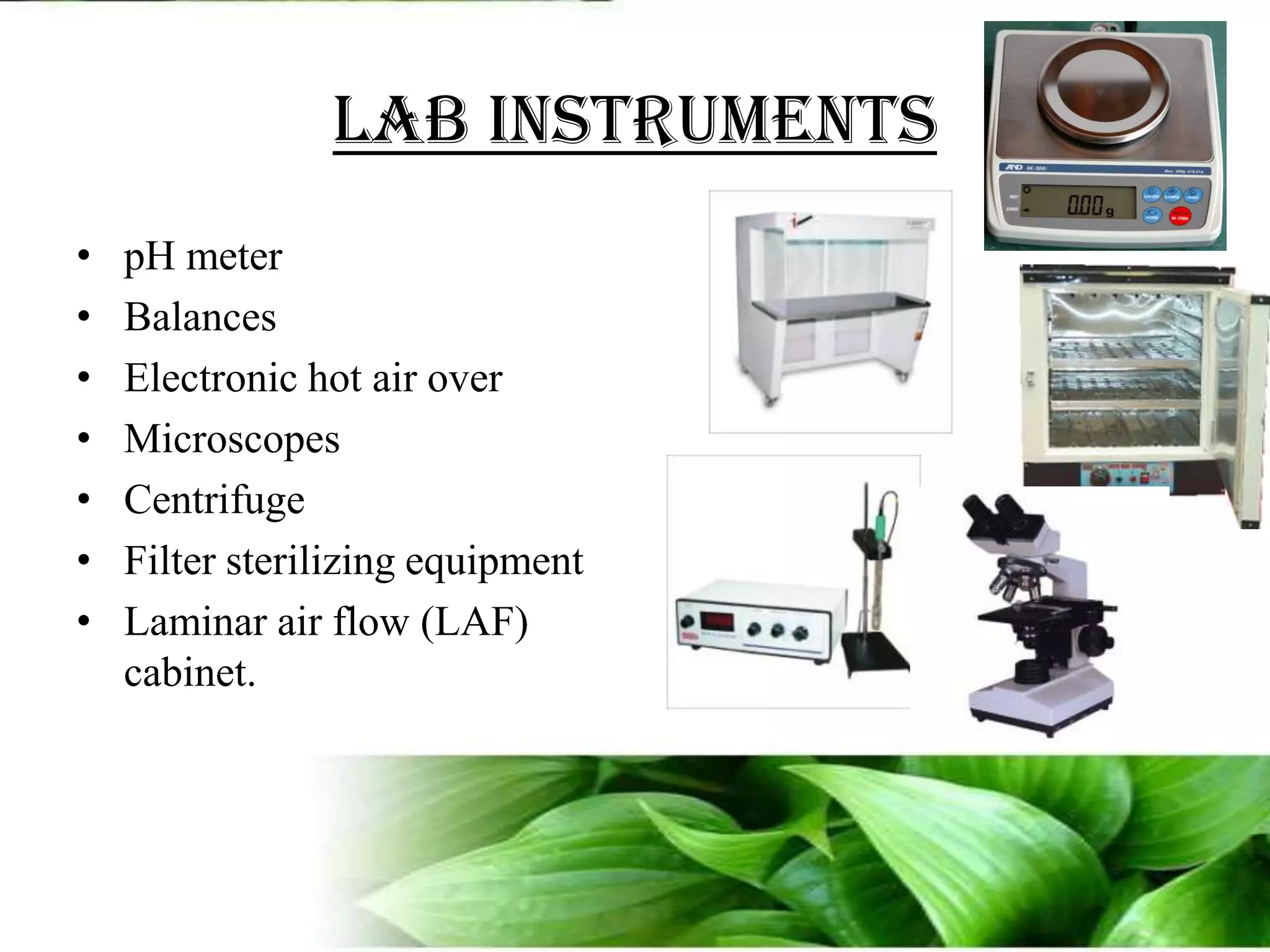
Lab instrumentspH meterBalancesElectronic hot air overMicroscopesCentrifugeFilter sterilizing equipmentLaminar air flow (LAF) cabinet.
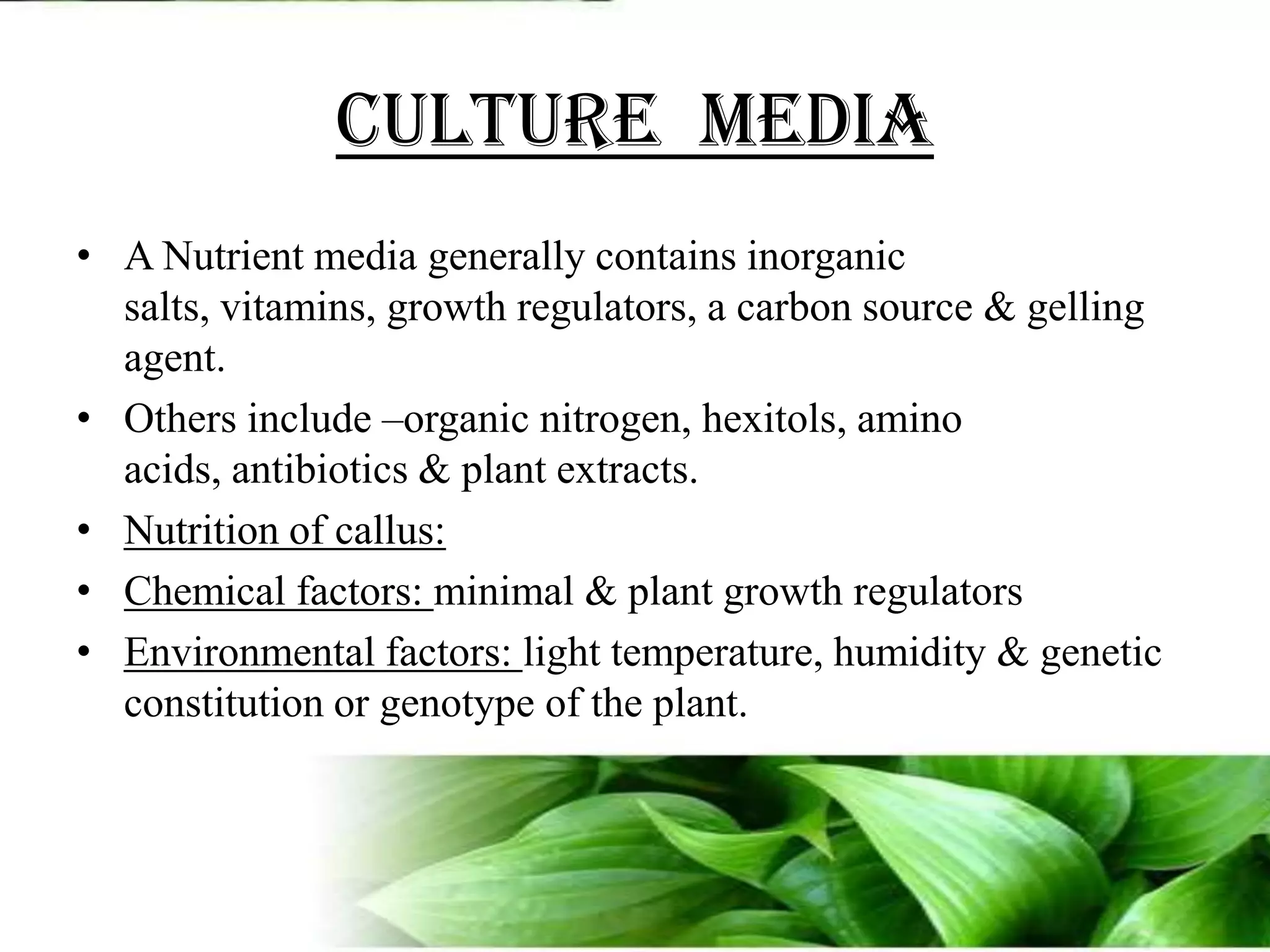
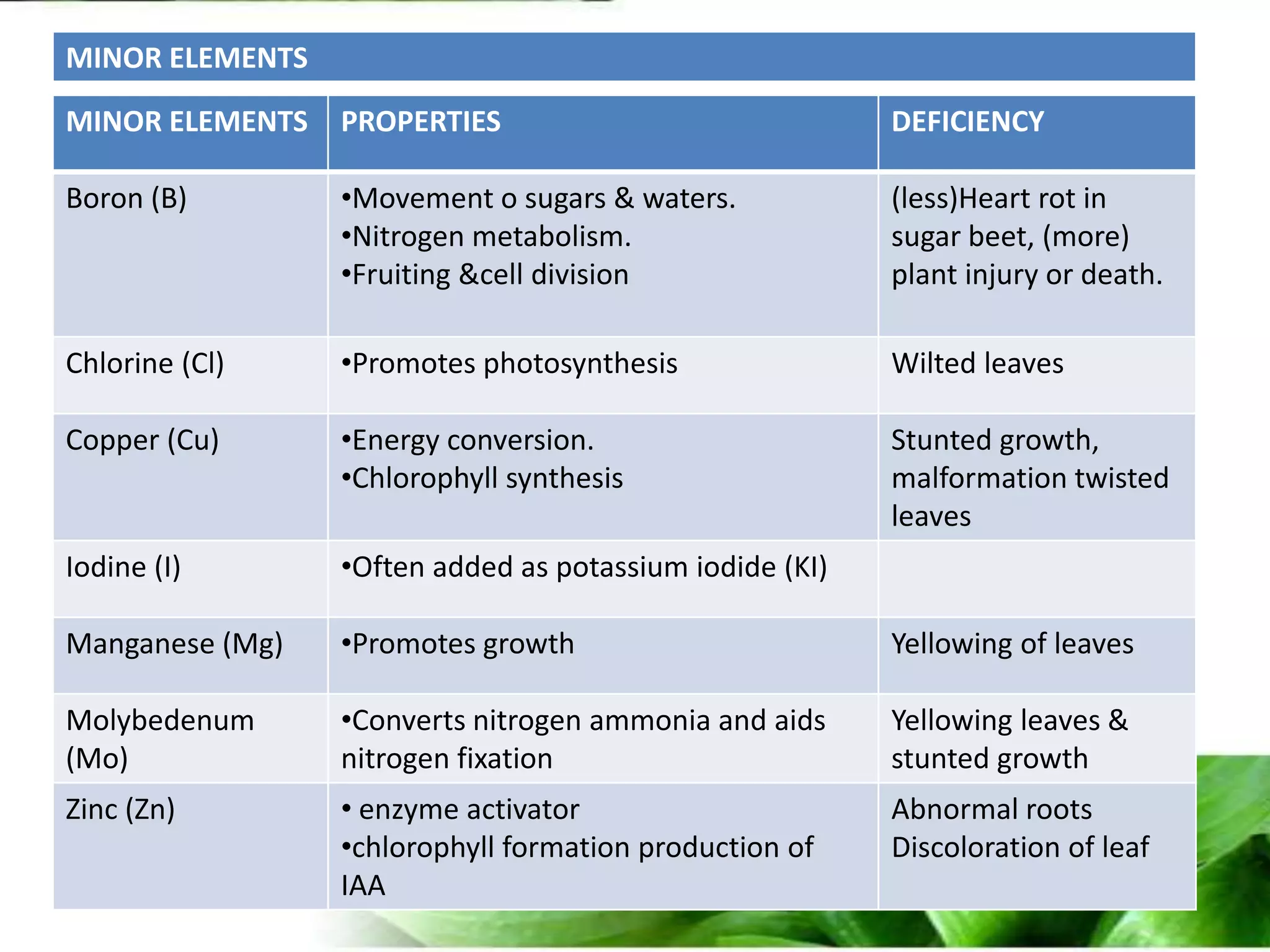
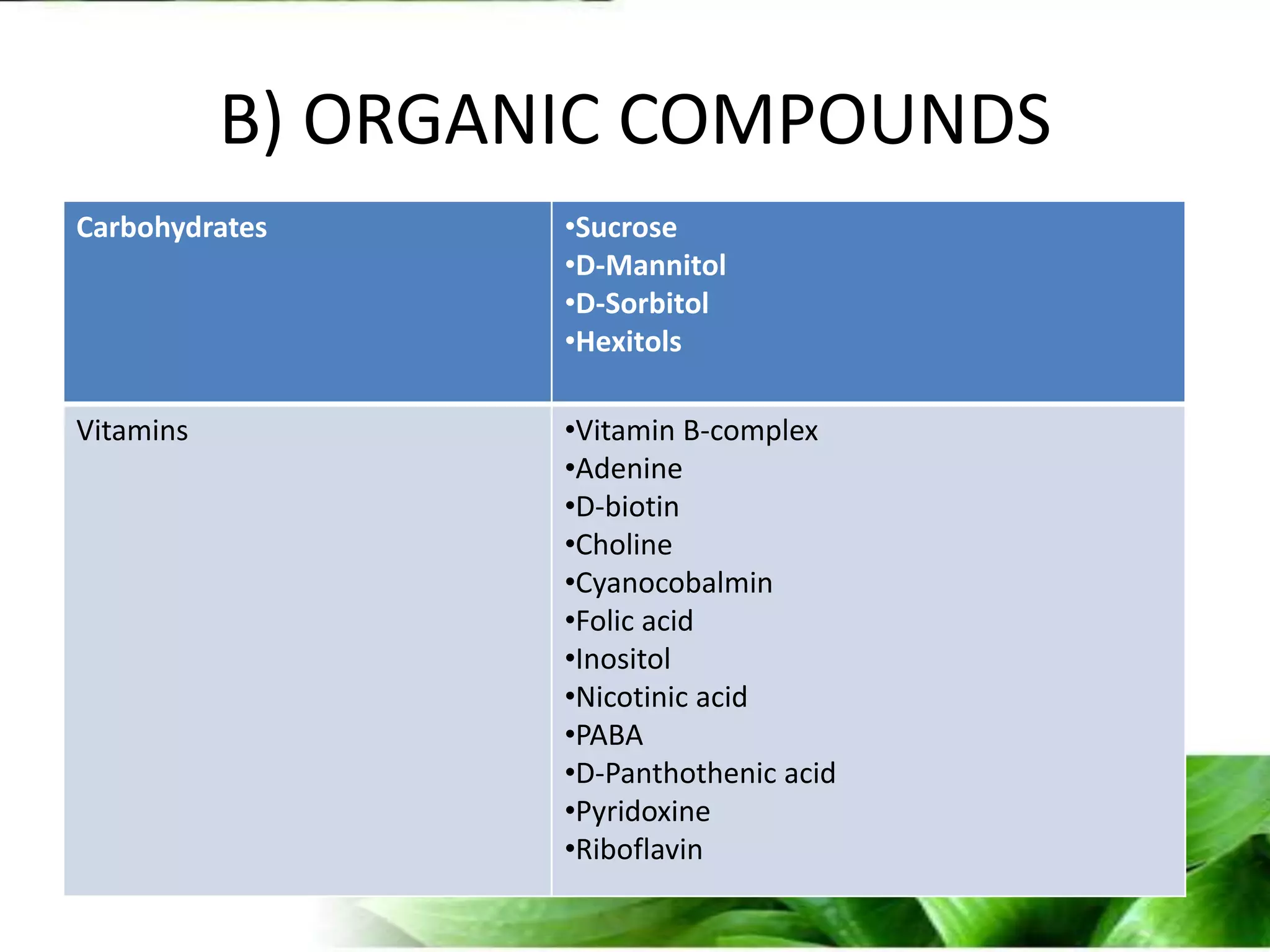
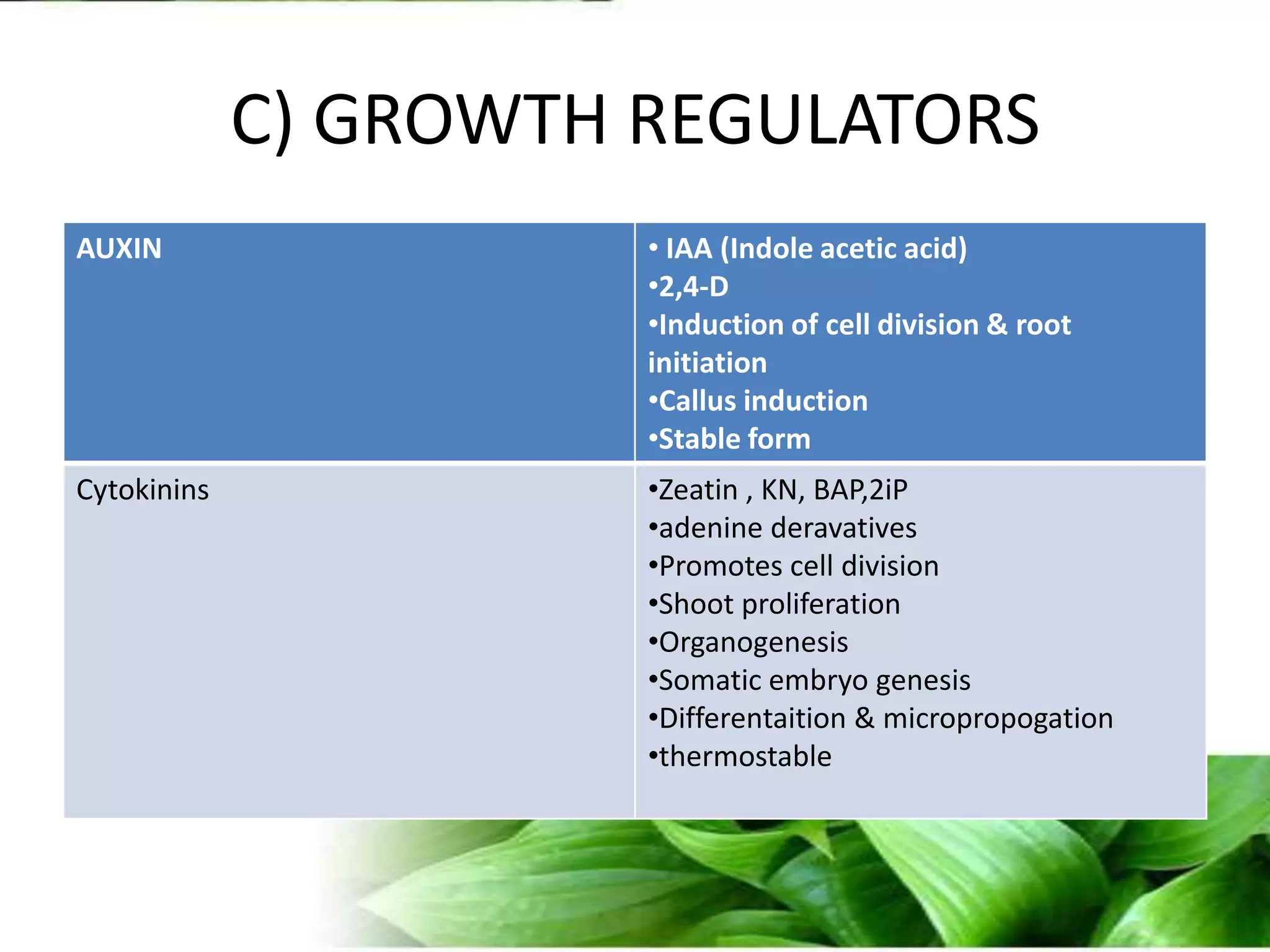
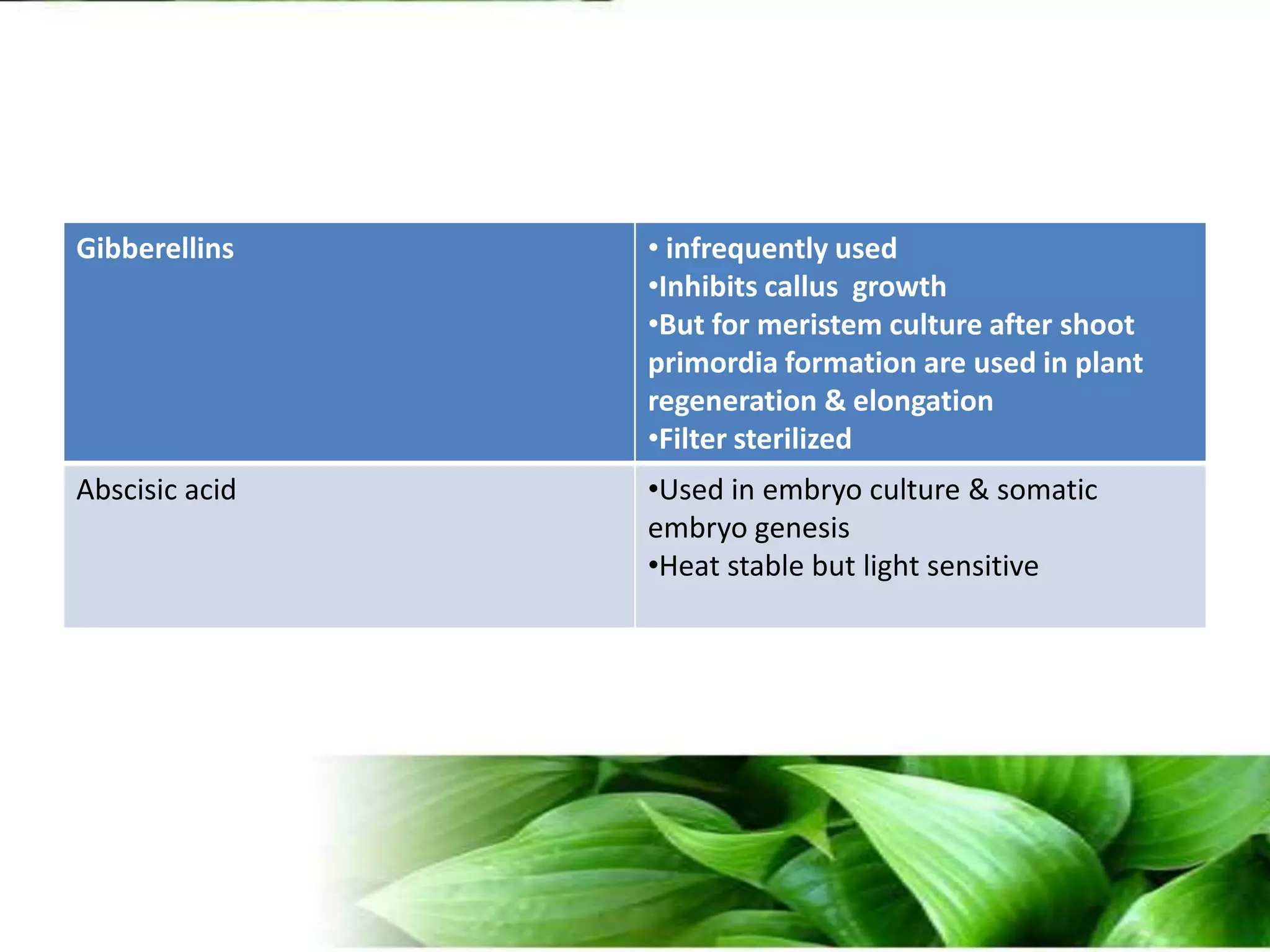
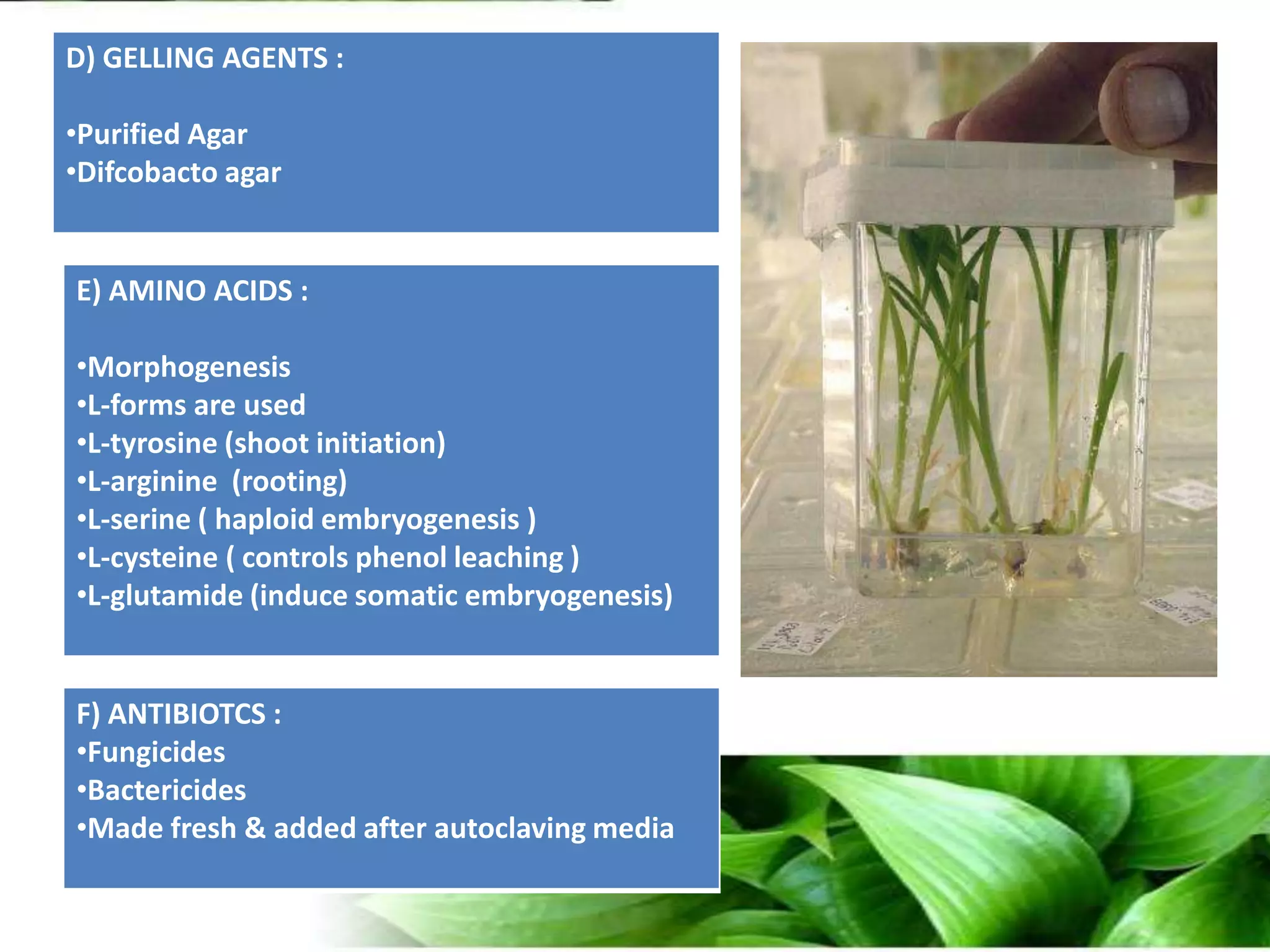
CULTURE  MEDIAA Nutrient media generally contains inorganic salts, vitamins, growth regulators, a carbon source & gelling agent.Others include –organic nitrogen, hexitols, amino acids, antibiotics & plant extracts.Nutrition of callus:Chemical factors: minimal & plant growth regulatorsEnvironmental factors: light temperature, humidity & genetic constitution or genotype of the plant.
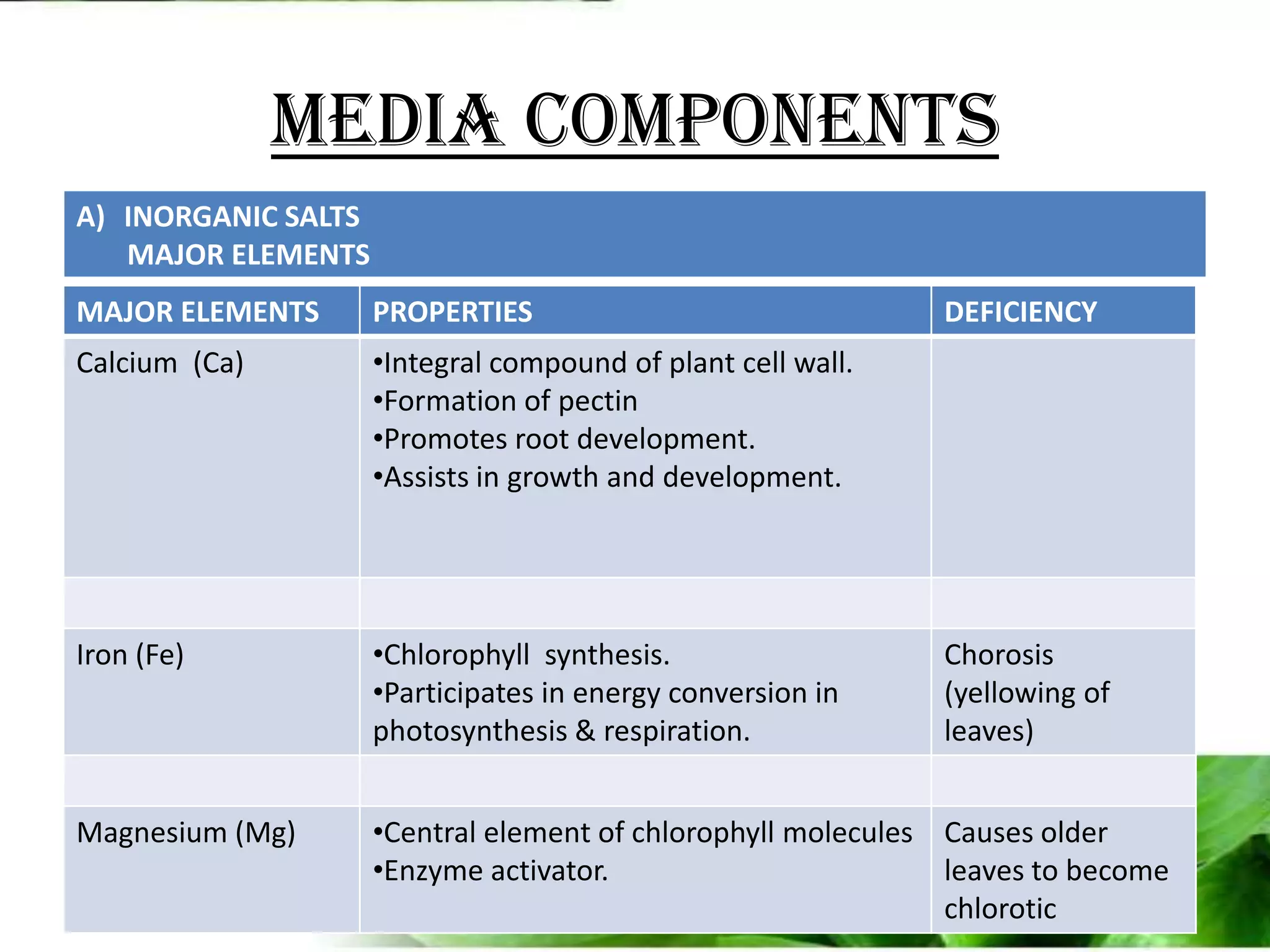
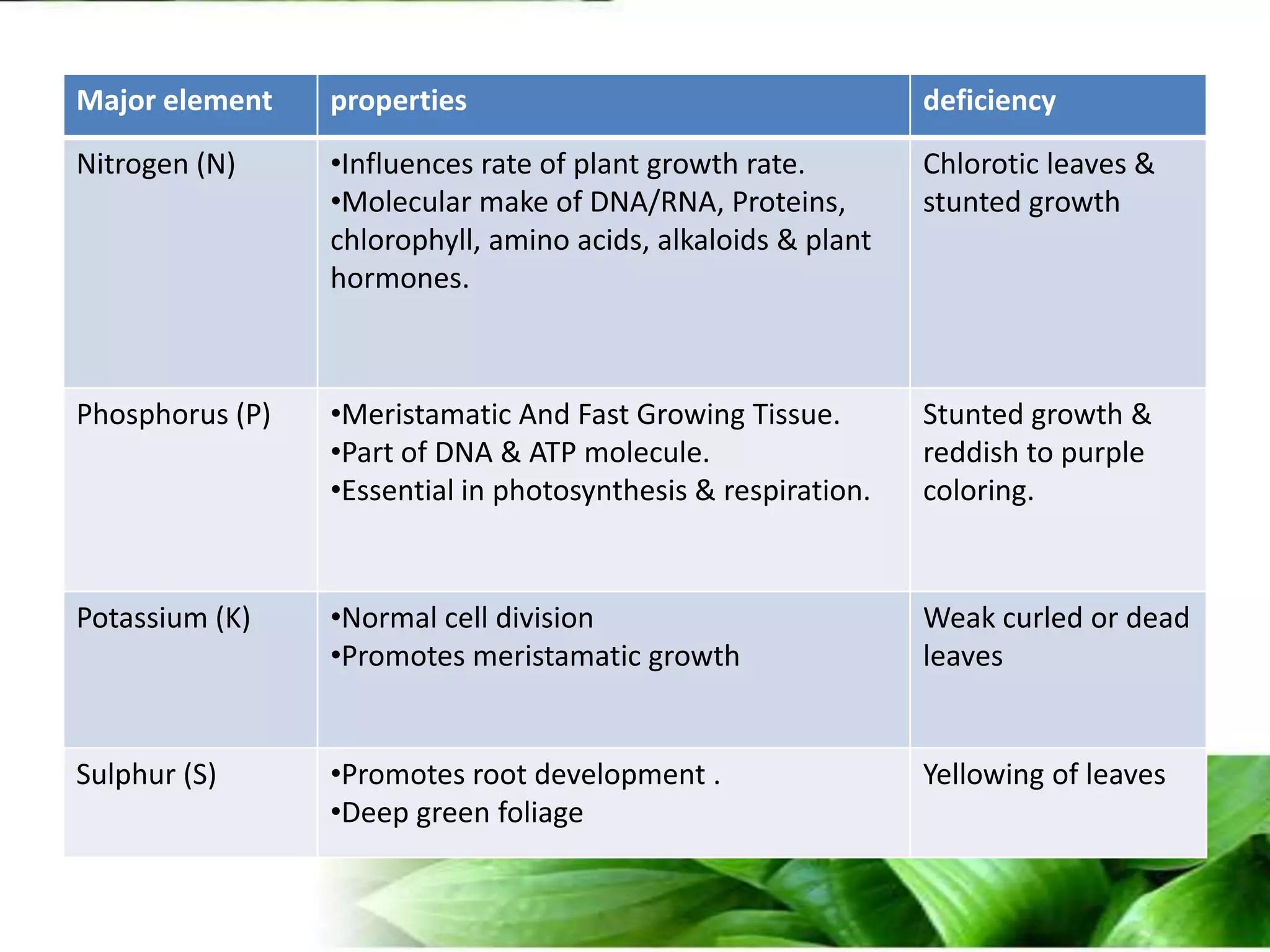
Media components
B) ORGANIC COMPOUNDS
C) GROWTH REGULATORS
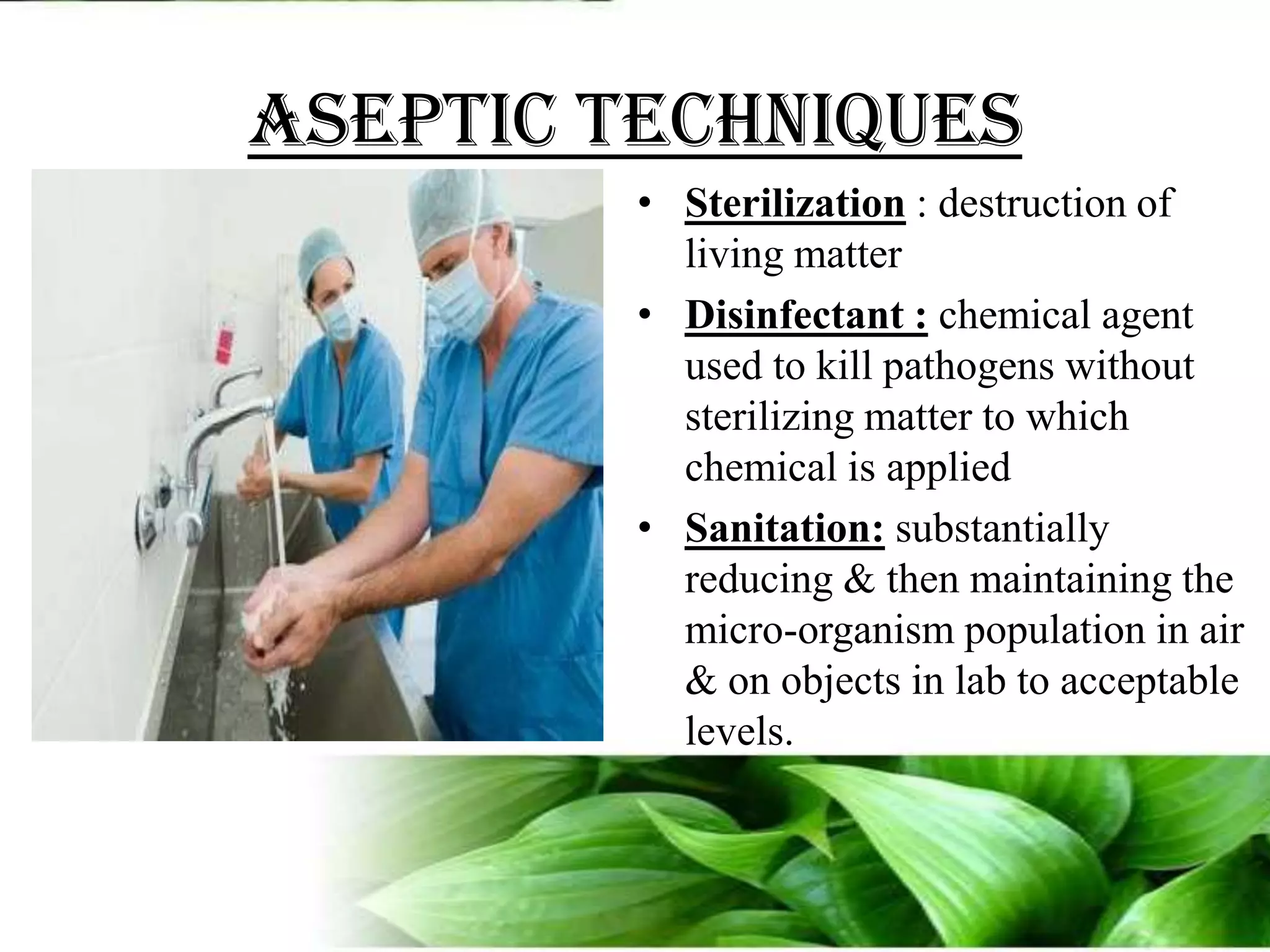
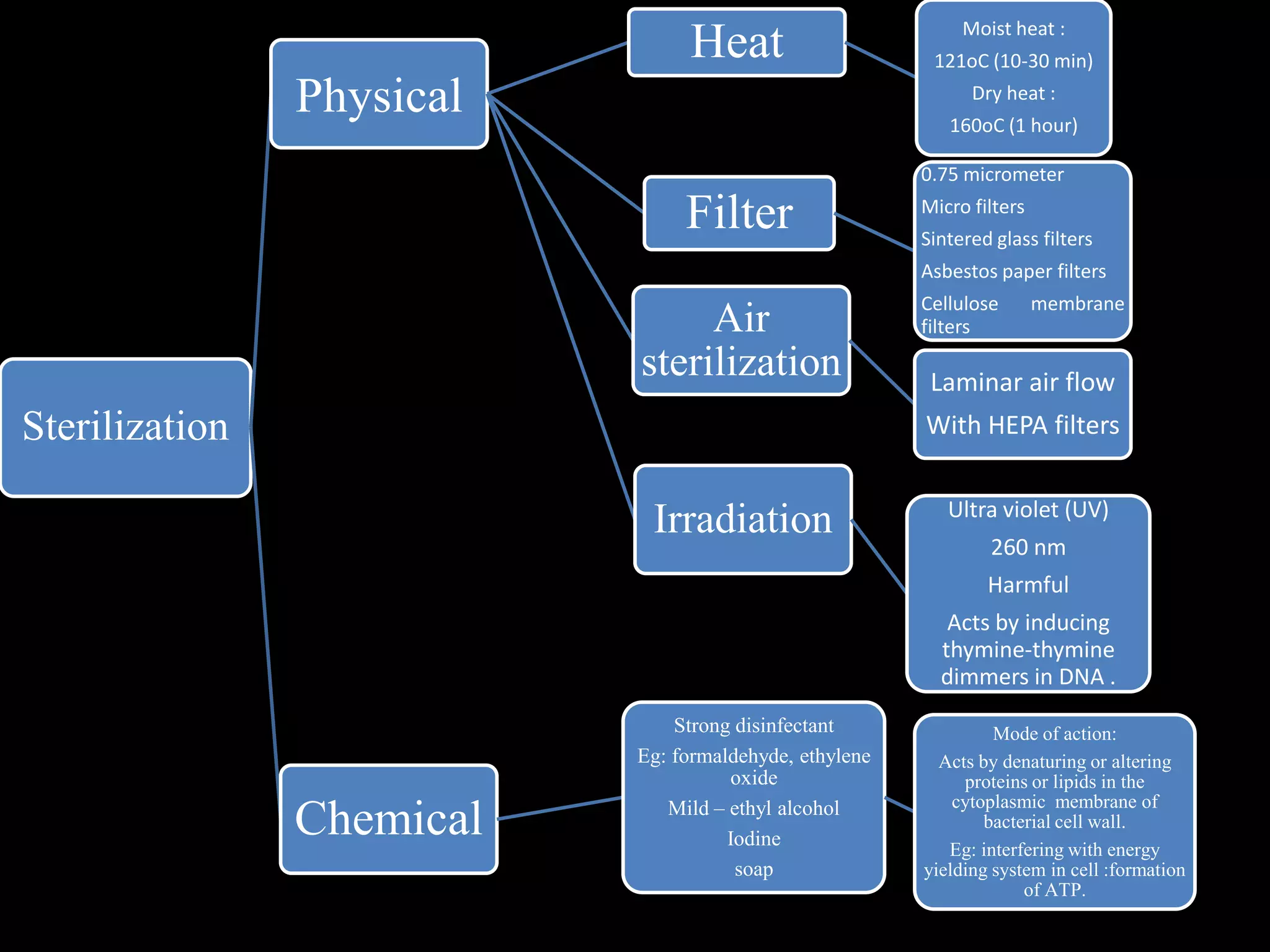
Aseptic techniquesSterilization : destruction of living matterDisinfectant : chemical agent used to kill pathogens without sterilizing matter to which chemical is appliedSanitation: substantially reducing & then maintaining the micro-organism population in air & on objects in lab to acceptable levels.
Sterilization of plant tissuesSodium hypochloride (NaOCl) : 0.025%-0.25%Calcium hypochloride (CaOCl): Hydrogen peroxide (H2O2): 3% -10 %Bromium water: 1% - 2%Silver nitrate (AgNO3) : 1%Mercuric chloride (MgCl2): 0.1 % - 1.1 %
Points to rememberCell theory aspects describing the fundamentals of the “CELL”CALLUS tissueTotipotencyGrowth & development Media componentsSterilization technique
Thank you

Plant Biotechnology Introduction

  • 1.
  • 2.
    TOPICS TO BECOVEREDCell Theory Plant Tissue Culture TechniquesCallus Tissue & OrganogenesisPrinciples Of GrowthPlant RegenerationConcept Of Totipotency Of CellsPlant Tissue Culture LabCulture MediaMedia ComponentsAseptic TechniquesSterilization TechniquesPoints To Remember
  • 3.
    Cell TheoryCell theorystates that:All living things or organisms are made of cells & their products.New cells are created by old cells dividing into two.Cells are basic building units of life.
  • 4.
  • 5.
    Callus tissue &organogenesisCallus Formation Is Found On Angiosperms, Gymnosperms, pteridophytes& BryophytesCallus Contains No Organized MeristemCallus Is Somewhat Abnormal Tissue which Has Potentiality To Produce Normal Roots & EmbroidsIn Turn It Develops Into Plantlets.Callus May Be Hard due To Lignifications Of Cell Walls Or Brittle And Sometimes Soft.Callus on a wounded plant parts or on a culture medium is made up of an amorphous , aggregate of loose parenchyma cells which proliferate from mother cells.
  • 6.
    Organogenesis is thedevelopment adventitious organs or primordia (embroid) from undifferentiated cell mass (callus)in tissue culture.
  • 7.
    Principles of growthGrowthSelf–multiplication of living materials, the protoplasm itself.Increase in size (volume/length) due to cell division and subsequent enlargement.Increase in dry weight.DevelopmentDefined as an ordered change or progress, often towards a higher, more ordered or more complex state.
  • 8.
    why growth occurs?Expressedas division of a cell to form two cells and the enlargement of newly divided cells.
  • 9.
    Growth kineticsFirst rapidphase.Maximum growth rate phase.Last phase.
  • 10.
  • 11.
    Concept of totipotencyAscell divide mitotically, they do so eqautionally to produce daughters cells.G.Haberlandt’s claimed that one day it could be possible to rear plants from isolated would be rarely surviving cells of flowering plants.He also sated that out of surviving somatic cells artificial embryos would be reared asexually Therefore every cell within the plant has a potential to regenerate into a whole plant.
  • 12.
    Plant tissue culturelabMedia preparation roomCulture media, washing powder/liquid disinfectants.Aseptic transfer chamber areaEnvironmentally controlled culture roomAnalytical roomAcclimatization roomMiscellaneous items ( air conditioner, marker, match box, burner, etc.)
  • 13.
    Lab instrumentspH meterBalancesElectronichot air overMicroscopesCentrifugeFilter sterilizing equipmentLaminar air flow (LAF) cabinet.
  • 14.
    CULTURE MEDIAANutrient media generally contains inorganic salts, vitamins, growth regulators, a carbon source & gelling agent.Others include –organic nitrogen, hexitols, amino acids, antibiotics & plant extracts.Nutrition of callus:Chemical factors: minimal & plant growth regulatorsEnvironmental factors: light temperature, humidity & genetic constitution or genotype of the plant.
  • 15.
  • 18.
  • 19.
  • 23.
    Aseptic techniquesSterilization :destruction of living matterDisinfectant : chemical agent used to kill pathogens without sterilizing matter to which chemical is appliedSanitation: substantially reducing & then maintaining the micro-organism population in air & on objects in lab to acceptable levels.
  • 24.
    Sterilization of planttissuesSodium hypochloride (NaOCl) : 0.025%-0.25%Calcium hypochloride (CaOCl): Hydrogen peroxide (H2O2): 3% -10 %Bromium water: 1% - 2%Silver nitrate (AgNO3) : 1%Mercuric chloride (MgCl2): 0.1 % - 1.1 %
  • 26.
    Points to rememberCelltheory aspects describing the fundamentals of the “CELL”CALLUS tissueTotipotencyGrowth & development Media componentsSterilization technique
  • 27.