
‫أحمد‬ ‫مالك‬
‫ماجد‬ ‫ميادة‬
‫عمار‬ ‫قبس‬
6-4-2016

Local Anaesthesia ~
There are two types of anesthesia, first is the general anaesthesia
and second is the local, that will be discussed in our seminar,
starting with the definitions, the drugs, then the vasoconstrictor,
and the undesired effect of L.A on the body.. ending with the
toxicity.
we chose this part of the subject due to its importance in clinical
procedures of dentistry.
-, –
DEFINITION:
Local Anaesthesia is defined as a transient reversible loss of
sensation and nociception in a circumscribed area of the body
caused by a depression of excitation in nerve endings or an
inhibition of the conduction process in peripheral nerves.
Local Anesthetic is a drug that causes the Local Anesthesia
symptoms in a restricted area of the body, when applied topically
or locally injected.
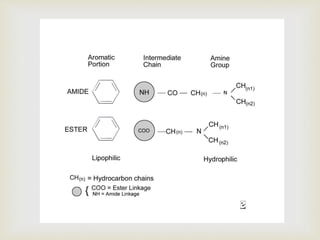
Amide anaesthetics:
Lignocaine (Lidocaine).
Mepivacaine.
prilocaine.
Bupivacaine.
Etidocaine.
 Contents of a typical
local anaesthetic
solution:
 Pyrogen- free distilled
water.
 Local analgesic:
 Vasoconstrictor.
 Antiseptic to maintain
sterility.
 Stabilising agent to
prevent decomposition of
the constituents.
 Buffering agent to
maintain pH.
Ester anaesthetics:
Cocaine.
Procaine.
Benzocaine.
Amethocaine.

Differences:
Amides
 Longer lasting analgesia.
 Produce more intense
analgesia.
 Rarely cause
hypersensitivity reaction.
 Bind to alpha 1 acid
glycoprotein in Plasma
Cholinestrase, more
slowly destroyed by liver
microsomal p450
enzymes.
Esters
 Short duration of action.
 Less intense analgesia.
 Higher risk of
hypersensitivity, rarely
used.
 Hydrolyzed by Plasma
Cholinestrase in blood.
 Rarely used for infltration
anesthesia.
 Useful topically on mucous
membranes.


Metabolism and excretion
Amides
 All are metabolised
hepatically by
amidases.
 This is a slower process,
hence their half-life is
longer and they can
accumulate if given in
repeated doses or by
infusion.
Esters
 (except cocaine) all are
broken down rapidly by
plasma esterases to
inactive compounds and
consequently have a short
half life.
 Cocaine is hydrolysed in
the liver.
 Ester metabolite excretion
is renal.

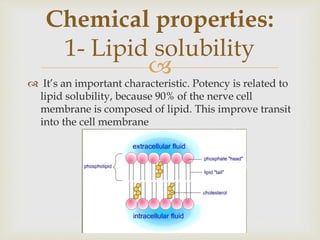
 It’s an important characteristic. Potency is related to
lipid solubility, because 90% of the nerve cell
membrane is composed of lipid. This improve transit
into the cell membrane
Chemical properties:
1- Lipid solubility

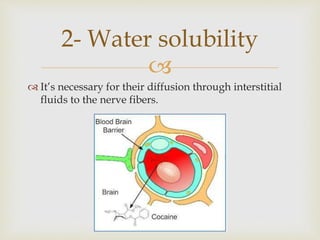
 It’s necessary for their diffusion through interstitial
fluids to the nerve fibers.
2- Water solubility
 Local anesthetics are weak bases and are usually
formulated as the hydrochloride salt to render them
water-soluble. And make molecules diffuses readily
across cell membranes.
 Once inside the cell the local anesthetic will be in
equilibrium, with the formation of the protonated
(ionized form), which does not readily pass back out of
the cell. This is referred to as "ion-trapping".
 Acidosis such as caused by inflammation at a wound
partly reduces the action of local anesthetics. This is
partly because most of the anesthetic is ionized and
therefore unable to cross the cell membrane to reach its
cytoplasmic-facing site of action on the sodium channel.
Effect of PH

1- Ultra short duration:
(2% Lignocaine without vasoconstrictor)
2- Short duration:
(2% Lignocaine with 1:100,000 Epinephrine)
3-Intermediate duration:
(2% Lignocaine with 1:200,000 Epinephrine)
4- Long duration:
(5% Lignocaine with 1:200,000 Epinephrine)
Classification of L.A Based
on duration of action:

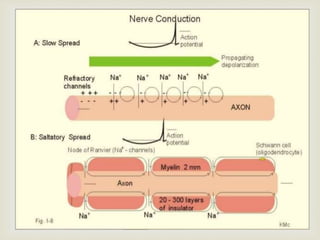
 Local anesthetics are membrane stabilizing
drugs.
Acts by inhibiting sodium influx through
voltage gated sodium specific ion channels in
the neuronal cells.
Hence action potential cannot arise due to
this inhibition and blockade of conduction is
established.
Mechanism of action:


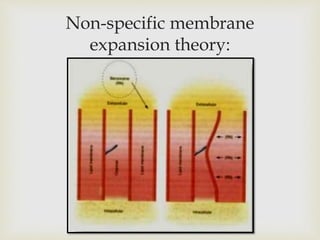
☺Non-specific membrane expansion theory:
The lipophilic part of the local anesthetic attaches to the
cell membrane to cause swelling. This then reduces
the size of the sodium channel to obstruct the flow of
sodium
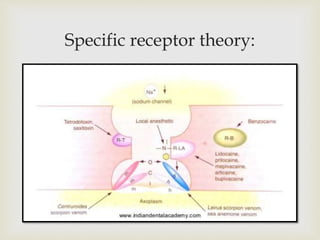
☺ Specific receptor theory:
The hydrophilic charged amino terminal binds to
specific receptors of the sodium gates to block the
passage of sodium ions
There are two theories on “how
sodium channels are blocked”:
Non-specific membrane
expansion theory:
Specific receptor theory:

Uses of the Local Anesthetic:
1- Local anesthesia.
2- Ventricular arrhythmia.
3- Decrease hemodynamic response to tracheal
4- intubation also decrease cough.
5- Treatment of epileptic fits.
Six Placement Sites Surface:
1- Topical anesthesia. 2- Local infiltration.
3- Peripheral nerve block. 4- Bier block (IV regional anesthesia).
5- Epidural anesthesia. 6- Spinal anesthesia.

 Analgesic especially post operative pain.
 Incision and drainage of incised abscess.
 Removal of cysts, residual infection areas,
hydrophilic groups and neoplastic growths, ranula
and salivary calculi.
 In the treatment of tic douloreux by producing
prolonged anesthesia with the combination of a local
anesthetic agent and alcohol injection.
 Lidocaine (xylocaine & lignocaine) also reduces
blood pressure response to direct laryngoscopic
tracheal intubation, an effect probably secondary to
generalized cardiovascular depression.
Indications
for using of the L.A. :

History of allergy to local anesthetic agent, or
history of allergy to any of the constituents of
the local anesthetic solution.
Presence of acute inflammation or
suppurative infection at the site of insertion
of needle.
Infants or small children.
Mentally retarded patients.
Contraindication
☺
Major surgical procedures with
haemodynamic unstability epilepsy.
Presence of methhaemoglobinemia, two
drugs are to be avoided: they are Benzocaine
and Articaine.
Presence of atypical plasma cholinesterase.
Hypotension not due to arrhythmia.
Bradycardia.
Accelerated Idioventricular Rhythm.

Advantages
 During local anesthesia the patient remains conscious.
 Maintains his own airway.
 Excellent muscle relaxant effect.
 Less pulmonary complications.
 Aspiration of gastric contents unlikely.
 Less nausea and vomiting.
 Postoperative analgesia.
 Suitable for patients who recently ingested food or fluids.
 Less bleeding.
 Expenses are less.

 There are individual variations in response to local
anesthetic drugs.
 Rapid absorption of the drug into the bloodstream
can cause severe, potentially fatal reactions.
 Direct damage of nerve.
 Post-dural headache from CSF leak.
 Hypotension and bradycardia through blockade of
the sympathetic nervous system.
 Not suitable for extremes of ages.
 Multiple needle pricks may be needed.
Disadvantages

VASOCONSTRICTORS
Vasoconstrictors are the drugs that constricts
the blood vessels and thereby control tissue
perfusion. They are added to local anesthesia to
oppose the vasodilatory action of local
anesthetic agent.
What happens if you don’t use a vasoconstrictor?
1) Blood vessels in the area dilate
2) Increase absorption of the local anesthetic into the cardiovascular
system (redistribution)
3) Higher plasma levels -> increased risk of toxicity
4) Decreased depth and duration of anesthesia -> diffusion from site
5) Increased bleeding due to increased blood perfusion to the area

 1) Constrict blood vessels -> decrease blood flow to
the surgical site.
 2) Cardiovascular absorption is slowed -> lower
anesthetic blood levels.
 3) Local anesthetic blood levels are lowered -> lower
risk of toxicity.
 4) Local anesthetic remains around the nerve for
longer periods -> increased duration of anesthesia
 5) Decreases bleeding.
NEED FOR
VASOCONSTRICTOR

CLASSIFICATION
Chemical Structure:
 Catecholamines:
Epinephrine
Norepinephrine
Levonordefrin
Isoproterenol
Dopamine
 Noncatecholamines:
Amphetamine
Methamphetamine
Ephedrine
Mephentermine
Hydroxyamphetamine
Metaraminol
Methoxamine
Phenylephrine

UNDESIRED EFFECTS
OF LOCAL
ANESTHETICS
-CENTRAL NERVOUS SYSTEM
-CARDIOVASCULAR SYSTEM
-METHEMOGLOBINEMIA
-Hypersensitivity
-Neurotoxicity

 CNS Stimulation: (More sensitive than cardiac).
 Dose-related spectrum of effects and All effects are due to
depression of neurons First an apparent CNS stimulation
( convulsions most serious).
 Followed by CNS depression ( death due to respiratory
depression).
 Premonitory signs include: ringing in ears, metallic taste,
numbness around lips.
 Cocaine - euphoria (unique in its ability to stimulate
CNS).
 Lidocaine - sedation even at non-toxic doses 49.
CENTRAL NERVOUS
SYSTEM

CARDIOVASCULAR
SYSTEM
ARRHYTHMIAS:
 Direct effect (More
resistant than CNS)
Decrease cardiac
excitability and
contractility Decreased
conduction rate Increased
refractory rate
(Bupivicaine ) ALL can
cause arrhythmias if conc.
is high enough.
HYPOTENSION:
 Arteriolar dilation is a
result of: Direct effect
(procaine and Lidocaine
have most effect) Block of
postganglionic
sympathetic fiber
function CNS depression
Avoid by adding
vasoconstrictor to the
preparation .
Note: cocaine is exception......it stimulates heart

 Some LA metabolites have significant oxidizing
properties.
 This may cause a significant conversion of hemoglobin to
methemoglobin and compromise ability to carry oxygen
 May be a problem if cardiopulmonary reserve is limited
 Treat with oxygen and methylene blue (converts
methemoglobin to hemoglobin).
 prilocaine benzocaine lidocaine have been implicated.
METHEMOGLOBINEMIA
Hypersensitivity:
Common with ester-linked L.A..
Rashes, angio -edema, dermatitis and rare anaphylaxis.
Sometimes typical asthmatic attack.
Neurotoxicity:
LA can cause concentration-dependent nerve damage.
to central and peripheral NS.
Mechanism(s) not clear.
Permanent neurological injury is rare.
May account for transient neurological symptoms.

Toxicity of local
anesthesia
CAUSES :
1- Accidental rapid intravenous injection.
2- Rapid absorption, such as from a very vascular site
i.e. mucous membranes.
3- Overdose.

 1-CNS toxicity :
1- Early or mild toxicity: light-headedness, dizziness,
tinnitus, circumoral numbness, abnormal taste,
confusion and drowsiness.
2- Severe toxicity: tonic-clonic convulsion leading to
progressive loss of consciousness, coma, respiratory
depression, and respiratory arrest.
SIGNS AND SYMPTOMS OF
LOCAL ANAESTHETIC TOXICITY
 2-CVS toxicity:
1- Early or mild toxicity: tachycardia and rise in blood
pressure. This will usually only occur if there is
adrenaline in the local anesthetic. If no adrenaline is
added then bradycardia with hypotension will occur.
2- Severe toxicity: Usually about 4 - 7 times the
convulsant dose needs to be injected before
cardiovascular collapse occurs. Collapse is due to the
depressant effect of the local anesthetic acting
directly on the myocardium.
It’s end

Local anesthesia

  • 1.
  • 2.
     Local Anaesthesia ~ Thereare two types of anesthesia, first is the general anaesthesia and second is the local, that will be discussed in our seminar, starting with the definitions, the drugs, then the vasoconstrictor, and the undesired effect of L.A on the body.. ending with the toxicity. we chose this part of the subject due to its importance in clinical procedures of dentistry. -, – DEFINITION: Local Anaesthesia is defined as a transient reversible loss of sensation and nociception in a circumscribed area of the body caused by a depression of excitation in nerve endings or an inhibition of the conduction process in peripheral nerves. Local Anesthetic is a drug that causes the Local Anesthesia symptoms in a restricted area of the body, when applied topically or locally injected.
  • 3.
    Amide anaesthetics: Lignocaine (Lidocaine). Mepivacaine. prilocaine. Bupivacaine. Etidocaine. Contents of a typical local anaesthetic solution:  Pyrogen- free distilled water.  Local analgesic:  Vasoconstrictor.  Antiseptic to maintain sterility.  Stabilising agent to prevent decomposition of the constituents.  Buffering agent to maintain pH. Ester anaesthetics: Cocaine. Procaine. Benzocaine. Amethocaine.
  • 4.
     Differences: Amides  Longer lastinganalgesia.  Produce more intense analgesia.  Rarely cause hypersensitivity reaction.  Bind to alpha 1 acid glycoprotein in Plasma Cholinestrase, more slowly destroyed by liver microsomal p450 enzymes. Esters  Short duration of action.  Less intense analgesia.  Higher risk of hypersensitivity, rarely used.  Hydrolyzed by Plasma Cholinestrase in blood.  Rarely used for infltration anesthesia.  Useful topically on mucous membranes.
  • 5.
  • 6.
     Metabolism and excretion Amides All are metabolised hepatically by amidases.  This is a slower process, hence their half-life is longer and they can accumulate if given in repeated doses or by infusion. Esters  (except cocaine) all are broken down rapidly by plasma esterases to inactive compounds and consequently have a short half life.  Cocaine is hydrolysed in the liver.  Ester metabolite excretion is renal.
  • 7.
      It’s animportant characteristic. Potency is related to lipid solubility, because 90% of the nerve cell membrane is composed of lipid. This improve transit into the cell membrane Chemical properties: 1- Lipid solubility
  • 8.
      It’s necessaryfor their diffusion through interstitial fluids to the nerve fibers. 2- Water solubility
  • 9.
     Local anestheticsare weak bases and are usually formulated as the hydrochloride salt to render them water-soluble. And make molecules diffuses readily across cell membranes.  Once inside the cell the local anesthetic will be in equilibrium, with the formation of the protonated (ionized form), which does not readily pass back out of the cell. This is referred to as "ion-trapping".  Acidosis such as caused by inflammation at a wound partly reduces the action of local anesthetics. This is partly because most of the anesthetic is ionized and therefore unable to cross the cell membrane to reach its cytoplasmic-facing site of action on the sodium channel. Effect of PH
  • 10.
     1- Ultra shortduration: (2% Lignocaine without vasoconstrictor) 2- Short duration: (2% Lignocaine with 1:100,000 Epinephrine) 3-Intermediate duration: (2% Lignocaine with 1:200,000 Epinephrine) 4- Long duration: (5% Lignocaine with 1:200,000 Epinephrine) Classification of L.A Based on duration of action:
  • 11.
      Local anestheticsare membrane stabilizing drugs. Acts by inhibiting sodium influx through voltage gated sodium specific ion channels in the neuronal cells. Hence action potential cannot arise due to this inhibition and blockade of conduction is established. Mechanism of action:
  • 12.
  • 13.
     ☺Non-specific membrane expansiontheory: The lipophilic part of the local anesthetic attaches to the cell membrane to cause swelling. This then reduces the size of the sodium channel to obstruct the flow of sodium ☺ Specific receptor theory: The hydrophilic charged amino terminal binds to specific receptors of the sodium gates to block the passage of sodium ions There are two theories on “how sodium channels are blocked”:
  • 14.
  • 15.
  • 16.
     Uses of theLocal Anesthetic: 1- Local anesthesia. 2- Ventricular arrhythmia. 3- Decrease hemodynamic response to tracheal 4- intubation also decrease cough. 5- Treatment of epileptic fits. Six Placement Sites Surface: 1- Topical anesthesia. 2- Local infiltration. 3- Peripheral nerve block. 4- Bier block (IV regional anesthesia). 5- Epidural anesthesia. 6- Spinal anesthesia.
  • 17.
      Analgesic especiallypost operative pain.  Incision and drainage of incised abscess.  Removal of cysts, residual infection areas, hydrophilic groups and neoplastic growths, ranula and salivary calculi.  In the treatment of tic douloreux by producing prolonged anesthesia with the combination of a local anesthetic agent and alcohol injection.  Lidocaine (xylocaine & lignocaine) also reduces blood pressure response to direct laryngoscopic tracheal intubation, an effect probably secondary to generalized cardiovascular depression. Indications for using of the L.A. :
  • 18.
     History of allergyto local anesthetic agent, or history of allergy to any of the constituents of the local anesthetic solution. Presence of acute inflammation or suppurative infection at the site of insertion of needle. Infants or small children. Mentally retarded patients. Contraindication
  • 19.
    ☺ Major surgical procedureswith haemodynamic unstability epilepsy. Presence of methhaemoglobinemia, two drugs are to be avoided: they are Benzocaine and Articaine. Presence of atypical plasma cholinesterase. Hypotension not due to arrhythmia. Bradycardia. Accelerated Idioventricular Rhythm.
  • 20.
     Advantages  During localanesthesia the patient remains conscious.  Maintains his own airway.  Excellent muscle relaxant effect.  Less pulmonary complications.  Aspiration of gastric contents unlikely.  Less nausea and vomiting.  Postoperative analgesia.  Suitable for patients who recently ingested food or fluids.  Less bleeding.  Expenses are less.
  • 21.
      There areindividual variations in response to local anesthetic drugs.  Rapid absorption of the drug into the bloodstream can cause severe, potentially fatal reactions.  Direct damage of nerve.  Post-dural headache from CSF leak.  Hypotension and bradycardia through blockade of the sympathetic nervous system.  Not suitable for extremes of ages.  Multiple needle pricks may be needed. Disadvantages
  • 22.
     VASOCONSTRICTORS Vasoconstrictors are thedrugs that constricts the blood vessels and thereby control tissue perfusion. They are added to local anesthesia to oppose the vasodilatory action of local anesthetic agent. What happens if you don’t use a vasoconstrictor? 1) Blood vessels in the area dilate 2) Increase absorption of the local anesthetic into the cardiovascular system (redistribution) 3) Higher plasma levels -> increased risk of toxicity 4) Decreased depth and duration of anesthesia -> diffusion from site 5) Increased bleeding due to increased blood perfusion to the area
  • 23.
      1) Constrictblood vessels -> decrease blood flow to the surgical site.  2) Cardiovascular absorption is slowed -> lower anesthetic blood levels.  3) Local anesthetic blood levels are lowered -> lower risk of toxicity.  4) Local anesthetic remains around the nerve for longer periods -> increased duration of anesthesia  5) Decreases bleeding. NEED FOR VASOCONSTRICTOR
  • 24.
     CLASSIFICATION Chemical Structure:  Catecholamines: Epinephrine Norepinephrine Levonordefrin Isoproterenol Dopamine Noncatecholamines: Amphetamine Methamphetamine Ephedrine Mephentermine Hydroxyamphetamine Metaraminol Methoxamine Phenylephrine
  • 25.
     UNDESIRED EFFECTS OF LOCAL ANESTHETICS -CENTRALNERVOUS SYSTEM -CARDIOVASCULAR SYSTEM -METHEMOGLOBINEMIA -Hypersensitivity -Neurotoxicity
  • 26.
      CNS Stimulation:(More sensitive than cardiac).  Dose-related spectrum of effects and All effects are due to depression of neurons First an apparent CNS stimulation ( convulsions most serious).  Followed by CNS depression ( death due to respiratory depression).  Premonitory signs include: ringing in ears, metallic taste, numbness around lips.  Cocaine - euphoria (unique in its ability to stimulate CNS).  Lidocaine - sedation even at non-toxic doses 49. CENTRAL NERVOUS SYSTEM
  • 27.
     CARDIOVASCULAR SYSTEM ARRHYTHMIAS:  Direct effect(More resistant than CNS) Decrease cardiac excitability and contractility Decreased conduction rate Increased refractory rate (Bupivicaine ) ALL can cause arrhythmias if conc. is high enough. HYPOTENSION:  Arteriolar dilation is a result of: Direct effect (procaine and Lidocaine have most effect) Block of postganglionic sympathetic fiber function CNS depression Avoid by adding vasoconstrictor to the preparation . Note: cocaine is exception......it stimulates heart
  • 28.
      Some LAmetabolites have significant oxidizing properties.  This may cause a significant conversion of hemoglobin to methemoglobin and compromise ability to carry oxygen  May be a problem if cardiopulmonary reserve is limited  Treat with oxygen and methylene blue (converts methemoglobin to hemoglobin).  prilocaine benzocaine lidocaine have been implicated. METHEMOGLOBINEMIA
  • 29.
    Hypersensitivity: Common with ester-linkedL.A.. Rashes, angio -edema, dermatitis and rare anaphylaxis. Sometimes typical asthmatic attack. Neurotoxicity: LA can cause concentration-dependent nerve damage. to central and peripheral NS. Mechanism(s) not clear. Permanent neurological injury is rare. May account for transient neurological symptoms.
  • 30.
     Toxicity of local anesthesia CAUSES: 1- Accidental rapid intravenous injection. 2- Rapid absorption, such as from a very vascular site i.e. mucous membranes. 3- Overdose.
  • 31.
      1-CNS toxicity: 1- Early or mild toxicity: light-headedness, dizziness, tinnitus, circumoral numbness, abnormal taste, confusion and drowsiness. 2- Severe toxicity: tonic-clonic convulsion leading to progressive loss of consciousness, coma, respiratory depression, and respiratory arrest. SIGNS AND SYMPTOMS OF LOCAL ANAESTHETIC TOXICITY
  • 32.
     2-CVS toxicity: 1-Early or mild toxicity: tachycardia and rise in blood pressure. This will usually only occur if there is adrenaline in the local anesthetic. If no adrenaline is added then bradycardia with hypotension will occur. 2- Severe toxicity: Usually about 4 - 7 times the convulsant dose needs to be injected before cardiovascular collapse occurs. Collapse is due to the depressant effect of the local anesthetic acting directly on the myocardium.
  • 33.