Sources of Knowledge in
Nursing Research
PIR BUX JOKHIO
Assistant Professor Nursing
Objectives
• On completing this chapter, you will be able
to:
• Describe alternative sources of evidence for
nursing practice
• Discuss Tradition, authority, Clinical
experience, trail & error, assembled information,
• Differentiate between Inductive & deductive
reasoning
• Explain disciplined research
Introduction
• Learning about best-practice nursing will continue
throughout your career.
• Millenson (1997) estimated that a full 85% of health
care practice was not scientifically validated.
• Although the percentage of validated practices may
have increased since 1997, there is widespread support
for the idea that nursing practice should rely more
heavily on evidence from research.
• Discussions of evidence hierarchies that acknowledge
that certain types of evidence are superior to others.
Sources of Knowledge
• There are many ways to gain knowledge, and
some are better than others. As social
scientist, you must be aware of each of these
methods. Let us look at several ways of
acquiring knowledge, beginning with sources
that may not be as reliable or accurate as
scientists might desire. We will then consider
sources that offer greater reliability and
ultimately discuss using science as a means of
gaining knowledge
Superstition and Intuition
• “Acquiring knowledge that is based on subjective
feelings, interpreting random events as nonrandom
events, or believing in magical events.
• For example, you may have heard someone say “Bad
things happen in threes.”
• Where does this idea come from?
• has ever documented that bad events occur in threes?
• Some people believe that breaking a mirror brings 7
years of bad luck
• Once again, these are examples of superstitious beliefs
that are not based on observation or hypothesis
testing.
Superstition and Intuition In Nursing
• The use of intuition and tacit knowledge can
include anticipating cardiac arrest, the need for
pain relief or belief that a patient’s life is near its
end
• Burnard (1989) has described intuition as an
acute sensitivity or ‘sixth sense’, drawing on
experience and knowledge to make a care
judgment.
• Tacit knowledge is also developed through
experience gained by engagement in practice
Tradition
• Certain beliefs are accepted as truths—and certain
practices are accepted as effective—simply based on
custom.
• Knowledge passed down through generations
• Tradition may, however, undermine effective
problem solving.
• In case of the beliefs and practices are imposed
• Traditions entrenched that their validity or
usefulness is not questioned or evaluated.
Tradition
• No questioning ??????????????????
• Bathing a patient in the morning?????????????????
• HAND OVER ?????????????
• As new evidence: often a need to challenge and
change traditional and ritualistic practices.
• T he need to practice using current evidence is
expressed as part of the Nurses Code of Professional
Conduct (Nursing and Midwifery Council, 2008;
www.nmc-uk.org) requires all practitioners to ‘Keep
your knowledge and skills up-to-date throughout
your working life.’(NMC, 2008: 7)
Personal Knowledge
• Intuition and tacit knowledge can inform the
development of personal knowledge
• Personal knowledge is individual knowledge
shaped through being personally involved in
situations and events in practice.
• Liaschenko and Fisher (1999) refer to ‘person
knowledge’, to knowing a person as an
individual, understanding personal experience
of illness and care delivery.
Authority
• Authority, a person with specialized expertise and recognition for that
expertise.
• Reliance on nursing authorities (e.g., nursing faculty) is to some degree
unavoidable;
• A source of information have limitations.
• Not infallible (particularly if their expertise is based primarily on personal
experience), yet their knowledge often goes unchallenged
Clinical Experience,
• Clinical experience is a familiar and functional
source of knowledge.
• The ability to recognize regularities, and to make
predictions based on observations is a hallmark
of the human mind.
• Nevertheless, personal experience has limitations
as a source of evidence for practice because each
nurse’s experience is typically too narrow to be
generally useful, and personal experiences are
often colored by biases.
Trail & Error
• Alternatives are tried successively until a
solution to a problem is found.
• May be practical in some cases, but it is often
fallible and inefficient.
• Tends to be haphazard and the solutions may
be idiosyncratic.
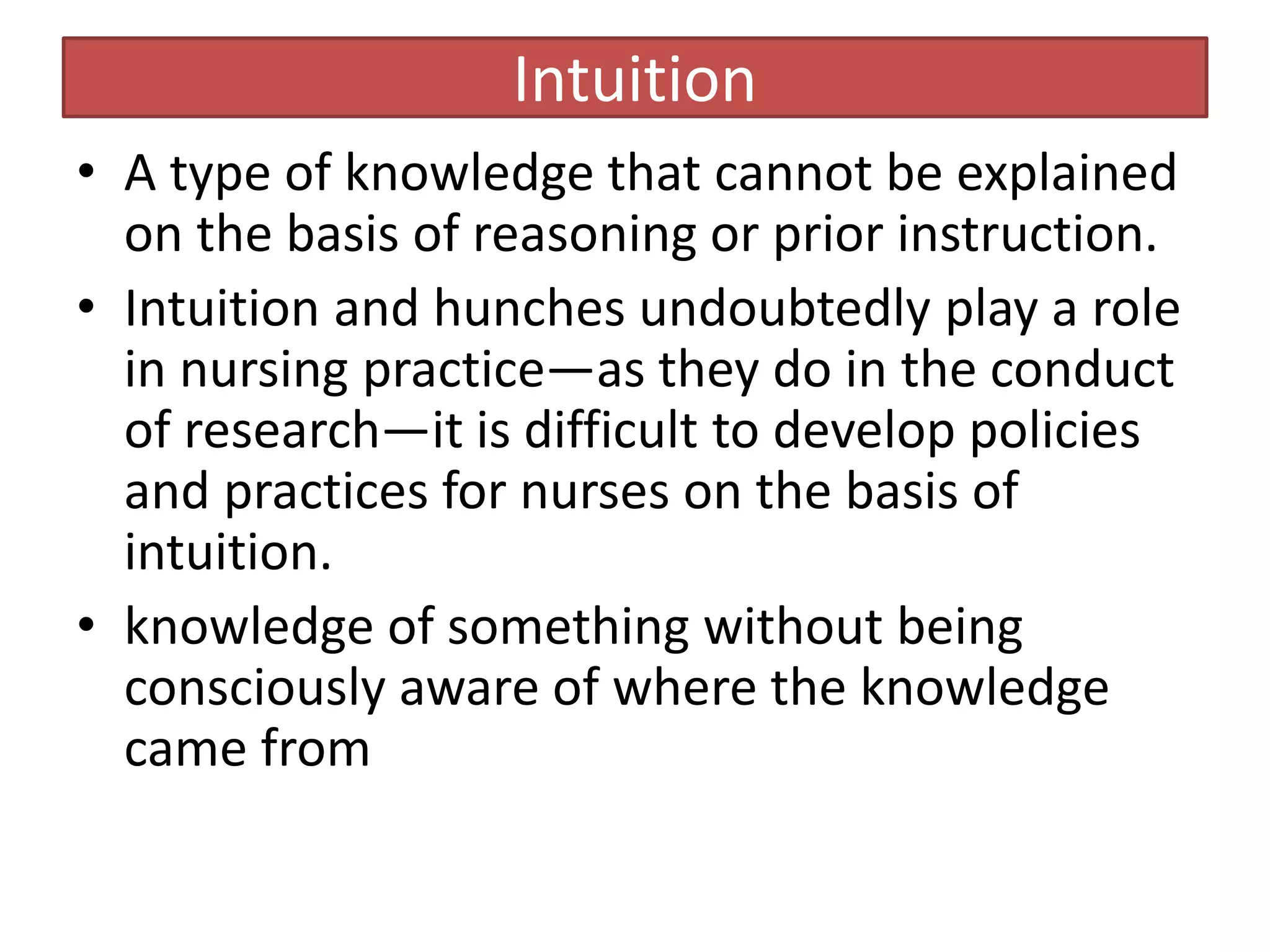
Intuition
• A type of knowledge that cannot be explained
on the basis of reasoning or prior instruction.
• Intuition and hunches undoubtedly play a role
in nursing practice—as they do in the conduct
of research—it is difficult to develop policies
and practices for nurses on the basis of
intuition.
• knowledge of something without being
consciously aware of where the knowledge
came from
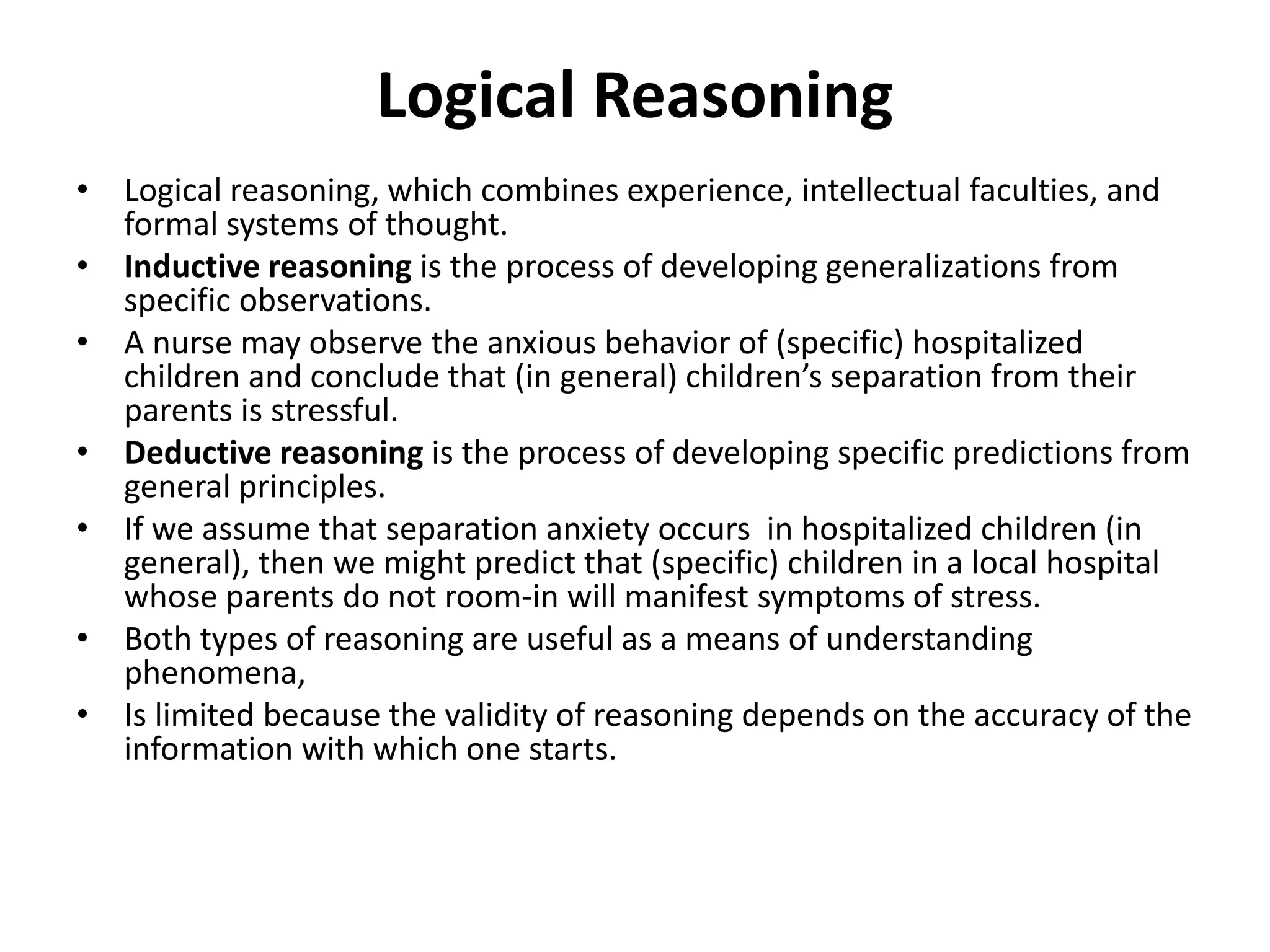
Logical Reasoning
• Logical reasoning, which combines experience, intellectual faculties, and
formal systems of thought.
• Inductive reasoning is the process of developing generalizations from
specific observations.
• A nurse may observe the anxious behavior of (specific) hospitalized
children and conclude that (in general) children’s separation from their
parents is stressful.
• Deductive reasoning is the process of developing specific predictions from
general principles.
• If we assume that separation anxiety occurs in hospitalized children (in
general), then we might predict that (specific) children in a local hospital
whose parents do not room-in will manifest symptoms of stress.
• Both types of reasoning are useful as a means of understanding
phenomena,
• Is limited because the validity of reasoning depends on the accuracy of the
information with which one starts.
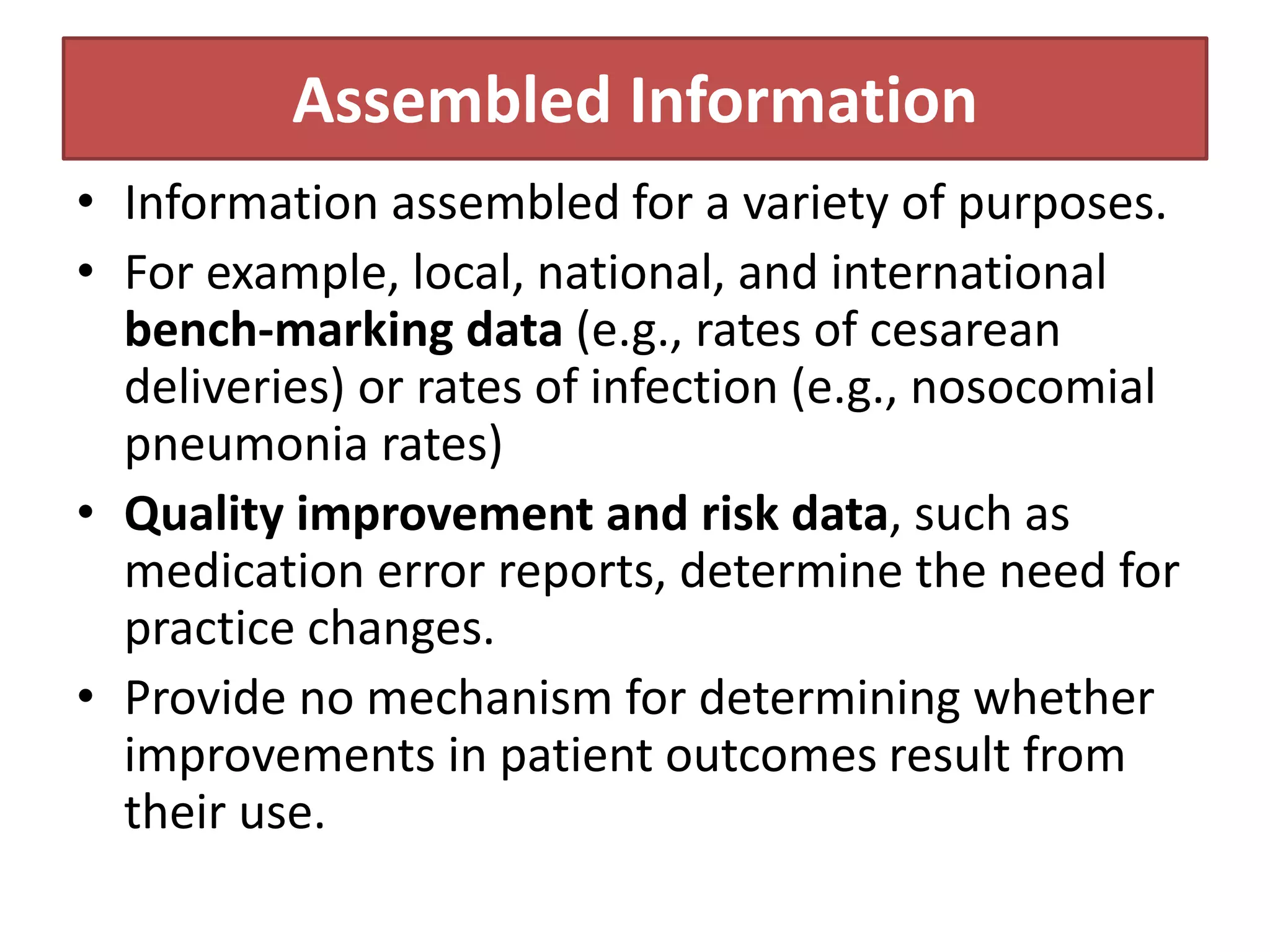
Assembled Information
• Information assembled for a variety of purposes.
• For example, local, national, and international
bench-marking data (e.g., rates of cesarean
deliveries) or rates of infection (e.g., nosocomial
pneumonia rates)
• Quality improvement and risk data, such as
medication error reports, determine the need for
practice changes.
• Provide no mechanism for determining whether
improvements in patient outcomes result from
their use.
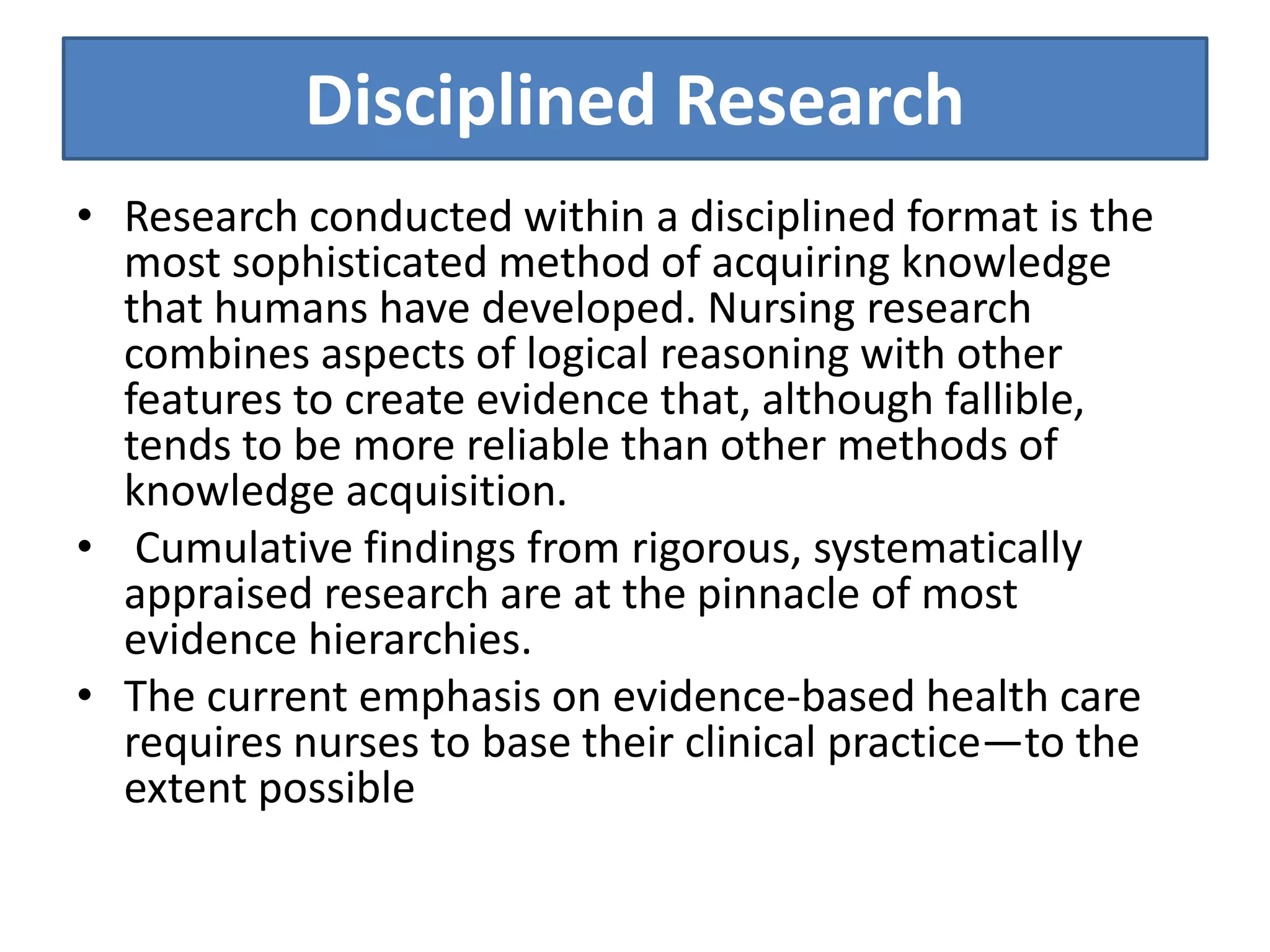
Disciplined Research
• Research conducted within a disciplined format is the
most sophisticated method of acquiring knowledge
that humans have developed. Nursing research
combines aspects of logical reasoning with other
features to create evidence that, although fallible,
tends to be more reliable than other methods of
knowledge acquisition.
• Cumulative findings from rigorous, systematically
appraised research are at the pinnacle of most
evidence hierarchies.
• The current emphasis on evidence-based health care
requires nurses to base their clinical practice—to the
extent possible
Objectives
• On completing this chapter, you will be
able to:
• Describe major characteristics of the positivist
and naturalistic paradigm, and discuss
• similarities and differences between the
traditional scientific method (quantitative
• research) and naturalistic methods (qualitative
research
PARADIGMS FOR NURSING RESEARCH
• A paradigm is a world view, a general perspective on the
complexities of the real world.
• Disciplined inquiry in the field of nursing within two broad
paradigms.
• The Positivist Paradigm ( logical positivism): is rooted in
19th century thought ( Comte, Newton, and Locke)
• Emphasizes the rational and the scientific.
• A fundamental assumption: a reality out there that can be
studied and known.
• (An assumption is a principle that is believed to be true
without proof or verification.)
• Nature is basically ordered and regular and that an
objective reality exists independent of human observation.
• world to be merely not a creation of the human mind.
Determinism
• The positivists’ belief that phenomena (observable facts and events)
are not haphazard or random, but rather have antecedent causes.
• If a person has a cerebrovascular accident, there must be one or
more reasons that can be potentially identified.
• Much research activity is directed at understanding the underlying
causes of natural phenomena.
• Belief in an objective reality
• The use of orderly, disciplined procedures with tight controls over
the research situation to test hunches about the nature of
phenomena being studied and relationships among them.
• Postpositivist paradigm: A belief in reality and a desire to
understand it, the impossibility of total objectivity.
• Appreciate the impediments to knowing reality with certainty and
probabilistic evidence (likelihood)
The Naturalistic Paradigm
• Constructivist paradigm: Weber and Kant
• Reality is not a fixed entity but rather a construction
of the individuals participating in the research; reality
exists within a context, and many constructions are
possible.
• Relativism: If , multiple interpretations of reality,
then there is no process by which the ultimate truth
or falsity of the constructions can be determined.
• Knowledge is maximized when the distance between
the inquirer and the participants in the study is
minimized.
• The voices and interpretations are crucial , subjective
interactions are the primary way to access them.
Paradigms and Methods: Quantitative and
Qualitative Research
• Research methods are the techniques
researchers use to structure a study and to
gather and analyze information relevant to the
research question.
• The methodologic distinction typically focuses
on differences between
• quantitative research, positivist tradition, and
qualitative research, naturalistic inquiry
The Scientific Method and Quantitative
Research
• The traditional, positivist scientific method entails a set of
orderly, disciplined procedures used to acquire information.
• Use deductive reasoning
• A systematic fashion from the definition of a problem and
the selection of concepts, to the solution of the problem.
• Systematic : Investigators progress logically through a series
of steps, according to a prespecified plan.
• Mechanisms designed to control the research situation so
that biases are minimized and precision and validity are
maximized.
• Empirical evidence—rooted in objective reality and
gathered directly or indirectly through the senses rather
than through personal beliefs or hunches
• Using formal instruments to collect needed information.
• quantitative—numeric information that results from some
type of formal measurement and that is analyzed with
statistical procedures.
• The ability to generalize research findings to individuals
other than those who participated in the study (
generalizability) is an important goal.
• One important limitation—common to both quantitative
and qualitative research—is that research methods cannot
be used to answer moral or ethical questions.
• Persistent and intriguing questions about the human
experience (e.g., should euthanasia be practiced?).
• It is inevitable that the nursing process will never rely
exclusively on scientific information.
• The traditional research approach also must contend
with problems of measurement.
• For example, if the phenomenon of interest were
patient morale, researchers might want to assess if
morale is high or low, or higher under certain
conditions.
• Such as morale or self-esteem.
• Human beings, inherently complex and diverse
• Complexities tend to be controlled and, if possible,
eliminated rather than studied directly.
• This narrow focus can sometimes obscure insights
• Accused of a narrowness and inflexibility of vision
• Sedimented view of the world that does not fully
capture the reality of experiences
Naturalistic Methods and Qualitative
Research
• Deal with the issue of human complexity by exploring it
directly.
• The inherent depth of humans, their ability to shape and
create their own experiences, and the idea that truth is a
composite of realities.
• Understanding the human experience as it is lived, usually
• through the careful collection and analysis of qualitative
materials that are narrative and subjective.
• Researchers who reject the traditional scientific method
believe that a major limitation of the classical model is that
it is reductionist—that is, it reduces human experience to
only the few concepts under investigation
• Emerging from the experiences (missed)
• Dynamic, holistic, and individual aspects of phenomena
and attempt to capture those aspects in their entirety,
within the context of those who are experiencing them.
• Flexible, evolving procedures are used to capitalize on
findings that emerge in the course of the study.
• Takes place in the field (i.e., in naturalistic settings), often
over an extended period.
• The collection of information and its analysis typically
progress concurrently; as researchers sift through
information, insights are gained, new questions emerge,
and further evidence is sought to amplify or confirm the
insights.
• Inductive process, researchers integrate information to
develop a theory or description that helps explicate the
phenomena under observation.
• Yield rich, in-depth information that can potentially clarify
the varied dimensions of a complicated phenomenon
• Typically grounded in the real-life experiences of people
with first-hand knowledge of a phenomenon.
• Human beings are used directly as the instrument through
which information is gathered, and humans are extremely
intelligent and sensitive—but fallible—tools.
• The subjectivity that enriches the analytic insights of skillful
researchers can yield trivial “findings” among less
competent ones.
• The subjective nature of the inquiry can raise questions
about the idiosyncratic nature of the conclusions.
• Involve a relatively small study group
• The generalizability can sometimes be challenged.
Multiple Paradigms and Nursing Research
• Paradigms are lenses that help to sharpen our focus on phenomena
of interest
• Ultimate goals.: is to gain understanding
• Seek to capture the truth with regard to an aspect of the world in
which they are interested, and make noteworthy—and mutually
beneficial—contributions
• External evidence.: gather and analyze evidence empirically, that is,
through their senses.
• Armchair analysts, relying on their own beliefs to generate their
evidence.
• Reliance on human cooperation. human cooperation is essential.
• To understand people’s characteristics and experiences, researchers
must persuade them to participate in the investigation and to speak
and act candidly.
• Ethical constraints: guided by ethical principles that
sometimes interfere with research goals.
• For example, if researchers want to test a potentially
beneficial intervention, is it ethical to withhold the
treatment from some people to see what happens?
• Fallibility of disciplined research: limitations, Every
research question can be addressed in many different
ways, and inevitably there are trade-offs.
• Financial constraints, even in well-funded research.
• It means that no single study can ever definitively
answer a research question.
• Each completed study adds to a body of accumulated
evidence.
References
• Pilot D.F, & Beck C.T. (2010) Introduction to
Nursing Research in an Evidence-Based
Practice Environment. In: Essentials of Nursing
Research: Appraising Evidence for Nursing
Practice, 07th edn), China, Wolter
Kluwer/lippincott Williams and Wilkins, p.12-
20

Sources of knowledge

  • 1.
    Sources of Knowledgein Nursing Research PIR BUX JOKHIO Assistant Professor Nursing
  • 2.
    Objectives • On completingthis chapter, you will be able to: • Describe alternative sources of evidence for nursing practice • Discuss Tradition, authority, Clinical experience, trail & error, assembled information, • Differentiate between Inductive & deductive reasoning • Explain disciplined research
  • 3.
    Introduction • Learning aboutbest-practice nursing will continue throughout your career. • Millenson (1997) estimated that a full 85% of health care practice was not scientifically validated. • Although the percentage of validated practices may have increased since 1997, there is widespread support for the idea that nursing practice should rely more heavily on evidence from research. • Discussions of evidence hierarchies that acknowledge that certain types of evidence are superior to others.
  • 4.
    Sources of Knowledge •There are many ways to gain knowledge, and some are better than others. As social scientist, you must be aware of each of these methods. Let us look at several ways of acquiring knowledge, beginning with sources that may not be as reliable or accurate as scientists might desire. We will then consider sources that offer greater reliability and ultimately discuss using science as a means of gaining knowledge
  • 5.
    Superstition and Intuition •“Acquiring knowledge that is based on subjective feelings, interpreting random events as nonrandom events, or believing in magical events. • For example, you may have heard someone say “Bad things happen in threes.” • Where does this idea come from? • has ever documented that bad events occur in threes? • Some people believe that breaking a mirror brings 7 years of bad luck • Once again, these are examples of superstitious beliefs that are not based on observation or hypothesis testing.
  • 6.
    Superstition and IntuitionIn Nursing • The use of intuition and tacit knowledge can include anticipating cardiac arrest, the need for pain relief or belief that a patient’s life is near its end • Burnard (1989) has described intuition as an acute sensitivity or ‘sixth sense’, drawing on experience and knowledge to make a care judgment. • Tacit knowledge is also developed through experience gained by engagement in practice
  • 7.
    Tradition • Certain beliefsare accepted as truths—and certain practices are accepted as effective—simply based on custom. • Knowledge passed down through generations • Tradition may, however, undermine effective problem solving. • In case of the beliefs and practices are imposed • Traditions entrenched that their validity or usefulness is not questioned or evaluated.
  • 8.
    Tradition • No questioning?????????????????? • Bathing a patient in the morning????????????????? • HAND OVER ????????????? • As new evidence: often a need to challenge and change traditional and ritualistic practices. • T he need to practice using current evidence is expressed as part of the Nurses Code of Professional Conduct (Nursing and Midwifery Council, 2008; www.nmc-uk.org) requires all practitioners to ‘Keep your knowledge and skills up-to-date throughout your working life.’(NMC, 2008: 7)
  • 9.
    Personal Knowledge • Intuitionand tacit knowledge can inform the development of personal knowledge • Personal knowledge is individual knowledge shaped through being personally involved in situations and events in practice. • Liaschenko and Fisher (1999) refer to ‘person knowledge’, to knowing a person as an individual, understanding personal experience of illness and care delivery.
  • 10.
    Authority • Authority, aperson with specialized expertise and recognition for that expertise. • Reliance on nursing authorities (e.g., nursing faculty) is to some degree unavoidable; • A source of information have limitations. • Not infallible (particularly if their expertise is based primarily on personal experience), yet their knowledge often goes unchallenged
  • 11.
    Clinical Experience, • Clinicalexperience is a familiar and functional source of knowledge. • The ability to recognize regularities, and to make predictions based on observations is a hallmark of the human mind. • Nevertheless, personal experience has limitations as a source of evidence for practice because each nurse’s experience is typically too narrow to be generally useful, and personal experiences are often colored by biases.
  • 12.
    Trail & Error •Alternatives are tried successively until a solution to a problem is found. • May be practical in some cases, but it is often fallible and inefficient. • Tends to be haphazard and the solutions may be idiosyncratic.
  • 13.
    Intuition • A typeof knowledge that cannot be explained on the basis of reasoning or prior instruction. • Intuition and hunches undoubtedly play a role in nursing practice—as they do in the conduct of research—it is difficult to develop policies and practices for nurses on the basis of intuition. • knowledge of something without being consciously aware of where the knowledge came from
  • 14.
    Logical Reasoning • Logicalreasoning, which combines experience, intellectual faculties, and formal systems of thought. • Inductive reasoning is the process of developing generalizations from specific observations. • A nurse may observe the anxious behavior of (specific) hospitalized children and conclude that (in general) children’s separation from their parents is stressful. • Deductive reasoning is the process of developing specific predictions from general principles. • If we assume that separation anxiety occurs in hospitalized children (in general), then we might predict that (specific) children in a local hospital whose parents do not room-in will manifest symptoms of stress. • Both types of reasoning are useful as a means of understanding phenomena, • Is limited because the validity of reasoning depends on the accuracy of the information with which one starts.
  • 15.
    Assembled Information • Informationassembled for a variety of purposes. • For example, local, national, and international bench-marking data (e.g., rates of cesarean deliveries) or rates of infection (e.g., nosocomial pneumonia rates) • Quality improvement and risk data, such as medication error reports, determine the need for practice changes. • Provide no mechanism for determining whether improvements in patient outcomes result from their use.
  • 16.
    Disciplined Research • Researchconducted within a disciplined format is the most sophisticated method of acquiring knowledge that humans have developed. Nursing research combines aspects of logical reasoning with other features to create evidence that, although fallible, tends to be more reliable than other methods of knowledge acquisition. • Cumulative findings from rigorous, systematically appraised research are at the pinnacle of most evidence hierarchies. • The current emphasis on evidence-based health care requires nurses to base their clinical practice—to the extent possible
  • 17.
    Objectives • On completingthis chapter, you will be able to: • Describe major characteristics of the positivist and naturalistic paradigm, and discuss • similarities and differences between the traditional scientific method (quantitative • research) and naturalistic methods (qualitative research
  • 18.
    PARADIGMS FOR NURSINGRESEARCH • A paradigm is a world view, a general perspective on the complexities of the real world. • Disciplined inquiry in the field of nursing within two broad paradigms. • The Positivist Paradigm ( logical positivism): is rooted in 19th century thought ( Comte, Newton, and Locke) • Emphasizes the rational and the scientific. • A fundamental assumption: a reality out there that can be studied and known. • (An assumption is a principle that is believed to be true without proof or verification.) • Nature is basically ordered and regular and that an objective reality exists independent of human observation. • world to be merely not a creation of the human mind.
  • 19.
    Determinism • The positivists’belief that phenomena (observable facts and events) are not haphazard or random, but rather have antecedent causes. • If a person has a cerebrovascular accident, there must be one or more reasons that can be potentially identified. • Much research activity is directed at understanding the underlying causes of natural phenomena. • Belief in an objective reality • The use of orderly, disciplined procedures with tight controls over the research situation to test hunches about the nature of phenomena being studied and relationships among them. • Postpositivist paradigm: A belief in reality and a desire to understand it, the impossibility of total objectivity. • Appreciate the impediments to knowing reality with certainty and probabilistic evidence (likelihood)
  • 20.
    The Naturalistic Paradigm •Constructivist paradigm: Weber and Kant • Reality is not a fixed entity but rather a construction of the individuals participating in the research; reality exists within a context, and many constructions are possible. • Relativism: If , multiple interpretations of reality, then there is no process by which the ultimate truth or falsity of the constructions can be determined. • Knowledge is maximized when the distance between the inquirer and the participants in the study is minimized. • The voices and interpretations are crucial , subjective interactions are the primary way to access them.
  • 21.
    Paradigms and Methods:Quantitative and Qualitative Research • Research methods are the techniques researchers use to structure a study and to gather and analyze information relevant to the research question. • The methodologic distinction typically focuses on differences between • quantitative research, positivist tradition, and qualitative research, naturalistic inquiry
  • 22.
    The Scientific Methodand Quantitative Research • The traditional, positivist scientific method entails a set of orderly, disciplined procedures used to acquire information. • Use deductive reasoning • A systematic fashion from the definition of a problem and the selection of concepts, to the solution of the problem. • Systematic : Investigators progress logically through a series of steps, according to a prespecified plan. • Mechanisms designed to control the research situation so that biases are minimized and precision and validity are maximized. • Empirical evidence—rooted in objective reality and gathered directly or indirectly through the senses rather than through personal beliefs or hunches
  • 23.
    • Using formalinstruments to collect needed information. • quantitative—numeric information that results from some type of formal measurement and that is analyzed with statistical procedures. • The ability to generalize research findings to individuals other than those who participated in the study ( generalizability) is an important goal. • One important limitation—common to both quantitative and qualitative research—is that research methods cannot be used to answer moral or ethical questions. • Persistent and intriguing questions about the human experience (e.g., should euthanasia be practiced?). • It is inevitable that the nursing process will never rely exclusively on scientific information.
  • 24.
    • The traditionalresearch approach also must contend with problems of measurement. • For example, if the phenomenon of interest were patient morale, researchers might want to assess if morale is high or low, or higher under certain conditions. • Such as morale or self-esteem. • Human beings, inherently complex and diverse • Complexities tend to be controlled and, if possible, eliminated rather than studied directly. • This narrow focus can sometimes obscure insights • Accused of a narrowness and inflexibility of vision • Sedimented view of the world that does not fully capture the reality of experiences
  • 25.
    Naturalistic Methods andQualitative Research • Deal with the issue of human complexity by exploring it directly. • The inherent depth of humans, their ability to shape and create their own experiences, and the idea that truth is a composite of realities. • Understanding the human experience as it is lived, usually • through the careful collection and analysis of qualitative materials that are narrative and subjective. • Researchers who reject the traditional scientific method believe that a major limitation of the classical model is that it is reductionist—that is, it reduces human experience to only the few concepts under investigation
  • 26.
    • Emerging fromthe experiences (missed) • Dynamic, holistic, and individual aspects of phenomena and attempt to capture those aspects in their entirety, within the context of those who are experiencing them. • Flexible, evolving procedures are used to capitalize on findings that emerge in the course of the study. • Takes place in the field (i.e., in naturalistic settings), often over an extended period. • The collection of information and its analysis typically progress concurrently; as researchers sift through information, insights are gained, new questions emerge, and further evidence is sought to amplify or confirm the insights. • Inductive process, researchers integrate information to develop a theory or description that helps explicate the phenomena under observation.
  • 27.
    • Yield rich,in-depth information that can potentially clarify the varied dimensions of a complicated phenomenon • Typically grounded in the real-life experiences of people with first-hand knowledge of a phenomenon. • Human beings are used directly as the instrument through which information is gathered, and humans are extremely intelligent and sensitive—but fallible—tools. • The subjectivity that enriches the analytic insights of skillful researchers can yield trivial “findings” among less competent ones. • The subjective nature of the inquiry can raise questions about the idiosyncratic nature of the conclusions. • Involve a relatively small study group • The generalizability can sometimes be challenged.
  • 28.
    Multiple Paradigms andNursing Research • Paradigms are lenses that help to sharpen our focus on phenomena of interest • Ultimate goals.: is to gain understanding • Seek to capture the truth with regard to an aspect of the world in which they are interested, and make noteworthy—and mutually beneficial—contributions • External evidence.: gather and analyze evidence empirically, that is, through their senses. • Armchair analysts, relying on their own beliefs to generate their evidence. • Reliance on human cooperation. human cooperation is essential. • To understand people’s characteristics and experiences, researchers must persuade them to participate in the investigation and to speak and act candidly.
  • 29.
    • Ethical constraints:guided by ethical principles that sometimes interfere with research goals. • For example, if researchers want to test a potentially beneficial intervention, is it ethical to withhold the treatment from some people to see what happens? • Fallibility of disciplined research: limitations, Every research question can be addressed in many different ways, and inevitably there are trade-offs. • Financial constraints, even in well-funded research. • It means that no single study can ever definitively answer a research question. • Each completed study adds to a body of accumulated evidence.
  • 30.
    References • Pilot D.F,& Beck C.T. (2010) Introduction to Nursing Research in an Evidence-Based Practice Environment. In: Essentials of Nursing Research: Appraising Evidence for Nursing Practice, 07th edn), China, Wolter Kluwer/lippincott Williams and Wilkins, p.12- 20