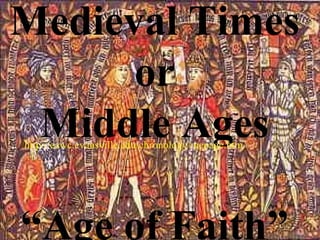
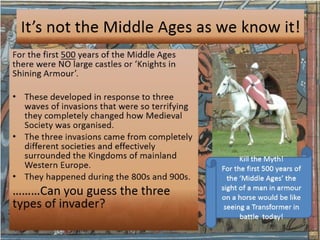
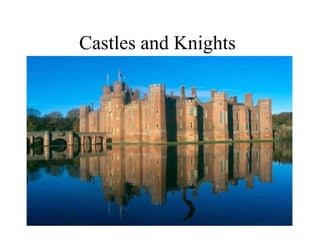
Medieval Times
or
Middle Ages
“Age of Faith”
http://eawc.evansville.edu/chronology/mepage.htm
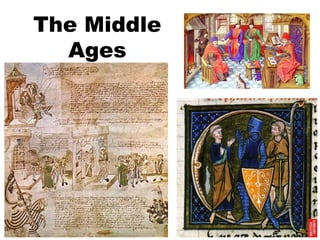
The Middle
Ages
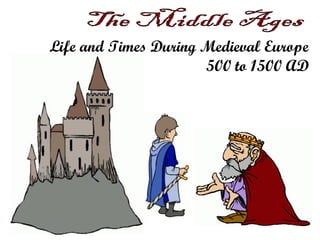
Life and Times During Medieval Europe
500 to 1500 AD
Started with the collapse of
Roman Empire
• Crumbling started in earnest 190 CE
• 476 Last Western Roman Empire leader
dethroned.
From Rome to Eastern Roman
Empire
Constantinople
• (former city of Byzantium) became new capital and control
centre for Eastern Roman Empire
• Was largest city by population in the world west of China
• Strategic location on trade routes
• One of largest natural harbours in the world linked the east and
west
• Byzantine gold coin (bezant) was the main currency of
international trade
• Ruled provinces by Roman model (governors, bureaucracy and
imperial army, heavy taxation and favouring of royal family
and priests in trade and taxes
Warriors and Warbands in the West
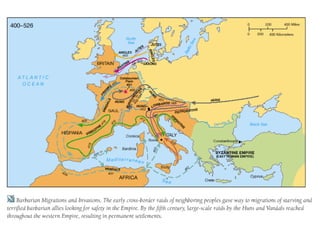
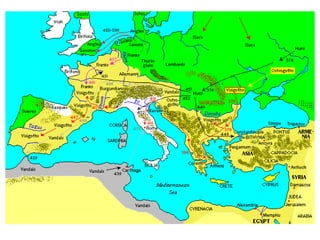
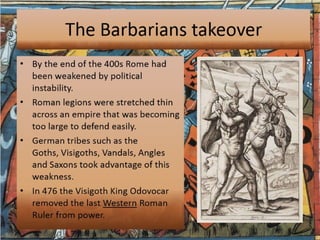
• Period of change in Western Europe as barbarians
were migrating in to areas given up by Romans
• As more barbarians moved westward, other tribes
were forced to move
• Groups categorized by languages and little else
• Celtic: Gauls, Britons, Bretons
• Germanic: Goths, Frank, Vandals, Saxons
• Slavic: Wends
• Repeated invasions and constant
warfare ended the Western Roman
Empire:
– Disruption of Trade--Merchants
faced invasions from land and sea.
Businesses collapse and money
becomes scarce.
– Downfall of Cities--Cities were
abandoned.
– Population Shift--Population moves
from cities to countryside (rural).
• People turned to church for order and
security.
– Germanic people called the Franks
were led by Clovis, who converted to
Christianity.
– The Church adapts to the rural
conditions of Western Europe. The
Church built religious communities
called monasteries.
PeriodizationPeriodization
Early Middle Ages: 500 – 1000
High Middle Ages: 1000 – 1250
Late Middle Ages: 1250 - 1500
Early Middle
Ages
• Dark Ages (500 CE- 1000 CE)- scholars named this as
a time when the forces of darkness (barbarians)
overwhelmed the forces of light (Romans)
• Rise of influence of barbarians as Roman Emperors
had granted barbarian mercenaries land with the
Roman Empire in return for military service and it was
these barbarians who eventually became the new rulers
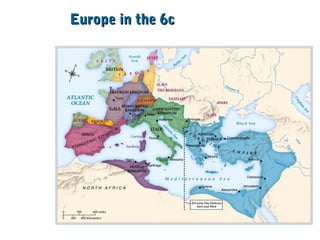
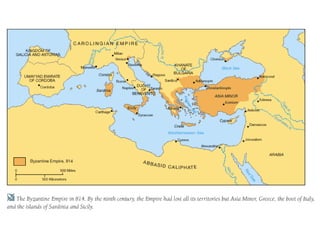
Byzantine Empire in 6th
Century
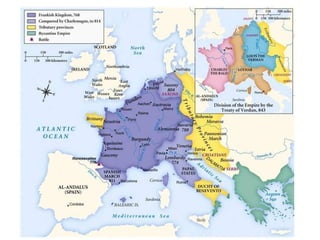
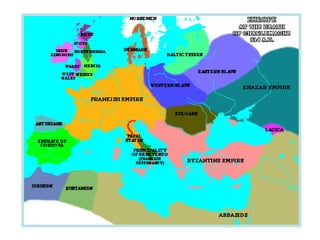
Europe in the 6cEurope in the 6c
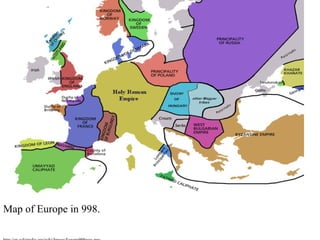
Map of Europe in 998.
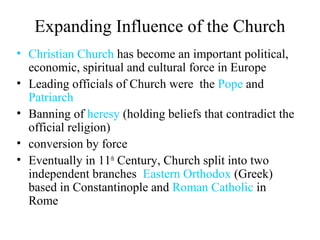
Expanding Influence of the Church
• Christian Church has become an important political,
economic, spiritual and cultural force in Europe
• Leading officials of Church were the Pope and
Patriarch
• Banning of heresy (holding beliefs that contradict the
official religion)
• conversion by force
• Eventually in 11th
Century, Church split into two
independent branches Eastern Orthodox (Greek)
based in Constantinople and Roman Catholic in
Rome
You scratch my back…
I’ll scratch yours….
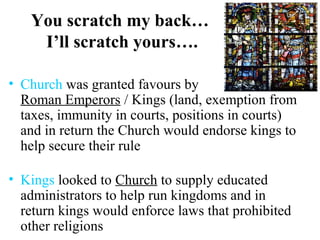
• Church was granted favours by
Roman Emperors / Kings (land, exemption from
taxes, immunity in courts, positions in courts)
and in return the Church would endorse kings to
help secure their rule
• Kings looked to Church to supply educated
administrators to help run kingdoms and in
return kings would enforce laws that prohibited
other religions
Monasticism and
Saints
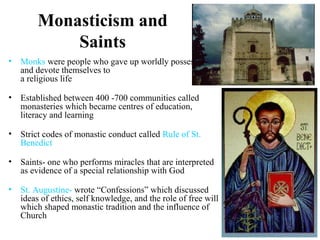
• Monks were people who gave up worldly possessions
and devote themselves to
a religious life
• Established between 400 -700 communities called
monasteries which became centres of education,
literacy and learning
• Strict codes of monastic conduct called Rule of St.
Benedict
• Saints- one who performs miracles that are interpreted
as evidence of a special relationship with God
• St. Augustine- wrote “Confessions” which discussed
ideas of ethics, self knowledge, and the role of free will
which shaped monastic tradition and the influence of
Church
The Holy Roman Empire &
Charlemagne
• Charlemagne (Charles the Great) who was a military
general and restored Pope Leo III who had been exiled
• In return, Leo placed a crown on Charlemagne and
named him the “Emperor of the Romans” which secured
the relationship between Frankish kings and the papacy
• Charlemagne became the first ruler of the Holy Roman
Empire, a dynasty that would last for more than 700
years
• Charlemagne- imposed order on empire through the
Church and state
• Ordered the standardization of Latin, textbooks,
manuals for preaching, schools for clergy and people,
new form of handwriting
• All these promoted education and scholars and produced
a precise written language (Latin)
Birth of Modern Languages
• Development of Middle Ages
• New languages born through migration,
resettlement, conflict and changes
• Old English (Anglo Saxon) began to
incorporate words borrowed from Latin and
Old French, Old German and Old Norse
• Roots of contemporary Spanish, Italian and
other Romance languages
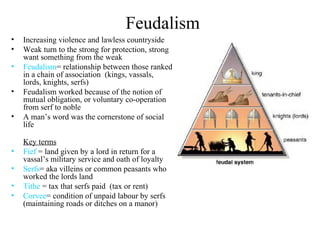
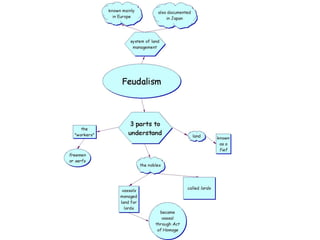
Feudalism
• Increasing violence and lawless countryside
• Weak turn to the strong for protection, strong
want something from the weak
• Feudalism= relationship between those ranked
in a chain of association (kings, vassals,
lords, knights, serfs)
• Feudalism worked because of the notion of
mutual obligation, or voluntary co-operation
from serf to noble
• A man’s word was the cornerstone of social
life
Key terms
• Fief = land given by a lord in return for a
vassal’s military service and oath of loyalty
• Serfs= aka villeins or common peasants who
worked the lords land
• Tithe = tax that serfs paid (tax or rent)
• Corvee= condition of unpaid labour by serfs
(maintaining roads or ditches on a manor)
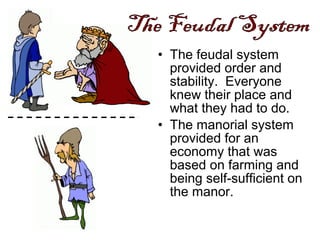
• The feudal system
provided order and
stability. Everyone
knew their place and
what they had to do.
• The manorial system
provided for an
economy that was
based on farming and
being self-sufficient on
the manor.
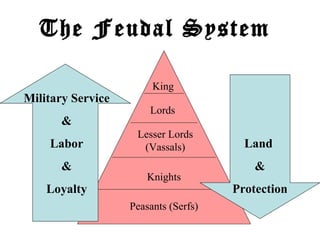
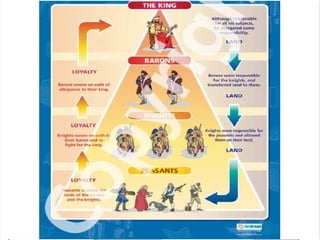
The Feudal System
King
Lords
Lesser Lords
(Vassals)
Knights
Peasants (Serfs)
Military Service
&
Labor
&
Loyalty
Land
&
Protection
Slaves and Serfs
• Slaves made up of conquered peoples
• Some treated harshly, while other were
treated fairly
• Rural slaves became serfs, who worked the
land and provided labour for owner (in
return from protection)
• Set up for system of feudalism
• The manor was the lord’s estate.
• The manor system was an
economic arrangement between a
lord and his serfs.
• The lord would provide serfs with
housing, strips of farmland, and
protection from bandits.
• In return, the serfs tended the lord’s
lands, cared for his animals, and
performed other tasks to maintain
the estate.
• The manor was largely a self-
sufficient community.
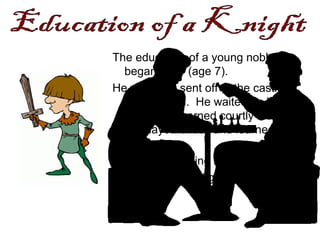
The education of a young noble
began early (age 7).
He would be sent off to the castle of
another lord. He waited on his
hosts and learned courtly manners.
He played chess and learned war
strategies.
To develop fighting skills, he would
practice sword fighting.
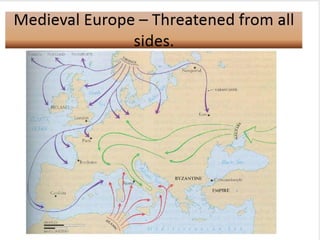
At around the age of 14, the boy
would become a squire.
A squire would act as a servant to a
knight.
The squire took care of the knight’s
armor, weapons, and warhorse.
The squire would also escort the
knight to battles.
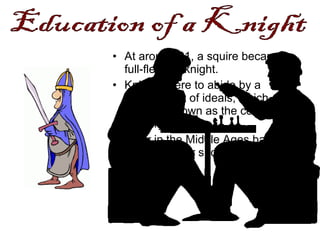
• At around 21, a squire became a
full-fledged knight.
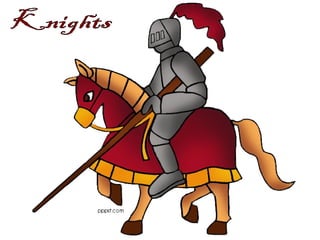
• Knights were to abide by a
complex set of ideals, which
became known as the code of
chivalry.
• Later in the Middle Ages battles
were often for show.
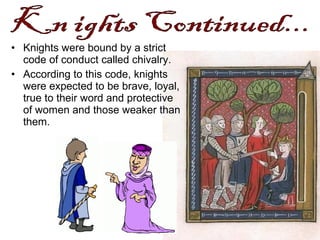
• Knights were bound by a strict
code of conduct called chivalry.
• According to this code, knights
were expected to be brave, loyal,
true to their word and protective
of women and those weaker than
them.
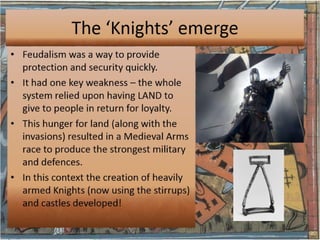
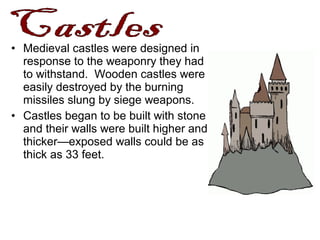
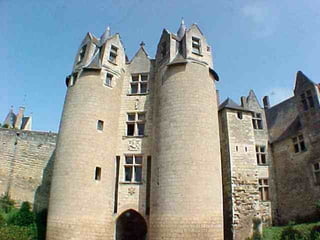
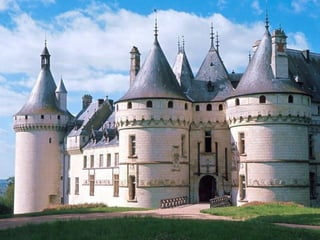
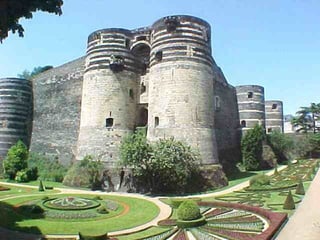
• Medieval castles were designed in
response to the weaponry they had
to withstand. Wooden castles were
easily destroyed by the burning
missiles slung by siege weapons.
• Castles began to be built with stone
and their walls were built higher and
thicker—exposed walls could be as
thick as 33 feet.
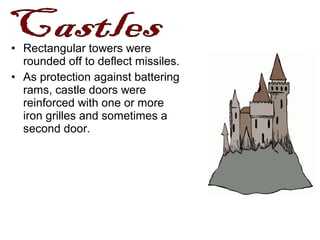
• Rectangular towers were
rounded off to deflect missiles.
• As protection against battering
rams, castle doors were
reinforced with one or more
iron grilles and sometimes a
second door.
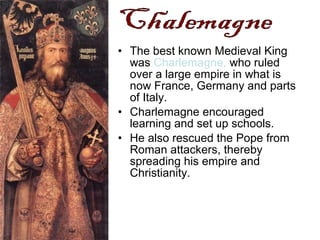
• The best known Medieval King
was Charlemagne, who ruled
over a large empire in what is
now France, Germany and parts
of Italy.
• Charlemagne encouraged
learning and set up schools.
• He also rescued the Pope from
Roman attackers, thereby
spreading his empire and
Christianity.
Charlemagne’s capital, Aachen, in Germany.
Feudalism and the manor system
created divisions among
people. Shared beliefs in the
teachings of the Church
bonded people together.
– Priests and other religious
officials administered the
sacraments, or important
religious ceremonies.
– Kings and peasants were
subject to canon law, or the
law of the Church, in matters
such as marriage and
religious practices.
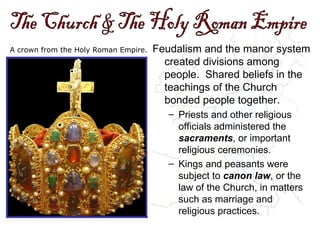
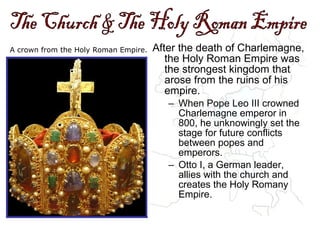
A crown from the Holy Roman Empire.
A crown from the Holy Roman Empire. After the death of Charlemagne,
the Holy Roman Empire was
the strongest kingdom that
arose from the ruins of his
empire.
– When Pope Leo III crowned
Charlemagne emperor in
800, he unknowingly set the
stage for future conflicts
between popes and
emperors.
– Otto I, a German leader,
allies with the church and
creates the Holy Romany
Empire.
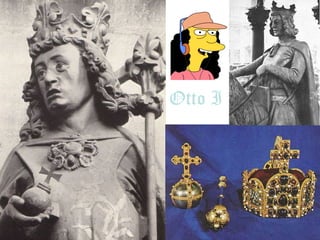
Otto I
Formation of Western Europe
800 to 1500 AD
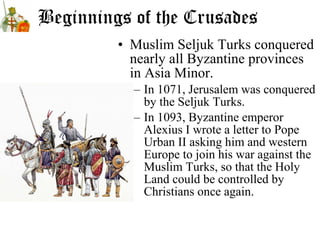
Beginnings of the Crusades
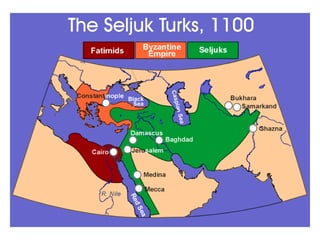
• Muslim Seljuk Turks conquered
nearly all Byzantine provinces
in Asia Minor.
– In 1071, Jerusalem was conquered
by the Seljuk Turks.
– In 1093, Byzantine emperor
Alexius I wrote a letter to Pope
Urban II asking him and western
Europe to join his war against the
Muslim Turks, so that the Holy
Land could be controlled by
Christians once again.
Beginnings of the Crusades
• The letter to the pope begged for
help, so that the Holy Sepulcher,
Christ’s tomb in Jerusalem, would
not be destroyed.
– At the Council of Clermont, Pope
Urban II declared a holy war in the East
and the Truce of God in the West.
– The pope called for this crusade, or holy
war, to help the Byzantine Empire, to
assert his own leadership in the West,
and to get the Christians in western
Europe to stop fighting each other.
Beginnings of the Crusades
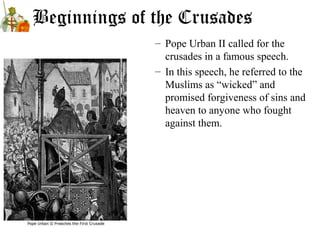
– Pope Urban II called for the
crusades in a famous speech.
– In this speech, he referred to the
Muslims as “wicked” and
promised forgiveness of sins and
heaven to anyone who fought
against them.
The Crusades
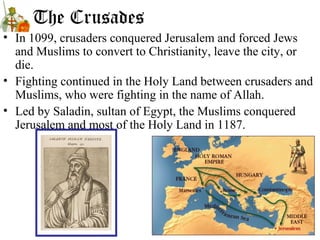
• In 1099, crusaders conquered Jerusalem and forced Jews
and Muslims to convert to Christianity, leave the city, or
die.
• Fighting continued in the Holy Land between crusaders and
Muslims, who were fighting in the name of Allah.
• Led by Saladin, sultan of Egypt, the Muslims conquered
Jerusalem and most of the Holy Land in 1187.
The Crusades
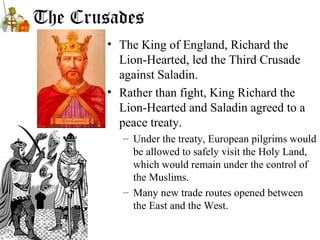
• The King of England, Richard the
Lion-Hearted, led the Third Crusade
against Saladin.
• Rather than fight, King Richard the
Lion-Hearted and Saladin agreed to a
peace treaty.
– Under the treaty, European pilgrims would
be allowed to safely visit the Holy Land,
which would remain under the control of
the Muslims.
– Many new trade routes opened between
the East and the West.
The Crusades Continue…
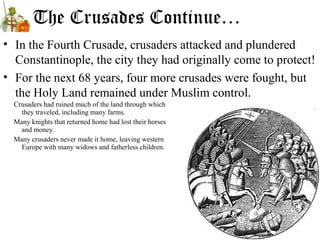
• In the Fourth Crusade, crusaders attacked and plundered
Constantinople, the city they had originally come to protect!
• For the next 68 years, four more crusades were fought, but
the Holy Land remained under Muslim control.
Crusaders had ruined much of the land through which
they traveled, including many farms.
Many knights that returned home had lost their horses
and money.
Many crusaders never made it home, leaving western
Europe with many widows and fatherless children.
Farming
Improvements:• Use of horses instead of oxen. Horses could plow twice as
much as an oxen in a day.
X
The Three Field System emerges. Enables people to use 2/3 of their 600
acres of farmland instead of just 1/2.
–Field 1: 200 acres for a winter crop such as wheat or rye.
–Field 2: 200 acres for a spring crop such as oats, barley, peas, or beans.
–Field 3: 200 acres lay fallow for animals to graze.
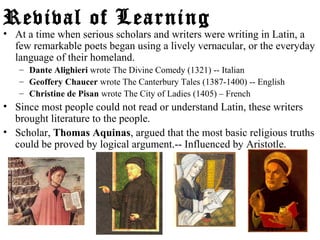
Revival of Learning
• At a time when serious scholars and writers were writing in Latin, a
few remarkable poets began using a lively vernacular, or the everyday
language of their homeland.
– Dante Alighieri wrote The Divine Comedy (1321) -- Italian
– Geoffery Chaucer wrote The Canterbury Tales (1387-1400) -- English
– Christine de Pisan wrote The City of Ladies (1405) – French
• Since most people could not read or understand Latin, these writers
brought literature to the people.
• Scholar, Thomas Aquinas, argued that the most basic religious truths
could be proved by logical argument.-- Influenced by Aristotle.
New Ideas and Culture
• Effects of Crusades
• Guild and communes
• Towns, cities and manors
• New thinkers (Thomas Aquinas) and writers
• Creation of universities
• New art and architecture (gothic, castles)
• Knighthood and chivalry
• Courtly entertainment (fables, playwrights)
Ideas, Inventions and Key Figures
• Roger Bacon (gunpowder)
• Luca Pacioli (Father of Accounting)
• Johannes Gutenberg (printing press)
• Christine de Pisan (writer); Geoffrey Chaucer
(writer)
• Joan of Arc (Hundred Year’s War)
• Pope Urban II (indulgences)
• Pope Innocent IV and Bernard Gui (inquisitions)
• Parliamentary Government in England
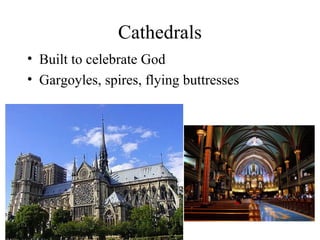
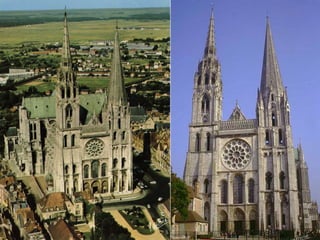
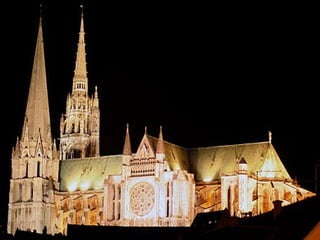
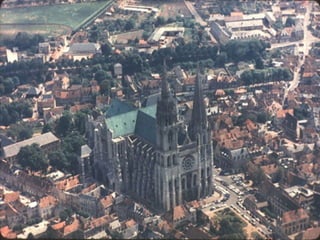
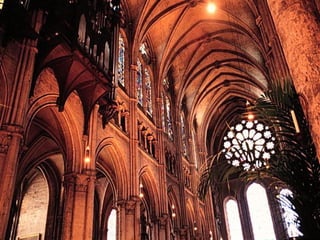
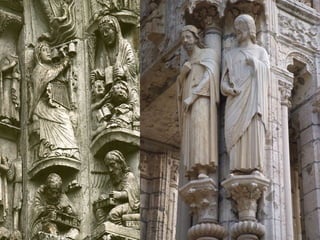
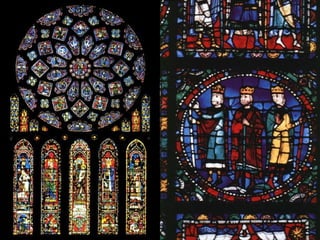
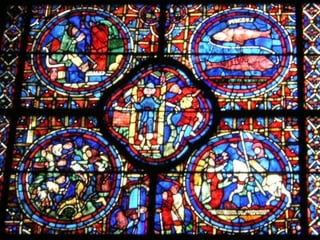
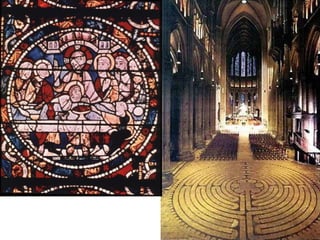
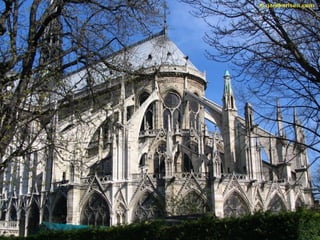
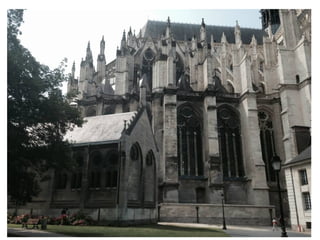
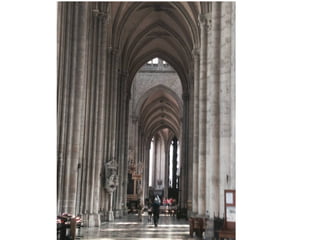
Cathedral of Chartres:
Gothic Architecture
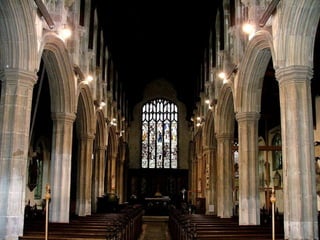
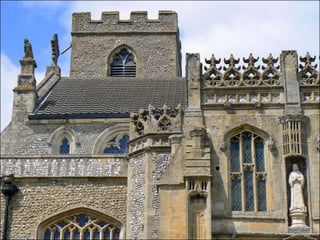
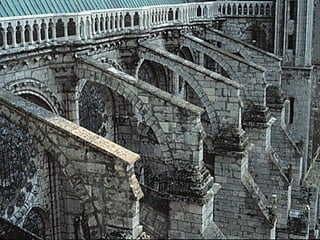
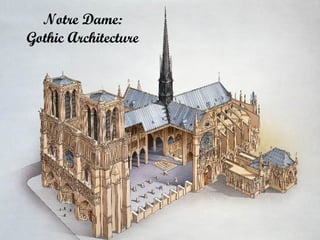
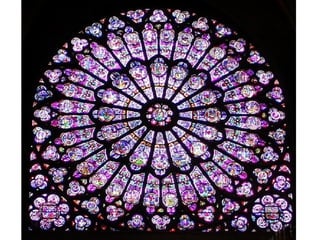
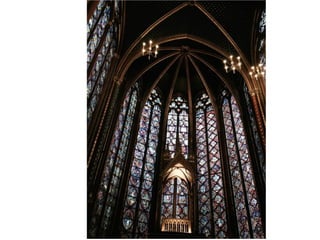
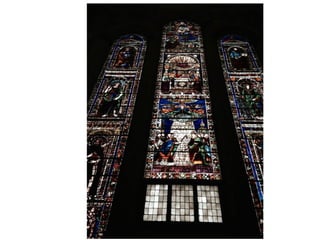
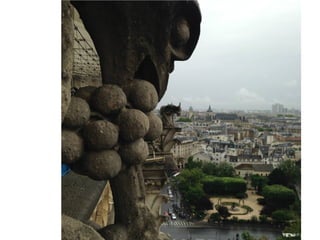
Cathedrals
• Built to celebrate God
• Gargoyles, spires, flying buttresses
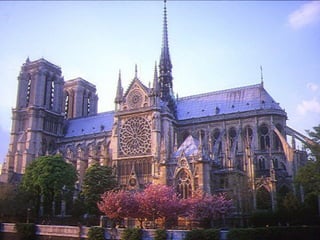
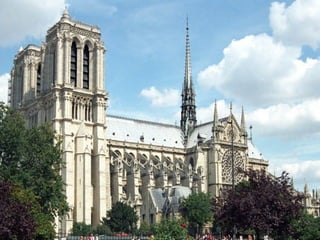
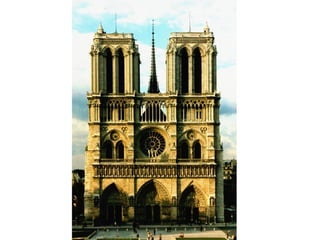
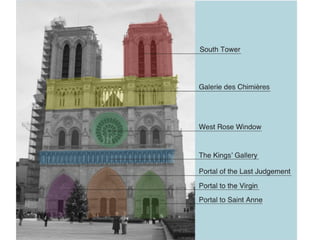
Notre Dame:
Gothic Architecture
Late Middle Ages
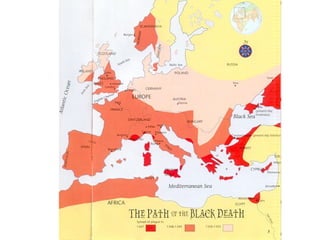
• Black Death
• a devastating
worldwide
pandemic that first
struck Europe in
the mid 14th
century
• killed about a
third of Europe’s
population, an
estimated 34
million people.
Black Death Begins
• Began in Europe around 1350, 1 in 3
people died
• Caused by a germ found on fleas from
rats (Cats could have helped)
The Bubonic Plague
• Called “black death” because of striking symptom of
the disease, in which sufferers' skin would blacken due
to hemorrhages under the skin
• Spread by fleas and rats
• painful lymph node swellings called buboes
• buboes in the groin and armpits, which ooze pus and
blood.
• damage to the skin and underlying tissue until they
were covered in dark blotches
• Most victims died within four to seven days after
infection
EFFECTS
• Caused massive depopulation and change
in social structure
• Weakened influence of Church
• Originated in Asia but was blamed on
Jews and lepers
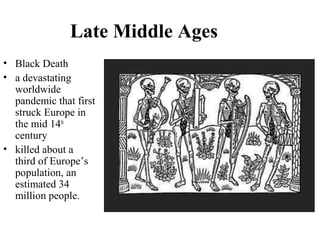
Illustration of the Black Death from the Toggenburg Bible (1411).
Impact of Black Death/Plague
• Population decreases
• People isolate themselves, learn about
cleanliness & spread of germs
• People move away from populated
areas back to secluded farms
• Ends feudal system
Crusades
• Started when Muslims invade
Constantinople
• Often exercises in futility, Children’s
Crusade
• Christians supposedly wanted the Holy
Lands to protect them from Muslims
• Introduced Muslim Ideas & Products
Muslim Products
• Universities, libraries, schools
• Use of zero & Arabic numerals
• Algebra & Geometry
• Chemical medicines
• Performed surgery
• Wrote medical textbooks
• Astronomy Records
The Middle Ages
• Existed from about 500 to 1500 A.D.
• Small Kingdoms replaced large empires
• Religion dominated over Reason
• Feudal system is used
Age of Faith v Renaissance
• Group
• Survival & self-
awareness
• Simple lifestyle
(survival)
• Celebrated the
Individual
• Ideas of Ancient
Greece & Rome
reappear
• People enjoy
worldly pleasures
Renaissance
• Scientific Revolution
• Industrial Revolution
• Enlightenment ( Revolution of Ideas)
• Cultural Revolution
• Political Revolutions
• Democratic Revolutions
Loss of the Roman Empire
• No strong central government
• Frequent invasions
• Limited Trade
• Limited large projects
Feudal System
• Feudalism is a system of government
& way of life
• Fiefdoms- serfs farm land, pay taxes,
landowner protects serfs from
invaders
• Nobles (kings & lords); clergy;
peasants/serfs
Castles and Knights
Church
Roman Catholic
• Built schools & churches & fed the
poor
• Controlled much of the flow of
information
• Held positions of great power
Bibliography
• http://eawc.evansville.edu/chronology/mepage.htm
• http://www.insecta-inspecta.com/fleas/bdeath/bdeath.html
• http://www.cybersleuth-
kids.com/sleuth/History/Ancient_Civilizations/Rome/index.htm
• People Through the Ages (grade 8 textbook)
• https://www.slideshare.net/Halligan/the-
middle-ages-introduction-and-overview?
from_action=save (most copied from here)

Medieval 2

  • 1.
    Medieval Times or Middle Ages “Ageof Faith” http://eawc.evansville.edu/chronology/mepage.htm
  • 2.
  • 4.
    Life and TimesDuring Medieval Europe 500 to 1500 AD
  • 5.
    Started with thecollapse of Roman Empire • Crumbling started in earnest 190 CE • 476 Last Western Roman Empire leader dethroned.
  • 6.
    From Rome toEastern Roman Empire Constantinople • (former city of Byzantium) became new capital and control centre for Eastern Roman Empire • Was largest city by population in the world west of China • Strategic location on trade routes • One of largest natural harbours in the world linked the east and west • Byzantine gold coin (bezant) was the main currency of international trade • Ruled provinces by Roman model (governors, bureaucracy and imperial army, heavy taxation and favouring of royal family and priests in trade and taxes
  • 8.
    Warriors and Warbandsin the West • Period of change in Western Europe as barbarians were migrating in to areas given up by Romans • As more barbarians moved westward, other tribes were forced to move • Groups categorized by languages and little else • Celtic: Gauls, Britons, Bretons • Germanic: Goths, Frank, Vandals, Saxons • Slavic: Wends
  • 9.
    • Repeated invasionsand constant warfare ended the Western Roman Empire: – Disruption of Trade--Merchants faced invasions from land and sea. Businesses collapse and money becomes scarce. – Downfall of Cities--Cities were abandoned. – Population Shift--Population moves from cities to countryside (rural).
  • 10.
    • People turnedto church for order and security. – Germanic people called the Franks were led by Clovis, who converted to Christianity. – The Church adapts to the rural conditions of Western Europe. The Church built religious communities called monasteries.
  • 11.
    PeriodizationPeriodization Early Middle Ages:500 – 1000 High Middle Ages: 1000 – 1250 Late Middle Ages: 1250 - 1500
  • 12.
    Early Middle Ages • DarkAges (500 CE- 1000 CE)- scholars named this as a time when the forces of darkness (barbarians) overwhelmed the forces of light (Romans) • Rise of influence of barbarians as Roman Emperors had granted barbarian mercenaries land with the Roman Empire in return for military service and it was these barbarians who eventually became the new rulers
  • 16.
  • 17.
    Europe in the6cEurope in the 6c
  • 19.
  • 29.
    Expanding Influence ofthe Church • Christian Church has become an important political, economic, spiritual and cultural force in Europe • Leading officials of Church were the Pope and Patriarch • Banning of heresy (holding beliefs that contradict the official religion) • conversion by force • Eventually in 11th Century, Church split into two independent branches Eastern Orthodox (Greek) based in Constantinople and Roman Catholic in Rome
  • 30.
    You scratch myback… I’ll scratch yours…. • Church was granted favours by Roman Emperors / Kings (land, exemption from taxes, immunity in courts, positions in courts) and in return the Church would endorse kings to help secure their rule • Kings looked to Church to supply educated administrators to help run kingdoms and in return kings would enforce laws that prohibited other religions
  • 31.
    Monasticism and Saints • Monkswere people who gave up worldly possessions and devote themselves to a religious life • Established between 400 -700 communities called monasteries which became centres of education, literacy and learning • Strict codes of monastic conduct called Rule of St. Benedict • Saints- one who performs miracles that are interpreted as evidence of a special relationship with God • St. Augustine- wrote “Confessions” which discussed ideas of ethics, self knowledge, and the role of free will which shaped monastic tradition and the influence of Church
  • 33.
    The Holy RomanEmpire & Charlemagne • Charlemagne (Charles the Great) who was a military general and restored Pope Leo III who had been exiled • In return, Leo placed a crown on Charlemagne and named him the “Emperor of the Romans” which secured the relationship between Frankish kings and the papacy • Charlemagne became the first ruler of the Holy Roman Empire, a dynasty that would last for more than 700 years • Charlemagne- imposed order on empire through the Church and state • Ordered the standardization of Latin, textbooks, manuals for preaching, schools for clergy and people, new form of handwriting • All these promoted education and scholars and produced a precise written language (Latin)
  • 35.
    Birth of ModernLanguages • Development of Middle Ages • New languages born through migration, resettlement, conflict and changes • Old English (Anglo Saxon) began to incorporate words borrowed from Latin and Old French, Old German and Old Norse • Roots of contemporary Spanish, Italian and other Romance languages
  • 40.
    Feudalism • Increasing violenceand lawless countryside • Weak turn to the strong for protection, strong want something from the weak • Feudalism= relationship between those ranked in a chain of association (kings, vassals, lords, knights, serfs) • Feudalism worked because of the notion of mutual obligation, or voluntary co-operation from serf to noble • A man’s word was the cornerstone of social life Key terms • Fief = land given by a lord in return for a vassal’s military service and oath of loyalty • Serfs= aka villeins or common peasants who worked the lords land • Tithe = tax that serfs paid (tax or rent) • Corvee= condition of unpaid labour by serfs (maintaining roads or ditches on a manor)
  • 41.
    • The feudalsystem provided order and stability. Everyone knew their place and what they had to do. • The manorial system provided for an economy that was based on farming and being self-sufficient on the manor.
  • 42.
    The Feudal System King Lords LesserLords (Vassals) Knights Peasants (Serfs) Military Service & Labor & Loyalty Land & Protection
  • 43.
    Slaves and Serfs •Slaves made up of conquered peoples • Some treated harshly, while other were treated fairly • Rural slaves became serfs, who worked the land and provided labour for owner (in return from protection) • Set up for system of feudalism
  • 46.
    • The manorwas the lord’s estate. • The manor system was an economic arrangement between a lord and his serfs. • The lord would provide serfs with housing, strips of farmland, and protection from bandits. • In return, the serfs tended the lord’s lands, cared for his animals, and performed other tasks to maintain the estate. • The manor was largely a self- sufficient community.
  • 49.
    The education ofa young noble began early (age 7). He would be sent off to the castle of another lord. He waited on his hosts and learned courtly manners. He played chess and learned war strategies. To develop fighting skills, he would practice sword fighting.
  • 50.
    At around theage of 14, the boy would become a squire. A squire would act as a servant to a knight. The squire took care of the knight’s armor, weapons, and warhorse. The squire would also escort the knight to battles.
  • 51.
    • At around21, a squire became a full-fledged knight. • Knights were to abide by a complex set of ideals, which became known as the code of chivalry. • Later in the Middle Ages battles were often for show.
  • 52.
    • Knights werebound by a strict code of conduct called chivalry. • According to this code, knights were expected to be brave, loyal, true to their word and protective of women and those weaker than them.
  • 53.
    • Medieval castleswere designed in response to the weaponry they had to withstand. Wooden castles were easily destroyed by the burning missiles slung by siege weapons. • Castles began to be built with stone and their walls were built higher and thicker—exposed walls could be as thick as 33 feet.
  • 54.
    • Rectangular towerswere rounded off to deflect missiles. • As protection against battering rams, castle doors were reinforced with one or more iron grilles and sometimes a second door.
  • 59.
    • The bestknown Medieval King was Charlemagne, who ruled over a large empire in what is now France, Germany and parts of Italy. • Charlemagne encouraged learning and set up schools. • He also rescued the Pope from Roman attackers, thereby spreading his empire and Christianity.
  • 61.
  • 62.
    Feudalism and themanor system created divisions among people. Shared beliefs in the teachings of the Church bonded people together. – Priests and other religious officials administered the sacraments, or important religious ceremonies. – Kings and peasants were subject to canon law, or the law of the Church, in matters such as marriage and religious practices. A crown from the Holy Roman Empire.
  • 63.
    A crown fromthe Holy Roman Empire. After the death of Charlemagne, the Holy Roman Empire was the strongest kingdom that arose from the ruins of his empire. – When Pope Leo III crowned Charlemagne emperor in 800, he unknowingly set the stage for future conflicts between popes and emperors. – Otto I, a German leader, allies with the church and creates the Holy Romany Empire.
  • 64.
  • 65.
    Formation of WesternEurope 800 to 1500 AD
  • 66.
    Beginnings of theCrusades • Muslim Seljuk Turks conquered nearly all Byzantine provinces in Asia Minor. – In 1071, Jerusalem was conquered by the Seljuk Turks. – In 1093, Byzantine emperor Alexius I wrote a letter to Pope Urban II asking him and western Europe to join his war against the Muslim Turks, so that the Holy Land could be controlled by Christians once again.
  • 68.
    Beginnings of theCrusades • The letter to the pope begged for help, so that the Holy Sepulcher, Christ’s tomb in Jerusalem, would not be destroyed. – At the Council of Clermont, Pope Urban II declared a holy war in the East and the Truce of God in the West. – The pope called for this crusade, or holy war, to help the Byzantine Empire, to assert his own leadership in the West, and to get the Christians in western Europe to stop fighting each other.
  • 69.
    Beginnings of theCrusades – Pope Urban II called for the crusades in a famous speech. – In this speech, he referred to the Muslims as “wicked” and promised forgiveness of sins and heaven to anyone who fought against them.
  • 70.
    The Crusades • In1099, crusaders conquered Jerusalem and forced Jews and Muslims to convert to Christianity, leave the city, or die. • Fighting continued in the Holy Land between crusaders and Muslims, who were fighting in the name of Allah. • Led by Saladin, sultan of Egypt, the Muslims conquered Jerusalem and most of the Holy Land in 1187.
  • 72.
    The Crusades • TheKing of England, Richard the Lion-Hearted, led the Third Crusade against Saladin. • Rather than fight, King Richard the Lion-Hearted and Saladin agreed to a peace treaty. – Under the treaty, European pilgrims would be allowed to safely visit the Holy Land, which would remain under the control of the Muslims. – Many new trade routes opened between the East and the West.
  • 73.
    The Crusades Continue… •In the Fourth Crusade, crusaders attacked and plundered Constantinople, the city they had originally come to protect! • For the next 68 years, four more crusades were fought, but the Holy Land remained under Muslim control. Crusaders had ruined much of the land through which they traveled, including many farms. Many knights that returned home had lost their horses and money. Many crusaders never made it home, leaving western Europe with many widows and fatherless children.
  • 74.
    Farming Improvements:• Use ofhorses instead of oxen. Horses could plow twice as much as an oxen in a day. X The Three Field System emerges. Enables people to use 2/3 of their 600 acres of farmland instead of just 1/2. –Field 1: 200 acres for a winter crop such as wheat or rye. –Field 2: 200 acres for a spring crop such as oats, barley, peas, or beans. –Field 3: 200 acres lay fallow for animals to graze.
  • 75.
    Revival of Learning •At a time when serious scholars and writers were writing in Latin, a few remarkable poets began using a lively vernacular, or the everyday language of their homeland. – Dante Alighieri wrote The Divine Comedy (1321) -- Italian – Geoffery Chaucer wrote The Canterbury Tales (1387-1400) -- English – Christine de Pisan wrote The City of Ladies (1405) – French • Since most people could not read or understand Latin, these writers brought literature to the people. • Scholar, Thomas Aquinas, argued that the most basic religious truths could be proved by logical argument.-- Influenced by Aristotle.
  • 76.
    New Ideas andCulture • Effects of Crusades • Guild and communes • Towns, cities and manors • New thinkers (Thomas Aquinas) and writers • Creation of universities • New art and architecture (gothic, castles) • Knighthood and chivalry • Courtly entertainment (fables, playwrights)
  • 77.
    Ideas, Inventions andKey Figures • Roger Bacon (gunpowder) • Luca Pacioli (Father of Accounting) • Johannes Gutenberg (printing press) • Christine de Pisan (writer); Geoffrey Chaucer (writer) • Joan of Arc (Hundred Year’s War) • Pope Urban II (indulgences) • Pope Innocent IV and Bernard Gui (inquisitions) • Parliamentary Government in England
  • 79.
  • 80.
    Cathedrals • Built tocelebrate God • Gargoyles, spires, flying buttresses
  • 92.
  • 116.
    Late Middle Ages •Black Death • a devastating worldwide pandemic that first struck Europe in the mid 14th century • killed about a third of Europe’s population, an estimated 34 million people.
  • 118.
    Black Death Begins •Began in Europe around 1350, 1 in 3 people died • Caused by a germ found on fleas from rats (Cats could have helped)
  • 121.
    The Bubonic Plague •Called “black death” because of striking symptom of the disease, in which sufferers' skin would blacken due to hemorrhages under the skin • Spread by fleas and rats • painful lymph node swellings called buboes • buboes in the groin and armpits, which ooze pus and blood. • damage to the skin and underlying tissue until they were covered in dark blotches • Most victims died within four to seven days after infection EFFECTS • Caused massive depopulation and change in social structure • Weakened influence of Church • Originated in Asia but was blamed on Jews and lepers
  • 124.
    Illustration of theBlack Death from the Toggenburg Bible (1411).
  • 125.
    Impact of BlackDeath/Plague • Population decreases • People isolate themselves, learn about cleanliness & spread of germs • People move away from populated areas back to secluded farms • Ends feudal system
  • 126.
    Crusades • Started whenMuslims invade Constantinople • Often exercises in futility, Children’s Crusade • Christians supposedly wanted the Holy Lands to protect them from Muslims • Introduced Muslim Ideas & Products
  • 127.
    Muslim Products • Universities,libraries, schools • Use of zero & Arabic numerals • Algebra & Geometry • Chemical medicines • Performed surgery • Wrote medical textbooks • Astronomy Records
  • 128.
    The Middle Ages •Existed from about 500 to 1500 A.D. • Small Kingdoms replaced large empires • Religion dominated over Reason • Feudal system is used
  • 129.
    Age of Faithv Renaissance • Group • Survival & self- awareness • Simple lifestyle (survival) • Celebrated the Individual • Ideas of Ancient Greece & Rome reappear • People enjoy worldly pleasures
  • 130.
    Renaissance • Scientific Revolution •Industrial Revolution • Enlightenment ( Revolution of Ideas) • Cultural Revolution • Political Revolutions • Democratic Revolutions
  • 131.
    Loss of theRoman Empire • No strong central government • Frequent invasions • Limited Trade • Limited large projects
  • 132.
    Feudal System • Feudalismis a system of government & way of life • Fiefdoms- serfs farm land, pay taxes, landowner protects serfs from invaders • Nobles (kings & lords); clergy; peasants/serfs
  • 133.
  • 134.
    Church Roman Catholic • Builtschools & churches & fed the poor • Controlled much of the flow of information • Held positions of great power
  • 135.
    Bibliography • http://eawc.evansville.edu/chronology/mepage.htm • http://www.insecta-inspecta.com/fleas/bdeath/bdeath.html •http://www.cybersleuth- kids.com/sleuth/History/Ancient_Civilizations/Rome/index.htm • People Through the Ages (grade 8 textbook) • https://www.slideshare.net/Halligan/the- middle-ages-introduction-and-overview? from_action=save (most copied from here)

Editor's Notes

  • #30 Christian Church has become an important political, economic, spiritual and cultural force in Europe Leading officials of Church were the bishops of Rome (Pope) and Constantinople (Patriarch) As influence grew, laws were passed to forced people to become Christians and banned heresy (holding beliefs that contradict the official religion) Fines were given against heretics, then harsher penalties and even death Eventually, conversion by force Eventually in 11th Century, Church split into two independent branches Eastern Orthodox (Greek) based in Constantinople and Roman Catholic in Rome
  • #32 Rule of St. Benedict- years probation, solemn vows of obedience, chastity, poverty and silence, strict rules, 5-6 hours of prayer, 4 hours of spiritual reading, 5 hours of labour
  • #34 Iberbia- (present day Spain) had privileged class of estate owners called seniores; strong ties to Church; southern Spain conquered by Moors (Islamic people from North Africa) and clashes between Christians and Muslims, who were called infidels (Latin meaning unfaithful)