Why retention matters?
Emre Güney - Global Senior Lifecycle Manager
What is retention?
Why retention is important?
What we can do to improve retention?
Today’s Plan
What is retention?
The ability of a company or
product to retain its
customers over some
specified period.
“How do we acquire more
users?”
From this
“How do we get better at
keeping the users we already
have?”
To this
Why retention is important?
Basic approach
If users don’t return, your
entire user base will eventually
disappear due to churn.
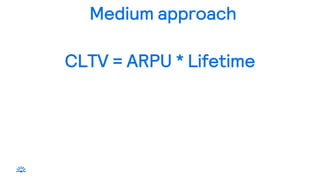
Medium approach
CLTV = ARPU * Lifetime
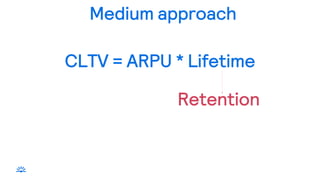
Medium approach
CLTV = ARPU * Lifetime
Retention
Medium approach
Higher CLTV means higher
CAC you can spend
More sophisticated approach
It is THE ONE growth metric
that moves acquisition,
monetization and virality.
(This is important because if you improve retention, you’ll also improve the rest
of your funnel.)
Source: Reforge
Retention
drives
acquisition
Retention
improves
monetisation
Retention
builds an
acquisition
competitive
edge
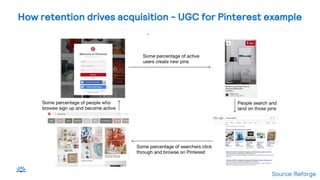
As you retain more users,
those additional users take
more of the key actions that
accelerate acquisition, either
through sharing, inviting,
word-of-mouth, or creating
content.
As more of those new users
retain, more are acquired -
improving retention sets off a
self-reinforcing cycle that
drives acquisition.
You can retain a larger
proportion of a cohort, and in
doing so, make more money
from that cohort within a
given period of time, and you
can increase the length of
time that a cohort
retains, increasing LTV.
As you increase retention,
monetisation, and LTV, you
can pay more to acquire a
customer. In doing so, you
can push competitors out of
acquisition channels, open up
new channels that were
previously too expensive, and
grow faster.
How retention drives acquisition - UGC for Pinterest example
Source: Reforge
Source: Reforge
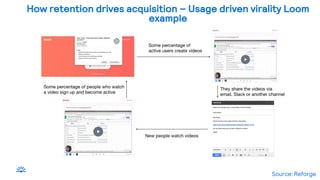
How retention drives acquisition – Usage driven virality Loom
example
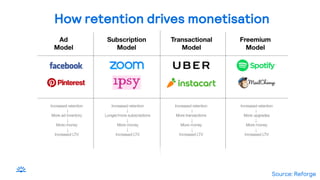
How retention drives monetisation
Source: Reforge
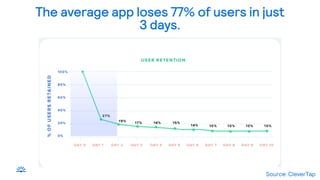
Bad news
The average app loses 77% of users in just
3 days.
Source: CleverTap
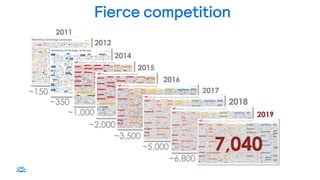
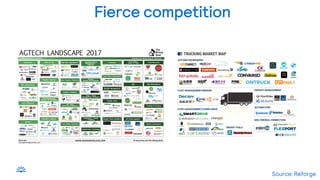
Improving retention is really hard.
(and getting harder)
Fierce competition
Fierce competition
Source: Reforge
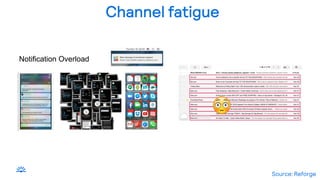
Channel fatigue
Source: Reforge
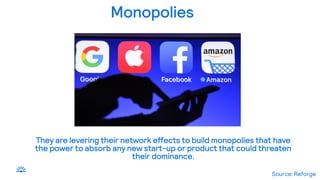
Monopolies
They are levering their network effects to build monopolies that have
the power to absorb any new start-up or product that could threaten
their dominance.
Source: Reforge
What we can do to improve
retention?
Phase 1
• The first 72 hours after acquisition
is the most critical, since it’s where
users get their first impression of
your product.
• Show new users the value of your
product and get them to the “aha
moment” ASAP.
Initial Retention
Phase 2
• Mid-term retention is about
forming, then reinforcing, your
users’ habits around your product.
• Eventually they won’t need
reminders to open the product,
they’ll keep coming back on their
own.
Mid-term Retention
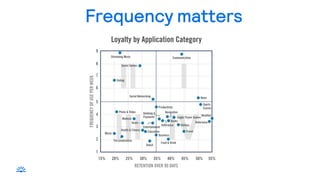
Frequency matters
Phase 3
• This final phase of retention is
about continuously improving the
product so it stays valuable to
users. And understand your users’
needs!
• Keep finding ways to solve their
problems by adding new features,
improving UI and UX, and fixing
bugs.
Long-term Retention
A final checklist
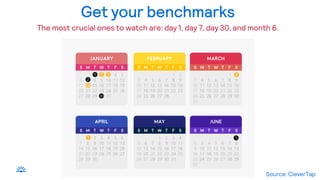
Get your benchmarks
The most crucial ones to watch are: day 1, day 7, day 30, and month 6.
Source: CleverTap
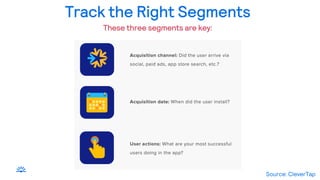
Track the Right Segments
These three segments are key:
Source: CleverTap
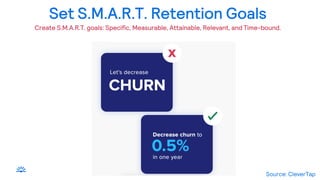
Set S.M.A.R.T. Retention Goals
Create S.M.A.R.T. goals: Specific, Measurable, Attainable, Relevant, and Time-bound.
Source: CleverTap
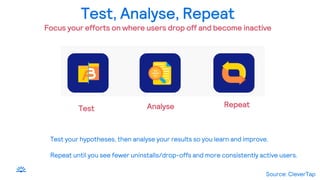
Test, Analyse, Repeat
Focus your efforts on where users drop off and become inactive
Source: CleverTap
Test Analyse Repeat
Test your hypotheses, then analyse your results so you learn and improve.
Repeat until you see fewer uninstalls/drop-offs and more consistently active users.
Retention is a marathon, not a sprint.
Every failed experiment leads you closer to finding
the winning combinations that keep your users
loyal to your product.
Thank you.

Emre Güney - Why retention matters - Digital Zone 2019

  • 1.
    Why retention matters? EmreGüney - Global Senior Lifecycle Manager
  • 2.
    What is retention? Whyretention is important? What we can do to improve retention? Today’s Plan
  • 3.
  • 4.
    The ability ofa company or product to retain its customers over some specified period.
  • 5.
    “How do weacquire more users?” From this
  • 6.
    “How do weget better at keeping the users we already have?” To this
  • 7.
    Why retention isimportant?
  • 8.
    Basic approach If usersdon’t return, your entire user base will eventually disappear due to churn.
  • 9.
    Medium approach CLTV =ARPU * Lifetime
  • 10.
    Medium approach CLTV =ARPU * Lifetime Retention
  • 11.
    Medium approach Higher CLTVmeans higher CAC you can spend
  • 12.
    More sophisticated approach Itis THE ONE growth metric that moves acquisition, monetization and virality. (This is important because if you improve retention, you’ll also improve the rest of your funnel.) Source: Reforge
  • 13.
    Retention drives acquisition Retention improves monetisation Retention builds an acquisition competitive edge As youretain more users, those additional users take more of the key actions that accelerate acquisition, either through sharing, inviting, word-of-mouth, or creating content. As more of those new users retain, more are acquired - improving retention sets off a self-reinforcing cycle that drives acquisition. You can retain a larger proportion of a cohort, and in doing so, make more money from that cohort within a given period of time, and you can increase the length of time that a cohort retains, increasing LTV. As you increase retention, monetisation, and LTV, you can pay more to acquire a customer. In doing so, you can push competitors out of acquisition channels, open up new channels that were previously too expensive, and grow faster.
  • 14.
    How retention drivesacquisition - UGC for Pinterest example Source: Reforge
  • 15.
    Source: Reforge How retentiondrives acquisition – Usage driven virality Loom example
  • 16.
    How retention drivesmonetisation Source: Reforge
  • 17.
  • 18.
    The average apploses 77% of users in just 3 days. Source: CleverTap
  • 19.
    Improving retention isreally hard. (and getting harder)
  • 20.
  • 21.
  • 22.
  • 23.
    Monopolies They are leveringtheir network effects to build monopolies that have the power to absorb any new start-up or product that could threaten their dominance. Source: Reforge
  • 24.
    What we cando to improve retention?
  • 25.
    Phase 1 • Thefirst 72 hours after acquisition is the most critical, since it’s where users get their first impression of your product. • Show new users the value of your product and get them to the “aha moment” ASAP. Initial Retention
  • 26.
    Phase 2 • Mid-termretention is about forming, then reinforcing, your users’ habits around your product. • Eventually they won’t need reminders to open the product, they’ll keep coming back on their own. Mid-term Retention
  • 27.
  • 28.
    Phase 3 • Thisfinal phase of retention is about continuously improving the product so it stays valuable to users. And understand your users’ needs! • Keep finding ways to solve their problems by adding new features, improving UI and UX, and fixing bugs. Long-term Retention
  • 29.
  • 30.
    Get your benchmarks Themost crucial ones to watch are: day 1, day 7, day 30, and month 6. Source: CleverTap
  • 31.
    Track the RightSegments These three segments are key: Source: CleverTap
  • 32.
    Set S.M.A.R.T. RetentionGoals Create S.M.A.R.T. goals: Specific, Measurable, Attainable, Relevant, and Time-bound. Source: CleverTap
  • 33.
    Test, Analyse, Repeat Focusyour efforts on where users drop off and become inactive Source: CleverTap Test Analyse Repeat Test your hypotheses, then analyse your results so you learn and improve. Repeat until you see fewer uninstalls/drop-offs and more consistently active users.
  • 34.
    Retention is amarathon, not a sprint. Every failed experiment leads you closer to finding the winning combinations that keep your users loyal to your product.
  • 36.