Conference Presentation:
Higher Education for a Sustainable Future
Original Lilly Conference on College Teaching
Miami University, Armstrong Student Center
Oxford, Ohio, USA
November 15-18, 2018
Dr. Patrick Blessinger
St. John’s University
HETL Association
New York, New York
Introduction
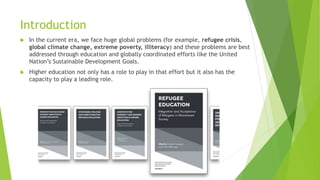
 In the current era, we face huge global problems (for example, refugee crisis,
global climate change, extreme poverty, illiteracy) and these problems are best
addressed through education and globally coordinated efforts like the United
Nation’s Sustainable Development Goals.
 Higher education not only has a role to play in that effort but it also has the
capacity to play a leading role.
Introduction
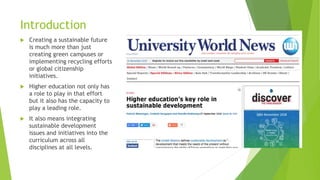
 Creating a sustainable future
is much more than just
creating green campuses or
implementing recycling efforts
or global citizenship
initiatives.
 Higher education not only has
a role to play in that effort
but it also has the capacity to
play a leading role.
 It also means integrating
sustainable development
issues and initiatives into the
curriculum across all
disciplines at all levels.
Sustainable development
 The United Nations (UN) defines sustainable development (SD) as
“…development that meets the needs of the present without compromising
the ability of future generations to meet their own needs.”
 As such, SD not only deals with environmental issues, but economic, social, and
cultural issues as well.
 Given the increased demands placed on societies and the environment due to,
among other factors, increased human migration, increased urbanization and
industrialization, as well as the ongoing depletion of non-renewable resources,
it is clear that global action is needed to create a more sustainable future.
 Given its primary role as knowledge producer, higher education can serve as a
powerful means to help create a more sustainable future.
 An increasing number of universities are offering programs in sustainable
development.
 Sustainability at Cornell: https://www.youtube.com/watch?v=pUe7dgkNpyQ
Education for sustainable development
 The concept of “education for sustainable development” (ESD) has become, in
recent years, one of the core educational initiatives.
 According to UNESCO, ESD “empowers people to change the way they think
and work towards a sustainable future”
 ESD, therefore, involves making access to quality education available at every
stage of life.
 It involves educating students on the necessity of SD by integrating SD issues
into all aspects of teaching, research, and service.
 This means reorienting the education system at all levels to help people think
and behave in ways that foster a more sustainable planet (for example, global
citizenship, recycling, climate change, biodiversity, renewable energy, and
social responsibility).
UN sustainable development goals
From Education for All to Education 2030
a Sustainable Development Goal
https://www.youtube.com/watch?v=ituW4smLwlA
https://www.youtube.com/watch?v=YQAGqCFz_o8
https://www.youtube.com/watch?v=oLDtZh-Smmc
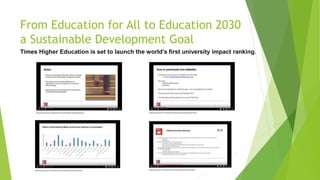
From Education for All to Education 2030
a Sustainable Development Goal
Times Higher Education is set to launch the world’s first university impact ranking.
UN sustainable development goals
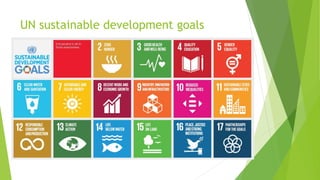
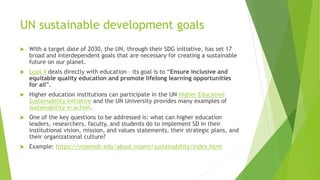
 With a target date of 2030, the UN, through their SDG initiative, has set 17
broad and interdependent goals that are necessary for creating a sustainable
future on our planet.
 Goal 4 deals directly with education – its goal is to “Ensure inclusive and
equitable quality education and promote lifelong learning opportunities
for all”.
 Higher education institutions can participate in the UN Higher Education
Sustainability Initiative and the UN University provides many examples of
sustainability in action.
 One of the key questions to be addressed is: what can higher education
leaders, researchers, faculty, and students do to implement SD in their
institutional vision, mission, and values statements, their strategic plans, and
their organizational culture?
 Example: https://miamioh.edu/about-miami/sustainability/index.html
Addressing goal 4
Ensure inclusive and equitable quality education
 Inclusion is broadly defined by UNESCO as “…a process of addressing and
responding to the diversity of needs of all children, youth and adults through
increasing participation in learning, cultures and communities, and reducing and
eliminating exclusion within and from education”
 To this end, HETL has launched a book series titled, International Perspectives
on Equity and Inclusion.
 In this forthcoming series, educational scholars from around the world address
four key issues in higher education, each of which has been developed into its
own volume:
 1) Diversity and Gender Identities,
 2) Diverse Student Identities,
 3) Strategies for Fostering Inclusive Classrooms, and
 4) Strategies for Facilitating Inclusive Campuses.
Addressing goal 4
Promote lifelong learning opportunities for all
 Lifelong learning is broadly defined to include all forms of learning (formal, non-
formal, informal) that is undertaken throughout the course of one’s life in order
to acquire or improve one’s knowledge, skills, behaviors, competencies, and
values.
 To help address lifelong learning opportunities for all, HETL has also launched a
book series titled, Refugee Education.
 In this forthcoming series, educational scholars from around the world address
three key issues in higher education relative to the refugee crisis, each of which
has been developed into its own volume:
 1) Integration and Acceptance of Refugees in Mainstream Society,
 2) Policies and Directions for Refugee Education, and
 3) Language Teaching and Pedagogy.
Application and Examplars
 Universities Co-creating Urban Sustainability:
https://ourworld.unu.edu/en/universities-co-creating-urban-sustainability
 University of Strathclyde is partnering with Glasgow City to make the region “one of
Europe’s most sustainable cities within 10 years”
 Utah Valley University: http://www.patrickblessinger.com/implementation-of-
sustainable-development-goals-and-mountain-targets-in-particular-through-student-
engaged-learning/
 The Oberlin Project is a joint effort of the City of Oberlin, Oberlin College, and
partners to improve the resilience, prosperity, and sustainability of our community.
 Global and Sustainable Development at Miami University
 http://miamioh.edu/cas/academics/departments/geography/global-sustainable-
development/index.html
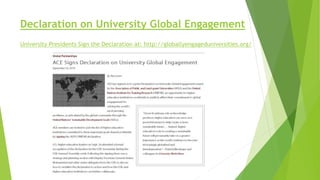
Declaration on University Global Engagement
University Presidents Sign the Declaration at: http://globallyengageduniversities.org/
Conclusion
 As noted by Taya Louise Owens, “It is important to note that sustainable
development works as an organising principle because it recognises that
complex natural and social systems are interconnected.”
 So, creating a sustainable future is much more than just creating green
campuses or implementing recycling efforts or global citizenship initiatives; it
may also involve implementing more blended learning programs, creating more
university partnerships involving SD as well as integrating SD issues and
initiatives into the curriculum across disciplines at all levels.
 HETL will publish (2020) new series titled, "Higher Education for a
Sustainable Future“ which will consist of the following volumes:
 1) integrating SD into the curriculum,
 2) SD leadership and strategies, and
 3) university partnerships for SD.
Sources
 Text for these slides comes from the article titled, Higher Education for a
Sustainable Future, published in University World News.
 What is sustainable development?
https://www.youtube.com/watch?v=7V8oFI4GYMY
 Sustainable development begins with education
https://www.youtube.com/watch?v=3OdP7bYe5wk
 Sustainable Development Goals
https://sustainabledevelopment.un.org/sdgs
 Higher education institutions can participate in the UN sustainability initiative
Higher Education Sustainability Initiative

Higher education for a sustainable future

  • 1.
    Conference Presentation: Higher Educationfor a Sustainable Future Original Lilly Conference on College Teaching Miami University, Armstrong Student Center Oxford, Ohio, USA November 15-18, 2018 Dr. Patrick Blessinger St. John’s University HETL Association New York, New York
  • 2.
    Introduction  In thecurrent era, we face huge global problems (for example, refugee crisis, global climate change, extreme poverty, illiteracy) and these problems are best addressed through education and globally coordinated efforts like the United Nation’s Sustainable Development Goals.  Higher education not only has a role to play in that effort but it also has the capacity to play a leading role.
  • 3.
    Introduction  Creating asustainable future is much more than just creating green campuses or implementing recycling efforts or global citizenship initiatives.  Higher education not only has a role to play in that effort but it also has the capacity to play a leading role.  It also means integrating sustainable development issues and initiatives into the curriculum across all disciplines at all levels.
  • 4.
    Sustainable development  TheUnited Nations (UN) defines sustainable development (SD) as “…development that meets the needs of the present without compromising the ability of future generations to meet their own needs.”  As such, SD not only deals with environmental issues, but economic, social, and cultural issues as well.  Given the increased demands placed on societies and the environment due to, among other factors, increased human migration, increased urbanization and industrialization, as well as the ongoing depletion of non-renewable resources, it is clear that global action is needed to create a more sustainable future.  Given its primary role as knowledge producer, higher education can serve as a powerful means to help create a more sustainable future.  An increasing number of universities are offering programs in sustainable development.  Sustainability at Cornell: https://www.youtube.com/watch?v=pUe7dgkNpyQ
  • 5.
    Education for sustainabledevelopment  The concept of “education for sustainable development” (ESD) has become, in recent years, one of the core educational initiatives.  According to UNESCO, ESD “empowers people to change the way they think and work towards a sustainable future”  ESD, therefore, involves making access to quality education available at every stage of life.  It involves educating students on the necessity of SD by integrating SD issues into all aspects of teaching, research, and service.  This means reorienting the education system at all levels to help people think and behave in ways that foster a more sustainable planet (for example, global citizenship, recycling, climate change, biodiversity, renewable energy, and social responsibility).
  • 6.
  • 7.
    From Education forAll to Education 2030 a Sustainable Development Goal https://www.youtube.com/watch?v=ituW4smLwlA https://www.youtube.com/watch?v=YQAGqCFz_o8 https://www.youtube.com/watch?v=oLDtZh-Smmc
  • 8.
    From Education forAll to Education 2030 a Sustainable Development Goal Times Higher Education is set to launch the world’s first university impact ranking.
  • 9.
    UN sustainable developmentgoals  With a target date of 2030, the UN, through their SDG initiative, has set 17 broad and interdependent goals that are necessary for creating a sustainable future on our planet.  Goal 4 deals directly with education – its goal is to “Ensure inclusive and equitable quality education and promote lifelong learning opportunities for all”.  Higher education institutions can participate in the UN Higher Education Sustainability Initiative and the UN University provides many examples of sustainability in action.  One of the key questions to be addressed is: what can higher education leaders, researchers, faculty, and students do to implement SD in their institutional vision, mission, and values statements, their strategic plans, and their organizational culture?  Example: https://miamioh.edu/about-miami/sustainability/index.html
  • 10.
    Addressing goal 4 Ensureinclusive and equitable quality education  Inclusion is broadly defined by UNESCO as “…a process of addressing and responding to the diversity of needs of all children, youth and adults through increasing participation in learning, cultures and communities, and reducing and eliminating exclusion within and from education”  To this end, HETL has launched a book series titled, International Perspectives on Equity and Inclusion.  In this forthcoming series, educational scholars from around the world address four key issues in higher education, each of which has been developed into its own volume:  1) Diversity and Gender Identities,  2) Diverse Student Identities,  3) Strategies for Fostering Inclusive Classrooms, and  4) Strategies for Facilitating Inclusive Campuses.
  • 11.
    Addressing goal 4 Promotelifelong learning opportunities for all  Lifelong learning is broadly defined to include all forms of learning (formal, non- formal, informal) that is undertaken throughout the course of one’s life in order to acquire or improve one’s knowledge, skills, behaviors, competencies, and values.  To help address lifelong learning opportunities for all, HETL has also launched a book series titled, Refugee Education.  In this forthcoming series, educational scholars from around the world address three key issues in higher education relative to the refugee crisis, each of which has been developed into its own volume:  1) Integration and Acceptance of Refugees in Mainstream Society,  2) Policies and Directions for Refugee Education, and  3) Language Teaching and Pedagogy.
  • 12.
    Application and Examplars Universities Co-creating Urban Sustainability: https://ourworld.unu.edu/en/universities-co-creating-urban-sustainability  University of Strathclyde is partnering with Glasgow City to make the region “one of Europe’s most sustainable cities within 10 years”  Utah Valley University: http://www.patrickblessinger.com/implementation-of- sustainable-development-goals-and-mountain-targets-in-particular-through-student- engaged-learning/  The Oberlin Project is a joint effort of the City of Oberlin, Oberlin College, and partners to improve the resilience, prosperity, and sustainability of our community.  Global and Sustainable Development at Miami University  http://miamioh.edu/cas/academics/departments/geography/global-sustainable- development/index.html
  • 13.
    Declaration on UniversityGlobal Engagement University Presidents Sign the Declaration at: http://globallyengageduniversities.org/
  • 14.
    Conclusion  As notedby Taya Louise Owens, “It is important to note that sustainable development works as an organising principle because it recognises that complex natural and social systems are interconnected.”  So, creating a sustainable future is much more than just creating green campuses or implementing recycling efforts or global citizenship initiatives; it may also involve implementing more blended learning programs, creating more university partnerships involving SD as well as integrating SD issues and initiatives into the curriculum across disciplines at all levels.  HETL will publish (2020) new series titled, "Higher Education for a Sustainable Future“ which will consist of the following volumes:  1) integrating SD into the curriculum,  2) SD leadership and strategies, and  3) university partnerships for SD.
  • 15.
    Sources  Text forthese slides comes from the article titled, Higher Education for a Sustainable Future, published in University World News.  What is sustainable development? https://www.youtube.com/watch?v=7V8oFI4GYMY  Sustainable development begins with education https://www.youtube.com/watch?v=3OdP7bYe5wk  Sustainable Development Goals https://sustainabledevelopment.un.org/sdgs  Higher education institutions can participate in the UN sustainability initiative Higher Education Sustainability Initiative