Keynote address:
        What role should education play in creating happiness?

                             Patrick Blessinger, Executive Director
International Higher Education Teaching and Learning Association
   A fundamental drive in humans.
   The search for happiness (in addition to other
    qualities like meaning, wisdom, and virtue) is
    embedded in our cultures, our myths, our
    folk tales, our legends, our religious
    doctrines, and in our histories.
   Yet, at the same time, happiness seems to be
    elusive and indefinable in a concrete way.
   Those like Aristotle and Epicurus viewed
    human happiness as the highest goal.
   Aristotle believed happiness to the ultimate
    end and main purpose of life.
   In the Nicomachean Ethics, Aristotle says that
    happiness is not solely an emotional state but
    rather a life well lived.
   According to Aristotle, happiness depends on
    the exercise of reason and on living a good life
    through the cultivation of virtue
    (e.g., courage, generosity, justice, friendship, ci
    tizenship).
   Virtue is achieved by maintaining a balance
    between excess and deficiency.
   Epicurus believed that pleasure is the greatest
    good and that the best way attain pleasure is
    to 1) live modestly, 2) understand how the
    world works, and 3) understand the limits of
    our own desires.
   He believed that attaining these conditions
    will lead to a state of tranquility and a state of
    absence of pain.
   He believed these two states constitutes
    happiness in its highest form.
   Schopenhauer believed that the main
    driving force in humans is the will to live.
   Nietzsche believed that the main driving
    force in humans is the will to power.
   Freud believed that the main driving force
    in humans is the will to pleasure.
   James believed the pursuit of happiness was
    the underlying drive for all that people do.
   Frankl believed that the main driving force
    in humans is the will to meaning.
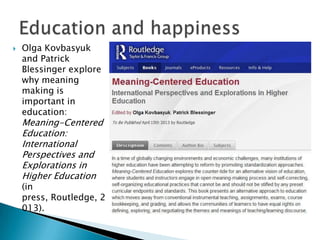
   Olga Kovbasyuk
    and Patrick
    Blessinger explore
    why meaning
    making is
    important in
    education:
    Meaning-Centered
    Education:
    International
    Perspectives and
    Explorations in
    Higher Education
    (in
    press, Routledge, 2
    013).
   Philosophers and theologians tend to view happiness in
    terms of living a virtuous life rather than an emotional
    state.
   Psychologists, economists, and social scientists tend to
    view happiness as a mental state (e.g, satisfaction)
    of well-being characterized by positive emotions.
   For instance, positive psychology, uses the scientific
    method to answer questions about the meaning of
    happiness and how to attain it.
   For instance, happiness economists believe that
    subjective measures (self-reported) of public happiness
    should be used in addition to traditional economic
    measures (objective) when evaluating public policy.
   Heredity, culture, and luck also play a role in
    how people experience happiness and to
    what degree.
   Although a lot of research and papers have
    been written on the general topic of
    happiness, relatively little academic research
    has been done on happiness in education.
   World Database of Happiness - register of
    scientific research on subjective appreciation
    of life . http://www1.eur.nl/fsw/happiness/
   In recent history, increasing focus is being
    placed on happiness as one of the most
    sought after human qualities, both on a
    global level, a national level, a community
    level, a group level, and an individual level.
   For instance, beginning in 1972, the nation of
    Bhutan replaced Gross National Product with
    Gross National Happiness as their main
    measure of progress.
   What are the relevant lenses through which we should
    view such a happiness philosophy:
    ◦ epistemologically (how we know, empirically-sensing
      vs. rationally-intuiting),
    ◦ ontologically (what is reality, objectively and
      subjectively),
    ◦ phenomenologically (how we experience
      reality, individually and relationally),
    ◦ axiologically (how we value, intrinsically and
      extrinsically)
   How can the phenomenon of happiness be understood
    in relation to the core learning domains
    (e.g., affective, behavioral, cognitive) to develop happy
    learners?
   Philosophy vs Theory vs Practice
   Science vs Art
   Behavioral vs Cognitive Psychology

   A process oriented paradigm
    ◦ Focus is on observable processes: teacher personality, teacher
      behavior, teacher-student interactions, and teaching methods.
   A product oriented paradigm
    ◦ Focus is on quantifiable outcomes: teacher effects, teacher
      productivity, and student learning outcomes and achievement.
   A context oriented paradigm
    ◦ Focus is on understanding the context of the educational setting:
      language, culture, meaning making, personally meaningful
      experiences, and humanistic understanding of teaching and
      learning.
   Diener Suh, and Oishi (1997, P. 25) define happiness
    as a state of well-being where a person
    “,,.experiences life satisfaction and frequent joy, and
    only infrequently experiences unpleasant emotions
    such as sadness or anger.”
   It helps provide the energy needed to live fully and it
    helps us better deal with adversities in life.
   James (1902) discussed many ways people experience
    happiness - believed that the pursuit of happiness
    was the underlying drive for all that people do.
   What is a useful theory(s) of happiness as it relates to
    teaching and learning that helps frame our
    understanding of happiness in educational contexts?
   Most modern empirical research on happiness is
    based on self-assessment surveys where
    individuals state their level of happiness in life.
   For example:
    ◦ The Satisfaction with Life Index is a global cognitive
      assessment of life satisfaction. It is an attempt to show
      the average self-reported happiness in different nations.
    ◦ Happy Life Years, a concept by Ruut
      Veenhoven, combines self-reported happiness with life
      expectancy.
    ◦ The Subjective Happiness Scale (SHS) is a four-item
      scale, measuring global subjective happiness.
   Researchers have identified several factors
     that help produce lasting and significant
     happiness:
     ◦   marriage,
     ◦   perceived health,
     ◦   religious practice,
     ◦   volunteerism,
     ◦   employment,
     ◦   quality of government, and
     ◦   social relationships.
(Bruno and Stutzer, 2005; Diener and Biswas-Deiner, 2008; Ferris, 2002;
Inglehart, Foa, Peterson and Welzel, 2008; Judge and Watanabe, 1993;
Layard, 2005; Nettles, 2005; Thoits and Hewitt, 2001).
   Since education plays a central role in the
    socialization of people, it seems appropriate
    therefore that educational institutions should
    also play a critical role in the effort to
    increase happiness.
   So, what specifically can and should
    educational institutions do to create the
    necessary conditions whereby happiness is
    cultivated?
   Assumption: in addition to their traditional
    roles of knowledge producer (e.g., teaching
    and research aim) and developing students
    into productive members of society
    (e.g., vocational aim), they also play a crucial
    role in helping students develop personally
    meaningful lives and sustainable happiness.
   Education therefore has multiple aims.
   There are many different perspectives on the
    concept of happiness
    (e.g., psychological, philosophical, sociologic
    al, religious, poetic, artistic).
   By looking at a broad set of evidence, from
    survey data to narratives to philosophical
    inquiry to scientific data, we can perhaps gain
    a more comprehensive view and deeper
    insight into the complex phenomenon of
    happiness.
   Most thinking on happiness prior to the 20th
    Century was done by philosophical and moral
    inquiry and beliefs as well as by the examination
    others’ personal experiences and narratives.
   However, in the modern era, with the
    advancement of social science and medical
    research methods, we can also rely on empirical
    research to aid our understanding of happiness.
   And most of this empirical research on happiness
    is based on self-assessment surveys where
    individuals state their level of happiness in life
    (Bok, D., 2010).
   To the extent that education prepares
    students to be well-functioning members of
    the work force, the employment factor is a
    relevant factor.
   To the extent that education prepares
    students to live and participate in the political
    system, the quality of government factor is a
    relevant factor.
   Education is a social institution and thus the
    social relationships factor is a relevant
    factor, especially the teacher-student
    relationship.
   Since education consumes such a large part
    of our individual lives and such a large part of
    government resources, then educational
    institutions at all levels are the obvious
    choice to take on this responsibility of
    cultivating knowledge, attitudes and
    behaviors that lead to greater happiness
    (Bok, D., 2010).
   As a source of happiness, it is not the job itself
    that is most important but rather the social
    relationships and sense of belonging to a group
    and the development of self-esteem
    (Rain, Lane, and Steiner, 1991).
   This suggests that the main focus of education
    should not be purely vocational but rather in
    nurturing interests, skills, and knowledge across
    an array of topics/activities that are personally
    meaningful and individualized to each student.
   In other words, the ultimate of goal education
    should be to prepare students for life in all its
    complexities, not just training for a specific job.
   Within this factor, the most important element is
    living with large degrees of economic, social, and
    political freedoms.
   So, the protection of personal liberties, rule of
    law, and responsiveness of government to the
    needs of its citizens are important in helping to
    create a happy society (Inglehart, Foa, Peterson
    and Welzel, 2008).
   Education can be used as an authentic and
    experiential means to integrate real life problems
    and situations into the curricula and help create a
    more personalized learning environment that is
    personally meaningful to the students.
   Because we are social creatures and we live
    within social structures, social relationships
    define most of what we do and how we think.
   Schools can embed social learning activities
    into the curricula (e.g., group-based
    learning, public speaking, service learning) as
    well as extra-curricular activities.
   What is important is to create authentic and
    personally meaningful learning activities so
    that students are more likely to be self-
    motivated to engage in the activities.
   Education can do a great deal to enrich
    students’ lives and help create a more happy
    society.
   So, the key should be to make learning more
    authentic, more experiential, more
    contextual, more humane, and more
    personally meaningful to students.
   To these ends, if designed properly and
    administered properly, education can play a
    vital role and serve as a valuable means to
    increase student happiness and academic
    motivation.
   Bok, D. (2010). The Politics of Happiness. Princeton University Press: Princeton.
   Bok, S. (2010). Exploring Happiness: From Aristotle to Brain Science. Yale
    University Press: New Haven.
   Bruno, F. and Stutzer, A. (2005). Happiness Research: State and Prospects. Review
    of Social Economy.
   Diener, E. and Biswas-Deiner, R. (2008). Happiness, Unlocking the Mysteries of
    Psychological Wealth.
   Ferris, A. (2002). Religion and the Quality of Life. Journal of Happiness Studies.
   Inglehart, R. F., Foa, R., Peterson, C. and Welzel, C. (2008).
    Development, Freedom, and Rising Happiness: A Global Perspective 1981-2007.
    Perspective on Psychological Science. Vol. 3, July 2008, 264-85.
   James, W. (1890). Principles of Psychology. New York: Holt.
   Judge, T. and Watanabe, S. (1993). Another Look at the Job Satisfaction-Life
    Satisfaction Relationship. Journal of Applied Psychology.
   Layard, R. (2005). Happiness: Lessons from a New Science.
   Nettles, D. (2005). Happiness: The Science Behind Your Smile.
   Thoits, P. and Hewitt, L. (2001). Volunteer Work and Well-Being. Journal of Health
    and Social Behavior.

2012 Felicitology Conference Blessinger

  • 1.
    Keynote address: What role should education play in creating happiness? Patrick Blessinger, Executive Director International Higher Education Teaching and Learning Association
  • 2.
    A fundamental drive in humans.  The search for happiness (in addition to other qualities like meaning, wisdom, and virtue) is embedded in our cultures, our myths, our folk tales, our legends, our religious doctrines, and in our histories.  Yet, at the same time, happiness seems to be elusive and indefinable in a concrete way.  Those like Aristotle and Epicurus viewed human happiness as the highest goal.
  • 3.
    Aristotle believed happiness to the ultimate end and main purpose of life.  In the Nicomachean Ethics, Aristotle says that happiness is not solely an emotional state but rather a life well lived.  According to Aristotle, happiness depends on the exercise of reason and on living a good life through the cultivation of virtue (e.g., courage, generosity, justice, friendship, ci tizenship).  Virtue is achieved by maintaining a balance between excess and deficiency.
  • 4.
    Epicurus believed that pleasure is the greatest good and that the best way attain pleasure is to 1) live modestly, 2) understand how the world works, and 3) understand the limits of our own desires.  He believed that attaining these conditions will lead to a state of tranquility and a state of absence of pain.  He believed these two states constitutes happiness in its highest form.
  • 5.
    Schopenhauer believed that the main driving force in humans is the will to live.  Nietzsche believed that the main driving force in humans is the will to power.  Freud believed that the main driving force in humans is the will to pleasure.  James believed the pursuit of happiness was the underlying drive for all that people do.  Frankl believed that the main driving force in humans is the will to meaning.
  • 6.
    Olga Kovbasyuk and Patrick Blessinger explore why meaning making is important in education: Meaning-Centered Education: International Perspectives and Explorations in Higher Education (in press, Routledge, 2 013).
  • 7.
    Philosophers and theologians tend to view happiness in terms of living a virtuous life rather than an emotional state.  Psychologists, economists, and social scientists tend to view happiness as a mental state (e.g, satisfaction) of well-being characterized by positive emotions.  For instance, positive psychology, uses the scientific method to answer questions about the meaning of happiness and how to attain it.  For instance, happiness economists believe that subjective measures (self-reported) of public happiness should be used in addition to traditional economic measures (objective) when evaluating public policy.
  • 8.
    Heredity, culture, and luck also play a role in how people experience happiness and to what degree.  Although a lot of research and papers have been written on the general topic of happiness, relatively little academic research has been done on happiness in education.  World Database of Happiness - register of scientific research on subjective appreciation of life . http://www1.eur.nl/fsw/happiness/
  • 9.
    In recent history, increasing focus is being placed on happiness as one of the most sought after human qualities, both on a global level, a national level, a community level, a group level, and an individual level.  For instance, beginning in 1972, the nation of Bhutan replaced Gross National Product with Gross National Happiness as their main measure of progress.
  • 10.
    What are the relevant lenses through which we should view such a happiness philosophy: ◦ epistemologically (how we know, empirically-sensing vs. rationally-intuiting), ◦ ontologically (what is reality, objectively and subjectively), ◦ phenomenologically (how we experience reality, individually and relationally), ◦ axiologically (how we value, intrinsically and extrinsically)  How can the phenomenon of happiness be understood in relation to the core learning domains (e.g., affective, behavioral, cognitive) to develop happy learners?
  • 11.
    Philosophy vs Theory vs Practice  Science vs Art  Behavioral vs Cognitive Psychology  A process oriented paradigm ◦ Focus is on observable processes: teacher personality, teacher behavior, teacher-student interactions, and teaching methods.  A product oriented paradigm ◦ Focus is on quantifiable outcomes: teacher effects, teacher productivity, and student learning outcomes and achievement.  A context oriented paradigm ◦ Focus is on understanding the context of the educational setting: language, culture, meaning making, personally meaningful experiences, and humanistic understanding of teaching and learning.
  • 12.
    Diener Suh, and Oishi (1997, P. 25) define happiness as a state of well-being where a person “,,.experiences life satisfaction and frequent joy, and only infrequently experiences unpleasant emotions such as sadness or anger.”  It helps provide the energy needed to live fully and it helps us better deal with adversities in life.  James (1902) discussed many ways people experience happiness - believed that the pursuit of happiness was the underlying drive for all that people do.  What is a useful theory(s) of happiness as it relates to teaching and learning that helps frame our understanding of happiness in educational contexts?
  • 13.
    Most modern empirical research on happiness is based on self-assessment surveys where individuals state their level of happiness in life.  For example: ◦ The Satisfaction with Life Index is a global cognitive assessment of life satisfaction. It is an attempt to show the average self-reported happiness in different nations. ◦ Happy Life Years, a concept by Ruut Veenhoven, combines self-reported happiness with life expectancy. ◦ The Subjective Happiness Scale (SHS) is a four-item scale, measuring global subjective happiness.
  • 14.
    Researchers have identified several factors that help produce lasting and significant happiness: ◦ marriage, ◦ perceived health, ◦ religious practice, ◦ volunteerism, ◦ employment, ◦ quality of government, and ◦ social relationships. (Bruno and Stutzer, 2005; Diener and Biswas-Deiner, 2008; Ferris, 2002; Inglehart, Foa, Peterson and Welzel, 2008; Judge and Watanabe, 1993; Layard, 2005; Nettles, 2005; Thoits and Hewitt, 2001).
  • 15.
    Since education plays a central role in the socialization of people, it seems appropriate therefore that educational institutions should also play a critical role in the effort to increase happiness.  So, what specifically can and should educational institutions do to create the necessary conditions whereby happiness is cultivated?
  • 16.
    Assumption: in addition to their traditional roles of knowledge producer (e.g., teaching and research aim) and developing students into productive members of society (e.g., vocational aim), they also play a crucial role in helping students develop personally meaningful lives and sustainable happiness.  Education therefore has multiple aims.
  • 17.
    There are many different perspectives on the concept of happiness (e.g., psychological, philosophical, sociologic al, religious, poetic, artistic).  By looking at a broad set of evidence, from survey data to narratives to philosophical inquiry to scientific data, we can perhaps gain a more comprehensive view and deeper insight into the complex phenomenon of happiness.
  • 18.
    Most thinking on happiness prior to the 20th Century was done by philosophical and moral inquiry and beliefs as well as by the examination others’ personal experiences and narratives.  However, in the modern era, with the advancement of social science and medical research methods, we can also rely on empirical research to aid our understanding of happiness.  And most of this empirical research on happiness is based on self-assessment surveys where individuals state their level of happiness in life (Bok, D., 2010).
  • 19.
    To the extent that education prepares students to be well-functioning members of the work force, the employment factor is a relevant factor.  To the extent that education prepares students to live and participate in the political system, the quality of government factor is a relevant factor.  Education is a social institution and thus the social relationships factor is a relevant factor, especially the teacher-student relationship.
  • 20.
    Since education consumes such a large part of our individual lives and such a large part of government resources, then educational institutions at all levels are the obvious choice to take on this responsibility of cultivating knowledge, attitudes and behaviors that lead to greater happiness (Bok, D., 2010).
  • 21.
    As a source of happiness, it is not the job itself that is most important but rather the social relationships and sense of belonging to a group and the development of self-esteem (Rain, Lane, and Steiner, 1991).  This suggests that the main focus of education should not be purely vocational but rather in nurturing interests, skills, and knowledge across an array of topics/activities that are personally meaningful and individualized to each student.  In other words, the ultimate of goal education should be to prepare students for life in all its complexities, not just training for a specific job.
  • 22.
    Within this factor, the most important element is living with large degrees of economic, social, and political freedoms.  So, the protection of personal liberties, rule of law, and responsiveness of government to the needs of its citizens are important in helping to create a happy society (Inglehart, Foa, Peterson and Welzel, 2008).  Education can be used as an authentic and experiential means to integrate real life problems and situations into the curricula and help create a more personalized learning environment that is personally meaningful to the students.
  • 23.
    Because we are social creatures and we live within social structures, social relationships define most of what we do and how we think.  Schools can embed social learning activities into the curricula (e.g., group-based learning, public speaking, service learning) as well as extra-curricular activities.  What is important is to create authentic and personally meaningful learning activities so that students are more likely to be self- motivated to engage in the activities.
  • 24.
    Education can do a great deal to enrich students’ lives and help create a more happy society.  So, the key should be to make learning more authentic, more experiential, more contextual, more humane, and more personally meaningful to students.  To these ends, if designed properly and administered properly, education can play a vital role and serve as a valuable means to increase student happiness and academic motivation.
  • 25.
    Bok, D. (2010). The Politics of Happiness. Princeton University Press: Princeton.  Bok, S. (2010). Exploring Happiness: From Aristotle to Brain Science. Yale University Press: New Haven.  Bruno, F. and Stutzer, A. (2005). Happiness Research: State and Prospects. Review of Social Economy.  Diener, E. and Biswas-Deiner, R. (2008). Happiness, Unlocking the Mysteries of Psychological Wealth.  Ferris, A. (2002). Religion and the Quality of Life. Journal of Happiness Studies.  Inglehart, R. F., Foa, R., Peterson, C. and Welzel, C. (2008). Development, Freedom, and Rising Happiness: A Global Perspective 1981-2007. Perspective on Psychological Science. Vol. 3, July 2008, 264-85.  James, W. (1890). Principles of Psychology. New York: Holt.  Judge, T. and Watanabe, S. (1993). Another Look at the Job Satisfaction-Life Satisfaction Relationship. Journal of Applied Psychology.  Layard, R. (2005). Happiness: Lessons from a New Science.  Nettles, D. (2005). Happiness: The Science Behind Your Smile.  Thoits, P. and Hewitt, L. (2001). Volunteer Work and Well-Being. Journal of Health and Social Behavior.