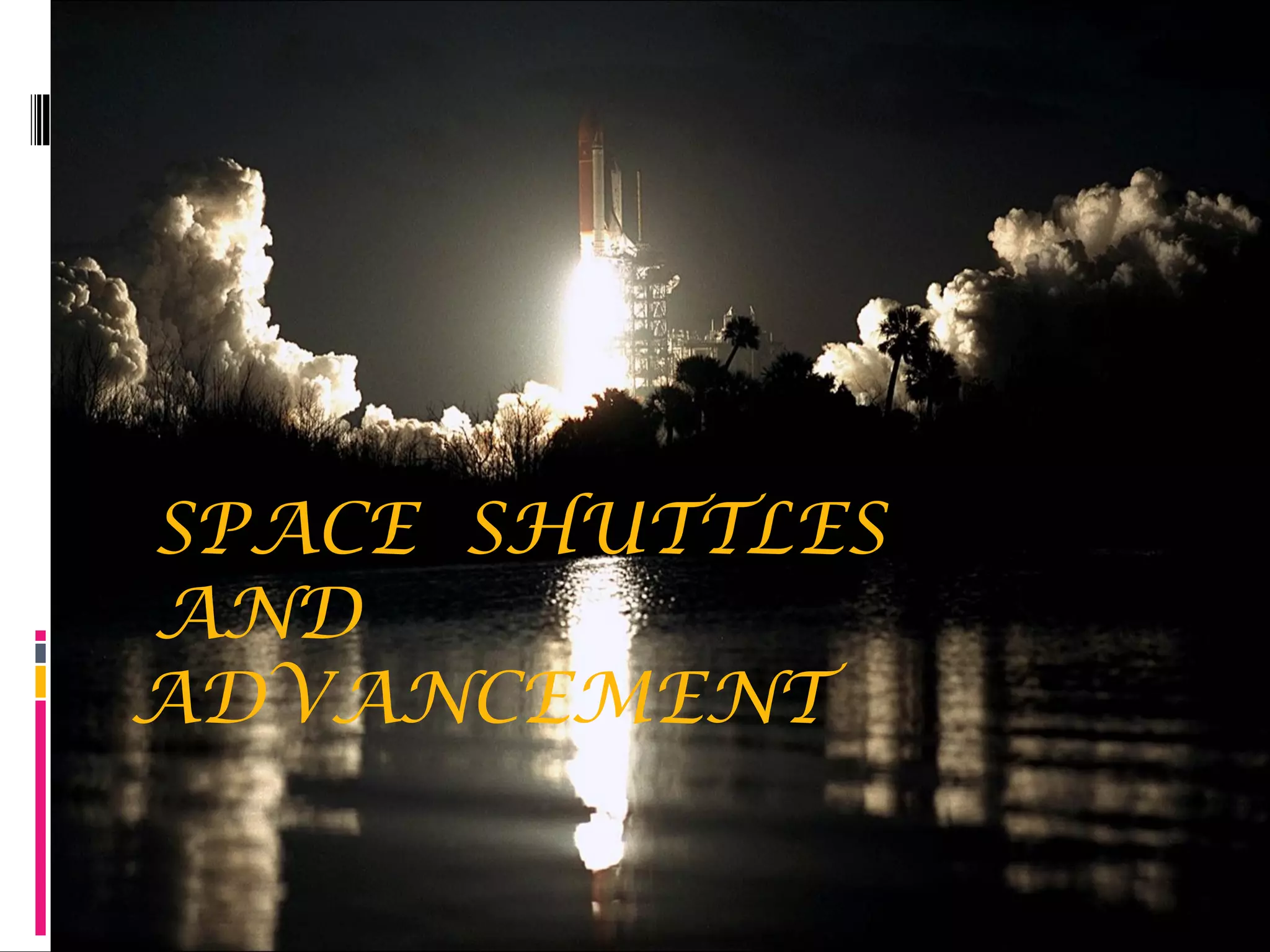
SPACE SHUTTLES 
AND 
ADVANCEMENT
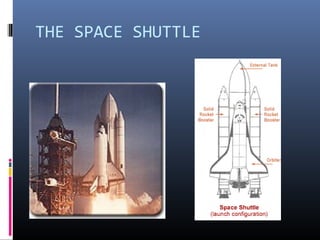
THE SPACE SHUTTLE
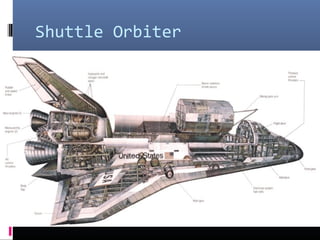
Shuttle Orbiter
The Space Shuttle 
 Primary objective is to improve access to 
space 
 First flight was April 1981 with astronauts 
Young and Crippen 
 Has flown approximately 100 missions 
carrying 1.5 million pounds of cargo and over 
600 major payloads
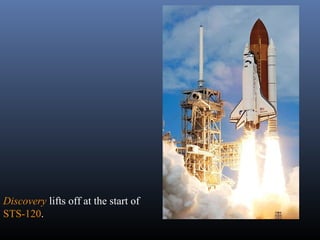
Discovery lifts off at the start of 
STS-120.
The Space Shuttle 
 World’s first and only reusable space vehicle 
 Can transport people, materials, equipment 
and spacecraft into orbit 
 Also used to service and repair satellites and 
observatories and to conduct medical and 
scientific experiments
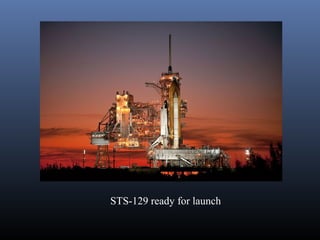
STS-129 ready for launch
 THE EXTERNAL TANK OR ET 
 SPACE SHUTTLES MAIN ENGINE 
 SOLID ROCKET BOOSTERS OR SRBs 
 ORBITAL VEHICLE
Space Shuttle Components 
 Orbiter-can carry up to 7 astronauts and the 
payload in its 60-foot long cargo bay 
(Atlantis, Discovery & Endeavour) 
 External tank (154 feet) which stores nearly 
half million pounds of liquid oxygen and 
hydrogen 
 Solid rocket boosters which generate nearly 6 
million pounds of thrust; jettisoned 2 minutes 
into flight.
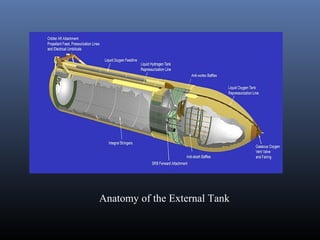
THE EXTERNAL TANK: 
 The main function of the Space Shuttle 
external tank was to supply the liquid oxygen 
and hydrogen fuel to the main engines. 
 It was also the backbone of the launch 
vehicle, providing attachment points for the 
two solid rocket boosters and the orbiter. 
 The external tank was the only part of the 
Shuttle system that was not reused.
Anatomy of the External Tank
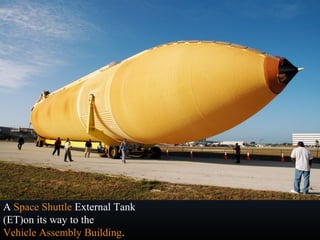
A Space Shuttle External Tank 
(ET)on its way to the 
Vehicle Assembly Building.
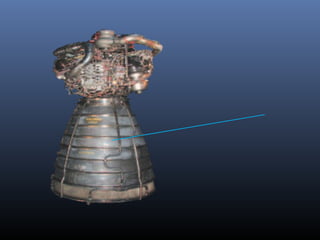
MAIN ENGINES: 
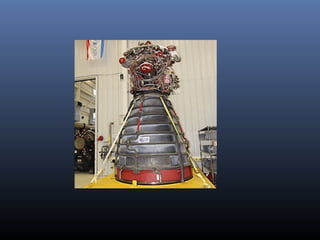
 The Space Shuttle Main Engine (SSME), is a 
liquid-fuel cryogenic rocket engine 
 Built in the United States by Rocketdyne, the 
RS-25 burns cryogenic liquid hydrogen & 
liquid oxygen propellants, with each engine 
producing 1,859 kN (418,000 lbf) of thrust at 
liftoff.
ENGINE COMPONENTS: 
 The Engine consists of various pumps, valves 
and other components which work in concert 
to produce thrust. 
 Developed in the 1970s by the Marshall Space 
Flight Center, the space shuttle main engine 
was the world's most sophisticated reusable 
rocket engine.
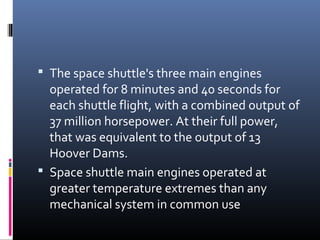
 The space shuttle's three main engines 
operated for 8 minutes and 40 seconds for 
each shuttle flight, with a combined output of 
37 million horsepower. At their full power, 
that was equivalent to the output of 13 
Hoover Dams. 
 Space shuttle main engines operated at 
greater temperature extremes than any 
mechanical system in common use
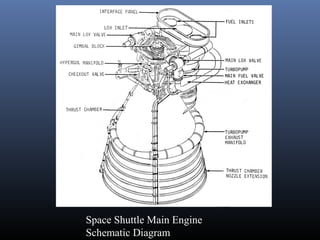
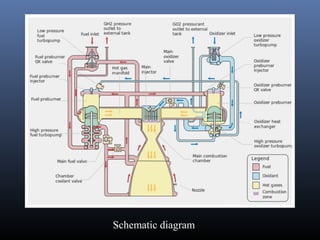
Space Shuttle Main Engine 
Schematic Diagram
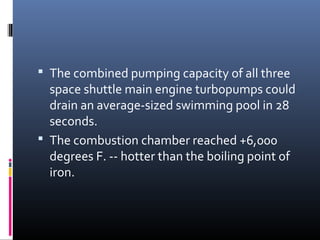
 The combined pumping capacity of all three 
space shuttle main engine turbopumps could 
drain an average-sized swimming pool in 28 
seconds. 
 The combustion chamber reached +6,000 
degrees F. -- hotter than the boiling point of 
iron.
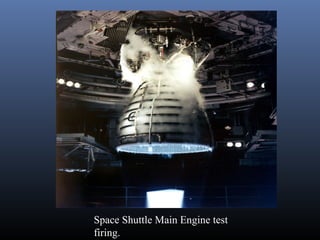
Space Shuttle Main Engine test 
firing.
 Each main engine was 14 feet long, weighed 
approximately 7,000 pounds and was 7.5 feet 
in diameter at the end of its nozzle. 
 The engine produces a specific impulse (Isp) of 
452 seconds (4.43 km/s) in a vacuum, or 366 
seconds (3.59 km/s) at sea level, has a mass of 
approximately 3.5 tonnes (7,700 pounds), and 
is capable of throttling between 67% and 
109% of its rated power level in one-percent 
increments
A Block II RS-25D Main 
Engine Controller 
Each engine is equipped with a 
Main Engine Controller (MEC), an 
integrated computer which controls 
all of the engine's functions 
(through the use of valves) and 
monitors its performance. Built by 
Honeywell Aerospace, each MEC 
originally comprised two redundant 
Honeywell HDC-601 computers, 
[11] later upgraded to a system 
composed of two doubly 
redundant Motorola 68000 
(M68000) processors (for a total of 
4 M68000s per controller).
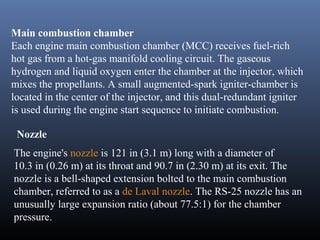
Main combustion chamber 
Each engine main combustion chamber (MCC) receives fuel-rich 
hot gas from a hot-gas manifold cooling circuit. The gaseous 
hydrogen and liquid oxygen enter the chamber at the injector, which 
mixes the propellants. A small augmented-spark igniter-chamber is 
located in the center of the injector, and this dual-redundant igniter 
is used during the engine start sequence to initiate combustion. 
Nozzle 
The engine's nozzle is 121 in (3.1 m) long with a diameter of 
10.3 in (0.26 m) at its throat and 90.7 in (2.30 m) at its exit. The 
nozzle is a bell-shaped extension bolted to the main combustion 
chamber, referred to as a de Laval nozzle. The RS-25 nozzle has an 
unusually large expansion ratio (about 77.5:1) for the chamber 
pressure.
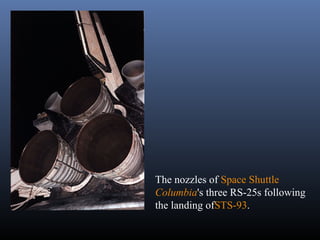
The nozzles of Space Shuttle 
Columbia's three RS-25s following 
the landing ofSTS-93.
SSME TEST FIRING: 
RS-25 testing at Stennis Space Center.
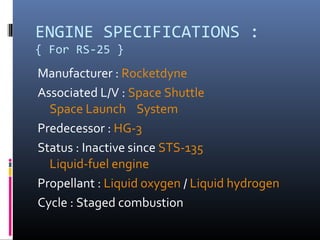
ENGINE SPECIFICATIONS : 
{ For RS-25 } 
Manufacturer : Rocketdyne 
Associated L/V : Space Shuttle 
Space Launch System 
Predecessor : HG-3 
Status : Inactive since STS-135 
Liquid-fuel engine 
Propellant : Liquid oxygen / Liquid hydrogen 
Cycle : Staged combustion
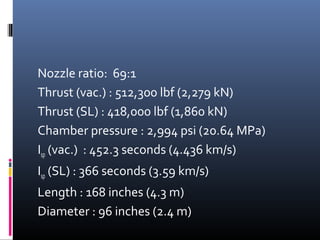
Nozzle ratio: 69:1 
Thrust (vac.) : 512,300 lbf (2,279 kN) 
Thrust (SL) : 418,000 lbf (1,860 kN) 
Chamber pressure : 2,994 psi (20.64 MPa) 
Isp (vac.) : 452.3 seconds (4.436 km/s) 
Isp (SL) : 366 seconds (3.59 km/s) 
Length : 168 inches (4.3 m) 
Diameter : 96 inches (2.4 m)
Schematic diagram
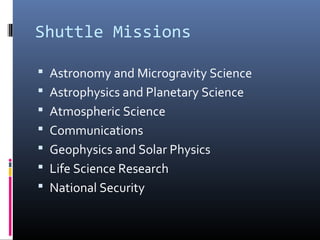
Shuttle Missions 
 Astronomy and Microgravity Science 
 Astrophysics and Planetary Science 
 Atmospheric Science 
 Communications 
 Geophysics and Solar Physics 
 Life Science Research 
 National Security
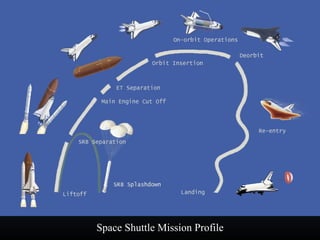
Space Shuttle Mission Profile
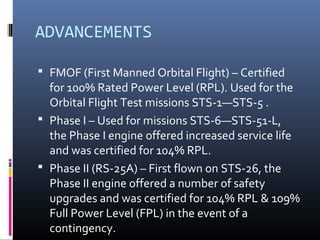
ADVANCEMENTS 
 FMOF (First Manned Orbital Flight) – Certified 
for 100% Rated Power Level (RPL). Used for the 
Orbital Flight Test missions STS-1—STS-5 . 
 Phase I – Used for missions STS-6—STS-51-L, 
the Phase I engine offered increased service life 
and was certified for 104% RPL. 
 Phase II (RS-25A) – First flown on STS-26, the 
Phase II engine offered a number of safety 
upgrades and was certified for 104% RPL & 109% 
Full Power Level (FPL) in the event of a 
contingency.
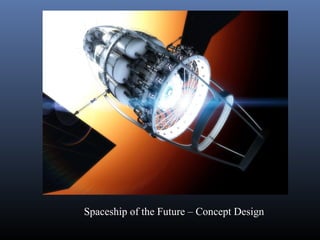
Spaceship of the Future – Concept Design
THANK YOU…

Space Shuttles & Advancement

  • 1.
    SPACE SHUTTLES AND ADVANCEMENT
  • 2.
  • 3.
  • 4.
    The Space Shuttle  Primary objective is to improve access to space  First flight was April 1981 with astronauts Young and Crippen  Has flown approximately 100 missions carrying 1.5 million pounds of cargo and over 600 major payloads
  • 5.
    Discovery lifts offat the start of STS-120.
  • 6.
    The Space Shuttle  World’s first and only reusable space vehicle  Can transport people, materials, equipment and spacecraft into orbit  Also used to service and repair satellites and observatories and to conduct medical and scientific experiments
  • 7.
  • 8.
     THE EXTERNALTANK OR ET  SPACE SHUTTLES MAIN ENGINE  SOLID ROCKET BOOSTERS OR SRBs  ORBITAL VEHICLE
  • 9.
    Space Shuttle Components  Orbiter-can carry up to 7 astronauts and the payload in its 60-foot long cargo bay (Atlantis, Discovery & Endeavour)  External tank (154 feet) which stores nearly half million pounds of liquid oxygen and hydrogen  Solid rocket boosters which generate nearly 6 million pounds of thrust; jettisoned 2 minutes into flight.
  • 11.
    THE EXTERNAL TANK:  The main function of the Space Shuttle external tank was to supply the liquid oxygen and hydrogen fuel to the main engines.  It was also the backbone of the launch vehicle, providing attachment points for the two solid rocket boosters and the orbiter.  The external tank was the only part of the Shuttle system that was not reused.
  • 12.
    Anatomy of theExternal Tank
  • 13.
    A Space ShuttleExternal Tank (ET)on its way to the Vehicle Assembly Building.
  • 14.
    MAIN ENGINES: The Space Shuttle Main Engine (SSME), is a liquid-fuel cryogenic rocket engine  Built in the United States by Rocketdyne, the RS-25 burns cryogenic liquid hydrogen & liquid oxygen propellants, with each engine producing 1,859 kN (418,000 lbf) of thrust at liftoff.
  • 16.
    ENGINE COMPONENTS: The Engine consists of various pumps, valves and other components which work in concert to produce thrust.  Developed in the 1970s by the Marshall Space Flight Center, the space shuttle main engine was the world's most sophisticated reusable rocket engine.
  • 17.
     The spaceshuttle's three main engines operated for 8 minutes and 40 seconds for each shuttle flight, with a combined output of 37 million horsepower. At their full power, that was equivalent to the output of 13 Hoover Dams.  Space shuttle main engines operated at greater temperature extremes than any mechanical system in common use
  • 18.
    Space Shuttle MainEngine Schematic Diagram
  • 19.
     The combinedpumping capacity of all three space shuttle main engine turbopumps could drain an average-sized swimming pool in 28 seconds.  The combustion chamber reached +6,000 degrees F. -- hotter than the boiling point of iron.
  • 20.
    Space Shuttle MainEngine test firing.
  • 21.
     Each mainengine was 14 feet long, weighed approximately 7,000 pounds and was 7.5 feet in diameter at the end of its nozzle.  The engine produces a specific impulse (Isp) of 452 seconds (4.43 km/s) in a vacuum, or 366 seconds (3.59 km/s) at sea level, has a mass of approximately 3.5 tonnes (7,700 pounds), and is capable of throttling between 67% and 109% of its rated power level in one-percent increments
  • 22.
    A Block IIRS-25D Main Engine Controller Each engine is equipped with a Main Engine Controller (MEC), an integrated computer which controls all of the engine's functions (through the use of valves) and monitors its performance. Built by Honeywell Aerospace, each MEC originally comprised two redundant Honeywell HDC-601 computers, [11] later upgraded to a system composed of two doubly redundant Motorola 68000 (M68000) processors (for a total of 4 M68000s per controller).
  • 23.
    Main combustion chamber Each engine main combustion chamber (MCC) receives fuel-rich hot gas from a hot-gas manifold cooling circuit. The gaseous hydrogen and liquid oxygen enter the chamber at the injector, which mixes the propellants. A small augmented-spark igniter-chamber is located in the center of the injector, and this dual-redundant igniter is used during the engine start sequence to initiate combustion. Nozzle The engine's nozzle is 121 in (3.1 m) long with a diameter of 10.3 in (0.26 m) at its throat and 90.7 in (2.30 m) at its exit. The nozzle is a bell-shaped extension bolted to the main combustion chamber, referred to as a de Laval nozzle. The RS-25 nozzle has an unusually large expansion ratio (about 77.5:1) for the chamber pressure.
  • 24.
    The nozzles ofSpace Shuttle Columbia's three RS-25s following the landing ofSTS-93.
  • 25.
    SSME TEST FIRING: RS-25 testing at Stennis Space Center.
  • 26.
    ENGINE SPECIFICATIONS : { For RS-25 } Manufacturer : Rocketdyne Associated L/V : Space Shuttle Space Launch System Predecessor : HG-3 Status : Inactive since STS-135 Liquid-fuel engine Propellant : Liquid oxygen / Liquid hydrogen Cycle : Staged combustion
  • 27.
    Nozzle ratio: 69:1 Thrust (vac.) : 512,300 lbf (2,279 kN) Thrust (SL) : 418,000 lbf (1,860 kN) Chamber pressure : 2,994 psi (20.64 MPa) Isp (vac.) : 452.3 seconds (4.436 km/s) Isp (SL) : 366 seconds (3.59 km/s) Length : 168 inches (4.3 m) Diameter : 96 inches (2.4 m)
  • 28.
  • 29.
    Shuttle Missions Astronomy and Microgravity Science  Astrophysics and Planetary Science  Atmospheric Science  Communications  Geophysics and Solar Physics  Life Science Research  National Security
  • 30.
  • 31.
    ADVANCEMENTS  FMOF(First Manned Orbital Flight) – Certified for 100% Rated Power Level (RPL). Used for the Orbital Flight Test missions STS-1—STS-5 .  Phase I – Used for missions STS-6—STS-51-L, the Phase I engine offered increased service life and was certified for 104% RPL.  Phase II (RS-25A) – First flown on STS-26, the Phase II engine offered a number of safety upgrades and was certified for 104% RPL & 109% Full Power Level (FPL) in the event of a contingency.
  • 32.
    Spaceship of theFuture – Concept Design
  • 33.