TERTIARY SECTOR
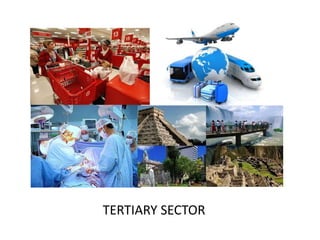
It´s the sector that includes all
the activities that consist in
rendering services to the
people. It´s a very diverse
sector, because it includes
many different activities:
trade, leisure, entertainment,
administration, tourism,
transport, education, justice,
security, healthcare, cleaning,
banking, financing...
The more developed a country is, the more workers will work in the tertiary
sector. More than 70% of the population works in the tertiary sector in the most
developed countries.
It´s the economic activity that
consists in exchanging products for
money or other products (barter).
Trade appeared in the Neolithic as
a result of surplus. People
exchanged the products they had
for the products they wanted to
have. Later, when money was
invented, products had a monetary
value.
Trade can be classified depending
on the amount of products
exchanged (retail or wholesale
trade) and depending on the place
where products are exchanged
(inland and foreign trade).
TRADE
o Depending on the quantity of
products exchanged:
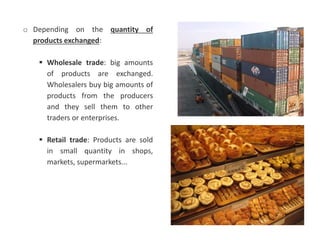
 Wholesale trade: big amounts
of products are exchanged.
Wholesalers buy big amounts of
products from the producers
and they sell them to other
traders or enterprises.
 Retail trade: Products are sold
in small quantity in shops,
markets, supermarkets...
o Depending on the place where
products are exchanged:
 Inland trade: it takes place
inside the country.
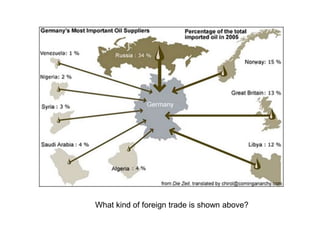
 Foreign trade: it takes place
between countries. It
includes exports and
imports:
 Exports are the sales of
a country to other
countries.
 Imports are the
purchases of products
of other countries.
What kind of foreign trade is shown above?
The trade balance is the difference between
the products a country sells to other countries
and the products it buys from other countries:
 It´s positive if the value of exports is
higher than the value of imports.
 It´s negative if the value of imports is
higher than the value of exports.
The balance of payments (BOP) includes all
the economic exchanges of a country with
other countries: trade exchanges (trade
balance), exchanges of services (tourism,
transports) and financial exchanges (credits,
movements of capital, investments...):
 If incomes are higher than expenses, the
balance of payments is positive (surplus)
 If expenses are higher than incomes, the
balance of payments is negative
(deficit).
Is the trade balance positive or negative for the USA? Why?
With the Industrial Revolution and the
internationalization of trade, some countries
started protecting their products from the
competition of foreign products by
establishing high tariffs. This policy was called
protectionism. When this policy extended,
international trade was reduced and this
caused negative effects to industries.
The opposite policy was free trade: free
circulation of products between countries and
low or inexistent tariffs.
WORLD TRADE
After World War 2 the United Nations proposed the creation of
a World Trade Organization (WTO) to reduce tariffs, liberalize
international trade and make the circulation of products
easier, but only 23 countries signed initially the GATT (General
Agreement on Tariffs and Trade). Finally the WTO was created
in 1995. 146 countries signed the foundation treaty. Nowadays
the WTO has 150 members.
CURRENT FREE TRADE AREAS IN THE WORLD
The liberalization of world trade hasn´t
produced the same results for all the
countries:
- Developed countries take advantage of
liberalization, because they can buy raw
materials from developing countries at low
cost and, at the same time, sell their
manufactured products without paying
high tariffs.
- Many products from developing countries
can´t compete with the subsidized
products of the developed ones. The
manufactured products of developed
countries also destroy local industries in
developing countries.
The case of Haiti shows how harmful
the liberalization of trade can be for a
developing country:
Some years ago, before the opening of
the markets, Haiti was a self-
sufficient country in rice. The Haitian
farmers produced enough rice to
maintain all the population and at a
reasonable price. With the
liberalization, foreign rice started
arriving to Haitian markets at a lower
cost. Haitian farmers couldn´t
compete with foreign rice, many lost
their farms and local production of
rice shrunk. The price of rice increased
a lot and many Haitians couldn´t buy
the basic product of their diet. Famine
has become chronic.
TRANSATLANTIC TRADE AND INVESTMENT PARTNERSHIP (TTIP)
This is a trade agreement between
the USA and the EU that is currently
being negotiated. Its approval will
mean that there won’t be barriers
for trade and investments between
these two areas, but many laws
that protect consumers, workers
and the environment will also be
eliminated. The negotiations are
secret and the big companies are
imposing their interests. That’s why
there is an increasing rejection
of this treaty.
https://www.youtube.com/wat
ch?v=Y4OQeekSD6s
WORLD TRADE FLOWS (Dymaxion/Fuller projection)
Most of the world trade flows
take place between the most
developed areas in the world
FAIR TRADE
https://www.youtube.com/watch?v=J60mvcp_Q_E
TRANSPORT
It´s the economic activity that consists of taking
people or goods from one place to a different
one.
Means of transport are the vehicles used to
take people or goods from one place to a
different one.
o Ground transport: it takes place on the
ground.
 Road transport: cars, buses and
trucks circulate through roads and
highways.
 Railway transport: trains and
tramways circulate over rails.
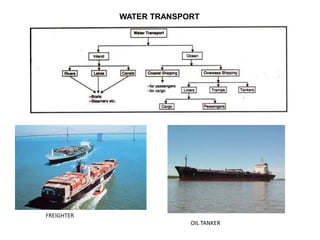
o Water transport: ships navigate through
oceans and seas, rivers and lakes.
o Air freight/ transport: planes and
helicopters fly across the sky.
Some 19th century inventions led to a
Transport Revolution: steam engine
(Watt), locomotive (Stephenson),
engines (Lenoir, Diesel, Benz)...
Speed increased and the duration
and cost of trips reduced. More
people could travel and international
relations and trade increased.
Every means of transport
needs different
infrastructures and has
advantages (pros) and
disadvantages (cons), which
have to be taken into account
to save money.
ROAD TRANSPORT
Road, guard rail and dividing line
Highway and median strip
Toll
The main advantages of road transport
are:
- it’s flexible
- it provides door to door service
- it’s fast
- it’s cheap for short distances
- it provides services to rural areas,
where other means of transport
don’t arrive.
Its main disadvantages are pollution,
risk of accidents, traffic congestions, the
price of fuel and it can be affected by
weather confitions
Commuter Train
Freight Train
RAILWAY TRANSPORT
Tramway
Subway
Funicular
Train Tracks
Its main advantages are:
- it’s fast
- it’s dependable (the least affected by weather
conditions)
- It doesn’t pollute
- it’s the safest transport
Main disadvantages:
-Not flexible (fixed routes and schedules)
-It needs important investments and infrastructures:
stations, railtracks, viaducts
-More expensive than road transport
-It doesn’t cover all the territory and many rural areas
don’t have access to it
http://www.yourarticlelibrary.com/geography/transportation/advantages-and-disadvantages-of-railway-
transport/42134/
FREIGHTER
OIL TANKER
WATER TRANSPORT
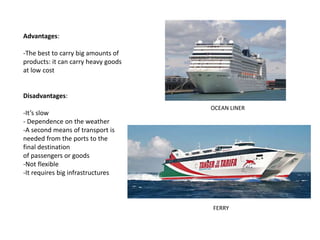
FERRY
OCEAN LINER
Advantages:
-The best to carry big amounts of
products: it can carry heavy goods
at low cost
Disadvantages:
-It’s slow
- Dependence on the weather
-A second means of transport is
needed from the ports to the
final destination
of passengers or goods
-Not flexible
-It requires big infrastructures
MARINAPORT
SHIPYARD
http://www.yourarticlelibrary.com/geography/trans
portation/water-transport-kinds-advantages-and-
disadvantages-of-water-transport/42133/
COMMERCIAL AIRPLANE
HELICOPTER LANDING
ON A HELIPAD
AIR TRANSPORT
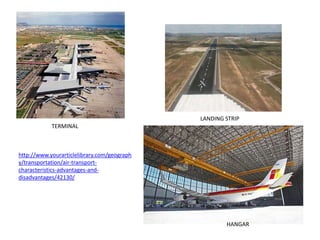
Advantages:
-The fastest means of transport
- Safety
Disadvantages:
-It’s expensive
-It pollutes a lot
- Limited cargo capacity (only for very expensive
light goods)
-It needs important infrastructures (airports)
LANDING STRIP
TERMINAL
HANGAR
http://www.yourarticlelibrary.com/geograph
y/transportation/air-transport-
characteristics-advantages-and-
disadvantages/42130/
It´s the economic activity that consists
in organizing trips and stays for the
people in their leisure time.
TOURISM
Tourism appeared in the 19th century, but it didn´t
become massive until the 2nd half of the 20th
century.
The factors for the development of tourism were:
o More free time for workers: generalization
of the five- day working week and paid
holydays: workers got the right to having
paid holidays.
o Development of the Welfare State: workers
receive retirement pensions, they don´t
have to save all their money for the future
and they have more money to spend.
o Development of transports has made trips
cheaper and faster.
These changes have made tourism possible for the
population of the richest countries.
In 1936 the Popular Front government in France was the first to
approve paid holidays for workers
The Welfare State provided workers with
retirement pensions
Tourists can visit their own countries or
foreign countries:
o Inland tourism: it takes place inside the
countries. Tourists travel to the coasts, the
mountains and cities that have cultural
background.
o Foreign tourism: tourists travel abroad to
visit other countries. The main destinations
are the tropical countries of the Caribbean
Sea, the Mediterranean Sea and the United
States of America. There are other exotic
destinations, such as China, India,
Polynesia, Egypt...
World map with land mass adjusted to show the number of tourists each country receives. France
is the most visited country in the world and Spain is the second world tourist destination.
POSITIVE IMPACTS
 tourism produces important
incomes
 there are more job
opportunities
 other economic activities
grow (leisure activities,
shops...)
 it allows cultural exchanges
 it provides opportunities for
learning languages.
Tourism has an important impact on touristic areas:
DEVELOPMENT OF OTHER ECONOMIC ACTIVITIES
OPPORTUNITY FOR LEARNING OTHER LANGUAGES
CULTURAL EXCHANGE
REAL ESTATE/ PROPERTY SPECULATION
NEGATIVE IMPACTS
 many jobs are temporary (only in
the touristic season),
 many workers don´t need special
qualification and they are not
generally well paid.
 Prices are more expensive.
 The construction of touristic
buildings (hotels and blocks of
flats) sometimes destroys the
natural environment
 there is property speculation
DESTRUCTION OF NATURAL ENVIRONMENTS
WATER SUPPLY
SEASONAL JOBS
NON QUALIFIED AND BADLY PAID JOBS
EXPENSIVE PRICES

Tertiary sector

  • 1.
  • 2.
    It´s the sectorthat includes all the activities that consist in rendering services to the people. It´s a very diverse sector, because it includes many different activities: trade, leisure, entertainment, administration, tourism, transport, education, justice, security, healthcare, cleaning, banking, financing...
  • 3.
    The more developeda country is, the more workers will work in the tertiary sector. More than 70% of the population works in the tertiary sector in the most developed countries.
  • 4.
    It´s the economicactivity that consists in exchanging products for money or other products (barter). Trade appeared in the Neolithic as a result of surplus. People exchanged the products they had for the products they wanted to have. Later, when money was invented, products had a monetary value. Trade can be classified depending on the amount of products exchanged (retail or wholesale trade) and depending on the place where products are exchanged (inland and foreign trade). TRADE
  • 5.
    o Depending onthe quantity of products exchanged:  Wholesale trade: big amounts of products are exchanged. Wholesalers buy big amounts of products from the producers and they sell them to other traders or enterprises.  Retail trade: Products are sold in small quantity in shops, markets, supermarkets...
  • 6.
    o Depending onthe place where products are exchanged:  Inland trade: it takes place inside the country.  Foreign trade: it takes place between countries. It includes exports and imports:  Exports are the sales of a country to other countries.  Imports are the purchases of products of other countries.
  • 7.
    What kind offoreign trade is shown above?
  • 8.
    What kind offoreign trade is shown above?
  • 9.
    The trade balanceis the difference between the products a country sells to other countries and the products it buys from other countries:  It´s positive if the value of exports is higher than the value of imports.  It´s negative if the value of imports is higher than the value of exports. The balance of payments (BOP) includes all the economic exchanges of a country with other countries: trade exchanges (trade balance), exchanges of services (tourism, transports) and financial exchanges (credits, movements of capital, investments...):  If incomes are higher than expenses, the balance of payments is positive (surplus)  If expenses are higher than incomes, the balance of payments is negative (deficit).
  • 11.
    Is the tradebalance positive or negative for the USA? Why?
  • 12.
    With the IndustrialRevolution and the internationalization of trade, some countries started protecting their products from the competition of foreign products by establishing high tariffs. This policy was called protectionism. When this policy extended, international trade was reduced and this caused negative effects to industries. The opposite policy was free trade: free circulation of products between countries and low or inexistent tariffs. WORLD TRADE
  • 14.
    After World War2 the United Nations proposed the creation of a World Trade Organization (WTO) to reduce tariffs, liberalize international trade and make the circulation of products easier, but only 23 countries signed initially the GATT (General Agreement on Tariffs and Trade). Finally the WTO was created in 1995. 146 countries signed the foundation treaty. Nowadays the WTO has 150 members.
  • 15.
    CURRENT FREE TRADEAREAS IN THE WORLD
  • 16.
    The liberalization ofworld trade hasn´t produced the same results for all the countries: - Developed countries take advantage of liberalization, because they can buy raw materials from developing countries at low cost and, at the same time, sell their manufactured products without paying high tariffs. - Many products from developing countries can´t compete with the subsidized products of the developed ones. The manufactured products of developed countries also destroy local industries in developing countries.
  • 18.
    The case ofHaiti shows how harmful the liberalization of trade can be for a developing country: Some years ago, before the opening of the markets, Haiti was a self- sufficient country in rice. The Haitian farmers produced enough rice to maintain all the population and at a reasonable price. With the liberalization, foreign rice started arriving to Haitian markets at a lower cost. Haitian farmers couldn´t compete with foreign rice, many lost their farms and local production of rice shrunk. The price of rice increased a lot and many Haitians couldn´t buy the basic product of their diet. Famine has become chronic.
  • 20.
    TRANSATLANTIC TRADE ANDINVESTMENT PARTNERSHIP (TTIP) This is a trade agreement between the USA and the EU that is currently being negotiated. Its approval will mean that there won’t be barriers for trade and investments between these two areas, but many laws that protect consumers, workers and the environment will also be eliminated. The negotiations are secret and the big companies are imposing their interests. That’s why there is an increasing rejection of this treaty. https://www.youtube.com/wat ch?v=Y4OQeekSD6s
  • 21.
    WORLD TRADE FLOWS(Dymaxion/Fuller projection) Most of the world trade flows take place between the most developed areas in the world
  • 22.
  • 24.
  • 25.
    TRANSPORT It´s the economicactivity that consists of taking people or goods from one place to a different one. Means of transport are the vehicles used to take people or goods from one place to a different one. o Ground transport: it takes place on the ground.  Road transport: cars, buses and trucks circulate through roads and highways.  Railway transport: trains and tramways circulate over rails. o Water transport: ships navigate through oceans and seas, rivers and lakes. o Air freight/ transport: planes and helicopters fly across the sky.
  • 26.
    Some 19th centuryinventions led to a Transport Revolution: steam engine (Watt), locomotive (Stephenson), engines (Lenoir, Diesel, Benz)... Speed increased and the duration and cost of trips reduced. More people could travel and international relations and trade increased.
  • 27.
    Every means oftransport needs different infrastructures and has advantages (pros) and disadvantages (cons), which have to be taken into account to save money.
  • 28.
  • 29.
    Road, guard railand dividing line Highway and median strip Toll The main advantages of road transport are: - it’s flexible - it provides door to door service - it’s fast - it’s cheap for short distances - it provides services to rural areas, where other means of transport don’t arrive. Its main disadvantages are pollution, risk of accidents, traffic congestions, the price of fuel and it can be affected by weather confitions
  • 30.
    Commuter Train Freight Train RAILWAYTRANSPORT Tramway Subway Funicular
  • 31.
    Train Tracks Its mainadvantages are: - it’s fast - it’s dependable (the least affected by weather conditions) - It doesn’t pollute - it’s the safest transport Main disadvantages: -Not flexible (fixed routes and schedules) -It needs important investments and infrastructures: stations, railtracks, viaducts -More expensive than road transport -It doesn’t cover all the territory and many rural areas don’t have access to it http://www.yourarticlelibrary.com/geography/transportation/advantages-and-disadvantages-of-railway- transport/42134/
  • 32.
  • 33.
    FERRY OCEAN LINER Advantages: -The bestto carry big amounts of products: it can carry heavy goods at low cost Disadvantages: -It’s slow - Dependence on the weather -A second means of transport is needed from the ports to the final destination of passengers or goods -Not flexible -It requires big infrastructures
  • 34.
  • 35.
    COMMERCIAL AIRPLANE HELICOPTER LANDING ONA HELIPAD AIR TRANSPORT Advantages: -The fastest means of transport - Safety Disadvantages: -It’s expensive -It pollutes a lot - Limited cargo capacity (only for very expensive light goods) -It needs important infrastructures (airports)
  • 36.
  • 37.
    It´s the economicactivity that consists in organizing trips and stays for the people in their leisure time. TOURISM
  • 38.
    Tourism appeared inthe 19th century, but it didn´t become massive until the 2nd half of the 20th century. The factors for the development of tourism were: o More free time for workers: generalization of the five- day working week and paid holydays: workers got the right to having paid holidays. o Development of the Welfare State: workers receive retirement pensions, they don´t have to save all their money for the future and they have more money to spend. o Development of transports has made trips cheaper and faster. These changes have made tourism possible for the population of the richest countries.
  • 39.
    In 1936 thePopular Front government in France was the first to approve paid holidays for workers The Welfare State provided workers with retirement pensions
  • 40.
    Tourists can visittheir own countries or foreign countries: o Inland tourism: it takes place inside the countries. Tourists travel to the coasts, the mountains and cities that have cultural background. o Foreign tourism: tourists travel abroad to visit other countries. The main destinations are the tropical countries of the Caribbean Sea, the Mediterranean Sea and the United States of America. There are other exotic destinations, such as China, India, Polynesia, Egypt...
  • 43.
    World map withland mass adjusted to show the number of tourists each country receives. France is the most visited country in the world and Spain is the second world tourist destination.
  • 46.
    POSITIVE IMPACTS  tourismproduces important incomes  there are more job opportunities  other economic activities grow (leisure activities, shops...)  it allows cultural exchanges  it provides opportunities for learning languages. Tourism has an important impact on touristic areas:
  • 47.
    DEVELOPMENT OF OTHERECONOMIC ACTIVITIES OPPORTUNITY FOR LEARNING OTHER LANGUAGES CULTURAL EXCHANGE
  • 48.
    REAL ESTATE/ PROPERTYSPECULATION NEGATIVE IMPACTS  many jobs are temporary (only in the touristic season),  many workers don´t need special qualification and they are not generally well paid.  Prices are more expensive.  The construction of touristic buildings (hotels and blocks of flats) sometimes destroys the natural environment  there is property speculation
  • 49.
    DESTRUCTION OF NATURALENVIRONMENTS WATER SUPPLY SEASONAL JOBS NON QUALIFIED AND BADLY PAID JOBS
  • 50.