PRIMARY SECTOR
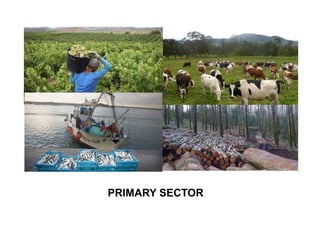
It includes all the activities related to
the extraction of natural resources
from nature: agriculture,
stockbreeding, fishing and forest
logging.
Nowadays 33.5% of the world
population works in the primary
sector, but there are important
differences between the developed
and the developing countries. In the
developed countries less than 10%
of the working population work in
the primary sector, while in the
developing countries more than 40%
of the working population work in it.
PRIMARY SECTOR
Factors that affect agriculture
- Physical factors: related to the physical
conditions, such as climate, relief and the
quality of the soil.
- Climate: every crop needs a specific
amount of water and heat
- Relief: plain areas are better than
mountainous areas to cultivate and
harvest.
- Quality of the soil: not all soils have the
same fertility. The best soils are those that
have more nutrients.
- Human factors: related to human intervention
in the soil. The main human factors are
economy and technological development. These
factors are usually related: the more developed
a society is, the more technologically developed
it becomes.
Agriculture is the economic activity that consists in cultivating the land to use the
products it gives.
AGRICULTURE OR FARMING
AGRARIAN LANDSCAPES
The agrarian landscape is the
natural landscape that has been
modified to obtain products
through agriculture. The main
elements of agrarian landscapes
are:
- plots of land
- farming systems
- habitat
A plot of land is a piece of land dedicated
to agriculture. Plots of land can be
classified depending on their size, their
shape and their limits.
o Size: large estates (big plots of land,
more than 100 hectares), small
estates (small plots of land,
between 0 and 10 hectares)
o Shape: plots can be regular (with
geometric shape) or irregular.
o Limits: plots can be open (open
fields), if there is no physical
separation between the fields, or
closed (enclosures or bocages), if
there are walls, fences or hedges
that separate the fields.
PLOTS OF LAND
FARMING SYSTEMS
Farming systems can be classified depending
on the variety of crops, the quantity of
water the crops need and the quantity of
investment made.
o Variety of crops:
 Monoculture: growing one single
crop over a wide area.
 Multiple cropping or polyculture:
growing different crops in the same
space.
o Quantity of water needed:
 Irrigated crops: crops that need an
extra amount of water to grow.
 Non- irrigated or dry- land crops:
crops that can grow only with rain
water.
SURFACE IRRIGATION/FLOOD IRRIGATION SPRINKLER IRRIGATION
DRIP IRRIGATION
o Quantity of work and investment made:
 Intensive agriculture: This type of
agriculture is usual in highly populated
places with not much space available. The
objective of this type of agriculture is to
produce the largest quantity of products in
the least space available. This requires
important investments in work,
techniques (fertilizers, seeds´ selection)
and workers.
 Extensive agriculture: This type of
agriculture is usual in sparsely populated
places with large extensions of land
available and scarce number of workers.
The main aim of this type of agriculture is
to produce big amounts of low-cost
products. Machines are usual in this type
of agriculture.
SCATTERED COMMUNITY
Rural habitats can be scattered (if the dwellings are far apart and disseminated
among the fields) or concentrated (if the dwellings are close together in the same
place).
HABITAT
CONCENTRATED COMMUNITY
SUBSISTENCE AGRICULTURE
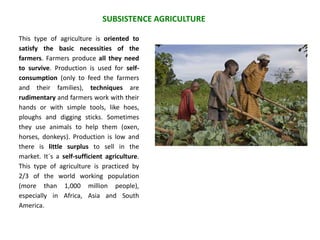
This type of agriculture is oriented to
satisfy the basic necessities of the
farmers. Farmers produce all they need
to survive. Production is used for self-
consumption (only to feed the farmers
and their families), techniques are
rudimentary and farmers work with their
hands or with simple tools, like hoes,
ploughs and digging sticks. Sometimes
they use animals to help them (oxen,
horses, donkeys). Production is low and
there is little surplus to sell in the
market. It´s a self-sufficient agriculture.
This type of agriculture is practiced by
2/3 of the world working population
(more than 1,000 million people),
especially in Africa, Asia and South
America.
SLASH AND BURN AGRICULTURE
It consists of cutting and
burning forests or
woodlands to create fields
for agriculture. Between
200 and 500 million farmers
in the world practice this
agriculture. The fields are
fertile for 4-5 years. This is
the reason why the farmers
have to leave the lands and
start again in a different
place.
This type of agriculture is practiced in equatorial and tropical areas of South
America, Africa and South Asia.
EXTENSIVE DRY-LAND AGRICULTURE
This type of agriculture is the most
common in the dry areas of Africa. It
consists of an association of farming
and stockbreeding. Farmers use the
three- year system of crop rotation,
leaving one part fallow. Fallow is used
to feed cattle. Animals fertilize the land
with their excrements and make the
land more fertile.
WET RICE AGRICULTURE
This is a type of intensive
agriculture practiced in the
Asian countries affected by the
monsoons (East and South
Eastern Asia). These winds are
wet in summer and allow the
farmers to cultivate rice, a
plant that needs lots of water
to grow. Farmers get 2-3
harvests of rice per year.
Production is high, but not
enough to allow farmers more
than subsistence.
COMMERCIAL AGRICULTURE
This type of agriculture is oriented to
sell the products in the market. The
origins of this agriculture are related to
the improvements introduced in
agriculture during the 18th century,
which led to an increase in production.
Farmers got enough production to feed
their families and surpluses that could
be sold in markets.
Commercial agriculture is practiced in
the most developed areas of the world:
North America, Europe, Japan, New
Zealand, Australia, Brazil, Argentina and
some areas of tropical climate.
Main features:
- The main aim is to produce more at the
lowest cost. Farmers invest big amounts of
money to achieve this goal:
o Use of technology to make the work
easier and faster and to save workers:
machines (tractors, harvesters,
threshing machines…), chemical
fertilizers, seeds´ selection, modern
irrigation techniques (drip irrigation,
hydroponics)…
o Crop specialization: farmers cultivate
what consumers demand.
Monoculture is common in
commercial agriculture, because
farmers can save money by cultivating
only one product in their fields.
- High production
- Small amount of workers, because the
most part of the work is mechanized.
SPECIALIZED AGRICULTURE
Practiced in the U.S.A. Large estates
dedicated to monoculture (wheat,
corn, cotton…), big investments in
technology, very few workers, big
harvests destined to agribusiness.
MEDITERRANEAN AGRICULTURE
It´s a traditional agriculture practiced all around
the Mediterranean Sea, which has modernized
to increase production. This type of agriculture
produces different products:
o Dry-land products: cultivated according
to extensive agriculture: vines, wheat
and olive trees.
o Irrigated crops: intensive crops, such as
fruit and vegetables. Greenhouse crops
are included in this group.
Satellite view of Almería´s
greenhouses
PLANTATION AGRICULTURE
COCOA PLANTATION RUBBER PLANTATION
BANANA PLANTATION
SUGARCANE PLANTATION
This type of agriculture takes
place in countries with
tropical climate. The owners
of the plantations are big
multinationals that crop
products that need heat and
humidity to grow. They hire
cheap labor (sometimes
workers are slaves) and the
production is oriented to
export. The products
cultivated in plantations are
coffee, tea, cocoa, pineapples,
rubber, oil palm, tobacco,
sugarcane …
Economic activity that consists
in breeding and raising animals
to use the products they give.
There are many animals that
have been domesticated and
can be bred: cattle, sheep,
horses, goats, pigs, rabbits
(cuniculture), hens and chicken,
geese (poultry)…
STOCKBREEDING
TRADITIONAL STOCKBREEDING
It´s often a complement of agriculture, because
the animals are used to work, to produce
fertilizers and they provide the farmers with
milk, wool and meat. This type of stockbreeding
is common in the tropics, in monsoon areas and
in some zones of the Mediterranean Sea.
There is also a subsistence stockbreeding in
very dry areas: nomadic shepherds move
periodically in search of pastures for their
livestock (camels, sheep or goats).
The main purpose is to sell the animal
products and get benefits. There are two
main ways of breeding animals:
extensive and intensive stockbreeding.
COMMERCIAL STOCKBREEDING
 Extensive stockbreeding:
animals graze in the open air
and few workers are needed.
Examples: cattle breeding in the
west of the U.S.A, sheep
breeding in the Pampa and
Patagonia in Argentina, Australia
and South Africa.
 Intensive stockbreeding: animals are bred
in farms or stables and they are fed by the
farmers. The purpose is to get a lot of
animals in a reduced space.
 In the stabled system animals
remain all the time in the stables all
the time and they are fed by the
farmers.
 In the semi-stabled system animals
spend part of the time in the stables
and part of the time outside.
Intensive stockbreeding is used to breed cattle
(to produce milk and meat) and poultry (eggs
and meat).
Commercial stockbreeding has become
very similar to an industry: animals are
vaccinated and injected with hormones in
order that they grow faster. This has caused
health problems, like the mad cow disease.
An alternative is ecological production.
The animals are bred in a natural way,
respecting their natural cycle.
FISHING
Economic activity that consists in extracting
resources from the aquatic environment (rivers
and seas).
The instruments used to fish are called fishing
equipment: hooks, nets, harpoons, traps…
There are different fishing techniques: netting,
trawling, trapping, angling, spearing,
almadraba (tuna fishery), electrofishing…
TYPES OF FISHING
- Traditional fishing: Fishers fish next to
the coast, they use traditional
techniques and production is low and
basically for self- consumption. In the
most developed countries traditional
fishing is used to fish expensive species
(hakes, seafood like lobsters, prawns…)
- Commercial or industrial fishing: The
main purpose is getting big amounts of
fish to sell in the market. Fishing
enterprises invest big amounts of
money in technology and
infrastructures to process fish.
Depending on the places where fish are
captured, we can classify fishing in two types:
o Inshore fishing: next to the coast.
Ships come back to port every day.
o High-sea fishing: in the ocean. Ships
are equipped with radars and sonar
to locate the shoals and freezers to
preserve the fish once it has been
processed (cleaned, salted).
The best fishing grounds or fisheries are located where there is a big
concentration of plankton. Plankton concentrates in some places of seas and
oceans: continental shelves, cold currents, confluence of cold and warm currents.
BEST FISHERIES
The international laws
recognize the right of every
coastal country to delimitate
its territorial waters: area of
200 marine miles (370
kilometers) from the coast to
the international waters. The
use of territorial waters is
exclusive of the country they
belong to.
TERRITORIAL WATERS OR EXCLUSIVE ECONOMIC ZONES
European Union exclusive economic zone
If the ships of a
country want to fish
in the territorial
waters of another
country, their
governments will
have to sign a fishing
agreement.
The main problems of fishing
are pollution and
overfishing. These problems
have reduced considerably
the quantity of fish available.
This has led to limit the fish
catch and to establish close
seasons for some species (for
example, Cantabrian
anchovy). But the problems
persist.
Fish discards
It consists of cultivating aquatic species in
enclosed places:
- Fish farms: freshwater fish and algae are
raised in tanks or enclosed sections of
rivers or dams.
- Mariculture: it consists in raising
saltwater fish, molluscs or algae in
marine farms, in an enclosed section of
the sea: shellfish, oysters, clams,
seaweeds, cultured pearls…
AQUACULTURE OR AQUAFARMING
Primary sector

Primary sector

  • 1.
  • 2.
    It includes allthe activities related to the extraction of natural resources from nature: agriculture, stockbreeding, fishing and forest logging. Nowadays 33.5% of the world population works in the primary sector, but there are important differences between the developed and the developing countries. In the developed countries less than 10% of the working population work in the primary sector, while in the developing countries more than 40% of the working population work in it. PRIMARY SECTOR
  • 3.
    Factors that affectagriculture - Physical factors: related to the physical conditions, such as climate, relief and the quality of the soil. - Climate: every crop needs a specific amount of water and heat - Relief: plain areas are better than mountainous areas to cultivate and harvest. - Quality of the soil: not all soils have the same fertility. The best soils are those that have more nutrients. - Human factors: related to human intervention in the soil. The main human factors are economy and technological development. These factors are usually related: the more developed a society is, the more technologically developed it becomes. Agriculture is the economic activity that consists in cultivating the land to use the products it gives. AGRICULTURE OR FARMING
  • 4.
    AGRARIAN LANDSCAPES The agrarianlandscape is the natural landscape that has been modified to obtain products through agriculture. The main elements of agrarian landscapes are: - plots of land - farming systems - habitat
  • 5.
    A plot ofland is a piece of land dedicated to agriculture. Plots of land can be classified depending on their size, their shape and their limits. o Size: large estates (big plots of land, more than 100 hectares), small estates (small plots of land, between 0 and 10 hectares) o Shape: plots can be regular (with geometric shape) or irregular. o Limits: plots can be open (open fields), if there is no physical separation between the fields, or closed (enclosures or bocages), if there are walls, fences or hedges that separate the fields. PLOTS OF LAND
  • 7.
    FARMING SYSTEMS Farming systemscan be classified depending on the variety of crops, the quantity of water the crops need and the quantity of investment made. o Variety of crops:  Monoculture: growing one single crop over a wide area.  Multiple cropping or polyculture: growing different crops in the same space. o Quantity of water needed:  Irrigated crops: crops that need an extra amount of water to grow.  Non- irrigated or dry- land crops: crops that can grow only with rain water.
  • 9.
    SURFACE IRRIGATION/FLOOD IRRIGATIONSPRINKLER IRRIGATION DRIP IRRIGATION
  • 10.
    o Quantity ofwork and investment made:  Intensive agriculture: This type of agriculture is usual in highly populated places with not much space available. The objective of this type of agriculture is to produce the largest quantity of products in the least space available. This requires important investments in work, techniques (fertilizers, seeds´ selection) and workers.  Extensive agriculture: This type of agriculture is usual in sparsely populated places with large extensions of land available and scarce number of workers. The main aim of this type of agriculture is to produce big amounts of low-cost products. Machines are usual in this type of agriculture.
  • 11.
    SCATTERED COMMUNITY Rural habitatscan be scattered (if the dwellings are far apart and disseminated among the fields) or concentrated (if the dwellings are close together in the same place). HABITAT CONCENTRATED COMMUNITY
  • 12.
    SUBSISTENCE AGRICULTURE This typeof agriculture is oriented to satisfy the basic necessities of the farmers. Farmers produce all they need to survive. Production is used for self- consumption (only to feed the farmers and their families), techniques are rudimentary and farmers work with their hands or with simple tools, like hoes, ploughs and digging sticks. Sometimes they use animals to help them (oxen, horses, donkeys). Production is low and there is little surplus to sell in the market. It´s a self-sufficient agriculture. This type of agriculture is practiced by 2/3 of the world working population (more than 1,000 million people), especially in Africa, Asia and South America.
  • 13.
    SLASH AND BURNAGRICULTURE It consists of cutting and burning forests or woodlands to create fields for agriculture. Between 200 and 500 million farmers in the world practice this agriculture. The fields are fertile for 4-5 years. This is the reason why the farmers have to leave the lands and start again in a different place. This type of agriculture is practiced in equatorial and tropical areas of South America, Africa and South Asia.
  • 14.
    EXTENSIVE DRY-LAND AGRICULTURE Thistype of agriculture is the most common in the dry areas of Africa. It consists of an association of farming and stockbreeding. Farmers use the three- year system of crop rotation, leaving one part fallow. Fallow is used to feed cattle. Animals fertilize the land with their excrements and make the land more fertile.
  • 15.
    WET RICE AGRICULTURE Thisis a type of intensive agriculture practiced in the Asian countries affected by the monsoons (East and South Eastern Asia). These winds are wet in summer and allow the farmers to cultivate rice, a plant that needs lots of water to grow. Farmers get 2-3 harvests of rice per year. Production is high, but not enough to allow farmers more than subsistence.
  • 17.
    COMMERCIAL AGRICULTURE This typeof agriculture is oriented to sell the products in the market. The origins of this agriculture are related to the improvements introduced in agriculture during the 18th century, which led to an increase in production. Farmers got enough production to feed their families and surpluses that could be sold in markets. Commercial agriculture is practiced in the most developed areas of the world: North America, Europe, Japan, New Zealand, Australia, Brazil, Argentina and some areas of tropical climate.
  • 18.
    Main features: - Themain aim is to produce more at the lowest cost. Farmers invest big amounts of money to achieve this goal: o Use of technology to make the work easier and faster and to save workers: machines (tractors, harvesters, threshing machines…), chemical fertilizers, seeds´ selection, modern irrigation techniques (drip irrigation, hydroponics)… o Crop specialization: farmers cultivate what consumers demand. Monoculture is common in commercial agriculture, because farmers can save money by cultivating only one product in their fields. - High production - Small amount of workers, because the most part of the work is mechanized.
  • 19.
    SPECIALIZED AGRICULTURE Practiced inthe U.S.A. Large estates dedicated to monoculture (wheat, corn, cotton…), big investments in technology, very few workers, big harvests destined to agribusiness.
  • 20.
    MEDITERRANEAN AGRICULTURE It´s atraditional agriculture practiced all around the Mediterranean Sea, which has modernized to increase production. This type of agriculture produces different products: o Dry-land products: cultivated according to extensive agriculture: vines, wheat and olive trees. o Irrigated crops: intensive crops, such as fruit and vegetables. Greenhouse crops are included in this group.
  • 21.
    Satellite view ofAlmería´s greenhouses
  • 22.
    PLANTATION AGRICULTURE COCOA PLANTATIONRUBBER PLANTATION BANANA PLANTATION SUGARCANE PLANTATION This type of agriculture takes place in countries with tropical climate. The owners of the plantations are big multinationals that crop products that need heat and humidity to grow. They hire cheap labor (sometimes workers are slaves) and the production is oriented to export. The products cultivated in plantations are coffee, tea, cocoa, pineapples, rubber, oil palm, tobacco, sugarcane …
  • 23.
    Economic activity thatconsists in breeding and raising animals to use the products they give. There are many animals that have been domesticated and can be bred: cattle, sheep, horses, goats, pigs, rabbits (cuniculture), hens and chicken, geese (poultry)… STOCKBREEDING
  • 24.
    TRADITIONAL STOCKBREEDING It´s oftena complement of agriculture, because the animals are used to work, to produce fertilizers and they provide the farmers with milk, wool and meat. This type of stockbreeding is common in the tropics, in monsoon areas and in some zones of the Mediterranean Sea. There is also a subsistence stockbreeding in very dry areas: nomadic shepherds move periodically in search of pastures for their livestock (camels, sheep or goats).
  • 25.
    The main purposeis to sell the animal products and get benefits. There are two main ways of breeding animals: extensive and intensive stockbreeding. COMMERCIAL STOCKBREEDING
  • 26.
     Extensive stockbreeding: animalsgraze in the open air and few workers are needed. Examples: cattle breeding in the west of the U.S.A, sheep breeding in the Pampa and Patagonia in Argentina, Australia and South Africa.
  • 27.
     Intensive stockbreeding:animals are bred in farms or stables and they are fed by the farmers. The purpose is to get a lot of animals in a reduced space.  In the stabled system animals remain all the time in the stables all the time and they are fed by the farmers.  In the semi-stabled system animals spend part of the time in the stables and part of the time outside. Intensive stockbreeding is used to breed cattle (to produce milk and meat) and poultry (eggs and meat).
  • 28.
    Commercial stockbreeding hasbecome very similar to an industry: animals are vaccinated and injected with hormones in order that they grow faster. This has caused health problems, like the mad cow disease. An alternative is ecological production. The animals are bred in a natural way, respecting their natural cycle.
  • 29.
    FISHING Economic activity thatconsists in extracting resources from the aquatic environment (rivers and seas). The instruments used to fish are called fishing equipment: hooks, nets, harpoons, traps… There are different fishing techniques: netting, trawling, trapping, angling, spearing, almadraba (tuna fishery), electrofishing…
  • 30.
    TYPES OF FISHING -Traditional fishing: Fishers fish next to the coast, they use traditional techniques and production is low and basically for self- consumption. In the most developed countries traditional fishing is used to fish expensive species (hakes, seafood like lobsters, prawns…) - Commercial or industrial fishing: The main purpose is getting big amounts of fish to sell in the market. Fishing enterprises invest big amounts of money in technology and infrastructures to process fish.
  • 31.
    Depending on theplaces where fish are captured, we can classify fishing in two types: o Inshore fishing: next to the coast. Ships come back to port every day. o High-sea fishing: in the ocean. Ships are equipped with radars and sonar to locate the shoals and freezers to preserve the fish once it has been processed (cleaned, salted).
  • 32.
    The best fishinggrounds or fisheries are located where there is a big concentration of plankton. Plankton concentrates in some places of seas and oceans: continental shelves, cold currents, confluence of cold and warm currents. BEST FISHERIES
  • 34.
    The international laws recognizethe right of every coastal country to delimitate its territorial waters: area of 200 marine miles (370 kilometers) from the coast to the international waters. The use of territorial waters is exclusive of the country they belong to. TERRITORIAL WATERS OR EXCLUSIVE ECONOMIC ZONES European Union exclusive economic zone
  • 35.
    If the shipsof a country want to fish in the territorial waters of another country, their governments will have to sign a fishing agreement.
  • 36.
    The main problemsof fishing are pollution and overfishing. These problems have reduced considerably the quantity of fish available. This has led to limit the fish catch and to establish close seasons for some species (for example, Cantabrian anchovy). But the problems persist. Fish discards
  • 37.
    It consists ofcultivating aquatic species in enclosed places: - Fish farms: freshwater fish and algae are raised in tanks or enclosed sections of rivers or dams. - Mariculture: it consists in raising saltwater fish, molluscs or algae in marine farms, in an enclosed section of the sea: shellfish, oysters, clams, seaweeds, cultured pearls… AQUACULTURE OR AQUAFARMING