Experiment 12 Agarose Gel Electrophoresis
Separation of DNA Fragments by Gel Electrophoresis Two Types Polyacrylamide gels Agarose gels
Polyacrylamide Gels Separate DNA fragments up to 1000 bp long Higher resolving power than agarose Separate fragments that differ in length by single nucleotide
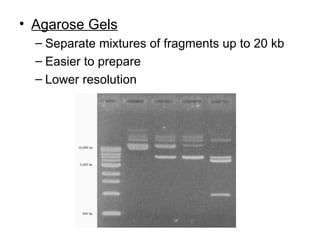
Agarose Gels Separate mixtures of fragments up to 20 kb Easier to prepare Lower resolution
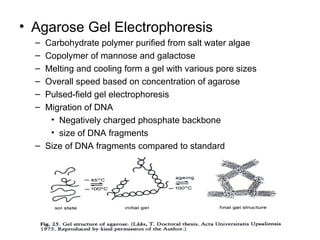
Agarose Gel Electrophoresis Carbohydrate polymer purified from salt water algae Copolymer of mannose and galactose Melting and cooling form a gel with various pore sizes Overall speed based on concentration of agarose Pulsed-field gel electrophoresis Migration of DNA Negatively charged phosphate backbone size of DNA fragments Size of DNA fragments compared to standard
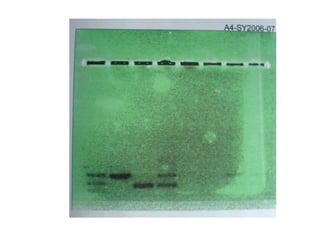
Bands of gel are visualized with UV light source central dye Ethidium Bromide Fluorescent under UV light
 
Results and Discussion Fragments of linear DNA migrate through agarose gels with a mobility that is inversely proportional to the log10 of their molecular weight.
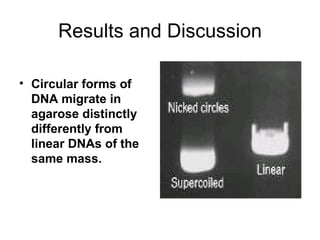
Results and Discussion Circular forms of DNA migrate in agarose distinctly differently from linear DNAs of the same mass.
Results and Discussion Several additional factors have important effects on the mobility of DNA fragments in agarose gels
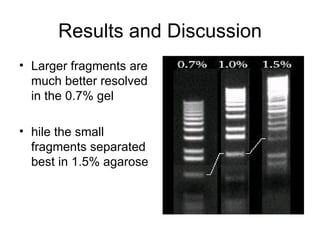
Results and Discussion Agarose Concentration   Higher concentrations of agarose facilitate separation of small DNAs,  Low agarose concentrations allow resolution of larger DNAs.
Results and Discussion Larger fragments are much better resolved in the 0.7% gel hile the small fragments separated best in 1.5% agarose
Results and Discussion Voltage   As the voltage applied to a gel is increased, larger fragments migrate proportionally faster that small fragments
Results and Discussion Electrophoresis Buffer   Buffers not only establish a pH, but provide ions to support conductivity.  DNA fragments will migrate at different rates due to differences in ionic strength.
Results and Discussion Effects of Ethidium Bromide   Binding of ethidium bromide to DNA alters its mass and rigidity, and therefore its mobility

Agarose Gel

  • 1.
    Experiment 12 AgaroseGel Electrophoresis
  • 2.
    Separation of DNAFragments by Gel Electrophoresis Two Types Polyacrylamide gels Agarose gels
  • 3.
    Polyacrylamide Gels SeparateDNA fragments up to 1000 bp long Higher resolving power than agarose Separate fragments that differ in length by single nucleotide
  • 4.
    Agarose Gels Separatemixtures of fragments up to 20 kb Easier to prepare Lower resolution
  • 5.
    Agarose Gel ElectrophoresisCarbohydrate polymer purified from salt water algae Copolymer of mannose and galactose Melting and cooling form a gel with various pore sizes Overall speed based on concentration of agarose Pulsed-field gel electrophoresis Migration of DNA Negatively charged phosphate backbone size of DNA fragments Size of DNA fragments compared to standard
  • 6.
    Bands of gelare visualized with UV light source central dye Ethidium Bromide Fluorescent under UV light
  • 7.
  • 8.
    Results and DiscussionFragments of linear DNA migrate through agarose gels with a mobility that is inversely proportional to the log10 of their molecular weight.
  • 9.
    Results and DiscussionCircular forms of DNA migrate in agarose distinctly differently from linear DNAs of the same mass.
  • 10.
    Results and DiscussionSeveral additional factors have important effects on the mobility of DNA fragments in agarose gels
  • 11.
    Results and DiscussionAgarose Concentration Higher concentrations of agarose facilitate separation of small DNAs, Low agarose concentrations allow resolution of larger DNAs.
  • 12.
    Results and DiscussionLarger fragments are much better resolved in the 0.7% gel hile the small fragments separated best in 1.5% agarose
  • 13.
    Results and DiscussionVoltage As the voltage applied to a gel is increased, larger fragments migrate proportionally faster that small fragments
  • 14.
    Results and DiscussionElectrophoresis Buffer Buffers not only establish a pH, but provide ions to support conductivity. DNA fragments will migrate at different rates due to differences in ionic strength.
  • 15.
    Results and DiscussionEffects of Ethidium Bromide Binding of ethidium bromide to DNA alters its mass and rigidity, and therefore its mobility