
Underwritten by: Presented by:
#AIIMYour Digital Transformation Begins with
Intelligent Information Management
Information Through a New Lens –
What Lies Beyond ECM
Presented 28th June, 2018
Underwritten by: Presented by:
#AIIMYour Digital Transformation Begins with
Intelligent Information ManagementYour Digital Transformation begins with
Intelligent Information Management
Underwritten by: Presented by:
Tips for Participating in Today’s Webinar
 Group Chat – to talk with each other, found in the icons along
the bottom. Note: everyone can see and participate.
 Q&A – for questions to the speakers, held for the end (and
tech help).
 Check out the Resources available to you today, in the box to
the right of the slides.
 A Survey will open at the conclusion of the webinar – we value
your feedback on how we did today.
Underwritten by: Presented by:
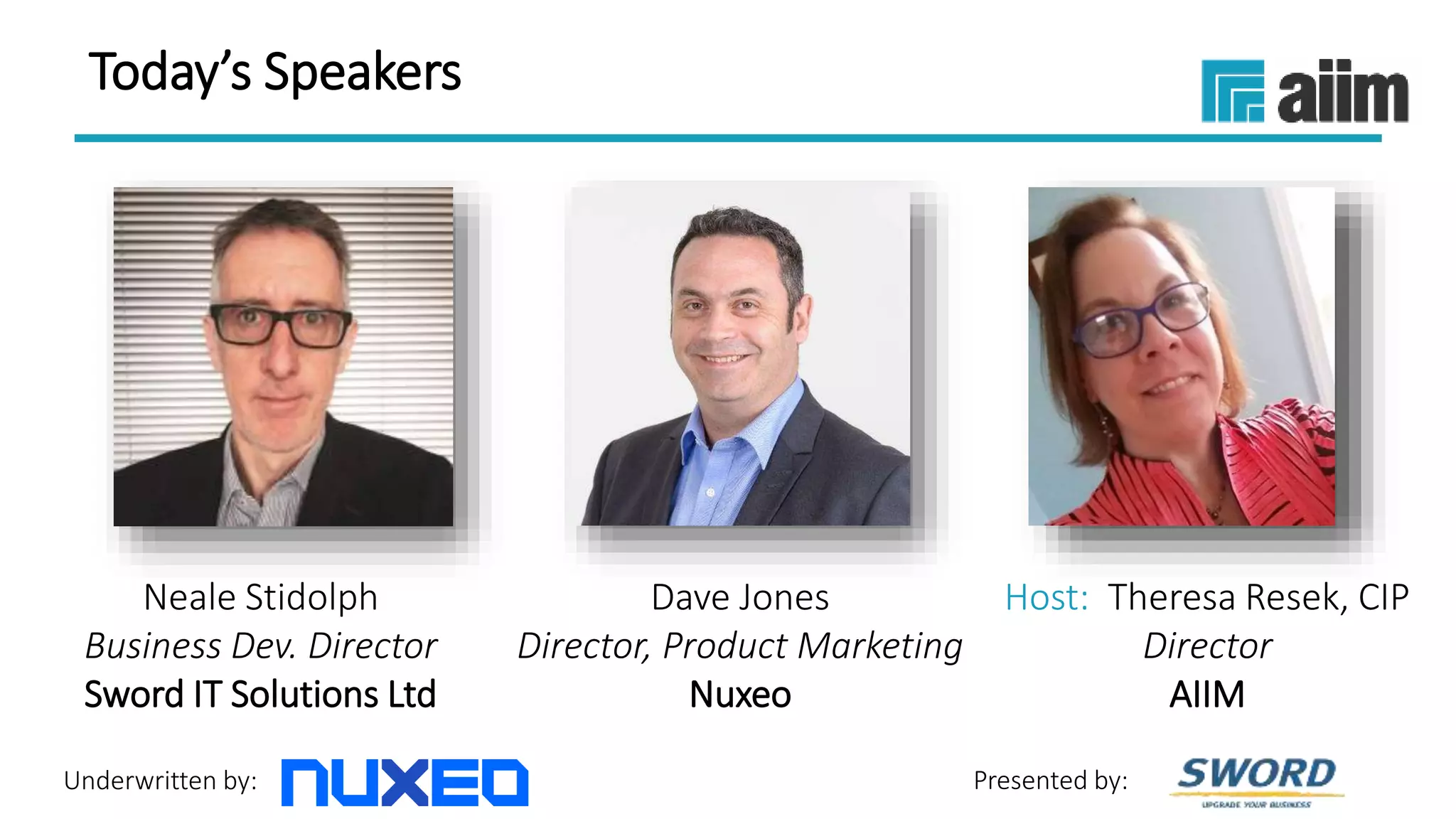
Neale Stidolph
Business Dev. Director
Sword IT Solutions Ltd
Dave Jones
Director, Product Marketing
Nuxeo
Host: Theresa Resek, CIP
Director
AIIM
Today’s Speakers
Underwritten by: Presented by:
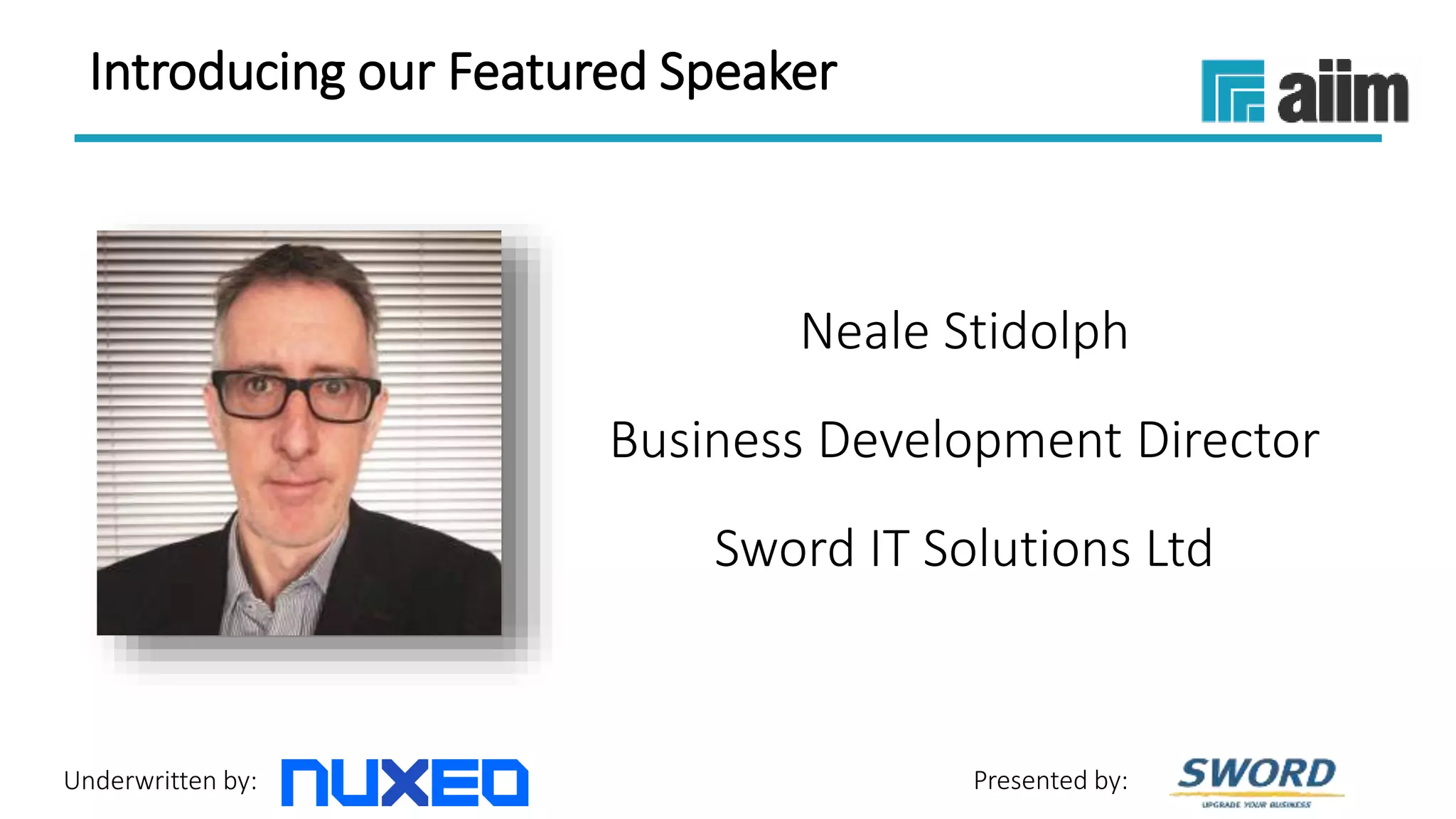
Neale Stidolph
Business Development Director
Sword IT Solutions Ltd
Introducing our Featured Speaker
Underwritten by: Presented by:
Contact me
Neale Stidolph
Strategy, Business Development, & IM Specialist, Sword Group
Experience
More than 30 years of IT & IM experience.
The Robert Gordon University, Industrial Advisory Group member
Ex-Board member of AIIM & Treasurer, GDPR + Oil & Gas Special Interest Groups
Oil & Gas UK Council Representative
Previous roles:
Head of Strategic Development Lockheed Martin UK, and
Head of Information Management, Lockheed Martin UK
https://www.linkedin.com/in/nealestidolphneale.stidolph@sword-group.com Tel. +44 7841 868974
Underwritten by: Presented by:
ECM, was it the answer
and is it obsolete?
The answer is valid but the
questions are changing
Intelligent Information
Management* is the new
philosophy
Content Services are the tools
*
Underwritten by: Presented by:
Driving Forces – moving beyond ECM
Your Information
Systems
Pushing forces Pulling forces
Product end-of-life
Supportability
Security
Maintenance
Licensing costs
Legacy skills / training
Vendor inertia
Regulatory pressure
Hard to make changes
Process modernisation
Business agility / flexibility
Get smarter (analytics)
User/Customer Experience
Competitive pressures
Inter-company collaboration
Cost saving (platform, AI/ML)
Automation (RPA..)
Trust (DLT / Blockchain…)
Pace of change
Fear-Uncertainty-Doubt
Complex customisation
“It ain’t broke”
New technology & skills
New vendors & partners
Legacy technology lock-in
Proof / Stakeholder fear
IT staff feel threatened
Underwritten by: Presented by:
ECM to Content Services
The way we were
Traditional org.
Slow change/scale
‘Slow’ content
Structure / Control
Complex & Rigid
Centralised/Internal
Demanding of users
Losing it…
Org. revolutions!
Cost escalation
IT-centric silos
Evolution
Interconnected
Lower cost, agile
People-centric
ECM will help? Wow, it’s hard! Content ServicesBefore 2005
Underwritten by: Presented by:
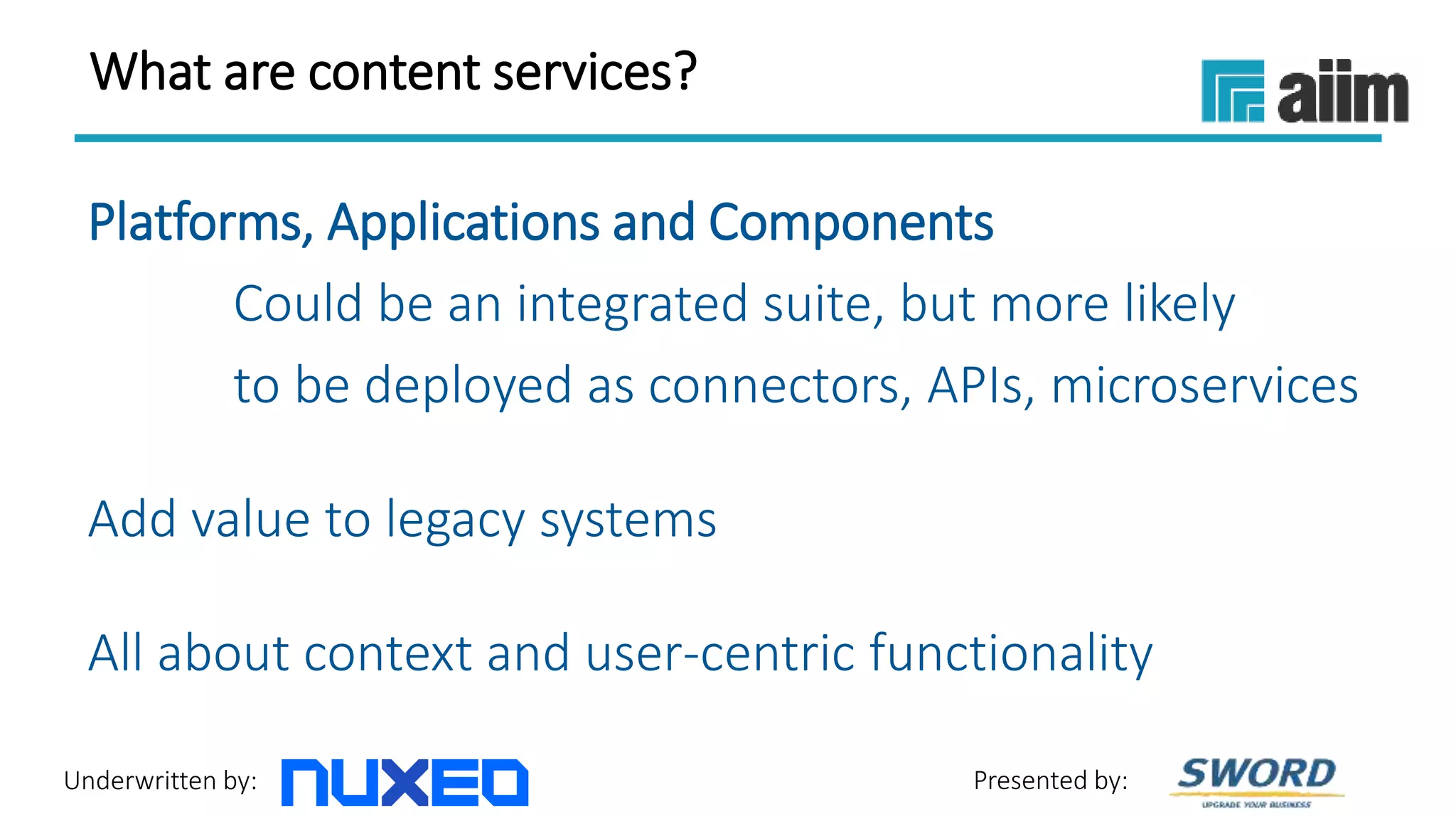
What are content services?
Platforms, Applications and Components
Could be an integrated suite, but more likely
to be deployed as connectors, APIs, microservices
Add value to legacy systems
All about context and user-centric functionality
Underwritten by: Presented by:
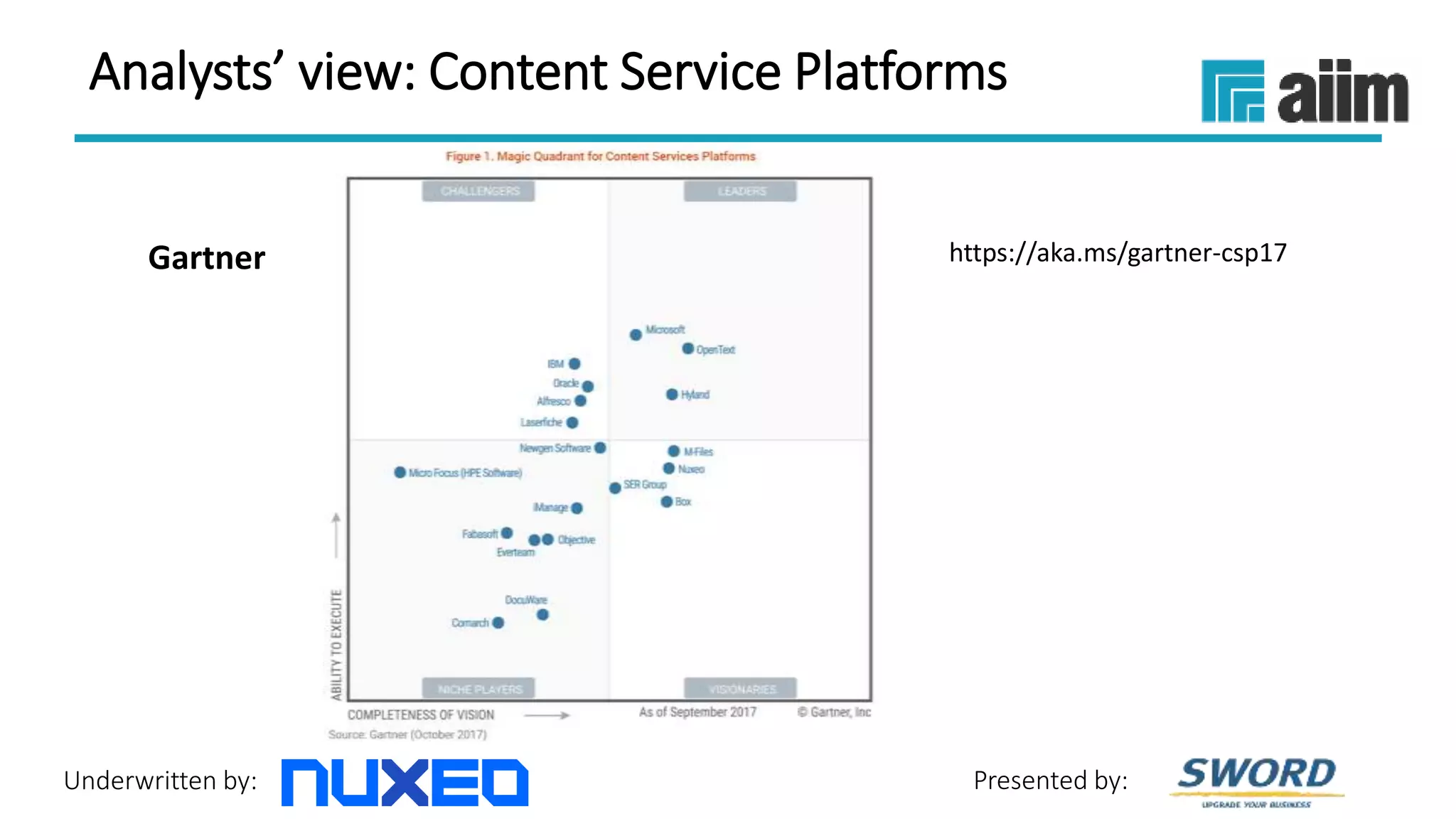
Analysts’ view: Content Service Platforms
https://aka.ms/gartner-csp17Gartner
Underwritten by: Presented by:
Why is organising information hard?
Explosive growth of systems
and apps
Consumerisation of IT
Diverse content
Acceleration in volume
People struggle with classification!
Cross-company collaboration
Regulatory changes
Radical business processes
Predicting future data uses
Boundary challenges:
Home / Work / Mobile / Cloud
Fewer admin people / librarians / doc control
IIM
Underwritten by: Presented by:
Organisational Forces & Strategy
Rate of change/growth
Competitive disruption
Customer expectations
Data variety and volume
Regulation
Insight from data
Privacy and security
Data capture / IoT / Edge
Disintermediation
Strategies
BaU – Ride train to the end
Exit / Sell up and move on
Evolve, and fast
Spin up a new org.
Cost
Technical innovation
Automation
Barriers to entry
Underwritten by: Presented by:
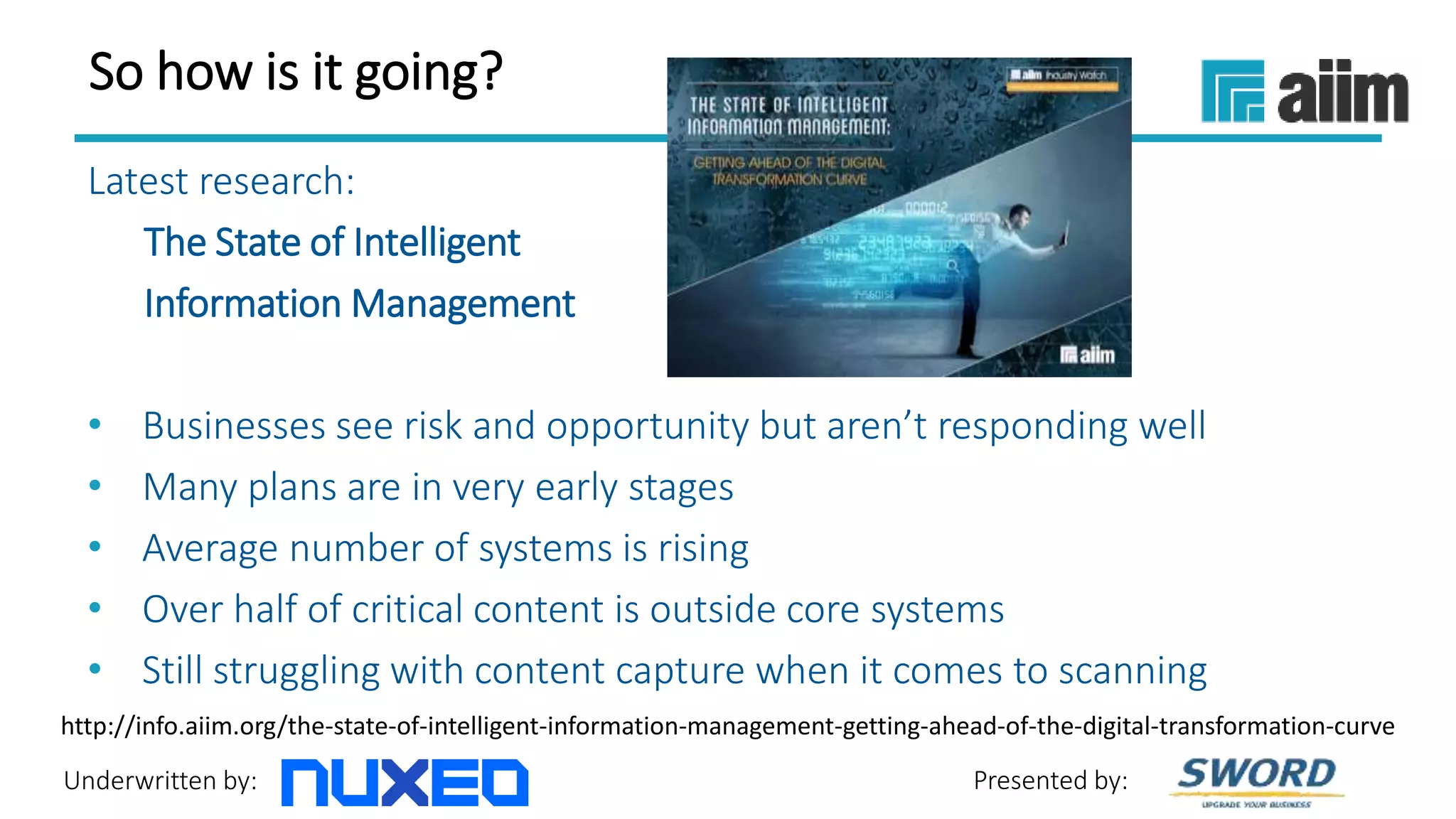
So how is it going?
Latest research:
The State of Intelligent
Information Management
• Businesses see risk and opportunity but aren’t responding well
• Many plans are in very early stages
• Average number of systems is rising
• Over half of critical content is outside core systems
• Still struggling with content capture when it comes to scanning
http://info.aiim.org/the-state-of-intelligent-information-management-getting-ahead-of-the-digital-transformation-curve
Underwritten by: Presented by:
Tribal wisdom of the Dakota Indians
What does your organisation do?
1. Prop it up and say it will be ok for a while?
2. Fit a new saddle?
3. Outsource the horse?
4. Create a team of dead horses?
5. Say that we can’t afford a new horse?
Reality Check
Underwritten by: Presented by:
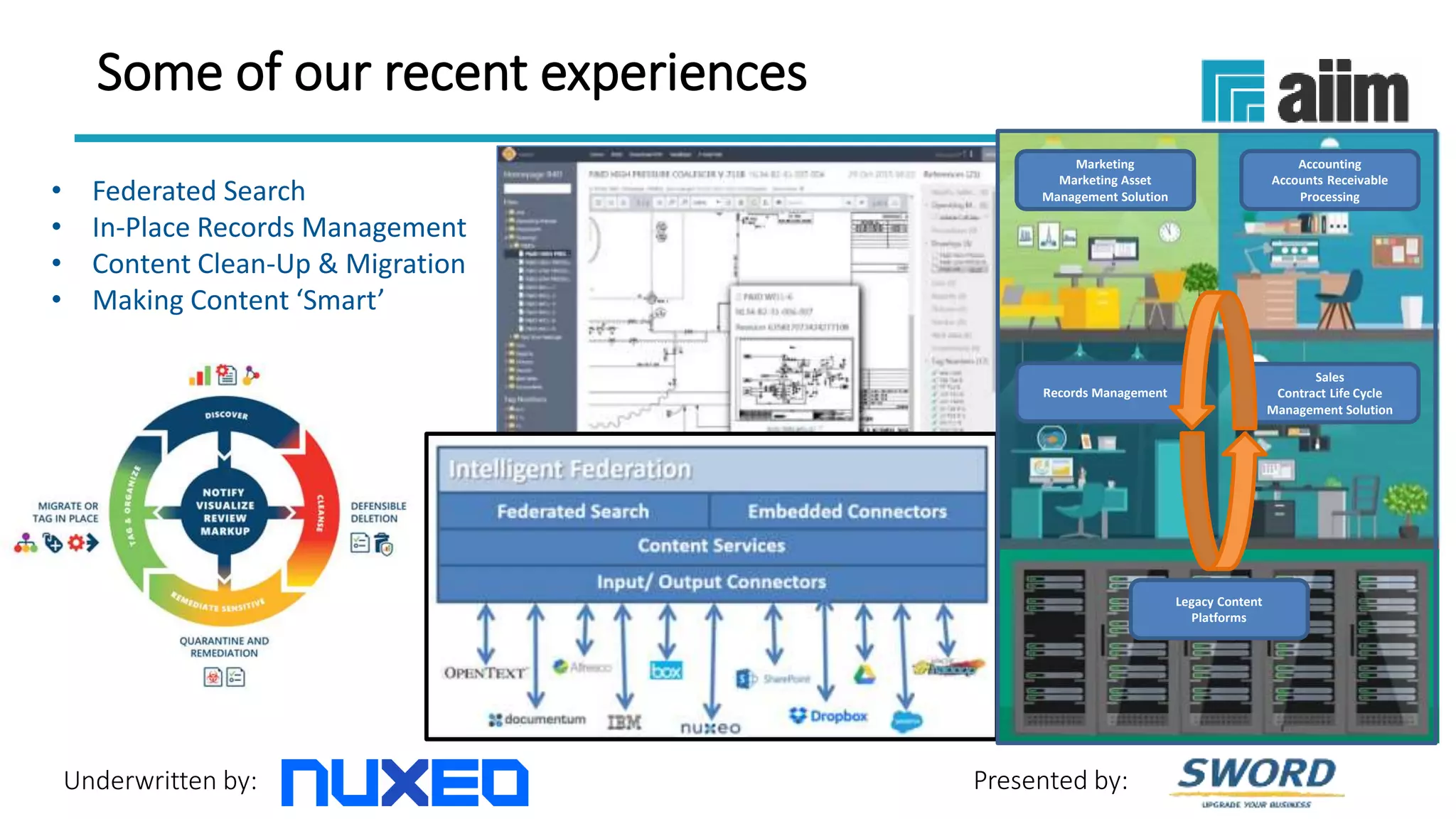
Some of our recent experiences
Sales
Contract Life Cycle
Management Solution
Marketing
Marketing Asset
Management Solution
Accounting
Accounts Receivable
Processing
Records Management
Legacy Content
Platforms
• Federated Search
• In-Place Records Management
• Content Clean-Up & Migration
• Making Content ‘Smart’
Underwritten by: Presented by:
INCREASE
PRODUCTIVITY
• Work through key
processes in less
time
• ‘Win’ more business
• Serve more people
• Increase your
revenue
IMPROVE
OVERHEADS
• Costs of
technology
• Cost to
maintain
• Cost to train
staff
• Project/upgrade
costs
INVESTMENT
IN PEOPLE
• Happier
workforce
• Higher
engagement
• Lower staff
turnover
• Less absenteeism
• Attracting talent
REDUCE RISK
• Maintain
compliance &
reduce likelihood
of fines / legal fees
• Protect Intellectual
Property
• Improved business
continuity
DRIVE
INNOVATION
• New products and
services
• Process
improvement and
automation
• New ways of
working
• User experience
What is everyone really trying to do?
Underwritten by: Presented by:
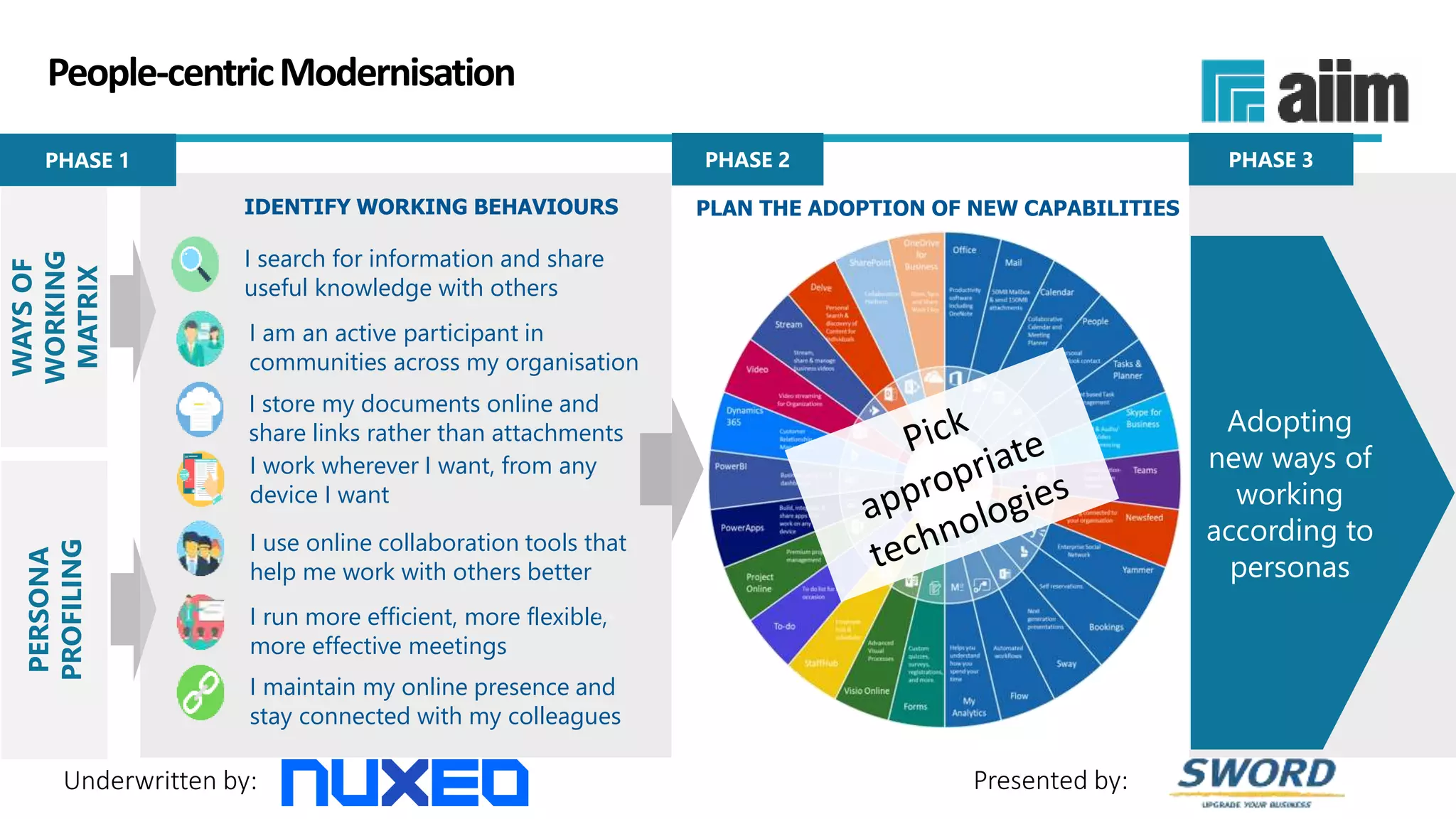
PERSONA
PROFILING
WAYSOF
WORKING
MATRIX
PLAN THE ADOPTION OF NEW CAPABILITIES
I am an active participant in
communities across my organisation
I run more efficient, more flexible,
more effective meetings
I use online collaboration tools that
help me work with others better
I search for information and share
useful knowledge with others
I work wherever I want, from any
device I want
I maintain my online presence and
stay connected with my colleagues
I store my documents online and
share links rather than attachments
IDENTIFY WORKING BEHAVIOURS
PHASE 1
People-centricModernisation
PHASE 2
Adopting
new ways of
working
according to
personas
PHASE 3
Underwritten by: Presented by:
Technology-centric Modernisation
Underwritten by: Presented by:
The rise of AI / ML and radical technologies
Knowledge
Discovery
Artificial
Intelligence
Machine
Learning
Pattern
Recognition
Statistics
Data
Mining
Deep
Learning
Emerging & future radical technologies
Internet of Things and Edge Computing
Blockchain / Distributed Ledger Technology
- Cryptocurrencies
- Ledger: UAE, Estonia…
Quantum Computing
- Post-quantum cryptography
- Spectacular AI, forecasting, modelling
PoC? Watch developments &
work with smart partners
Many others…
Underwritten by: Presented by:
My personal recommendations
This is not an IT issue, it’s about BUSINESS OPPORTUNITY
• Strategy
Reassess your information: its value now, and potential value
Create the vision for the business future mode of operation
Get executive ownership of organizational transformation
• Tactics & Technology
Apply Intelligent Information Management methods
i.e. Deploy Content Services for quick wins
Build out your wider technology transformation over time
Underwritten by: Presented by:
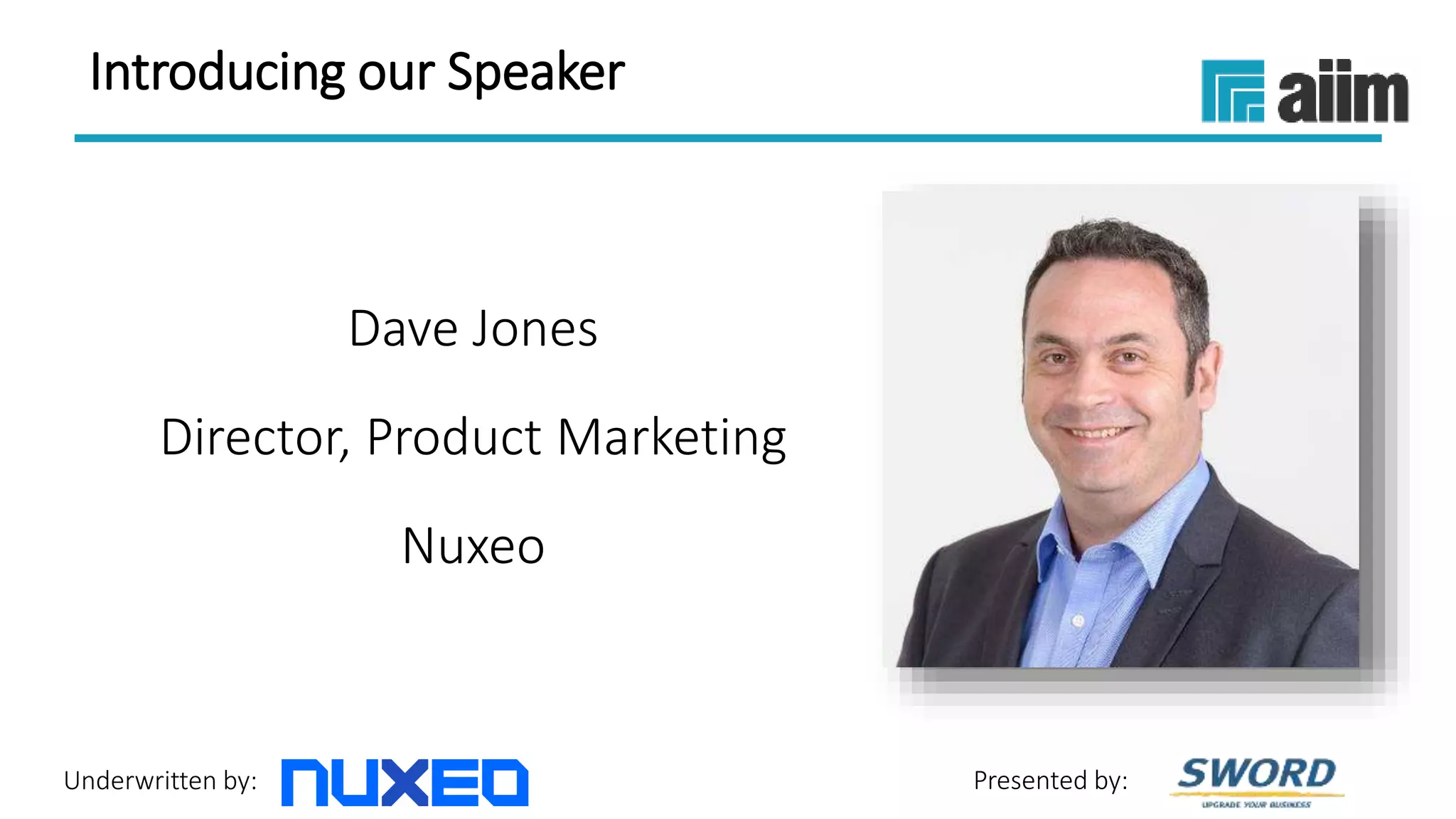
Dave Jones
Director, Product Marketing
Nuxeo
Introducing our Speaker
Underwritten by: Presented by:
Content Services
“...the strategies, methods and
tools used to capture, manage,
store, preserve, analyse, and
deliver data and content, related to
an organization.”
Enterprise Content Management
(ECM)
“...the strategies, methods and
tools used to capture, manage,
store, preserve, and deliver
content and documents related to
organisational processes.”
From ECM to Content Services
Underwritten by: Presented by:
But who really
cares?
Underwritten by: Presented by:
Inability to
connect
information from
different systems
Problem for
79%of
organizations
Underwritten by: Presented by:
“The kinds of information
management capabilities
we need vary wildly
depending on the process
we are considering.”
76%
of
organizations
Underwritten by: Presented by:
You want to buy a
car….
More info or subtitle can go here.
For example
Underwritten by: Presented by:
But is that what
you really want?
More info or subtitle can go here.
Underwritten by: Presented by:
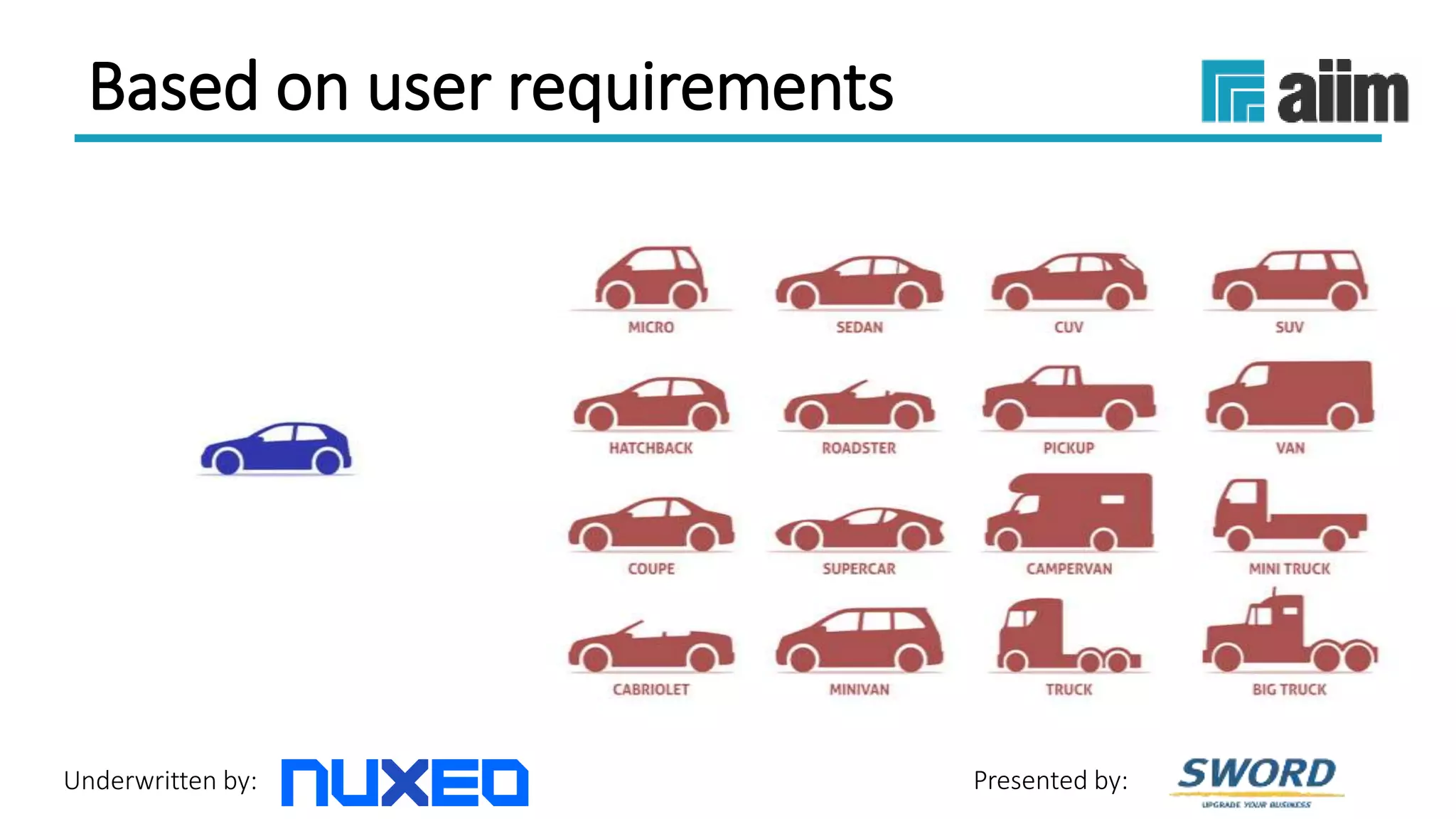
Based on user requirements
Underwritten by: Presented by:
From ECM to Content Services
ECM (1.0) was
1. Single repository
2. Designed to solely serve information
management professionals
3. A single vendor solution
Content services (ECM 2.0) IS
1. Multi-repository
2. Designed for use anywhere in the
organization by anyone on any device
3. A connected eco-system of services
Underwritten by: Presented by:
Conclusions
 Content Services is an evolutionary series of steps
from ECM
 Small but important changes
 Find a platform that
 Delivers what you need today
 Has the flexibility to manage what you might need tomorrow
 Has the capability to manage what you installed yesterday
Underwritten by: Presented by:
Thank
you!
Dave Jones
djones@nuxeo.com
@InstinctiveDave
Nuxeo.com
@Nuxeo
Underwritten by: Presented by:

Webinar: Information Through a New Lens - What Lies Beyond ECM

  • 1.
    Underwritten by: Presentedby: #AIIMYour Digital Transformation Begins with Intelligent Information Management Information Through a New Lens – What Lies Beyond ECM Presented 28th June, 2018
  • 2.
    Underwritten by: Presentedby: #AIIMYour Digital Transformation Begins with Intelligent Information ManagementYour Digital Transformation begins with Intelligent Information Management
  • 4.
    Underwritten by: Presentedby: Tips for Participating in Today’s Webinar  Group Chat – to talk with each other, found in the icons along the bottom. Note: everyone can see and participate.  Q&A – for questions to the speakers, held for the end (and tech help).  Check out the Resources available to you today, in the box to the right of the slides.  A Survey will open at the conclusion of the webinar – we value your feedback on how we did today.
  • 5.
    Underwritten by: Presentedby: Neale Stidolph Business Dev. Director Sword IT Solutions Ltd Dave Jones Director, Product Marketing Nuxeo Host: Theresa Resek, CIP Director AIIM Today’s Speakers
  • 6.
    Underwritten by: Presentedby: Neale Stidolph Business Development Director Sword IT Solutions Ltd Introducing our Featured Speaker
  • 7.
    Underwritten by: Presentedby: Contact me Neale Stidolph Strategy, Business Development, & IM Specialist, Sword Group Experience More than 30 years of IT & IM experience. The Robert Gordon University, Industrial Advisory Group member Ex-Board member of AIIM & Treasurer, GDPR + Oil & Gas Special Interest Groups Oil & Gas UK Council Representative Previous roles: Head of Strategic Development Lockheed Martin UK, and Head of Information Management, Lockheed Martin UK https://www.linkedin.com/in/nealestidolphneale.stidolph@sword-group.com Tel. +44 7841 868974
  • 8.
    Underwritten by: Presentedby: ECM, was it the answer and is it obsolete? The answer is valid but the questions are changing Intelligent Information Management* is the new philosophy Content Services are the tools *
  • 9.
    Underwritten by: Presentedby: Driving Forces – moving beyond ECM Your Information Systems Pushing forces Pulling forces Product end-of-life Supportability Security Maintenance Licensing costs Legacy skills / training Vendor inertia Regulatory pressure Hard to make changes Process modernisation Business agility / flexibility Get smarter (analytics) User/Customer Experience Competitive pressures Inter-company collaboration Cost saving (platform, AI/ML) Automation (RPA..) Trust (DLT / Blockchain…) Pace of change Fear-Uncertainty-Doubt Complex customisation “It ain’t broke” New technology & skills New vendors & partners Legacy technology lock-in Proof / Stakeholder fear IT staff feel threatened
  • 10.
    Underwritten by: Presentedby: ECM to Content Services The way we were Traditional org. Slow change/scale ‘Slow’ content Structure / Control Complex & Rigid Centralised/Internal Demanding of users Losing it… Org. revolutions! Cost escalation IT-centric silos Evolution Interconnected Lower cost, agile People-centric ECM will help? Wow, it’s hard! Content ServicesBefore 2005
  • 11.
    Underwritten by: Presentedby: What are content services? Platforms, Applications and Components Could be an integrated suite, but more likely to be deployed as connectors, APIs, microservices Add value to legacy systems All about context and user-centric functionality
  • 12.
    Underwritten by: Presentedby: Analysts’ view: Content Service Platforms https://aka.ms/gartner-csp17Gartner
  • 13.
    Underwritten by: Presentedby: Why is organising information hard? Explosive growth of systems and apps Consumerisation of IT Diverse content Acceleration in volume People struggle with classification! Cross-company collaboration Regulatory changes Radical business processes Predicting future data uses Boundary challenges: Home / Work / Mobile / Cloud Fewer admin people / librarians / doc control IIM
  • 14.
    Underwritten by: Presentedby: Organisational Forces & Strategy Rate of change/growth Competitive disruption Customer expectations Data variety and volume Regulation Insight from data Privacy and security Data capture / IoT / Edge Disintermediation Strategies BaU – Ride train to the end Exit / Sell up and move on Evolve, and fast Spin up a new org. Cost Technical innovation Automation Barriers to entry
  • 15.
    Underwritten by: Presentedby: So how is it going? Latest research: The State of Intelligent Information Management • Businesses see risk and opportunity but aren’t responding well • Many plans are in very early stages • Average number of systems is rising • Over half of critical content is outside core systems • Still struggling with content capture when it comes to scanning http://info.aiim.org/the-state-of-intelligent-information-management-getting-ahead-of-the-digital-transformation-curve
  • 16.
    Underwritten by: Presentedby: Tribal wisdom of the Dakota Indians What does your organisation do? 1. Prop it up and say it will be ok for a while? 2. Fit a new saddle? 3. Outsource the horse? 4. Create a team of dead horses? 5. Say that we can’t afford a new horse? Reality Check
  • 17.
    Underwritten by: Presentedby: Some of our recent experiences Sales Contract Life Cycle Management Solution Marketing Marketing Asset Management Solution Accounting Accounts Receivable Processing Records Management Legacy Content Platforms • Federated Search • In-Place Records Management • Content Clean-Up & Migration • Making Content ‘Smart’
  • 18.
    Underwritten by: Presentedby: INCREASE PRODUCTIVITY • Work through key processes in less time • ‘Win’ more business • Serve more people • Increase your revenue IMPROVE OVERHEADS • Costs of technology • Cost to maintain • Cost to train staff • Project/upgrade costs INVESTMENT IN PEOPLE • Happier workforce • Higher engagement • Lower staff turnover • Less absenteeism • Attracting talent REDUCE RISK • Maintain compliance & reduce likelihood of fines / legal fees • Protect Intellectual Property • Improved business continuity DRIVE INNOVATION • New products and services • Process improvement and automation • New ways of working • User experience What is everyone really trying to do?
  • 19.
    Underwritten by: Presentedby: PERSONA PROFILING WAYSOF WORKING MATRIX PLAN THE ADOPTION OF NEW CAPABILITIES I am an active participant in communities across my organisation I run more efficient, more flexible, more effective meetings I use online collaboration tools that help me work with others better I search for information and share useful knowledge with others I work wherever I want, from any device I want I maintain my online presence and stay connected with my colleagues I store my documents online and share links rather than attachments IDENTIFY WORKING BEHAVIOURS PHASE 1 People-centricModernisation PHASE 2 Adopting new ways of working according to personas PHASE 3
  • 20.
    Underwritten by: Presentedby: Technology-centric Modernisation
  • 21.
    Underwritten by: Presentedby: The rise of AI / ML and radical technologies Knowledge Discovery Artificial Intelligence Machine Learning Pattern Recognition Statistics Data Mining Deep Learning Emerging & future radical technologies Internet of Things and Edge Computing Blockchain / Distributed Ledger Technology - Cryptocurrencies - Ledger: UAE, Estonia… Quantum Computing - Post-quantum cryptography - Spectacular AI, forecasting, modelling PoC? Watch developments & work with smart partners Many others…
  • 22.
    Underwritten by: Presentedby: My personal recommendations This is not an IT issue, it’s about BUSINESS OPPORTUNITY • Strategy Reassess your information: its value now, and potential value Create the vision for the business future mode of operation Get executive ownership of organizational transformation • Tactics & Technology Apply Intelligent Information Management methods i.e. Deploy Content Services for quick wins Build out your wider technology transformation over time
  • 23.
    Underwritten by: Presentedby: Dave Jones Director, Product Marketing Nuxeo Introducing our Speaker
  • 24.
    Underwritten by: Presentedby: Content Services “...the strategies, methods and tools used to capture, manage, store, preserve, analyse, and deliver data and content, related to an organization.” Enterprise Content Management (ECM) “...the strategies, methods and tools used to capture, manage, store, preserve, and deliver content and documents related to organisational processes.” From ECM to Content Services
  • 25.
    Underwritten by: Presentedby: But who really cares?
  • 26.
  • 27.
    Underwritten by: Presentedby: Inability to connect information from different systems Problem for 79%of organizations
  • 28.
  • 29.
    Underwritten by: Presentedby: “The kinds of information management capabilities we need vary wildly depending on the process we are considering.” 76% of organizations
  • 30.
    Underwritten by: Presentedby: You want to buy a car…. More info or subtitle can go here. For example
  • 31.
  • 32.
  • 33.
    Underwritten by: Presentedby: But is that what you really want? More info or subtitle can go here.
  • 34.
    Underwritten by: Presentedby: Based on user requirements
  • 35.
    Underwritten by: Presentedby: From ECM to Content Services ECM (1.0) was 1. Single repository 2. Designed to solely serve information management professionals 3. A single vendor solution Content services (ECM 2.0) IS 1. Multi-repository 2. Designed for use anywhere in the organization by anyone on any device 3. A connected eco-system of services
  • 36.
    Underwritten by: Presentedby: Conclusions  Content Services is an evolutionary series of steps from ECM  Small but important changes  Find a platform that  Delivers what you need today  Has the flexibility to manage what you might need tomorrow  Has the capability to manage what you installed yesterday
  • 37.
    Underwritten by: Presentedby: Thank you! Dave Jones djones@nuxeo.com @InstinctiveDave Nuxeo.com @Nuxeo
  • 38.
  • 40.

Editor's Notes

  • #2 Note – this cover slide will change to the art that will be used in aiim’s promo campaign.
  • #9 Why change? Tightly regulated market? Formal & clear processes? Mainly internal information management? Effective and working well? Economics look OK? Hey, maybe you don’t need to change now! A ‘monolithic’ ECM can be appropriate and valuable
  • #11 ECM businesses are evolving Content Services is about the change in philosophy – heterogenous, decentralised, interconnected across org boundaries, moving to the Edge Fun facts Gartner: 1m new IoT devices sold PER HOUR by 2021 Data flipping; from centre to edge By 2022, 75% will be created/processed outside core
  • #12 Smarts: Content/Sentiment Analysis, NLP, ‘Graph’ functions, auto-classification, big data, AI & ML…
  • #13 It’s not just about platforms, consider the services and connectors that can unite multiple platforms
  • #14 Adding smarter components to understand our content Our personal experiences mirror this; photos for example Move to metadata-based organisation Need to understand the architecture and the governance requirements
  • #15 How is your organisation tracking drivers for change? What is your org doing about it? Business Improvement function? Are you involved? The rise of the CIO and information professional!
  • #17 Does your org trust investments in tech? Outcomes of past systems? Stuck with legacy? Willing to abandon bad investments?
  • #18 Over 10x reduction in cost analysing engineering drawings More visual ways of working. Intuitive Legacy ECM connectors, smart migration, federated search - NHS Hospital transition from Documentum to O365 - 250,000 patient records classified & moved in a week Unified content views across silos Multi-ECM environments being simplified ROT removal: Oil co. 55Tb 50% reduction
  • #19 Enable innovation Enrich customer experience Execute processes nimbly and on demand Engage the next generation of employees & customers Less risk and improved economics
  • #20 Macro Consequences Displaced people? All replaced by AI? The Luddite Fallacy? Estimate c.-47% in the UK – debate rages Change in job types Downward pressure on pay But – living costs could fall Global work redistribution Discuss it, plan for it
  • #21 Microsoft Cortana Intelligence Suite Example: Cognitive Services, image analysis & metadata tagging Digital personal assistants – Google Duplex demo https://www.wired.com/story/google-duplex-phone-calls-ai-future/ You don’t have to remain in the Microsoft technical stack, it’s very open
  • #22 Podcast: Deep Analysis / Alan Pelz-Sharpe ‘UAE Blockchain Strategy 2021’ Save nearly $3bn on doc circulation annually Save millions of work hours Reduce doc by 389m Save 1.6 bn kilometers spent driving
  • #25 So what is enterprise content management – or ecm for short? Well according to AIIM – who were the people that invented the term is is the strategies, methods and tools used to capture, manage, store, preserve, and deliver content and documents related to organisational processes.” Wow – that’s certainly an exhaustive definition but for me ECM was simply the way in which you manage documents and their associated processes within an organization. It was the evolution from capture and document management systems that came before – that were essentially glorified archives – and started to address classic business processes such as invoice processing, hr file management, contracts management and so on. Parts of the business that involved a lot of paper and typically a lot of manual input. ECM combined document capture with simple ocr or recognition of the text on a scanned document with automated workflows. What this provided was a massive productivity boost in these areas and also a reduction in error rates. So all good so far? So what went wrong?
  • #32 Would you rather buy your car like this??
  • #33 Or like this???
  • #35 Or like this???
  • #40 We offer live, instructor-led training // as well as online, self-paced classes. You can thoroughly immerse yourself with a "deep-dive" course, or dip into a topic with our "quick study" offerings. We can even arrange for a trainer to come to your place of business and provide a custom perspective to our instructor-led programs. Info on all of that can be found at aiim.org/training