ULTRASOUND
        OF
INFERIOR VENA CAVA
OBJECTIVES
Describe indications for using ultrasound at the
bedside to image the inferior vena cava.

Describe how to performing bedside ultrasound of
the inferior vena cava.

Use the findings on ultrasound to guide assessment
of intravascular volume status.

Generate group discussion regarding the potential
value of learning this procedure for patient
management
CASE
46 M was admitted with alcoholic hepatitis and newly diagnosed
cirrhosis with ascites. On exam he had flat JVD in supine position,
tense abdominal distension, and moderate leg edema to the knees.
He was started on a 28 day Trental protocol

Hospital Course

Day 1-9 - 3 paracenteses;
        - removal of 11 liters of ascitic fluid.
Day 10
        - JVD flat in supine position
        - Abdomen still distended but not tense
        - moderate leg edema
        - Na = 136, Cr = 1.0, BUN = 11
        - furosemide started at 20 mg QD
        - spironolactone started at 50mg QD.
CASE

Day 12
         - JVD flat in supine position
         - persistent leg edema
         - apparent increase in abdominal girth on exam
         - Na = 134, Cr = 0.7, BUN = 12
         - furosemide increased to 40mg QD

Day 19
         - JVD flat in supine position
         - persistent leg edema
         - abdominal girth same to slightly decreased
         - Na = 136, Cr = 0.8, BUN = 12
         - furosemide increased to 80mg QD
         - spironolactone increased to 200mg QD
CASE
Day 21
         - JVD flat in supine position
         - leg edema the same
         - Abdominal girth the same
         - Na = 130, Cr = 0.9, BUN = 10

Day 24
         - JVD flat in the supine position
         - leg edema the same
         - Abdominal girth the same to slightly increased
         - Na = 127, Cr = 0.7, BUN = 13, Urine Na < 10


Daily weights and Input/Output measures were collected
sporadically and could not be assessed for any trends.
CLASSIC
                               HYPONATREMIA


            UNa                        UOsm > SOsm                    UNa
                                       UNa > 40


  < 10                 > 20          YES             NO     < 10            > 20


 Volume           Mineralcorticoid   SIADH      OTHER     Cirrhosis         CKD
Depletion           Deficiency                            Nephrosis
                                                          CHF
QUESTION
What type of hyponatremia does this patient have and how should it
be managed?

A. Hypovolemic hyponatremia
   stop diuretics; begin normal saline infusion; liberalize po fluid intake;
   monitor Na over the course of the next several days; if Na does not
   improve or worsens, entertain hypervolemic hyponatremia as the cause

A. Hypervolemic hyponatremia
   increase the diuretics and tighten the fluid restriction; monitor Na over
   the course of the next several days; if Na does not improve or worsens,
   entertain hypovolemic hyponatremia as the cause.

A. Not sure
   consult nephrology for an opinion about the hyponatremia
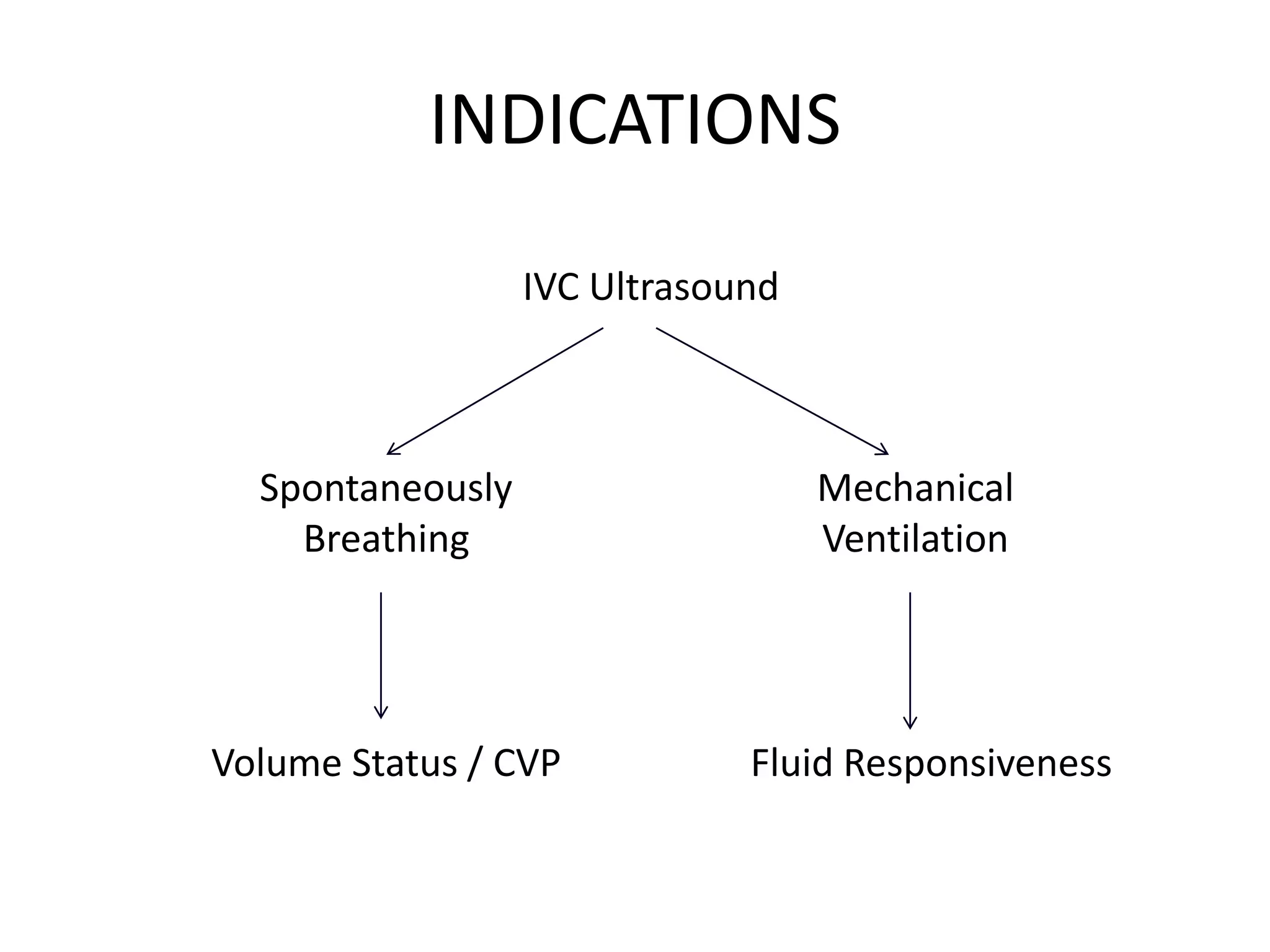
INDICATIONS

                  IVC Ultrasound


  Spontaneously                    Mechanical
    Breathing                      Ventilation


Volume Status / CVP           Fluid Responsiveness
INDICATIONS
            Assessing
Intravascular Volume Status / CVP


    VOLUME DEPLETED STATES
    - Hyponatremia
    - Acute Kidney Injury (? Prerenal)
    - Diuretic therapy
    - Sepsis


    VOLUME OVERLOAD STATES
    -Hyponatremia
    - Heart Failure
    -Cirrhosis with ascites
    - Anasarca
INDICATIONS
                    Assessing
          Fluid Responsiveness in Shock


- IVC diameter does not correlate with right atrial pressure in
patients who are intubated with shock

- Measuring the variation in IVC diameter in these situations
can help determine whether the patient’s blood pressure will
respond to fluids or whether inotropic support (i.e.
dobutamine) will be needed
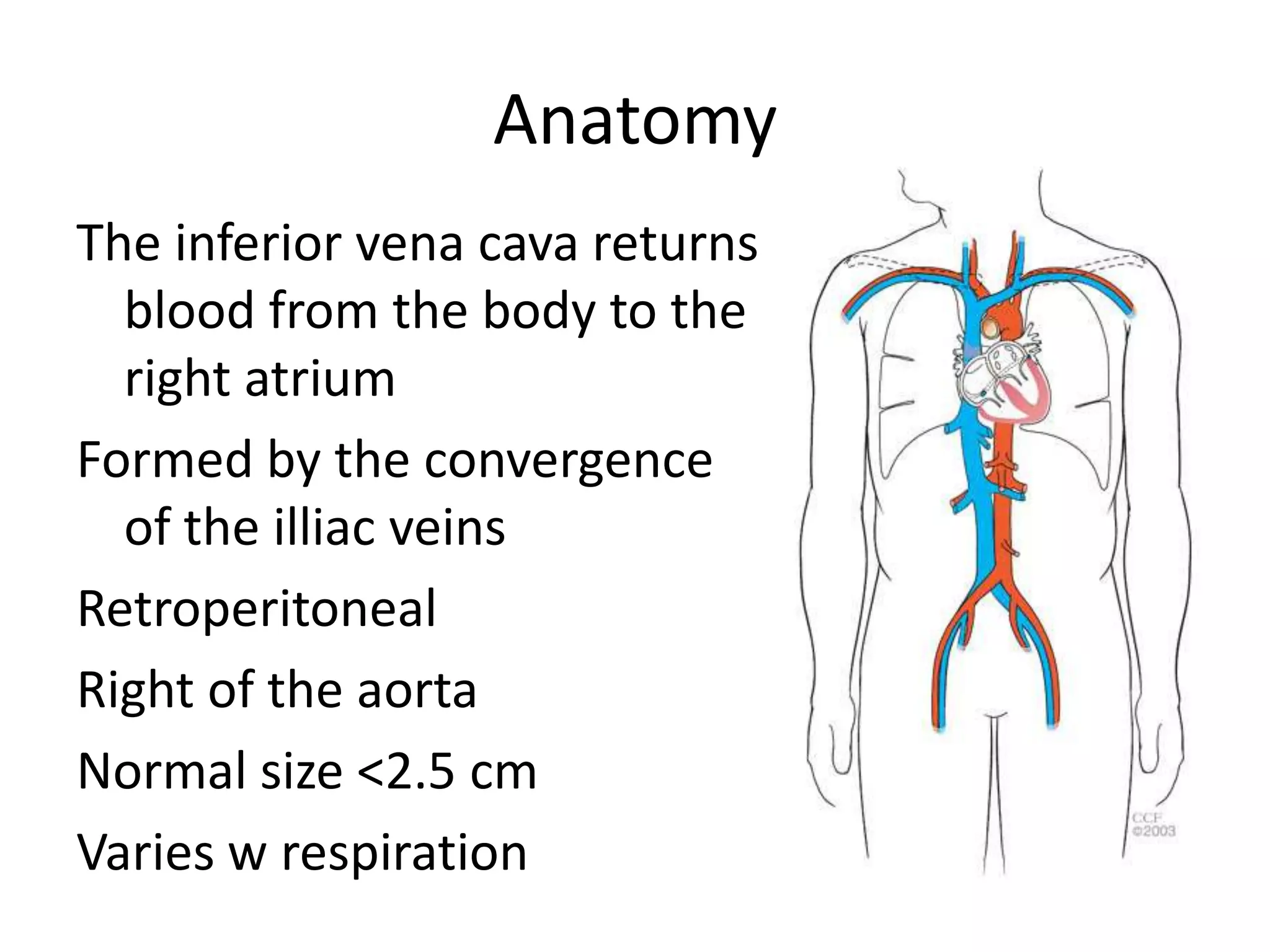
Anatomy
The inferior vena cava returns
  blood from the body to the
  right atrium
Formed by the convergence
  of the illiac veins
Retroperitoneal
Right of the aorta
Normal size <2.5 cm
Varies w respiration
Respiratory variation

Expands w/ expiration

Contracts w/ inspiration

Due to changing intrathoracic pressures.
Respiratory Variation


Figure 2: Physiological respiratory variations in IVC diameter in a healthy volunteer breathing quietly.: From:
http://www.pifo.uvsq.fr/hebergement/webrea/index.php?option=com_content&task=view&id=36&Itemid=93
IVC diameter decreases on each inspiration.


http://www.criticalecho.com/content/tutorial-4-volume-status-and-preload-responsiveness-assessment
Measuring the IVC Diameter


      Measure IVC 2cm distal to right atrium
Inspiratory (Minimal) IVC Diameter
Maximum (Expiratory) IVC Diameter
M-Mode IVC Diameters
CAVAL INDEX (CI)

         maximum (expiratory)      minimal (inspiratory)
              diameter                  diameter
CI   =
                     maximum (expiratory)
                          diameter
CAVAL INDEX (CI)


  0%                           100%

Volume                         Volume
Overload                      Depletion
IVC v CVP
  Correlation Between IVC Diameter Plus CI and CVP
IVC Max Diameter         CI               CVP
      (cm)                              (mmHg)
                        100%
      < 1.5                               0-5
                   (total collapse)

     1.5-2.5           > 50%             6-10

     1.5-2.5           < 50%             11-15

      > 2.5            < 50%             16-20

                         0%
      > 2.5                               >20
                    (no collapse)
M-Mode Volume Depletion
M-Mode Volume Overload
IVC v CVP
  Correlation Between IVC Diameter Plus CI and CVP
IVC Max Diameter         CI               CVP
      (cm)                              (mmHg)
                        100%
      < 1.5                               0-5
                   (total collapse)

     1.5-2.5           > 50%             6-10

     1.5-2.5           < 50%             11-15

      > 2.5            < 50%             16-20

                         0%
      > 2.5                               >20
                    (no collapse)
PROCEDURE
                  Positioning

1 Supine
2 Degree of head elevation has not been
  shown to make a significant difference in
  measurements
PROCEDURE
              Probe Selection


1 Low frequency 2-5 MHz
2 Curvalinear probe
PROCEDURE

Approach #1 – Xiphoid View
PROCEDURE
                 Landmarks
Aproach #1 – Xiphoid View
1 Most common approach
2 Place probe longitudinally just below the
  xiphoid process with the probe marker to the
  patient’s head
3 Look for IVC going into right atrium – may
  need to move probe 1-2cm to patient’s right
  and then tilt it slightly towards the heart
IVC Longitudinal
PROCEDURE

Approach #2 – Anterior Mid-Axillary View
PROCEDURE
                   Landmarks
Aproach #2 – Anterior Mid-Axillary View
1 Place probe longitudinally in right anterior
  mid-axillary line with marker towards the
  head
2 Look for IVC running longitudinally adjacent
  to liver crossing the diaphragm.
3 Track superiorly until it enters right atrium
  confirming that it is the IVC and not the
  aorta.
IVC Anterior Mid-Axillary View
PEARLS
                  Bowel Gas

1 May impede visualization in the xiphoid view
2 Gentle graded pressure may help move
  bowel out of way
3 Don’t press too hard or will collapse IVC
  causing false measurements
4 Consider anterior mid-axillary view
PEARLS
          Plethoric (dilated/sluggish) IVC

1   Volume overload
2   Cardiac tamponade
3   Mitral regurgitation
4   Aortic stenosis
PEARLS
            Mechanical Ventilation

1 Causes reversal of IVC changes with
  respiration
2 Maximum diameter with inspiration,
  minimum diameter with expiration
PEARLS

                       IVC v Aorta
Aorta                            IVC
Thick, echogenic walls           Thin walls
Pulsatile                        Usually not pulsatile
High flow velocity               Low flow velocity
Not compressable                 Compressable
No respiratory variation         Respiratory variation
Above vertebral bodies           Right of vertebral bodies
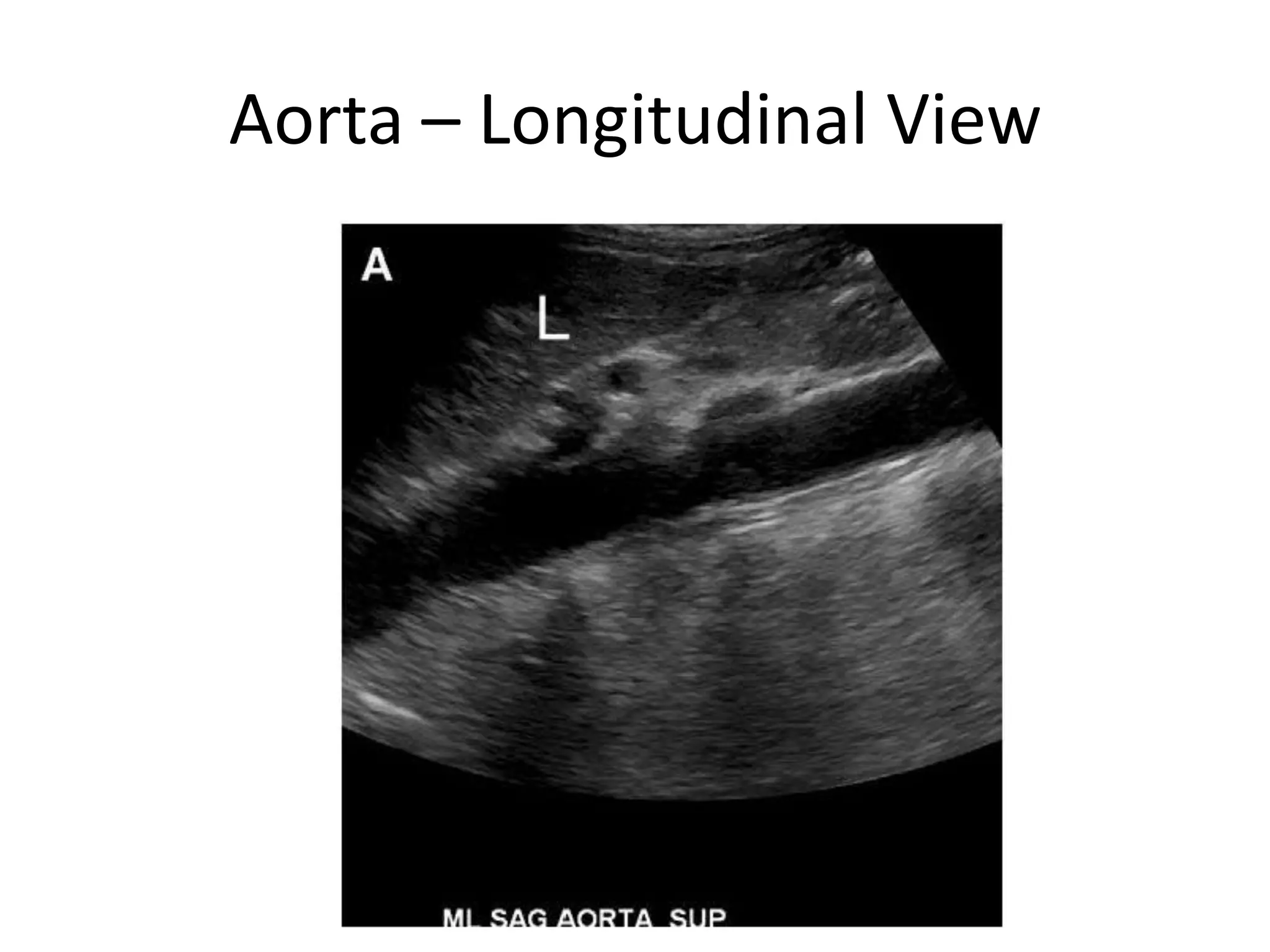
Aorta – Longitudinal View
SonoSite 180 Plus
SonoSite 180 Plus
SonoSite 180 Plus


Changing and Inserting
the Transducer
SonoSite 180 Plus


Insert the transducer
Twist lock counterclockwise
SonoSite 180 Plus


Fold lock down
SonoSite 180 Plus


Ready to power-up
machine
SonoSite 180 Plus


                    Power
                    Button
SonoSite 180 Plus
SonoSite 180 Plus
SonoSite 180 Plus
SonoSite 180 Plus


Wrong Transducer is
Connected

Correct Transducer Menu
-GYN
-OB
-Abdominal
SonoSite 180 Plus
                    2D View (default)


                        M-Mode
SonoSite 180 Plus


        GAIN
Changes the contrast
on the screen
SonoSite 180 Plus
SonoSite 180 Plus
CASE
An IVC Ultrasound was performed at the bedside.

Maximum IVC diameter during expiration = 1.10 cm. The

Minimum IVC diameter during inspiration = 0 cm.

Caval Index = 100% (total collapse)
CASE
     Correlation Between IVC Diameter Plus CI and CVP

   IVC Max Diameter         CI              CVP
         (cm)                             (mmHg)

                           100%
         < 1.5                               0-5
                      (total collapse)
        1.5-2.5           > 50%             6-10
        1.5-2.5           < 50%             11-15
         > 2.5            < 50%             16-20
                            0%
         > 2.5                               >20
                       (no collapse)


                 Interpretation:
              Mixed hyponatremia
(intravascular volume depletion plus free water
             excess from cirrhosis)
CASE
Treatment:
- one liter of normal saline IV to expand
  intravascular volume

- reduced free water oral intake from
  1500cc to 1000cc/d

- Continued current diuretic dosing to
  remove free water

Result:
In 3 days, the patient’s Na progressively increased
to 136
REFERENCES
-De Lorenzo RA, Morris MJ, William JB, et al. Does a simple bedside sonographic measurement of the inferior vena cava correlate
     to central venous pressure? J. Emer. Med. 2011; 42(4); 429-436.

-Kosiak W, Swieton D, Piskunowicz M. Sonographic inferior vena cava/aorta diameter index, a new approach to the body fluid
      status assessment in children and young adults in emergency ultrasound preliminary study. Acad. J. Emerg.
      Med. 2008;26:320-5

-Blehar DJ, Dickman E, Gaspari R. Identification of congestive heart failure via respiratory variation of inferior vena cava
     diameter. Am. J. Emerg. Med. 2009;27:71-5.

-Chen L, Santucci KA, Kim Y. Use of ultrasound measurement of the inferior vena cava diameter as an objective tool in the
      assessment of children with clinical dehydration. Acad. Emerg. Med. 2007:14:841-5.

-Feissel M, Michard F, Faller JP, et al. The respiratory variation in inferior vena cava diameter as a guide to fluid therapy. Intensive
      Care Med. 2004;30:1834-7.

-Fields JM, Lee PA, Jenq KY, et al. The interrater reliability of inferior vena cava ultrasound by bedside clinician sonographers in
      emergency department patients. Acad. Emerg. Med. 2011;18:98-101.

-Kircher BJ, Himelman RB, Schiller NB. Noninvasive estimation of right atrial pressure from the inspiratory collapse of the inferior
      vena cava. Am J. Cardiol. 1990;66:493-6.

-Randazzo MR, Snoey ER, Levitt MA, et al. Accuracy of emergency physician assessment of left ventricular ejection fraction and
     central venous pressure using echocardiography. Acad. Emerg. Med.2003;10:973-7.

-ACEP Policy Statement on Emergency Ultrasound Guidelines. Ann. Emerg. Med. 2009;53:550-70

-Nagdev AD, Merchant RC, Tirado-Gonzalez A, et al. Emergency department bedside ultrasonographic measurement of the caval
     index for noninvasive determination of low central venous pressure. Ann. Emerg. Med. 2010;55:290-5.
DISCUSSION

IVC Ultrasound

  • 1.
    ULTRASOUND OF INFERIOR VENA CAVA
  • 2.
    OBJECTIVES Describe indications forusing ultrasound at the bedside to image the inferior vena cava. Describe how to performing bedside ultrasound of the inferior vena cava. Use the findings on ultrasound to guide assessment of intravascular volume status. Generate group discussion regarding the potential value of learning this procedure for patient management
  • 3.
    CASE 46 M wasadmitted with alcoholic hepatitis and newly diagnosed cirrhosis with ascites. On exam he had flat JVD in supine position, tense abdominal distension, and moderate leg edema to the knees. He was started on a 28 day Trental protocol Hospital Course Day 1-9 - 3 paracenteses; - removal of 11 liters of ascitic fluid. Day 10 - JVD flat in supine position - Abdomen still distended but not tense - moderate leg edema - Na = 136, Cr = 1.0, BUN = 11 - furosemide started at 20 mg QD - spironolactone started at 50mg QD.
  • 4.
    CASE Day 12 - JVD flat in supine position - persistent leg edema - apparent increase in abdominal girth on exam - Na = 134, Cr = 0.7, BUN = 12 - furosemide increased to 40mg QD Day 19 - JVD flat in supine position - persistent leg edema - abdominal girth same to slightly decreased - Na = 136, Cr = 0.8, BUN = 12 - furosemide increased to 80mg QD - spironolactone increased to 200mg QD
  • 5.
    CASE Day 21 - JVD flat in supine position - leg edema the same - Abdominal girth the same - Na = 130, Cr = 0.9, BUN = 10 Day 24 - JVD flat in the supine position - leg edema the same - Abdominal girth the same to slightly increased - Na = 127, Cr = 0.7, BUN = 13, Urine Na < 10 Daily weights and Input/Output measures were collected sporadically and could not be assessed for any trends.
  • 6.
    CLASSIC HYPONATREMIA UNa UOsm > SOsm UNa UNa > 40 < 10 > 20 YES NO < 10 > 20 Volume Mineralcorticoid SIADH OTHER Cirrhosis CKD Depletion Deficiency Nephrosis CHF
  • 7.
    QUESTION What type ofhyponatremia does this patient have and how should it be managed? A. Hypovolemic hyponatremia stop diuretics; begin normal saline infusion; liberalize po fluid intake; monitor Na over the course of the next several days; if Na does not improve or worsens, entertain hypervolemic hyponatremia as the cause A. Hypervolemic hyponatremia increase the diuretics and tighten the fluid restriction; monitor Na over the course of the next several days; if Na does not improve or worsens, entertain hypovolemic hyponatremia as the cause. A. Not sure consult nephrology for an opinion about the hyponatremia
  • 8.
    INDICATIONS IVC Ultrasound Spontaneously Mechanical Breathing Ventilation Volume Status / CVP Fluid Responsiveness
  • 9.
    INDICATIONS Assessing Intravascular Volume Status / CVP VOLUME DEPLETED STATES - Hyponatremia - Acute Kidney Injury (? Prerenal) - Diuretic therapy - Sepsis VOLUME OVERLOAD STATES -Hyponatremia - Heart Failure -Cirrhosis with ascites - Anasarca
  • 10.
    INDICATIONS Assessing Fluid Responsiveness in Shock - IVC diameter does not correlate with right atrial pressure in patients who are intubated with shock - Measuring the variation in IVC diameter in these situations can help determine whether the patient’s blood pressure will respond to fluids or whether inotropic support (i.e. dobutamine) will be needed
  • 11.
    Anatomy The inferior venacava returns blood from the body to the right atrium Formed by the convergence of the illiac veins Retroperitoneal Right of the aorta Normal size <2.5 cm Varies w respiration
  • 12.
    Respiratory variation Expands w/expiration Contracts w/ inspiration Due to changing intrathoracic pressures.
  • 13.
    Respiratory Variation Figure 2:Physiological respiratory variations in IVC diameter in a healthy volunteer breathing quietly.: From: http://www.pifo.uvsq.fr/hebergement/webrea/index.php?option=com_content&task=view&id=36&Itemid=93 IVC diameter decreases on each inspiration. http://www.criticalecho.com/content/tutorial-4-volume-status-and-preload-responsiveness-assessment
  • 14.
    Measuring the IVCDiameter Measure IVC 2cm distal to right atrium
  • 15.
  • 16.
  • 17.
  • 18.
    CAVAL INDEX (CI) maximum (expiratory) minimal (inspiratory) diameter diameter CI = maximum (expiratory) diameter
  • 19.
    CAVAL INDEX (CI) 0% 100% Volume Volume Overload Depletion
  • 20.
    IVC v CVP Correlation Between IVC Diameter Plus CI and CVP IVC Max Diameter CI CVP (cm) (mmHg) 100% < 1.5 0-5 (total collapse) 1.5-2.5 > 50% 6-10 1.5-2.5 < 50% 11-15 > 2.5 < 50% 16-20 0% > 2.5 >20 (no collapse)
  • 21.
  • 22.
  • 23.
    IVC v CVP Correlation Between IVC Diameter Plus CI and CVP IVC Max Diameter CI CVP (cm) (mmHg) 100% < 1.5 0-5 (total collapse) 1.5-2.5 > 50% 6-10 1.5-2.5 < 50% 11-15 > 2.5 < 50% 16-20 0% > 2.5 >20 (no collapse)
  • 24.
    PROCEDURE Positioning 1 Supine 2 Degree of head elevation has not been shown to make a significant difference in measurements
  • 25.
    PROCEDURE Probe Selection 1 Low frequency 2-5 MHz 2 Curvalinear probe
  • 26.
  • 27.
    PROCEDURE Landmarks Aproach #1 – Xiphoid View 1 Most common approach 2 Place probe longitudinally just below the xiphoid process with the probe marker to the patient’s head 3 Look for IVC going into right atrium – may need to move probe 1-2cm to patient’s right and then tilt it slightly towards the heart
  • 28.
  • 29.
    PROCEDURE Approach #2 –Anterior Mid-Axillary View
  • 30.
    PROCEDURE Landmarks Aproach #2 – Anterior Mid-Axillary View 1 Place probe longitudinally in right anterior mid-axillary line with marker towards the head 2 Look for IVC running longitudinally adjacent to liver crossing the diaphragm. 3 Track superiorly until it enters right atrium confirming that it is the IVC and not the aorta.
  • 31.
  • 32.
    PEARLS Bowel Gas 1 May impede visualization in the xiphoid view 2 Gentle graded pressure may help move bowel out of way 3 Don’t press too hard or will collapse IVC causing false measurements 4 Consider anterior mid-axillary view
  • 33.
    PEARLS Plethoric (dilated/sluggish) IVC 1 Volume overload 2 Cardiac tamponade 3 Mitral regurgitation 4 Aortic stenosis
  • 34.
    PEARLS Mechanical Ventilation 1 Causes reversal of IVC changes with respiration 2 Maximum diameter with inspiration, minimum diameter with expiration
  • 35.
    PEARLS IVC v Aorta Aorta IVC Thick, echogenic walls Thin walls Pulsatile Usually not pulsatile High flow velocity Low flow velocity Not compressable Compressable No respiratory variation Respiratory variation Above vertebral bodies Right of vertebral bodies
  • 36.
  • 37.
  • 38.
  • 39.
    SonoSite 180 Plus Changingand Inserting the Transducer
  • 40.
    SonoSite 180 Plus Insertthe transducer Twist lock counterclockwise
  • 41.
  • 42.
    SonoSite 180 Plus Readyto power-up machine
  • 43.
    SonoSite 180 Plus Power Button
  • 44.
  • 45.
  • 46.
  • 47.
    SonoSite 180 Plus WrongTransducer is Connected Correct Transducer Menu -GYN -OB -Abdominal
  • 48.
    SonoSite 180 Plus 2D View (default) M-Mode
  • 49.
    SonoSite 180 Plus GAIN Changes the contrast on the screen
  • 50.
  • 51.
  • 52.
    CASE An IVC Ultrasoundwas performed at the bedside. Maximum IVC diameter during expiration = 1.10 cm. The Minimum IVC diameter during inspiration = 0 cm. Caval Index = 100% (total collapse)
  • 53.
    CASE Correlation Between IVC Diameter Plus CI and CVP IVC Max Diameter CI CVP (cm) (mmHg) 100% < 1.5 0-5 (total collapse) 1.5-2.5 > 50% 6-10 1.5-2.5 < 50% 11-15 > 2.5 < 50% 16-20 0% > 2.5 >20 (no collapse) Interpretation: Mixed hyponatremia (intravascular volume depletion plus free water excess from cirrhosis)
  • 54.
    CASE Treatment: - one literof normal saline IV to expand intravascular volume - reduced free water oral intake from 1500cc to 1000cc/d - Continued current diuretic dosing to remove free water Result: In 3 days, the patient’s Na progressively increased to 136
  • 55.
    REFERENCES -De Lorenzo RA,Morris MJ, William JB, et al. Does a simple bedside sonographic measurement of the inferior vena cava correlate to central venous pressure? J. Emer. Med. 2011; 42(4); 429-436. -Kosiak W, Swieton D, Piskunowicz M. Sonographic inferior vena cava/aorta diameter index, a new approach to the body fluid status assessment in children and young adults in emergency ultrasound preliminary study. Acad. J. Emerg. Med. 2008;26:320-5 -Blehar DJ, Dickman E, Gaspari R. Identification of congestive heart failure via respiratory variation of inferior vena cava diameter. Am. J. Emerg. Med. 2009;27:71-5. -Chen L, Santucci KA, Kim Y. Use of ultrasound measurement of the inferior vena cava diameter as an objective tool in the assessment of children with clinical dehydration. Acad. Emerg. Med. 2007:14:841-5. -Feissel M, Michard F, Faller JP, et al. The respiratory variation in inferior vena cava diameter as a guide to fluid therapy. Intensive Care Med. 2004;30:1834-7. -Fields JM, Lee PA, Jenq KY, et al. The interrater reliability of inferior vena cava ultrasound by bedside clinician sonographers in emergency department patients. Acad. Emerg. Med. 2011;18:98-101. -Kircher BJ, Himelman RB, Schiller NB. Noninvasive estimation of right atrial pressure from the inspiratory collapse of the inferior vena cava. Am J. Cardiol. 1990;66:493-6. -Randazzo MR, Snoey ER, Levitt MA, et al. Accuracy of emergency physician assessment of left ventricular ejection fraction and central venous pressure using echocardiography. Acad. Emerg. Med.2003;10:973-7. -ACEP Policy Statement on Emergency Ultrasound Guidelines. Ann. Emerg. Med. 2009;53:550-70 -Nagdev AD, Merchant RC, Tirado-Gonzalez A, et al. Emergency department bedside ultrasonographic measurement of the caval index for noninvasive determination of low central venous pressure. Ann. Emerg. Med. 2010;55:290-5.
  • 56.