NUCLEAR POWER PLANT
SAFETY MEASURES IN NUCLEAR
REACTOR CONTROL
By
Nishtha Shreya
1
NUCLEAR POWER PLANT
• It is a thermal power station in which a nuclear
reactor is used as heat source instead of furnace.
• Nuclear Reactor-It is an apparatus in which heat
is produced by a sustained nuclear fission chain
reaction.
• It differs from conventional power plant only in
steam generating part.
• India ranks 6th in nuclear power generation in
the world with its numerous nuclear power
plants in operation.
2
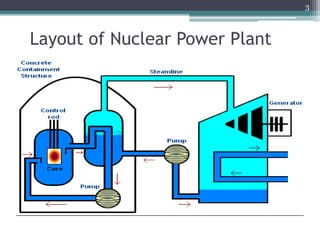
Layout of Nuclear Power Plant
3
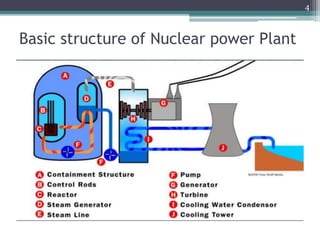
Basic structure of Nuclear power Plant
4
Working of a Nuclear Reactor
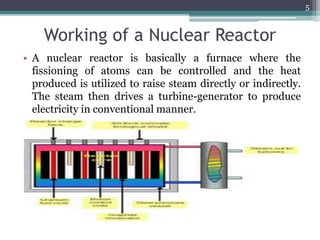
• A nuclear reactor is basically a furnace where the
fissioning of atoms can be controlled and the heat
produced is utilized to raise steam directly or indirectly.
The steam then drives a turbine-generator to produce
electricity in conventional manner.
5
Components of Nuclear Reactor and
Reactor Control
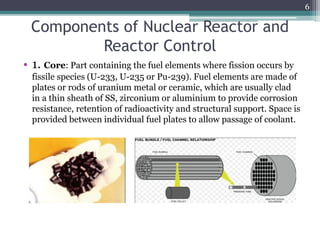
• 1. Core: Part containing the fuel elements where fission occurs by
fissile species (U-233, U-235 or Pu-239). Fuel elements are made of
plates or rods of uranium metal or ceramic, which are usually clad
in a thin sheath of SS, zirconium or aluminium to provide corrosion
resistance, retention of radioactivity and structural support. Space is
provided between individual fuel plates to allow passage of coolant.
6
Components of Nuclear Reactor and
Reactor Control
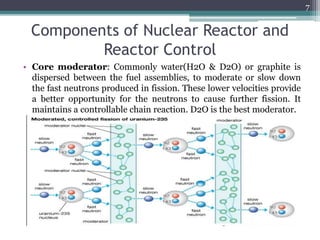
• Core moderator: Commonly water(H2O & D2O) or graphite is
dispersed between the fuel assemblies, to moderate or slow down
the fast neutrons produced in fission. These lower velocities provide
a better opportunity for the neutrons to cause further fission. It
maintains a controllable chain reaction. D2O is the best moderator.
7
Components of Nuclear Reactor and
Reactor Control
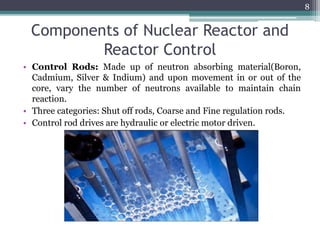
• Control Rods: Made up of neutron absorbing material(Boron,
Cadmium, Silver & Indium) and upon movement in or out of the
core, vary the number of neutrons available to maintain chain
reaction.
• Three categories: Shut off rods, Coarse and Fine regulation rods.
• Control rod drives are hydraulic or electric motor driven.
8
Components of Nuclear Reactor and
Reactor Control
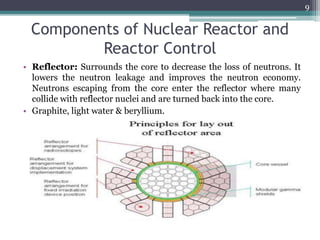
• Reflector: Surrounds the core to decrease the loss of neutrons. It
lowers the neutron leakage and improves the neutron economy.
Neutrons escaping from the core enter the reflector where many
collide with reflector nuclei and are turned back into the core.
• Graphite, light water & beryllium.
9
Components of Nuclear Reactor and
Reactor Control
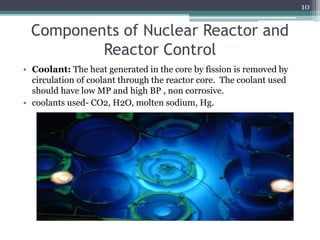
• Coolant: The heat generated in the core by fission is removed by
circulation of coolant through the reactor core. The coolant used
should have low MP and high BP , non corrosive.
• coolants used- CO2, H2O, molten sodium, Hg.
10
Components of Nuclear Reactor and
Reactor Control
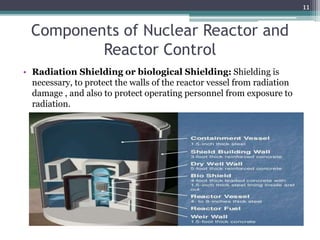
• Radiation Shielding or biological Shielding: Shielding is
necessary, to protect the walls of the reactor vessel from radiation
damage , and also to protect operating personnel from exposure to
radiation.
11
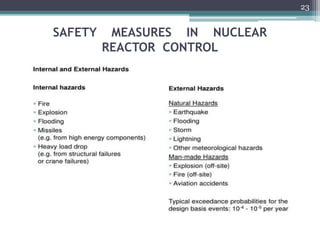
SAFETY MEASURES IN NUCLEAR REACTOR
CONTROL
• The radioactivity of the fission products which
accumulate in the fuel during reactor operation has an
important influence on design of nuclear reactors.
• Accidents: Three mile island, Chernobyl, Fukushima
Daichi.
• Radioactive material in the air or water constitutes a
potential health hazard, special precautions should be
taken.
• Nuclear energy can turn into a devastating enemy if
handled without care and precautions.
• The engineered safety features are designed to prevent
or minimize the escape of radioactive fission products
present in the fuel.
12
SAFETY MEASURES IN NUCLEAR
REACTOR CONTROL
• The basic objective of nuclear safety is the safety of
operating personnel, general public and the
minimum impact on the environment.
• Three levels of nuclear safety
1. First level: It addresses the prevention of accidents
by virtue of design, construction and surveillance
of the plant.
2. Second level: It provides safety systems to protect
operators and general public and to minimize or
prevent damage.
3. Third level: It supplements the first two by adding
margin of safety in the event of extremely unlikely
or unforeseen events.
13
SAFETY MEASURES IN NUCLEAR
REACTOR CONTROL
• Safety should be ensured in all stages, from the inception
of the plant to its full fledged commissioning and finally
decommissioning.
• Basic features relating to nuclear power plant safety:
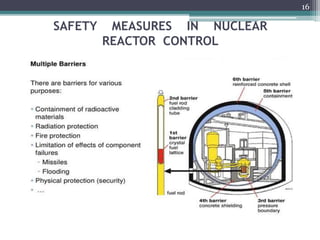
1. Building: Nuclear reactor has exothermic nuclear
reactions going on inside its core, so its structure
housing should be made from relevant materials which
have the capacity to shield the outside environment
both during normal operations and accidents.
2. Core: Here fission occurs which is sustained to get a
chain reaction. Appropriate measures must be taken to
maintain ideal conditions via control rods and core
cooling.
14
SAFETY MEASURES IN NUCLEAR
REACTOR CONTROL
Control rods: As the reaction proceeds, the number of
uranium-235 nuclei decreases and fission by-products
which absorb neutrons build up. To keep the chain
reaction going, the control rods must be withdrawn
further. At some point, the chain reaction cannot be
maintained and the fuel must be replenished.
Generation Time for fission: The average time for a
neutron emitted in one fission to cause another fission is
called the generation time.
Doubling time=(693)(0.001s)=0.693seconds
Not much time to respond to a power surge! This is
modified significantly by inclusion of the delayed
neutrons.
15
SAFETY MEASURES IN NUCLEAR
REACTOR CONTROL
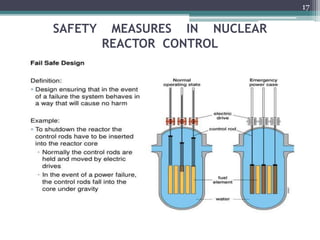
16
SAFETY MEASURES IN NUCLEAR
REACTOR CONTROL
17
SAFETY MEASURES IN NUCLEAR REACTOR
CONTROL
3. Monitoring: Human beings working inside the power plant need to
be constantly monitored for any over exposure of radiation as a
result of their routine job operations. The standards laid down in
this regard should be strictly adhered to and the working
environment should be regularly checked for radiation levels.
Dose Limits:
1. Effective dose (whole body)
• 1.1 20 Milli- Sievert (mSv)/year averaged over five consecutive
years, calculated on a sliding scale of 5 years. (The cumulative
effective dose in the same 5-year period shall not exceed 100 mSv.)
• 1.2 A maximum of 30 mSv in any year.
2. Equivalent dose (individual organs)
• 2.1 Eye lens 150 mSv/year.
• 2.2 Skin 500 mSv/year.
• 2.3 Extremities 500 mSv/year (hands and feet).
18
SAFETY MEASURES IN NUCLEAR
REACTOR CONTROL
3.Pregnant woman
• 3.1 Equivalent dose limit to the surface of the woman's
lower abdomen (for the remaining period of pregnancy)
– 2 mSv.
• 3.2 Annual Limit on Intake (ALI) for radionuclides –
0.05 ALI. (For the remaining period of pregnancy.)
4. Apprentices and students (above the age of 16 years)
• Effective dose (whole body): 6 mSv/year.
• Equivalent dose (individual organs)
• 4.1 Eye lens 15 mSv/year.
• 4.2 Skin 50 mSv/year.
• 4.3 Extremities 50 mSv/year (hands and feet).
19
SAFETY MEASURES IN NUCLEAR
REACTOR CONTROL
4. Waste Disposal: The most challenging task is the proper
disposal of waste materials from the nuclear power plant.
These waste materials come in different forms such as solid,
liquid and gaseous. All these types of wastes have their own
methods of disposal and the main idea is to dispose off these
wastes in a manner which is least harmful for human beings,
flora, fauna and the natural environment.
The radioactive liquid wastes generated are segregated, filtered
and conditioned as per procedure and after adequate dilution
to comply with the limits of discharges, disposed to the
environment water body. The activity discharged is monitored
at the point of discharge and accounted on a daily basis.
The radioactive solid wastes are disposed off in brick-lined
earthen trenches, Re-enforced cement concrete (RCC) vaults
or tile holes, depending on the radioactivity content and the
radiation levels.
20
SAFETY MEASURES IN NUCLEAR
REACTOR CONTROL
21
SAFETY MEASURES IN NUCLEAR
REACTOR CONTROL
• Proper Emergency Response Plans: Nobody
wants an accident to happen but things do go
out of control sometimes either due to human
error, nature’s fury or machinery failure. The
best thing is to be prepared for such a situation
and have properly trained personnel as well as
the requisite equipment in order to deal
effectively with such situations.
PREPAREDNESS!!
22
SAFETY MEASURES IN NUCLEAR
REACTOR CONTROL
23
Conclusions
• The benefits resulting from the nuclear reactors
truly justify the reasons of its scope of
development in future.
• If the above mentioned dictums are followed
properly, it would ensure that the tremendous
energy which lies in the atom is harnessed in a
proper manner without causing damage to men,
material, or environment.
24
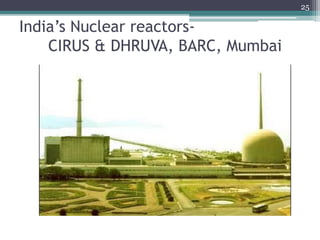
India’s Nuclear reactors-
CIRUS & DHRUVA, BARC, Mumbai
25
THANK YOU!!
26

Nuclear power plant-safety measures

  • 1.
    NUCLEAR POWER PLANT SAFETYMEASURES IN NUCLEAR REACTOR CONTROL By Nishtha Shreya 1
  • 2.
    NUCLEAR POWER PLANT •It is a thermal power station in which a nuclear reactor is used as heat source instead of furnace. • Nuclear Reactor-It is an apparatus in which heat is produced by a sustained nuclear fission chain reaction. • It differs from conventional power plant only in steam generating part. • India ranks 6th in nuclear power generation in the world with its numerous nuclear power plants in operation. 2
  • 3.
    Layout of NuclearPower Plant 3
  • 4.
    Basic structure ofNuclear power Plant 4
  • 5.
    Working of aNuclear Reactor • A nuclear reactor is basically a furnace where the fissioning of atoms can be controlled and the heat produced is utilized to raise steam directly or indirectly. The steam then drives a turbine-generator to produce electricity in conventional manner. 5
  • 6.
    Components of NuclearReactor and Reactor Control • 1. Core: Part containing the fuel elements where fission occurs by fissile species (U-233, U-235 or Pu-239). Fuel elements are made of plates or rods of uranium metal or ceramic, which are usually clad in a thin sheath of SS, zirconium or aluminium to provide corrosion resistance, retention of radioactivity and structural support. Space is provided between individual fuel plates to allow passage of coolant. 6
  • 7.
    Components of NuclearReactor and Reactor Control • Core moderator: Commonly water(H2O & D2O) or graphite is dispersed between the fuel assemblies, to moderate or slow down the fast neutrons produced in fission. These lower velocities provide a better opportunity for the neutrons to cause further fission. It maintains a controllable chain reaction. D2O is the best moderator. 7
  • 8.
    Components of NuclearReactor and Reactor Control • Control Rods: Made up of neutron absorbing material(Boron, Cadmium, Silver & Indium) and upon movement in or out of the core, vary the number of neutrons available to maintain chain reaction. • Three categories: Shut off rods, Coarse and Fine regulation rods. • Control rod drives are hydraulic or electric motor driven. 8
  • 9.
    Components of NuclearReactor and Reactor Control • Reflector: Surrounds the core to decrease the loss of neutrons. It lowers the neutron leakage and improves the neutron economy. Neutrons escaping from the core enter the reflector where many collide with reflector nuclei and are turned back into the core. • Graphite, light water & beryllium. 9
  • 10.
    Components of NuclearReactor and Reactor Control • Coolant: The heat generated in the core by fission is removed by circulation of coolant through the reactor core. The coolant used should have low MP and high BP , non corrosive. • coolants used- CO2, H2O, molten sodium, Hg. 10
  • 11.
    Components of NuclearReactor and Reactor Control • Radiation Shielding or biological Shielding: Shielding is necessary, to protect the walls of the reactor vessel from radiation damage , and also to protect operating personnel from exposure to radiation. 11
  • 12.
    SAFETY MEASURES INNUCLEAR REACTOR CONTROL • The radioactivity of the fission products which accumulate in the fuel during reactor operation has an important influence on design of nuclear reactors. • Accidents: Three mile island, Chernobyl, Fukushima Daichi. • Radioactive material in the air or water constitutes a potential health hazard, special precautions should be taken. • Nuclear energy can turn into a devastating enemy if handled without care and precautions. • The engineered safety features are designed to prevent or minimize the escape of radioactive fission products present in the fuel. 12
  • 13.
    SAFETY MEASURES INNUCLEAR REACTOR CONTROL • The basic objective of nuclear safety is the safety of operating personnel, general public and the minimum impact on the environment. • Three levels of nuclear safety 1. First level: It addresses the prevention of accidents by virtue of design, construction and surveillance of the plant. 2. Second level: It provides safety systems to protect operators and general public and to minimize or prevent damage. 3. Third level: It supplements the first two by adding margin of safety in the event of extremely unlikely or unforeseen events. 13
  • 14.
    SAFETY MEASURES INNUCLEAR REACTOR CONTROL • Safety should be ensured in all stages, from the inception of the plant to its full fledged commissioning and finally decommissioning. • Basic features relating to nuclear power plant safety: 1. Building: Nuclear reactor has exothermic nuclear reactions going on inside its core, so its structure housing should be made from relevant materials which have the capacity to shield the outside environment both during normal operations and accidents. 2. Core: Here fission occurs which is sustained to get a chain reaction. Appropriate measures must be taken to maintain ideal conditions via control rods and core cooling. 14
  • 15.
    SAFETY MEASURES INNUCLEAR REACTOR CONTROL Control rods: As the reaction proceeds, the number of uranium-235 nuclei decreases and fission by-products which absorb neutrons build up. To keep the chain reaction going, the control rods must be withdrawn further. At some point, the chain reaction cannot be maintained and the fuel must be replenished. Generation Time for fission: The average time for a neutron emitted in one fission to cause another fission is called the generation time. Doubling time=(693)(0.001s)=0.693seconds Not much time to respond to a power surge! This is modified significantly by inclusion of the delayed neutrons. 15
  • 16.
    SAFETY MEASURES INNUCLEAR REACTOR CONTROL 16
  • 17.
    SAFETY MEASURES INNUCLEAR REACTOR CONTROL 17
  • 18.
    SAFETY MEASURES INNUCLEAR REACTOR CONTROL 3. Monitoring: Human beings working inside the power plant need to be constantly monitored for any over exposure of radiation as a result of their routine job operations. The standards laid down in this regard should be strictly adhered to and the working environment should be regularly checked for radiation levels. Dose Limits: 1. Effective dose (whole body) • 1.1 20 Milli- Sievert (mSv)/year averaged over five consecutive years, calculated on a sliding scale of 5 years. (The cumulative effective dose in the same 5-year period shall not exceed 100 mSv.) • 1.2 A maximum of 30 mSv in any year. 2. Equivalent dose (individual organs) • 2.1 Eye lens 150 mSv/year. • 2.2 Skin 500 mSv/year. • 2.3 Extremities 500 mSv/year (hands and feet). 18
  • 19.
    SAFETY MEASURES INNUCLEAR REACTOR CONTROL 3.Pregnant woman • 3.1 Equivalent dose limit to the surface of the woman's lower abdomen (for the remaining period of pregnancy) – 2 mSv. • 3.2 Annual Limit on Intake (ALI) for radionuclides – 0.05 ALI. (For the remaining period of pregnancy.) 4. Apprentices and students (above the age of 16 years) • Effective dose (whole body): 6 mSv/year. • Equivalent dose (individual organs) • 4.1 Eye lens 15 mSv/year. • 4.2 Skin 50 mSv/year. • 4.3 Extremities 50 mSv/year (hands and feet). 19
  • 20.
    SAFETY MEASURES INNUCLEAR REACTOR CONTROL 4. Waste Disposal: The most challenging task is the proper disposal of waste materials from the nuclear power plant. These waste materials come in different forms such as solid, liquid and gaseous. All these types of wastes have their own methods of disposal and the main idea is to dispose off these wastes in a manner which is least harmful for human beings, flora, fauna and the natural environment. The radioactive liquid wastes generated are segregated, filtered and conditioned as per procedure and after adequate dilution to comply with the limits of discharges, disposed to the environment water body. The activity discharged is monitored at the point of discharge and accounted on a daily basis. The radioactive solid wastes are disposed off in brick-lined earthen trenches, Re-enforced cement concrete (RCC) vaults or tile holes, depending on the radioactivity content and the radiation levels. 20
  • 21.
    SAFETY MEASURES INNUCLEAR REACTOR CONTROL 21
  • 22.
    SAFETY MEASURES INNUCLEAR REACTOR CONTROL • Proper Emergency Response Plans: Nobody wants an accident to happen but things do go out of control sometimes either due to human error, nature’s fury or machinery failure. The best thing is to be prepared for such a situation and have properly trained personnel as well as the requisite equipment in order to deal effectively with such situations. PREPAREDNESS!! 22
  • 23.
    SAFETY MEASURES INNUCLEAR REACTOR CONTROL 23
  • 24.
    Conclusions • The benefitsresulting from the nuclear reactors truly justify the reasons of its scope of development in future. • If the above mentioned dictums are followed properly, it would ensure that the tremendous energy which lies in the atom is harnessed in a proper manner without causing damage to men, material, or environment. 24
  • 25.
    India’s Nuclear reactors- CIRUS& DHRUVA, BARC, Mumbai 25
  • 26.