
BIOLOGY FORM 5 
CHAPTER 2 
LOCOMOTION & SUPPORT 
PART 4
SUPPORT IN 
PLANTS
• Support in Aquatic Plants 
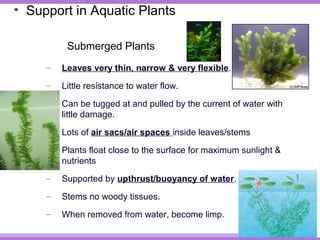
Submerged Plants 
– Leaves very thin, narrow & very flexible. 
– Little resistance to water flow. 
– Can be tugged at and pulled by the current of water with 
little damage. 
– Lots of air sacs/air spaces inside leaves/stems 
– Plants float close to the surface for maximum sunlight & 
nutrients 
– Supported by upthrust/buoyancy of water. 
– Stems no woody tissues. 
– When removed from water, become limp.
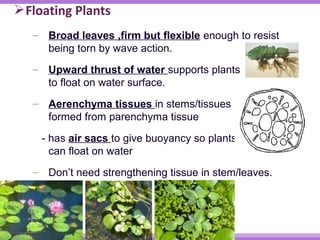
Floating Plants 
– Broad leaves ,firm but flexible enough to resist 
being torn by wave action. 
– Upward thrust of water supports plants 
to float on water surface. 
– Aerenchyma tissues in stems/tissues 
formed from parenchyma tissue 
- has air sacs to give buoyancy so plants 
can float on water 
– Don’t need strengthening tissue in stem/leaves.
Support in Terrestrial Plants 
Herbaceous Plants 
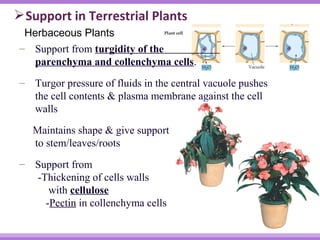
– Support from turgidity of the 
parenchyma and collenchyma cells. 
– Turgor pressure of fluids in the central vacuole pushes 
the cell contents & plasma membrane against the cell 
walls 
Maintains shape & give support 
to stem/leaves/roots 
– Support from 
-Thickening of cells walls 
with cellulose 
-Pectin in collenchyma cells
Special Structural Adaptations FFoorr EExxtteerrnnaall SSuuppppoorrtt 
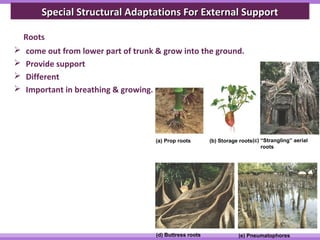
Roots 
 come out from lower part of trunk & grow into the ground. 
 Provide support 
 Different 
 Important in breathing & growing. 
(a) Prop roots (b) Storage roots(c) “Strangling” aerial 
roots 
(d) Buttress roots (e) Pneumatophores
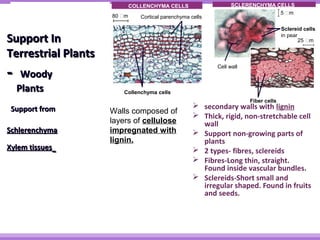
 secondary walls with lignin 
 Thick, rigid, non-stretchable cell 
wall 
 Support non-growing parts of 
plants 
 2 types- fibres, sclereids 
 Fibres-Long thin, straight. 
Found inside vascular bundles. 
 Sclereids-Short small and 
irregular shaped. Found in fruits 
and seeds. 
PARENCHYMA CELLS 
Parenchyma cells 60 m 
COLLENCHYMA CELLS 
80 m Cortical parenchyma cells 
Collenchyma cells 
SCLERENCHYMA CELLS 
Cell wall 
Sclereid cells 
in pear 
25 m 
Fiber cells 
5 m 
Walls composed of 
layers of cellulose 
impregnated with 
lignin. 
SSuuppppoorrtt IInn 
TTeerrrreessttrriiaall PPllaannttss 
-- WWooooddyy 
PPllaannttss 
SSuuppppoorrtt ffrroomm 
SScchhlleerreenncchhyymmaa 
XXyylleemm ttiissssuueess
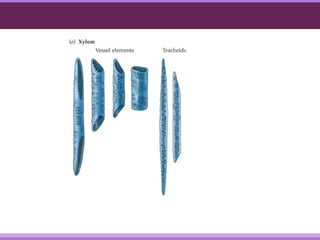
XXyylleemm 
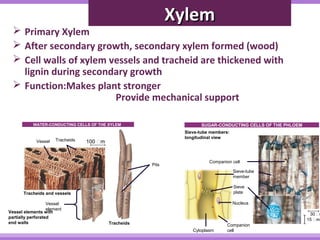
 Primary Xylem 
 After secondary growth, secondary xylem formed (wood) 
 Cell walls of xylem vessels and tracheid are thickened with 
lignin during secondary growth 
 Function:Makes plant stronger 
Provide mechanical support 
WATER-CONDUCTING CELLS OF THE XYLEM 
Vessel Tracheids 100 m 
Tracheids and vessels 
Vessel 
Vessel elements weiltehment 
partially perforated 
end walls 
Pits 
Tracheids 
SUGAR-CONDUCTING CELLS OF THE PHLOEM 
Companion cell 
Sieve-tube 
member 
Sieve-tube members: 
longitudinal view 
Sieve 
plate 
Nucleus 
Cytoplasm 
Companion 
cell 
30 m 
15 m
THE END

Biology Form 5 Chapter 2 - Locomotion & Support : 2.3

  • 1.
    BIOLOGY FORM 5 CHAPTER 2 LOCOMOTION & SUPPORT PART 4
  • 2.
  • 3.
    • Support inAquatic Plants Submerged Plants – Leaves very thin, narrow & very flexible. – Little resistance to water flow. – Can be tugged at and pulled by the current of water with little damage. – Lots of air sacs/air spaces inside leaves/stems – Plants float close to the surface for maximum sunlight & nutrients – Supported by upthrust/buoyancy of water. – Stems no woody tissues. – When removed from water, become limp.
  • 4.
    Floating Plants –Broad leaves ,firm but flexible enough to resist being torn by wave action. – Upward thrust of water supports plants to float on water surface. – Aerenchyma tissues in stems/tissues formed from parenchyma tissue - has air sacs to give buoyancy so plants can float on water – Don’t need strengthening tissue in stem/leaves.
  • 5.
    Support in TerrestrialPlants Herbaceous Plants – Support from turgidity of the parenchyma and collenchyma cells. – Turgor pressure of fluids in the central vacuole pushes the cell contents & plasma membrane against the cell walls Maintains shape & give support to stem/leaves/roots – Support from -Thickening of cells walls with cellulose -Pectin in collenchyma cells
  • 6.
    Special Structural AdaptationsFFoorr EExxtteerrnnaall SSuuppppoorrtt Roots  come out from lower part of trunk & grow into the ground.  Provide support  Different  Important in breathing & growing. (a) Prop roots (b) Storage roots(c) “Strangling” aerial roots (d) Buttress roots (e) Pneumatophores
  • 7.
     secondary wallswith lignin  Thick, rigid, non-stretchable cell wall  Support non-growing parts of plants  2 types- fibres, sclereids  Fibres-Long thin, straight. Found inside vascular bundles.  Sclereids-Short small and irregular shaped. Found in fruits and seeds. PARENCHYMA CELLS Parenchyma cells 60 m COLLENCHYMA CELLS 80 m Cortical parenchyma cells Collenchyma cells SCLERENCHYMA CELLS Cell wall Sclereid cells in pear 25 m Fiber cells 5 m Walls composed of layers of cellulose impregnated with lignin. SSuuppppoorrtt IInn TTeerrrreessttrriiaall PPllaannttss -- WWooooddyy PPllaannttss SSuuppppoorrtt ffrroomm SScchhlleerreenncchhyymmaa XXyylleemm ttiissssuueess
  • 8.
    XXyylleemm  PrimaryXylem  After secondary growth, secondary xylem formed (wood)  Cell walls of xylem vessels and tracheid are thickened with lignin during secondary growth  Function:Makes plant stronger Provide mechanical support WATER-CONDUCTING CELLS OF THE XYLEM Vessel Tracheids 100 m Tracheids and vessels Vessel Vessel elements weiltehment partially perforated end walls Pits Tracheids SUGAR-CONDUCTING CELLS OF THE PHLOEM Companion cell Sieve-tube member Sieve-tube members: longitudinal view Sieve plate Nucleus Cytoplasm Companion cell 30 m 15 m
  • 10.