© 2014 IBM Corporation
What Skills Issue?
From the perspective of a Generation
z CICS Customer (ASZ-4236)
Arshia Bigdeli
CICS Systems Engineer
arshia.bigdeli@wellsfargo.com
Training Generation z is the key!
• “Train people well enough so they can leave, treat them
well enough so they don’t want to.” – Sir Richard Branson,
Founder of Virgin Group
http://www.virgin.com/richard-branson/look-after-your-staff
• It is one thing to meet the immediate need by hiring a contractor
to do a project or specific function for your company, but it does
nothing to address the long-term need for an experienced CICS
System Programmer.
• While there is a challenge in the market today to fill the shoes of
the existing CICS workforce, there are individuals just waiting to
get their feet wet!
1
Attract, Train,
& Retain
A long-term approach
• This will not be an overnight journey, and uncertainty of the
future is part of the adventure. The promise of learning and a
secure future will be the driver for growth.
• Think long-term for your entire CICS workforce, from the entry-
level college graduate to the experienced professional that
could debug your system with their eyes closed.
• Make a commitment to a new hire that what they hire into is the
start of a career, not the end with only the current job
description summary to look forward to.
3
Attract, Train,
& Retain
Start small, and build from there
• A “newbie” to CICS has much to learn, but can lean on
those already in your environment.
• They should learn alongside other SysProgs; not as their
replacement for next year, but as their replacement in 10 or 20
years.
• CICS maintenance, installation, upgrades, and tuning would be
responsibilities as growth continues.
• All the while, continued exploration of the capabilities of CICS
should be encouraged.
• Just as the human element does not stand still, neither does
our beloved product
• As IBM continues CICS’s growth into new areas, an open mind
should be kept to these technologies and how they can be
leveraged in your organization
– Gen z SysProgs are surrounded by the Web day-in and day-out,
and thus, can be a natural fit in leveraging web services, restful
languages, and the mobile arena.
5
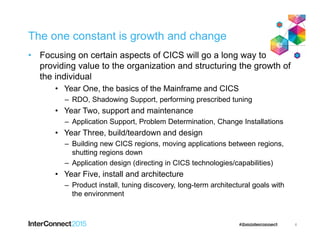
The one constant is growth and change
• Focusing on certain aspects of CICS will go a long way to
providing value to the organization and structuring the growth of
the individual
• Year One, the basics of the Mainframe and CICS
– RDO, Shadowing Support, performing prescribed tuning
• Year Two, support and maintenance
– Application Support, Problem Determination, Change Installations
• Year Three, build/teardown and design
– Building new CICS regions, moving applications between regions,
shutting regions down
– Application design (directing in CICS technologies/capabilities)
• Year Five, install and architecture
– Product install, tuning discovery, long-term architectural goals with
the environment
6
Attract, Train,
& Retain
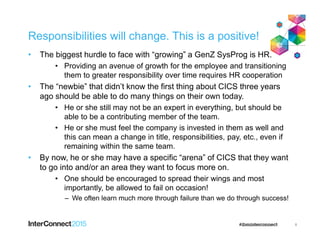
Responsibilities will change. This is a positive!
• The biggest hurdle to face with “growing” a GenZ SysProg is HR.
• Providing an avenue of growth for the employee and transitioning
them to greater responsibility over time requires HR cooperation
• The “newbie” that didn’t know the first thing about CICS three years
ago should be able to do many things on their own today.
• He or she still may not be an expert in everything, but should be
able to be a contributing member of the team.
• He or she must feel the company is invested in them as well and
this can mean a change in title, responsibilities, pay, etc., even if
remaining within the same team.
• By now, he or she may have a specific “arena” of CICS that they want
to go into and/or an area they want to focus more on.
• One should be encouraged to spread their wings and most
importantly, be allowed to fail on occasion!
– We often learn much more through failure than we do through success!
8
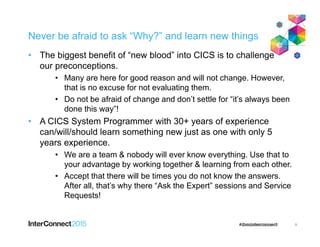
Never be afraid to ask “Why?” and learn new things
• The biggest benefit of “new blood” into CICS is to challenge
our preconceptions.
• Many are here for good reason and will not change. However,
that is no excuse for not evaluating them.
• Do not be afraid of change and don’t settle for “it’s always been
done this way”!
• A CICS System Programmer with 30+ years of experience
can/will/should learn something new just as one with only 5
years experience.
• We are a team & nobody will ever know everything. Use that to
your advantage by working together & learning from each other.
• Accept that there will be times you do not know the answers.
After all, that’s why there “Ask the Expert” sessions and Service
Requests!
9
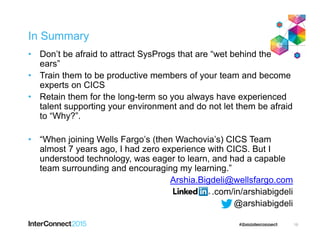
In Summary
• Don’t be afraid to attract SysProgs that are “wet behind the
ears”
• Train them to be productive members of your team and become
experts on CICS
• Retain them for the long-term so you always have experienced
talent supporting your environment and do not let them be afraid
to “Why?”.
• “When joining Wells Fargo’s (then Wachovia’s) CICS Team
almost 7 years ago, I had zero experience with CICS. But I
understood technology, was eager to learn, and had a capable
team surrounding and encouraging my learning.”
Arshia.Bigdeli@wellsfargo.com
.com/in/arshiabigdeli
@arshiabigdeli
10
Thank You
Your Feedback is
Important!
Access the InterConnect 2015
Conference CONNECT Attendee Portal
to complete your session surveys from
your smartphone, laptop or conference
kiosk.

4236 What Skills Issue? From the perspective of a Generation z CICS customer

  • 1.
    © 2014 IBMCorporation What Skills Issue? From the perspective of a Generation z CICS Customer (ASZ-4236) Arshia Bigdeli CICS Systems Engineer arshia.bigdeli@wellsfargo.com
  • 2.
    Training Generation zis the key! • “Train people well enough so they can leave, treat them well enough so they don’t want to.” – Sir Richard Branson, Founder of Virgin Group http://www.virgin.com/richard-branson/look-after-your-staff • It is one thing to meet the immediate need by hiring a contractor to do a project or specific function for your company, but it does nothing to address the long-term need for an experienced CICS System Programmer. • While there is a challenge in the market today to fill the shoes of the existing CICS workforce, there are individuals just waiting to get their feet wet! 1
  • 3.
  • 4.
    A long-term approach •This will not be an overnight journey, and uncertainty of the future is part of the adventure. The promise of learning and a secure future will be the driver for growth. • Think long-term for your entire CICS workforce, from the entry- level college graduate to the experienced professional that could debug your system with their eyes closed. • Make a commitment to a new hire that what they hire into is the start of a career, not the end with only the current job description summary to look forward to. 3
  • 5.
  • 6.
    Start small, andbuild from there • A “newbie” to CICS has much to learn, but can lean on those already in your environment. • They should learn alongside other SysProgs; not as their replacement for next year, but as their replacement in 10 or 20 years. • CICS maintenance, installation, upgrades, and tuning would be responsibilities as growth continues. • All the while, continued exploration of the capabilities of CICS should be encouraged. • Just as the human element does not stand still, neither does our beloved product • As IBM continues CICS’s growth into new areas, an open mind should be kept to these technologies and how they can be leveraged in your organization – Gen z SysProgs are surrounded by the Web day-in and day-out, and thus, can be a natural fit in leveraging web services, restful languages, and the mobile arena. 5
  • 7.
    The one constantis growth and change • Focusing on certain aspects of CICS will go a long way to providing value to the organization and structuring the growth of the individual • Year One, the basics of the Mainframe and CICS – RDO, Shadowing Support, performing prescribed tuning • Year Two, support and maintenance – Application Support, Problem Determination, Change Installations • Year Three, build/teardown and design – Building new CICS regions, moving applications between regions, shutting regions down – Application design (directing in CICS technologies/capabilities) • Year Five, install and architecture – Product install, tuning discovery, long-term architectural goals with the environment 6
  • 8.
  • 9.
    Responsibilities will change.This is a positive! • The biggest hurdle to face with “growing” a GenZ SysProg is HR. • Providing an avenue of growth for the employee and transitioning them to greater responsibility over time requires HR cooperation • The “newbie” that didn’t know the first thing about CICS three years ago should be able to do many things on their own today. • He or she still may not be an expert in everything, but should be able to be a contributing member of the team. • He or she must feel the company is invested in them as well and this can mean a change in title, responsibilities, pay, etc., even if remaining within the same team. • By now, he or she may have a specific “arena” of CICS that they want to go into and/or an area they want to focus more on. • One should be encouraged to spread their wings and most importantly, be allowed to fail on occasion! – We often learn much more through failure than we do through success! 8
  • 10.
    Never be afraidto ask “Why?” and learn new things • The biggest benefit of “new blood” into CICS is to challenge our preconceptions. • Many are here for good reason and will not change. However, that is no excuse for not evaluating them. • Do not be afraid of change and don’t settle for “it’s always been done this way”! • A CICS System Programmer with 30+ years of experience can/will/should learn something new just as one with only 5 years experience. • We are a team & nobody will ever know everything. Use that to your advantage by working together & learning from each other. • Accept that there will be times you do not know the answers. After all, that’s why there “Ask the Expert” sessions and Service Requests! 9
  • 11.
    In Summary • Don’tbe afraid to attract SysProgs that are “wet behind the ears” • Train them to be productive members of your team and become experts on CICS • Retain them for the long-term so you always have experienced talent supporting your environment and do not let them be afraid to “Why?”. • “When joining Wells Fargo’s (then Wachovia’s) CICS Team almost 7 years ago, I had zero experience with CICS. But I understood technology, was eager to learn, and had a capable team surrounding and encouraging my learning.” Arshia.Bigdeli@wellsfargo.com .com/in/arshiabigdeli @arshiabigdeli 10
  • 12.
    Thank You Your Feedbackis Important! Access the InterConnect 2015 Conference CONNECT Attendee Portal to complete your session surveys from your smartphone, laptop or conference kiosk.