INTERNAL AUDIT & 
FRAUD PREVENTION. 
Real-life case studies of prevention and detection.
ABOUT THE AUTHORS 
JOHN MILNER 
John is an Irish Chartered Accountant and a part-ner 
of Kreston CSM. He has expertise in the areas 
of internal audit, due diligence, financial strategy 
and mergers and acquisitions. He specializes in 
internal control, risk evaluation and fraud preven-tion 
and detection. 
He has managed the Internal Audit departments 
both internationally and in Mexico for companies 
such as Unisys and Waldo’s. He has held Finance 
Director positions for other companies such as 
AstraZeneca, where he successfully managed the 
finance, tax and legal merger as Corporate CFO. 
He has worked extensively in Europe, Mexico and 
the United States and is financial advisor and a 
board member for a number of different compa-nies. 
He has successfully raised capital and per-formed 
due diligence for companies such as 
Masisa and Qualita. 
CO-AUTHOR 
INTERNAL AUDIT & FRAUD PREVENTION
ABOUT THE AUTHORS 
MARTÍN GHIRARDOTTI 
Martin Ghirardotti a partner with Lisicki, Litvin & 
Associates, a member firm of Kreston International, 
CEO of Resguarda (a whistleblower hotline), 
member of the Executive Committee of the Institute 
of Internal Auditors in Argentina, Vice President of 
INICA and a member of ACFE (Association of Certi-fied 
Fraud Examiners – U.S.) 
He has participated as a guest speaker and panelist 
on numerous forums regarding money laundering, 
fraud, whistleblower techniques and internal audit 
for universities, private industry and government 
agencies in Argentina and throughout Latin Ameri-ca. 
He has written many articles in Argentina for both 
business magazines and newspapers, such as La 
Nacion, Clarin, Ambito Financiero, Revista IDEA 
etc. 
CO-AUTHOR 
INTERNAL AUDIT & FRAUD PREVENTION
ABOUT THE AUTHORS 
ENRIQUE PASTOR 
INTRODUCTION AND PERFACE 
Enrique is a member of both the Institute and Col-lege 
of Public Accountants in Mexico. 
He is a Certified Public Accountant and Tax Spe-cialist 
from both of these bodies, is a Certified Au-ditor 
and qualified to perform tax and social securi-ty 
audits at a federal level and also at state level in 
Mexico City, State of Mexico and Veracruz. 
He has participated as a speaker at many different 
tax forums throughout Mexico. 
He is a Board member for many different compa-nies 
in Mexico and often acts as their commissary 
or auditor as required by law. He is the Treasurer 
for CANIETI (the Electronics, Telecommunications 
and Information Technologies Chamber) and is a 
member of the Swedish-Mexican Chamber of 
Commerce. 
He was a recognized consultant for JICA (the 
Japan International Cooperation Agency) in 2009 
and is a partner of Kreston CSM. 
INTERNAL AUDIT & FRAUD PREVENTION
ABOUT THE AUTHORS 
MIGUEL DEL OLMO 
Miguel is an Audit and Corporate Governance 
Partner of Kreston CSM. He is member of the 
Audit Committee for Kreston International for the 
Latin American region. 
He has over 25 years’ experience, both interna-tional 
and in Mexico, as a financial and tax audi-tor. 
He has worked and given seminars in the 
United States, South Africa, Argentina, Brazil, 
Panama, Nicaragua and Guatemala. 
He has particular expertise in Sarbanes-Oxley and 
Mexican Bankruptcy law. He is a certified Internal 
Auditor under ISO 9001 as stipulated by INLAC, 
the Latin American Quality Institute. 
Miguel sits on the Audit Committee for many com-panies 
in Mexico. 
CONCLUSIONS 
INTERNAL AUDIT & FRAUD PREVENTION
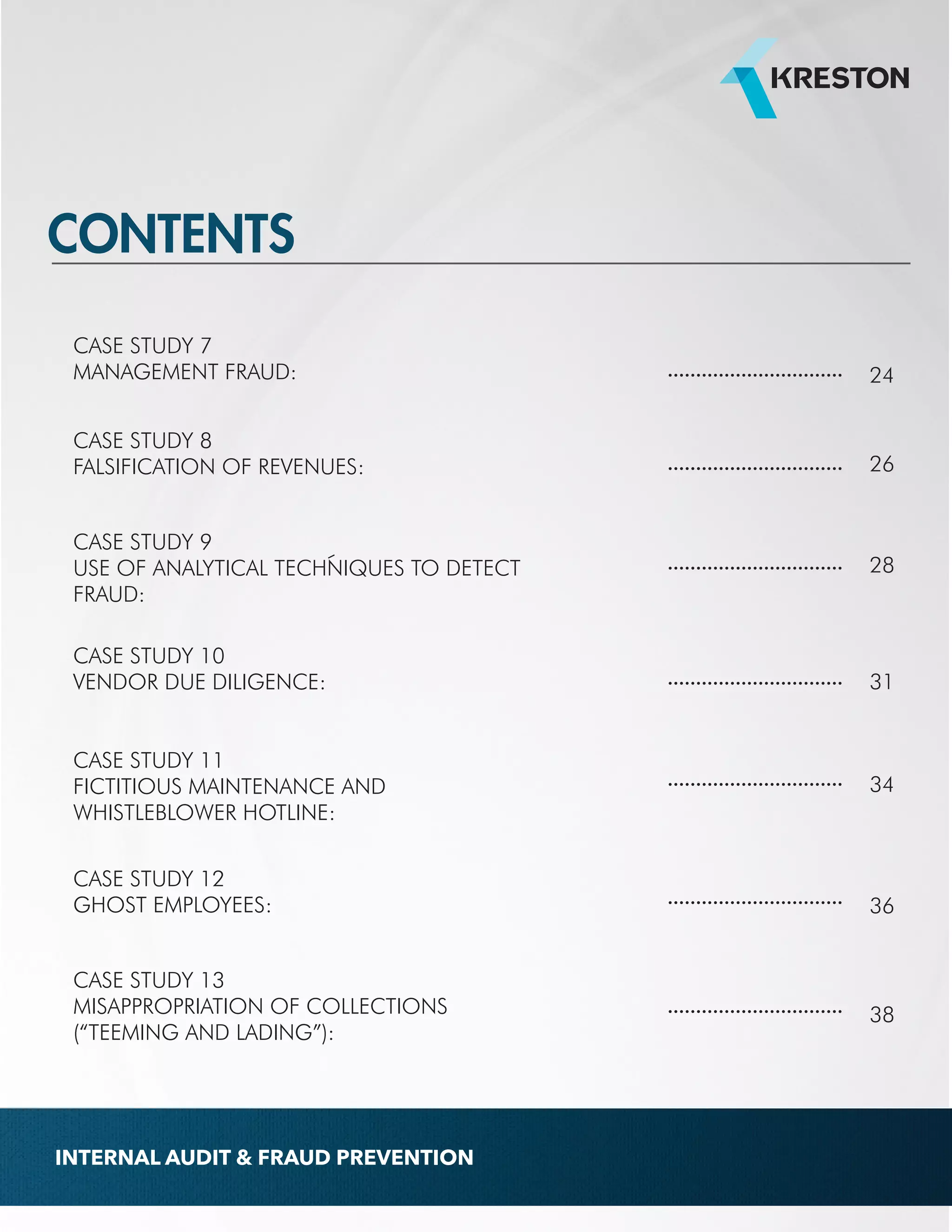
CONTENTS 
INTRODUCTION: ............................... 8 
PREFACE: 
CASE STUDY 1 
FREIGHT OVERCHARGING: 
CASE STUDY 2 
MISAPPROPRIATION OF CASH AND CHEQUES: 
CASE STUDY 3 
MANIPULATION OF ACCOUNTING RECORDS: 
CASE STUDY 4 
ABUSE OF POWER BY CEO: 
CASE STUDY 5 
TAMPERING OF CHECKS: 
CASE STUDY 6 
GHOST VENDOR AND PERSONAL LIFESTYLE: 
............................... 
............................... 
............................... 
............................... 
............................... 
............................... 
............................... 
9 
10 
13 
15 
18 
20 
22 
INTERNAL AUDIT & FRAUD PREVENTION
CASE STUDY 7 
MANAGEMENT FRAUD: ............................... 24 
CASE STUDY 8 
FALSIFICATION OF REVENUES: 
CASE STUDY 9 
USE OF ANALYTICAL TECHNIQUES TO DETECT 
FRAUD: 
CASE STUDY 10 
VENDOR DUE DILIGENCE: 
CASE STUDY 11 
FICTITIOUS MAINTENANCE AND 
WHISTLEBLOWER HOTLINE: 
CASE STUDY 12 
GHOST EMPLOYEES: 
CASE STUDY 13 
MISAPPROPRIATION OF COLLECTIONS 
(“TEEMING AND LADING”): 
............................... 
............................... 
............................... 
............................... 
............................... 
............................... 
26 
28 
31 
34 
36 
38 
CONTENTS 
INTERNAL AUDIT & FRAUD PREVENTION
CONTENTS 
CASE STUDY 14 
DISCOUNTS TO FAMILY AND FRIENDS AND 
WHISTLEBLOWER: 
CASE STUDY 15 
MANIPULATION OF CASH RECEIPTS: 
CASE STUDY 16 
GHOST VENDOR: 
CASE STUDY 17 
MISAPPROPRIATION OF CASH: 
CASE STUDY 18 
MISAPPROPRIATION OF CASH SALES AND 
WHISTLEBLOWER: 
............................... 40 
............................... 
............................... 
............................... 
............................... 
42 
44 
47 
49 
CONCLUSIONS: ............................... 52 
INTERNAL AUDIT & FRAUD PREVENTION
INTRODUCTION 
We are pleased to share a collection of fraud case studies with our readers. 
These are based on real-life experiences which we have accumulated over 
the years, some from past experiences of having worked in different organiza-tions 
and others from situations which we encountered with our clients in 
Kreston ©. It is likely that our readers will be able to draw comparisons from 
similar situations in their own particular environment and hopefully they will 
serve as a preventative mechanism within their organization. In any environ-ment, 
good controls, documented procedures and robust vigilance to ensure 
compliance will help preserve the organization’s assets and help save money. 
This is a joint collaboration between the Kreston offices in Mexico and Argen-tina 
and the cases are based on real-life experiences whereby names of 
countries, amounts of monies and industries have been amended to ensure 
that the organizations involved are not compromised. The names of the 
organizations have been excluded. 
Kreston has a global practice in Internal Audit and Risk Management where-by 
it helps its clients in measuring risks, defining and implementing controls 
and implementing mechanisms to ensure compliance and reduce the risk of 
fraud occurring. 
Co-Authors 
Dr. Martin Ghirardotti & John Milner 
Editing, Introduction and Conclusion 
Enrique Pastor & Miguel del Olmo 
Published by Kreston CSM © 
All rights reserved 2013 “Kreston CSM”©. The partial or complete repro-duction 
is prohibited without the prior written permission of the authors. 
8 
INTERNAL AUDIT & FRAUD PREVENTION
PREFACE 
Since time began, the risk of fraud has existed in all organizations created by man. No matter 
how big or small the organization, corporation or government, whether it is a group of ten 
people or ten thousand, the potential exists for fraud to occur. 
One person alone can commit a fraud. Where the group is more than one and collusion exists, 
the fraud is easier to perpetrate and has the capacity of being of greater magnitude. In bygone 
times, the fraud tended to be more rudimentary and usually involved the misappropriation of 
cash or tangible items, such as inventory, cars or other assets. As society and commerce devel-oped, 
frauds became more sophisticated and involved banks and check fraud. In recent times, 
with the spread of e-commerce, electronic banking and the widespread adoption of ERP (Enter-pise 
Resource Planning) systems across governments and corporations, the variety, complexity 
and magnitude of frauds has increased dramatically. Whereas collusion between personnel 
internal and external to the organization was necessary in the past, today it is possible for per-sonnel 
external to the organization to perpetrate the fraud without help internally. This can be 
done by the ability to access and hack the organizations’ systems. 
The fact that fraud continues to be a factor with which modern business needs to cope, the need 
to design and implement control, prevention and detection mechanisms is all the more neces-sary. 
The controls need to be as sophisticated and as robust as the intelligence and planning 
that goes behind the intention to commit a fraud. Auditors need to be as familiar and as capa-ble 
in terms of using technology as their perpetrators in both preventing and detecting frauds. 
Organizations need to continually invest in structures, processes and controls at all levels from 
the Internal Audit Committee to the cashier at the store level. Neither should we lose sight of the 
desire to have a capable and motivated workforce which is focused on achieving the goals of 
the organization and has no wish to cause harm. 
We have put together 18 case studies which share real-life experiences in a number of different 
countries, where we realize that human nature can always fall to temptation, regardless of the 
culture. These case studies bring home the realization that sometimes the fraud is much closer 
to us than we may have imagined. We should always be conscious of maintaining and upgrad-ing 
controls and procedures to ensure that the organization’s assets and financial records are 
safeguarded and not in danger. It is important that we raise the necessary flags and ensure that 
protective steps are taken, even if only a doubt exists that a fraud may take place. 
Kreston has a global practice in Internal Audit and Risk Management whereby it helps its clients 
in measuring risks, defining and implementing controls and implementing mechanisms to 
ensure compliance and reduce the risk of fraud occurring. 
Note: all amounts of monies in the case studies are denominated in US dollars. 
INTERNAL AUDIT & FRAUD PREVENTION 9
CASE STUDY 1. 
COMPANY BACKGROUND 
Argentinian subsidiary of a German parent manufactures and distributes industrial machinery 
products with annual revenues of $84 million. 
FINDINGS 
Operations had requested that Internal Audit make a detailed review of Transport charges. 
Internal Audit performed a detailed review of the Company’s database including an analysis of 
the charges paid with deal by customer, volume and route of the machinery which was transport-ed. 
The review resulted in the discovery of significant variations in the expenses incurred by the 
Company in freight. The review revealed the following: 
The excessive amount of kilometers charged. The freight supplier was billing distances in 
accordance with a pre-determined table. The amounts charged per kilometer and distance 
coincided with the table. Company personnel satisfactorily reconciled vendor invoices with the 
amount of kilometers charged as per the table. Internal Audit checked the distances with 
amounts as per guidelines issued by the government. These revealed distances as per the table 
far in excess of those set out in the governmental guidelines. For example, the driving distance 
according to the table for the journey from Buenos Aires to Rosario was 645 km, whereas the 
actual distance was 298km, a difference which represented an overcharge of 116%. 
The freight vendor was charging for additional routes. For example, the vendor had 2 
deliveries on the route which started at point A and had drop-offs at points B and C, but he 
charged the full routes from A to B and A to C, even though he had made only one trip. This 
was in violation of the contractual agreement between the vendor and the Company. 
The vendor was charging round trips, even though the vehicles returned empty, also in 
violation of the agreement between the vendor and the Company. 
10 
FREIGHT OVERCHARGING 
INTERNAL AUDIT & FRAUD PREVENTION
IMPACT 
Total misappropriation of funds amounted to $1,243,298. 
As a result of the review, a significant overcharge on most of the invoices issued by the vendor to the 
Company was detected. 
A comparison was made between the kilometers charged by the vendor and the actual distances. 
This analysis revealed that the kilometers charged were in excess of the actual distances, in the majori-ty 
of cases. The amounts overcharged are set out as follows: 
The above misappropriation of funds was allowed to happen for the following reasons: 
Failure by Operations personnel to review the route distances. 
Failure by Operations to compare the vendor’s invoices with the documental support 
such as shipping documents, driver and customer signatures etc. 
Failure by the CFO and the Operations Directors to properly review and detect adverse 
variations in Freight Expenses. 
11 
Kilometers charged by the vendor 
Actual kilometers 
Excess kilometers 
Amount overcharged 
YEAR 1 YEAR 2 TOTAL 
$1,973,828 
$1,088,443 
$885,385 
$717,162 
$1,376,884 
$750,412 
$626,472 
$526,236 
$3,350,712 
$1,838,855 
$1,511,857 
$1,243,398 
CASE STUDY 1. FREIGHT OVERCHARGING 
INTERNAL AUDIT & FRAUD PREVENTION
ACTIONS AND FOLLOW-UP 
The Company suspended payments to the freight vendor and began negotiations to recover the over-charged 
amounts. It began to reduce its freight business with the vendor, and once it had recovered 
the negotiated amount, terminated its relationship. 
The Company decided not to terminate the employment of the Operations personnel, concluding that 
it was innocent oversight on their part. A number of corrective measures were implemented including 
a more detailed review of the distances, rates charged and volumes shipped, for all vendors. 
12 
CASE STUDY 1. FREIGHT OVERCHARGING 
INTERNAL AUDIT & FRAUD PREVENTION
CASE STUDY 2. 
13 
MISAPPROPRIATION OF CASH 
AND CHECKS 
COMPANY BACKGROUND 
A Chilean company imports and manufactures raw materials for the electrical industry in the 
construction sector with annual revenues of $150 million. 
FINDINGS 
The Treasurer was misappropriating funds from the Company. Upon receipt of collections in the 
form of cash and checks from the collectors, the Treasurer would deposit part of these funds to 
her own personal account and to the accounts of third parties who had no relationship with the 
Company. This was possible due to: 
Lack of controls 
Conflict between Treasury and Credit & Collections and 
Little or no review by Internal Audit. 
The Treasurer maintained the misappropriated balances in accounts receivable balances. 
When Internal Audit performed bank reconciliations, the Treasurer would request loan balances 
from a financial institution and return these loans once the audit was completed (the reconcilia-tions 
were not performed on a surprise basis). At the same time, Credit & Collections was not 
performing adequate controls over the receivable balances and was not circulating customers 
in order to verify balances. 
INTERNAL AUDIT & FRAUD PREVENTION
14 
CASE STUDY 2. 
MISAPPROPRIATION OF CASH 
AND CHECKS 
IMPACT 
The misappropriation of funds amounted to $230,000. 
This fraud was allowed to occur due to the following: 
o Lack of adequate control procedures. The reviews performed by Internal Audit were noti-fied 
and planned in conjunction with the Treasurer. 
o Credit & Collections was not performing customer circularization in order to verify 
account balances. Whenever an error was detected, a detailed review was not performed and 
Credit & Collections would request an explanation of the Treasurer who would quickly cover up 
any impropriety. 
o Subsequent investigation revealed anomalies in the behavior of the Treasurer. Upon 
reviewing certain account movements, it was discovered that the Treasurer was addicted to gam-bling. 
A history of online betting and gambling was found in her computer during working 
hours. This lead management to conclude that the hiring and selection process was deficient in 
that these character traits in her personality had not been detected. 
ACTIONS AND FOLLOW-UP 
The Treasurer was fired and a criminal law suit was taken against her in order to recover the 
monies stolen. Controls were reviewed and tightened in the areas of Treasury, Credit & Collec-tions 
and Personnel Selection. A Financial Dashboard was also updated to help prevent the 
reoccurrence of such a fraud. The Manager of Internal Audit was also fired for not performing 
surprise audits of the Treasurer. 
INTERNAL AUDIT & FRAUD PREVENTION
MANIPULATION OF ACCOUNTING 
RECORDS 
CASE STUDY 3. 
COMPANY BACKGROUND 
Chilean subsidiary of a Canadian parent imports specialized industrial machinery, with annual 
revenues of $110 million. 
FINDINGS 
Internal Audit discovered a reimbursement to the local CEO for the amount of $45,456, arising 
from the return of a vehicle which he had acquired from the Company on October 31, 2012, via 
a deduction from payroll. On October 31, 2012, the vehicle, which was the property of the Com-pany, 
was sold to the CEO at a price of $38,781. (The CEO had the option to acquire the vehicle 
15 
at a pre-determined price). 
The CEO returned the vehicle and sold it to the Company in November 2012 at the higher price 
of $45,456. A check for this amount was issued by the Company to the CEO on the same day 
(November 11, 2012). 
Upon the review of the supporting documentation, it was revealed that the accounting entry of 
November 11, 2012 was made in December 2012. The journal entry for the check was booked 
in the SAP system on December 16, 2012 and the CEO signed as having received the check on 
December 23, 2012. This was the only check dated in the month of November in this period. All 
prior and subsequent checks were dated in December. The check was issued in December but 
booked to the accounting system with a November date. The date on the check was deliberately 
manipulated so as to give the impression that the vehicle was reacquired by the Company on 
November 11, 2012, when in fact this took place a month later. 
During the time that the vehicle was the property of the CEO, it was involved in an accident and it 
was resold to the Company in a damaged state. This apparently was the reason that the local 
Chilean CEO did not want to retain the ownership of the vehicle. 
Internal Audit had also observed that the check was prepared by an employee who worked in the 
Accounting Department. Corporate Policy requires that Treasury was solely responsible for the 
custody and emission of all checks, a breach of which occurred in this case. Segregation of duties 
was not applied in the emission of the check and the date and the accounting records were delib-erately 
altered. 
INTERNAL AUDIT & FRAUD PREVENTION
MANIPULATION OF ACCOUNTING 
RECORDS 
CASE STUDY 3. 
FINDINGS 
The transaction was registered in the system in November, when in fact the check was prepared in 
December. 
At the date of the publication of Internal Audit’s report, the Company was unaware as to the loca-tion 
16 
of the vehicle. 
IMPACT 
The Chilean CEO did not have the authority to act on behalf of the Company in the purchase 
and sale of Fixed Assets with himself, without written approval from Corporate Head Office in 
Toronto. 
The above situation was allowed to take place due to the following: 
Lack of segregation of functions. Accounting had access to checks and was also respon-sible 
for the accounting records. Treasury did not have total control over the custody and emis-sion 
of checks. 
Deliberate alteration of the date on a check. Accounting issued the check with a Novem-ber 
date, when in fact the check was issued in December. 
Lack of control in the system. A document was allowed to be booked in December, with 
a November date. 
Abuse of power by the local CEO, who was not authorized to purchase and sell vehicles 
with himself. 
Lack of internal control. Controlling performed an incorrect transaction upon the verbal 
instructions of the CEO. Controlling should have received written approval from Head Office. 
INTERNAL AUDIT & FRAUD PREVENTION
MANIPULATION OF ACCOUNTING 
RECORDS 
17 
CASE STUDY 3. 
ACTIONS AND FOLLOW-UP 
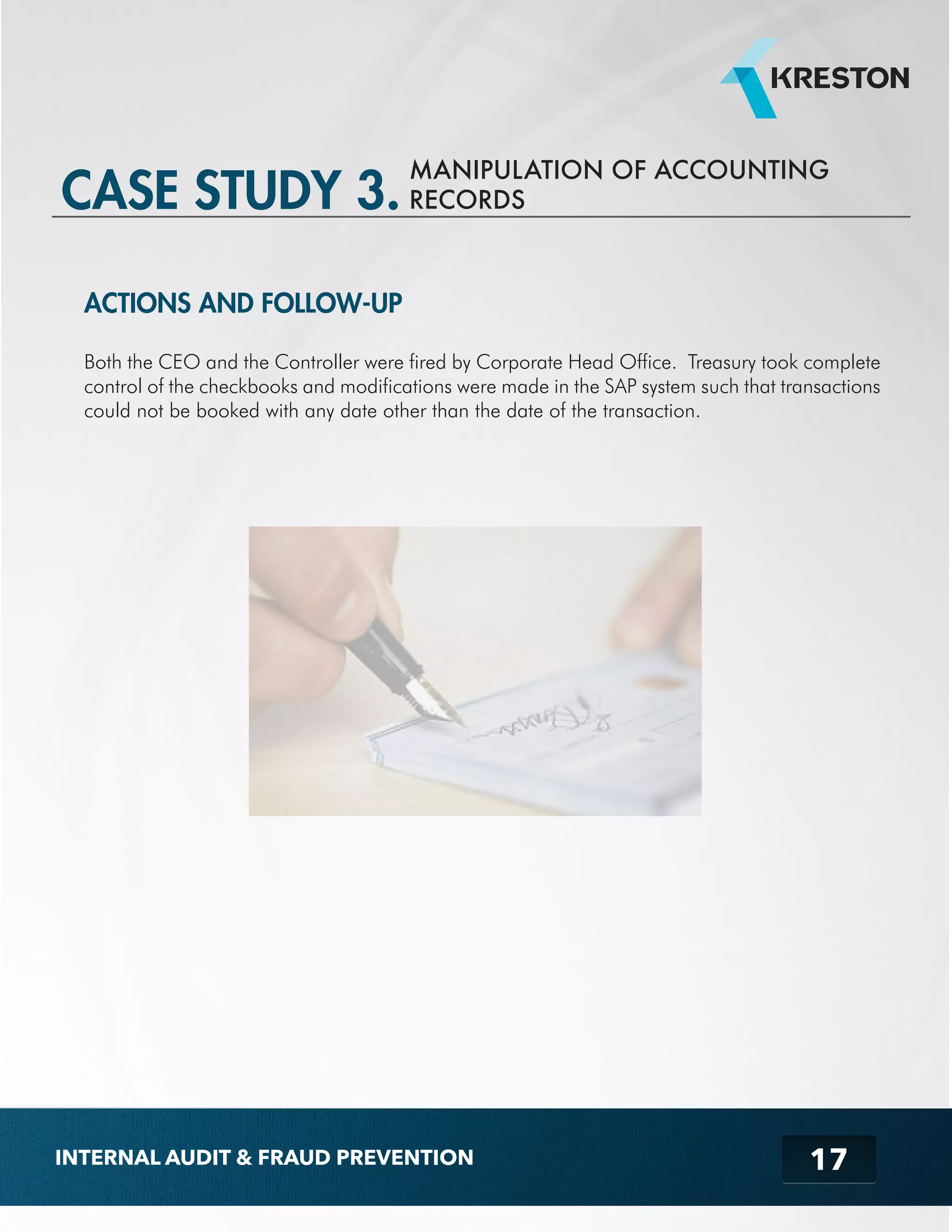
Both the CEO and the Controller were fired by Corporate Head Office. Treasury took complete 
control of the checkbooks and modifications were made in the SAP system such that transactions 
could not be booked with any date other than the date of the transaction. 
INTERNAL AUDIT & FRAUD PREVENTION
CASE STUDY 4. ABUSE OF POWER BY CEO 
COMPANY BACKGROUND 
Company manufactures ships, with operations in Mexico, Colombia and Brazil, has over 5,000 
employees and annual revenues of $280 million. 
FINDINGS 
As part of its expansion plan, the Company acquired a company in Brazil, for a price of $45 
million, in order to initiate operations in that market. 
As part of the integration of the Brazilian acquisition into the existing operations, two cars which 
formed part of the Fixed Assets of the new company could not be located. 
An investigation revealed that, as part of the acquisition process, the CEO of the acquired compa-ny 
had sold these vehicles to himself at a price of ten cents each. These vehicles had a market 
value of $70,000 and $65,000 each, both having been acquired by the Company in the previous 
six months. The CEO was able to perform these transactions on behalf of the Company as in prior 
years Corporate Head Office had assigned wide legal powers to him. The Company had trans-ferred 
18 
the legal ownership of the cars to the CEO. 
Meetings were held subsequent to the acquisition whereby requests were made of the CEO to 
return the cars. 
INTERNAL AUDIT & FRAUD PREVENTION
CASE STUDY 4. ABUSE OF POWER BY CEO 
IMPACT 
The abuse of power by the CEO resulted in the Company suffering a financial loss of $135,000. 
This loss was caused by an abuse of power by the CEO. The powers in the organization were 
clearly established in the Delegation of Authority Policy and in the Company Vehicle Policy, in 
which it was established that the CEO had the option to acquire vehicles which had been 
assigned to him at a pre-established preferential price once a period of three years employment 
had been reached. 
19 
ACTIONS AND FOLLOW-UP 
The Company appointed a new CEO from within its own organization rather than award the 
position to the CEO from the acquired company. It also initiated a criminal lawsuit against the 
CEO on the basis of fraud in order to recover the two vehicles. 
INTERNAL AUDIT & FRAUD PREVENTION
COMPANY BACKGROUND 
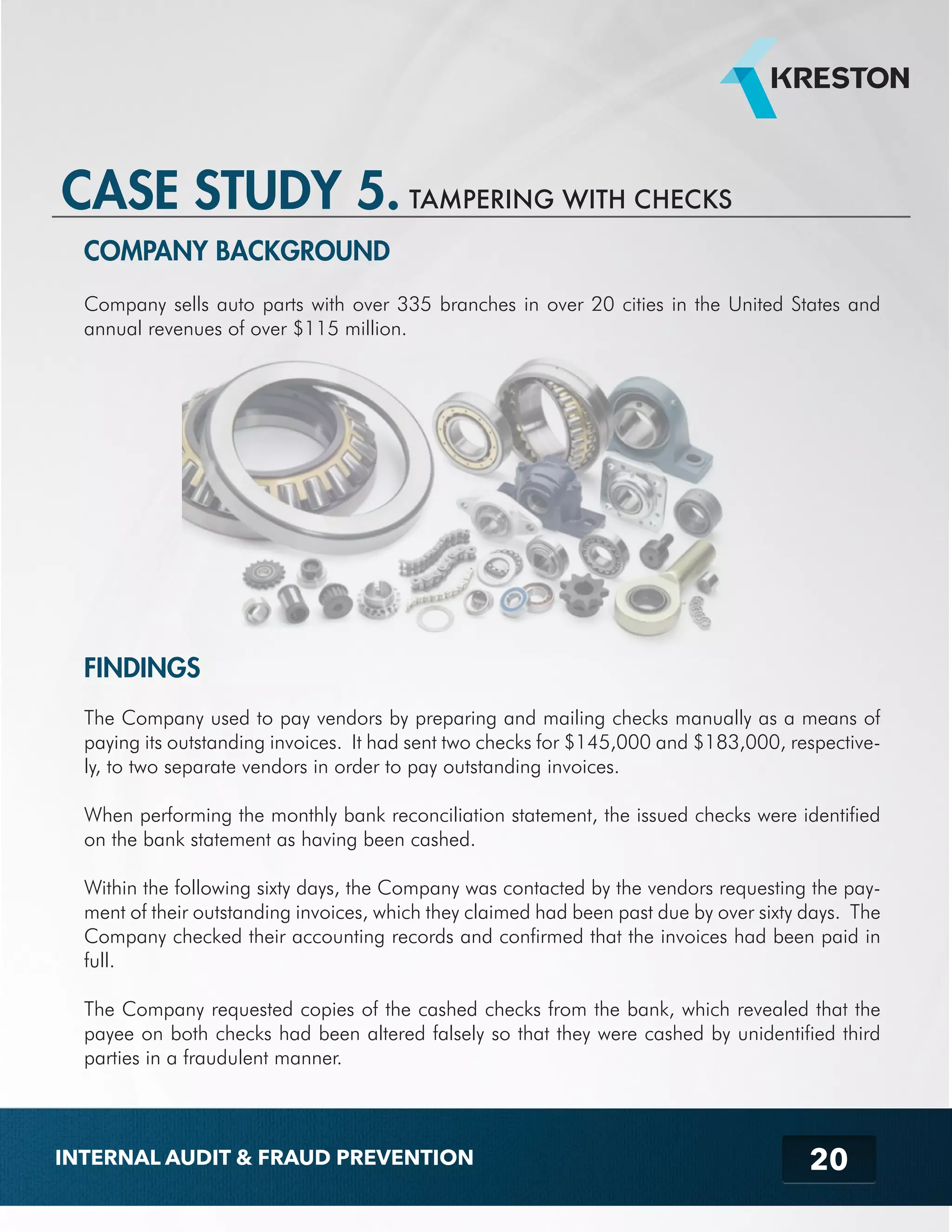
Company sells auto parts with over 335 branches in over 20 cities in the United States and 
annual revenues of over $115 million. 
FINDINGS 
The Company used to pay vendors by preparing and mailing checks manually as a means of 
paying its outstanding invoices. It had sent two checks for $145,000 and $183,000, respective-ly, 
to two separate vendors in order to pay outstanding invoices. 
When performing the monthly bank reconciliation statement, the issued checks were identified 
on the bank statement as having been cashed. 
Within the following sixty days, the Company was contacted by the vendors requesting the pay-ment 
of their outstanding invoices, which they claimed had been past due by over sixty days. The 
Company checked their accounting records and confirmed that the invoices had been paid in 
full. 
The Company requested copies of the cashed checks from the bank, which revealed that the 
payee on both checks had been altered falsely so that they were cashed by unidentified third 
parties in a fraudulent manner. 
20 
CASE STUDY 5. TAMPERING WITH CHECKS 
INTERNAL AUDIT & FRAUD PREVENTION
IMPACT 
The Company suffered a loss of $328,000 as a result of the fraudulent alteration of two 
checks in the payment of vendors’ invoices. 
ACTIONS AND FOLLOW-UP 
Best practice recommends using printed checks generated from computer systems to pay ven-dors, 
rather than prepare them manually, and have them collected in the offices of the paying 
company by authorized representatives of the vendor. Electronic wire transfers are considered 
an even more secure form of paying vendors assuming that required control procedures are 
implemented. 
The Company changed its policy on paying vendors by restricting the use of checks to exception-al 
cases only and moved to electronic wire transfers, the required controls being implemented in 
the process. 
The Company informed the Police of the check fraud. An investigation to find the culprits was 
initiated but was unsuccessful. 
21 
CASE STUDY 5. TAMPERING WITH CHECKS 
INTERNAL AUDIT & FRAUD PREVENTION
GHOST VENDOR AND PERSONAL 
22 
CASE STUDY 6. LIFESTYLE 
COMPANY BACKGROUND 
Colombian company provides Information Technology services with annual revenues of over 
$48 million. 
FINDINGS 
An Accounts Payable Associate entered a false new vendor in the Master File in the computer 
system, under the concept of systems development. Each week he would register fictitious 
invoices with the forged signatory of the Systems Development Director. At the same time, due 
to the lack of segregation of duties and inadequate supervision in the Treasury Department, the 
same associate would prepare checks for amounts of between $500 and $600 each. The asso-ciate 
worked on the eight floor of the building. The procedure to pay vendors was such that 
another person in Treasury would bring the checks to the ground floor, to the Cashier’s office, 
where vendors would arrive to collect these checks. 
The AP Associate intervened and modified the process whereby he personally delivered the 
checks to the Cashier. Instead of delivering the checks for the ghost vendor, he would keep the 
respective checks and subsequently cash them at the bank. This did not arouse any suspicion 
due to the low value of the amounts of the checks. 
Over time the Company noted a distinct change in the associate’s lifestyle whereby his clothes, 
car and personal trips did not correspond with the salary which he received from the Company. 
This resulted in the Company ordering an investigation. 
IMPACT 
The Company suffered financial losses of up to $90,000 over a period of two years, as a result 
of the fictitious invoices generated by the AP associate. This fraud was allowed to occur due to 
the following: 
INTERNAL AUDIT & FRAUD PREVENTION
23 
IMPACT 
Lack of segregation of functions in that IT had no control over new vendors in the system. 
Accounts Payable was able to add new vendors to the system. 
Lack of control in that the Company allowed such a large volume of manual checks to be 
generated. 
Inadequate supervision by the Treasurer and the Manager of Accounts Payable. 
Lack of segregation of duties which allowed the associate to take physical control of the 
checks whereby he pretended to personally deliver the checks to the Cashier. 
ACTIONS AND FOLLOW-UP 
The Company fired the AP Associate and proceeded to recover the majority of the funds which 
had been stolen from the Company. It also implemented the following changes: 
Greater supervision by the Treasurer and the Manager of AP. 
The procedure for adding new vendors was modified such that all new vendors could be 
added only by IT with the approval of Purchasing. 
Significant reduction in the use of checks. 
Increase in compliance with Internal Control. 
More reviews by Internal Audit 
GHOST VENDOR AND PERSONAL 
CASE STUDY 6. LIFESTYLE 
INTERNAL AUDIT & FRAUD PREVENTION
24 
CASE STUDY 7. MANAGEMENT FRAUD 
COMPANY BACKGROUND 
An Argentinian subsidiary of an English company imports and distributes parts for the automo-bile 
industry with annual revenues of $223 million. 
FINDINGS 
Management manipulated the financial results of the subsidiary by booking the following entries 
in the local accounting records: 
Freight charges from third party vendors were deferred and booked to the Income State-ment 
over a period of 6 months, rather than charging them directly to expense, as required by 
accounting best practices. This resulted in profits being inflated by $3.6 million. 
Importation Costs. The Company’s normal carrying period for inventory was 60 days, 
during which time it should have expensed the corresponding importation costs related to this 
product. Rather than book the importation costs to cost of goods sold over 60 days, it booked 
them over 180 days, resulting in the asset value of inventory being overstated by the amount of 
$6.4 million. 
Deferred Advertising Expenses. The Company deferred advertising expenses on the basis 
that it expected to have higher sales and improved financial results in a later period, at which 
time it planned to book the corresponding expense. This resulted in profits being overstated by 
a total of $2.8 million. 
Inventory Shrinkage. The Company had a historical shrinkage rate of 3.2% of sales, 
resulting from product being stolen, damaged or lost due to poor controls. Rather than book 
the 3.2% to cost of sales, the Company decided to understate costs and overstate profits by 
booking a lower amount of 0.8% to cost of sales. This resulted in profits being overstated by 
$5.8 million. 
INTERNAL AUDIT & FRAUD PREVENTION
CASE STUDY 7. MANAGEMENT FRAUD 
All of the above was revealed by the Internal Audit Department as part of their detailed reviews. 
In order to comply with best accounting practice, a negative adjustment totaling $18.6 million 
was booked to account for all of the above, resulting in the subsidiary recording a loss for the 
fiscal year, rather than a profit. These adjustments were reviewed and approved by the external 
auditor as part of its statutory review. 
IMPACT 
The Company negatively impacted the results for the year to the amount of $18.6 million, due 
to the deliberate manipulation of the financial records. This practice is known as management 
fraud. The situation was caused by the following: 
25 
Failure to follow Generally Accepted Accounting Principles. 
Failure to follow Company’s Policies and Procedures. 
Collusion between the CEO and the CFO to allow the adjustments to take place. 
Deliberate manipulation of the financial results of the Company. 
ACTIONS AND FOLLOW-UP 
Corporate Office in England decided to terminate the employment of both the CEO and CFO, 
on the grounds of deliberate manipulation of the financial statements. 
The new management team reviewed Accounting Policies and implemented workshops with per-sonnel 
to ensure that Policy would be strictly followed going forward. 
INTERNAL AUDIT & FRAUD PREVENTION
CASE STUDY 8. FALSIFICATION OF REVENUES 
COMPANY BACKGROUND 
A U.S. subsidiary of a Swiss corporation imports and manufactures chemical products with 
annual revenues of $418 million. 
FINDINGS 
The CEO of the subsidiary attempted to falsely inflate revenues by the amount of $18 million in 
a specific month. The operation was detected and detained by the Finance Director of the Com-pany. 
26 
The detailed findings are set out as follows: 
As part of the monthly operational and financial review, the CEO realized that the subsidi-ary 
was not going to achieve its monthly goal for revenues or profits. 
The Company had customer orders for the amount of $18 million. The manufacturing 
production of the products in these orders had not yet commenced. 
A few days prior to the month-end close, it was determined that the production of the 
above-mentioned products was to begin 15 days into the following month. It was unclear as to 
whether the Company would have been able to successfully ship the products to the customers 
during the following month. 
The CEO instructed the Finance Director to create a revenue provision of $18 million, the 
value of the orders. 
The Finance Director clarified that the revenue did not comply with the revenue recogni-tion 
requirements under U.S. or international GAAP (generally accepted accounting principles). 
A telephone conversation was held with the regional Finance Director for NAFTA, whose 
position was in agreement with that of the U.S. CEO. 
INTERNAL AUDIT & FRAUD PREVENTION
27 
CASE STUDY 8. FALSIFICATION OF REVENUES 
FINDINGS 
The following day the U.S. Finance Director sent an email to his regional counterpart 
(copying the U.S. CEO) requesting written authorization in order to book the revenue provision 
of $18 million. 
He received an immediate response from the regional Finance Director denying any 
knowledge of the operation and instructing him not to book the revenue provision. 
The revenue provision was not booked. 
The relationship between the U.S. CEO and his Finance Director became tense, the 
former claiming that the Finance Director was not working as a team player in order to achieve 
the goals of the Company. 
IMPACT 
There was no impact, financial or otherwise, for the Company as the transaction was not 
booked. 
The attempt by the CEO to falsify the financial statements with the support of the regional 
Finance Director (commonly known as management fraud), was unsuccessful due to the profes-sionalism 
and integrity of the Finance Director of the business unit. 
ACTIONS AND FOLLOW-UP 
The above incident was the first and only attempt by management to falsify the financial results 
of the business unit. Although the relationship was strained, the CEO and Finance Director sub-sequently 
managed to work in harmony, both working within the standards of the Company and 
according to best practices. 
INTERNAL AUDIT & FRAUD PREVENTION
USE OF ANALYTICAL TECHNIQUES 
28 
COMPANY BACKGROUND 
A Canadian subsidiary, with a French parent, distributes and markets soft drinks products with 
annual revenues of $214 million. 
FINDINGS 
Internal Audit was using financial reports to detect trends in costs and expenses which lead to the 
detection of a fraud. The details are explained as follows: 
Internal Audit was using an application to access the date bases and financial systems of 
the Company. 
As part of a purchasing and procurement review, Internal Audit applied its IT tool to access 
the historical data base of purchases of packaging material: labels, bottles, bottletops, cardboard 
boxes, etc. This tool helped in revealing a number of significant variations in cost of sales for these 
products over a period of time. The application generated a graph which illustrated the tenden-cies 
and increase in costs as a percentage of sales over a period of time. 
Internal Audit requested and received detailed information of product cost details from 
other plants throughout the world, from Corporate Head office in Paris, together with the corre-sponding 
variations from standard or normal cost. 
The comparison of the prices for the Canadian subsidiary versus standard costs for a 
sample of some of the products is set out as follows: 
LABELS 
BOTTLES 
CARDBOARD BOXES 
BOTTLETOPS 
STANDARD 
PRICE 
ACTUAL 
PRICE % 
0.87 
1.21 
15.41 
0.42 
1.14 
1.46 
23.47 
0.66 
31 
21 
52 
57 
CASE STUDY 9. TO DETECT FRAUD 
INTERNAL AUDIT & FRAUD PREVENTION
USE OF ANALYTICAL TECHNIQUES 
29 
CASE STUDY 9. TO DETECT FRAUD 
FINDINGS 
With the help of this information, Internal Audit performed a more detailed review, 
increased its testing and found the following: 
A number of the vendors had common owners even though they came from different sectors. 
Family relationship between some of the purchasing personnel and the vendors. 
Lack of transparency in the selection process of vendors. 
The failure to seek alternative quotations from other vendors, as required by Company Policy. 
Internal Audit concluded that the overcharging in prices by vendors resulted in a misappro-priation 
of funds of the Company to the amount of $3.6 million. 
Collusion between the Purchasing Director, 2 members of the Purchasing Department and 
vendors. 
The Company suffered a loss of $3.6 million for the following reasons: 
The lack of transparency in the Purchasing Department. 
The failure to comply with Company Policy by not obtaining alternative quotations from other 
vendors. 
The failure to comply with the Code of Ethics which prohibits family relationships between 
employees and vendors of the Company. 
The inability of local management to detect significant variations from standard costs. 
INTERNAL AUDIT & FRAUD PREVENTION
USE OF ANALYTICAL TECHNIQUES 
30 
CASE STUDY 9. TO DETECT FRAUD 
ACTIONS AND FOLLOW-UP 
The Company took the following actions: 
Termination of employment of the Purchasing Director and two buyers. 
Termination of the relationship with five vendors. 
Revision, update and publication of a new Purchasing manual, whereby controls and 
transparency were strengthened as part of the process. 
The Company succeeded in reducing its annual product costs by more than $5 million 
as a result of the selection and appointment of new vendors. 
INTERNAL AUDIT & FRAUD PREVENTION
31 
CASE STUDY 10. VENDOR DUE DILIGENCE 
COMPANY BACKGORUND 
A Mexican company provides food services to the corporate sector with annual 
revenues of $63 million. 
FINDINGS 
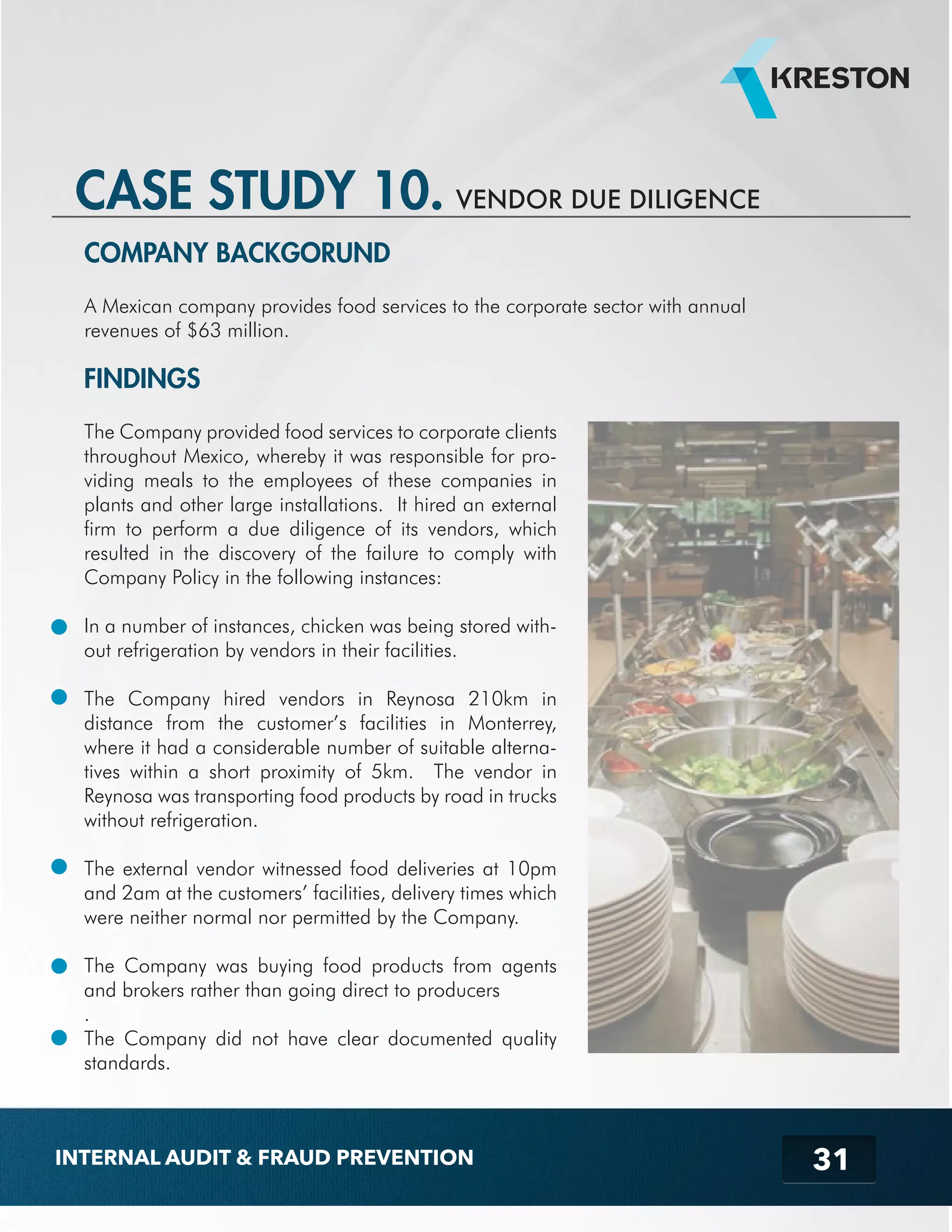
The Company provided food services to corporate clients 
throughout Mexico, whereby it was responsible for pro-viding 
meals to the employees of these companies in 
plants and other large installations. It hired an external 
firm to perform a due diligence of its vendors, which 
resulted in the discovery of the failure to comply with 
Company Policy in the following instances: 
In a number of instances, chicken was being stored with-out 
refrigeration by vendors in their facilities. 
The Company hired vendors in Reynosa 210km in 
distance from the customer’s facilities in Monterrey, 
where it had a considerable number of suitable alterna-tives 
within a short proximity of 5km. The vendor in 
Reynosa was transporting food products by road in trucks 
without refrigeration. 
The external vendor witnessed food deliveries at 10pm 
and 2am at the customers’ facilities, delivery times which 
were neither normal nor permitted by the Company. 
The Company was buying food products from agents 
and brokers rather than going direct to producers 
. 
The Company did not have clear documented quality 
standards. 
INTERNAL AUDIT & FRAUD PREVENTION
32 
CASE STUDY 10. VENDOR DUE DILIGENCE 
FINDINGS 
It was more common to use small rather than large institutional vendors. The Company’s 
level of purchasing was sufficient to be able to obtain large volume discounts. 
The external firm hired to perform the due diligence obtained alternative external quotations 
which revealed that current vendors were overcharging significantly. The percentage overcharged 
by food category are listed as follows: 
As a result of the above findings, the external firm performed a lifestyle check on the 
Purchasing Manager, as requested by the Company: 
The external firm interviewed the Purchasing Manager, who explained that he lived in a 
home of modest standards and which he had financed mainly by a bank mortgage. 
A credit check was performed on the Purchasing Manager, upon his written authorization. 
This credit check revealed that a bank loan had not been obtained. 
The title of the house where he lived was in his name and had a value which was 
significantly higher and disproportionate to his level of income. 
The Purchasing Manager agreed to hand over to the external firm his bank statements to 
prove his income and expenditure but this didn´t occur. 
The external firm concluded that the Company was overcharged by its vendors by the 
amount of $2.4 million. 
MEAT 
CHICKEN 
COLD MEAT 
GROCERIES 
22% 
27% 
17% 
15% 
INTERNAL AUDIT & FRAUD PREVENTION
33 
CASE STUDY 10. VENDOR DUE DILIGENCE 
IMPACT 
The misappropriation of funds to the amount of $2.4 million was allowed to take place due to 
the following: 
The lack of a process to monitor the moral integrity of employees in positions of confi-dence, 
especially those in procurement. 
The lack of quality standards for food vendors. 
Negligence on the part of Internal Audit. 
The Company put itself and its customers at a health risk by using small and non-institu-tional 
vendors. 
ACTIONS AND FOLLOW-UP 
The Company implemented the following: 
It implemented a Transparency Policy whereby employees in positions of trust (including 
its buyers) were obliged to deliver a list of their patrimony (assets and debts) to the Company 
once a year. 
All managers, directors and buyers were required to sign a new Code of Conduct once a 
year, declaring in writing that they were not participating in any fraud or illegal acts. 
The Company implemented a Quality Program with its vendors, whereby periodic audits 
of its vendors, their installations and transport vehicles were performed using strict guidelines. 
The Purchasing Manager resigned from the Company, without receiving any compensa-tion, 
on the basis that the Company would not take any legal action against him. 
INTERNAL AUDIT & FRAUD PREVENTION
FICTITIOUS MAINTENANCE AND 
34 
CASE STUDY 11. WHISTLEBLOWER HOTLINE 
COMPANY BACKGROUND 
A Chilean company provides ambulance emergency services. It has annual revenues of $80 
million with over 700 ambulances and 3,000 employees. 
FINDINGS 
Repairs and spare parts represented one of the principal costs of the operation of the ambulanc-es. 
The company used a software application to control the maintenance and repairs, by means 
of which each vehicle is assigned a unique number to which all repairs and costs are charged. 
Each part taken from the warehouse had to be charged to a specific ambulance. Where this 
was not the case, the written authorization of the Spare Parts Warehouse Manager was required. 
Internal Audit used to perform periodic physical cycle counts with the objective of verifying the 
inventory balances. The results of these cycle counts were satisfactory in that the physical bal-ances 
always coincided with the system. 
Even though the cycle counts did not present any variations, a group of mechanics decided to 
repeat the same repair work on the same vehicle a number of times in the same year. This was 
done by means of collusion between the drivers and the mechanics whereby the drivers would 
request a fictitious service or mechanical repair work in order to ensure that the corresponding 
spare part was requested from the warehouse. This was performed successfully as the Company 
did not have a mechanism in place to check the reasonableness of the work performed. The 
drivers would subsequently sell the spare parts in the black market and share the proceeds with 
the mechanics. The situation was discovered as a result of a whistleblower who filed an anony-mous 
report via the Company’s hotline. 
INTERNAL AUDIT & FRAUD PREVENTION
FICTITIOUS MAINTENANCE AND 
CASE STUDY 11. WHISTLEBLOWER HOTLINE 
IMPACT 
Once the above situation was determined a full audit was performed of all spare parts utilized 
with a value higher than $200 and the use of the part was compared to the useful life of each 
ambulance. Also it was determined that spare parts had left the warehouse without the required 
signature of the Warehouse Manager. 
The estimated loss to the Company from stolen spare parts was calculated at $430,000 and 
was allowed to take place due to the following: 
The lack of adequate controls to control the issuance of spare parts from the warehouse 
35 
and the lack of supervision by the Spare Parts Warehouse Supervisor. 
The lack of reasonableness checks to ensure that the use of spare parts and the cost of 
maintaining each vehicle were reasonable. 
Poor control environment in the Company resulting in the ambulance drivers being able 
to realize the ease with which they could steal the spare parts. 
ACTIONS AND FOLLOW-UP 
The Company implemented the following control measures: 
It terminated the employment of 5 mechanics and 16 drivers. 
All spare parts repair requests with a value above $300 had to be approved by the Main-tenance 
Manager. 
Modifications were made to the system such that all unusual repairs would produce an 
alert and allow the maintenance request to be fully checked to ensure that the request was 
authentic. 
INTERNAL AUDIT & FRAUD PREVENTION
CASE STUDY 12. GHOST EMPLOYEES 
COMPANY BACKGROUND 
A Mexican company provides medical emergency services with annual revenues of $200 million 
and over 700 employees. 
FINDINGS 
The external auditors of the Company discovered that salaries had continued to be paid in the 
name of employees long after their employment had been terminated by the Company. In the 
case of one employee who had resigned from the Company in April, salary deposits had been 
made for each one of the subsequent months of the calendar year. This was determined by 
comparing payroll records with the bank accounts of the Company. By reviewing the payroll 
records, it was revealed that the payroll deposits were being made to the bank account of the 
same individual, who worked in the payroll department. This individual had access to the pay-roll 
modifications in the system and was able to access the employee bank account details and 
modify them to include his own bank account details, in the case where employees were leaving 
the Company. In this way, the corresponding employee was able to continue receiving payroll 
deposits for former employees. 
The investigation was extended to the previous five years and a total of 23 cases were identified, 
all in the name of the same individual, who would keep the payments to his account (in the 
name of the former employee) alive for a few months and then remove the employee from the 
system. This individual worked in Human Resources and had access to the magnetic cards 
which controlled the access of all employees to the facilities. In the case of these 23 cases, he 
ensured that the respective magnetic cards were not destroyed and he would continue to register 
the entry and departure of these former employees so as to maintain their employment “alive” 
in the system. 
IMPACT 
The total losses were estimated at $621,000, which included both the salary amounts deposited 
to the above payroll employee and also the social security payments made by the Company to 
the respective authorities. 
36 
INTERNAL AUDIT & FRAUD PREVENTION
CASE STUDY 12. GHOST EMPLOYEES 
ACTIONS AND FOLLOW-UP 
The guilty party’s employment was terminated by the Company and criminal action was taken 
against the employee. The following corrective actions were taken by the Company: 
The assignment of a new employee responsible for updating employee hires, terminations 
37 
1 
and payroll changes in the system. 
All employee terminations were checked against subsequent payroll payments, by 
2 
Accounting. 
Surprise checks of employee assistance were performed subsequently by Accounting and 
3 
compared to the system assistance log-in. 
INTERNAL AUDIT & FRAUD PREVENTION
MISAPPROPRIATION OF COLLECTIONS 
CASE STUDY 13. (“TEEMING AND LADING”) 
COMPANY BACKGROUND 
An Argentinian company distributes and sells books through a chain of 20 bookstores with 
annual revenues of over $100 million. 
FINDINGS 
The Treasurer of the Company was able to perpetrate a fraud due to the lack of internal controls 
in the organization. The responsibilities of the Treasurer included collections and the corre-sponding 
updating of the accounting records, which represented a lack of segregation of func-tions. 
The Company had the practice of having a large number of unidentified collections from 
customers. These amounts represented deposits from different bookstores and would remain as 
unidentified deposits on the bank reconciliation statements for a number of months. When new 
deposits were received by means of cash or bearer checks, he would steal these amounts and 
replace them with the old unidentified deposits, destroying the most recent receipt. This practice 
is referred to as “teeming and lading”. The Treasurer was able to perform these defalcations 
due to his ability to access collections and the accounting records and to the weak controls over 
bank reconciliations. 
IMPACT 
The total defalcation amounted to $120,000 and was allowed to take place due to the follow-ing: 
Lack of segregation of duties between the control over collections and the accounting 
38 
records. 
The failure by Credit & Collections to pursue old past due accounts receivable balances. 
The Treasurer was able to apply recent collections to these balances. These were often minor 
balances outstanding from customers who were no longer doing business with the Company. 
INTERNAL AUDIT & FRAUD PREVENTION
MISAPPROPRIATION OF COLLECTIONS 
39 
CASE STUDY 13. (“TEEMING AND LADING”) 
IMPACT 
Lack of control. The most recent receipts relating to deposits which were misappropriated 
by the Treasurer were also cancelled by him. These cancellations went undetected by Internal 
Audit. 
Lax internal controls and reasonableness checks as the Finance Manager was unaware 
as to the accumulation of past due receivable balances which were above average for the indus-try. 
ACTIONS AND FOLLOW UP 
The Treasurer’s employment was terminated by the Company and a criminal lawsuit was initiat-ed 
against him in order to recover the misappropriated funds. Access to the accounting records 
by the new Treasurer was not permitted. A full review and overhaul of Policies and Procedures 
for Treasury, Collections and Accounting took place resulting in a new Finance Dashboard being 
implemented, to allow the Company the ability to monitor all financial ratios and metrics going 
forward. 
INTERNAL AUDIT & FRAUD PREVENTION
DISCOUNTS TO FAMILY AND 
CASE STUDY 14. FRIENDS AND WHISTLEBLOWER 
COMPANY BACKGROUND 
A U.S. company sells electro domestic products through a chain of 100 retail outlets with annual 
revenues of over $1,000 million. 
FINDINGS 
The manager of one of the retail outlets was applying discounts above the amounts established 
for purchases by family and friends. The manager had been applying these discounts for the 
previous five years but in the last year both the amount and frequency of the discounts increased 
substantially. This defalcation went undetected until another employee in the same retail outlet 
filed an anonymous report via the Company’s whistleblower hotline. 
IMPACT 
The discounts resulted in total losses of $50,000 to the Company. 
40 
The fraud was allowed to happen due to the following: 
Lax control environment and lack of reasonableness controls. The Finance Manager had 
not realized that the average discounts for that retail outlet were higher than the normal average, 
especially in the previous year. Neither had he detected the cases of sales at below cost generat-ed 
by the discounts. 
Lack of supervisory controls. The Store Manager was able to authorize the discounts with 
out any review or approval by a higher authority within the organization. 
Having discovered the defalcation the Company analyzed the behavior of the Store Man-ager 
and discovered that he had been offering and selling the stolen products online at levels 
below normal retail prices. 
INTERNAL AUDIT & FRAUD PREVENTION
DISCOUNTS TO FAMILY AND 
CASE STUDY 14. FRIENDS AND WHISTLEBLOWER 
ACTIONS AND FOLLOW-UP 
The Store Manager’s employment was terminated by the Company and criminal action was initi-ated 
by the Company to recover the misappropriated funds. The procedures for granting 
employee discounts on products at the store level were revised and the IT system was amended 
to control the maximum amounts that could be approved by managers. 
The Internal Audit Manager’s employment was also terminated by the Company due to his 
inability to detect the fraud. 
41 
INTERNAL AUDIT & FRAUD PREVENTION
MANIPULATION OF CASH 
CASE STUDY 15. RECEIPTS 
COMPANY BACKGROUND 
A Spanish subsidiary of a German holding manufactures and sells chemical products with 
annual sales of $40 million. 
FINDINGS 
The Sales Manager was authorizing sales to a customer, one of whose shareholders was an 
ex-employee of the Company. The sales to this customer were correctly registered in the books. 
In collusion with another employee of the Company, the Sales Manager falsely inflated the cash 
receipts such that the amount recorded was higher than the actual payment. This resulted in a 
liability being generated for this customer. This liability was settled by the shipping of additional 
product to the customer. 
As the customer was suffering financial difficulties, the Company accepted deferred payments 
for its invoices. The Company was allowed to discount these deferred payments with the bank, 
before their maturity, resulting in a financial cost. 
42 
INTERNAL AUDIT & FRAUD PREVENTION
MANIPULATION OF CASH 
CASE STUDY 15. RECEIPTS 
IMPACT 
The falsification of the cash receipts resulted in product to a value of $130,000 being shipped 
to the customer. The Company also incurred financial costs of $20,000 due to the discounting 
of the documents. 
43 
The above losses were allowed to take place due to the following: 
Lack of control procedures, including the fact that the Company did not have an Internal 
Audit function. 
Credit & Collections failed to circularize customers on a regular basis to reconcile bal-ances. 
Failure by the Finance Manager to detect a credit balance with the customer, which of its 
own was quite unusual. 
The Finance Manager also failed to escalate the fact that the Company was receiving 
documents from the customer with deferred payment dates. This was not an accepted practice 
for other customers. 
The failure to perform regular physical cycle counts in the plant. By performing a physical 
inventory just once a year, all differences were booked to cost of sales, resulting in the inability 
of the Company to detect the above defalcation. 
ACTIONS AND FOLLOW UP 
The employments of both the Sales Manager and the individual responsible for modifying the 
cash receipts were terminated by the Company. Procedures were modified to ensure greater 
control over sales, cash receipts and collections. 
INTERNAL AUDIT & FRAUD PREVENTION
CASE STUDY 16. GHOST VENDOR 
COMPANY BACKGROUND 
A Mexican subsidiary of a French holding distributes pharmaceutical products with annual sales 
of $300 million. 
FINDINGS 
Two years previously the Company had performed a restructuring of its Accounts Payable 
function by automating payments to vendors to ensure a speedier fulfillment of its orders from 
vendors 
A new wire transfer system was implemented allowing automated electronic transfers to 
44 
be made to the Company’s vendors. 
The new system caused quite a number of problems, as the Accounts Payable personnel 
was not properly trained on how to use the new system. 
One of the employees in Accounts Payable registered an anonymous complaint via the 
whistleblower hotline complaining about the new system and requesting an improvement in the 
process. This resulted in the Company deciding to initiate a special audit of the process with 
particular emphasis on bottlenecks and the whole implementation process. 
The auditor discovered a number of segregation of duties issues with personnel in 
Accounts Payable. He also discovered a number of invoices with unusual services and for round 
sum amounts ($4,000, $5,000 etc.) on a monthly basis. 
Upon further investigation by the auditor, he discovered that the bank account to which 
the monies were being deposited corresponded with the bank account of one of the employees 
in Accounts Payable. 
The Accounts Payable employee that was perpetrating the fraud had generated a ghost 
vendor in the system, together with fictitious invoices and had set up the bank account such that 
all payments were made on a monthly basis by wire transfer. 
INTERNAL AUDIT & FRAUD PREVENTION
CASE STUDY 16. GHOST VENDOR 
IMPACT 
The above resulted in the misappropriation of funds to the amount of $60,000 in one year. The 
following breakdown in controls allowed the fraud to occur: 
The configuration of the system profiles of personnel in Accounts Payable was not proper-ly 
set up and did not have a correct segregation of functions. For example, the same individual 
was able to add a new vendor, register invoices and process the payment. 
Internal Audit did not participate in the implementation of the new vendor payments 
45 
system. 
The new vendor payments system did not contemplate any delegation or escalation pro-cess 
based on the amounts of the payments. 
ACTIONS AND FOLLOW-UP 
A full documentation of all the invoices related to the fraud was performed in the presence of a 
notary public. The evidence was presented to the employee, who made a full confession accept-ing 
culpability for the fraud. The employee resigned from the Company and subsequently 
returned the stolen funds. 
INTERNAL AUDIT & FRAUD PREVENTION
CASE STUDY 17. MISAPPROPRIATION OF CASH 
COMPANY BACKGROUND 
An Argentinian company sells cars and agricultural machinery with annual sales of $120 
million. 
FINDINGS 
Due to a lack of controls and dishonesty, the Treasurer was able to perpetrate a fraud 
47 
resulting in a loss to the Company of $80,000. The details are set out as follows: 
The Treasurer was responsible for receiving cash from the sales of cars and agricultural 
machinery in certain cases. It was common for some customers to pay in cash in the 
rural parts of Argentina. 
He was responsible for controlling these cash receipts and delivering them to the 
transport company, whose responsibility was to deposit these monies to the Company’s 
bank account. 
The Treasurer would take monies from the cash receipts and keep them for his personal 
use with the balance being handed over to the cash transport company. He would 
subsequently register the full sale in the Company’s accounting system, triggering a 
difference between the monies deposited and the amount of the full sale. 
The Treasurer was able to cover up the fraud as he was also responsible for preparing 
the bank reconciliation statements and did not perform any follow-up on the 
outstanding differences caused by his own dishonesty. 
The Treasury liked to gamble and was seen (by an anonymous individual) betting large 
amounts of money in a casino. This person informed the CEO of the Company, who in turn 
instructed that a full audit be carried out. 
INTERNAL AUDIT & FRAUD PREVENTION
CASE STUDY 17. MISAPPROPRIATION OF CASH 
IMPACT 
The total amount of money stolen by the Treasurer amounted to $80,000. The following 
circumstances permitted the fraud to occur: 
Lack of segregation of functions in that the Treasurer was responsible for receiving cash 
and updating the system. A correct segregation of functions would ensure that one 
person is responsible for receiving cash and another for updating the accounting 
system. 
The Accounting Department did not perform the bank reconciliation statements, as 
should be their responsibility to ensure a correct segregation of functions. This would 
help ensure vigilance over the control of cash and the booking of the sale in the system. 
The Company also maintained Petty Cash balances. These were checked periodically 
by Accounting, who used to perform surprise cash counts. This is a correct control but 
should have been extended to control over the cash sales performed by the Company. 
ACTIONS AND FOLLOW-UP 
The Company’s lawyers documented the fraud together with the support of an accounting 
fraud expert. They reviewed the documentation and prepared a file detailing the misappropri-ation 
48 
of funds with dates and amounts. 
The Treasurer’s employment was terminated and a criminal lawsuit was initiated against him. 
The Company made a complete review of its internal controls and made changes to ensure 
that the correct segregation of functions and control and supervisory mechanisms were put in 
place to safeguard the assets and accounting records of the Company. 
INTERNAL AUDIT & FRAUD PREVENTION
MISAPPROPRIATION OF CASH SALES 
CASE STUDY 18. AND WHISTLEBLOWER 
COMPANY BACKGROUND 
Grupo gastronómico con 50 locales a la calle. Facturación anual estimada 72 M USD anual. 
FINDINGS 
The manager of a restaurant in Buenos Aires with one of the highest sales was able to misap-propriate 
funds by working in collusion with the cashier and another employee of the restau-rant: 
The restaurant is located in a shopping mall close to an area with a high concentration 
of secondary schools. The students were regular customers of the restaurant, paid by 
cash and did not request receipts for their meals. 
During peak hours, the cashier, manager and other employee colluded to exclude 
approximately one out of every four sales from the accounting system used to record the 
sale. The cash was safeguarded in the cash register at the time of the sale and was 
removed later at the end of the shift. 
The cashier was the sole person with access to the cash register, which could be opened 
only by registering a sale. The cashier would book the sale at a very low price, being a 
fraction of the real value of the meal (at a unit price of $0.02, for example, instead of 
$8.63). In this way, he was able to open the cash register, book the sale (at a very low 
value), give the change to the customer and leave the excess in the cash register. This 
was applied in the case of cash sales, which represented a high percentage of business. 
It was possible for the cashier to cover up the fraud by not issuing a receipt to the 
customer, which, as already mentioned, the customer did not require. 
At the end of the shift or working day, the manager and the cashier would reconcile 
cash receipts with the system and ensure that the excess was taken by them. They would 
then proceed to perform a closing of sales and cash for the day. 
49 
INTERNAL AUDIT & FRAUD PREVENTION
MISAPPROPRIATION OF CASH SALES 
50 
CASE STUDY 18. AND WHISTLEBLOWER 
HALLAZGOS 
The manager was responsible for preparing and submitting a weekly report to the 
Inventory Control Department. This report was falsely manipulated by the manager to 
ensure that any shrinkage was disguised to cover up the missing sales. 
An Internal Audit Department existed but they were negligent in that they did not perform any 
surprise visits to verify cash sales or an inventory of stock. 
The fraud was detected by means of an anonymous report filed by another employee of the 
restaurant via the Company’s whistleblower hotline. 
IMPACT 
The total fraud perpetrated by the employees in the restaurant was estimated at $360,000. 
The following breakdowns in the Company’s internal control system allowed the fraud to take 
place: 
The system allowed changes to be made to the unit values such that meal items were 
booked at a fraction of their normal retail price. 
Internal Audit was not reviewing the value of the unit items which were sold. This could 
have been easily checked against the menu prices. Neither was this detected by 
Operations, whose job it was to control the operation of the restaurants. 
Internal Audit did not perform surprise cash counts or inventory cycle counts. 
The three restaurant personnel who colluded to perpetrate the fraud had not taken 
vacation in over 24 months, a situation which should have been detected by Human 
Resources and Internal Audit. 
Operations did not properly control shrinkage for the restaurant. 
INTERNAL AUDIT & FRAUD PREVENTION
MISAPPROPRIATION OF CASH SALES 
51 
CASE STUDY 18. AND WHISTLEBLOWER 
ACTIONS AND FOLLOW-UP 
Once the whistleblower filed his report, a full investigation took place, with the participation of 
Legal, Internal Audit and Human Resources. 
An auditor was sent to the restaurant as a mystery shopper and did not receive a receipt for his 
meal, as required by Company Policy. A surprise cash count was performed and this revealed 
a large excess of cash in the cash register. 
The fraudulent activities were documented, the three employees’ employment was terminated 
by the Company and a criminal lawsuit was initiated with the objective of recovering the 
monies stolen. The system was modified to prevent any future alteration of the unit prices. 
INTERNAL AUDIT & FRAUD PREVENTION
CONCLUSIONS 
We have witnessed some of the most creative and imaginative schemes to perpetrate frauds, 
within organizations; in these cases corporations. Even though these have involved some of 
the most devious and selfish mechanisms, we are firm believers in that most of human behavior 
is focused on being creative and on growing value for the organization. Often the discontent-ed 
and demotivated seek their reward with a self-justification as a means of getting back at the 
promotion or pay rise which never took place. They feel that the monies gained by the fraud 
are just desserts for opportunities which did not come their way or compensation for the 
rewards earned by others. 
It becomes our responsibility to learn from these frauds and ensure that the adequate controls, 
structures and risk minimization techniques are implemented to prevent re-occurrence. We 
need to keep abreast of latest techniques and technologies to ensure that the organization is 
best prepared for the least expected. Training and staff development are key elements at all 
levels. 
As external consultants and specialists in internal audit, corporate governance and promoters 
of best practices, our job is to stay close to our clients and help them design and implement the 
best controls and standards available, at all times. We also need to ensure that the “tone at 
the top” is established by adopting the highest ethical standards in the organization. This 
example from the top is probably the most effective and least expensive method in achieving a 
fraud-free environment. 
In Kreston we are always striving to achieve the highest standards by developing technologies 
such as whistleblower hotlines, business analytical tools and data mining techniques all focused 
on improving our clients’ controls and profitability. 
We hope that these case studies will be a useful tool in terms of allowing us to stand back and 
take a second look within our organization to prevent these frauds from taking place. 
52 
Unless…….they have already occurred? 
INTERNAL AUDIT AND FRAUD PREVENTION 
Kreston CSM. © 
INTERNAL AUDIT & FRAUD PREVENTION
INTERNAL AUDIT & FRAUD PREVENTION 
KRESTON INTERNATIONAL: 
jon@kreston.com 
KRESTON MÉXICO: 
John Milner 
jmilner@krestoncsm.com 
KRESTON ARGENTINA: 
Martín Ghirardotti 
mghirardotti@llyasoc.com.ar 
AUTHORS: 
John Milner 
Martin Ghirardotti 
COPY STYLE: 
Enrique Pastor 
Miguel del Olmo 
CONCLUSIONS: 
Miguel del Olmo 
DESIGN: 
Alejandra Jiménez. 
POSTED BY: 
Digital Army. 
Legal: 
Kreston International © (Kreston) is a worldwide 
network of experienced, independent accounting 
firms, each with its own established client base. Each 
firm is a member of Kreston International ©, a com-pany 
registered in the UK and limited by guarantee 
and does not provide services to the clients of its 
member firms. 
Each firm is a separate entity, and as such has no 
liability for the acts or omissions of any other member 
firm. 
Kreston CSM, S.C. is a firm of accountants and busi-ness 
consultants belonging to Kreston International 
©. 
Kreston International © (Kreston) is a worldwide 
network of experienced, independent accounting 
firms, each with its own established client base. Each 
firm is a member of Kreston International ©, a com-pany 
registered in the UK and limited by guarantee 
and does not provide services to the clients of its 
member firms. 
Each firm is a separate entity, and as such has no 
liability for the acts or omissions of any other member 
firm.

Ebook audit case study

  • 1.
    INTERNAL AUDIT & FRAUD PREVENTION. Real-life case studies of prevention and detection.
  • 2.
    ABOUT THE AUTHORS JOHN MILNER John is an Irish Chartered Accountant and a part-ner of Kreston CSM. He has expertise in the areas of internal audit, due diligence, financial strategy and mergers and acquisitions. He specializes in internal control, risk evaluation and fraud preven-tion and detection. He has managed the Internal Audit departments both internationally and in Mexico for companies such as Unisys and Waldo’s. He has held Finance Director positions for other companies such as AstraZeneca, where he successfully managed the finance, tax and legal merger as Corporate CFO. He has worked extensively in Europe, Mexico and the United States and is financial advisor and a board member for a number of different compa-nies. He has successfully raised capital and per-formed due diligence for companies such as Masisa and Qualita. CO-AUTHOR INTERNAL AUDIT & FRAUD PREVENTION
  • 3.
    ABOUT THE AUTHORS MARTÍN GHIRARDOTTI Martin Ghirardotti a partner with Lisicki, Litvin & Associates, a member firm of Kreston International, CEO of Resguarda (a whistleblower hotline), member of the Executive Committee of the Institute of Internal Auditors in Argentina, Vice President of INICA and a member of ACFE (Association of Certi-fied Fraud Examiners – U.S.) He has participated as a guest speaker and panelist on numerous forums regarding money laundering, fraud, whistleblower techniques and internal audit for universities, private industry and government agencies in Argentina and throughout Latin Ameri-ca. He has written many articles in Argentina for both business magazines and newspapers, such as La Nacion, Clarin, Ambito Financiero, Revista IDEA etc. CO-AUTHOR INTERNAL AUDIT & FRAUD PREVENTION
  • 4.
    ABOUT THE AUTHORS ENRIQUE PASTOR INTRODUCTION AND PERFACE Enrique is a member of both the Institute and Col-lege of Public Accountants in Mexico. He is a Certified Public Accountant and Tax Spe-cialist from both of these bodies, is a Certified Au-ditor and qualified to perform tax and social securi-ty audits at a federal level and also at state level in Mexico City, State of Mexico and Veracruz. He has participated as a speaker at many different tax forums throughout Mexico. He is a Board member for many different compa-nies in Mexico and often acts as their commissary or auditor as required by law. He is the Treasurer for CANIETI (the Electronics, Telecommunications and Information Technologies Chamber) and is a member of the Swedish-Mexican Chamber of Commerce. He was a recognized consultant for JICA (the Japan International Cooperation Agency) in 2009 and is a partner of Kreston CSM. INTERNAL AUDIT & FRAUD PREVENTION
  • 5.
    ABOUT THE AUTHORS MIGUEL DEL OLMO Miguel is an Audit and Corporate Governance Partner of Kreston CSM. He is member of the Audit Committee for Kreston International for the Latin American region. He has over 25 years’ experience, both interna-tional and in Mexico, as a financial and tax audi-tor. He has worked and given seminars in the United States, South Africa, Argentina, Brazil, Panama, Nicaragua and Guatemala. He has particular expertise in Sarbanes-Oxley and Mexican Bankruptcy law. He is a certified Internal Auditor under ISO 9001 as stipulated by INLAC, the Latin American Quality Institute. Miguel sits on the Audit Committee for many com-panies in Mexico. CONCLUSIONS INTERNAL AUDIT & FRAUD PREVENTION
  • 6.
    CONTENTS INTRODUCTION: ...............................8 PREFACE: CASE STUDY 1 FREIGHT OVERCHARGING: CASE STUDY 2 MISAPPROPRIATION OF CASH AND CHEQUES: CASE STUDY 3 MANIPULATION OF ACCOUNTING RECORDS: CASE STUDY 4 ABUSE OF POWER BY CEO: CASE STUDY 5 TAMPERING OF CHECKS: CASE STUDY 6 GHOST VENDOR AND PERSONAL LIFESTYLE: ............................... ............................... ............................... ............................... ............................... ............................... ............................... 9 10 13 15 18 20 22 INTERNAL AUDIT & FRAUD PREVENTION
  • 7.
    CASE STUDY 7 MANAGEMENT FRAUD: ............................... 24 CASE STUDY 8 FALSIFICATION OF REVENUES: CASE STUDY 9 USE OF ANALYTICAL TECHNIQUES TO DETECT FRAUD: CASE STUDY 10 VENDOR DUE DILIGENCE: CASE STUDY 11 FICTITIOUS MAINTENANCE AND WHISTLEBLOWER HOTLINE: CASE STUDY 12 GHOST EMPLOYEES: CASE STUDY 13 MISAPPROPRIATION OF COLLECTIONS (“TEEMING AND LADING”): ............................... ............................... ............................... ............................... ............................... ............................... 26 28 31 34 36 38 CONTENTS INTERNAL AUDIT & FRAUD PREVENTION
  • 8.
    CONTENTS CASE STUDY14 DISCOUNTS TO FAMILY AND FRIENDS AND WHISTLEBLOWER: CASE STUDY 15 MANIPULATION OF CASH RECEIPTS: CASE STUDY 16 GHOST VENDOR: CASE STUDY 17 MISAPPROPRIATION OF CASH: CASE STUDY 18 MISAPPROPRIATION OF CASH SALES AND WHISTLEBLOWER: ............................... 40 ............................... ............................... ............................... ............................... 42 44 47 49 CONCLUSIONS: ............................... 52 INTERNAL AUDIT & FRAUD PREVENTION
  • 9.
    INTRODUCTION We arepleased to share a collection of fraud case studies with our readers. These are based on real-life experiences which we have accumulated over the years, some from past experiences of having worked in different organiza-tions and others from situations which we encountered with our clients in Kreston ©. It is likely that our readers will be able to draw comparisons from similar situations in their own particular environment and hopefully they will serve as a preventative mechanism within their organization. In any environ-ment, good controls, documented procedures and robust vigilance to ensure compliance will help preserve the organization’s assets and help save money. This is a joint collaboration between the Kreston offices in Mexico and Argen-tina and the cases are based on real-life experiences whereby names of countries, amounts of monies and industries have been amended to ensure that the organizations involved are not compromised. The names of the organizations have been excluded. Kreston has a global practice in Internal Audit and Risk Management where-by it helps its clients in measuring risks, defining and implementing controls and implementing mechanisms to ensure compliance and reduce the risk of fraud occurring. Co-Authors Dr. Martin Ghirardotti & John Milner Editing, Introduction and Conclusion Enrique Pastor & Miguel del Olmo Published by Kreston CSM © All rights reserved 2013 “Kreston CSM”©. The partial or complete repro-duction is prohibited without the prior written permission of the authors. 8 INTERNAL AUDIT & FRAUD PREVENTION
  • 10.
    PREFACE Since timebegan, the risk of fraud has existed in all organizations created by man. No matter how big or small the organization, corporation or government, whether it is a group of ten people or ten thousand, the potential exists for fraud to occur. One person alone can commit a fraud. Where the group is more than one and collusion exists, the fraud is easier to perpetrate and has the capacity of being of greater magnitude. In bygone times, the fraud tended to be more rudimentary and usually involved the misappropriation of cash or tangible items, such as inventory, cars or other assets. As society and commerce devel-oped, frauds became more sophisticated and involved banks and check fraud. In recent times, with the spread of e-commerce, electronic banking and the widespread adoption of ERP (Enter-pise Resource Planning) systems across governments and corporations, the variety, complexity and magnitude of frauds has increased dramatically. Whereas collusion between personnel internal and external to the organization was necessary in the past, today it is possible for per-sonnel external to the organization to perpetrate the fraud without help internally. This can be done by the ability to access and hack the organizations’ systems. The fact that fraud continues to be a factor with which modern business needs to cope, the need to design and implement control, prevention and detection mechanisms is all the more neces-sary. The controls need to be as sophisticated and as robust as the intelligence and planning that goes behind the intention to commit a fraud. Auditors need to be as familiar and as capa-ble in terms of using technology as their perpetrators in both preventing and detecting frauds. Organizations need to continually invest in structures, processes and controls at all levels from the Internal Audit Committee to the cashier at the store level. Neither should we lose sight of the desire to have a capable and motivated workforce which is focused on achieving the goals of the organization and has no wish to cause harm. We have put together 18 case studies which share real-life experiences in a number of different countries, where we realize that human nature can always fall to temptation, regardless of the culture. These case studies bring home the realization that sometimes the fraud is much closer to us than we may have imagined. We should always be conscious of maintaining and upgrad-ing controls and procedures to ensure that the organization’s assets and financial records are safeguarded and not in danger. It is important that we raise the necessary flags and ensure that protective steps are taken, even if only a doubt exists that a fraud may take place. Kreston has a global practice in Internal Audit and Risk Management whereby it helps its clients in measuring risks, defining and implementing controls and implementing mechanisms to ensure compliance and reduce the risk of fraud occurring. Note: all amounts of monies in the case studies are denominated in US dollars. INTERNAL AUDIT & FRAUD PREVENTION 9
  • 11.
    CASE STUDY 1. COMPANY BACKGROUND Argentinian subsidiary of a German parent manufactures and distributes industrial machinery products with annual revenues of $84 million. FINDINGS Operations had requested that Internal Audit make a detailed review of Transport charges. Internal Audit performed a detailed review of the Company’s database including an analysis of the charges paid with deal by customer, volume and route of the machinery which was transport-ed. The review resulted in the discovery of significant variations in the expenses incurred by the Company in freight. The review revealed the following: The excessive amount of kilometers charged. The freight supplier was billing distances in accordance with a pre-determined table. The amounts charged per kilometer and distance coincided with the table. Company personnel satisfactorily reconciled vendor invoices with the amount of kilometers charged as per the table. Internal Audit checked the distances with amounts as per guidelines issued by the government. These revealed distances as per the table far in excess of those set out in the governmental guidelines. For example, the driving distance according to the table for the journey from Buenos Aires to Rosario was 645 km, whereas the actual distance was 298km, a difference which represented an overcharge of 116%. The freight vendor was charging for additional routes. For example, the vendor had 2 deliveries on the route which started at point A and had drop-offs at points B and C, but he charged the full routes from A to B and A to C, even though he had made only one trip. This was in violation of the contractual agreement between the vendor and the Company. The vendor was charging round trips, even though the vehicles returned empty, also in violation of the agreement between the vendor and the Company. 10 FREIGHT OVERCHARGING INTERNAL AUDIT & FRAUD PREVENTION
  • 12.
    IMPACT Total misappropriationof funds amounted to $1,243,298. As a result of the review, a significant overcharge on most of the invoices issued by the vendor to the Company was detected. A comparison was made between the kilometers charged by the vendor and the actual distances. This analysis revealed that the kilometers charged were in excess of the actual distances, in the majori-ty of cases. The amounts overcharged are set out as follows: The above misappropriation of funds was allowed to happen for the following reasons: Failure by Operations personnel to review the route distances. Failure by Operations to compare the vendor’s invoices with the documental support such as shipping documents, driver and customer signatures etc. Failure by the CFO and the Operations Directors to properly review and detect adverse variations in Freight Expenses. 11 Kilometers charged by the vendor Actual kilometers Excess kilometers Amount overcharged YEAR 1 YEAR 2 TOTAL $1,973,828 $1,088,443 $885,385 $717,162 $1,376,884 $750,412 $626,472 $526,236 $3,350,712 $1,838,855 $1,511,857 $1,243,398 CASE STUDY 1. FREIGHT OVERCHARGING INTERNAL AUDIT & FRAUD PREVENTION
  • 13.
    ACTIONS AND FOLLOW-UP The Company suspended payments to the freight vendor and began negotiations to recover the over-charged amounts. It began to reduce its freight business with the vendor, and once it had recovered the negotiated amount, terminated its relationship. The Company decided not to terminate the employment of the Operations personnel, concluding that it was innocent oversight on their part. A number of corrective measures were implemented including a more detailed review of the distances, rates charged and volumes shipped, for all vendors. 12 CASE STUDY 1. FREIGHT OVERCHARGING INTERNAL AUDIT & FRAUD PREVENTION
  • 14.
    CASE STUDY 2. 13 MISAPPROPRIATION OF CASH AND CHECKS COMPANY BACKGROUND A Chilean company imports and manufactures raw materials for the electrical industry in the construction sector with annual revenues of $150 million. FINDINGS The Treasurer was misappropriating funds from the Company. Upon receipt of collections in the form of cash and checks from the collectors, the Treasurer would deposit part of these funds to her own personal account and to the accounts of third parties who had no relationship with the Company. This was possible due to: Lack of controls Conflict between Treasury and Credit & Collections and Little or no review by Internal Audit. The Treasurer maintained the misappropriated balances in accounts receivable balances. When Internal Audit performed bank reconciliations, the Treasurer would request loan balances from a financial institution and return these loans once the audit was completed (the reconcilia-tions were not performed on a surprise basis). At the same time, Credit & Collections was not performing adequate controls over the receivable balances and was not circulating customers in order to verify balances. INTERNAL AUDIT & FRAUD PREVENTION
  • 15.
    14 CASE STUDY2. MISAPPROPRIATION OF CASH AND CHECKS IMPACT The misappropriation of funds amounted to $230,000. This fraud was allowed to occur due to the following: o Lack of adequate control procedures. The reviews performed by Internal Audit were noti-fied and planned in conjunction with the Treasurer. o Credit & Collections was not performing customer circularization in order to verify account balances. Whenever an error was detected, a detailed review was not performed and Credit & Collections would request an explanation of the Treasurer who would quickly cover up any impropriety. o Subsequent investigation revealed anomalies in the behavior of the Treasurer. Upon reviewing certain account movements, it was discovered that the Treasurer was addicted to gam-bling. A history of online betting and gambling was found in her computer during working hours. This lead management to conclude that the hiring and selection process was deficient in that these character traits in her personality had not been detected. ACTIONS AND FOLLOW-UP The Treasurer was fired and a criminal law suit was taken against her in order to recover the monies stolen. Controls were reviewed and tightened in the areas of Treasury, Credit & Collec-tions and Personnel Selection. A Financial Dashboard was also updated to help prevent the reoccurrence of such a fraud. The Manager of Internal Audit was also fired for not performing surprise audits of the Treasurer. INTERNAL AUDIT & FRAUD PREVENTION
  • 16.
    MANIPULATION OF ACCOUNTING RECORDS CASE STUDY 3. COMPANY BACKGROUND Chilean subsidiary of a Canadian parent imports specialized industrial machinery, with annual revenues of $110 million. FINDINGS Internal Audit discovered a reimbursement to the local CEO for the amount of $45,456, arising from the return of a vehicle which he had acquired from the Company on October 31, 2012, via a deduction from payroll. On October 31, 2012, the vehicle, which was the property of the Com-pany, was sold to the CEO at a price of $38,781. (The CEO had the option to acquire the vehicle 15 at a pre-determined price). The CEO returned the vehicle and sold it to the Company in November 2012 at the higher price of $45,456. A check for this amount was issued by the Company to the CEO on the same day (November 11, 2012). Upon the review of the supporting documentation, it was revealed that the accounting entry of November 11, 2012 was made in December 2012. The journal entry for the check was booked in the SAP system on December 16, 2012 and the CEO signed as having received the check on December 23, 2012. This was the only check dated in the month of November in this period. All prior and subsequent checks were dated in December. The check was issued in December but booked to the accounting system with a November date. The date on the check was deliberately manipulated so as to give the impression that the vehicle was reacquired by the Company on November 11, 2012, when in fact this took place a month later. During the time that the vehicle was the property of the CEO, it was involved in an accident and it was resold to the Company in a damaged state. This apparently was the reason that the local Chilean CEO did not want to retain the ownership of the vehicle. Internal Audit had also observed that the check was prepared by an employee who worked in the Accounting Department. Corporate Policy requires that Treasury was solely responsible for the custody and emission of all checks, a breach of which occurred in this case. Segregation of duties was not applied in the emission of the check and the date and the accounting records were delib-erately altered. INTERNAL AUDIT & FRAUD PREVENTION
  • 17.
    MANIPULATION OF ACCOUNTING RECORDS CASE STUDY 3. FINDINGS The transaction was registered in the system in November, when in fact the check was prepared in December. At the date of the publication of Internal Audit’s report, the Company was unaware as to the loca-tion 16 of the vehicle. IMPACT The Chilean CEO did not have the authority to act on behalf of the Company in the purchase and sale of Fixed Assets with himself, without written approval from Corporate Head Office in Toronto. The above situation was allowed to take place due to the following: Lack of segregation of functions. Accounting had access to checks and was also respon-sible for the accounting records. Treasury did not have total control over the custody and emis-sion of checks. Deliberate alteration of the date on a check. Accounting issued the check with a Novem-ber date, when in fact the check was issued in December. Lack of control in the system. A document was allowed to be booked in December, with a November date. Abuse of power by the local CEO, who was not authorized to purchase and sell vehicles with himself. Lack of internal control. Controlling performed an incorrect transaction upon the verbal instructions of the CEO. Controlling should have received written approval from Head Office. INTERNAL AUDIT & FRAUD PREVENTION
  • 18.
    MANIPULATION OF ACCOUNTING RECORDS 17 CASE STUDY 3. ACTIONS AND FOLLOW-UP Both the CEO and the Controller were fired by Corporate Head Office. Treasury took complete control of the checkbooks and modifications were made in the SAP system such that transactions could not be booked with any date other than the date of the transaction. INTERNAL AUDIT & FRAUD PREVENTION
  • 19.
    CASE STUDY 4.ABUSE OF POWER BY CEO COMPANY BACKGROUND Company manufactures ships, with operations in Mexico, Colombia and Brazil, has over 5,000 employees and annual revenues of $280 million. FINDINGS As part of its expansion plan, the Company acquired a company in Brazil, for a price of $45 million, in order to initiate operations in that market. As part of the integration of the Brazilian acquisition into the existing operations, two cars which formed part of the Fixed Assets of the new company could not be located. An investigation revealed that, as part of the acquisition process, the CEO of the acquired compa-ny had sold these vehicles to himself at a price of ten cents each. These vehicles had a market value of $70,000 and $65,000 each, both having been acquired by the Company in the previous six months. The CEO was able to perform these transactions on behalf of the Company as in prior years Corporate Head Office had assigned wide legal powers to him. The Company had trans-ferred 18 the legal ownership of the cars to the CEO. Meetings were held subsequent to the acquisition whereby requests were made of the CEO to return the cars. INTERNAL AUDIT & FRAUD PREVENTION
  • 20.
    CASE STUDY 4.ABUSE OF POWER BY CEO IMPACT The abuse of power by the CEO resulted in the Company suffering a financial loss of $135,000. This loss was caused by an abuse of power by the CEO. The powers in the organization were clearly established in the Delegation of Authority Policy and in the Company Vehicle Policy, in which it was established that the CEO had the option to acquire vehicles which had been assigned to him at a pre-established preferential price once a period of three years employment had been reached. 19 ACTIONS AND FOLLOW-UP The Company appointed a new CEO from within its own organization rather than award the position to the CEO from the acquired company. It also initiated a criminal lawsuit against the CEO on the basis of fraud in order to recover the two vehicles. INTERNAL AUDIT & FRAUD PREVENTION
  • 21.
    COMPANY BACKGROUND Companysells auto parts with over 335 branches in over 20 cities in the United States and annual revenues of over $115 million. FINDINGS The Company used to pay vendors by preparing and mailing checks manually as a means of paying its outstanding invoices. It had sent two checks for $145,000 and $183,000, respective-ly, to two separate vendors in order to pay outstanding invoices. When performing the monthly bank reconciliation statement, the issued checks were identified on the bank statement as having been cashed. Within the following sixty days, the Company was contacted by the vendors requesting the pay-ment of their outstanding invoices, which they claimed had been past due by over sixty days. The Company checked their accounting records and confirmed that the invoices had been paid in full. The Company requested copies of the cashed checks from the bank, which revealed that the payee on both checks had been altered falsely so that they were cashed by unidentified third parties in a fraudulent manner. 20 CASE STUDY 5. TAMPERING WITH CHECKS INTERNAL AUDIT & FRAUD PREVENTION
  • 22.
    IMPACT The Companysuffered a loss of $328,000 as a result of the fraudulent alteration of two checks in the payment of vendors’ invoices. ACTIONS AND FOLLOW-UP Best practice recommends using printed checks generated from computer systems to pay ven-dors, rather than prepare them manually, and have them collected in the offices of the paying company by authorized representatives of the vendor. Electronic wire transfers are considered an even more secure form of paying vendors assuming that required control procedures are implemented. The Company changed its policy on paying vendors by restricting the use of checks to exception-al cases only and moved to electronic wire transfers, the required controls being implemented in the process. The Company informed the Police of the check fraud. An investigation to find the culprits was initiated but was unsuccessful. 21 CASE STUDY 5. TAMPERING WITH CHECKS INTERNAL AUDIT & FRAUD PREVENTION
  • 23.
    GHOST VENDOR ANDPERSONAL 22 CASE STUDY 6. LIFESTYLE COMPANY BACKGROUND Colombian company provides Information Technology services with annual revenues of over $48 million. FINDINGS An Accounts Payable Associate entered a false new vendor in the Master File in the computer system, under the concept of systems development. Each week he would register fictitious invoices with the forged signatory of the Systems Development Director. At the same time, due to the lack of segregation of duties and inadequate supervision in the Treasury Department, the same associate would prepare checks for amounts of between $500 and $600 each. The asso-ciate worked on the eight floor of the building. The procedure to pay vendors was such that another person in Treasury would bring the checks to the ground floor, to the Cashier’s office, where vendors would arrive to collect these checks. The AP Associate intervened and modified the process whereby he personally delivered the checks to the Cashier. Instead of delivering the checks for the ghost vendor, he would keep the respective checks and subsequently cash them at the bank. This did not arouse any suspicion due to the low value of the amounts of the checks. Over time the Company noted a distinct change in the associate’s lifestyle whereby his clothes, car and personal trips did not correspond with the salary which he received from the Company. This resulted in the Company ordering an investigation. IMPACT The Company suffered financial losses of up to $90,000 over a period of two years, as a result of the fictitious invoices generated by the AP associate. This fraud was allowed to occur due to the following: INTERNAL AUDIT & FRAUD PREVENTION
  • 24.
    23 IMPACT Lackof segregation of functions in that IT had no control over new vendors in the system. Accounts Payable was able to add new vendors to the system. Lack of control in that the Company allowed such a large volume of manual checks to be generated. Inadequate supervision by the Treasurer and the Manager of Accounts Payable. Lack of segregation of duties which allowed the associate to take physical control of the checks whereby he pretended to personally deliver the checks to the Cashier. ACTIONS AND FOLLOW-UP The Company fired the AP Associate and proceeded to recover the majority of the funds which had been stolen from the Company. It also implemented the following changes: Greater supervision by the Treasurer and the Manager of AP. The procedure for adding new vendors was modified such that all new vendors could be added only by IT with the approval of Purchasing. Significant reduction in the use of checks. Increase in compliance with Internal Control. More reviews by Internal Audit GHOST VENDOR AND PERSONAL CASE STUDY 6. LIFESTYLE INTERNAL AUDIT & FRAUD PREVENTION
  • 25.
    24 CASE STUDY7. MANAGEMENT FRAUD COMPANY BACKGROUND An Argentinian subsidiary of an English company imports and distributes parts for the automo-bile industry with annual revenues of $223 million. FINDINGS Management manipulated the financial results of the subsidiary by booking the following entries in the local accounting records: Freight charges from third party vendors were deferred and booked to the Income State-ment over a period of 6 months, rather than charging them directly to expense, as required by accounting best practices. This resulted in profits being inflated by $3.6 million. Importation Costs. The Company’s normal carrying period for inventory was 60 days, during which time it should have expensed the corresponding importation costs related to this product. Rather than book the importation costs to cost of goods sold over 60 days, it booked them over 180 days, resulting in the asset value of inventory being overstated by the amount of $6.4 million. Deferred Advertising Expenses. The Company deferred advertising expenses on the basis that it expected to have higher sales and improved financial results in a later period, at which time it planned to book the corresponding expense. This resulted in profits being overstated by a total of $2.8 million. Inventory Shrinkage. The Company had a historical shrinkage rate of 3.2% of sales, resulting from product being stolen, damaged or lost due to poor controls. Rather than book the 3.2% to cost of sales, the Company decided to understate costs and overstate profits by booking a lower amount of 0.8% to cost of sales. This resulted in profits being overstated by $5.8 million. INTERNAL AUDIT & FRAUD PREVENTION
  • 26.
    CASE STUDY 7.MANAGEMENT FRAUD All of the above was revealed by the Internal Audit Department as part of their detailed reviews. In order to comply with best accounting practice, a negative adjustment totaling $18.6 million was booked to account for all of the above, resulting in the subsidiary recording a loss for the fiscal year, rather than a profit. These adjustments were reviewed and approved by the external auditor as part of its statutory review. IMPACT The Company negatively impacted the results for the year to the amount of $18.6 million, due to the deliberate manipulation of the financial records. This practice is known as management fraud. The situation was caused by the following: 25 Failure to follow Generally Accepted Accounting Principles. Failure to follow Company’s Policies and Procedures. Collusion between the CEO and the CFO to allow the adjustments to take place. Deliberate manipulation of the financial results of the Company. ACTIONS AND FOLLOW-UP Corporate Office in England decided to terminate the employment of both the CEO and CFO, on the grounds of deliberate manipulation of the financial statements. The new management team reviewed Accounting Policies and implemented workshops with per-sonnel to ensure that Policy would be strictly followed going forward. INTERNAL AUDIT & FRAUD PREVENTION
  • 27.
    CASE STUDY 8.FALSIFICATION OF REVENUES COMPANY BACKGROUND A U.S. subsidiary of a Swiss corporation imports and manufactures chemical products with annual revenues of $418 million. FINDINGS The CEO of the subsidiary attempted to falsely inflate revenues by the amount of $18 million in a specific month. The operation was detected and detained by the Finance Director of the Com-pany. 26 The detailed findings are set out as follows: As part of the monthly operational and financial review, the CEO realized that the subsidi-ary was not going to achieve its monthly goal for revenues or profits. The Company had customer orders for the amount of $18 million. The manufacturing production of the products in these orders had not yet commenced. A few days prior to the month-end close, it was determined that the production of the above-mentioned products was to begin 15 days into the following month. It was unclear as to whether the Company would have been able to successfully ship the products to the customers during the following month. The CEO instructed the Finance Director to create a revenue provision of $18 million, the value of the orders. The Finance Director clarified that the revenue did not comply with the revenue recogni-tion requirements under U.S. or international GAAP (generally accepted accounting principles). A telephone conversation was held with the regional Finance Director for NAFTA, whose position was in agreement with that of the U.S. CEO. INTERNAL AUDIT & FRAUD PREVENTION
  • 28.
    27 CASE STUDY8. FALSIFICATION OF REVENUES FINDINGS The following day the U.S. Finance Director sent an email to his regional counterpart (copying the U.S. CEO) requesting written authorization in order to book the revenue provision of $18 million. He received an immediate response from the regional Finance Director denying any knowledge of the operation and instructing him not to book the revenue provision. The revenue provision was not booked. The relationship between the U.S. CEO and his Finance Director became tense, the former claiming that the Finance Director was not working as a team player in order to achieve the goals of the Company. IMPACT There was no impact, financial or otherwise, for the Company as the transaction was not booked. The attempt by the CEO to falsify the financial statements with the support of the regional Finance Director (commonly known as management fraud), was unsuccessful due to the profes-sionalism and integrity of the Finance Director of the business unit. ACTIONS AND FOLLOW-UP The above incident was the first and only attempt by management to falsify the financial results of the business unit. Although the relationship was strained, the CEO and Finance Director sub-sequently managed to work in harmony, both working within the standards of the Company and according to best practices. INTERNAL AUDIT & FRAUD PREVENTION
  • 29.
    USE OF ANALYTICALTECHNIQUES 28 COMPANY BACKGROUND A Canadian subsidiary, with a French parent, distributes and markets soft drinks products with annual revenues of $214 million. FINDINGS Internal Audit was using financial reports to detect trends in costs and expenses which lead to the detection of a fraud. The details are explained as follows: Internal Audit was using an application to access the date bases and financial systems of the Company. As part of a purchasing and procurement review, Internal Audit applied its IT tool to access the historical data base of purchases of packaging material: labels, bottles, bottletops, cardboard boxes, etc. This tool helped in revealing a number of significant variations in cost of sales for these products over a period of time. The application generated a graph which illustrated the tenden-cies and increase in costs as a percentage of sales over a period of time. Internal Audit requested and received detailed information of product cost details from other plants throughout the world, from Corporate Head office in Paris, together with the corre-sponding variations from standard or normal cost. The comparison of the prices for the Canadian subsidiary versus standard costs for a sample of some of the products is set out as follows: LABELS BOTTLES CARDBOARD BOXES BOTTLETOPS STANDARD PRICE ACTUAL PRICE % 0.87 1.21 15.41 0.42 1.14 1.46 23.47 0.66 31 21 52 57 CASE STUDY 9. TO DETECT FRAUD INTERNAL AUDIT & FRAUD PREVENTION
  • 30.
    USE OF ANALYTICALTECHNIQUES 29 CASE STUDY 9. TO DETECT FRAUD FINDINGS With the help of this information, Internal Audit performed a more detailed review, increased its testing and found the following: A number of the vendors had common owners even though they came from different sectors. Family relationship between some of the purchasing personnel and the vendors. Lack of transparency in the selection process of vendors. The failure to seek alternative quotations from other vendors, as required by Company Policy. Internal Audit concluded that the overcharging in prices by vendors resulted in a misappro-priation of funds of the Company to the amount of $3.6 million. Collusion between the Purchasing Director, 2 members of the Purchasing Department and vendors. The Company suffered a loss of $3.6 million for the following reasons: The lack of transparency in the Purchasing Department. The failure to comply with Company Policy by not obtaining alternative quotations from other vendors. The failure to comply with the Code of Ethics which prohibits family relationships between employees and vendors of the Company. The inability of local management to detect significant variations from standard costs. INTERNAL AUDIT & FRAUD PREVENTION
  • 31.
    USE OF ANALYTICALTECHNIQUES 30 CASE STUDY 9. TO DETECT FRAUD ACTIONS AND FOLLOW-UP The Company took the following actions: Termination of employment of the Purchasing Director and two buyers. Termination of the relationship with five vendors. Revision, update and publication of a new Purchasing manual, whereby controls and transparency were strengthened as part of the process. The Company succeeded in reducing its annual product costs by more than $5 million as a result of the selection and appointment of new vendors. INTERNAL AUDIT & FRAUD PREVENTION
  • 32.
    31 CASE STUDY10. VENDOR DUE DILIGENCE COMPANY BACKGORUND A Mexican company provides food services to the corporate sector with annual revenues of $63 million. FINDINGS The Company provided food services to corporate clients throughout Mexico, whereby it was responsible for pro-viding meals to the employees of these companies in plants and other large installations. It hired an external firm to perform a due diligence of its vendors, which resulted in the discovery of the failure to comply with Company Policy in the following instances: In a number of instances, chicken was being stored with-out refrigeration by vendors in their facilities. The Company hired vendors in Reynosa 210km in distance from the customer’s facilities in Monterrey, where it had a considerable number of suitable alterna-tives within a short proximity of 5km. The vendor in Reynosa was transporting food products by road in trucks without refrigeration. The external vendor witnessed food deliveries at 10pm and 2am at the customers’ facilities, delivery times which were neither normal nor permitted by the Company. The Company was buying food products from agents and brokers rather than going direct to producers . The Company did not have clear documented quality standards. INTERNAL AUDIT & FRAUD PREVENTION
  • 33.
    32 CASE STUDY10. VENDOR DUE DILIGENCE FINDINGS It was more common to use small rather than large institutional vendors. The Company’s level of purchasing was sufficient to be able to obtain large volume discounts. The external firm hired to perform the due diligence obtained alternative external quotations which revealed that current vendors were overcharging significantly. The percentage overcharged by food category are listed as follows: As a result of the above findings, the external firm performed a lifestyle check on the Purchasing Manager, as requested by the Company: The external firm interviewed the Purchasing Manager, who explained that he lived in a home of modest standards and which he had financed mainly by a bank mortgage. A credit check was performed on the Purchasing Manager, upon his written authorization. This credit check revealed that a bank loan had not been obtained. The title of the house where he lived was in his name and had a value which was significantly higher and disproportionate to his level of income. The Purchasing Manager agreed to hand over to the external firm his bank statements to prove his income and expenditure but this didn´t occur. The external firm concluded that the Company was overcharged by its vendors by the amount of $2.4 million. MEAT CHICKEN COLD MEAT GROCERIES 22% 27% 17% 15% INTERNAL AUDIT & FRAUD PREVENTION
  • 34.
    33 CASE STUDY10. VENDOR DUE DILIGENCE IMPACT The misappropriation of funds to the amount of $2.4 million was allowed to take place due to the following: The lack of a process to monitor the moral integrity of employees in positions of confi-dence, especially those in procurement. The lack of quality standards for food vendors. Negligence on the part of Internal Audit. The Company put itself and its customers at a health risk by using small and non-institu-tional vendors. ACTIONS AND FOLLOW-UP The Company implemented the following: It implemented a Transparency Policy whereby employees in positions of trust (including its buyers) were obliged to deliver a list of their patrimony (assets and debts) to the Company once a year. All managers, directors and buyers were required to sign a new Code of Conduct once a year, declaring in writing that they were not participating in any fraud or illegal acts. The Company implemented a Quality Program with its vendors, whereby periodic audits of its vendors, their installations and transport vehicles were performed using strict guidelines. The Purchasing Manager resigned from the Company, without receiving any compensa-tion, on the basis that the Company would not take any legal action against him. INTERNAL AUDIT & FRAUD PREVENTION
  • 35.
    FICTITIOUS MAINTENANCE AND 34 CASE STUDY 11. WHISTLEBLOWER HOTLINE COMPANY BACKGROUND A Chilean company provides ambulance emergency services. It has annual revenues of $80 million with over 700 ambulances and 3,000 employees. FINDINGS Repairs and spare parts represented one of the principal costs of the operation of the ambulanc-es. The company used a software application to control the maintenance and repairs, by means of which each vehicle is assigned a unique number to which all repairs and costs are charged. Each part taken from the warehouse had to be charged to a specific ambulance. Where this was not the case, the written authorization of the Spare Parts Warehouse Manager was required. Internal Audit used to perform periodic physical cycle counts with the objective of verifying the inventory balances. The results of these cycle counts were satisfactory in that the physical bal-ances always coincided with the system. Even though the cycle counts did not present any variations, a group of mechanics decided to repeat the same repair work on the same vehicle a number of times in the same year. This was done by means of collusion between the drivers and the mechanics whereby the drivers would request a fictitious service or mechanical repair work in order to ensure that the corresponding spare part was requested from the warehouse. This was performed successfully as the Company did not have a mechanism in place to check the reasonableness of the work performed. The drivers would subsequently sell the spare parts in the black market and share the proceeds with the mechanics. The situation was discovered as a result of a whistleblower who filed an anony-mous report via the Company’s hotline. INTERNAL AUDIT & FRAUD PREVENTION
  • 36.
    FICTITIOUS MAINTENANCE AND CASE STUDY 11. WHISTLEBLOWER HOTLINE IMPACT Once the above situation was determined a full audit was performed of all spare parts utilized with a value higher than $200 and the use of the part was compared to the useful life of each ambulance. Also it was determined that spare parts had left the warehouse without the required signature of the Warehouse Manager. The estimated loss to the Company from stolen spare parts was calculated at $430,000 and was allowed to take place due to the following: The lack of adequate controls to control the issuance of spare parts from the warehouse 35 and the lack of supervision by the Spare Parts Warehouse Supervisor. The lack of reasonableness checks to ensure that the use of spare parts and the cost of maintaining each vehicle were reasonable. Poor control environment in the Company resulting in the ambulance drivers being able to realize the ease with which they could steal the spare parts. ACTIONS AND FOLLOW-UP The Company implemented the following control measures: It terminated the employment of 5 mechanics and 16 drivers. All spare parts repair requests with a value above $300 had to be approved by the Main-tenance Manager. Modifications were made to the system such that all unusual repairs would produce an alert and allow the maintenance request to be fully checked to ensure that the request was authentic. INTERNAL AUDIT & FRAUD PREVENTION
  • 37.
    CASE STUDY 12.GHOST EMPLOYEES COMPANY BACKGROUND A Mexican company provides medical emergency services with annual revenues of $200 million and over 700 employees. FINDINGS The external auditors of the Company discovered that salaries had continued to be paid in the name of employees long after their employment had been terminated by the Company. In the case of one employee who had resigned from the Company in April, salary deposits had been made for each one of the subsequent months of the calendar year. This was determined by comparing payroll records with the bank accounts of the Company. By reviewing the payroll records, it was revealed that the payroll deposits were being made to the bank account of the same individual, who worked in the payroll department. This individual had access to the pay-roll modifications in the system and was able to access the employee bank account details and modify them to include his own bank account details, in the case where employees were leaving the Company. In this way, the corresponding employee was able to continue receiving payroll deposits for former employees. The investigation was extended to the previous five years and a total of 23 cases were identified, all in the name of the same individual, who would keep the payments to his account (in the name of the former employee) alive for a few months and then remove the employee from the system. This individual worked in Human Resources and had access to the magnetic cards which controlled the access of all employees to the facilities. In the case of these 23 cases, he ensured that the respective magnetic cards were not destroyed and he would continue to register the entry and departure of these former employees so as to maintain their employment “alive” in the system. IMPACT The total losses were estimated at $621,000, which included both the salary amounts deposited to the above payroll employee and also the social security payments made by the Company to the respective authorities. 36 INTERNAL AUDIT & FRAUD PREVENTION
  • 38.
    CASE STUDY 12.GHOST EMPLOYEES ACTIONS AND FOLLOW-UP The guilty party’s employment was terminated by the Company and criminal action was taken against the employee. The following corrective actions were taken by the Company: The assignment of a new employee responsible for updating employee hires, terminations 37 1 and payroll changes in the system. All employee terminations were checked against subsequent payroll payments, by 2 Accounting. Surprise checks of employee assistance were performed subsequently by Accounting and 3 compared to the system assistance log-in. INTERNAL AUDIT & FRAUD PREVENTION
  • 39.
    MISAPPROPRIATION OF COLLECTIONS CASE STUDY 13. (“TEEMING AND LADING”) COMPANY BACKGROUND An Argentinian company distributes and sells books through a chain of 20 bookstores with annual revenues of over $100 million. FINDINGS The Treasurer of the Company was able to perpetrate a fraud due to the lack of internal controls in the organization. The responsibilities of the Treasurer included collections and the corre-sponding updating of the accounting records, which represented a lack of segregation of func-tions. The Company had the practice of having a large number of unidentified collections from customers. These amounts represented deposits from different bookstores and would remain as unidentified deposits on the bank reconciliation statements for a number of months. When new deposits were received by means of cash or bearer checks, he would steal these amounts and replace them with the old unidentified deposits, destroying the most recent receipt. This practice is referred to as “teeming and lading”. The Treasurer was able to perform these defalcations due to his ability to access collections and the accounting records and to the weak controls over bank reconciliations. IMPACT The total defalcation amounted to $120,000 and was allowed to take place due to the follow-ing: Lack of segregation of duties between the control over collections and the accounting 38 records. The failure by Credit & Collections to pursue old past due accounts receivable balances. The Treasurer was able to apply recent collections to these balances. These were often minor balances outstanding from customers who were no longer doing business with the Company. INTERNAL AUDIT & FRAUD PREVENTION
  • 40.
    MISAPPROPRIATION OF COLLECTIONS 39 CASE STUDY 13. (“TEEMING AND LADING”) IMPACT Lack of control. The most recent receipts relating to deposits which were misappropriated by the Treasurer were also cancelled by him. These cancellations went undetected by Internal Audit. Lax internal controls and reasonableness checks as the Finance Manager was unaware as to the accumulation of past due receivable balances which were above average for the indus-try. ACTIONS AND FOLLOW UP The Treasurer’s employment was terminated by the Company and a criminal lawsuit was initiat-ed against him in order to recover the misappropriated funds. Access to the accounting records by the new Treasurer was not permitted. A full review and overhaul of Policies and Procedures for Treasury, Collections and Accounting took place resulting in a new Finance Dashboard being implemented, to allow the Company the ability to monitor all financial ratios and metrics going forward. INTERNAL AUDIT & FRAUD PREVENTION
  • 41.
    DISCOUNTS TO FAMILYAND CASE STUDY 14. FRIENDS AND WHISTLEBLOWER COMPANY BACKGROUND A U.S. company sells electro domestic products through a chain of 100 retail outlets with annual revenues of over $1,000 million. FINDINGS The manager of one of the retail outlets was applying discounts above the amounts established for purchases by family and friends. The manager had been applying these discounts for the previous five years but in the last year both the amount and frequency of the discounts increased substantially. This defalcation went undetected until another employee in the same retail outlet filed an anonymous report via the Company’s whistleblower hotline. IMPACT The discounts resulted in total losses of $50,000 to the Company. 40 The fraud was allowed to happen due to the following: Lax control environment and lack of reasonableness controls. The Finance Manager had not realized that the average discounts for that retail outlet were higher than the normal average, especially in the previous year. Neither had he detected the cases of sales at below cost generat-ed by the discounts. Lack of supervisory controls. The Store Manager was able to authorize the discounts with out any review or approval by a higher authority within the organization. Having discovered the defalcation the Company analyzed the behavior of the Store Man-ager and discovered that he had been offering and selling the stolen products online at levels below normal retail prices. INTERNAL AUDIT & FRAUD PREVENTION
  • 42.
    DISCOUNTS TO FAMILYAND CASE STUDY 14. FRIENDS AND WHISTLEBLOWER ACTIONS AND FOLLOW-UP The Store Manager’s employment was terminated by the Company and criminal action was initi-ated by the Company to recover the misappropriated funds. The procedures for granting employee discounts on products at the store level were revised and the IT system was amended to control the maximum amounts that could be approved by managers. The Internal Audit Manager’s employment was also terminated by the Company due to his inability to detect the fraud. 41 INTERNAL AUDIT & FRAUD PREVENTION
  • 43.
    MANIPULATION OF CASH CASE STUDY 15. RECEIPTS COMPANY BACKGROUND A Spanish subsidiary of a German holding manufactures and sells chemical products with annual sales of $40 million. FINDINGS The Sales Manager was authorizing sales to a customer, one of whose shareholders was an ex-employee of the Company. The sales to this customer were correctly registered in the books. In collusion with another employee of the Company, the Sales Manager falsely inflated the cash receipts such that the amount recorded was higher than the actual payment. This resulted in a liability being generated for this customer. This liability was settled by the shipping of additional product to the customer. As the customer was suffering financial difficulties, the Company accepted deferred payments for its invoices. The Company was allowed to discount these deferred payments with the bank, before their maturity, resulting in a financial cost. 42 INTERNAL AUDIT & FRAUD PREVENTION
  • 44.
    MANIPULATION OF CASH CASE STUDY 15. RECEIPTS IMPACT The falsification of the cash receipts resulted in product to a value of $130,000 being shipped to the customer. The Company also incurred financial costs of $20,000 due to the discounting of the documents. 43 The above losses were allowed to take place due to the following: Lack of control procedures, including the fact that the Company did not have an Internal Audit function. Credit & Collections failed to circularize customers on a regular basis to reconcile bal-ances. Failure by the Finance Manager to detect a credit balance with the customer, which of its own was quite unusual. The Finance Manager also failed to escalate the fact that the Company was receiving documents from the customer with deferred payment dates. This was not an accepted practice for other customers. The failure to perform regular physical cycle counts in the plant. By performing a physical inventory just once a year, all differences were booked to cost of sales, resulting in the inability of the Company to detect the above defalcation. ACTIONS AND FOLLOW UP The employments of both the Sales Manager and the individual responsible for modifying the cash receipts were terminated by the Company. Procedures were modified to ensure greater control over sales, cash receipts and collections. INTERNAL AUDIT & FRAUD PREVENTION
  • 45.
    CASE STUDY 16.GHOST VENDOR COMPANY BACKGROUND A Mexican subsidiary of a French holding distributes pharmaceutical products with annual sales of $300 million. FINDINGS Two years previously the Company had performed a restructuring of its Accounts Payable function by automating payments to vendors to ensure a speedier fulfillment of its orders from vendors A new wire transfer system was implemented allowing automated electronic transfers to 44 be made to the Company’s vendors. The new system caused quite a number of problems, as the Accounts Payable personnel was not properly trained on how to use the new system. One of the employees in Accounts Payable registered an anonymous complaint via the whistleblower hotline complaining about the new system and requesting an improvement in the process. This resulted in the Company deciding to initiate a special audit of the process with particular emphasis on bottlenecks and the whole implementation process. The auditor discovered a number of segregation of duties issues with personnel in Accounts Payable. He also discovered a number of invoices with unusual services and for round sum amounts ($4,000, $5,000 etc.) on a monthly basis. Upon further investigation by the auditor, he discovered that the bank account to which the monies were being deposited corresponded with the bank account of one of the employees in Accounts Payable. The Accounts Payable employee that was perpetrating the fraud had generated a ghost vendor in the system, together with fictitious invoices and had set up the bank account such that all payments were made on a monthly basis by wire transfer. INTERNAL AUDIT & FRAUD PREVENTION
  • 46.
    CASE STUDY 16.GHOST VENDOR IMPACT The above resulted in the misappropriation of funds to the amount of $60,000 in one year. The following breakdown in controls allowed the fraud to occur: The configuration of the system profiles of personnel in Accounts Payable was not proper-ly set up and did not have a correct segregation of functions. For example, the same individual was able to add a new vendor, register invoices and process the payment. Internal Audit did not participate in the implementation of the new vendor payments 45 system. The new vendor payments system did not contemplate any delegation or escalation pro-cess based on the amounts of the payments. ACTIONS AND FOLLOW-UP A full documentation of all the invoices related to the fraud was performed in the presence of a notary public. The evidence was presented to the employee, who made a full confession accept-ing culpability for the fraud. The employee resigned from the Company and subsequently returned the stolen funds. INTERNAL AUDIT & FRAUD PREVENTION
  • 47.
    CASE STUDY 17.MISAPPROPRIATION OF CASH COMPANY BACKGROUND An Argentinian company sells cars and agricultural machinery with annual sales of $120 million. FINDINGS Due to a lack of controls and dishonesty, the Treasurer was able to perpetrate a fraud 47 resulting in a loss to the Company of $80,000. The details are set out as follows: The Treasurer was responsible for receiving cash from the sales of cars and agricultural machinery in certain cases. It was common for some customers to pay in cash in the rural parts of Argentina. He was responsible for controlling these cash receipts and delivering them to the transport company, whose responsibility was to deposit these monies to the Company’s bank account. The Treasurer would take monies from the cash receipts and keep them for his personal use with the balance being handed over to the cash transport company. He would subsequently register the full sale in the Company’s accounting system, triggering a difference between the monies deposited and the amount of the full sale. The Treasurer was able to cover up the fraud as he was also responsible for preparing the bank reconciliation statements and did not perform any follow-up on the outstanding differences caused by his own dishonesty. The Treasury liked to gamble and was seen (by an anonymous individual) betting large amounts of money in a casino. This person informed the CEO of the Company, who in turn instructed that a full audit be carried out. INTERNAL AUDIT & FRAUD PREVENTION
  • 48.
    CASE STUDY 17.MISAPPROPRIATION OF CASH IMPACT The total amount of money stolen by the Treasurer amounted to $80,000. The following circumstances permitted the fraud to occur: Lack of segregation of functions in that the Treasurer was responsible for receiving cash and updating the system. A correct segregation of functions would ensure that one person is responsible for receiving cash and another for updating the accounting system. The Accounting Department did not perform the bank reconciliation statements, as should be their responsibility to ensure a correct segregation of functions. This would help ensure vigilance over the control of cash and the booking of the sale in the system. The Company also maintained Petty Cash balances. These were checked periodically by Accounting, who used to perform surprise cash counts. This is a correct control but should have been extended to control over the cash sales performed by the Company. ACTIONS AND FOLLOW-UP The Company’s lawyers documented the fraud together with the support of an accounting fraud expert. They reviewed the documentation and prepared a file detailing the misappropri-ation 48 of funds with dates and amounts. The Treasurer’s employment was terminated and a criminal lawsuit was initiated against him. The Company made a complete review of its internal controls and made changes to ensure that the correct segregation of functions and control and supervisory mechanisms were put in place to safeguard the assets and accounting records of the Company. INTERNAL AUDIT & FRAUD PREVENTION
  • 49.
    MISAPPROPRIATION OF CASHSALES CASE STUDY 18. AND WHISTLEBLOWER COMPANY BACKGROUND Grupo gastronómico con 50 locales a la calle. Facturación anual estimada 72 M USD anual. FINDINGS The manager of a restaurant in Buenos Aires with one of the highest sales was able to misap-propriate funds by working in collusion with the cashier and another employee of the restau-rant: The restaurant is located in a shopping mall close to an area with a high concentration of secondary schools. The students were regular customers of the restaurant, paid by cash and did not request receipts for their meals. During peak hours, the cashier, manager and other employee colluded to exclude approximately one out of every four sales from the accounting system used to record the sale. The cash was safeguarded in the cash register at the time of the sale and was removed later at the end of the shift. The cashier was the sole person with access to the cash register, which could be opened only by registering a sale. The cashier would book the sale at a very low price, being a fraction of the real value of the meal (at a unit price of $0.02, for example, instead of $8.63). In this way, he was able to open the cash register, book the sale (at a very low value), give the change to the customer and leave the excess in the cash register. This was applied in the case of cash sales, which represented a high percentage of business. It was possible for the cashier to cover up the fraud by not issuing a receipt to the customer, which, as already mentioned, the customer did not require. At the end of the shift or working day, the manager and the cashier would reconcile cash receipts with the system and ensure that the excess was taken by them. They would then proceed to perform a closing of sales and cash for the day. 49 INTERNAL AUDIT & FRAUD PREVENTION
  • 50.
    MISAPPROPRIATION OF CASHSALES 50 CASE STUDY 18. AND WHISTLEBLOWER HALLAZGOS The manager was responsible for preparing and submitting a weekly report to the Inventory Control Department. This report was falsely manipulated by the manager to ensure that any shrinkage was disguised to cover up the missing sales. An Internal Audit Department existed but they were negligent in that they did not perform any surprise visits to verify cash sales or an inventory of stock. The fraud was detected by means of an anonymous report filed by another employee of the restaurant via the Company’s whistleblower hotline. IMPACT The total fraud perpetrated by the employees in the restaurant was estimated at $360,000. The following breakdowns in the Company’s internal control system allowed the fraud to take place: The system allowed changes to be made to the unit values such that meal items were booked at a fraction of their normal retail price. Internal Audit was not reviewing the value of the unit items which were sold. This could have been easily checked against the menu prices. Neither was this detected by Operations, whose job it was to control the operation of the restaurants. Internal Audit did not perform surprise cash counts or inventory cycle counts. The three restaurant personnel who colluded to perpetrate the fraud had not taken vacation in over 24 months, a situation which should have been detected by Human Resources and Internal Audit. Operations did not properly control shrinkage for the restaurant. INTERNAL AUDIT & FRAUD PREVENTION
  • 51.
    MISAPPROPRIATION OF CASHSALES 51 CASE STUDY 18. AND WHISTLEBLOWER ACTIONS AND FOLLOW-UP Once the whistleblower filed his report, a full investigation took place, with the participation of Legal, Internal Audit and Human Resources. An auditor was sent to the restaurant as a mystery shopper and did not receive a receipt for his meal, as required by Company Policy. A surprise cash count was performed and this revealed a large excess of cash in the cash register. The fraudulent activities were documented, the three employees’ employment was terminated by the Company and a criminal lawsuit was initiated with the objective of recovering the monies stolen. The system was modified to prevent any future alteration of the unit prices. INTERNAL AUDIT & FRAUD PREVENTION
  • 52.
    CONCLUSIONS We havewitnessed some of the most creative and imaginative schemes to perpetrate frauds, within organizations; in these cases corporations. Even though these have involved some of the most devious and selfish mechanisms, we are firm believers in that most of human behavior is focused on being creative and on growing value for the organization. Often the discontent-ed and demotivated seek their reward with a self-justification as a means of getting back at the promotion or pay rise which never took place. They feel that the monies gained by the fraud are just desserts for opportunities which did not come their way or compensation for the rewards earned by others. It becomes our responsibility to learn from these frauds and ensure that the adequate controls, structures and risk minimization techniques are implemented to prevent re-occurrence. We need to keep abreast of latest techniques and technologies to ensure that the organization is best prepared for the least expected. Training and staff development are key elements at all levels. As external consultants and specialists in internal audit, corporate governance and promoters of best practices, our job is to stay close to our clients and help them design and implement the best controls and standards available, at all times. We also need to ensure that the “tone at the top” is established by adopting the highest ethical standards in the organization. This example from the top is probably the most effective and least expensive method in achieving a fraud-free environment. In Kreston we are always striving to achieve the highest standards by developing technologies such as whistleblower hotlines, business analytical tools and data mining techniques all focused on improving our clients’ controls and profitability. We hope that these case studies will be a useful tool in terms of allowing us to stand back and take a second look within our organization to prevent these frauds from taking place. 52 Unless…….they have already occurred? INTERNAL AUDIT AND FRAUD PREVENTION Kreston CSM. © INTERNAL AUDIT & FRAUD PREVENTION
  • 53.
    INTERNAL AUDIT &FRAUD PREVENTION KRESTON INTERNATIONAL: jon@kreston.com KRESTON MÉXICO: John Milner jmilner@krestoncsm.com KRESTON ARGENTINA: Martín Ghirardotti mghirardotti@llyasoc.com.ar AUTHORS: John Milner Martin Ghirardotti COPY STYLE: Enrique Pastor Miguel del Olmo CONCLUSIONS: Miguel del Olmo DESIGN: Alejandra Jiménez. POSTED BY: Digital Army. Legal: Kreston International © (Kreston) is a worldwide network of experienced, independent accounting firms, each with its own established client base. Each firm is a member of Kreston International ©, a com-pany registered in the UK and limited by guarantee and does not provide services to the clients of its member firms. Each firm is a separate entity, and as such has no liability for the acts or omissions of any other member firm. Kreston CSM, S.C. is a firm of accountants and busi-ness consultants belonging to Kreston International ©. Kreston International © (Kreston) is a worldwide network of experienced, independent accounting firms, each with its own established client base. Each firm is a member of Kreston International ©, a com-pany registered in the UK and limited by guarantee and does not provide services to the clients of its member firms. Each firm is a separate entity, and as such has no liability for the acts or omissions of any other member firm.