20-1
Chapter 15
Product Liability and Consumer
Protection
20-2
Learning Objectives
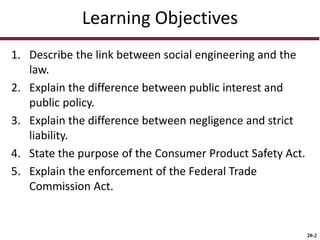
1. Describe the link between social engineering and the
law.
2. Explain the difference between public interest and
public policy.
3. Explain the difference between negligence and strict
liability.
4. State the purpose of the Consumer Product Safety Act.
5. Explain the enforcement of the Federal Trade
Commission Act.
20-3
Learning Objectives
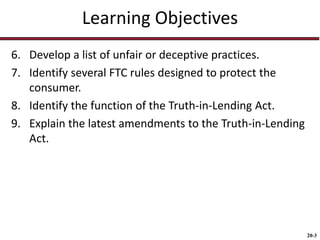
6. Develop a list of unfair or deceptive practices.
7. Identify several FTC rules designed to protect the
consumer.
8. Identify the function of the Truth-in-Lending Act.
9. Explain the latest amendments to the Truth-in-Lending
Act.
20-4
Social Engineering and the Law
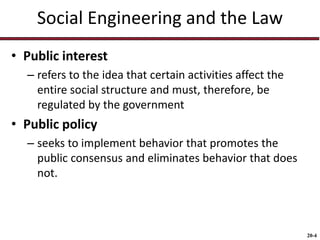
• Public interest
– refers to the idea that certain activities affect the
entire social structure and must, therefore, be
regulated by the government
• Public policy
– seeks to implement behavior that promotes the
public consensus and eliminates behavior that does
not.
20-5
Product Liability (tort law)
• A buyer or user of a product who is injured
because of the product’s unsafe or defective
condition may recover damages from the
manufacturer, the seller, or the supplier of the
goods.
• Two areas:
– Negligence
– Strict liability
20-6
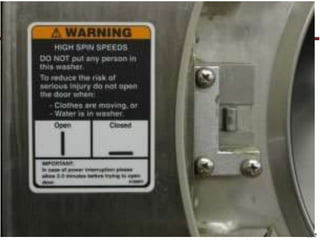
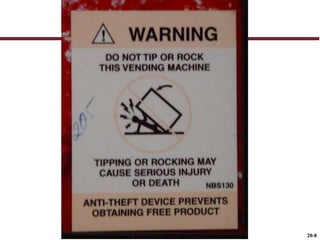
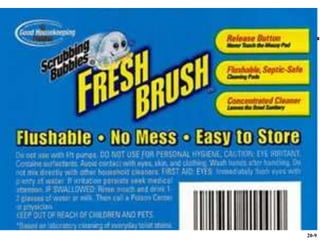
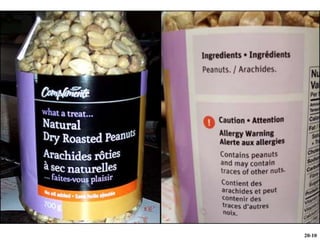
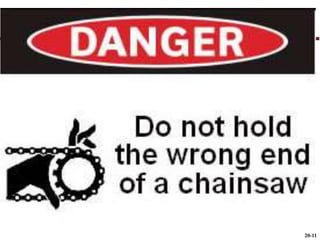
Defect
• The defective condition may arise through:
– faulty product design
– faulty manufacturing
– inadequate warning of danger
– improper instructions for the product’s use
20-7
20-8
20-9
20-10
20-11
20-12
Negligence
• Failure to exercise that degree of care that a
reasonable person would have exercised under
the same circumstances and conditions
20-13
Negligence
To recover for negligence in a product
liability case, the victim must prove:
1. that the manufacturer or seller owed a duty to
the victim
2. that the manufacturer or the seller violated that
duty by not following the appropriate standard
of care;
20-14
Negligence
3. that the victim suffered an injury because of that
careless action
4. the careless action was both the actual and the
proximate cause of the victim’s injury.
20-15
Strict Liability
• Legal theory that imposes liability on
manufacturers or suppliers for selling goods that
are unreasonably dangerous, without regard to
fault or negligence
• Principal consideration is the safety of the
product
• Manufacturers have a duty to make reasonably
safe products, provide instructions for proper
use, and warn of possible danger
20-16
Consumer Product Safety Act
• Established the Consumer Product Safety
Commission (CPSC) to protect consumers from
unreasonable risk or injury from hazardous
products
• CPSC can order recalls, impose civil fines, and
cease-and-desist orders
20-17
Federal and State Consumer Protection Laws
• Consumer protection laws apply to transactions
between someone conducting a business and a
consumer
• Consumer
– someone who buys or leases real estate, goods, or
services for personal, family, or household purposes.
20-18
Federal and State Consumer
Protection Laws
• Federal Trade Commission (FTC) Act defines
commerce as “commerce among the several
states or with foreign nations or the District of
Columbia.”
• Interstate commerce
– business activity that touches more than one state
• Intrastate commerce
– no out-of-state connections, not governed by FTC
20-19
Federal and State Consumer
Protection Laws
• Some tools of the FTC:
– Consent order
• the company agrees to stop the disputed practice without
necessarily admitting that it violated the law
– Complaint
• Begins hearing process before an administrative law judge
– Cease-and-desist order
• If a violation is found
20-20
Unfair or Deceptive Act or Practices
• Fraudulent Misrepresentations
• Unordered Merchandise
• Bait-and-Switch Schemes
• Odometer Tampering
20-21
Unfair or Deceptive Act or Practices
• Fraudulent misrepresentation
– a statement that has the effect of deceiving the buyer
• Usually occurs when the seller misstates facts
important to the consumer.
20-22
Unordered Merchandise
• It is a violation of the postal law and the FTC Act
to send merchandise through the mail to people
who did not order it
– Exceptions: free samples, goods sent by charitable
organizations soliciting contributions
• Illegal to send a bill for such unordered
merchandise or to send dunning letters
• People who receive unordered merchandise may
keep/use/dispose it with no obligation to the
sender
20-23
Unfair or Deceptive Act or Practices
• Bait-and-switch scheme
– an alluring but insincere offer to sell a product or
service
• “No advertisement containing an offer to sell a
product shall be made when the offer is not a
bona fide effort to sell the advertised product”
• FTC guide against Bait Advertising
• FTC policy statement on deception
• Advertising FAQ’s for small businesses
20-24
Odometer Tampering
• The federal Odometer Law prohibits people from
disconnecting, resetting, or altering the
odometer of a motor vehicle to register any
mileage other than the true mileage driven.
20-25
The FTC Trade Regulation Rules
• Used Car Rule
• Cooling-Off Rule
• Negative Option Rule
• Identity Theft
• Online Transactions Involving Foreign Countries
• Antispam Law
• Antislamming Law
• Mail, Telephone, Internet, or Fax Rule
• Telemarketing Sales Rule
• 900-Telephone Number Rules
20-26
The FTC Trade Regulation Rules
• Used Car Rule
– requires used car dealers that sell more than five used
vehicles in a 12-month period to place a window
sticker, called a Buyer’s Guide, in the window of each
used car they offer for sale.
• Information on warranties
• Statement not to rely on spoken promises
• Suggestion that consumer have mechanic inspect the
vehicle
• List of the major systems of an automobile and some major
defects that can happen in them
• Dealer’s guide to used car rule FTC used car guide
20-27
The FTC Trade Regulation Rules
• Cooling-Off Rule
– sales of consumer goods or services over $25 made
away from the seller’s regular place of business, such
as at a customer’s home, may be canceled within
three business days after the sale occurs.
• Does not apply to:
– Sales made totally by mail or phone,
– sales for real estate,
– Insurance or securities,
– emergency home repairs,
– arts and crafts sold at fairs or other locations
20-28
The FTC Trade Regulation Rules
Negative Option Rule - sellers must tell subscribers:
• How many selections they must buy, if any.
• How and when they can cancel the membership.
• How to notify the seller when they do not want the selection.
• When to return the “negative option” form to cancel shipment of
a selection.
• When they can get credit for return of a selection
• How postage and handling costs are charged
• How often they will receive announcements and forms
20-29
The FTC Trade Regulation Rules
• Mail, Telephone, Internet, or Fax Rule
– sellers must ship orders within the time promised in
their advertisements
– If no time period is promised, sellers must either ship
the order within 30 days after they receive it or send
the consumer an option notice
• Option notice – notifies buyer of delay and gives buyer right
to either agree to the delay or cancel the order
20-30
The FTC Trade Regulation Rules
• Telemarketing Sales Rule
– designed to protect consumers from abusive and
unscrupulous telemarketers
– established the Do Not Call Registry
– requires telemarketing firms to identify themselves on
Caller ID technology
– sets various other restrictions on telemarketing
– https://www.donotcall.gov/
– Telemarketing Sales Rule compliance guide
20-31
900-Telephone Number Rules
• FTC regulations require that people who dial 900-
prefix numbers be warned of the cost of the calls
and given a chance to hang up before being
charged.
• Telephone companies must block service to 900-
prefix numbers if so requested by the customer.
20-32
The FTC Trade Regulation Rules
• Can Spam Act
– unsolicited commercial e-mail messages must be
truthful and cannot use misleading subject lines or
incorrect return addresses
– Compliance guide for businesses
20-33
The FTC Trade Regulation Rules
• Slamming
– the illegal practice of changing a consumer’s
telephone service without permission.
– If you’ve been slammed and haven’t paid your bill yet,
you don’t have to pay anyone for up to 30 days after
being slammed
– If you have already paid your bill, the slamming
company must pay your authorized company 150% of
the charges you paid them. 50% of the charges you
paid would be reimbursed to you.
20-34
The FTC Trade Regulation Rules
• Identity theft
– occurs when someone uses another’s identifying
information without their permission to commit fraud
or other crimes
20-35
Online Transactions Involving Foreign Countries
• When there is a problem involving an online
transaction with someone in a foreign country,
consumers may file a complaint at
www.econsumer.gov
20-36
Consumer Credit Laws
• Truth in Lending
• Equal Credit Opportunity
• Unauthorized Use of Credit Cards
• Fair Credit Reporting
• Fair Credit Billing
• Fair Debt Collection Practices
20-37
Consumer Credit Laws
• Truth-in-Lending Act
– lenders must disclose two important things to
borrowers: the finance charge (the actual cost of the
loan in dollars and cents) and the annual percentage
rate (APR) (the true rate of interest of the loan).
• CARD Act (2009)
– Rules from www.federal reserve.gov
20-38
Consumer Credit Laws
• Equal Credit Opportunity Act
– ensures that all consumers are given an equal chance
to receive credit
– makes it illegal for banks and businesses to
discriminate against credit applicants because of their
sex, race, marital status, national origin, religion, or
age or because they get public assistance income
20-39
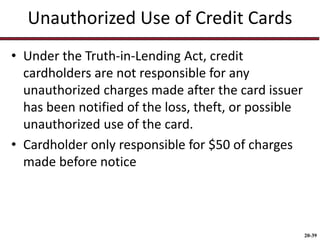
Unauthorized Use of Credit Cards
• Under the Truth-in-Lending Act, credit
cardholders are not responsible for any
unauthorized charges made after the card issuer
has been notified of the loss, theft, or possible
unauthorized use of the card.
• Cardholder only responsible for $50 of charges
made before notice
20-40
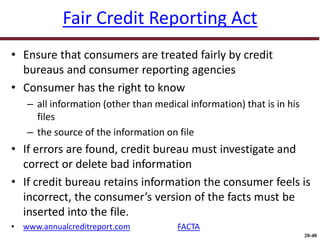
Fair Credit Reporting Act
• Ensure that consumers are treated fairly by credit
bureaus and consumer reporting agencies
• Consumer has the right to know
– all information (other than medical information) that is in his
files
– the source of the information on file
• If errors are found, credit bureau must investigate and
correct or delete bad information
• If credit bureau retains information the consumer feels is
incorrect, the consumer’s version of the facts must be
inserted into the file.
• www.annualcreditreport.com FACTA
20-41
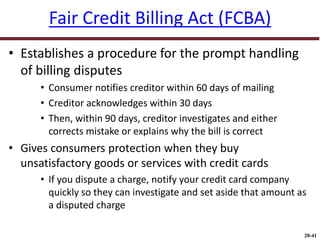
Fair Credit Billing Act (FCBA)
• Establishes a procedure for the prompt handling
of billing disputes
• Consumer notifies creditor within 60 days of mailing
• Creditor acknowledges within 30 days
• Then, within 90 days, creditor investigates and either
corrects mistake or explains why the bill is correct
• Gives consumers protection when they buy
unsatisfactory goods or services with credit cards
• If you dispute a charge, notify your credit card company
quickly so they can investigate and set aside that amount as
a disputed charge
20-42
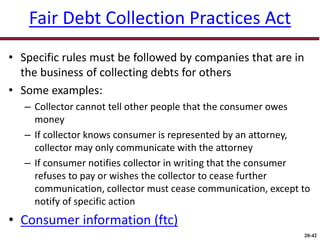
Fair Debt Collection Practices Act
• Specific rules must be followed by companies that are in
the business of collecting debts for others
• Some examples:
– Collector cannot tell other people that the consumer owes
money
– If collector knows consumer is represented by an attorney,
collector may only communicate with the attorney
– If consumer notifies collector in writing that the consumer
refuses to pay or wishes the collector to cease further
communication, collector must cease communication, except to
notify of specific action
• Consumer information (ftc)
20-43
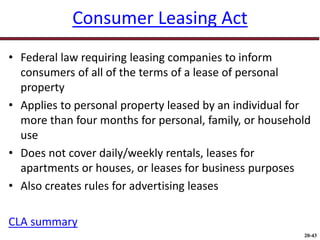
Consumer Leasing Act
• Federal law requiring leasing companies to inform
consumers of all of the terms of a lease of personal
property
• Applies to personal property leased by an individual for
more than four months for personal, family, or household
use
• Does not cover daily/weekly rentals, leases for
apartments or houses, or leases for business purposes
• Also creates rules for advertising leases
CLA summary
20-44
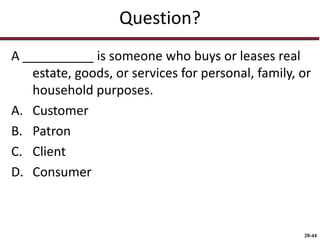
Question?
A __________ is someone who buys or leases real
estate, goods, or services for personal, family, or
household purposes.
A. Customer
B. Patron
C. Client
D. Consumer
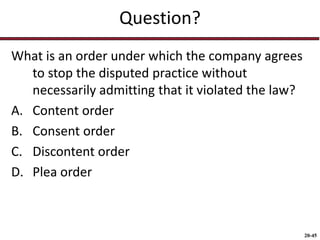
20-45
Question?
What is an order under which the company agrees
to stop the disputed practice without
necessarily admitting that it violated the law?
A. Content order
B. Consent order
C. Discontent order
D. Plea order
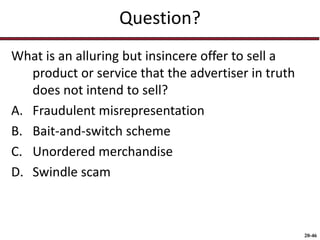
20-46
Question?
What is an alluring but insincere offer to sell a
product or service that the advertiser in truth
does not intend to sell?
A. Fraudulent misrepresentation
B. Bait-and-switch scheme
C. Unordered merchandise
D. Swindle scam
20-47
Question?
What is the illegal practice of changing a
consumer’s telephone service without
permission?
A. Slamming
B. Spamming
C. Service spiking
D. Thumping
20-48
Question?
Which act requires leasing companies to inform
consumers of all of the terms of a lease of
personal property?
A. Truth-in-lending Act
B. Consumer Product Safety Act
C. Consumer Leasing Act
D. Fair Credit Reporting Act
20-49
Question?
Which act specific rules must be followed by
companies that are in the business of collecting
debts for others?
A. Truth-in-Lending Act
B. Fair Credit Reporting Act
C. Fair Credit Billing Act
D. Fair Debt Collection Practices Act

Chap015 product liability and consumer protection

  • 1.
    20-1 Chapter 15 Product Liabilityand Consumer Protection
  • 2.
    20-2 Learning Objectives 1. Describethe link between social engineering and the law. 2. Explain the difference between public interest and public policy. 3. Explain the difference between negligence and strict liability. 4. State the purpose of the Consumer Product Safety Act. 5. Explain the enforcement of the Federal Trade Commission Act.
  • 3.
    20-3 Learning Objectives 6. Developa list of unfair or deceptive practices. 7. Identify several FTC rules designed to protect the consumer. 8. Identify the function of the Truth-in-Lending Act. 9. Explain the latest amendments to the Truth-in-Lending Act.
  • 4.
    20-4 Social Engineering andthe Law • Public interest – refers to the idea that certain activities affect the entire social structure and must, therefore, be regulated by the government • Public policy – seeks to implement behavior that promotes the public consensus and eliminates behavior that does not.
  • 5.
    20-5 Product Liability (tortlaw) • A buyer or user of a product who is injured because of the product’s unsafe or defective condition may recover damages from the manufacturer, the seller, or the supplier of the goods. • Two areas: – Negligence – Strict liability
  • 6.
    20-6 Defect • The defectivecondition may arise through: – faulty product design – faulty manufacturing – inadequate warning of danger – improper instructions for the product’s use
  • 7.
  • 8.
  • 9.
  • 10.
  • 11.
  • 12.
    20-12 Negligence • Failure toexercise that degree of care that a reasonable person would have exercised under the same circumstances and conditions
  • 13.
    20-13 Negligence To recover fornegligence in a product liability case, the victim must prove: 1. that the manufacturer or seller owed a duty to the victim 2. that the manufacturer or the seller violated that duty by not following the appropriate standard of care;
  • 14.
    20-14 Negligence 3. that thevictim suffered an injury because of that careless action 4. the careless action was both the actual and the proximate cause of the victim’s injury.
  • 15.
    20-15 Strict Liability • Legaltheory that imposes liability on manufacturers or suppliers for selling goods that are unreasonably dangerous, without regard to fault or negligence • Principal consideration is the safety of the product • Manufacturers have a duty to make reasonably safe products, provide instructions for proper use, and warn of possible danger
  • 16.
    20-16 Consumer Product SafetyAct • Established the Consumer Product Safety Commission (CPSC) to protect consumers from unreasonable risk or injury from hazardous products • CPSC can order recalls, impose civil fines, and cease-and-desist orders
  • 17.
    20-17 Federal and StateConsumer Protection Laws • Consumer protection laws apply to transactions between someone conducting a business and a consumer • Consumer – someone who buys or leases real estate, goods, or services for personal, family, or household purposes.
  • 18.
    20-18 Federal and StateConsumer Protection Laws • Federal Trade Commission (FTC) Act defines commerce as “commerce among the several states or with foreign nations or the District of Columbia.” • Interstate commerce – business activity that touches more than one state • Intrastate commerce – no out-of-state connections, not governed by FTC
  • 19.
    20-19 Federal and StateConsumer Protection Laws • Some tools of the FTC: – Consent order • the company agrees to stop the disputed practice without necessarily admitting that it violated the law – Complaint • Begins hearing process before an administrative law judge – Cease-and-desist order • If a violation is found
  • 20.
    20-20 Unfair or DeceptiveAct or Practices • Fraudulent Misrepresentations • Unordered Merchandise • Bait-and-Switch Schemes • Odometer Tampering
  • 21.
    20-21 Unfair or DeceptiveAct or Practices • Fraudulent misrepresentation – a statement that has the effect of deceiving the buyer • Usually occurs when the seller misstates facts important to the consumer.
  • 22.
    20-22 Unordered Merchandise • Itis a violation of the postal law and the FTC Act to send merchandise through the mail to people who did not order it – Exceptions: free samples, goods sent by charitable organizations soliciting contributions • Illegal to send a bill for such unordered merchandise or to send dunning letters • People who receive unordered merchandise may keep/use/dispose it with no obligation to the sender
  • 23.
    20-23 Unfair or DeceptiveAct or Practices • Bait-and-switch scheme – an alluring but insincere offer to sell a product or service • “No advertisement containing an offer to sell a product shall be made when the offer is not a bona fide effort to sell the advertised product” • FTC guide against Bait Advertising • FTC policy statement on deception • Advertising FAQ’s for small businesses
  • 24.
    20-24 Odometer Tampering • Thefederal Odometer Law prohibits people from disconnecting, resetting, or altering the odometer of a motor vehicle to register any mileage other than the true mileage driven.
  • 25.
    20-25 The FTC TradeRegulation Rules • Used Car Rule • Cooling-Off Rule • Negative Option Rule • Identity Theft • Online Transactions Involving Foreign Countries • Antispam Law • Antislamming Law • Mail, Telephone, Internet, or Fax Rule • Telemarketing Sales Rule • 900-Telephone Number Rules
  • 26.
    20-26 The FTC TradeRegulation Rules • Used Car Rule – requires used car dealers that sell more than five used vehicles in a 12-month period to place a window sticker, called a Buyer’s Guide, in the window of each used car they offer for sale. • Information on warranties • Statement not to rely on spoken promises • Suggestion that consumer have mechanic inspect the vehicle • List of the major systems of an automobile and some major defects that can happen in them • Dealer’s guide to used car rule FTC used car guide
  • 27.
    20-27 The FTC TradeRegulation Rules • Cooling-Off Rule – sales of consumer goods or services over $25 made away from the seller’s regular place of business, such as at a customer’s home, may be canceled within three business days after the sale occurs. • Does not apply to: – Sales made totally by mail or phone, – sales for real estate, – Insurance or securities, – emergency home repairs, – arts and crafts sold at fairs or other locations
  • 28.
    20-28 The FTC TradeRegulation Rules Negative Option Rule - sellers must tell subscribers: • How many selections they must buy, if any. • How and when they can cancel the membership. • How to notify the seller when they do not want the selection. • When to return the “negative option” form to cancel shipment of a selection. • When they can get credit for return of a selection • How postage and handling costs are charged • How often they will receive announcements and forms
  • 29.
    20-29 The FTC TradeRegulation Rules • Mail, Telephone, Internet, or Fax Rule – sellers must ship orders within the time promised in their advertisements – If no time period is promised, sellers must either ship the order within 30 days after they receive it or send the consumer an option notice • Option notice – notifies buyer of delay and gives buyer right to either agree to the delay or cancel the order
  • 30.
    20-30 The FTC TradeRegulation Rules • Telemarketing Sales Rule – designed to protect consumers from abusive and unscrupulous telemarketers – established the Do Not Call Registry – requires telemarketing firms to identify themselves on Caller ID technology – sets various other restrictions on telemarketing – https://www.donotcall.gov/ – Telemarketing Sales Rule compliance guide
  • 31.
    20-31 900-Telephone Number Rules •FTC regulations require that people who dial 900- prefix numbers be warned of the cost of the calls and given a chance to hang up before being charged. • Telephone companies must block service to 900- prefix numbers if so requested by the customer.
  • 32.
    20-32 The FTC TradeRegulation Rules • Can Spam Act – unsolicited commercial e-mail messages must be truthful and cannot use misleading subject lines or incorrect return addresses – Compliance guide for businesses
  • 33.
    20-33 The FTC TradeRegulation Rules • Slamming – the illegal practice of changing a consumer’s telephone service without permission. – If you’ve been slammed and haven’t paid your bill yet, you don’t have to pay anyone for up to 30 days after being slammed – If you have already paid your bill, the slamming company must pay your authorized company 150% of the charges you paid them. 50% of the charges you paid would be reimbursed to you.
  • 34.
    20-34 The FTC TradeRegulation Rules • Identity theft – occurs when someone uses another’s identifying information without their permission to commit fraud or other crimes
  • 35.
    20-35 Online Transactions InvolvingForeign Countries • When there is a problem involving an online transaction with someone in a foreign country, consumers may file a complaint at www.econsumer.gov
  • 36.
    20-36 Consumer Credit Laws •Truth in Lending • Equal Credit Opportunity • Unauthorized Use of Credit Cards • Fair Credit Reporting • Fair Credit Billing • Fair Debt Collection Practices
  • 37.
    20-37 Consumer Credit Laws •Truth-in-Lending Act – lenders must disclose two important things to borrowers: the finance charge (the actual cost of the loan in dollars and cents) and the annual percentage rate (APR) (the true rate of interest of the loan). • CARD Act (2009) – Rules from www.federal reserve.gov
  • 38.
    20-38 Consumer Credit Laws •Equal Credit Opportunity Act – ensures that all consumers are given an equal chance to receive credit – makes it illegal for banks and businesses to discriminate against credit applicants because of their sex, race, marital status, national origin, religion, or age or because they get public assistance income
  • 39.
    20-39 Unauthorized Use ofCredit Cards • Under the Truth-in-Lending Act, credit cardholders are not responsible for any unauthorized charges made after the card issuer has been notified of the loss, theft, or possible unauthorized use of the card. • Cardholder only responsible for $50 of charges made before notice
  • 40.
    20-40 Fair Credit ReportingAct • Ensure that consumers are treated fairly by credit bureaus and consumer reporting agencies • Consumer has the right to know – all information (other than medical information) that is in his files – the source of the information on file • If errors are found, credit bureau must investigate and correct or delete bad information • If credit bureau retains information the consumer feels is incorrect, the consumer’s version of the facts must be inserted into the file. • www.annualcreditreport.com FACTA
  • 41.
    20-41 Fair Credit BillingAct (FCBA) • Establishes a procedure for the prompt handling of billing disputes • Consumer notifies creditor within 60 days of mailing • Creditor acknowledges within 30 days • Then, within 90 days, creditor investigates and either corrects mistake or explains why the bill is correct • Gives consumers protection when they buy unsatisfactory goods or services with credit cards • If you dispute a charge, notify your credit card company quickly so they can investigate and set aside that amount as a disputed charge
  • 42.
    20-42 Fair Debt CollectionPractices Act • Specific rules must be followed by companies that are in the business of collecting debts for others • Some examples: – Collector cannot tell other people that the consumer owes money – If collector knows consumer is represented by an attorney, collector may only communicate with the attorney – If consumer notifies collector in writing that the consumer refuses to pay or wishes the collector to cease further communication, collector must cease communication, except to notify of specific action • Consumer information (ftc)
  • 43.
    20-43 Consumer Leasing Act •Federal law requiring leasing companies to inform consumers of all of the terms of a lease of personal property • Applies to personal property leased by an individual for more than four months for personal, family, or household use • Does not cover daily/weekly rentals, leases for apartments or houses, or leases for business purposes • Also creates rules for advertising leases CLA summary
  • 44.
    20-44 Question? A __________ issomeone who buys or leases real estate, goods, or services for personal, family, or household purposes. A. Customer B. Patron C. Client D. Consumer
  • 45.
    20-45 Question? What is anorder under which the company agrees to stop the disputed practice without necessarily admitting that it violated the law? A. Content order B. Consent order C. Discontent order D. Plea order
  • 46.
    20-46 Question? What is analluring but insincere offer to sell a product or service that the advertiser in truth does not intend to sell? A. Fraudulent misrepresentation B. Bait-and-switch scheme C. Unordered merchandise D. Swindle scam
  • 47.
    20-47 Question? What is theillegal practice of changing a consumer’s telephone service without permission? A. Slamming B. Spamming C. Service spiking D. Thumping
  • 48.
    20-48 Question? Which act requiresleasing companies to inform consumers of all of the terms of a lease of personal property? A. Truth-in-lending Act B. Consumer Product Safety Act C. Consumer Leasing Act D. Fair Credit Reporting Act
  • 49.
    20-49 Question? Which act specificrules must be followed by companies that are in the business of collecting debts for others? A. Truth-in-Lending Act B. Fair Credit Reporting Act C. Fair Credit Billing Act D. Fair Debt Collection Practices Act