This programme has been funded with
support from the European Commission
MODULE 7
THE SMALL PRINT
This module will introduce Creative Entrepreneurs
to some of the legal implications they
must be aware on when selling online.
It covers the topics of consumer law and
consumer rights regarding online purchases.
Learning Focus
• Introduction to Consumer Law – Key Terms
• Spotlight on the European Directive on Consumer Rights
• Need to know credit card and data protection
• About the European Online Dispute Resolution (ODR) platform
• Summary – Ten things to think about to legally sell online
• Resources and Links for more information
Disclaimer: The information contained on this module is for the purposes of guidance only. The
information is provided with the understanding that it does not constitute legal advice. As such,
it should not be used as a substitute for consultation with professional advisers. While we have
made every attempt to ensure that the information contained in this guidance document is
accurate and reliable, we are not responsible for any errors or omissions, or for the results
obtained from the use of this information. All traders are directed to the Regulations themselves
for more detailed as to their obligations under these provisions
The FFF model of online consumer behavior
As previously discussed in Module 5, the FFF model takes into
consideration internal and external factors affecting consumer buying
behaviour. It then proceeds to discuss various filtering elements
customers apply to make a selection of a store to purchase from and
revised filtered buying behaviour based on their final selection.
Importantly, the three filtering elements which ultimatly lead to buying
are very much rooted in the module which follows, these are focused
on concers around security, privacy and trustworthiness.
The F’s3
External Factors
Internal Factors
Demographics
Socio-economics
Technology &
Public Policy
Culture
Sub- Culture
Reference Group
and Marketing
Attitudes
Learning
Perception
Motivation
Self Image
Semiotics
Buying
Motives
Filtering
Elements
Filtered
Buying
Motives
Buying
Security Concern
Privacy Concern
Trust &
Trusworthiness
TheFFFmodelofonlineconsumerbehavior
The F’s3
The FFF model of online consumer behavior
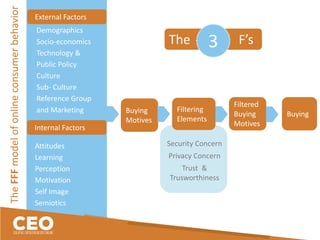
Graphically the model representing customer journey to purchase looks
like this:
Kimar and Dange recognized security, privacy and trust as three
hurdles to online purchases. Customers use these three factors to filter
their buying choices and decide on the final selection of stores they are
willing to buy from.
In other words, if your store doesn’t pass your customers’ security,
privacy and trustworthiness criteria, they won’t buy from you. Even if
you are cheaper.
The F’s3
The FFF model of online consumer behavior
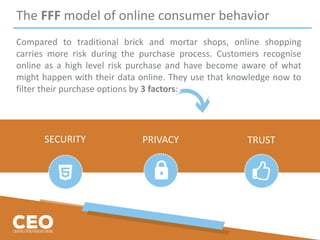
Compared to traditional brick and mortar shops, online shopping
carries more risk during the purchase process. Customers recognise
online as a high level risk purchase and have become aware of what
might happen with their data online. They use that knowledge now to
filter their purchase options by 3 factors:
SECURITY PRIVACY TRUST
It’s an unfortunate characteristics of the internet that information there
could be easily lost or stolen. Your payment details or personal
information could easily be retrieved from a database it is stored in by
the shop for instance, as we have seen recently with few major security
breaches.
Customers are growing more aware of the dangers of stolen data from
the web. And they filter their purchasing alternatives against security
criteria.
Security
Another type of risk online is having personal information handed over
to or stolen by 3rd party companies to send unsolicited emails and
spam to customers. Even though the results of privacy breaches may
not be as severe as losing your financial data, it can still cause a great
deal of frustration and diminish trust in stores.
A lack of trust in a store’s privacy policies is a serious obstacle for many
customers. Similarly, many customers look for reassurance that their
data will be protected and not handed over to any 3rd parties for
further use in marketing.
Privacy
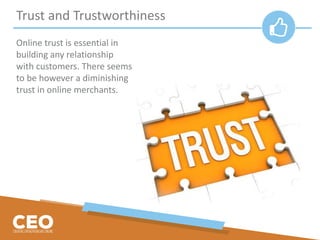
Trust and Trustworthiness
Online trust is essential in
building any relationship
with customers. There seems
to be however a diminishing
trust in online merchants.
INTRODUCTION TO
CONSUMER LAW &
CONSUMER RIGHTS
Introduction to consumer law & consumer rights
The rights of consumers of goods and services are protected by
National and EU laws.
Consumer Law
Consumer law aims to ensure that consumers have enough information
about prices and quality of products and services to make suitable
choices on what to buy. Consumer law also aims to ensure that goods
are safe and are manufactured to an acceptable standard. Consumer
law only takes effect in certain situations and depends on what the
contract is between the consumer and the provider of the items or
services in question. The following explains who is a consumer and
what is a contract.
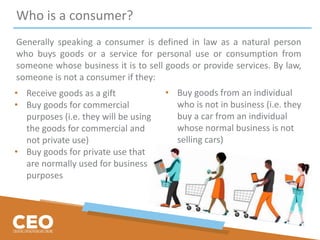
Who is a consumer?
Generally speaking a consumer is defined in law as a natural person
who buys goods or a service for personal use or consumption from
someone whose business it is to sell goods or provide services. By law,
someone is not a consumer if they:
• Receive goods as a gift
• Buy goods for commercial
purposes (i.e. they will be using
the goods for commercial and
not private use)
• Buy goods for private use that
are normally used for business
purposes
• Buy goods from an individual
who is not in business (i.e. they
buy a car from an individual
whose normal business is not
selling cars)
What is a contract?
A contract is a formal agreement between two or more people that is
enforceable by law. When a consumer buy your goods or services they
enter into a contract with the you, the seller. Contracts are made up of
terms; some of which can be implied terms.
Contracts may be written or oral. It is easier to know what the terms
are in a written contract but an oral contract is also enforceable in law.
Contracts may differ in many ways and there are no hard and fast rules
governing what terms should be in a consumer contract. Terms in
consumer contracts must always be fair and clear to the consumer.
What is a contract?
The following general rules apply to consumer contracts.
• Goods must be of merchantable quality – goods should be of
reasonable quality taking into account what they are meant to do,
their durability and their price
• Goods must be fit for their purpose – they must do what they are
reasonably expected to do
• Goods must be as described - the buyer must not be mislead into
buying something by the description of goods or services given
orally by a salesperson or an advertisement.
• When you buy goods in a sale you have the same rights as when you
pay full price for the goods.
What is a contract?
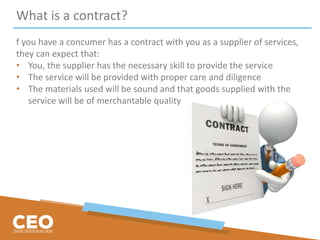
f you have a concumer has a contract with you as a supplier of services,
they can expect that:
• You, the supplier has the necessary skill to provide the service
• The service will be provided with proper care and diligence
• The materials used will be sound and that goods supplied with the
service will be of merchantable quality
What is a contract?
In Ireland, consumer contracts are protected by the Sale of
Goods and Supply of Services Act, 1980.
In the UK, consumer contracts are protected by the
In Poland, consumer contracts are protected by the
EUROPEAN DIRECTIVE ON CONSUMER RIGHTS
As from June 13th 2014, the EU brought in the Consumer Rights
Directive which applies in all EU countries and means that
consumers can always be sure which rules apply in their
own countries and when making cross-border purchases.
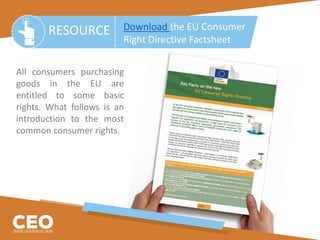
All consumers purchasing
goods in the EU are
entitled to some basic
rights. What follows is an
introduction to the most
common consumer rights.
RESOURCE Download the EU Consumer
Right Directive Factsheet
The right to clear & accurate info. before they buy
Before the consumer is bound by a distance contract, you the trader
must make certain information available including:
• The name of the business, including any trading names
• A description of what you are buying - main characteristics of the
goods or service
• If products or services come in the form of downloadable digital
content, it must be clear as to the compatibility of the digital content
with different hardware and software. It must also include any
technical protection measures, for example, the number of copies
that can be made
• The full postal address, contact details for the business including an
email address and phone number.
The right to clear & accurate info. before they buy
• The price, including any taxes
• Where a distance contract is concluded through a trading website,
the website must indicate clearly at the beginning of the ordering
process, whether any delivery restrictions apply and which means of
payment are accepted and also any costs for returning the item
• The arrangements for payment and delivery
• Details of how to cancel your order and get a refund. You should be
able to cancel using a cancellation form available on their website.
• Details on what to do if you change your mind, and a copy of the
form for returning goods. The business must tell you if the change of
mind option, known as the ‘cooling-off’ period doesn’t apply.
• The cost of ordering – for example, the cost of a premium rate
phone call if you have to order this way.
The right to clear & accurate info. before they buy
• How long the offer or price is valid
• Details of any guarantees or after-sales services and the cost of
communication, if it is above a basic rate
• Confirmation of your order in a durable form, this could be a letter
or email. Where a distance contract is concluded by electronic
means the trader must ensure that the button that the consumer
presses in order to complete their order must include an
acknowledgement that they will have to pay for the goods or
services.
A full list of information requirements for distance and off-premises
contracts can be found in the Consumer Rights Directive, Chapter III,
Article 6.
The right to a refund for the
goods if they are not delivered
Consumers should receive the goods no later
than 30 days from the date of purchase unless an
alternative date has been agreed between the consumer
and the business before entering into the contact.
If the goods are not delivered within the time frame the consumer has
the right to contact you, the business and arrange another date that is
suitable. If you fail to deliver the goods on the new agreed date the
consumer can end the contract (due to the business not keeping to
their side of the contract) and can request a full refund (including
delivery cost if paid by them) without delay.
The right to a refund for the
goods if they are not delivered
In cases where the delivery of the item is essential within a specified
time frame e.g. a wedding dress. At the beginning of the contract the
consumer should inform the business of the wedding and agree a
specific date for delivery. However, if it turns out the business cannot
deliver the item, in this case the wedding dress, within this time frame
and inform the consumer of this, the consumer can end the contract
You should receive a full refund (including delivery cost if paid by you)
without delay. The business should refund you without any delay. It
there is a delay in you receiving your refund and you paid for the goods
using a credit or debit card, your card provider may agree to reverse the
transaction. This is called a chargeback.
The right to return something
because you change your mind
When you buy online, you are given a cooling-off period of 14 days.
This means you have the right to cancel an order or contract for any
reason within this specified period.
If you buy a product online, the cooling off period ends 14 days after
you receive it. In the case of a contract for a service, the cooling-off
period ends 14 days after you conclude the contract, for example, when
you agree to the contract or give your credit card details.
To ..….......................…...................…...................…..................….................... ..….......................…...................…...................…..................…..................... ..….......................…..............................
I/We…................ …..................... ….......................... hereby give notice that I/We I/We…................ …..................... …..................................
cancel my/our…................….....................….......................................................... contract of sale for the following goods
…................ …..................... ….................................. for the provision of the following service…................….....................…..........................
Ordered on: .............….. /.............….. /............….. Received on : ............….. /.............….. /............…..
Name of Consumer(s): .......…...................…...................…. .......…...................…...................…. .......…...................…............................................................................….
Address of Consumer(s): .......…...................…...................…. .......…...................…...........................................................................................................................….
Signature of Consumer(s): ..................................................................................….. Date : ............….. /.............….. /............…..
MODEL CANCELLATION FORM
[Complete and return this form only if you wish to cancel the contract]
[here the trader’s name, address and, where available, fax number and email address]
DD MM YY DD MM YY
DD MM YY
RESOURCE Use this template to create a Cancellation Form
In the case of goods, the consumer must also return the item within 14
days from the day of cancellation. If the consumer cancels the order
because they change their mind, they may have to pay for the cost of
returning it. But, if the item is faulty, then they generally do not have to
pay for the cost of returning it. There are some items and services that
are not covered by the cooling-off period, some of which may be
applicable to creative businesses:
• Customised goods, for example, a football jersey with your name
printed on it
• Audio or video recordings which have been unsealed or used by the
consumer
• Swimwear or underwear that has been unsealed, which cannot be
returned for hygiene reasons
• Items that are likely to deteriorate or expire rapidly
The right to cancel a service
In the case of a contract for a service, the cooling-off period ends 14
days after the consumer concludes the contract, for example, when the
consumer agrees to the contract or gives you their credit card details.
How to cancel a service should be explained by the business before the
consumer makes the purchase, for example, in the terms and
conditions of the contract.
Under the Consumer Rights Directive, a standard EU cancellation form
must be provided for consumers. Businesses do not have to send a hard
copy of same with each delivery, but they must make the form available
to you online.
The right to return something that is faulty
If a consumer buy something through distance selling (online, over the
phone, from a mail order catalogue or a TV shopping channel) and it
turns out to be faulty then the consumer rights are the same as if they
bought it in a shop. If what they bought is damaged or faulty they have
the right to complain to the business in writing immediately, by email,
fax or letter, and ask for a refund or replacement. If they bought
something from an EU-based website and they have to return the item
because it is faulty, the seller has to pay for any return shipping costs.
If they return a faulty item, and the refund is not provided within 14
days and they paid for the goods using a credit or debit card, the card
provider may agree to reverse the transaction. This is called a
chargeback.
DATA
PROTECTION
What is data protection?
When a consumer gives their personal details to an organisation or
individual, the receiver has a duty to keep these details private and
safe. Any data collected by an online retailer will be subject to the Data
Protection Act and similar legislation in other EU countries. Retailers
should ensure that they have a privacy policy explaining how they
propose to use customer data
It is generally acceptable for a retailer to use
personal data in order to fulfil an order but
disclosure to third parties will require explicit
consent. This process is known as data protection.
Organisations or individuals who control the
contents and use of these personal details as
often known as 'data controllers'.
Our legal responsibilities as a data controller
You must ...
1. Obtain and process the information fairly
2. Keep it only for one or more specified and lawful purposes
3. Process it only in ways compatible with the purposes for which it
was given to you initially
4. Keep it safe and secure
5. Keep it accurate and up-to-date
6. Ensure that it is adequate, relevant and not excessive
7. Retain it no longer than is necessary for the specified purpose or
purposes
8. Give a copy of his/her personal data to any individual, on request
Source: Office of the Data Protection Commissioner, Ireland.
Our legal responsibilities as a data controller
Under data protection law, there are a certain set of rights regarding
the use of these personal details and data controllers have certain
responsibilities in how they handle this information.
Data protection rights will help ensure that the information stored
about is:
• factually correct;
• only available to those who should have it;
• only used for stated purposes.
Useful Links: European Union Data Protection Authorities Guidelines
for the contents and use of Privacy Statements on Websites
You have the right to data
protection when your details are:
• held on a computer;
• held on paper or other manual form as part of a filing system; and
• made up of photographs or video recordings of your image or
recordings of your voice.
Data Protection Commissioner is on hand to deal with complaints and
queries if an organisation or individual does not respect that data
protection rights. If the Commissioner agrees with a complaint, he will try
to make sure that the data controller obeys the law and puts matters
right. If the Commissioner rejects the complaint, he will let the parties
know in writing. If someone is not happy with the Commissioner's
decision, they can appeal the decision in the Circuit Court.
PROTECTING
CONSUMERS CREDIT
CARD PAYMENTS
Protecting consumers - credit card payments
If you propose to collect and process credit card payments directly, you
need to comply with the Payment Card Industry Data Security
Standard (PCI-DSS) which includes security and encryption
requirements for any business that stores, processes or transmits
payment cardholder data.
For SME’s, the easiest was to comply is to use or licence a payment
gateway from a third party, such as PayPal, who will collect the data and
process the payment on behalf of the retailer. Retailers should ensure
they use reputable payment gateways which are compliant with local
data protection standards as the implications of non-compliance can be
very serious.
KEY TAKEWAYS
TO CONSIDER
WHEN SELLING ONLINE
10
key takeaways to consider when selling online
While selling your products through a website is a simple, low-cost way
of entering the European and global markets, there are also legal and
non-legal issues that you need to be aware of. Enterprise Europe
Network provides 10 tips for selling online.
1. Make it clear who you are to your customers. The design of your
website should be easy to use. There is a legal obligation to clearly
indicate your company or business name, postal and email address.
2. Include a set of terms and conditions, protect your customers’ data
and publish a privacy statement. Contract terms and conditions
should always be drafted in simple language with any ambiguities
interpreted in favour of consumers. Measures to protect customers’
data should be included in your long-term strategy for selling online.
10
key takeaways to consider when selling online
3. Add a secure payment processing and a shopping cart to your
website. Buyers should be able to place multiple products into the
cart, and checkout, before payment is made. Sensitive customer
transaction information must be protected and secured.
4. Ensure that certain information is provided. Since June 13th 2014,
customers are not bound by online contracts if it is not made clear
when activating a button or similar function to place an order that
there is an obligation to pay.
10
key takeaways to consider when selling online
5. Products must be of merchantable quality, fit for purpose, as
described and correspond to any samples or models used. If the
fault occurs within the first six months of delivery it is presumed that
it existed at the time of delivery and the consumer has the right to
repair or replacement at no extra cost, unless you can prove that
there was no lack of conformity (e.g. induced damage, improper
maintenance, or misuse). If neither of these remedies can be
offered within a reasonable time or without significant
inconvenience, the consumer can seek to obtain a refund. These
rights also exist after the initial six month period has elapsed,
however, the onus is on the consumer to prove that the fault was
inherent at the time of delivery (e.g. manufacturer’s defect).
10
key takeaways to consider when selling online
6. Pre-ticked boxes for additional payments are no longer permitted. It
is no longer possible to charge customers extra by obtaining consent
by way of default or opt-out provisions.
7. Period for order completion. Goods must be delivered within 30
days from the day after the order was placed, unless otherwise
agreed. If you are unable to uphold your end of the contract,
customers may terminate it immediately if the delivery period was
essential. Where agreement is reached on an additional period of
time for delivery, the customer will be entitled to terminate the
contract if you fail to deliver on time.
10
key takeaways to consider when selling online
8. In the EU, customers have 14 working days within which to cancel or
withdraw from a purchase without having to give any reason. When
a customer exercises this right, traders have 14 days within which to
refund the money. The only charge that may be made to the
customer is the direct cost of returning the goods unless the trader
has agreed to bear them or the trader failed to inform the consumer
about this charge.
9. Requirement to eliminate surcharges for the use of credit cards and
hotlines. Under EU rules, you can cannot charge customers more for
paying by a particular method of payment than the costs actually
incurred by you. If you operate a telephone hotline it is not
permissible to charge more than the basic telephone rate for the
calls.
10
key takeaways to consider when selling online
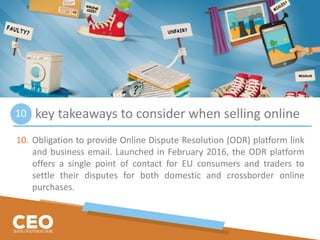
10. Obligation to provide Online Dispute Resolution (ODR) platform link
and business email. Launched in February 2016, the ODR platform
offers a single point of contact for EU consumers and traders to
settle their disputes for both domestic and crossborder online
purchases.
10
Online Dispute Resolution (ODR): Solving disputes
online platform for consumers and traders
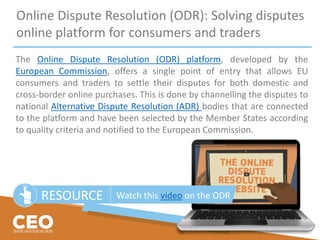
The Online Dispute Resolution (ODR) platform, developed by the
European Commission, offers a single point of entry that allows EU
consumers and traders to settle their disputes for both domestic and
cross-border online purchases. This is done by channelling the disputes to
national Alternative Dispute Resolution (ADR) bodies that are connected
to the platform and have been selected by the Member States according
to quality criteria and notified to the European Commission.
RESOURCE Watch this video on the ODR
Online Dispute Resolution (ODR): Solving disputes
online platform for consumers and traders
Key features:
• The platform is user-friendly and accessible on all types of devices.
Consumers can fill out the complaint form on the platform in three
simple steps.
• The platform offers users the possibility to conduct the entire
resolution procedure online.
• The platform is multilingual. A translation service is available on the
platform to assist disputes involving parties based in different
European countries.
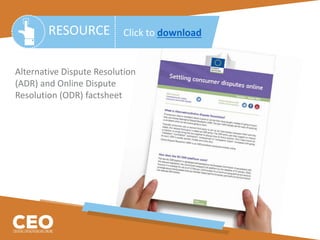
RESOURCE Click to download
Alternative Dispute Resolution
(ADR) and Online Dispute
Resolution (ODR) factsheet
Congratulations
you have completed Module 7

CEO Module 7

  • 1.
    This programme hasbeen funded with support from the European Commission MODULE 7 THE SMALL PRINT
  • 2.
    This module willintroduce Creative Entrepreneurs to some of the legal implications they must be aware on when selling online. It covers the topics of consumer law and consumer rights regarding online purchases.
  • 3.
    Learning Focus • Introductionto Consumer Law – Key Terms • Spotlight on the European Directive on Consumer Rights • Need to know credit card and data protection • About the European Online Dispute Resolution (ODR) platform • Summary – Ten things to think about to legally sell online • Resources and Links for more information Disclaimer: The information contained on this module is for the purposes of guidance only. The information is provided with the understanding that it does not constitute legal advice. As such, it should not be used as a substitute for consultation with professional advisers. While we have made every attempt to ensure that the information contained in this guidance document is accurate and reliable, we are not responsible for any errors or omissions, or for the results obtained from the use of this information. All traders are directed to the Regulations themselves for more detailed as to their obligations under these provisions
  • 4.
    The FFF modelof online consumer behavior As previously discussed in Module 5, the FFF model takes into consideration internal and external factors affecting consumer buying behaviour. It then proceeds to discuss various filtering elements customers apply to make a selection of a store to purchase from and revised filtered buying behaviour based on their final selection. Importantly, the three filtering elements which ultimatly lead to buying are very much rooted in the module which follows, these are focused on concers around security, privacy and trustworthiness. The F’s3
  • 5.
    External Factors Internal Factors Demographics Socio-economics Technology& Public Policy Culture Sub- Culture Reference Group and Marketing Attitudes Learning Perception Motivation Self Image Semiotics Buying Motives Filtering Elements Filtered Buying Motives Buying Security Concern Privacy Concern Trust & Trusworthiness TheFFFmodelofonlineconsumerbehavior The F’s3
  • 6.
    The FFF modelof online consumer behavior Graphically the model representing customer journey to purchase looks like this: Kimar and Dange recognized security, privacy and trust as three hurdles to online purchases. Customers use these three factors to filter their buying choices and decide on the final selection of stores they are willing to buy from. In other words, if your store doesn’t pass your customers’ security, privacy and trustworthiness criteria, they won’t buy from you. Even if you are cheaper. The F’s3
  • 7.
    The FFF modelof online consumer behavior Compared to traditional brick and mortar shops, online shopping carries more risk during the purchase process. Customers recognise online as a high level risk purchase and have become aware of what might happen with their data online. They use that knowledge now to filter their purchase options by 3 factors: SECURITY PRIVACY TRUST
  • 8.
    It’s an unfortunatecharacteristics of the internet that information there could be easily lost or stolen. Your payment details or personal information could easily be retrieved from a database it is stored in by the shop for instance, as we have seen recently with few major security breaches. Customers are growing more aware of the dangers of stolen data from the web. And they filter their purchasing alternatives against security criteria. Security
  • 9.
    Another type ofrisk online is having personal information handed over to or stolen by 3rd party companies to send unsolicited emails and spam to customers. Even though the results of privacy breaches may not be as severe as losing your financial data, it can still cause a great deal of frustration and diminish trust in stores. A lack of trust in a store’s privacy policies is a serious obstacle for many customers. Similarly, many customers look for reassurance that their data will be protected and not handed over to any 3rd parties for further use in marketing. Privacy
  • 10.
    Trust and Trustworthiness Onlinetrust is essential in building any relationship with customers. There seems to be however a diminishing trust in online merchants.
  • 11.
  • 12.
    Introduction to consumerlaw & consumer rights The rights of consumers of goods and services are protected by National and EU laws. Consumer Law Consumer law aims to ensure that consumers have enough information about prices and quality of products and services to make suitable choices on what to buy. Consumer law also aims to ensure that goods are safe and are manufactured to an acceptable standard. Consumer law only takes effect in certain situations and depends on what the contract is between the consumer and the provider of the items or services in question. The following explains who is a consumer and what is a contract.
  • 13.
    Who is aconsumer? Generally speaking a consumer is defined in law as a natural person who buys goods or a service for personal use or consumption from someone whose business it is to sell goods or provide services. By law, someone is not a consumer if they: • Receive goods as a gift • Buy goods for commercial purposes (i.e. they will be using the goods for commercial and not private use) • Buy goods for private use that are normally used for business purposes • Buy goods from an individual who is not in business (i.e. they buy a car from an individual whose normal business is not selling cars)
  • 14.
    What is acontract? A contract is a formal agreement between two or more people that is enforceable by law. When a consumer buy your goods or services they enter into a contract with the you, the seller. Contracts are made up of terms; some of which can be implied terms. Contracts may be written or oral. It is easier to know what the terms are in a written contract but an oral contract is also enforceable in law. Contracts may differ in many ways and there are no hard and fast rules governing what terms should be in a consumer contract. Terms in consumer contracts must always be fair and clear to the consumer.
  • 15.
    What is acontract? The following general rules apply to consumer contracts. • Goods must be of merchantable quality – goods should be of reasonable quality taking into account what they are meant to do, their durability and their price • Goods must be fit for their purpose – they must do what they are reasonably expected to do • Goods must be as described - the buyer must not be mislead into buying something by the description of goods or services given orally by a salesperson or an advertisement. • When you buy goods in a sale you have the same rights as when you pay full price for the goods.
  • 16.
    What is acontract? f you have a concumer has a contract with you as a supplier of services, they can expect that: • You, the supplier has the necessary skill to provide the service • The service will be provided with proper care and diligence • The materials used will be sound and that goods supplied with the service will be of merchantable quality
  • 17.
    What is acontract? In Ireland, consumer contracts are protected by the Sale of Goods and Supply of Services Act, 1980. In the UK, consumer contracts are protected by the In Poland, consumer contracts are protected by the EUROPEAN DIRECTIVE ON CONSUMER RIGHTS As from June 13th 2014, the EU brought in the Consumer Rights Directive which applies in all EU countries and means that consumers can always be sure which rules apply in their own countries and when making cross-border purchases.
  • 18.
    All consumers purchasing goodsin the EU are entitled to some basic rights. What follows is an introduction to the most common consumer rights. RESOURCE Download the EU Consumer Right Directive Factsheet
  • 19.
    The right toclear & accurate info. before they buy Before the consumer is bound by a distance contract, you the trader must make certain information available including: • The name of the business, including any trading names • A description of what you are buying - main characteristics of the goods or service • If products or services come in the form of downloadable digital content, it must be clear as to the compatibility of the digital content with different hardware and software. It must also include any technical protection measures, for example, the number of copies that can be made • The full postal address, contact details for the business including an email address and phone number.
  • 20.
    The right toclear & accurate info. before they buy • The price, including any taxes • Where a distance contract is concluded through a trading website, the website must indicate clearly at the beginning of the ordering process, whether any delivery restrictions apply and which means of payment are accepted and also any costs for returning the item • The arrangements for payment and delivery • Details of how to cancel your order and get a refund. You should be able to cancel using a cancellation form available on their website. • Details on what to do if you change your mind, and a copy of the form for returning goods. The business must tell you if the change of mind option, known as the ‘cooling-off’ period doesn’t apply. • The cost of ordering – for example, the cost of a premium rate phone call if you have to order this way.
  • 21.
    The right toclear & accurate info. before they buy • How long the offer or price is valid • Details of any guarantees or after-sales services and the cost of communication, if it is above a basic rate • Confirmation of your order in a durable form, this could be a letter or email. Where a distance contract is concluded by electronic means the trader must ensure that the button that the consumer presses in order to complete their order must include an acknowledgement that they will have to pay for the goods or services. A full list of information requirements for distance and off-premises contracts can be found in the Consumer Rights Directive, Chapter III, Article 6.
  • 22.
    The right toa refund for the goods if they are not delivered Consumers should receive the goods no later than 30 days from the date of purchase unless an alternative date has been agreed between the consumer and the business before entering into the contact. If the goods are not delivered within the time frame the consumer has the right to contact you, the business and arrange another date that is suitable. If you fail to deliver the goods on the new agreed date the consumer can end the contract (due to the business not keeping to their side of the contract) and can request a full refund (including delivery cost if paid by them) without delay.
  • 23.
    The right toa refund for the goods if they are not delivered In cases where the delivery of the item is essential within a specified time frame e.g. a wedding dress. At the beginning of the contract the consumer should inform the business of the wedding and agree a specific date for delivery. However, if it turns out the business cannot deliver the item, in this case the wedding dress, within this time frame and inform the consumer of this, the consumer can end the contract You should receive a full refund (including delivery cost if paid by you) without delay. The business should refund you without any delay. It there is a delay in you receiving your refund and you paid for the goods using a credit or debit card, your card provider may agree to reverse the transaction. This is called a chargeback.
  • 24.
    The right toreturn something because you change your mind When you buy online, you are given a cooling-off period of 14 days. This means you have the right to cancel an order or contract for any reason within this specified period. If you buy a product online, the cooling off period ends 14 days after you receive it. In the case of a contract for a service, the cooling-off period ends 14 days after you conclude the contract, for example, when you agree to the contract or give your credit card details.
  • 25.
    To ..….......................…...................…...................…..................….................... ..….......................…...................…...................…..................….......................….......................….............................. I/We…................ …..................... ….......................... hereby give notice that I/We I/We…................ …..................... ….................................. cancel my/our…................….....................….......................................................... contract of sale for the following goods …................ …..................... ….................................. for the provision of the following service…................….....................….......................... Ordered on: .............….. /.............….. /............….. Received on : ............….. /.............….. /............….. Name of Consumer(s): .......…...................…...................…. .......…...................…...................…. .......…...................…............................................................................…. Address of Consumer(s): .......…...................…...................…. .......…...................…...........................................................................................................................…. Signature of Consumer(s): ..................................................................................….. Date : ............….. /.............….. /............….. MODEL CANCELLATION FORM [Complete and return this form only if you wish to cancel the contract] [here the trader’s name, address and, where available, fax number and email address] DD MM YY DD MM YY DD MM YY RESOURCE Use this template to create a Cancellation Form
  • 26.
    In the caseof goods, the consumer must also return the item within 14 days from the day of cancellation. If the consumer cancels the order because they change their mind, they may have to pay for the cost of returning it. But, if the item is faulty, then they generally do not have to pay for the cost of returning it. There are some items and services that are not covered by the cooling-off period, some of which may be applicable to creative businesses: • Customised goods, for example, a football jersey with your name printed on it • Audio or video recordings which have been unsealed or used by the consumer • Swimwear or underwear that has been unsealed, which cannot be returned for hygiene reasons • Items that are likely to deteriorate or expire rapidly
  • 27.
    The right tocancel a service In the case of a contract for a service, the cooling-off period ends 14 days after the consumer concludes the contract, for example, when the consumer agrees to the contract or gives you their credit card details. How to cancel a service should be explained by the business before the consumer makes the purchase, for example, in the terms and conditions of the contract. Under the Consumer Rights Directive, a standard EU cancellation form must be provided for consumers. Businesses do not have to send a hard copy of same with each delivery, but they must make the form available to you online.
  • 28.
    The right toreturn something that is faulty If a consumer buy something through distance selling (online, over the phone, from a mail order catalogue or a TV shopping channel) and it turns out to be faulty then the consumer rights are the same as if they bought it in a shop. If what they bought is damaged or faulty they have the right to complain to the business in writing immediately, by email, fax or letter, and ask for a refund or replacement. If they bought something from an EU-based website and they have to return the item because it is faulty, the seller has to pay for any return shipping costs. If they return a faulty item, and the refund is not provided within 14 days and they paid for the goods using a credit or debit card, the card provider may agree to reverse the transaction. This is called a chargeback.
  • 29.
  • 30.
    What is dataprotection? When a consumer gives their personal details to an organisation or individual, the receiver has a duty to keep these details private and safe. Any data collected by an online retailer will be subject to the Data Protection Act and similar legislation in other EU countries. Retailers should ensure that they have a privacy policy explaining how they propose to use customer data It is generally acceptable for a retailer to use personal data in order to fulfil an order but disclosure to third parties will require explicit consent. This process is known as data protection. Organisations or individuals who control the contents and use of these personal details as often known as 'data controllers'.
  • 31.
    Our legal responsibilitiesas a data controller You must ... 1. Obtain and process the information fairly 2. Keep it only for one or more specified and lawful purposes 3. Process it only in ways compatible with the purposes for which it was given to you initially 4. Keep it safe and secure 5. Keep it accurate and up-to-date 6. Ensure that it is adequate, relevant and not excessive 7. Retain it no longer than is necessary for the specified purpose or purposes 8. Give a copy of his/her personal data to any individual, on request Source: Office of the Data Protection Commissioner, Ireland.
  • 32.
    Our legal responsibilitiesas a data controller Under data protection law, there are a certain set of rights regarding the use of these personal details and data controllers have certain responsibilities in how they handle this information. Data protection rights will help ensure that the information stored about is: • factually correct; • only available to those who should have it; • only used for stated purposes. Useful Links: European Union Data Protection Authorities Guidelines for the contents and use of Privacy Statements on Websites
  • 33.
    You have theright to data protection when your details are: • held on a computer; • held on paper or other manual form as part of a filing system; and • made up of photographs or video recordings of your image or recordings of your voice. Data Protection Commissioner is on hand to deal with complaints and queries if an organisation or individual does not respect that data protection rights. If the Commissioner agrees with a complaint, he will try to make sure that the data controller obeys the law and puts matters right. If the Commissioner rejects the complaint, he will let the parties know in writing. If someone is not happy with the Commissioner's decision, they can appeal the decision in the Circuit Court.
  • 34.
  • 35.
    Protecting consumers -credit card payments If you propose to collect and process credit card payments directly, you need to comply with the Payment Card Industry Data Security Standard (PCI-DSS) which includes security and encryption requirements for any business that stores, processes or transmits payment cardholder data. For SME’s, the easiest was to comply is to use or licence a payment gateway from a third party, such as PayPal, who will collect the data and process the payment on behalf of the retailer. Retailers should ensure they use reputable payment gateways which are compliant with local data protection standards as the implications of non-compliance can be very serious.
  • 36.
  • 37.
    key takeaways toconsider when selling online While selling your products through a website is a simple, low-cost way of entering the European and global markets, there are also legal and non-legal issues that you need to be aware of. Enterprise Europe Network provides 10 tips for selling online. 1. Make it clear who you are to your customers. The design of your website should be easy to use. There is a legal obligation to clearly indicate your company or business name, postal and email address. 2. Include a set of terms and conditions, protect your customers’ data and publish a privacy statement. Contract terms and conditions should always be drafted in simple language with any ambiguities interpreted in favour of consumers. Measures to protect customers’ data should be included in your long-term strategy for selling online. 10
  • 38.
    key takeaways toconsider when selling online 3. Add a secure payment processing and a shopping cart to your website. Buyers should be able to place multiple products into the cart, and checkout, before payment is made. Sensitive customer transaction information must be protected and secured. 4. Ensure that certain information is provided. Since June 13th 2014, customers are not bound by online contracts if it is not made clear when activating a button or similar function to place an order that there is an obligation to pay. 10
  • 39.
    key takeaways toconsider when selling online 5. Products must be of merchantable quality, fit for purpose, as described and correspond to any samples or models used. If the fault occurs within the first six months of delivery it is presumed that it existed at the time of delivery and the consumer has the right to repair or replacement at no extra cost, unless you can prove that there was no lack of conformity (e.g. induced damage, improper maintenance, or misuse). If neither of these remedies can be offered within a reasonable time or without significant inconvenience, the consumer can seek to obtain a refund. These rights also exist after the initial six month period has elapsed, however, the onus is on the consumer to prove that the fault was inherent at the time of delivery (e.g. manufacturer’s defect). 10
  • 40.
    key takeaways toconsider when selling online 6. Pre-ticked boxes for additional payments are no longer permitted. It is no longer possible to charge customers extra by obtaining consent by way of default or opt-out provisions. 7. Period for order completion. Goods must be delivered within 30 days from the day after the order was placed, unless otherwise agreed. If you are unable to uphold your end of the contract, customers may terminate it immediately if the delivery period was essential. Where agreement is reached on an additional period of time for delivery, the customer will be entitled to terminate the contract if you fail to deliver on time. 10
  • 41.
    key takeaways toconsider when selling online 8. In the EU, customers have 14 working days within which to cancel or withdraw from a purchase without having to give any reason. When a customer exercises this right, traders have 14 days within which to refund the money. The only charge that may be made to the customer is the direct cost of returning the goods unless the trader has agreed to bear them or the trader failed to inform the consumer about this charge. 9. Requirement to eliminate surcharges for the use of credit cards and hotlines. Under EU rules, you can cannot charge customers more for paying by a particular method of payment than the costs actually incurred by you. If you operate a telephone hotline it is not permissible to charge more than the basic telephone rate for the calls. 10
  • 42.
    key takeaways toconsider when selling online 10. Obligation to provide Online Dispute Resolution (ODR) platform link and business email. Launched in February 2016, the ODR platform offers a single point of contact for EU consumers and traders to settle their disputes for both domestic and crossborder online purchases. 10
  • 43.
    Online Dispute Resolution(ODR): Solving disputes online platform for consumers and traders The Online Dispute Resolution (ODR) platform, developed by the European Commission, offers a single point of entry that allows EU consumers and traders to settle their disputes for both domestic and cross-border online purchases. This is done by channelling the disputes to national Alternative Dispute Resolution (ADR) bodies that are connected to the platform and have been selected by the Member States according to quality criteria and notified to the European Commission. RESOURCE Watch this video on the ODR
  • 44.
    Online Dispute Resolution(ODR): Solving disputes online platform for consumers and traders Key features: • The platform is user-friendly and accessible on all types of devices. Consumers can fill out the complaint form on the platform in three simple steps. • The platform offers users the possibility to conduct the entire resolution procedure online. • The platform is multilingual. A translation service is available on the platform to assist disputes involving parties based in different European countries.
  • 45.
    RESOURCE Click todownload Alternative Dispute Resolution (ADR) and Online Dispute Resolution (ODR) factsheet
  • 46.