Competition & Consumer Act 2010
& the Australian Consumer Law
Miranda Chamber of Commerce
Workshop
25 September 2013
Presented by Michael Jerabek
Education & Engagement Manager (NSW & ACT)
Australian Competition & Consumer Commission
National law enforcement agency responsible for
administering the Competition and Consumer Act
2010, which aims to:
• promote competition and fair trading; and
• protect consumers
NSW Fair Trading/Consumer Trader Tenancy Tribunal
What will I cover today?
• Assessing your awareness of your rights and responsibilities under
the CCA/ACL
• Consumer guarantees & voluntary (express) warranties
• Misleading & deceptive conduct/false & misleading representations
• Unfair contract terms law
• Unconscionable conduct
• Product Safety
• Small business scams
• Restrictive trade practices
• Other useful agencies
• Q&A
Negotiating, selling and advertising…
• ‘If you say something dishonest, you’re breaking the
law, but not mentioning something is ok.’
• ‘A business owner can be liable for comments made on
their business’ social media by 3rd
parties if those
comments are misleading.’
• ‘A statement may be true in fact yet be considered
misleading in law.’
True or False?
Faulty goods and/or returns…
• A customer tries to return a good purchased from you
that is faulty due to a manufacturing defect but you refer
her to the manufacturer instead as that is where the
source of the problem lies
Signs in store or online:
• ‘Be warned - No refunds given under any
circumstances’
• ‘No refunds given for change of mind’
• ‘Refund given on demand for goods in original condition’
What are the implications, if any, of the above?
Consumer guarantees
Consumer guarantees apply to:
• goods or services of any type up to $40,000 in value (and...)
• purchased but also leased and hired
• online, over the phone or in person
• both new & second hand
Consumer guarantees do NOT apply to:
• one-off sales (e.g. private sales such as car or garage sale)
• buying to on-sell (e.g. car repairer purchasing parts to be used in repairs)
• If consumers simply change their minds
• If consumers misuse the goods
• If purpose not specified and not obvious from the circumstances
Nine consumer guarantees applying to goods:
• Acceptable quality (acceptable
appearance & finish, free from
defects, safe & durable)
• Reasonably fit for purpose
• Description is accurate
• Goods match sample
• Reasonable availability of spare
parts & repair facilities for
reasonable length of time
• Voluntary (express) warranties to
be satisfied
• Suppliers guarantee clear title
• Suppliers guarantees undisturbed
possession
• Goods to be free of hidden
securities or charges
If any of these guarantees are not met, the consumer
has a right to a remedy.
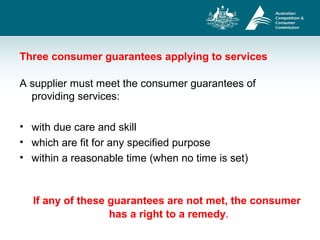
Three consumer guarantees applying to services
A supplier must meet the consumer guarantees of
providing services:
• with due care and skill
• which are fit for any specified purpose
• within a reasonable time (when no time is set)
If any of these guarantees are not met, the consumer
has a right to a remedy.
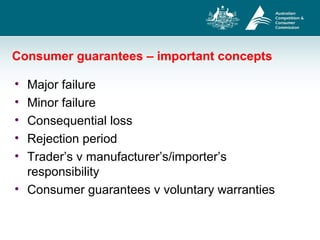
Consumer guarantees – important concepts
• Major failure
• Minor failure
• Consequential loss
• Rejection period
• Trader’s v manufacturer’s/importer’s
responsibility
• Consumer guarantees v voluntary warranties
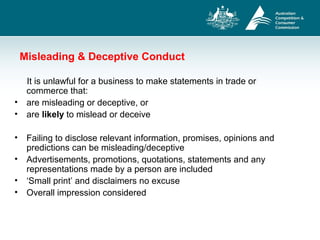
Misleading & Deceptive Conduct
It is unlawful for a business to make statements in trade or
commerce that:
• are misleading or deceptive, or
• are likely to mislead or deceive
• Failing to disclose relevant information, promises, opinions and
predictions can be misleading/deceptive
• Advertisements, promotions, quotations, statements and any
representations made by a person are included
• ‘Small print’ and disclaimers no excuse
• Overall impression considered
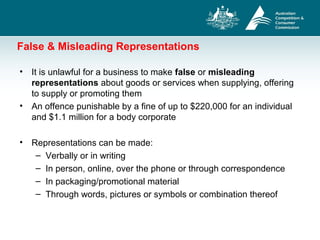
False & Misleading Representations
• It is unlawful for a business to make false or misleading
representations about goods or services when supplying, offering
to supply or promoting them
• An offence punishable by a fine of up to $220,000 for an individual
and $1.1 million for a body corporate
• Representations can be made:
– Verbally or in writing
– In person, online, over the phone or through correspondence
– In packaging/promotional material
– Through words, pictures or symbols or combination thereof
A business must not make false or misleading
representations about:
• standard, quality, value or grade of goods & services
• place of origin of a product
• buyer’s need for the goods or services and whether the goods are
new (also their history & use)
• sponsorship, approval, performance, benefits and uses of goods
and services
• price of goods and services
• any guarantee, warranty or condition
Also:
• Whether a representation is misleading may depend on the
characteristics of a specific group
• A representation can be misleading even if it s true or partly true
Advertising & Selling
• Comparative advertising (use with caution)
– Is the comparison accurate?
– Are the products/services similar?
– Is the comparison valid for life of promotion?
• Two-price advertising (use with caution)
– Was / now price; RRP / sale price
– Price comparisons must be accurate & genuine
– Sufficient number of goods must be sold at previous price for
reasonable period
– Goods must be actually sold at RRP
• Clarity in Pricing
– If component prices are used, single total price must be provided
Unconscionable conduct
• Under the ACL unconscionable conduct covers business to
business transactions as well as business to consumer
transactions
• UC can be described as behaviour which is irreconcilable with what
is right or reasonable and is seen as harsh and/or oppressive
• Usually involves a stronger party exploiting its bargaining
advantage to impose terms or conditions that are unreasonable or
against good conscience towards a smaller or weaker party
Some examples of possible unconscionable conduct
• Failing to disclose important contractual terms
• Not allowing sufficient time for consumer to read
agreement, seek advice, ask questions & decide
• Refusing to deal with legitimate complaints
• Not explaining terms of contract to consumers from
NESB
• Using friends/relatives to influence decision-making
• Refusing to accept ‘No’ for an answer
Unfair contract terms
• ACL enables a court to find a contract term unfair &
declare it to be VOID (treated as if it never existed)
• Applies to standard form contracts including written
and oral – over the phone or face to face.
• Applies to contracts entered into on or after
1 July 2010, and terms of contracts altered on or after 1
July 2010
• Contract remains binding to the extent that it can
operate without the unfair term
Unfair contract term test
• Does the term create a significant imbalance between
rights and obligations of the two parties?
• Is the term reasonably necessary to protect legitimate
interests of the business?
• Would the term cause a detriment (financial or non-
financial) if the business tried to enforce it?
• How transparent is the term?
Product Safety
• Imposing mandatory safety standards
• Product testing
• Issuing public safety warning notices
• Issuing compulsory recall notices
• Banning unsafe products
• Mandatory reporting
www.productsafety.gov.au
www.recalls.gov.au
Small business scams
• Overpayment scams
• Directory entry/unauthorised advertising scams
• Domain name scam
• Office supply scam
• Email intercept scam
• Ransomware scam
Protecting your business from scams
• Have clear procedures for verifying, paying and managing accounts
and invoices
• Limit number of staff authorised to place orders & pay invoices
• Keep filing & accounting system well organised
• Make sure the business billing you is the one you normally deal
with, verify ID of person speaking to you & who they represent
• Install reputable computer protection software & firewall
• Subscribe to scam notification service: www.scamwatch.gov.au
• Do not agree to deals/offers straight away – if it sounds too good to
be true, it probably is!
Selling goods online
Whether you’re trading online or through a retail outlet,
your customers’ legal rights are the same:
•Right to accurate information
•Right to a fair contract
•Right to a safe product
•Right to repair, refund or replacement
Australian Guidelines for Electronic Commerce 2006 (Australian
Government Treasury) – ‘Best Practice’ model
Restrictive Trade Practices
• Cartel conduct (s.44)
• Anti-competitive agreements (s.45)
• Misuse of market power (s.46)
• Exclusive dealing (s.47)
• Resale price maintenance (s.48)
• Prohibition of acquisitions (s.50)
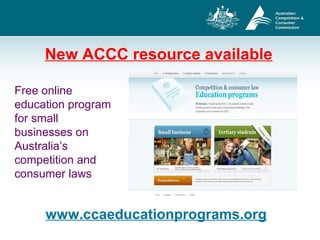
New ACCC resource available
Free online
education program
for small
businesses on
Australia’s
competition and
consumer laws
www.ccaeducationprograms.org
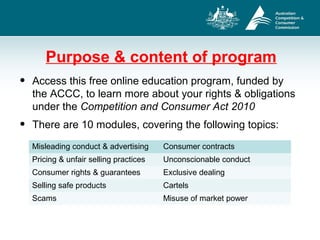
Purpose & content of program
• Access this free online education program, funded by
the ACCC, to learn more about your rights & obligations
under the Competition and Consumer Act 2010
• There are 10 modules, covering the following topics:
Misleading conduct & advertising Consumer contracts
Pricing & unfair selling practices Unconscionable conduct
Consumer rights & guarantees Exclusive dealing
Selling safe products Cartels
Scams Misuse of market power
Further information
• Call the ACCC Infocentre – 1300 302 502
• Visit www.accc.gov.au
• Visit www.productsafety.gov.au
• Visit www.scamwatch.gov.au
• Visit www.consumerlaw.gov.au
• Subscribe to the
ACCC Small Business Information Network
for regular fair trading email updates
Other useful agencies
• NSW Small Business Commissioner (advocacy,
advice & mediation)
web: http://www.smallbusiness.nsw.gov.au
Infoline: 1300-795-534 or 8222-4800
• NSW Fair Trading (education, licencing & compliance)
web: www.fairtrading.nsw.gov.au Infoline: 13-32-20
• ASIC
web: www.asic.gov.au Infoline: 1300-300-630
Open forum
Any questions arising from the checklist or the
presentation?
Small business self assessment checklist
• You have 15 minutes to complete the checklist
• Write down any questions that may come up for you
• Feel free to discuss with your neighbour/s when finished

ACCC Presentation - Michael Jerabek

  • 1.
    Competition & ConsumerAct 2010 & the Australian Consumer Law Miranda Chamber of Commerce Workshop 25 September 2013 Presented by Michael Jerabek Education & Engagement Manager (NSW & ACT)
  • 2.
    Australian Competition &Consumer Commission National law enforcement agency responsible for administering the Competition and Consumer Act 2010, which aims to: • promote competition and fair trading; and • protect consumers NSW Fair Trading/Consumer Trader Tenancy Tribunal
  • 3.
    What will Icover today? • Assessing your awareness of your rights and responsibilities under the CCA/ACL • Consumer guarantees & voluntary (express) warranties • Misleading & deceptive conduct/false & misleading representations • Unfair contract terms law • Unconscionable conduct • Product Safety • Small business scams • Restrictive trade practices • Other useful agencies • Q&A
  • 4.
    Negotiating, selling andadvertising… • ‘If you say something dishonest, you’re breaking the law, but not mentioning something is ok.’ • ‘A business owner can be liable for comments made on their business’ social media by 3rd parties if those comments are misleading.’ • ‘A statement may be true in fact yet be considered misleading in law.’ True or False?
  • 5.
    Faulty goods and/orreturns… • A customer tries to return a good purchased from you that is faulty due to a manufacturing defect but you refer her to the manufacturer instead as that is where the source of the problem lies Signs in store or online: • ‘Be warned - No refunds given under any circumstances’ • ‘No refunds given for change of mind’ • ‘Refund given on demand for goods in original condition’ What are the implications, if any, of the above?
  • 6.
    Consumer guarantees Consumer guaranteesapply to: • goods or services of any type up to $40,000 in value (and...) • purchased but also leased and hired • online, over the phone or in person • both new & second hand Consumer guarantees do NOT apply to: • one-off sales (e.g. private sales such as car or garage sale) • buying to on-sell (e.g. car repairer purchasing parts to be used in repairs) • If consumers simply change their minds • If consumers misuse the goods • If purpose not specified and not obvious from the circumstances
  • 7.
    Nine consumer guaranteesapplying to goods: • Acceptable quality (acceptable appearance & finish, free from defects, safe & durable) • Reasonably fit for purpose • Description is accurate • Goods match sample • Reasonable availability of spare parts & repair facilities for reasonable length of time • Voluntary (express) warranties to be satisfied • Suppliers guarantee clear title • Suppliers guarantees undisturbed possession • Goods to be free of hidden securities or charges If any of these guarantees are not met, the consumer has a right to a remedy.
  • 8.
    Three consumer guaranteesapplying to services A supplier must meet the consumer guarantees of providing services: • with due care and skill • which are fit for any specified purpose • within a reasonable time (when no time is set) If any of these guarantees are not met, the consumer has a right to a remedy.
  • 9.
    Consumer guarantees –important concepts • Major failure • Minor failure • Consequential loss • Rejection period • Trader’s v manufacturer’s/importer’s responsibility • Consumer guarantees v voluntary warranties
  • 10.
    Misleading & DeceptiveConduct It is unlawful for a business to make statements in trade or commerce that: • are misleading or deceptive, or • are likely to mislead or deceive • Failing to disclose relevant information, promises, opinions and predictions can be misleading/deceptive • Advertisements, promotions, quotations, statements and any representations made by a person are included • ‘Small print’ and disclaimers no excuse • Overall impression considered
  • 11.
    False & MisleadingRepresentations • It is unlawful for a business to make false or misleading representations about goods or services when supplying, offering to supply or promoting them • An offence punishable by a fine of up to $220,000 for an individual and $1.1 million for a body corporate • Representations can be made: – Verbally or in writing – In person, online, over the phone or through correspondence – In packaging/promotional material – Through words, pictures or symbols or combination thereof
  • 12.
    A business mustnot make false or misleading representations about: • standard, quality, value or grade of goods & services • place of origin of a product • buyer’s need for the goods or services and whether the goods are new (also their history & use) • sponsorship, approval, performance, benefits and uses of goods and services • price of goods and services • any guarantee, warranty or condition Also: • Whether a representation is misleading may depend on the characteristics of a specific group • A representation can be misleading even if it s true or partly true
  • 13.
    Advertising & Selling •Comparative advertising (use with caution) – Is the comparison accurate? – Are the products/services similar? – Is the comparison valid for life of promotion? • Two-price advertising (use with caution) – Was / now price; RRP / sale price – Price comparisons must be accurate & genuine – Sufficient number of goods must be sold at previous price for reasonable period – Goods must be actually sold at RRP • Clarity in Pricing – If component prices are used, single total price must be provided
  • 14.
    Unconscionable conduct • Underthe ACL unconscionable conduct covers business to business transactions as well as business to consumer transactions • UC can be described as behaviour which is irreconcilable with what is right or reasonable and is seen as harsh and/or oppressive • Usually involves a stronger party exploiting its bargaining advantage to impose terms or conditions that are unreasonable or against good conscience towards a smaller or weaker party
  • 15.
    Some examples ofpossible unconscionable conduct • Failing to disclose important contractual terms • Not allowing sufficient time for consumer to read agreement, seek advice, ask questions & decide • Refusing to deal with legitimate complaints • Not explaining terms of contract to consumers from NESB • Using friends/relatives to influence decision-making • Refusing to accept ‘No’ for an answer
  • 16.
    Unfair contract terms •ACL enables a court to find a contract term unfair & declare it to be VOID (treated as if it never existed) • Applies to standard form contracts including written and oral – over the phone or face to face. • Applies to contracts entered into on or after 1 July 2010, and terms of contracts altered on or after 1 July 2010 • Contract remains binding to the extent that it can operate without the unfair term
  • 17.
    Unfair contract termtest • Does the term create a significant imbalance between rights and obligations of the two parties? • Is the term reasonably necessary to protect legitimate interests of the business? • Would the term cause a detriment (financial or non- financial) if the business tried to enforce it? • How transparent is the term?
  • 18.
    Product Safety • Imposingmandatory safety standards • Product testing • Issuing public safety warning notices • Issuing compulsory recall notices • Banning unsafe products • Mandatory reporting www.productsafety.gov.au www.recalls.gov.au
  • 19.
    Small business scams •Overpayment scams • Directory entry/unauthorised advertising scams • Domain name scam • Office supply scam • Email intercept scam • Ransomware scam
  • 20.
    Protecting your businessfrom scams • Have clear procedures for verifying, paying and managing accounts and invoices • Limit number of staff authorised to place orders & pay invoices • Keep filing & accounting system well organised • Make sure the business billing you is the one you normally deal with, verify ID of person speaking to you & who they represent • Install reputable computer protection software & firewall • Subscribe to scam notification service: www.scamwatch.gov.au • Do not agree to deals/offers straight away – if it sounds too good to be true, it probably is!
  • 21.
    Selling goods online Whetheryou’re trading online or through a retail outlet, your customers’ legal rights are the same: •Right to accurate information •Right to a fair contract •Right to a safe product •Right to repair, refund or replacement Australian Guidelines for Electronic Commerce 2006 (Australian Government Treasury) – ‘Best Practice’ model
  • 22.
    Restrictive Trade Practices •Cartel conduct (s.44) • Anti-competitive agreements (s.45) • Misuse of market power (s.46) • Exclusive dealing (s.47) • Resale price maintenance (s.48) • Prohibition of acquisitions (s.50)
  • 23.
    New ACCC resourceavailable Free online education program for small businesses on Australia’s competition and consumer laws www.ccaeducationprograms.org
  • 24.
    Purpose & contentof program • Access this free online education program, funded by the ACCC, to learn more about your rights & obligations under the Competition and Consumer Act 2010 • There are 10 modules, covering the following topics: Misleading conduct & advertising Consumer contracts Pricing & unfair selling practices Unconscionable conduct Consumer rights & guarantees Exclusive dealing Selling safe products Cartels Scams Misuse of market power
  • 25.
    Further information • Callthe ACCC Infocentre – 1300 302 502 • Visit www.accc.gov.au • Visit www.productsafety.gov.au • Visit www.scamwatch.gov.au • Visit www.consumerlaw.gov.au • Subscribe to the ACCC Small Business Information Network for regular fair trading email updates
  • 26.
    Other useful agencies •NSW Small Business Commissioner (advocacy, advice & mediation) web: http://www.smallbusiness.nsw.gov.au Infoline: 1300-795-534 or 8222-4800 • NSW Fair Trading (education, licencing & compliance) web: www.fairtrading.nsw.gov.au Infoline: 13-32-20 • ASIC web: www.asic.gov.au Infoline: 1300-300-630
  • 27.
    Open forum Any questionsarising from the checklist or the presentation?
  • 28.
    Small business selfassessment checklist • You have 15 minutes to complete the checklist • Write down any questions that may come up for you • Feel free to discuss with your neighbour/s when finished