What is Harvard Referencing? This   is the system used to acknowledge  and record the source(s) you have used in  your work.
Why do we need to do it? · Protect yourself against charges of  plagiarism!! · To support your arguments and give your work a factual basis.  · The reader can follow up your references and  · check that your arguments are valid
What should you cite? Direct quotes Summaries Paraphrased text  Electronic Sources Designs or plans Statistics Theories Ideas Images (photos, graphs, tables, etc) Music
How it’s done 1 .  Citing This requires you to mention, within the text, the sources you have used in your writing.  When you cite you include the author’s  surname,   year of publication  and  page number. 2. Reference list At the end of your work, under the heading  References , you must write a full description of each source you have cited.
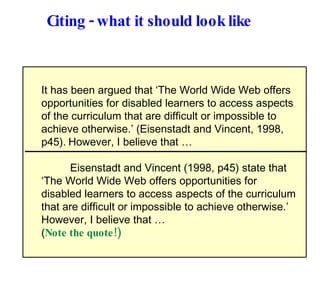
Citing - what it should look like It has been argued that ‘The World Wide Web offers opportunities for disabled learners to access aspects of the curriculum that are difficult or impossible to achieve otherwise.’ (Eisenstadt and Vincent, 1998, p45).   However, I believe that …  Eisenstadt and Vincent (1998, p45) state that  ‘ The World Wide Web offers opportunities for disabled learners to access aspects of the curriculum that are difficult or impossible to achieve otherwise.’ However, I believe that … ( Note the quote!)
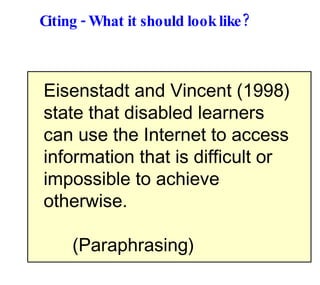
Citing - What it should look like? Eisenstadt and Vincent (1998)  state that disabled learners can use the Internet to access information that is difficult or impossible to achieve otherwise. (Paraphrasing)
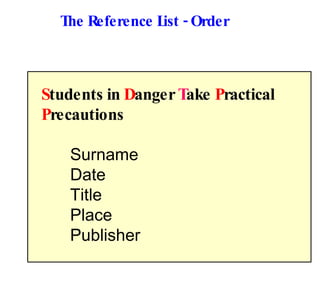
The Reference List - Order S tudents in  D anger  T ake  P ractical  P recautions Surname Date Title Place Publisher
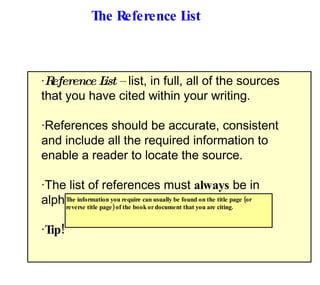
The Reference List · Reference List –  list, in full, all of the sources that you have cited within your writing. · References should be accurate, consistent and include all the required information to enable a reader to locate the source. · The list of references must  always  be in alphabetical order. · Tip! The information you require can usually be found on the title page (or reverse title page) of the book or document that you are citing.
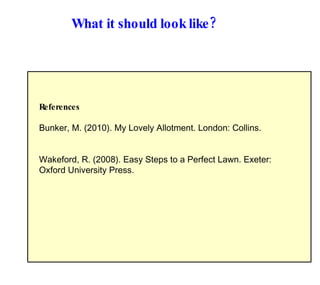
What it should look like? References Bunker, M. (2010). My Lovely Allotment. London: Collins. Wakeford, R. (2008). Easy Steps to a Perfect Lawn. Exeter: Oxford  University Press.
Hopefully you should now know a little more about Harvard Referencing? Still unsure? Click here for our guide, which is full of examples that you can copy.

Harvard referencing - An Introduction

  • 1.
    What is HarvardReferencing? This is the system used to acknowledge and record the source(s) you have used in your work.
  • 2.
    Why do weneed to do it? · Protect yourself against charges of plagiarism!! · To support your arguments and give your work a factual basis. · The reader can follow up your references and · check that your arguments are valid
  • 3.
    What should youcite? Direct quotes Summaries Paraphrased text Electronic Sources Designs or plans Statistics Theories Ideas Images (photos, graphs, tables, etc) Music
  • 4.
    How it’s done1 . Citing This requires you to mention, within the text, the sources you have used in your writing. When you cite you include the author’s surname, year of publication and page number. 2. Reference list At the end of your work, under the heading References , you must write a full description of each source you have cited.
  • 5.
    Citing - whatit should look like It has been argued that ‘The World Wide Web offers opportunities for disabled learners to access aspects of the curriculum that are difficult or impossible to achieve otherwise.’ (Eisenstadt and Vincent, 1998, p45). However, I believe that … Eisenstadt and Vincent (1998, p45) state that ‘ The World Wide Web offers opportunities for disabled learners to access aspects of the curriculum that are difficult or impossible to achieve otherwise.’ However, I believe that … ( Note the quote!)
  • 6.
    Citing - Whatit should look like? Eisenstadt and Vincent (1998) state that disabled learners can use the Internet to access information that is difficult or impossible to achieve otherwise. (Paraphrasing)
  • 7.
    The Reference List- Order S tudents in D anger T ake P ractical P recautions Surname Date Title Place Publisher
  • 8.
    The Reference List· Reference List – list, in full, all of the sources that you have cited within your writing. · References should be accurate, consistent and include all the required information to enable a reader to locate the source. · The list of references must always be in alphabetical order. · Tip! The information you require can usually be found on the title page (or reverse title page) of the book or document that you are citing.
  • 9.
    What it shouldlook like? References Bunker, M. (2010). My Lovely Allotment. London: Collins. Wakeford, R. (2008). Easy Steps to a Perfect Lawn. Exeter: Oxford University Press.
  • 10.
    Hopefully you shouldnow know a little more about Harvard Referencing? Still unsure? Click here for our guide, which is full of examples that you can copy.